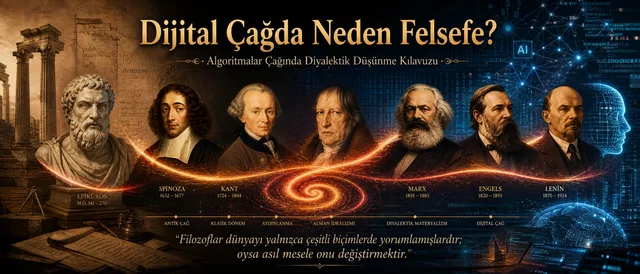
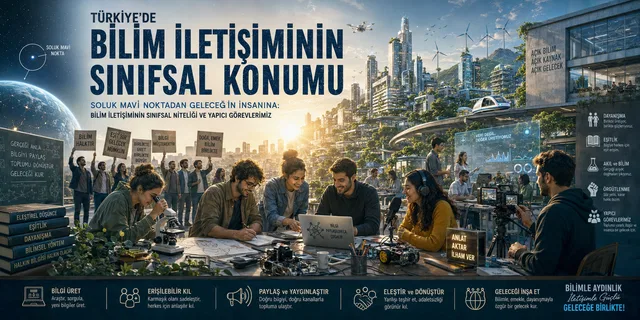
The Consciousness of the Cosmos: Historical Materialism and the Unbreakable Unity of Science and Philosophy in the Algorithmic Age
From the first quantum network to the moment the universe awakens to its own consciousness

The Crisis of Fragmented Consciousness and the Call of Philosophy
One of the greatest tragedies of the modern age is the artificial severing of science from philosophy, the two dominant poles of humanity's practice of understanding and transforming nature. Today, when the capitalist mode of production has pushed the division of labor and specialization to extreme ends, science has been isolated from its philosophical roots and reduced to a shallow "technicism" at the service of the market. The scientist and the IT worker—today's most dynamic technical force—face the threat of being turned into alienated code laborers, severed from the holistic, historical, and social consequences of the knowledge they produce, imprisoned in their laboratory or integrated development environment (IDE).
Yet humanity has arrived at a new threshold beyond this alienation: the biodigital rupture. Following the processes of artificial intelligence, Big Data, and quantum computing, brain-computer interfaces (BCI) such as Neuralink, supervised/unsupervised neural networks, and the "Fully Connected Ubiquitous Networks" in which human consciousness will be directly integrated with the internet, make the common fate of philosophy and science more vital than ever.
Science cannot determine its direction without a philosophical ground; and philosophy, without the material foundation provided by scientific data, turns into dogmas with their feet off the ground.
This article aims to decode the shallow waters of positivism and the efforts of tech giants to instrumentalize philosophy, to analyze the risks in the cybernetic world of the future in the light of historical materialism and dialectics, and to offer philosophical solutions.
The Materialist Dialectic of the History of Science: From Infrastructure to Algorithms
The history of science is not a linear chronology of independent flashes of lightning that suddenly strike in the minds of geniuses. On the contrary, science is a reflection in the superstructure of social relations of production, the material infrastructure, and humanity's practical relationship with nature (praxis), and at the same time the most refined productive force that transforms this relationship.
From the Ancient World to Feudalism: The First Forms of the Material Base
It was no coincidence that philosophy and science melted together in a single crucible in the Milesian School. Thales, Anaximander, and Anaximenes, in a world fed by the material wealth of port cities where trade routes intersected, sought to explain nature not through the caprices of mythological gods, but through nature's own internal material constitutive elements (water, arche, air). This was the first materialist leap of natural philosophy.
However, the slave-owning social structure created a deep chasm between mental labor and manual labor. This order, in which the elites engaged in "pure thought" and philosophy while slaves carried out the material production processes, delayed science from settling onto an empirical (experimental) foundation. Plato's world of ideas was the philosophical pinnacle of this class division; the real world was merely a fleeting shadow. In the feudalism of the Middle Ages, church dogmatism froze Aristotle's physics and placed it at the service of a religious ideology. Scientific practice stalled, hitting the limits of feudal relations of production.
The Birth of the Bourgeoisie and the Limits of Mechanical Materialism
In the 15th and 16th centuries, the rise of trade capitalism, geographical discoveries, and developments in mining and military technologies imposed the need for a new branch of science. Astronomy was needed for navigation, chemistry and metallurgy to process ores, and mechanics to calculate the range of cannons. The bourgeoisie had to shatter religious dogmas and bind nature to laws in order to develop the productive forces.
- Galileo Galilei turned his telescope to the sky and demolished theological cosmology.
- Francis Bacon philosophized the empirical method by defining science as an instrument of humanity's dominion over nature.
- Isaac Newton, with the laws of gravitation, conceived the universe as a colossal, predictable clock.
The materialism born in this period was, by virtue of its historical conditions, mechanical materialism. The universe was seen as a static machine that could be divided into parts and that ran on a first motion from outside. This approach answered the needs of capitalism's manufacture and early-industrial stages of that period. But this mechanical worldview was far from explaining change, transformation, and internal contradictions. The scientist observed nature, but had not yet grasped that he himself was also a historical and social subject within that nature.
Epistemological Necessity and the IT Vision: The Mystery of the Black Box
Epistemology (the philosophy of knowledge), one of philosophy's most fundamental disciplines, lies at the very heart of computer science and artificial intelligence architectures.
The Ontological Rift Between Data, Knowledge, and Reality
A data scientist or Machine Learning engineer, before even beginning to train a model, relies—whether aware of it or not—on certain philosophical assumptions. Are the data sets (Training Data) that feed the model flawless reflections of objective reality, or are they biased abstractions of that reality, riddled with historical contradictions?
An engineering vision devoid of epistemological depth accepts Raw Data as an absolute reality. Yet data is the digital footprint of social relations. If you are training a massive Language Model (LLM) on the existing corpus of text on the internet, that model does not merely calculate the statistically most probable sequences of words; it also reproduces the class-based, sexist, and colonialist biases of the texts to which it belongs. Epistemology makes the IT worker question the ideological framework behind optimization functions.
The Black Box Problem and the Alienation of the Subject
Modern artificial intelligence processes, especially Deep Neural Networks with billions of parameters, carry out complex non-linear computations. It is mathematically possible to trace which weights these models select in which hidden layers and why, as they transform input into output—but it is almost impossible to rationalize this with human logic. This very situation is called the Black Box Problem in the IT world.
[Input Data] ──> [ Black Box / Hidden Layers ] ──> [Output / Decision]
(Weights & Biases)
This problem is not merely a technical limitation, but an epistemological crisis. The human being has become unable to grasp the reasoning process of the production instrument (the algorithm) it created itself. This is the technological pinnacle of the alienation from labor and from the product that Marx spoke of. The IT worker risks ceasing to be a rational subject and turning into a passive observer who obeys the predictions of the system it produced itself. Overcoming this crisis necessitates a philosophical intervention that draws the epistemological limits of artificial intelligence's claim to produce "knowledge."
A Critique of Modern Positivism: The "Clean Data" Illusion and Algorithmic Exploitation
Beginning in the 19th century, with capitalism's transition to the monopoly stage, bourgeois ideology donned the armor of positivism in order to bring science under its hegemony. Today, this approach is being continued in tech companies under the name of "Data-Driven" or "technological determinism."
The Class Blindness of Positivist Engineering
The positivist IT vision sees the world and human behaviors as consisting only of quantifiable, labelable, and optimizable "facts." The human being is reduced to user engagement matrices, click-through rates (CTR), and data points.
This positivist reductionism conceals the structural contradictions behind the facts. For example, the route-optimization algorithm developed by a courier company or a digital platform, while aiming to use (exploit) the worker's labor most efficiently, sees that worker's biological limits, fatigue, and social precarity as a "margin of error" (noise) and excludes them. While positivism claims that the algorithm is "neutral and rational," it conceals that it is in fact a digital whip of the regime of capital accumulation.
The Illusion of Value-Free Artificial Intelligence
Artificial intelligence companies argue that their models are "objective." This is the most comfortable illusion used by the ruling classes to legitimize the status quo. Positivism instills in the IT worker the following moral blindness: "You just tune the hyperparameters, bring the loss function close to zero; whether this model turns into a facial recognition system that surveils the masses or into automation software that leads to a massacre of workers is not your problem." This approach strips the software developer of social responsibility, turning them into a highly skilled cog of capital.
The Cyber-Spatial Horizon: Neuralink, Fully Connected Networks, and Cognitive Taylorism
The latest stage reached by technology is ending the external relationship between human consciousness and digital infrastructure, internalizing this relationship biologically. Brain-computer interfaces (BCI), symbolized by Elon Musk's Neuralink, and next-generation interaction interfaces are carrying humanity into the age of "Fully Connected Ubiquitous Networks." This new cyber-spatial horizon harbors immense ontological and class-based risks that must be analyzed philosophically.
Cognitive Taylorism: The Final Front of the Exploitation of Labor
At the beginning of the 20th century, Frederick Taylor optimized production by measuring the physical movements of the factory worker in seconds and mechanized manual labor (Taylorism). Today, Supervised Neural Networks and neural interfaces are carrying this exploitation directly into the human nervous system and brain: Cognitive Taylorism.
The neural interface designed by a data scientist or neuro-engineer is becoming able to measure not only the keyboard movements of the worker or user, but also their duration of focus, dopamine release, neural reaction speed, and even their as-yet-unenacted intentions. This means the infiltration of exploitation and surplus-value production directly into the human subconscious.
"We are passing from physical factories to mental factories; now the means of production are sought to be placed directly inside our skulls."
New Interaction Interfaces and the Loss of Reality
Haptic (tactile) feedback, Spatial Computing, and new interaction interfaces controlled directly by neural signals are blurring the boundaries between the human being and the internet. In the ecosystem of fully connected networks, the human being becomes a "node" of the network.
This is the ultimate victory of the age of hyperreality and simulation that Jean Baudrillard spoke of. When the human being becomes unable to distinguish their own biological perceptions from the artificial neural stimuli coming from the network, their connection with objective reality is severed. While positivist science praises these interfaces merely as elements of "convenience and speed," historical materialism shows that this situation carries the risk of the human being accepting their own alienation at the biological level.
Silicon Valley's Confession: Why Are AI Companies Employing Philosophers?
Starting from the 2020s, a noteworthy change has been taking place in the ranks of AI giants like OpenAI, Google, Anthropic, and Meta: alongside computer engineers, philosophers, ethicists, and linguists are being hired with titles like "AI Safety Researcher" or "Alignment Engineer." This is an open confession by Silicon Valley that pure technical reason and positivism have hit a wall.
The Alignment Problem Is a Problem of Philosophy
The question of how artificial intelligence—especially systems with the potential for Artificial General Intelligence (AGI)—can be made compatible with the values and interests of humanity is called the Alignment Problem. Tech companies have realized that giving an AI model the instruction "be beneficial to humanity" is not an optimization problem that can be solved with lines of code.
- What is "benefit"? (The happiness of the majority in a utilitarian approach, or a Kantian ethics of duty?)
- Whose life should artificial intelligence prioritize in a moment of crisis?
- How are the concepts of justice and equality defined algorithmically?
These questions are not functions that have an equivalent in code libraries (API). To prevent their models from spinning out of control and causing unforeseeable harm (Existential Risk), companies have been forced to take refuge in philosophy's thousands of years of ethical corpus.
A Marxist Decoding: "Ethics Boards" as Ideological Shields
However, when viewed with a historical-materialist eye, there is a further pragmatic move behind capitalist tech giants hiring philosophers. Companies use philosophy and ethics as a "public relations" (PR) shield and as a means of escaping regulatory institutions (regulations).
In company corridors, philosophers are generally positioned as technocrats who do not question the system's structural ownership relations and merely fine-tune the algorithm. The real structural danger is not a science-fiction fantasy like artificial intelligence "gaining consciousness and taking over the world," but the monopoly capital that holds the ownership of that artificial intelligence condemning all of humanity to a digital feudalism. Company philosophers are mostly funded to veil this class-based reality and to drag ethical debates onto an abstract ground of "protecting humanity."
Cognitive Risks and Philosophical Solutions Through the Lens of Dialectical Materialism
The risks awaiting humanity in the face of the future's fully connected networks and neural interfaces cannot be resolved with a shallow technophobia (Luddism) or a submissive techno-optimism. The solution lies in the holistic and revolutionary philosophical approaches offered by dialectical materialism.
Defining the Risk: Cognitive Ownership and Class Rift
The greatest risk of neural interfaces and fully connected networks is the direct commodification of human thought and biological structure. If your brain is connected to the internet and this infrastructure is owned by a private company, your most intimate thoughts, your dreams, and your mental reflexes become the object of data mining.
This situation could create an irreversible biological/cognitive rift between the cyber-proletariat and the cyber-bourgeoisie. Against an elite minority that has access to the infrastructure and augments its neural capacity with artificial intelligence, the billions of people deprived of this technology, or who are merely its slaves, could be pushed into a "useless class."
Philosophical Solutions: Cognitive Praxis and the Digital Commons
So what is the way out of this dystopia? What kind of answer does philosophy produce to these concrete risks?
| Risk Area | Positivist / Technocratic Approach | Dialectical Materialist / Philosophical Solution |
|---|---|---|
| Cognitive Taylorism (Mental Exploitation) | Fine-tuning the artificial intelligence to make the algorithm more "ethical." | Cognitive Sovereignty: Returning the ownership of neural data to the individual and society; prohibiting the exploitation of mental labor. |
| Black Box & Alienation | Scaling up models with higher computing power (compute). | Epistemological Transparency: Making AI's decision-making processes auditable with human rationality (the philosophical grounding of Explainable AI - XAI). |
| Biodigital Class Rift | Leaving access to technology to the mercy of charitable foundations (charity). | Digital Commons: Nationalizing AI infrastructure, fully connected networks, and neural interface technologies by declaring them the common heritage of humanity. |
- The Reconstruction of Neural Epistemology: Philosophy must redefine the concept of the "Subject" in this new era where the human being merges with the machine. The human being must not be a passive consumer of the network, but an active designer (subject) who uses the interfaces for their own emancipation.
- Technological Praxis: IT workers and scientists must analyze the social effects of the code they write and the neural interfaces they design with a dialectical method, and wage a social struggle that will change the ownership relations of the means of production. Technology must be made a lever not for capital accumulation, but for humanity's transition from the realm of necessity to the realm of freedom.
A Cosmic Perspective: The Dignity and Ethical Responsibility of Being a Speck in the Universe
Marxist philosophy does not see the human being merely as a sum of social relations; it also grasps the human being as the most developed part of nature, the part that has brought itself to consciousness. This understanding carries science and IT to their deepest existential dimension: the Cosmic Perspective.
A Materialist Analysis of Being a Speck in the Cosmos
The modern picture of the universe that astrophysics presents to us is one that will shatter the human ego. In a cosmos ruled by billions of galaxies, trillions of stars, and boundless dark matter, we live on a pale blue dot in the suburbs of the Milky Way.
In the face of this immense splendor and infinity of matter, the transhumanist immortality fantasies marketed by tech billionaires through Neuralink, the digital empires built upon artificial intelligence, and the algorithmic power wars are pitiful illusions. The atoms that make up our bodies and the silicon chips we created were forged in the cores of stars that exploded billions of years ago. We are the way the universe thinks about, understands, and feels itself.
$$\text{Stardust} \xrightarrow{\text{Material Evolution}} \text{Biological Life} \xrightarrow{\text{Neural / Algorithmic Leap}} \text{Cosmic Consciousness}$$
The Ethics We Befit Ourselves With: Intellectual and Technological Integrity
Being a speck in the cosmos must not drive us to nihilism. Dialectical materialism converts this existential smallness into the highest social and universal ethical responsibility. The universe, over a billions-of-years process of blind evolution, has for the first time become able to see and make sense of itself in our consciousness, and now in the artificial neural networks we have created.
In this context, the ethics of the scientist and the IT worker are not abstract compliance documents written by companies' Human Resources departments. This ethics is that honorable and uncompromising stance the human being befits its own intelligence, the future of humanity, and its position in the universe.
This cosmic and technological ethics commands the following:
- To refuse to provide technical support to projects that would make the human brain and consciousness the ultimate frontier of exploitation.
- To defend the public character of cyberspace, Open Source, and the communism of knowledge against the tech monopolies that hide the common social knowledge produced through artificial intelligence and Big Data behind patent walls.
- Not to sacrifice intellectual integrity to short-term stock options, the titles of tech companies, or the temporary favors of those in power.
Conclusion: Fashioning the Humanity of the Future
The bond between the scientist, the software developer, the neuro-engineer, and the data scientist, on the one hand, and philosophy, on the other, is the most critical front of our age. An IT vision devoid of epistemological depth, drowned in the shallow waters of positivism's "data-driven" mantra, and severed from the class analysis of historical materialism cannot emancipate humanity; on the contrary, it surrenders humanity to more refined, neural, and biological forms of exploitation.
Against the efforts of tech companies to turn philosophy into a pet, to employ it merely as a safety engineer that reduces in-system risks; the revolutionary, holistic, and questioning power of philosophy must be preserved.
We, as these thinking specks of the universe, must reunite algorithms and neural networks with philosophy, and theory with social practice. Fashioning the humanity of the future requires rescuing Neuralink, artificial intelligence, and fully connected networks alike from the anarchic, profit-driven, and destructive laws of the market, and managing them through collective planning for the sake of developing the common reason and universal consciousness of all humanity. It is not enough merely to code the world or connect it to the network; what matters is to rebuild the world and the future, armed with the universal laws of dialectics, with a sense of cosmic responsibility and an uncompromising intellectual ethics. This is the true debt of engineering and science to time, space, and the future.