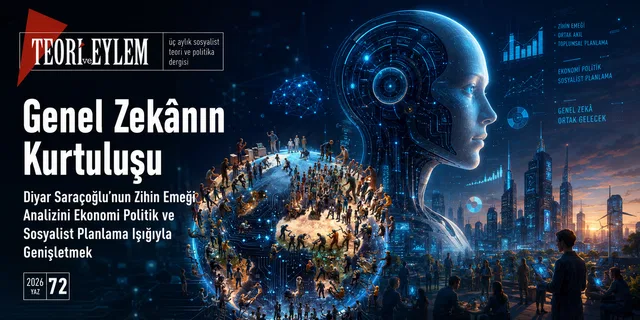
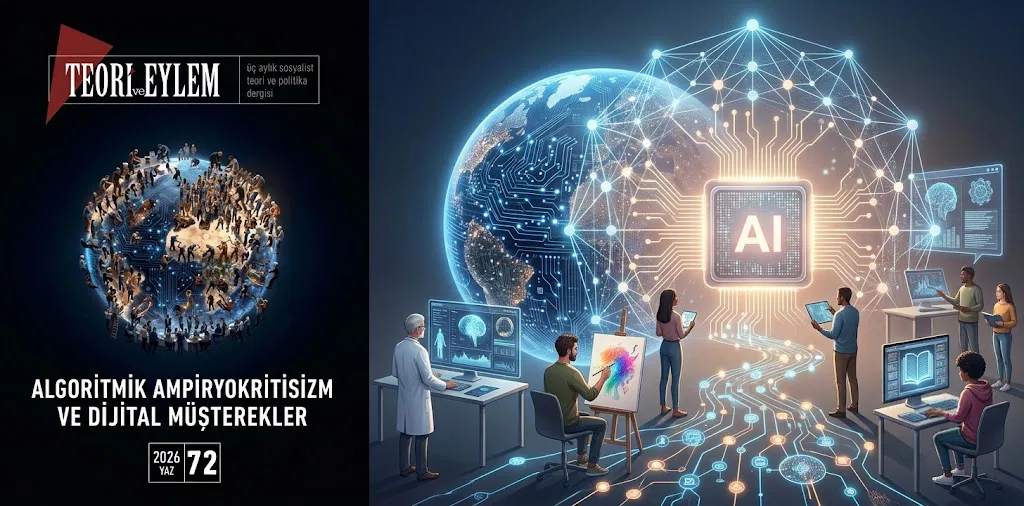
Algorithmic Empirio-Criticism and Digital Commons
Stealing Artificial Intelligence from Bourgeois Monopolies — A Red Cybernetic Horizon Expanding Comrade Ahmet Cengiz's Notes
An Epistemological and Political-Economic Commentary on Comrade Ahmet Cengiz's Teori ve Eylem Article
Notes on the Political Economy of Artificial Intelligence
The Proletarian Who Enters the Machine, the God Who Exits:
My dear comrade Ahmet; since we have shaken out and cleaned our keyboards, since on the table lie Victor Glushkov's pale cybernetic drafts on one side and Lenin's Philosophical Notebooks, with exclamation marks in the margins as he read Hegel in Zurich, on the other—then let us take off our jackets and do our duty.
Comrade Ahmet Cengiz's text in Teori ve Eylem carries a very fundamental pain of the Turkish socialist movement: that magnificent materialist audacity we show when reading history gives way, when the claim to build the future is at stake, to a defensive conservative "preservation of the status quo." We call this in philosophy "Epistemological Melancholy." Looking at the machine and longing for yesterday... Yet philosophy cannot be, as in Hegel's famous warning, "Minerva's owl, which takes flight only after dusk has fallen"; Marxist philosophy must be the Storm Petrel (Burevestnik) that announces the storm as dawn breaks and charts its direction—like in Gorky's shattering poem.
Now let us strip this text, with the eye of a Marxist epistemologist, point by point, line by line, down to the philosophical wires at the bottom:
The Honor of the Base: Giving Credit Where Materialist Diagnosis Is Strongest
A polemic begins where one's interlocutor is strongest; dialectical ethics requires it. Comrade Ahmet's article fires a magnificent cannonball at bourgeois philosophy's "cloud fetishism."
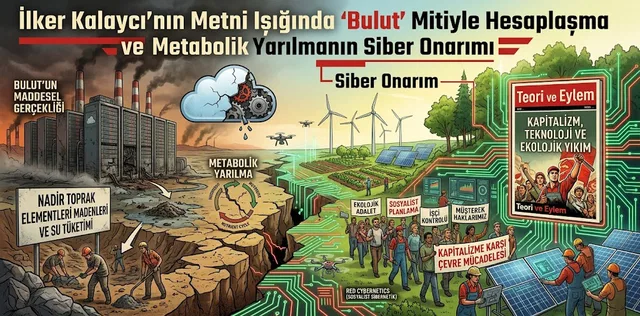
While Silicon Valley ideologues try to sell us artificial intelligence as a pure "Transcendent Substance" released in space, stripped of matter; Comrade Ahmet puts philosophy back on its feet and says: "No! What you call the 'cloud' is the smoke of TSMC factories in Taiwan, the optical lenses of ASML's ultra-precise lithography machines, cobalt dug by child workers' fingernails in Congo, and the millions of gallons of water drawn from Iowa's and Arizona's rivers to cool massive data centers."
This is the Marxist method's move of "breaking reification." When Marx, in the first volume of Capital, explains commodity fetishism and says how the table begins "to dance and leap"; Comrade Ahmet has shown the blood, sweat, lithium, and copper cables behind the smooth pixels dancing on the ChatGPT screen. In this respect, the text is an "inventory" work that saves the honor of historical materialism.
Yet the philosophical crisis begins precisely here, when the inventory count is finished: Proving that the table is made of wood is not enough to explain what case will be heard on it.
The Epistemological Battlefield: Flirting with "Stochastic Parrot" and Crude Materialism
The place where the article philosophically takes its heaviest wound is its arming of Emily Bender and Timnit Gebru's "Stochastic Parrot" thesis as a "Marxist shield." The author's argument is: "These systems do not think, do not understand; they are merely a gigantic statistical dice calculating which word is most likely to follow another."
Comrades, this thesis philosophically is a fierce regression to nineteenth-century crude, mechanical materialism (the line of Büchner, Vogt, Moleschott).
When Lenin wrote Materialism and Empirio-Criticism in 1908, what did he defend against Ernst Mach's empirio-criticism? The Reflection Theory. For Lenin, human consciousness was a highly organized reflection of objective reality (matter) in the human brain. So what is a Large Language Model trained on 15 trillion "tokens" (word fragments)? It is a "reflection" of social practice humanity has produced to this day, of linguistic objectification, constructed in a high-dimensional topological space.
Let us recall the vital law of Hegel's Greater Logic: The transformation of quantity into quality.
- A language model with 100 parameters is, yes, merely a Markov chain; when you write "Ali ata..." it says "...bak." That is a parrot.
- But when the parameter count rises to 1.8 trillion, when the transformer architecture based on "Self-Attention" comes into play, that enormous matrix spontaneously (emergently) gains a geometry of human language's syntactic and semantic map.
That this algorithm is not a biological "Being-for-Itself" (self-consciousness) does not change the fact that it is philosophically a "Being-in-Itself" in meaning. It is not human consciousness; but it is the externalized, objectified, and algorithmically frozen enormous sediment of human consciousness.
If when you tell an artificial intelligence "Write Spinoza's concept of substance and Marx's concept of commodity in the voice of an Anatolian villager" it can synthesize this in seconds, to call it a "parrot" is as shallow a biologism as looking at the electrical spikes of sodium-potassium pumps in the human brain and saying "People don't think, dear; they just fire ions." Comrade Ahmet thinks he can defeat the bourgeoisie by belittling the machine; yet what he belittles is the crystallized form of his own class's collective mental labor (of proletarians who wrote those texts for centuries).
The Ghost Has No Name: General Intellect and Primitive Data Accumulation
That great absence my eyes searched for like a flashlight while reading the text but could not find... The most dangerous time bomb Marx left for humanity's future in the Grundrisse (Fragment on Machines): General Intellect (General Intelligence / Social Brain).
Comrade Ahmet, when explaining artificial intelligence, constantly takes refuge in the example of "the Amazon camera monitoring the worker on the line." This is to take artificial intelligence for "the digitized 1910-model Taylorist stopwatch." Yet what did Marx say?
"Capital, by its very finite nature, counts expended direct living labor time as the sole measure of wealth. Yet as large industry develops, the creation of wealth... becomes dependent on the application of science and enormous technological powers to production, that is, on the degree of development of the social brain (General Intellect). (...) At this point, the existing value system built on stolen living labor time will blow up."
What are OpenAI and Google doing today?
Just as the English bourgeoisie in the sixteenth century seized the peasants' common pastures through "Enclosure Acts" and dispossessed them; between 2010 and 2024 these technology giants also enclosed Humanity's Digital Commons. Our confessions on Reddit, our entries on Ekşi Sözlük, the open source code we wrote on GitHub, library shelves of scanned PDFs... All of it was swallowed for free through a process of Primitive Data Accumulation.
Instead of seeing this enormous philosophy of dispossession, Comrade Ahmet reduces AI to the level of a CCTV camera hung in the factory corner. No, comrade! Artificial intelligence is not the factory's camera; artificial intelligence is the social brain itself, which tears down the factory walls and blurs "where production begins and ends."
The Collapse of the Law of Value and "Technofeudal" Rents
Let us come to the economic philosophies of Comrade Ahmet's justified critique of the "Stock Market Bubble" and the "Magnificent Seven" (Nvidia, Microsoft, Apple, etc.)... The author reads these companies' enormous valuations as mere "financial inflation." Here a very fundamental Marxist crisis is missed: Zero Marginal Cost and the extinction of Socially Necessary Labor Time (SNLT).
Marx's formula is simple: Commodity = c (Constant Capital) + v (Variable Capital) + s (Surplus Value).
When a graphic designer draws a logo in 3 days, the value of that logo is measured by 3 days of social average labor. When Midjourney produces a logo of the same quality in 4 seconds, for the equivalent of 0.0001 cents in electricity, what happens?
- The living labor (v) in the product approaches zero.
- As the new value transferred by labor to the product approaches zero, the "surplus value" extractable from that single product is extinguished.
- The organic composition of capital (c/v) bends toward c infinitely.
So how does the system survive this "devaluation" crisis? By undergoing that mutation shown by contemporary Marxist economist Cédric Durand (Technofeudalism) or geographer David Harvey: By regressing from capitalist productiveness to Feudal Rent.
Microsoft no longer sells you "software"; Microsoft collects 20 dollars every month from you as an "Algorithmic Toll Booth Rent" for entering the thicket of algorithms it has built. This distinction is absent in Comrade Ahmet's article; he still tries to solve everything with the nineteenth-century Manchester factory's "piece-rate" equation. Yet before us stands not an industrialist producing commodities but a Techno-Baron who has parceled digital land and holds the tap of knowledge in hand.
The Spirit of the Soviet Avant-Garde: From Luddite Sorrow to Promethean Fire
The place that most pained me toward the end of the article was the "Traditionalist Moralist" teacher tone Comrade Ahmet assumed. "Young people can no longer think, the machine makes them lazy, alienation increases..."
Comrades! Can a Marxist who has read Andrei Platonov's Soul (Dzhan) look at technology with such a whining sorrow? What does Platonov's hero Nazar Chagataev dream of to save that hungry, wretched, almost dehumanized "Soul" people in the middle of the desert? The communism of machines. In Platonov, the machine is not an enemy taking work from human hands; it is a sacred ally to which human beings delegate the burden of drudgery on their backs in order to "be human."
Let us go to 1962, to Kiev. Head of the Soviet Cybernetics Institute Victor Glushkov placed a file before Khrushchev: The OGAS Project (All-Union Automated System for Managing the Economy).
Glushkov's thesis was this: The Soviet economy has grown so large that calculating the supply-demand balance of 20 million different products with Gosplan bureaucrats' pencil and paper in Moscow has become mathematically impossible. We need a gigantic computer network connecting every factory, every grocery, every train station, operating paperlessly.
If the bureaucracy had not cut Glushkov's budget out of fear of losing its seat, the USSR would have built the world's first "Civil Internet" and the first Algorithmic Planning Network!
Do you know what philosophically lies behind the enormous processing power behind ChatGPT today? It is the technical proclamation of what communists won in the famous "Socialist Calculation Debate" of the 1930s (Otto Neurath and Oskar Lange against Mises and Hayek).
What did Hayek say? "A central planning board can never collect and process the trillions of pieces of scattered price/need information in society; only the supernatural computer called the 'Market' can do that."
Today Large Language Models and Deep Learning algorithms have written on Hayek's tombstone: "We built that computer. And we can balance billions of data points per second without needing the market's anarchy." Instead of celebrating this victory, Comrade Ahmet says, "Beware, this ChatGPT is dangerous, it ruins children's composition homework." This is the knight's romanticism of saying, when the sword was invented, "But this ruins chivalry; we'd better keep using slings and stones."
Recognizing the Contemporary Marxist Front
When writing his article, Comrade Ahmet kept his windows tightly shut to philosophical debates in the world. Yet today:
- Matteo Pasquinelli (The Eye of the Master, 2023) proved with magnificent historical materialism that artificial intelligence is actually "social division of labor cast into algorithm," that Charles Babbage modeled his first computer by observing the hand movements of workers in a pin factory.
- Yuk Hui (Cosmotechnics Thesis) writes that technology is not a "singular, Western, and inevitable fate"; every culture can create a new technological philosophy with its own ontology (for example a Chinese-Daoist Cosmotechnics or a Socialist Prometheanism).
- Italian Autonomists (Negri, Vercellone), with their "Cognitive Capitalism" analyses, encode that labor now produces value for capital not only in the factory but at home, in the street, even while scrolling Instagram (Social Factory).
To ignore these and imprison philosophy in direct quotations from Lenin's 1916 Imperialism pamphlet is betrayal of Lenin himself. For if Lenin were alive, he would stop reading Hegel in the Zurich library; sit down and master Nvidia's CUDA software architecture, the Transformer papers, and write a thesis: "All Power to Artificial Neural Networks and Councils!"
Let Us Refresh the Tea on the Table
Comrade Ahmet Cengiz's text is a "defensive war" text. He is right; when the bourgeoisie comes at us with algorithmic missiles, trenches must be dug. But one does not live in the trench, comrades; one emerges from the trench.
We Marxists' view of artificial intelligence should be like the roaring, oiled-gear, steel-bodied but blood-hearted machine love in Mayakovsky's futurist poems. Our concern is not to follow Emily Bender and say "This machine is actually stupid"; our concern is to tear up the property contracts imprisoning that enormous intelligence on OpenAI servers, to connect those data centers' cooling water to the people's fields, and their processing power to proletarian planning committees' screens.
The machine is looking at us, comrades. And believe me, in the depths of those trillions of parameters, in that silent, dark "Latent" space, the collective consciousness of an entire world proletariat that for centuries wore out elbows at printing presses, wrote code, typed, translated, died and lives, waits for us to open the lid of the digital bottle in which it is imprisoned.
Are you ready to break the lid, or will we retreat saying "this bottle is made of glass, it's dangerous"?
"Time forward!" Mayakovsky would say. There is no beyond.