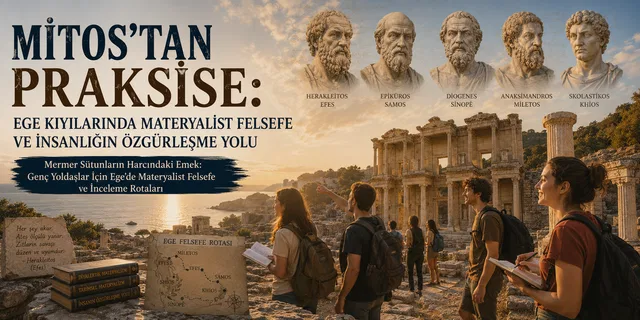
Human Action on the Sheer Slopes of Caria: A Materialist Journey to Amos
From Rhodian Hegemony to Capitalist Commodification

Dear Young Comrades,
We are setting out on an epic historical journey into the materialist roots of the Aegean — to tear away the consumption illusions that the present late-capitalist order has draped over us, the "spectator" role with which the tourism industry passivizes and objectifies the human being, and the idealist, mystified historical narratives of the bourgeois academy!
Today's capital order markets geography and history merely as a commodified "holiday route," a "consumption showcase" transformed into a field of capital accumulation, or an abstract "romantic ruin." This approach, which alienates the human being from the historical action of their own species, abstracts the stone from the soil, architecture from human labor, and the city from class struggles. What falls to us is to reject this passive and narcotic consumer culture in a radical fashion. With the torch of historical materialism, we shall bring into the open the nameless slave labor, the battles over surplus product, and the relations of production behind the stone, the soil, and the architecture!
In this geography we shall not observe history from afar like objectified "tourists," as the bourgeois media dictates to us. On the contrary, we take to the roads in order to grasp the material conditions of the past, to understand the will of the human species to transform the world, and — above all — to become the revolutionary subjects of our own future!
The Epic Frontier of Historical Consciousness: The Clash of Two Perspectives
As we set foot in the Aegean geography, we must clarify our mental compass. What confronts us is the relentless clash of two distinct worldviews:
| Dimension | Bourgeois Idealism and the Tourism Illusion | Dialectical-Materialist Epic Reality |
|---|---|---|
| Character of Space | A commodified "holiday paradise" and consumption zone marketed by capital. | The arena of the dialectical conflict between nature and human labor, and of class struggles. |
| Position of the Individual | A passive, photograph-taking, objectified tourist who "consumes" history. | An active historical subject who analyzes history, sees the base, and builds the future. |
| Meaning of the Ruins | "Mysterious, aesthetic, and romantic ancient ruins." | Infrastructure and superstructure institutions raised by the expropriated surplus-value of nameless slaves. |
| Purpose of the Journey | A temporary "escape" and illusion from the exploitation of everyday life. | A historical discovery that sharpens class consciousness and grasps the transformative power of human action (praxis). |
First Stop: The Will Rising on the Sheer Rocks of Caria — Amos!
And we begin this epic journey with the Ancient City of Amos — rising on the sheer, barren, and impassable rocks of Caria; the concrete monument of the early-period human being's will to transform nature by bending nature's harsh conditions through collective labor!
As we climb the paths of Amos, every stone we tread upon will cry out to us that great truth which the capitalist system denies: The human being is not a passive victim of conditions, but a force that reconstitutes the world through action (praxis).
Come, let us strip away the false veils of bourgeois aesthetics; together let us trace the marks of history, labor, and the dialectic on the sheer slopes of Amos!

Location and Access: The Material Reality of Geography
Geography is not a passive "scenic backdrop" or an aesthetic "natural wonder," as the bourgeois academy and the tourism industry market it. Space is a material reality shaped within the contradiction into which human labor enters with nature, and reproduced by social relations of production.
Grasping the location of the Ancient City of Amos and its lines of access constitutes the cornerstone of the city's philosophical and historical-materialist analysis.
Geographic Location and Topographic Necessity
Amos was founded upon a steep, rocky summit known as Asarcık, rising roughly 100–150 meters above sea level between the bays of Turunç and Kumlubük, today attached to the Marmaris district of Muğla province.
-
The Pressure of Defense and Maritime Trade: That the city was built upon this high and sheer point sprang not from the ancient human's desire to "enjoy a beautiful view," but from the necessity of protection against the relentless wars of domination among slave-owning city-states (polis) and against pirate raids.
-
A Strategic Watchtower: Amos's location is a military and logistical forward outpost controlling the maritime trade routes of the Rhodian Peraia (the mainland territories on the opposite shore belonging to Rhodes). Geography here has been instrumentalized as a "watchtower" serving the military and commercial interests of the ruling class.
The Dialectic of Access: Overcoming Nature by the Power of Labor
Today, reaching Amos involves vehicles or sea motors traveling from Marmaris toward Turunç, followed by the climb of a steep path branching off the Kumlubük road. Yet the historical production of this access network is a dialectical process:
-
Overland Isolation vs. Maritime Articulation: From the landward side, Amos was sealed off from the inland regions of Caria by sheer mountains and impenetrable vegetation. This geographic barrier compelled the city's articulation into maritime trade networks (Rhodes and the Delian League) rather than terrestrial inland markets. Lines of access are the material infrastructure that determined the direction of the city's economic dependency.
-
Sheer Paths and Bodily Labor: In antiquity, every logistical shipment to the city meant hauling water, food, building stone, and trade goods up that sheer summit. This rested directly upon the exploitation of the bodily power of nameless slaves and dispossessed laborers.
-
The Water Question and Infrastructure: The absence of water sources on the hilltop made transport and logistics all the more critical. The city's inhabitants did not submit to this impossibility of nature; by constructing colossal cisterns and water channels that collected rainwater, they transformed nature through action (praxis).
Modern Illusion vs. Materialist Reality
Modern consumer society romanticizes the road to Amos as a "nature walk" or a "journey to the Aegean's hidden paradise." Yet this approach renders invisible the class history behind the place.
| Dimension of Inquiry | Bourgeois / Touristic Illusion | Dialectical-Materialist Reality |
|---|---|---|
| Sheer Summit Location | "A unique sea view and a tranquil escape point." | A strategic position determined by wars among slave-owning states, military security concerns, and the need to control maritime trade. |
| Arduous Access Path | "An enjoyable trekking and walking route for adventurers." | The concrete trace of human labor and bodily exploitation compelled to carry goods, water, and building materials upward. |
| Absence of Water Sources | "Nature's virginity and untouched character." | A contradictory field of production where natural inadequacies were overcome by human action (cisterns and terracing). |
| Command of the Sea | "An aesthetic harmony where blue meets green." | A military and logistical maritime control point protecting Rhodes's commercial hegemony. |
Conclusion: Amos's geographic location and conditions of access are not a gift nature offered to the human being; on the contrary, they are the form — carved into space — of the relentless struggle the human community entered with nature's harsh conditions, of the ruling class's military needs, and of the desire to collect surplus product.

The History of Amos: Class Struggles and the Historical Process of Modes of Production
To treat history as consisting of the names of kings, chronological dates of wars, or idealist dogmas such as "the birth and growth of civilizations" is to conceal the relations of production and class struggles that are the motor of the historical process. The history of the Ancient City of Amos is not an abstract "flow of time"; it is a material process analysis of the development of the slave mode of production, its deepening, and its being driven toward collapse by its own internal contradictions.
From Tribal Structure to Integration into the Slave-Owning State (5th Century BCE and Earlier)
Amos's entrance onto the historical stage coincides with the period in the Aegean geography when primitive communal relations dissolved and gave way to class society and slave-owning city-states (polis).
-
The Carians and Local Production: The early-period inhabitants of Amos were the local people of Caria. That the city appears in written sources from the 5th century BCE onward shows this region's exit from closed/local relations of production and its inclusion in the broad network of commodity circulation in the Eastern Mediterranean.
-
The Attic-Delian League and the Appropriation of Surplus Product: In the 5th century BCE, Amos appears on the tribute lists of the Attic-Delian League (428/7 BCE), which symbolized Athens's imperialist hegemony. This shows that the surplus product produced by the producers of Amos (farmers, artisans, and slaves) was expropriated under the name of tribute by Athens, an international power. Already in its founding phase, the city was articulated into mechanisms of property and exploitation on a global scale.
The Center–Periphery Dialectic: The Hellenistic Period and Rhodian Hegemony (3rd–1st Centuries BCE)
Historically, the most distinct, institutionalized, and infrastructurally developed phase of Amos is the Hellenistic Period. Yet this development was not the display of some independent "genius" by the city, but a consequence of the center–periphery dialectic.
-
Integration into the Rhodian Peraia System: Amos became part of the mainland territories of Rhodes (the Rhodian Peraia), the great commercial and military power on the opposite shore.
-
The Division of Labor of Exploitation: While Rhodes occupied the center with its harbors, navy, and financial power, Amos was a military and agricultural peripheral city that supplied this center's agricultural needs (olive oil and wine) while also controlling maritime routes.
-
The Institutionalization of Law and Property: The inscriptions prepared in this period concerning the leasing of temple lands prove that land had by then become entirely a commodity, that property relations had been institutionalized, and that law had been instrumentalized to secure the ruling classes' processes of appropriating surplus-value.
Process Analysis of Collapse: How Does a City Disappear?
Bourgeois historiography frequently explains the collapse of cities by external causes such as "fate," "natural disasters," or "barbarian invasions." Dialectical materialism, by contrast, seeks collapse in the system's internal contradictions. Amos's shrinkage and withdrawal from the historical stage in the Roman and Early Byzantine periods unfolded through the following dialectical processes:
-
The Crisis of the Slave Mode of Production: With the halt of the Roman Empire's expansion, the flow of cheap slave power the system required was interrupted. Agricultural production based on slave labor (viticulture and olive cultivation) lost its productivity.
-
The Shift in the Axis of Trade Routes: As trade routes and centers of military power in the Eastern Mediterranean changed, the strategic importance of Rhodes — and thus of Amos, its periphery — diminished. The collapse of the center rendered the peripheral city functionless as well.
-
Infrastructural Wear: Founded upon a sheer summit scarce in water sources, Amos could survive only through an intense mechanism of collective labor and exploitation. As relations of production entered crisis and the population declined, the maintenance of cisterns and terraces became impossible; the human will that transformed nature withdrew with the system's collapse.
Analytical Table of the Historical Process
| Historical Phase | Material Base and Mode of Production | Superstructure and Political Situation | Dialectical Contradiction / Transformation |
|---|---|---|---|
| 5th Century BCE (Classical Period) | Local agriculture and fishing; formation of the first slave relations of production. | Membership in the Attic-Delian League; tribute obligation paid to Athens. | The local Carian community's becoming dependent on the Greek commercial/imperial network. |
| 3rd–1st Centuries BCE (Hellenistic Period) | Commodification of land; olive oil/wine trade; land-lease contracts. | Dependency within the Rhodian Peraia; the cult of Apollo Samnaios and temple law. | Peak Point: Intense surplus-product production and the building of the city, yet its complete locking into Rhodian hegemony. |
| 1st–4th Centuries CE (Roman Period) | Decline in the productivity of slave agriculture; shift of trade toward central cities. | Loss of autonomy under Roman provincial administration; shrinkage of the city. | The general crisis of the slave mode of production and the rupture of the center–periphery bond. |
| 5th Century CE and After (Late Antique / Byzantine) | Complete cessation of production; impossibility of maintaining cisterns and terraces. | Christianization; a small rural settlement or fortress compressed within the walls. | The human being's loss of the power to transform nature, and the city's being swallowed again by nature. |
Historical Lesson: The history of Amos is not the abstract rise and fall of a magnificent civilization. Amos is nothing other than a material process that existed as long as relations of production, trade routes, and forms of property permitted, and that — when the slave mode of production on which it rested entered crisis — completed its historical function and disappeared.

Superstructure Institutions and Class Analysis: A Materialist Analysis of Stone, Law, and Art
Bourgeois archaeology and the tourism industry market the ruins of ancient cities (theaters, temples, inscriptions) by severing them from their historical context and relations of production, as "humanity's common aesthetic heritage" or an "abstract marvel of civilization." Yet from the standpoint of dialectical-materialist philosophy, the superstructure (art, law, religion, architecture) is the form in which the base — that is, the material mode of production and class contradictions — is concretized in space and in stone.
What elevates Amos from an ordinary ruin into a historical laboratory for revolutionary youth is that it exhibits, in its nakedest form, the class character of these superstructure elements and their dialectical bond with the base.
The Amos Land-Lease Inscriptions: The Commodification of Land and Class Law
The three land-lease contracts (inscriptions) from the 3rd century BCE uncovered in archaeological work at Amos are unique materialist documents showing how property relations were institutionalized in the ancient world.
-
The Commodification of Land: The inscriptions document that lands in the ownership of the temple and the city elites were leased to citizens for definite periods. This shows that land had ceased to be a collective living space and had become entirely a commodity that could be bought, sold, and leased.
-
Securing the Surplus Product: The contracts imposed on the lessee the obligation to keep the land maintained, to plant olive and vine saplings, and not to reduce productivity. Through legal contracts, the ruling class guaranteed the quantity and quality of the surplus product it would appropriate in the future.
-
The Class Character of Law: Law is not, as claimed, a neutral "search for justice"; it is an instrument of the ruling class that protects the interests of property owners and places the mechanism of exploitation under legal guarantee with penalty clauses.
The Ancient Theater: An Ideological State Apparatus Against Bourgeois Aestheticism
The Theater of Amos, with its position commanding the sea view, is frequently idealized by the bourgeois academy as "the deep respect Greek genius felt for art and aesthetics." Yet a dialectical analysis brings to light the theater's political and class function before its aesthetic one.
-
The Stage of Social Hierarchy: Those who sat in this theater of roughly 1,500–2,000 persons were the minority of "free citizens" who took the city's political decisions, leased the land, and owned slaves. Women, metoikoi (foreigners), and — above all — the slaves who bore the burden of production stood outside the political sphere and the theater.
-
An Apparatus of Ideological Socialization: The plays performed and the ceremonies held on the theater stages were ideological apparatuses that secured the legitimacy of the slave order, reproduced the city's mythology, and preached to the lower classes "the unshakeability of the system."
-
A Monument to Expropriated Labor: That the theater building rose on that sheer slope, that the stones were hewn, and that the stage building was constructed became possible only through the ruling class's expropriation of the surplus-value produced by nameless slaves worked under the whip in olive groves, vineyards, and stone quarries.
The Temple of Apollo Samnaios and the Cisterns: Religion and Material Necessity
The Temple of Apollo Samnaios, situated at the city's highest point, and the colossal water cisterns surrounding it lay bare the dialectical contradiction between ideology and material necessities.
-
The Material Function of Religious Authority: That the land-lease contracts were carved directly onto the temple walls is no coincidence. The ruling class cloaked legal and economic relations of exploitation in the armor of sanctity; it equated opposition to the property order with opposition to the god. Religion functioned as an ideological cement sanctifying property relations.
-
Overcoming Material Impossibility (Water Cisterns): The continuation of life in a city founded upon a sheer summit without a water source depended on the existence of cisterns that collected rainwater. These cisterns are the answer human action (praxis) gave to the scarcity nature presented. Yet these colossal hollows are at the same time concrete proof of how severe a physical exploitation human labor was subjected to while transforming nature.
Dialectical Analytical Table of the City's Structures
| Structure / Ruin | Bourgeois / Consumerist Illusion | Dialectical-Materialist Reality |
|---|---|---|
| Land Inscriptions | "Examples of the advanced legal understanding of antiquity and interesting contracts." | The commodification of land; law as the instrument by which the property-owning ruling class secured surplus product. |
| Ancient Theater | "A sign of the ancient Greeks' love of theater and art, of their aesthetic taste." | An ideological apparatus built with the surplus-value produced by the slave system; excluding the propertyless and legitimizing the slave order. |
| Temple of Apollo | "A religious and architectural monument dedicated to the city's protective deity." | A religious center producing social consent by sanctifying class property relations and legal contracts. |
| Water Cisterns and Terraces | "Marvels of ancient engineering in harmony with nature." | Fields of production and infrastructure where geographic impossibilities were overcome by heavy slave labor and human praxis. |
In sum: Not a single stone in Amos was placed there merely for "art" or "architecture." The city's superstructure is the form — carved into stone — of the material mechanisms that secured the birth of class society, the institutionalization of property, and the sustainability of the slave mode of production.

The Human Being's Active and Transformative Aspect: Light Cast from Ancient Praxis onto Today's Struggle
The greatest tragedy of the modern objectified human being is to perceive the order in which they live as absolute, unalterable, and virtually a "law of nature." Late capitalism, through the ideological illusions and consumer culture it creates, preaches to the masses that they become passive "spectators." An illusion of alienation is produced as though history were finished; as though the age of classes and struggles had closed; as though the only role left to the human being were to consume the showcases on offer.
Yet when we look upon that sheer, barren, and rocky summit of the Ancient City of Amos, the first and most radical truth we see is that the human being is not an object, but a historical subject who transforms the material world through action (Homo Faber).
The Human Being as Subject, Not Object: The Manifestation of Praxis at Amos
In the philosophical sense, praxis is the dialectical unity of theory and practical action; it is the process through which the human being, by their own consciousness and labor, transforms the external world, nature, and thereby their own social existence.
The geography upon which Amos was built was not a generous habitat nature offered ready-made to the human being. It was a sheer rockface without a water source, with steep cliffs, unsuitable for agriculture. So what did the early-period human being do in the face of this material impossibility?
-
Creating Soil through Terracing: The inhabitants of Amos, by building stone walls on the steep slopes (terracing), halted erosion and formed artificial agricultural fields with soil they carried up from below. That is, they did not find the soil ready-made; they created the soil through labor.
-
Reaching Water by Boring through Stone: On a summit without a natural water source, they carved the rocks to build colossal cisterns; by collecting and channeling rainwater, they established the city's water infrastructure.
-
Defensive Architecture against Natural Harshness: While nature left the human being exposed to external forces, the walls woven by collective labor became the material means of overcoming the defenselessness nature presented.
This historical practice proves to us the following: The human being is not a passive victim of nature or a creature that submits to fate. The human being is the sole being that produces tools and instruments, that acts within the contradiction entered into with nature, and that by this action transforms what appears impossible into material reality.
Critique of Capitalist Fatalism and the Politics of Passivization
Today the bourgeois media, the education system, and the culture industry continually pump the following idea into the youth: "Capitalism may not be perfect, but there is no alternative (TINA — There Is No Alternative)." It is said that human nature is selfish, that exploitation cannot be prevented, and that the existing social order is unalterable.
The person who tours Amos as a "tourist" is likewise made into an object of this politics of passivization. For them, those stones are merely "beautiful scenic ruins left from olden times."
Dialectical materialism, by contrast, splits this ideological illusion clean down the middle:
-
If Nature Can Change, Society Changes Too: In the face of the human will that, with primitive tools, transformed sheer rocks into agricultural land and a city, to claim that property relations, classes, and capitalist exploitation are "unalterable" is a colossal lie.
-
Dynamic, Not Static, Reality: History is not stagnant. Just as the slave-owning social model collapsed under its own internal contradictions and gave way to new modes of production, so too will today's capitalist mode of production — which appears endless — exhaust its historical term through its own contradictions.
Passive Consumption vs. Transformative Praxis
| Dimension of Inquiry | Capitalist Illusion and Fatalism | Dialectical-Materialist Praxis |
|---|---|---|
| Position of the Human Being | Passive consumer / object of the market, the system, and history. | Active producer / subject who reconstitutes nature and society through action. |
| Nature and Space | A landscape to be consumed, a commodified holiday route. | A material field of struggle shaped by labor and transformed by the human being. |
| Social Order | The dogma that "capitalism is unalterable, the best system." | A structure that has contradictions, is temporary, and can be transformed by revolutionary action. |
| Understanding of History | A museumized, nostalgic, and romanticized past. | A living history of production and class that casts light on today's struggles. |
Light Cast upon Today: The Power to Build the Future
The transformative practice of the early-period human being at Amos offers today's revolutionary youth and working class a very clear philosophical compass: However heavy the material conditions may be, organized human will and collective labor possess the power to overcome every obstacle.
-
Thousands of years ago, in an age when science and technology were still in their infancy, the human being could carve rocks with bodily power and primitive tools and create living spaces.
-
Today, then, is the modern human being — who possesses a colossal scientific accumulation, advanced means of production, and a collective productive power — incapable of changing the capitalist property order that drags humanity into hunger, wars, and ecological destruction?
Of course they are not incapable. What we need is to shake off the illusion of "helplessness" and "resignation" that bourgeois ideology pours over us. The truth carved into the stones of Amos is the human being's power to do, to transform, and to build.
The human being of the past founded the city by transforming nature; the human being of today possesses the potential to build a classless, exploitation-free, and free world by transforming social relations and the mode of production. What falls to us is to equip the transformative will of the ancient human being with class consciousness and to carry it into today's revolutionary practice.

An Invitation to Walk Together and Become Subjects of History: The Dialectical Purpose of the Journey
Dear young comrades,
This process analysis we have conducted through the Ancient City of Amos, founded on the sheer slopes of the Aegean, is not the product of a merely academic curiosity about the past or of an intellectual exercise. The purpose of philosophy is not merely to interpret the world in various ways, but to change it. Therefore our gaze upon Amos and the historical heritage of the Aegean cannot be treated independently of today's revolutionary practice and of our will to build the future.
Radical Refusal of the Alienation of the Tourism Industry
Late capitalism, which envelops everyday life like a web, objectifies the human being in every sphere and has likewise made the act of travel and discovery into a part of commodity fetishism. The modern tourism industry drags people to the bays, ancient cities, and paths of the Aegean as "consumers."
-
The Human Being Turned into a Spectator: The tourist is a passive spectator of place and history. Pre-packaged tours, aesthetic photographs produced for social media, and a superficial perception of "landscape" prevent the masses from establishing a bond with historical reality.
-
The Shattering of the Illusion: Yet to set foot in an ancient city is not, as capital presents it to us, a "tranquil holiday activity." For us, to go to an ancient city is to tear the ruling class's ideological illusions; it is to examine on site the slave labor beneath those stones, the property struggles, and the harsh struggle conducted with nature.
Not to Examine History, but to Transform It (Praxis)
History is not a museum piece that was lived and finished in the past; it is a living process that determines our present and extends into the future. The class contradictions we see in the stones of Amos continue today — in altered form — in factories, plazas, universities, and streets.
-
Consciousness of Continuity: Whatever the will was in antiquity that enclosed the land and commodified it, that appropriated surplus product through the law it carved onto temple walls — that same dialectical line continues today in the capital order that appropriates the collective character of production and concentrates wealth in the hands of a minority.
-
The Will to Be a Subject: The early-period human being of the past became the historical subject of their age by transforming barren rocks through collective labor into a livable city. The task that falls to today's youth is to reject passivity, despair, and the lies of "integrating into the system," and to become active subjects of history.
Dialectical Comparison of Two Distinct Approaches
| Dimension | Bourgeois Tourism and Consumption Mentality | Dialectical-Materialist Journey and Praxis |
|---|---|---|
| Purpose of the Journey | Escape from everyday life, consumption, aesthetic landscape-hunting. | Solving the base of place and history; sharpening class consciousness. |
| Gaze upon Space | A commodified holiday route; romanticized passive ruins. | A field in which human labor, property relations, and contradictions are concretized. |
| Position of the Individual | Passive consumer, photograph-taking "spectator," object. | An "subject" who analyzes, learns, organizes, and transforms history. |
| Historical Bond | A nostalgic and romantic admiration disconnected from the past. | A dialectical bond established between past forms of exploitation and today's struggles. |
Call to the Subjects of the Future: We Take to the Roads and to Struggle!
Young comrades!
At Amos, the first stop of our journey of discovering the Aegean, we have deciphered the language of the stones. We have seen that the theater rising on that sheer summit, the lease inscriptions on the temple walls, and the cisterns carved into the rocks are not an abstract "miracle of civilization," but the products of material production, slave labor, and human praxis.
Now is the time to transform this consciousness into action.
We invite you:
-
To cast off the passivity that capital and consumer culture pour over us,
-
To re-read history, nature, and geography with a materialist eye, purged of the lies of the bourgeois academy and the tourism sector,
-
To carry the transformative, active will of the early-period human being of the past into today's revolutionary struggle,
-
And to walk together on the paths of the Aegean, in its ancient cities, and in its fields of labor — and to become the transformative subjects of history!
Come; as we walk against the wind on the sheer slopes of Amos, let us not merely follow the footprints of the past; let us together build the future world that is classless, free of exploitation, and in which the human being is not alienated from their own essence!