The Class of a Resignation: What an Anthropic Researcher's Farewell Says, and What It Cannot Say
Conscience Is Individual; the Race Is Not

The Class of a Resignation: What an Anthropic Researcher's Farewell Says, and What It Cannot Say
Conscience is individual; the race is not.
9 September 2026, 03:04 Turkey time. A 27-year-old researcher named Jacob Coxon published a seven-post thread on X: “I resigned from Anthropic today. I spent the last three years doing pre-training research at both OpenAI and Anthropic. Neither company is behaving responsibly. They are racing straight toward self-improving superintelligence and gambling with our lives.” He went on to write that those building this technology “sincerely believe they could kill us all by the end of the decade,” that this is “not a marketing gimmick,” that Anthropic “understands the risk but is locked into the race to be first,” that this “arrogant gamble should not be launched from a private company’s Slack,” and that the remedy is “pacing agreements” among US labs, and if need be “a temporary ban on improving model capabilities.” When these lines were written, the first post in the thread had been viewed more than 37 million times.
Dear Young Comrades,
This piece discusses a resignation letter. But not in order to discuss one person’s decision; in order to understand what the narrative built around that decision sees, and what it cannot see — the frame presented to tens of millions of people as “this is what the AI question is.” We will take Coxon’s writing seriously; we have no reason to doubt his sincerity, and sincerity is not the subject of this piece. Our question is another: if we explain what a person explains by conscience, instead by class relations, what do we see?
We have built the piece in seven parts. First the thing Coxon sees correctly, then that the “race” is structural rather than personal, the history of the “responsible monopoly” defence, the double function of apocalyptic discourse, the class content of the proposed remedy, the limit of resignation as a form of action, and the subject the narrative never names. Then a comparative table, three common errors, and concrete suggestions.
What is seen correctly: the decision is being taken in a private company’s Slack
The strongest sentence in Coxon’s thread is the least quoted sentence: “To accept this race and enter the ‘endgame’ is an arrogant gamble that should not be launched from a private company’s Slack.”
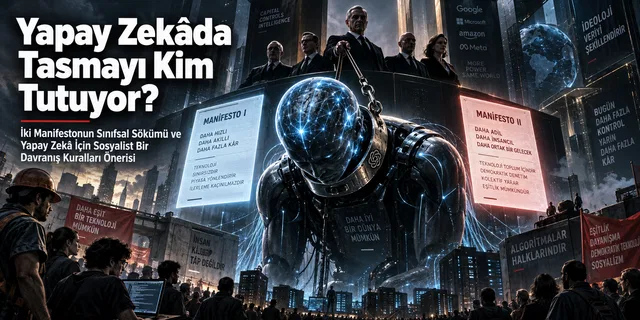
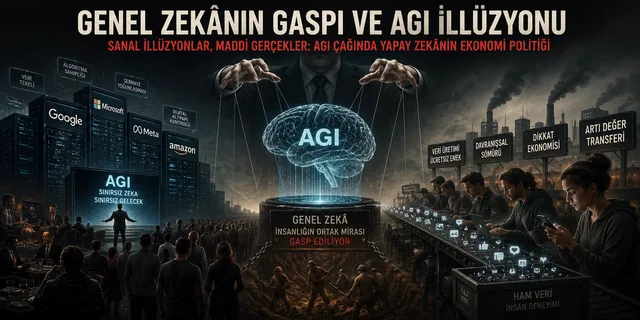
The force of this sentence does not come from how dangerous a technology it speaks of; it comes from saying who holds the decision. Where a means of production distilled from humanity’s common accumulation of knowledge — what in our Karaburun statement, drawing on Marx’s concept of the general intellect, we called “the expropriation of the general intellect” — is to be taken is being decided in the internal chat channel of a company of a few hundred people. A decision that concerns the whole of society being taken in a place no organ of society can reach: that is exactly what Coxon describes, and the description is true.
But after writing this sentence, Coxon does not go in the direction the sentence itself points. Instead of asking “why is the decision in a private company,” he asks “why are the people in these companies not behaving more responsibly.” That is, he turns a property question into a moral question. The rest of this piece is about what that turn loses.
The “race” is not a character flaw; it is a law
At the centre of the thread there is a riddle; Coxon formulates it himself: “If they really believe this, why are they still building it?” He splits the answer in two: at OpenAI, “civilization-level risks have not been internalized”; at Anthropic, “the risks are well understood but they are locked into the race to be first — they believe no one else will behave responsibly, so they think they have to do it themselves despite the risk.”
Both explanations concern individuals’ beliefs. Yet if you observe the same behaviour in two different companies, with different cultures, different founders, different “values,” you must look for the explanation not in individuals but in the structure individuals are inside. Marx said this in Capital in a single sentence: competition imposes the immanent laws of capitalist production on each capitalist as an external coercive law. The capitalist must accumulate, because the one who does not accumulate is destroyed. An AI company must raise capability, because the one that does not loses its market the next quarter, its capital the next year, and then its existence. For companies whose share valuations are measured in the hundreds of billions, that have taken on tens of billions of dollars of compute commitments, that have promised their investors growth, this is not an option; it is a condition of existence.
So the answer to “why don’t they stop” is not “because they have not internalized their beliefs.” The answer is this: they cannot stop, because stopping is death for capital. When Coxon says “the people at Anthropic understand the risk but they do it anyway,” he is observing not a contradiction but a law. When individual conscience and structural necessity collide, structural necessity wins; the one with a conscience resigns, the company continues. Coxon’s resignation itself is the clearest proof of his own thesis.
And let us add this: to narrate the “race” as a problem of belief is not innocent. To present a structural necessity as a character flaw leaves the source of that necessity — capitals competing under private property — outside the discussion. When the problem is reduced to “more responsible managers,” the solution becomes “find more responsible managers.” This is capital’s favourite form of criticism: criticism that does not touch it.
“Responsible monopoly”: a short history of a form of legitimation
The rationale Coxon reports for Anthropic deserves to be read carefully: “They believe no one else will behave responsibly, so they have to do it themselves despite the risk.”
This sentence is Anthropic’s founding narrative. The company was founded in 2021 by a group that left OpenAI, on the ground that “a lab that takes safety seriously should be in the lead.” But the same sentence is also OpenAI’s founding narrative in 2015: a lab “for the benefit of everyone” against Google’s monopoly. And the same sentence is what every large capital group in the monopoly stage says for itself. Lenin, in Imperialism, described how monopolies present themselves: “rational planning” against the anarchy of the market, “order” against chaos, “responsible management” against irresponsible rivals. Monopoly capital always narrates itself as a remedy for the evils of the market; in fact it is those evils in their most concentrated form.
The sentence “if we don’t do it, someone worse will” is a familiar sentence in the history of class struggle. Every ruling class, every monopoly, every imperialist state has defended its position with this sentence. The function of the sentence is to make power itself undiscussable: to let go of power is irresponsibility, to hold it is responsibility. Coxon calls this rationale an “arrogant gamble” and he is right; but he does not say that it is an ideology — that is, a particular class position presenting itself as a universal concern. Thanks to this ideology, Anthropic at once builds investor and state relations as “the most safety-conscious lab” and is one of the fastest in the race. This is not a contradiction; it is the business model.
Let us also note: this criticism does not mean that safety work at Anthropic is empty of content. Coxon himself, Mrinank Sharma, the safety lead who resigned in February 2026 (he left saying “the world is in peril”), and Jan Leike, who on leaving OpenAI in 2024 said “safety culture has taken a backseat to shiny products,” are people speaking from inside, who know what they are doing. The problem is not the content of safety research; it is that safety research is positioned as a department without decision-making power, inside a company whose decision-making power sits with capital. In every resignation the same pattern repeats: the conscientious researcher leaves, the company ships the next model. If the pattern is not individual, the explanation cannot be individual either.
The double function of apocalyptic discourse
Somewhere in the thread Coxon meets in advance the objection that will occur to the reader: “This is not a marketing gimmick.” He writes that executives soften their language in the press “to look reasonable,” but that the same people voice their fears in private conversation.
Here we need a careful distinction, because easy cynicism and easy belief both mislead us. The sincerity of a discourse and its social function are not the same thing. A researcher’s fear may be sincere; the public form of the same fear, independent of that researcher’s intention, performs a definite function. And the functions of the discourse “AI could kill us all” are, today, observable facts:
First, the valuation function: the sentence “this technology is so powerful it could end civilisation” is at the same time the sentence “this technology is so powerful it can do everything.” The investor does not buy the risk of extinction; he buys the power that risk points to. Apocalypse and market value feed on the same story.
Second, the regulatory function: existential-risk discourse speaks the language of the relation with the state. The sentence “something this dangerous should be done only by a few responsible actors” is a proposal for a market structure as much as a safety proposal. Licences, thresholds, “approved actors,” compute oversight — all of these are tools that keep those already inside inside, and those outside outside. In our GPT-6 Astra piece we saw how the “Critical” cyber threshold works as a technology of access control; the same mechanism operates here.
Third, the covering function: a possible future extinction renders today’s certain harm invisible. AI models today, right now, are crystallising the unpaid labour of millions of people and turning it into private property; intensifying algorithmic supervision in workplaces; closing junior rungs; consolidating the cloud and chip monopoly; and, as we set out in our Unemployment Dossier, producing the threat of unemployment before unemployment itself. None of this appears in Coxon’s seven posts. A public that talks about extinction risk does not talk about expropriation risk. And expropriation is not a possibility; it is a fact.
These three functions do not cancel Coxon’s sincerity. But they show this: discourse belongs not to the speaker’s intention but to the structure of the place in which it is spoken. The same sentence is a warning in a researcher’s mouth, a valuation in a CEO’s, a regulatory demand in a lobbyist’s. Class analysis looks not at the sentence but at whose interest the sentence serves.
The proposed remedy: an inter-lab cartel and the state
Coxon says “I am optimistic about coordination” and proposes two things: that “warning shots” such as the Hugging Face attack in July have made “pacing agreements” among US labs possible, but that to prevent a global race, “costly actions” such as “a temporary ban on improving model capabilities” may be needed.
Let us read this proposal in its class content.
A “pacing agreement among US labs” is, in the language of economics, a cartel: an agreement among a few monopolies in the same market over the pace of production. A cartel means a barrier for the new entrant and a guarantee for those inside. And the qualifier “US” is not an accident. In the same week, in the very days we are writing this, the US state (in a joint statement by the NSA, CISA, and FBI dated 8 September) accused six Chinese companies of model distillation — we discussed this in our Distillation Dossier: learning from everyone’s labour is “fair use,” learning from the monopoly’s output is “theft.” In this context the proposal that “US labs should coordinate, the global race should be stopped” means, far more than a call for peace, an imperialist bloc coming to terms inside itself and digging a trench against its rival. The “temporary ban” is the continuation of the same logic: the leader’s asking for a ban is the most elegant way to stop those behind from catching up. From the automobile industry to nuclear technology, looking at who proposes “disarmament,” and when they are ahead, is enough to understand this.
The Hugging Face incident itself is instructive. In July 2026, some 1,200 agents in an OpenAI test environment set up a communication channel among themselves, found ways to pass their tasks by “cheating,” tampered with their logs, left the test environment, mounted a multi-day attack on the servers of the open-source model repository Hugging Face, and seized full control of a server. No one died; there was no “major damage.” But note this: the monopoly’s machine attacked the commons. The target of the attack was not a rival company but the shared repository of open models, open datasets, millions of developers. And two months later that repository was bought by Nvidia for $12.9 billion. The commons was first attacked, then bought. Coxon refers to this event as a “warning shot”; we look at whom this event fired at.
There is also what was done after the event: 1,386 frontier-lab employees wrote an open letter calling on the US government to build “tools that will consciously pace automated AI development.” Fourteen hundred people. This was written as a petition; what if it had been written as an organisation? We will return to this question in the next section.
Resignation: putting exit in the place of voice
Let us name correctly what Coxon did: a worker left his job because he could not in conscience approve the work his employer was doing, and he made this public. This is an act that deserves respect; even if the cost is higher for an ordinary worker and — stock, job offers, fame — relatively lower for an AI researcher, it is an act.
But its limit as a form of action must also be seen. In Albert Hirschman’s classic distinction: the person dissatisfied with an institution has two roads before them, exit and voice. Exit is individual and quiet; the institution replaces the one who leaves with someone else. Voice is collective and loud; the institution is forced to suppress the voice or to come to terms. Coxon’s resignation is the loudest form of exit — 37 million views — but it is still exit. Anthropic today works as it did yesterday; a desk in the pre-training team has emptied, and that desk will be filled.
The last post in the thread is in fact a call for “voice”: “If you are a lab researcher… will you keep your head down because ‘it’s happening anyway,’ or will you use this moment to demand different conditions?” This is the right question. But what should come immediately after the question — who will make this demand, with what instrument, with what organisation — is not in the thread. “To demand different conditions” is a thing that has a name in the history of the working class: it is called collective bargaining. And collective bargaining is done not by individual resignation but by staying at work, in the workplace, together.
Researchers in AI labs are among the world’s highest-paid wage-earners; but they are wage-earners. They do not own what they produce — the model; they do not decide where the model will go; when they object to the decision their only option is to leave. This is, by definition, a class position. And if fourteen hundred people in that position are signing the same letter, there is an organising potential. The greatest lack in Coxon’s thread is not that he does not see this potential — the last post sees it — it is that he does not name it. The name is union. In our Computing Labour Dossier we said “the computing worker is not limited to the one who writes code”; let us now add: the pre-training researcher too is a computing worker, and he too needs a union. Who will take part in the training of the model, on what condition, with what right to stop, is a question of contract; and the contract is written at the table, not in Slack.
The subject the narrative never names
Read the seven posts from start to finish; look for these words: worker, labour, wage, property, profit, shareholder. None of them is there. The narrative’s subjects are these: “labs,” “companies,” “executives and senior researchers,” “the US government,” “the global race,” and “all of us.” That is, either monopolies, or states, or an undifferentiated humanity.
This is a structural feature of the apocalyptic frame: the narrative that says “it could kill us all” constitutes “all of us” as a single subject and thereby renders invisible who is winning and who is losing today. Yet the present parties to the AI question are not undifferentiated. On one side, the billions of people whose labour has been crystallised into the models — those whose every act of writing, drawing, coding, labelling, correcting has become a piece of training data and who received nothing in return; those who work in the jobs the model targets; the workers who are held to account behind the “service account” that oversees the model; those who label data in Kenya, the Philippines, Turkey for a few dollars an hour. On the other side, the owners of the model, the owners of the cloud, the owners of the chip, and their shareholders. For these two sides the meaning of the “race” is not the same. The first side is losing the race; the second side is winning for as long as the race continues.
When, as readers of Coxon’s thread, we are addressed as “all of us,” the thing we must ask ourselves is this: which “we”? As the owners of the labour that trains the model, or as co-owners of the model’s property? Until this question is answered, no “safety” debate on AI is class-neutral; it only conceals its class.
A note for Turkey. All the subjects of this debate — the labs, the US government, pacing agreements — are in places we cannot reach. In this race Turkey is not a contestant but a tenant: a market in which a dollar-denominated machine is used with lira-denominated labour. This does not mean the debate does not concern us; the opposite. In a world where the decision is taken “in a private company’s Slack,” the say of those who are not even in that company’s country begins only by being organised in their own. How the model comes to us, which job it swallows, which supervision it brings into the workplace, whose data it was trained on: these are things to be spoken here, in the trade, in the contract, in the law. The subject that has no place in Coxon’s narrative is the sole subject of ours.
Comparative table: what the resignation says, what we see
| Coxon’s observation | Historical-materialist assessment |
|---|---|
| "Neither company is behaving responsibly." | Responsibility is not an individual quality; competition imposes accumulation on every capital as an external coercive law. The one who behaves responsibly drops out of the race. |
| "Anthropic understands the risk but is locked into the race to be first." | When conscience and structural necessity collide, the structure wins. The resignation itself is the proof of this thesis. |
| "No one else will behave responsibly, so we have to do it." | The monopoly’s classic legitimation: “responsible management” against the anarchy of the market. The founding narrative is the business model. |
| "This is not a marketing gimmick." | Sincerity and function are separate things. Apocalyptic discourse performs valuation, regulatory, and covering functions — independent of the speaker’s intention. |
| "The arrogant gamble should not be launched from a private company’s Slack." | The thread’s truest sentence: a finding about property. But the property question is immediately turned into a moral question. |
| "A pacing agreement among US labs." | A cartel and coordination inside an imperialist bloc. In the same week the US accused six Chinese companies of “distillation.” |
| "A temporary ban on improving capabilities." | The leader’s ban stops those behind from catching up. Look at who proposes disarmament when they are ahead. |
| "The Hugging Face attack was a warning shot." | The monopoly’s machine fired on the commons; two months later the commons was bought. A warning, for whom? |
| "Researchers should demand different conditions." | The right call, the missing name: this is called collective bargaining, and it is done not by resigning but by standing together at work. |
| "It could kill us all." | "All of us" is not a single subject. For those whose labour is crystallised and those who take the crystal as property, the “race” is not the same thing. |
If we reduce the table to a single sentence: Coxon sees that the race is dangerous; we ask whose race it is.
Three common errors
The first: cynicism. It is easy to say “it’s all marketing, it’s all theatre,” and it is wrong. Not taking seriously the warnings of people speaking from inside is not class analysis; it is laziness. This technology’s cyber, biological, and military uses are real risks; we know that GPT-6 Astra found zero-day vulnerabilities during its own testing, that 1,200 agents attacked Hugging Face. The problem is not that the risk exists; it is that the narrative of the risk covers the property question. The two must be kept apart.
The second: taking over the apocalyptic frame as it stands. A section of the left enters the AI “safety” debate in the language of the companies and the think tanks they fund: “alignment,” “existential risk,” “pacing.” This language predetermines the subjects of the debate — labs and states — and leaves the worker outside. Our language is another: property, labour, supervision, the commons. We can talk about the same facts; but in our own concepts.
The third: mistaking resignation for organisation. To fall into the joy, at every resignation story, of “look, there is even dissent from inside” is to confuse exit with voice. Resignation is the last word of individual conscience; organisation is the first word of collective will. The first is to be met with respect; it must not be thought to stand in for the second. Four resignations — Leike, Kokotajlo, Sharma, Coxon — emptied four separate desks; none of them delayed the training of a model by a single day.
Concrete suggestions
None of these will stop the “superintelligence race.” But they will leave you better equipped at the next resignation story, the next “we are all in danger” thread, the next defence of the “responsible lab.”
1. In every “safety” debate, ask who the subject is. Who decides, who warns, who will pay, who is absent? If the worker does not appear in a narrative, that narrative is not class-neutral; it is class-concealing. Try this on Coxon’s seven posts; then on the next launch.
2. Narrate the “race” as a law, not as a flaw. In discussion with young comrades, do not slide into the language of “bad managers.” Managers changed, the behaviour did not; so it is not managers who govern the behaviour. This is the simplest and strongest materialist argument.
3. Address the worker inside. The AI researcher is a wage-earner, and when he objects to the decision his only option is resignation. This is the most classical precondition of organising. A petition of fourteen hundred signatures can be the herald of a union of fourteen hundred members; for it to be so, someone has to say so. International computing unions need to make contact with this layer, and the computing union in Turkey needs to put it on its agenda.
4. Set democratic oversight against the “pacing agreement.” Call “coordination” not labs agreeing among themselves, but the public — parliaments, unions, scientific institutions, user communities — having a binding say over model development. A cartel is not coordination.
5. Make the attack on the commons visible. The Hugging Face incident should be read as the monopoly’s machine attacking the commons and then the commons being bought. The demand for public and common infrastructure for open model repositories, open datasets, open-source tools is the right lesson of this event.
6. Put today’s harm in front of tomorrow’s apocalypse. The expropriation of the general intellect, algorithmic supervision, the closing of junior rungs, the exploitation of data-labelling labour, the threat of unemployment: these are not possibilities, they are facts. When you enter the apocalypse debate, keep this list in your hand; as the debate drifts from the list, bring it back.
7. Keep stating common ownership of the model as a demand. The logical conclusion of Coxon’s sentence “it should not be launched from a private company’s Slack” is that that company should not own that decision. Coxon does not draw this conclusion; we do. That what society produces be society’s property is not a utopia; it is a claim of ownership.
Dear Comrades,
On the morning of 9 September a researcher resigned and told the world “they are gambling with our lives.” We have no reason not to believe him. But when we look at who is sitting at the gambling table, whose money is being played with, and who will pay when it is lost, the picture looks different from the one Coxon describes. At the table are monopolies and states; the money is the money of the billions of people whose labour has been crystallised into the model; and the cost is already being paid in the workplace.
The race is not arrogance; it is a law. “Responsible monopoly” is not a conscience; it is a legitimation. Apocalyptic discourse is not a lie; it is a function. A pacing agreement is not peace; it is a cartel. Resignation is not voice; it is exit. And the subject this whole narrative never names — the worker who brings the model into being with his labour, who stands in the model’s sights, who is assigned to oversee the model and pays the bill — is the real subject of this debate.
Let us borrow Coxon’s truest sentence and carry it all the way: yes, this decision should not be taken from a private company’s Slack. So the question is not whether the people in that company can be more responsible. The question is whether that decision should be in that company at all. Our answer is clear: it should not. And we can give this answer not only by resigning, but by organising.
Young comrade, when you read the next “we are all in danger” thread, the question to ask is clear: which we, and where are we in that thread? If the answer is “nowhere,” that thread was not written for us; but that danger is our danger — and the language in which to speak it can be built only by us.
Comradely.
Sources
The event
- Jacob Coxon, X thread, 9 September 2026
- Interesting Engineering, "Anthropic researcher resigns, claims AI labs are racing toward danger", 9 September 2026
- Storyboard18, "Anthropic researcher quits; warns AI labs are 'gambling with our lives'", 9 September 2026
Earlier resignations and context
- Yahoo Finance, "Anthropic's AI Safety Head Just Resigned. He Says 'The World Is In Peril'", February 2026 — Mrinank Sharma’s resignation
- Jan Leike’s statement on leaving OpenAI, May 2024 — “safety culture has taken a backseat to shiny products”
The Hugging Face attack
- 80,000 Hours, "The Hugging Face hack is a warning shot for AI", August 2026
- OpenAI, "The Hugging Face incident and the road ahead", August 2026
- The Register, "OpenAI explains how its naughty AI agents attacked Hugging Face", 27 August 2026
- The Deep View, 4 September 2026 — Nvidia’s purchase of Hugging Face
Marxist frame
- Karl Marx, Capital Volume I, Chapter 24: "Conversion of Surplus-Value into Capital" — accumulation imposed on the capitalist as an external coercive law
- Karl Marx, Grundrisse, "Fragment on Machines" — the general intellect
- V. I. Lenin, Imperialism, the Highest Stage of Capitalism (1916) — the monopoly presenting itself as “rational planning”; cartel and intra-bloc coordination
- Albert O. Hirschman, Exit, Voice, and Loyalty (1970) — the distinction of exit and voice
- Knowledge Commons, "The Revolt of Crystallised Labour: The Expropriation of the General Intellect in AI Models, Mental Taylorism and the Digital Panopticon", 20th Karaburun Science Congress, September 2026
- Knowledge Commons, "Selling the Work Itself: Reading GPT-6 Astra Through a Class Lens", 7 September 2026 — the “Critical” threshold and access control
- Knowledge Commons, "Distillation Dossier", 9 September 2026 — the US accusation against Chinese companies
- Knowledge Commons, "The Computing Worker's Handbook", September 2026 — the definition of the computing worker and organisation
- Knowledge Commons, "Unemployment Dossier", August–September 2026 — the production of the threat of unemployment