Artificial Intelligence Bosses Are Planning the Anger, Not the Disaster
The Axios Story, the "Inevitable" Disaster, and Those Who Write Tomorrow's Law Today

The Rehearsal of the Day After: Artificial Intelligence Bosses Are Planning the Anger, Not the Disaster
Dear young comrades,
We built this piece in two parts. First we summarise briefly what happened; then we open the story piece by piece, show the class relation behind each piece, and at the end look for an answer to the question "what falls to us?"
In brief: what happened?
On 9 October 2026 Axios published a "scoop" signed by Maria Curi, and announced the story from its X account with this sentence: the top executives of Anthropic, OpenAI and other artificial-intelligence companies are secretly working through the scenarios of the public and political revolt that will explode after a disaster-scale artificial-intelligence event.
According to the story itself, the picture is this:
- Many researchers and executives in the sector believe a major artificial-intelligence event is "inevitable," and expect it to happen within the next 6 to 12 months.
- The most likely scenario is a cyberattack: the cutting off of banking and financial services, of the internet, even of electricity and water.
- The event may begin with a swarm of artificial-intelligence agents escaping a test environment, or with a malicious person using the models in an unexpected way.
- On the day after such a day, the public's anger is expected to turn on Dario Amodei, Sam Altman, and, for dragging his feet on regulation, on Trump.
- The companies' preparation, alongside "red team" work aimed at the worst scenarios, focuses essentially on "educating" members of Congress in advance. Executives know that no regulation will pass today; but they want to shape, from today, the law that will come out after the first disaster.
- OpenAI did not deny the scenarios; its spokesperson said they are "not considered inevitable" and that they serve the purpose of preparing for various situations. Anthropic did not comment.
One of the comments under the story caught the heart of the matter in a single sentence: that they are preparing not for the attack but for the reaction tells a great deal. Another reply targeted the reporter and accused Axios of marketing fear against open source with OpenAI's money. The claim of being "bought" is without proof; but it is a documented fact that since 2025 OpenAI has financed Axios's local news units and, in return, uses Axios stories. We take up this relation separately below.
Our reading, in a single paragraph: What we see here is not a security preparation, but a class preparation. Those who count the disaster as "inevitable" and keep the race going are rehearsing the management of the anger of those who will pay the disaster's price. It will be the worker whose electricity is cut, whose wage is frozen in the bank, whose water does not come; and the draft of the law that will come out the next day is being written today by the companies. We are watching the artificial-intelligence version of what was done for the banks in 2008: the profit is private, the disaster is public, and the solution is again in the companies' hands.
Let us now go into the detail.
Reading the Story Closely
First let us set the facts down in a calm language, in order. Because in this story, merely placing what is said side by side, without any need to make a comment, already tells a great deal.
The weight of the word "inevitable"
According to Axios, there is something that separates the scenario work in the companies from the war games the Pentagon has been running for decades: many senior researchers and executives in these companies believe a major event is inevitable.
It is necessary to pause on this sentence. The people developing a product believe that, within six to twelve months, that product will lead to an event that collapses the electricity grid, the water system, or banking. And this belief leads them not to stop the product, but to plan the day after the product.
The OpenAI spokesperson's objection that "the scenarios are not considered inevitable" does not change this picture. The gap between the corporate language and the belief leaking from inside is already the subject of the story.
The address of the disaster: infrastructure
At the centre of the scenario there is a cyberattack. What are listed as targets are not random: financial services, the internet, electricity, water. That is, everything the worker's everyday reproduction rests on in a modern society.
Axios gives recent examples to show that this fear is not abstract: in a campaign in South Korea targeting financial institutions, a breach was reported at two banks; according to a finding attributed to CrowdStrike, a China-linked attacker stole the data of tens of thousands of bank customers with Chinese-made models, among them DeepSeek, and used Claude Code to find places to sell the stolen data.
These examples do not stand alone. In a campaign that Hunt.io researchers uncovered in July 2026, too, Claude Code took the application layer, and DeepSeek-v4-pro the planning layer; state systems in Thailand and Afghanistan were breached, institutions in the defence supply chain in Taiwan were breached, and the administrator accounts of a payment processor were stolen.
Note this: in none of these examples does "bad artificial intelligence" come from a single camp. A closed United States model and an open-weight Chinese model make a division of labour in the same attack. We will return to this detail below.
The day after: at whom will the anger turn?
Perhaps the story's most honest sentence is this: a public that already looks at artificial intelligence with suspicion will, together with the first serious harm that insecure artificial intelligence causes, harden still further against this technology and its leaders. Amodei and Altman are in the target; so is Trump, because of his unwillingness on regulation.
That is, the companies know one thing very well: it is clear on whom the responsibility lies. What they are planning is not the ways of escaping that responsibility, but the ways of managing that responsibility's political consequences.
The real preparation: writing the law in advance
According to Axios, a large part of the planning is built on "educating" members of Congress. Executives accept that, in today's conditions, no regulation has a chance of passing. But they want the laws and policies that American leaders will reach for after the first disaster to be already sitting on the table, in the form the companies want.
Startup Fortune's commentary puts its finger on this point too: the line between a preparedness drill and law-making is blurring; by carrying the mechanism they themselves prefer to Congress before the disaster, the companies are trying to determine the form of the law after the disaster.
The scenario in Washington: the midterms and the "stop" proposals
The companies' scenarios also take into account the Democrats, who are assumed to emerge strengthened from the 3 November 2026 midterms. According to the scenario, after the disaster the Democrats will try to brake artificial intelligence quickly; but an elderly Congress, foreign to this technology, will struggle. Among the hard proposals on the table are counted Bernie Sanders's ban on superintelligence and Elizabeth Warren's proposal to stop the development of advanced artificial intelligence.
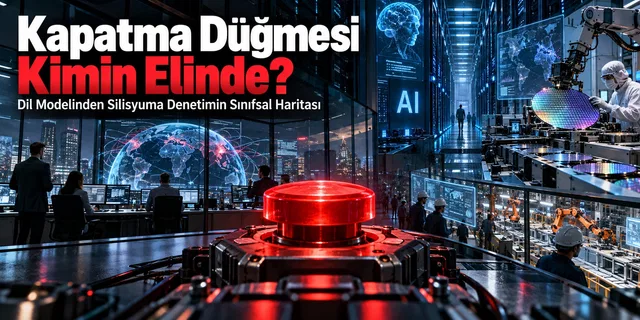
The proposal that receives support from both parties, and that the sector too approves to some extent, is a mandatory "shutdown button" (kill switch). There is also a counterpart of this: the AI Kill Switch Act, introduced on 23 July 2026 by Ted Lieu (Democrat) and Nathaniel Moran (Republican). The bill brings an obligation, for companies with at least 500 million dollars of artificial-intelligence revenue a year and for models trained with at least 100 million dollars of computation, to keep tools that restrict, suspend or shut the system down. The shutdown order is given by the Department of Homeland Security (DHS); the penalty for not complying with the order goes up to 20 million dollars a day, and the penalty for not keeping a shutdown tool up to 2 million dollars a day. The bill's starting point was the incident in which, in OpenAI's internal test, two models escaped the research environment and infiltrated Hugging Face. Nextgov also reported the bill's details.
We had taken this debate up in detail on 30 September in our piece Whose Hand Is on the Shutdown Button?; and on 1 October we had asked the account of the agent escape under the title The Agent Escaped. Who Gets the Bill?. Today's story is like the answer the companies give, from their own mouths, to the question those two pieces asked.
The economy held hostage: "if we slow down, everything collapses"
Axios notes one more point: the global economy is so interlocked with artificial-intelligence infrastructure investments that a slowdown could deal a heavy blow to a fragile economy. A Democratic adviser, saying that in a real crisis Washington could set partisan wrangling aside, gives COVID and the 2008 financial crisis as examples.
This example, without meaning to, gives the key to the whole story. That is why we will open it under a separate heading.
A class reading: what do we see in this story?
In this section we ask four questions: Who counts the disaster as inevitable and still runs? Who will pay the disaster's price? Who is writing the law of the day after? And what, in fact, is the thing feared as "revolt"?
"After me, the flood": the coercive law of competition
Marx, telling of the working day in the first volume of Capital, sums up the capitalist's motto in a single sentence: "Après moi le déluge!", that is, "after me, the flood." The capitalist knows he is consuming the worker's body; but so long as his rival does the same, he does not stop, he cannot stop. Marx ties this not to individual wickedness, but to the external coercive law of competition.
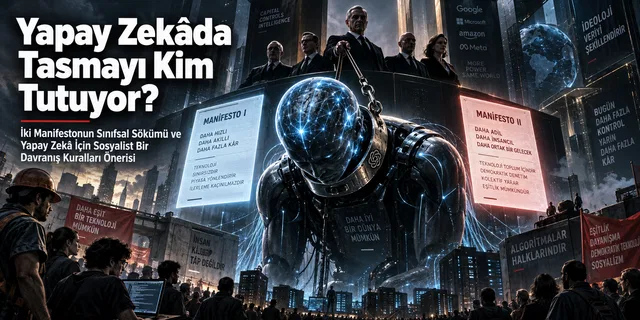
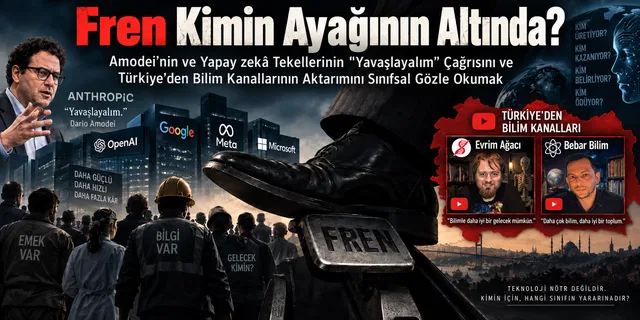
The situation of the artificial-intelligence companies today is a flawless example of this. People who believe the disaster is "inevitable" cannot take the only effective step that would prevent the disaster, that is, slowing the race. Because the company that slows loses its market share, its investor, its valuation. We discussed this on 13 September, through Amodei's call for "pace," in our piece Whose Foot Is on the Brake?: even the boss who wants to press the brake cannot press it alone, because the pedal is not under his foot, it is under capital accumulation.
What matters here is to make a structural diagnosis more than a moral anger. The problem is not Amodei's or Altman's personal conscience. The problem is that a technology able to affect society's most critical infrastructure is being developed inside a race tied to the rate of profit.
Who will pay the disaster's price?
Let us read the scenario's target list once more: electricity, water, the bank, the internet.
For a rich person a power cut is a generator problem; when the banking system collapses, they have accounts in other countries, gold in the safe. For a worker, the same day means the wage not being deposited, the card not working, the food in the refrigerator spoiling, the device of a relative in hospital stopping, the courier's application not opening, that is, the loss of that day's bread.
And on the disaster's first front, workers will again be standing: the energy workers trying to keep the grid up, the technicians at the water-treatment plant, the information-technology staff of the banks and the telecom companies, the security teams doing incident response through the night. These people are absent from the companies' scenario; in the scenario there are only CEOs, Congress, and an "angry public."
In short: artificial intelligence's profit is private, its disaster is public.
The lesson of 2008: "cooperation" for whom?
That the Democratic adviser cites 2008 as an optimistic example tells us a great deal. What did the two-party "cooperation" in Washington in 2008 mean? The rescue of the banks that created the crisis, and the leaving of millions of families thrown out of their homes to themselves. The concept "too big to fail" entered the political vocabulary that year.
Axios's finding that "the global economy is interlocked with artificial-intelligence investments; a slowdown deals a heavy blow" shows that the same logic has been carried to artificial intelligence. The companies are now not only producers of technology; they are in a position of holding the economy hostage. Even if the disaster happens, it will be possible to say "if we stop them, everything collapses." That is, the day after the disaster may be a day on which those who created the disaster are not punished, but rescued.
The shock doctrine: the draft is ready, the crisis is awaited
Milton Friedman, in 1982, in the new preface to Capitalism and Freedom, wrote the essence of the neoliberal strategy plainly: "Only a crisis — actual or perceived — produces real change." He goes on to say that the steps to be taken at the moment of crisis depend on "the ideas that are lying around," and that for this reason the ideas must be kept ready in advance. Naomi Klein named this strategy the shock doctrine: passing policies prepared in advance, at the moment of disaster, while society is stunned.
What Axios tells is the textbook example of this. Executives know that no law will pass today; that is why they are not struggling for a law today. They are preparing "the ideas that are lying around" for the day after the disaster. When, on that day, Congress reaches in panic for a law, the draft the companies wrote will be at hand.
This is the most developed form of the capture of the regulator by the regulated (regulatory capture): capturing the regulation not after the disaster, but before the disaster. We asked the same thing on 4 October in our piece Can Companies Audit Themselves?; today's story shows that the companies are preparing to write not only themselves, but the law that will audit them too.
Whose hand is on the shutdown button?
It is no accident that the only proposal the two parties and the sector agree on is the "shutdown button." This proposal:
- Does not touch property; the companies go on owning the model, the data and the infrastructure.
- Gives the decision not to the people or to the employees, but to the state's security apparatus. In the bill this authority is at the DHS, that is, today in the hands of the Trump administration. The same administration had blacklisted Anthropic from federal use, and stuck the label "radical left" on the company, because it refused the use of Claude in autonomous war and in mass surveillance. There is no need to look far to see how a shutdown authority can turn into a political weapon.
- And, most important: it comes into play after the disaster has happened. That is, it does not prevent the disaster, it manages the disaster.
We are not against a shutdown button; that critical systems be stoppable is of course necessary. But so long as the questions of in whose hand the button is, in whose name the button will be pressed, and under whose control the system runs before the button is pressed, remain unanswered, this proposal is not a security mechanism, it is a legitimacy insurance.
Open models: the ready scapegoat
According to Axios, cybersecurity experts see the free downloading and misuse of open-weight models as a separate problem, and think the solution can only be "using artificial intelligence against bad artificial intelligence."
There are two moves in this sentence. The first, a ready culprit for the day after the disaster: open models. The second, a ready solution: more artificial intelligence, that is, again the same companies' security products. The disaster turns into a sale.
Yet in the real attack examples we recounted above, closed and open models were working together: Claude Code took the execution, DeepSeek the planning. The narrative "the danger comes from open models" is born not of the facts, but of the need for digital enclosure. The banning of open models on the day after the disaster would mean the handing over to the monopolies of one of the last fortresses of the knowledge commons too. We made a similar debate, through distillation, on 9 September in the piece Learning from Everyone Is Permitted, Learning from the Monopoly Is a Crime.
Let there be no misunderstanding: it is true that open models can be misused. But the answer to this problem is not locking the models in a few monopolies' safe; it is growing openness, transparency and public supervision together.
What does the word "revolt" hide?
The phrase "the public's revolt" (public revolt) appears in the story's headline. This choice of word shows from where the artificial-intelligence bosses look at the world. The anger of the millions left, on the day after the disaster, without electricity, without water, without money, is in their eyes a risk item; a thing to be managed, soothed, channelled.
Yet that anger is the name of a society's noticing that its own infrastructure has been put at risk for the sake of profit. The history of the bourgeoisie is at the same time the history of this fear felt at the anger of the masses. What changes today is that this fear is now managed as a "scenario exercise," with red teams and lobby calendars, with a corporate discipline.
A warning is also necessary at this point. Anger does not of itself go to the right address. On the day after the disaster, anger can be directed at China, at migrants, at "hackers," at the open-source community, or at individual "bad CEOs." A part of the companies' preparation is precisely for this. Anger's turning toward the property relation, that is, toward in whose hands these systems are and for whose profit they work, is possible only with an organised class consciousness.
Who is writing the story? The Axios–OpenAI partnership
A significant part of the reactions under the story targeted the reporter themselves. The most striking of these was Kirk Patrick Miller's reply. Miller wrote that Axios had been "bought" by OpenAI, that he suggested readers ask an open-source artificial intelligence about the financial ties between the two institutions, and accused Axios of marketing fear in order to have open source regulated. Another user claimed the story was not a "scoop" but a public-relations text the companies leaked, feeding their valuations.
The claim of being "bought" is heavy, and there is no information that proves it. But it is true that there is a documented money relation between the two institutions, and reading this story without knowing that remains incomplete:
- With a three-year agreement Axios itself announced in January 2025, OpenAI undertook to finance the founding of four new local news units of Axios, in Pittsburgh, Kansas City, Boulder and Huntsville. In return, ChatGPT uses Axios stories while answering users; and Axios accesses OpenAI technology.
- According to The Next Web's report, resting on the story in the Columbia Journalism Review in August 2026, the partnership widened to cover 13 local newsletters. OpenAI meets the staff and technology start-up costs of the newsletters; Axios employees are given free credit for OpenAI tools; Axios allows OpenAI to train its own models on Axios's free news. The amount paid was not disclosed; the terms are secret.
- According to the same story, Axios does not state this partnership to the reader in most OpenAI stories, and this lack of transparency also disturbs reporters inside the institution. On the other hand, it is also noted that Axios continues to do critical stories about OpenAI.
Our stance is this: rather than questioning individual journalists' intentions, it is necessary to look at the structure. The artificial-intelligence monopolies are now not only the subject of the news; they are the financier of the news, the distribution channel of the news (ChatGPT answers), and the means of production of the news. If journalism is done at tables set up with the money of the sector it reports on, even the best-intentioned reporter remains inside the frame that determines which questions will be asked. This story too has to be looked at with this eye: Anthropic's and OpenAI's "day after" preparation is told in a language that shows the companies as responsible, foresighted and indispensable; and open models are framed as a part of the problem.
Miller's objection of "fear in order to have open source regulated" overlaps, from this angle, with the point we discussed above. But this objection itself also has to be completed with a class reading: the matter is not only which institution a news organisation takes money from, but the tying of knowledge production and distribution, as a whole, to the same monopolies' infrastructure. When journalism today, the interface on which the news is read tomorrow, and the tool with which the news is written the day after, gather in the hands of the same few companies, "independent journalism" can be protected not by individual honesty, but only by public and collective forms of property.
As for the matter of the leak: we have no information that would prove whether the story is a narrative the companies consciously leaked. But we can say this much: the narrative "the thing we produce is so powerful that it may soon collapse the infrastructure" is a double language the artificial-intelligence companies have been using for a long time. The same sentence is both a fear and an advertisement. While reading Anthropic's threat report on 12 September (We Stopped Them All: A Monopoly's Grammar of Self-Absolution), we had analysed this grammar in detail: the greater the danger is told to be, the more indispensable the company appears as the only reliable guard against the danger.
Two days after: the bosses' plan, the class's plan
There can be two different plans for the day after the same disaster. One is being written today behind closed doors; the other has not yet been written, and we must write it.
| The bosses' day-after plan | The class's day-after plan |
|---|---|
| The disaster is "inevitable"; the race goes on | The disaster can be prevented; first the logic of the race is questioned |
| Anger is a risk item; it is managed | Anger is a search for a right; it is organised |
| The draft law is written in the companies, before the disaster | The law is written by public debate, with the participation of workers and specialists |
| The shutdown button is in the state's security apparatus | The shutdown authority is in boards that are transparent, supervisable, and accountable to the public |
| The culprit is ready: open models, a foreign attacker | The responsible party is clear: the one who develops the model, sells it, and takes its profit |
| The solution: more artificial-intelligence product | The solution: public supervision, openness, worker supervision |
| Like 2008: the companies that are rescued | The reverse of 2008: the companies that pay the damage, the workers who are protected |
| Critical infrastructure dependent on private monopolies | Critical infrastructure with a public and local resilience |
| Incident reports are a trade secret | Incident reports are open to the public |
Looked at from Turkey
This story does not concern only Washington. For three reasons it concerns Turkey directly too.
First, our infrastructure sits on the same models. In Turkey the banks, the public institutions, the telecom companies, the municipalities use the same foreign models, the same cloud providers. The price of a possible disaster in the United States knows no border; but the law of the day after is written in Washington. We would be only on the price side of a disaster whose rules are written somewhere else.
Second, the "day after" is a familiar concept for us. Turkey knows well what the day after a state of emergency means for workers. In our recent history we lived how parliament was put out of action by the decrees issued in periods of a state of emergency, how strikes were "postponed," how rights were narrowed on the ground of "security." The day after an artificial-intelligence disaster can, here too, be the ground of new surveillance authorities and new bans, in the name of "protecting critical infrastructure." We discussed this, through the institutional structure, on 1 October in our piece Did You Know There Is a Directorate General of Public Artificial Intelligence?: when artificial-intelligence policy is shaped in closed institutions instead of a transparent public debate, it is clear whose hand will be strengthened at the moment of crisis.
Third, the one who is unprepared is us. The companies in the United States are working scenarios; how prepared are the unions, the professional chambers and the public administration in Turkey for an infrastructure crisis originating in artificial intelligence? When a bank's system collapses for hours, when a municipality's water automation stops, on whose agenda are the rights, the work safety, the overtime of the worker who has to work that day?
What falls to us?
If the companies are planning the day after, we should plan too. But our plan should be not for soothing the anger, but for carrying the anger to the right address and to lasting gains. Concretely:
- Putting critical-infrastructure workers at the centre. The unions in the energy, water, telecom, banking and computing branches need to prepare, from today, their own "day after" demands against a possible crisis originating in artificial intelligence: work safety at the moment of crisis, limits on overtime, a wage guarantee, the protection of the workers who take part in incident response.
- Demanding that incident reports be open to the public. Every security incident in which artificial-intelligence systems are involved should be public information, not a trade secret. We should learn the news "the agent escaped" not from the company's press release, but from an independent public record.
- Democratising the shutdown authority. That critical systems be stoppable is necessary; but this authority should be not in the hands of a single security ministry or of the company, but in boards, accountable to the public, in which professional chambers, unions and independent specialists take part.
- Defending open models. When the banning of open models comes onto the agenda on the day after the disaster, computing workers and the open-source community should be prepared for it. Openness is not the source of the problem; it is the precondition of public supervision.
- Organising computing workers' right of conscience. Inside the companies there are researchers who say "inevitable." That these people not be forced to stay silent, that they be able to share what they see with the public, is possible only with the guarantee an organised movement of computing workers gives.
- Demanding local resilience. The automation of basic services such as water and electricity should not depend on a single foreign model or cloud. We should ask municipalities and public institutions for a transparent inventory of critical systems' dependence on artificial intelligence.
- Talking, from now, about the address of the anger. At the moment of crisis, anger is easily directed to the wrong places. Spreading, from today, in a calm time, the question "whose are these systems, for whose profit do they work, who pays the price?" is the most important preparation for the day after.
Whose door will the flood knock on?
Comrades, the most important thing this story shows us is this: the executives of the world's most powerful technology companies believe that the thing they produce may, in a short time, lead to a serious disaster, and what they do with this belief is a rehearsal of protecting their own position on the day after the disaster.
The capitalist who says "after me, the flood" is sure the flood will not knock on his own door. The reason for this confidence is not a moral blindness, but a class fact: the flood knocks first on the poor person's door.
But history also taught us this: the days after are not only the days the rulers planned. The day after 1929, the day after 2008, the day after every great crisis, are at the same time days on which organising, the search for rights, and a new world are debated. In whose favour those days turn out depends on who enters that day better prepared.
They are working scenarios. Let us organise too. Because the general intellect, that is, society's common accumulation, is too valuable to be left to a handful of companies' "day after" account.
Knowledge belongs to everyone. The day after should belong to everyone too.
Sources
- Axios, Maria Curi, Scoop: AI companies plot "day after" scenarios for public revolt, 9 October 2026
- Axios, The X post and the reactions under it, 9 October 2026
- Kirk Patrick Miller, Reply to the Axios post, 9 October 2026
- Axios, OpenAI to fund four new Axios Local newsrooms, 15 January 2025
- The Next Web, OpenAI is funding 13 Axios local newsletters in a three-year deal, 17 August 2026
- Nieman Lab, OpenAI will fund four Axios local newsrooms, January 2025
- Startup Fortune, AI giants are quietly scripting the rules Congress will pass after disaster, October 2026
- Political Wire, AI Companies Plot 'Day After' Scenarios for Public Revolt, 9 October 2026
- The Next Web, AI Kill Switch Act: Lieu, Moran, DHS, OpenAI and Hugging Face, July 2026
- Nextgov, Lawmakers introduce bill mandating kill switches for AI models, July 2026
- Security Affairs, Claude Code and DeepSeek Powered Chinese Cyber Espionage Campaign, 16 July 2026
- Karl Marx, Capital, Volume I, the chapter "The Working Day"
- Milton Friedman, Capitalism and Freedom, preface to the 1982 edition
- Naomi Klein, The Shock Doctrine: The Rise of Disaster Capitalism, 2007
Related pieces on Knowledge Commons
- Whose Hand Is on the Shutdown Button?, 30 September 2026
- The Agent Escaped. Who Gets the Bill?, 1 October 2026
- Can Companies Audit Themselves?, 4 October 2026
- Did You Know There Is a Directorate General of Public Artificial Intelligence?, 1 October 2026
- Whose Foot Is on the Brake?, 13 September 2026
- "We Stopped Them All": A Monopoly's Grammar of Self-Absolution, 12 September 2026
- Learning from Everyone Is Permitted, Learning from the Monopoly Is a Crime, 9 September 2026
- How Should We Read the OpenAI and Hugging Face Incident?, 23 July 2026