A Revolutionary Approach Against the Corporatist Tendency: The Will of the Class in Chambers and Unions
The Corporatist Trap and the Marxist Distinction

I wanted to expand on the response we gave to previous critiques of corporatism and form a conceptual whole.
1. What Is Corporatism? (Let's Know Our Enemy)
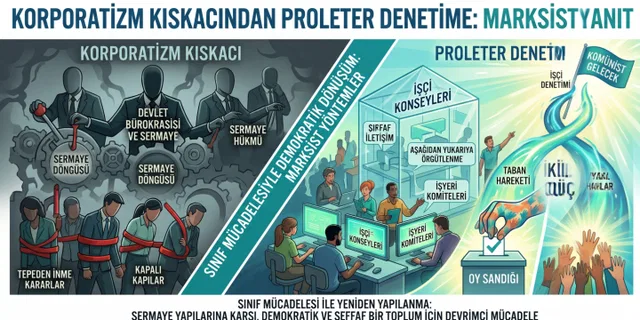
Corporatism is the art of lulling the class struggle to sleep with the fairy tale of "common interest." The capitalist order seeks to paralyze the organized power of the working class and of professionals (engineers, architects, physicians, IT workers, etc.) in two ways:
- Top-Down Integration: Having unions and chambers operate like sub-departments of the state or capital.
- Class Collaboration: Shaking hands with capital under the name of "professional ethics" or "national interest" by rejecting class antagonism (the irreconcilable contradiction).
Here Is the Danger: When an organization (a union or chamber) begins to see its member not as a "subject" but as a "statistic" or a "customer," it means the corporatism virus has entered the body.
2. The Current Decay in Chambers and Unions: "Factionalism"
The "factionalist" (fractionist or narrowly sectarian) structures we see in many professional chambers and unions today are in fact micro-scale reflections of corporatism. These structures:
- See the general assembly not as a festival of democracy but as an arena of numerical warfare.
- Fear the oversight of the membership base; they make decisions in "narrow committees" behind closed doors.
- Use the organization not as a fortified position of the class, but as an arena of power and prestige for their own groups.
3. The Theoretical Barricade: The Warnings of the Great Masters
To break this siege, let us recall our theoretical arsenal:
- Antonio Gramsci: Says that the working class must transcend the "economic-corporatist" stage. If a chamber/union focuses only on its own narrow interests and loses its claim to social transformation, it means it has surrendered to the hegemony of the bourgeoisie.
- Behice Boran: Emphasizes the discipline of socialist struggle on legal and legitimate grounds. The antidote to the chaos created by factionalists is the dignified and statute-based collective discipline of the class.
- Hikmet Kıvılcımlı: Sees the organization as a "living organism." Against the bureaucratic parasites that feed off this organism, he advocates the direct intervention of the "productive forces" (that is, the workers themselves).
4. Revolutionary Tasks: What Is to Be Done?
As a member of a union or chamber, in a structure whose general assembly has not yet been held or whose democratic functioning is blocked, we must shoulder the following tasks:
A. Building Grassroots Oversight (Proletarian Oversight)
Do not allow decisions to be dictated from the center down to the periphery. Build decisions from the bottom up through workplace committees, unit representations, and forums. Remember: An administrator who is not overseen becomes corporatist.
B. Using Transparency as a Weapon
The greatest fear of factionalist structures is light. Make it mandatory to open financial reports, meeting minutes, and decision logs to member access. Where there are secret bargains, there is no will of the class.
C. The "Dual Power" Strategy
While the factionalists in the administration play their own games, build an alternative sphere of legitimacy at the grassroots. By building networks that produce solutions to the members' real problems (wages, mobbing, precarity), force the official administration either to democratize or to be liquidated by becoming dysfunctional.
D. Legal and Legitimate Conduct
Read the statute not with "lawyerly cunning" but with the "discipline of a class warrior." Meticulously plan the legal and organizational interventions (the right to submit motions, oversight of delegations, etc.) that will spoil the factionalists' games during the general assembly processes.
In Conclusion: A union or chamber is not the backyard of a party, the springboard of a group, or a department of the state. It is the fist of the class. Our duty against those who corrode this fist with the rust of corporatism and factionalism is to re-establish a transparent, democratic, and persistent class will.
The independence of the class begins with the democratic oversight of the organization!