The Academy in the Grip of Capital and Politics: The Closure of İstanbul Bilgi University and the Commodification of the Education System
Rethinking the university as a nest of science against capitalist greed for profit, and defending the right to public education

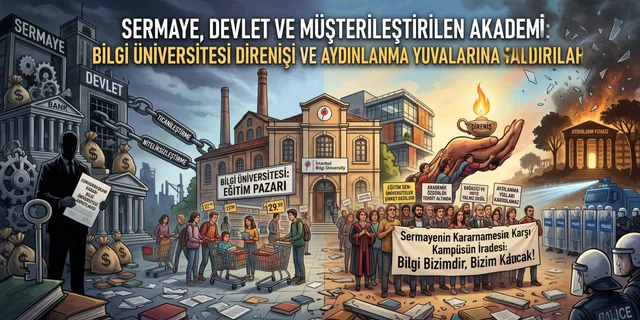
In Turkey, the boundaries of civil space, academic freedom, and the security of education were profoundly shaken by a radical decision published on the night of May 21, 2026. With a Presidential Decree appearing in the Official Gazette, the operating license of İstanbul Bilgi University—one of Turkey's most long-established and prestigious foundation higher-education institutions—was entirely revoked.
This decision, which sacrifices the right to education to the commercial fate of holdings and to state-capital reckonings, is regarded by international human-rights observers as a grave intervention against civil society and the academy. In this report, the property reckonings experienced in the specific case of Bilgi University, the social outrage rising on the X (Twitter) platform, and the structural contradictions of the capitalist education system are analyzed through a Marxist-critical filter.
The Closure Process of İstanbul Bilgi University and the Reckonings of Capital
The overnight cancellation of İstanbul Bilgi University's operating license is the most concrete and destructive result, reflected directly into the field of education, of the power wars waged in Turkey between capital groups and the state apparatus.
The Liquidation Process Step by Step
- Holding Operation and Seizure: The property operations conducted against Can Holding, which held the financial patronage and ownership of the university, spilled directly over into the field of education.
- Appointment of a Trustee to the Founding Foundation: Following the liquidation of the capital group, a trustee was appointed by state decision to the founding foundation that bore the university's corporate legal personality and administrative structure.
- Lockdown by Presidential Decree: Immediately after the foundation passed under trustee control, the university's operating license was entirely revoked in line with the decision published in the Official Gazette dated May 21, 2026.
- Large-Scale Victimization: As a result of this liquidation decision taken overnight, thousands of students and hundreds of scientists studying and working at the university were left, amid administrative and legal wreckage, face to face with great uncertainty.
The X Platform (Twitter) and Social Reactions on the Street
With the announcement of the decision, the X platform (Twitter) and the university campuses turned into a veritable center of protest and rage. The anatomy of the social reaction escalated under the following headings:
Reactions in the Digital Sphere
- The "The Right to Education Cannot Be Held Hostage" Campaign: Thousands of students, alumni, and academics, through the mass campaigns they launched on the X platform, sharply protested the revenge for the holding operations being taken out on students and on the nests of science.
- A Wave of Systemic Distrust: It was emphasized in public opinion that in an order where an entire university can be erased overnight by a single decree, no foundation higher-education institution or private high school in Turkey has any security of property or education left.
- The "Who's Next?" Anxiety: Just as happened in past years at certain opposition or capital-linked private high schools and educational institutions, the fact that corporate structures can be so easily discarded gave rise to serious anxiety about the future within civil society.
The Capitalist Order of Education and the Commodification of Universities
The collapse experienced in the specific case of İstanbul Bilgi University is a structural and inevitable result of the commodification process that higher education has undergone within capitalist relations of production. From the perspective of scientific political economy, the contradictions of an education system that has been privatized and marketized under the name of "foundation" are as follows:
The Subordination of Education to the Market and Structural Contradictions
| Concept | Its Equivalent in Capitalist / Privatized Education | Scientific-Critical Analysis |
|---|---|---|
| Educational Institution | A profit-oriented holding's instrument of prestige and investment. | The institution becomes not the base of science, but of capital accumulation and surplus-value production. |
| Student | A "customer" who purchases the educational service. | Qualified labor power whose access to knowledge depends on its class position and which will in future be subordinated to the system. |
| Academic | Personnel working according to lecture hours and performance criteria. | A precarious-ized mind-worker who, through their intellectual production, produces surplus value for the owner of capital. |
| The University's Role | Companies' R&D and human-resources department. | Instead of producing social benefit, it serves the ideological and economic interests of the ruling classes. |
The umbilical attachment of private universities and high schools to the financial structures of commercial holdings is the greatest trap of bourgeois property relations in the field of education. The university model that grows when the holding profits, but that has a lock thrown on its door overnight when the holding's property is subjected to a state operation, proves how precarious and instrumental education is under capitalist market conditions.
The Liquidation of Scientificity and the Drift Away from Social Benefit
The privatization of education radically changes the historical, philosophical, and social roles of universities, imprisoning scientific production within market rationality.
The Reduction of Science to the Criterion of Profitability
In a higher-education system indexed to private capital and holding interests, the criterion of scientific research and academic production becomes not "social benefit" or "objective truth" but "market value and profitability." Universities are stripped of being spaces where science is produced freely and independently for the common welfare of humanity. Fundamental fields with no direct market return and low profit margins—the social sciences, theoretical physics, philosophy—are deliberately liquidated; the academy is transformed into an instrument of ideological legitimacy for the ruling classes.
The Deepening of Class Division
This order, in which the right to public education is abolished and only those with money can receive a quality education, further deepens the chasm between social classes. Higher education and quality high schools have ceased to be a public space in which the children of laborers can realize themselves; they have turned into a class filter through which the bourgeoisie purchases status. The moment these institutions—which ought to prioritize social benefit—become holding-ized, they are the first structures to be sacrificed in property crises.
Conclusion
The overnight revocation of İstanbul Bilgi University's operating license is, beyond leaving higher education at the mercy of holding-ized structures and capital-state reckonings, a structural threat to the academy and to the ground of scientific production. This case lays bare in the plainest form how the historical and social roles of universities are reduced to mere market apparatuses.
Universities are, above all, autonomous nests of science that must be positioned entirely outside market rationality, models of capital accumulation, and capitalist greed for profit.
The essential role of universities is not to train cheap and qualified labor for the economic needs of the ruling classes or to expand the financial portfolios of holdings; it is to be the center of free scientific production that watches over objective truth, critical thought, and the common welfare of humanity. The commodification of education and knowledge severs universities from their historical mission of prioritizing collective social benefit, and lowers them to the level of mere commercial enterprises that can easily be sacrificed in the profit-and-loss calculations of dominant economic cliques. In an order where science is reduced to profitability and market value, there can be no talk of either academic freedom or of an objective scientificity that serves the common future of humanity.
For this reason, in the face of locks being thrown on the doors of higher-education institutions and the liquidation of academic labor, technical defenses to be conducted in courthouse corridors or property negotiations among elites will not on their own suffice to break this systematic siege. Freeing knowledge and the academy from the grip of capital makes it imperative for students, academics, education unions, bar associations, and all components of civil society to set aside their structural divisions and form a determined united front.
More vital than all of these, the real element that will reverse this dark course is the people directly laying claim to their own right to education, to the autonomy of science, and to its future. The right to free, scientific, and public education is not a periodic privilege bestowed by holding boards of directors or administrative decrees. What brings universities into being is not official seals, title deeds, or profit margins, but the mass will that believes in free thought and social progress. The future of Turkey and of the academy will be determined not by capital's greed for profit or by liquidation operations imposed from the top down, but by the organized power of a people that lays claim—without compromise—to the dignity of science, the right to public education, and the heritage of the Enlightenment.