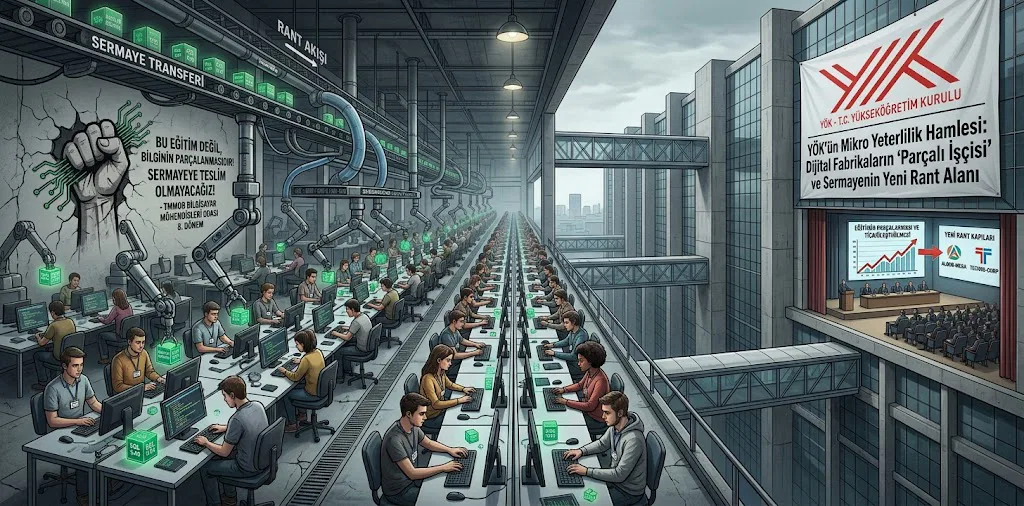
YÖK's Micro-Credential Push: The 'Fragmented Worker' of Digital Factories and Capital's New Rent-Extraction Zone
The Commodification of Education and a New Stage of Neoliberal Decay
The historical development of the capitalist mode of production compels capital to penetrate even the remotest corners of social life and to leave no sphere uncommodified in order to overcome its accumulation crises. As Karl Marx noted in Capital, the lifeblood of capitalism lies not only in subjecting the worker's labor to capital, but also in subjecting the conditions that produce and reproduce that labor to capital's logic. In today's neoliberal world, one of the most strategic fronts of this subjugation is undoubtedly the higher education system.
For a long time now, universities have been stripped of their role as autonomous centers of scientific knowledge production and transformed into commercial enterprises that manufacture "human capital" shaped to the market's immediate needs. The latest steps taken by the Council of Higher Education (YÖK) are the freshest and most striking example of this neoliberal transformation and of academia being fully swallowed by capital.
The Process Exposed by BMO: "Micro-Credentials" and the Fragmentation of Academic Education
The Chamber of Computer Engineers of TMMOB (BMO), in its statement of 30 June 2026, exposed a structural liquidation and rent-extraction operation quietly being implemented in higher education. This process, which BMO rightly underscored, is the logical outcome of three critical moves YÖK has announced in rapid succession:
- Shortening the Duration of Education: Plans to reduce four-year undergraduate programs to three years.
- A Pool of Cheap Labor: Through the Framework Regulation on Applied Education in Higher Education, opening the door for students to work for at least one semester in companies as insecure and cheap/free labor under the label of "vocational training."
- Micro-Credentials Framework: YÖK's regulation announced on 23 June 2026, "Procedures and Principles Regarding the Micro-Credentials Framework in Higher Education Institutions."
According to BMO's analysis, this latest regulation legitimized under the name of "micro-credentials" envisages entities outside the university (private companies, multinational technology monopolies) granting short-term certificates to students under the title of "Educator," and university senates recognizing those certificates as academic credit.
Although YÖK markets this move under the cover of "equipping students with up-to-date competencies demanded by the business world in artificial intelligence, data science, and digital technologies," the reality BMO presented to the public is that this process hollows out university education, delivers it to the domination of multinational technology monopolies, and creates a new channel of exploitation and rent extraction for students and their families.
Through a Marxist Lens on BMO's Response: Strengths and Gaps in the Position Taken
The statement by the Chamber of Computer Engineers (BMO) is extremely valuable as a locus of public resistance against market dynamics and the impositions of technology monopolies. As a trade unionist and class comrade, we must both salute this stance and evaluate it with constructive collective reason in order to advance the struggle further.
Valuable Approaches That Strengthen Our Class Reflex (What Works Well)
The voice our chamber has raised contains a powerful and justified antidote to the devaluation of labor. In particular, the following points are among the finest and most commendable aspects of the text for keeping our class consciousness alive:
- A Clear Stand Against the Commodification of Labor and Knowledge: In the statement, resisting the reduction of the multidimensional structure of engineering education to the business world's "accelerated certificates" is an excellent observation. Refusing to turn knowledge into an instant commodity to be consumed by the market is fundamental to the struggle to preserve the quality of labor.
- The Correct Diagnosis of Monopoly Capitalism: The emphasis on education policy being "delivered to the domination of multinational technology monopolies and capital" aligns perfectly with Lenin's analyses of imperialism and monopoly capital. Our chamber has pointed to the enemy from exactly the right place.
- An Early Warning Against Social Exploitation: Identifying that micro-credentials will open a new financial burden and rent gate (a paid certification machine) on students and families shows how high the level of political-economic sensitivity is. In this respect, the statement carries a public character that defends not only engineers but the interests of the entire people.
Points Worth Considering to Expand the Struggle Further
To broaden the impact of this excellent step BMO has taken at the social level and to reinforce our theoretical ground, it will be useful, in a spirit of friendly solidarity, to keep the following in mind as well:
- Correctly Positioning the Historical Role of Universities: The phrase in the text, "university education whose main goal ought to be the public good..." is a clean and well-intentioned wish. Yet as Marxist philosophy and thinkers such as Louis Althusser remind us, schools and universities in a capitalist order are essentially ideological state apparatuses of the ruling class. Rather than fully idealizing academia's past relative autonomy, acknowledging that it has always been a mechanism for training labor power for capital—and building our demands not on "returning to the good old days" but on "the radical democratization/publicization of academia and education"—can place us on a more revolutionary line.
- Transcending Professional Boundaries to Achieve Class Unity: While defending the quality of engineering education and the profession, we must be careful that this justified stance is not perceived from outside as an effort to "protect the privileges of degreed engineers." In today's IT sector, there are thousands of self-taught developers, designers, and system administrators without computer engineering degrees who are crushed under the sector's heavy exploitation. From a Marxist perspective, the degreed engineer and the self-taught developer are both parts of the same "Collective Worker." For this reason, enriching our discourse not only with "protecting engineering education" but with a common front language against the precarization of all IT workers will multiply our organizing potential many times over.
Philosophical and Epistemological Ground: The Alienation of Knowledge and the "Fragmented Worker"
To fully grasp YÖK's "micro-credentials" project at the conceptual level, we must turn to Karl Marx's analyses of the division of labor in the manufacturing period. In the first volume of Capital, Marx describes how the holistic production knowledge of an independent craftsman is fragmented until the worker becomes the executor of a single function:
"Manufacture cripples the worker, turning him into a freak, because it artificially develops his productive inclinations and abilities in one direction only—much as cattle bred on the La Plata plains are slaughtered solely for their hides or tallow... The individual is split up and reduced to the automatic motor of a partial operation." (Karl Marx, Capital, Vol. I)
"Micro-credentials" today are exactly this. Computer engineering education is to be stripped of its status as holistic scientific knowledge encompassing system architecture, algorithmic logic, mathematics, and social context. Capital does not want the worker to possess a holistic scientific grasp, because the worker with holistic knowledge is both expensive and has the potential to control the production process. What capital needs are "fragmented workers" who know only the practical use of Amazon Web Services (AWS), Google Cloud, or a particular AI library at a given moment—modular and rapidly consumable.
Friedrich Engels, in Anti-Dühring, criticizes the destructive effect of capitalist division of labor on the human mind in these words:
"With the division of labor, man is also divided. All other physical and mental faculties are sacrificed for the lifelong exercise of a single activity." (Friedrich Engels, Anti-Dühring)
YÖK's new education model, with its civil-society veneer and corporate partnerships, destroys the epistemological integrity of knowledge and reduces it to instantaneous market directives. Young developer and engineer candidates, rather than being subjects of their own intellectual development, are turned into guinea pigs used by multinational corporations to spread their own technologies. Knowledge is stripped of its character as a social practice that liberates humanity and, as BMO also notes, made a direct object of rent and exploitation.
Lenin, in Imperialism, sheds light on today's marriage of YÖK and technology companies when he describes how the state and monopolies interpenetrate:
"As capitalism develops, with the scarcity of raw materials and increasing monopolization, the fusion of finance capital with the state apparatus becomes all the more brazen and reckless." (V.I. Lenin, Imperialism: The Highest Stage of Capitalism)
YÖK's "bold and innovative" step is the strategy of finance capital and IT monopolies to shift the cost of training the labor force (the cost of producing variable capital) off their own budgets and directly onto the backs of the working class and their families. Companies will no longer allocate budgets to train the personnel they hire; by commanding university senates, they will have students' paid certificates counted as credit.
Class Stance and a Call to Sector Workers: What Must Be Done?
We address all our comrades sweating in the IT, software, data science, and engineering sectors, our worker comrades: We are not an elite stratum kept busy with capital's "white-collar" illusions. We are the organic components of the modern working class that produces surplus value at the keyboard in today's boundless digital factories, lives under the constant risk of being thrown out the door, and has its overtime stolen—the Collective Worker, in Marx's phrase.
YÖK's micro-credential imposition is a tactic of enlarging the "industrial reserve army" (unemployed and semi-qualified certificate-holding masses) in the labor market to pull down developers' and engineers' wages and make precarity permanent. Our class stance and the roadmap we must follow in the face of this attack must be clear.
The Path Class Organizations (Unions and Professional Chambers) Must Follow
- Moving Beyond Title Protectionism, Building Class Unity: BMO and similar class organizations must not conduct the struggle solely on the ground of "preserving the prestige of the four-year degree." On the contrary, they must unite degreed engineers with self-taught developers, trainees chasing certificates, and university students on a "Common Struggle Against Precarity" front. The division is not between degreed and non-degreed, but between capital and labor.
- Anti-Monopoly Barricades on Campuses and in Workplaces: Against technology monopolies (Microsoft, Google, AWS, etc.) using university lecture halls as commercial branches and university senates as puppets, joint resistance committees of academics, students, and labor organizations must be established on campuses.
- Resistance to the Certificate Rip-Off: Mandatory certification processes imposed by employers on workers, extending beyond working hours and mostly paid by the worker, must be rejected. Class organizations must make the demand "The right to training must be during working hours and fully covered by the employer" a collective bargaining and resistance clause.
- The Demand for Holistic, Free, and Scientific Education: Against education fragmented by capital, the right to free, public, and scientific education that develops human mental and physical capacities as a whole—not as market serfs—must be defended without compromise.
Conclusion and Class Stance: A Common Barricade Against Digital Darkness
The IT, software, and digital technology sector has long been packaged by capitalism's ideological apparatuses with illusions of "free work environments," "flexible hours," and "high plaza salaries." Engineers and developers were pushed to see themselves as an elite stratum exempt from the fate of the working class, neighbors of the bourgeoisie.
Yet today's economic reality shows in the rawest terms that we have reached the end of this rosy illusion. IT sector workers face the most savage, most lawless, and most refined forms of exploitation capital has to offer. The micro-credential imposition BMO exposed is only the latest link in a structural attack that will deepen this exploitation.
The Sector's Current Wounds: Savage Capitalism Behind the Keyboard
The problems our comrades in the sector face today are too deep to be covered by individual success stories:
- "Crunch" Culture and Endless Overtime: Timelessness imposed under the name of "flexible work" has turned our homes into digital factories. Deployments stretching past midnight, weekend "on-call" shifts seized from us, and unpaid overtime are the most common form of our labor being transferred to capital without compensation.
- The AI Threat and Substitution Pressure: Generative AI tools (AI agents, LLMs) are not used to liberate developers but wielded as a stick to make one developer do the work of three, cut labor costs, and trigger waves of layoffs.
- Eroding Wages and Proletarianization: Against high inflation and economic crisis, IT workers' real wages are eroding rapidly; even senior engineers are being pushed toward the poverty line. We are now the proletariat itself, in Marx's definition—those who have no choice but to sell their labor power to survive.
- Algorithmic Surveillance and Bossware: Remote work processes have been turned into a full panopticon prison with spyware (bossware) that tracks keyboard movements and captures screenshots. Our labor has been reduced to data measured second by second.
If We Do Not Organize: What Future Awaits Us?
If we do not develop a common class stance against YÖK's capital-oriented micro-credential push and the lawlessness of the market, and if we remain atomized, the scenarios of destruction we will live through are entirely clear:
1. An Army of Undegreed, Insecure, and Devalued Labor: With the fragmentation of university education, millions of young people with 3–6 month certificates bought for money, who do not know how to claim their rights and accept very cheap wages, will be driven into the market. This will dramatically pull down existing workers' wages; the "Industrial Reserve Army" will become a guillotine constantly hanging over our heads.
2. Early Burnout and Professional Disposal: Senior workers who reach 35–40 with no strength left to chase endlessly changing "micro-certificates" will be pushed out of the system, making way for cheaper young labor from behind, and our professional lifespans will be shortened.
3. Total Alienation and Psychological Collapse: The IT worker who does not know the holistic purpose of the code they produce, who constantly performs fragmented tasks, who is unionless and left alone, will be caught in a full vortex of alienation (Entfremdung); burnout and depression will darken our lives as individual guilt psychologies.
A Call to Meet on Common Ground: There Is No Other Way!
Engineer, architect, urban planner, self-taught developer, system administrator, data analyst, interface designer, or technical support worker... Whatever our titles, diplomas, or the size of the companies we work for, we are all equal before the boss: We are all wage laborers.
We cannot allow capital to divide us as "senior/junior," "self-taught/formally trained," "remote/on-site." To be divided is to be hunted one by one. To come together is our only option.
- Rally Under the BMO Umbrella: BMO's justified and public outcry is an issue all sector workers must claim, not engineers alone. We must turn our chambers and commissions from discussion clubs into active positions of class struggle.
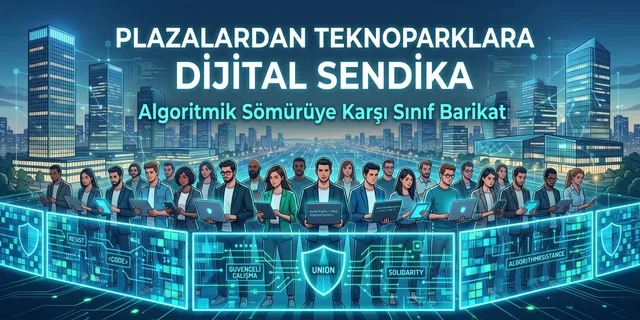
- Grow Union Organization: We must establish covert or open workplace committees in companies, office towers, and technoparks. We must strengthen union structures in the sector and defend the right to collective bargaining.
- Build Solidarity Networks: We must weave legal and practical solidarity networks against rights violations, mobbing, and unjust dismissals. One comrade's unjust dismissal is a blow struck against all our code blocks.
Our final word is clear: Against the YÖK and monopoly-capital alliance that wants to make universities the back gardens of corporations and us the cheap gardeners of those gardens—we will defend scientific education, secure work, and a human life. We throw our guitars, our foosball tables, and the false freedom tales offered to us in capital's face.
Our real power lies in our ability to stop production and in our organized unity. The hands that turn the world, keep servers running, and build billion-dollar systems have the power to stop capitalism's wheels of exploitation when they unite.
Our future lies not in the rent zones of certificate merchants but in the calloused, keyboard-worn hands of our class. There is no salvation alone—either all IT workers shoulder to shoulder, or none of us!