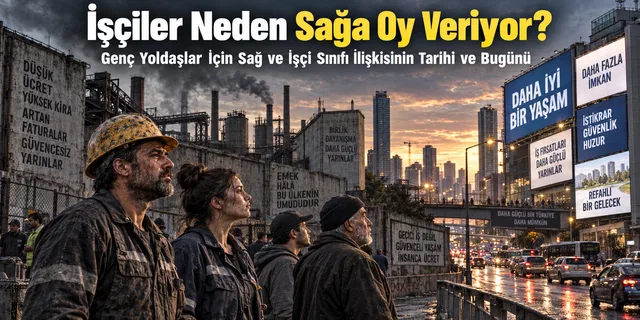
TÜİK: Two Figures, One Country: 8.1% and 30.6%
TÜİK Released the July 2026 Labour Force Figures Today. Headline Unemployment 8.1%. Two Pages Later in the Same Bulletin, the Idle Labour Force Is 30.6%

Two Figures, One Country: 8.1% and 30.6%
31 August 2026, 10:00. TÜİK published the Labour Force Statistics bulletin for July 2026 (Press Release No. 57999). Headline: "The seasonally adjusted unemployment rate stood at 8.1%." On the last page of the same bulletin, from the same institution's same data: "The idle labour force rate was 30.6%." The same day TÜİK also released second-quarter growth: the economy grew 2.3%, and labour payments' share of gross value added fell from 38.3% to 38.1%. And again the same day TÜRK-İŞ released the August hunger threshold: 37,388 TL. Net minimum wage: 28,075 TL.
Dear Young Comrade, this piece is long. But read it to the end, because what you will learn here is not a month's news — it is how an apparatus works.
I will ask you a simple question.
In a country, 388 thousand people lose their jobs in a month. By how many does the number of unemployed rise?
You said "388 thousand," didn't you? Logical. But wrong.
According to TÜİK's figures today, the number of unemployed rose by 150 thousand.
So where did the remaining 238 thousand people go?
This piece is looking for that answer. And once you have found it, you will never look at unemployment statistics the way you used to.
First lesson: Anatomy of the figure — how 238 thousand people evaporated
First let us put the data on the table as they are. No invention, no commentary. TÜİK's own table:
| Indicator (15+, seasonally adjusted) | July 2026 | June 2026 | Change |
|---|---|---|---|
| Population aged 15 and over | 67,043 thousand | 66,983 thousand | +60 thousand |
| Labour force | 35,222 thousand | 35,460 thousand | −238 thousand |
| Employment | 32,362 thousand | 32,750 thousand | −388 thousand |
| Unemployed | 2,860 thousand | 2,710 thousand | +150 thousand |
| Not in the labour force | 31,821 thousand | 31,523 thousand | +298 thousand |
| Labour force participation rate | 52.5% | 52.9% | −0.4 points |
| Employment rate | 48.3% | 48.9% | −0.6 points |
| Unemployment rate | 8.1% | 7.6% | +0.5 points |
| Youth unemployment (15–24) | 14.5% | 13.0% | +1.5 points |
| Idle labour force rate | 30.6% | 28.8% | +1.8 points |
Now look carefully, comrade. Employment fell by 388 thousand. The unemployed rose by 150 thousand. The 238 thousand in between moved into the "not in the labour force" column.
How is the unemployment rate calculated? Like this:
Unemployment rate = Number of unemployed ÷ Labour force
And what is the "labour force"? Those in work plus those looking for work. The person who stops looking is removed from the denominator as well as from the numerator. That is: they both go uncounted, and they shrink the total of those who will be counted.
Now let us do the sum together. Suppose the labour force participation rate had stayed at June's 52.9%:
- Labour force = 67,043 × 0.529 = 35,466 thousand people
- Employment (unchanged) = 32,362 thousand
- Unemployed = 35,466 − 32,362 = 3,104 thousand people
- Unemployment rate = 3,104 ÷ 35,466 = 8.75%
So today's headlines say 8.1%; whereas if people had not given up looking for work the figure would have been 8.8%.
0.7 points became invisible by turning into despair.
Comrade, read this sentence once more: What lowered the unemployment rate was not finding a job. It was giving up looking for one.
Second lesson: The ideology of the statistic — how the narrow definition is built
Let us clear up a misunderstanding at once, because this piece being taken seriously depends on it.
TÜİK is not falsifying the data. The bulletin itself honestly writes the idle labour force as 30.6%. The tables are in place, the method is open, the series are published.
The issue is not falsification. The issue is definition.
Under the International Labour Organization (ILO) standard, for a person to be counted as "unemployed" they must meet all three conditions at once:
- To have not worked at all in the reference week,
- To have actively looked for work in the last four weeks,
- To be ready to start work within two weeks.
Dwell on the second condition, comrade. Because the whole issue is there.
"To have actively looked for work." That is: unemployment is defined not as a social relation but as an individual behaviour. The labour-power that capitalist production does not need is measured in the statistic by its own effort of searching.
The result is this: a woman who has looked for two years and not found work, and has now stopped looking, is not unemployed. A young person sitting in their village, ready to go if there were work, but not looking because they know there is no work in the region, is not unemployed. A courier who works 20 hours a week and wants to work 40 is not unemployed — they are "in employment."
All of this is correct by definition. And that is exactly why the definition is ideological.
The narrow definition turns capital's shortfall in demand for labour into the worker's lack of motivation.
So what is the real scale? TÜİK itself calculates this too — it just does not put it in the headline. It is called the idle labour force. In DİSK-AR's bulletin today its components are broken down as follows (I back-checked the figures against TÜİK's own composite rates — 20.8% and 19.5% — and they hold):
| Component | Persons | What does it mean? |
|---|---|---|
| Official unemployed | 2,860 thousand | Actively looking, passing the four-week criterion |
| Potential labour force | 4,990 thousand | Ready to work but not looking — 831 thousand of them have given up hope entirely |
| Time-related underemployment | 4,455 thousand | Working under 40 hours a week, wanting to work more |
| Broad unemployed (idle labour force) | 12,305 thousand | Rate: 30.6% |
For every 1 official unemployed person, 3.3 more people are waiting outside this definition.
And now the single most instructive figure in this piece. Look at DİSK-AR's two-year comparison:
| July 2024 | July 2026 | Change | |
|---|---|---|---|
| Narrow unemployment | 9.0% | 8.1% | −0.9 points |
| Broad unemployment | 27.5% | 30.6% | +3.1 points |
| Gap between the two definitions | 18.5 points | 22.5 points | +4 points |
Do you see, comrade?
In two years official unemployment fell and real unemployment rose. In the same country, in the same period, with the same institution's data.
The government shows the first row. We show all three rows at once. The difference is not propaganda; it is a difference of scope.
Third lesson: The reserve army of labour — this is not a malfunction, it is a mode of working
Now we have come to the heart of the piece. Everything from here on explains everything.
In chapter 23 of the first volume of Capital, Marx says something bourgeois economics still cannot digest: capitalism does not produce unemployment as an accident; it produces it as a condition.
The logic works like this. As capital accumulates it is forced to raise productivity — machines, technology, organisation. This raises the "organic composition" of capital: the same quantity of capital draws less and less living labour. Thus accumulation, while creating its own demand for labour, at the same time creates its own surplus of labour.
Marx calls this the relative surplus population, or by its better-known name the reserve army of labour.
This army serves two purposes:
One: It supplies ready labour at the moment of expansion. When capital rushes into a sector, it does not wait to train the worker — it finds them ready.
Two — and the essential one: It holds down the wages of those in work. If a mass is waiting at the gate, the worker inside cannot ask for a raise, cannot refuse overtime, cannot risk going on strike. The reserve army is the boss's invisible stick.
Now return to the July 2026 data and see this mechanism with laboratory cleanliness. Two figures standing side by side in the bulletin:
- The average weekly hours actually worked: 42.0 hours. (Above the 40-hour norm.)
- 4,455 thousand people are working under 40 hours and want to work more.
Marx wrote it like this in 1867: the overwork of one part of the working class is the condition of the forced idleness of the other.
Comrade, this is not a distribution error. It is not a coincidence either. It is a method. Because:
- Concentrating total hours in a smaller number of workers is cheaper for the employer (more hours per unit of insurance, severance, hiring cost).
- While a pool of 12.3 million people waits outside, the capacity of the worker inside to say "no" falls.
These two things are two faces of the same coin. Overwork and unemployment are not opposites of each other; they are conditions of each other.
Fourth lesson: Why does the army obey? — the architecture of precarity
So why do 12.3 million people put up with this order? Why is this mass not a pressure but an instrument of pressure?
The answer in a single word: because they have nothing to hold onto.
I will show this with three figures.
(a) Unemployment benefit: there is a fund, there is no benefit
- Number of people receiving unemployment benefit in June 2026: 460,501.
- By DİSK-AR's calculation, only 17 in every 100 registered unemployed can reach the benefit.
- In the first half of 2026, only 413,883 of 892,380 applications qualified. Qualification rate: 46.4%. And while applications rose by 30 thousand on the previous year, the number who qualified fell.
- And now the real figure: more than 96% of the 12.3 million broadly defined unemployed receive no income support at all.
So is there no money? There is. The Unemployment Insurance Fund stood at 755.6 billion TL as of 31 May 2026.
Where, then, does the money go? Look at DİSK-AR's August report:
| Distribution of fund resources | 2016 | 2026 |
|---|---|---|
| Share of unemployment benefit | 37.4% | 31% |
| Share of employer incentives | 20.3% | 44.3% |
In the last 3.5 years, 51.6% of the fund went to employers and only 28.5% to workers.
Think carefully, comrade. This fund is built with premiums cut from the worker's wage. That line on your payslip that says "unemployment insurance 1%" is this. And that money, when you become unemployed, does not come back to you — it goes as an incentive to the class that sacked you.
This is not corruption. It is a legal, open, budgeted policy. And it performs exactly the function of cutting the reserve army's livelihood security: an unemployed person with no livelihood security means a worker with no bargaining power.
(b) Non-unionisation: the army is unorganised
According to the statistic published by the Ministry of Labour in the Official Gazette on 28 July 2026:
- Registered workers: 17,630,475
- Unionised workers: 2,432,789
- Unionisation rate: 13.80%
And this detail matters a great deal: in January the rate was 14.45%. In seven months the number of registered workers rose by 931 thousand; the number of unionised workers by only 19 thousand. That is: as employment rises, organisation recedes.
DİSK-AR's July 2026 Trade Union Rights Report is harsher still:
- Collective-agreement coverage nationwide is about 10%.
- In the private sector collective-agreement coverage is only 4.2%. 96 of every 100 private-sector workers have no collective agreement.
- Counting the unregistered as well, 16.3 million workers are unorganised.
- Unionisation among women is 9.6% (14.2% among men). Among the young (15–24) 6.3%.
- Of 246 workers' unions, only 60 clear the 1% branch threshold.
(c) And the price of this is paid in death
According to İSİG Meclisi, in the first seven months of 2026 at least 1,279 workers died while working. In July alone, 214 people.
And a single figure summarises this whole section:
97% of the workers who died were non-union.
Comrade, non-unionisation is not an abstract shortfall. If there is no collective subject that can voice a demand for workplace safety, the fire escape is found "costly." Disorganisation means the grave.
Fifth lesson: Women's labour — the army's real barracks
Now let us come to the most talked-about and least understood part of the data.
On the narrow definition women's unemployment is 10.6%, men's 6.8%. There is a gap, but it does not look dramatic.
The real figure is somewhere else. Look at the labour force participation rate:
| Men | Women | |
|---|---|---|
| Labour force participation rate | 70.3% | 35.2% |
| Employment rate | 65.5% | 31.4% |
| Not in the labour force | 9,845 thousand | 21,976 thousand |
Almost two thirds of the female population aged 15 and over are counted as "outside the labour force" from the start. 69% of the 31.8 million people not in the labour force are women.
And on DİSK-AR's calculation, broad unemployment among women: 40.4%. The gap among women approaches 30 points.
Add the youth figure as well: according to TÜİK's "Youth in Statistics 2025" bulletin, the share of young people neither in education nor in employment is 23.3% — but 30.9% among women, 16.3% among men.
Now read very carefully, comrade, because the difference of interpretation here is a difference of politics.
Bourgeois economics reads this tableau as "women's non-participation in the labour force." As a preference, a cultural lag, an "education problem."
The Marxist reading says something else: those women are not not-working; they are working without pay.
Domestic labour — cooking, cleaning, care of children and the sick, care of the elderly — is the daily and intergenerational reproduction of labour-power. That is: the worker capital will find tomorrow morning in the factory, the workshop, the call centre exists thanks to that labour. Capital uses this labour but does not pay for it; the cost sits on the household, that is, on the woman.
And this arrangement has a second function — the decisive one from the standpoint of the reserve army:
The woman bound to unpaid domestic labour is a reserve who can be called at any moment, and whose cost of living, when she is not called, is met by the household.
In a crisis she is the first expelled — in today's data women's employment fell by 160 thousand. In recovery she is also the one taken back most cheaply. According to DİSK-AR, the share of those working at or below the minimum wage in the private sector is 46.7% overall and 60.1% among women.
So women's labour is both the largest and the cheapest section of the reserve army. And this comes not from women's "preference," but from the way the division of labour between unpaid and paid labour is built.
Sixth lesson: The young — 2.7 points in a month
The single-month jump in youth unemployment is the hardest part of the data:
| Youth unemployment (15–24) | June 2026 | July 2026 | Change |
|---|---|---|---|
| Total | 13.0% | 14.5% | +1.5 points |
| Men | 10.5% | 11.3% | +0.8 points |
| Women | 17.6% | 20.3% | +2.7 points |
2.7 points in a month. This is not a fluctuation; it is an eviction.
Marx divides the reserve army of labour into three layers: floating (moving in and out of work), latent (hidden in agriculture or in the household), and stagnant (stuck in irregular, precarious jobs). The young worker is by definition the floating layer: without seniority, with low or no severance, non-union (6.3%), without a contract. The first out in a contraction, the cheapest in in an expansion.
Read this together with the NEET figure as well: 23.3% of young people are neither in education nor in employment. This rate was 22.5% in 2023 and 22.9% in 2024 — that is, it is rising in a stable way.
On DİSK-AR's second-quarter calculation, broad youth unemployment is 38.7%, among young women 48.5%.
Do not miss what this means, comrade: in this country nearly half of young women want to work and cannot.
Seventh lesson: Unregistered work — the boss's preference
Now let us look inside the 32.4 million people counted as "in employment." There is a hierarchy there too.
TÜİK's latest verifiable full series (2025 Q4):
| Unregistered rate | |
|---|---|
| Overall | 24.6% (more than 8 million people) |
| Agriculture | 80.8% |
| Non-agriculture | 15.9% |
| Women | 29.3% |
| Men | 23.3% |
| Unpaid family workers | 85.8% |
| Own-account workers | 58.4% |
(For 2026 Q2 the Ministry of Treasury and Finance released only the non-agricultural rate: 15.7%. The overall rate and the headcount were not in publicly available sources at the date this piece was written.)
What does an unregistered worker mean? It means this:
- Because they have no insurance, they cannot fall ill.
- Because they have no record, they cannot complain.
- Because they have no contract, they cannot claim severance.
- Because they cannot join a union, they cannot bargain.
And note: unregistered work is not the worker's choice. Nobody bargains to be told "employ me without insurance." Unregistered work is the employer's cost decision.
A very important conclusion follows. The reserve army of labour is not made only of the unemployed. Inside, millions of workers counted as "in employment" but without rights are also part of that army. Because the worker without rights pulls down the wage of the worker with rights. If there is a boss in a branch who employs without insurance, the boss who employs with insurance also holds down the wage on grounds of "competition."
Eighth lesson: Wages — a growing economy, a shrinking share
Now let us tie the whole tableau to a single place: money.
Today, the same day, three institutions released three figures. Put them side by side:
| Amount | |
|---|---|
| Net minimum wage (2026) | 28,075.50 TL |
| TÜRK-İŞ hunger threshold (August 2026) — food spending only for a family of four | 37,388.30 TL |
| TÜRK-İŞ poverty line (August 2026) | 121,786 TL |
| Monthly cost of living for a single worker | 48,305.38 TL |
Do the sum, comrade:
- The minimum wage is 9,312.80 TL below the hunger threshold. That is, a minimum-wage worker runs a deficit even if they try only to feed their family.
- The minimum wage is 23% of the poverty line.
- The minimum wage is 58% even of the cost of living of a single worker living alone.
And according to DİSK-AR's research, 46.7% of those working in the private sector (about 8.36 million workers) earn the minimum wage or below. Among women this rate is 60.1%.
So what happened in real terms? The 2026 raise was 27%; realised inflation (December 2025 annual) was 30.89%. That is, the wage was given with about a 3% real loss at the moment it was given. Then cumulative inflation to the end of July was 19.86% and an interim raise was not made — while civil servants and pensioners were given an inflation adjustment, the minimum wage was held fixed. By DİSK-AR's calculation the purchasing power of the minimum wage eroded by 5,576 TL in seven months.
Now combine this with today's growth data. TÜİK released on 31 August 2026:
| 2025 Q2 | 2026 Q2 | |
|---|---|---|
| Labour payments' share of gross value added | 38.3% | 38.1% |
| Share of net operating surplus / mixed income | 41.3% | 41.6% |
| Economic growth | — | 2.3% |
Comrade, this table is this piece's entire proof. In a single sentence:
The economy grew. Labour's share fell. Capital's share rose.
This is not a coincidence; it is accounting. In the distribution of the value produced in the same economy, labour is receding and capital is advancing. And what makes this distribution possible is exactly everything we have recounted above: a reserve army of 12.3 million, 13.8% unionisation, 4.2% private-sector collective-agreement coverage, the unemployed who cannot get benefit, 8 million workers without insurance.
Unemployment is the cause of wages staying low; wages staying low is the cause of profit staying high. That is the chain.
Ninth lesson: And technology? — the return of crystallised labour
Now let us be honest, because propaganda is not our job.
The monthly labour force bulletin does not give a sectoral breakdown. That is: we cannot say from this data how much of the 388-thousand employment loss comes from automation. Anyone who claims that is guessing, not finding it in the data. For the sectoral composition we have to wait for the third-quarter figures.
But two things can be said, and both matter.
First: These data are seasonally adjusted. That is, there is a contraction of 388 thousand after the seasonal revival of tourism, agriculture and construction in July has been accounted for. This is not an ordinary summer fluctuation. In the second quarter industrial employment had already fallen by 121 thousand people. This is a sign of weakening in the accumulation regime's capacity to absorb labour.
Second, and the essential one: Marx's theory of the relative surplus population is already built on the machine replacing labour. As the organic composition of capital rises, the same volume of accumulation draws less and less living labour. Artificial-intelligence models are a new moment of this mechanism — and a distinctive one.
Why distinctive? Because an AI model is the crystallised form of the collective labour of millions of people. Texts written, photographs taken, code written, answers given, pictures drawn — all are products of living labour. The model gathers these products, compresses them, and turns them into a means of production. What Marx in the Grundrisse called "general intellect" — social knowledge turning directly into a productive force — is happening here. But in whose property?
That is the real question, comrade. "Does AI create jobs or destroy them" is the wrong question — because it constitutes technology as a natural event. The right question is this:
In whose property did this accumulated collective labour crystallise, under whose control is it operated, for whose benefit is it used?
For Turkey there is an extra twist. Here labour is often replaced not by automation but by cheapness. Platform capitalism's "owner-operator courier" model turns unemployment not into employment but into an intermediate form without status: on paper the person becomes an "own-account worker," in reality they are at the algorithm's command; in the statistic they appear "in employment," in reality they are inside the reserve army.
It is not hard to guess that a significant part of the 4.46 million in time-related underemployment is in this form. And remember that unregistered work among own-account workers is 58.4%.
So technology here is not abolishing labour — it is putting labour outside the law. Mental Taylorism, while breaking work into micro-tasks and reducing the worker to a measurable data stream, erases legal status along with it.
Watch out: three narrative traps
When you meet these data, three sentences will be put to you. Recognise all three.
1. "Unemployment fell; the economy is going well."
Half true: the narrow rate came down from 9% to 8.1% in two years. But in the same period the broad rate went from 27.5% to 30.6%. What made the figure fall is not finding a job; it is giving up looking. The improvement of an indicator does not mean the improvement of what it measures.
2. "To create employment we must cut labour costs."
The falsehood of this sentence is written in today's data. Labour's share of gross value added is already falling (38.3% → 38.1%), capital's share is rising (41.3% → 41.6%) — and in the same quarter employment did not rise; it fell. Cutting costs did not create employment; it created profit. Moreover more than half the unemployment fund already goes to employer incentives. The result of the prescription applied for ten years is in front of us.
3. "The unemployed are too picky about jobs."
The oldest, most functional lie. The data's answer is clear: 4.46 million people are already working and want to work more. 831 thousand people gave up because they looked and did not find. And being picky would have been a luxury — when the minimum wage is 9,312 TL below the hunger threshold, nobody is in a position to bargain.
Against all three, the tool in your hand is the same: Which definition? Which denominator? For whose benefit?
So what is to be done?
Comrade, let us be honest: what follows will not abolish capitalism. But it will weaken the reserve army's capacity to be an instrument of pressure. And when that capacity weakens, the class's bargaining power rises. These are concrete, measurable, defensible demands.
1. Let the headline indicator change: let the idle labour force be published as the official unemployment rate. TÜİK already calculates it. The demand is not that a new datum be produced — it is that the existing datum be moved to the headline. Policy does not change while the measure stays the same. And also: let the detailed price data still withheld despite a court ruling be opened.
2. Let the conditions of access to unemployment benefit be loosened, and let the fund return to the worker. There is a fund of 755.6 billion TL and 83% of the unemployed cannot get benefit. Let the premium-day requirement be lowered, the payment period extended, and the benefit not fall below the hunger threshold. And let the 44.3% share of the fund allocated to employer incentives be cut: this fund is taken from the worker's wage; it is not a subsidy for the employer.
3. Let the union thresholds be abolished. 186 of 246 unions sit below the 1% branch threshold. In the private sector 96 of every 100 workers have no collective agreement. The threshold is an apparatus that makes organisation legally impossible. Let the branch and workplace thresholds be lifted, and let sectoral collective agreement become possible.
4. Let unregistered work be prosecuted as the employer's crime, not the worker's. There are more than 8 million unregistered workers; in agriculture the rate is 80.8%. Let the number and deterrent force of inspections be raised; let employing off the books be grounds for exclusion from incentives.
5. Let the minimum wage be raised above the hunger threshold and updated automatically within the year. The gap between 28,075 TL and 37,388 TL is not an "austerity"; it is a decision for hunger. Let the interim-raise mechanism become law. And let the voting weight of the workers' confederations on the minimum-wage commission become real.
6. Free, public, widespread care services for women's employment. Women's labour force participation is 35.2%. What will change this is not incentives or sermons, but the public provision of crèches, childcare, eldercare, and care of the sick. Without the publicisation of unpaid domestic labour, women's position in the labour market does not change.
7. Let working time be shortened with no loss of pay. On one side people working 42 hours; on the other 4.46 million people working under 40 hours and wanting more. This is a problem that can be solved by sharing out the work. Let the legal working week be cut from 45 hours to 35, and let pay not be cut.
And one of them is addressed directly to you, comrade:
Tomorrow somewhere someone will say "unemployment is eight percent." In a conversation, in a group message, in a news bulletin.
Do not open an argument at that moment. Ask a question.
"By which definition?" — "How many people in the denominator?" — "Where are those who gave up looking counted?" — "In which column is the person working 20 hours a week written?"
Because a statistic is not a debate; it is a framing. Widening the frame is more effective than winning the argument.
Last word
Young comrade, let us look back.
Today an institution announced that 388 thousand people lost their jobs in a month. The same institution also announced that this raised the unemployment rate by only half a point. Both are true. Because 238 thousand people dropped out of the statistic the moment they gave up looking for work.
The same day, in the same country: the economy grew 2.3%, labour's share receded. The minimum wage stayed 9,312 lira below the hunger threshold. 12.3 million people want to work and cannot. 96% of them receive no benefit. 96 of every 100 private-sector workers have no collective agreement. In seven months of the year 1,279 workers died while working, and 97% of them were non-union.
None of these figures is independent of the others.
The 12.3 million people who want to work and cannot hold down the wage of those who work. The held-down wage grows profit. Growing profit means more machines and fewer workers. Fewer workers means a larger reserve army. And the circle begins again.
Marx wrote this not as a moral complaint but as a law of motion. Capitalism produces unemployment not because it is broken — but because this is exactly how it works.
Unemployment is not a malfunction of capitalism. It is capitalism's mode of working.
And 8.1% is not an indicator of welfare. It is an accounting decision.
Today the official figure fell and the real figure rose. In the 22.5-point gap between the two, about ten million people live: women who have given up looking for work, couriers who cannot fill their hours, unregistered agricultural workers, young people neither in school nor in work.
They are not a statistical error. They are the product of this order.
And one day when someone says to you "look, unemployment fell," look not at the rate itself — look at the denominator.
In comradeship, Knowledge Commons
Sources
Primary source: TÜİK
- Labour Force Statistics, July 2026 — TÜİK Press Release No. 57999, 31 August 2026
- Labour Force Statistics, March 2026 — TÜİK Press Release No. 57998 (for comparison)
- Quarterly Gross Domestic Product, Q2 2026 — 31 August 2026 (labour's share of GVA)
- Quarterly Labour Force Statistics, Q2: April–June 2026 — 19 August 2026 (sectoral breakdown)
- Youth in Statistics 2025 — TÜİK, 14 May 2026 (NEET rate)
- Income and Living Conditions Survey, 2024 — TÜİK, 26 December 2025 (Gini 0.410; P80/P20 7.5)
- Unregistered employment, 2025 Q4 series — Dünya, Naki Bakır, 5 March 2026
News and commentary
- TÜİK announced: Sharp rise in unemployment — BirGün, 31 August 2026
- DİSK-AR: Broad unemployed reached 12.3 million — BirGün, 31 August 2026
- Broad unemployed reached 12.3 million: up 1.4 million in two years — Ekonomim, 31 August 2026
- DİSK-AR: Only 22.9 million of 66.9 million working-age people are in registered employment — Kısa Dalga, 19 August 2026
Unemployment Insurance Fund and benefit
- İŞKUR Fund Bulletin, May 2026 (PDF) — fund size 755.6 billion TL
- DİSK-AR: Wide gap in the unemployment fund — crumbs for the worker, a huge share for the boss, August 2026
- DİSK-AR: In the last three and a half years 51.6% of the fund went to employers — Haberler.com
- 892 thousand people lost their jobs; only 413 thousand could get unemployment pay — Başkent Gazete
Unionisation and collective agreement
- Branch statistics, July 2026 — Ministry of Labour and Social Security, 28 July 2026
- DİSK-AR: 87 of every 100 workers non-union, strikes at the bottom — bianet, July 2026
- DİSK-AR Trade Union Rights Report: historic retreat in union rights — Egemen Gazetesi, 31 July 2026
Wages and livelihood
- Minimum Wage 2026 — Ministry of Labour and Social Security official table (PDF)
- TÜRK-İŞ August 2026 hunger and poverty thresholds — Karar, 31 August 2026
- DİSK-AR Minimum Wage Research 2026 (PDF) — 46.7% in the private sector, 60.1% among women
- DİSK-AR: Purchasing power of the minimum wage eroded 5,576 TL in 7 months — Ekonomim, August 2026
- DİSK-AR: Total inflation and tax bill for workers 1.5 trillion TL — bianet, 6 August 2026
- July 2026 inflation data: TÜİK 31.75%, ENAG 50.49% — Euronews, 3 August 2026
Workplace murders
- İSİG Meclisi July 2026 report: 214 in July, 1,279 workers in the first seven months of the year
- In June 228, in the first six months of 2026 1,063 workers lost their lives while working — bianet
Theoretical sources
- Karl Marx, Capital Vol. I, Ch. 23: "The General Law of Capitalist Accumulation" — Marxists Internet Archive
- Karl Marx, Grundrisse, "Fragment on Machines" — Marxists Internet Archive
- ILO, Standards on Labour Force Statistics — 19th ICLS Resolution (definitions of unemployment and labour underutilization)
Method note
The two calculations in this piece are derived from TÜİK data and are not ready-made in the sources; they are stated openly so the reader can check them:
- Counterfactual unemployment rate (8.75%). Holding the labour force participation rate at the June level (52.9%): 67,043 × 0.529 = 35,466 thousand labour force; 35,466 − 32,362 = 3,104 thousand unemployed; 3,104 ÷ 35,466 = 8.75%.
- Disaggregation of idle-labour-force components. The denominator was calculated from DİSK-AR's 12,305 thousand and 30.6% (12,305 ÷ 0.306 = 40,212 thousand); subtracting the labour force gave the potential labour force (40,212 − 35,222 = 4,990 thousand); the remainder was obtained as time-related underemployment (12,305 − 2,860 − 4,990 = 4,455 thousand). Results were checked against TÜİK's own composite rates: (2,860 + 4,990) ÷ 40,212 = 19.5% ✓ and (2,860 + 4,455) ÷ 35,222 = 20.8% ✓.
Also: because the overall unregistered rate and the distribution by employment status for 2026 Q2 were not found in publicly available sources at the date this piece was written, the latest verifiable full series — 2025 Q4 — was used for that heading, and the period was stated openly.