Where Did Unemployment Hide in August?
Unemployment Did Not Fall. It Changed Clothes: Underemployment, Despair, and Longer Hours

7.8% Fell, 31% Rose: Where Did Unemployment Hide in August?
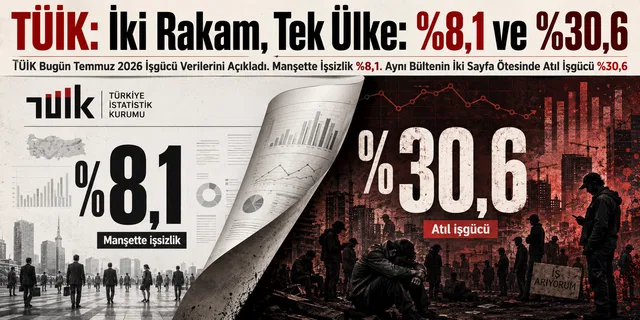
This morning TÜİK made two statements, and the two statements stood side by side in the same bulletin:
The unemployment rate fell by 0.3 points, to 7.8%.
The idle labour force rate rose by 0.4 points, to 31.0%.
On the evening news you will hear the first sentence. A few papers, among them BirGün and Karar, carried the second into the headline. The two sentences do not contradict each other. They explain each other. Unemployment did not fall. It changed form. Part of it left the "unemployed" column and passed into the columns of "underemployed" and "those who have given up hope."
Dear Young Comrades, a month ago, on the July figures, we wrote the piece "Two Figures, One Country: 8.1% and 30.6%" (TÜİK: Two Figures, One Country). In that piece we said that the gap between the narrow definition and the broad definition is not a measurement error. It is an ideology. The August figure tested this thesis once more: in one month the gap widened from 22.5 points to 23.2 points. In this piece we will do three things. We will take the figures apart, we will show where unemployment hid, and we will tie this to the pieces we have written under the economy heading over the last three months: to inflation, to diesel, to the stock exchange, to the courier, to artificial intelligence. Because read on its own, the unemployment figure is a statistic. Read together with the others, it is the balance sheet of a programme.
The Figures: The Bulletin Itself
First, the bare data. TÜİK's household labour force statistics for August 2026, seasonally adjusted (Alomaliye, İşçi Haber, Yeni Ankara):
| Indicator | August 2026 | Monthly change |
|---|---|---|
| Number of unemployed (15+) | 2 million 740 thousand | −106 thousand |
| Unemployment rate | 7.8% | −0.3 points |
| Men / women unemployment | 6.6% / 10.1% | — |
| Youth (15–24) unemployment | 13.0% | −1.1 points |
| Young men / young women | 9.7% / 19.4% | — |
| Employment | 32 million 507 thousand | +136 thousand |
| Employment rate | 48.4% | +0.1 points |
| Men / women employment rate | 65.8% / 31.5% | — |
| Labour force | 35 million 247 thousand | +29 thousand |
| Labour force participation rate | 52.5% | unchanged |
| Men / women participation | 70.5% / 35.0% | — |
| Time-related underemployment + unemployed | 20.2% | — |
| Potential labour force + unemployed | 20.2% | — |
| Idle labour force rate | 31.0% | +0.4 points |
| Average actual weekly hours | 42.5 hours | +0.5 hours |
The first thing that stands out in this table is the arithmetic itself. Employment rose by 136 thousand, the unemployed fell by 106 thousand, and the labour force grew by 29 thousand. So the greater part of the new jobs was filled from the pool of the unemployed. This looks like good news. But in the same month the idle labour force rate rose. If the unemployed fall and the idle labour force rises, the rise has come from the other two items: either more people are working fewer hours than they want, or more people have stopped looking for work but are waiting, ready to work. Most likely, both at once.
Unemployment in Three Layers: Putting the Concepts in Place
A discussion cannot be had without distinguishing the four rates in TÜİK's bulletin. Let us put them in place in plain language.
The narrowly defined unemployed. A person who has looked for work in the last four weeks and could start within two weeks, but did not work even one hour in the survey week. If you worked one hour, you are in employment. If you did not look for four weeks, you are outside the labour force.
Time-related underemployment. The person is working, but for fewer than 40 hours a week; they want to work more, and they are ready to. The part-time cashier, the piece-rate courier, the construction worker called in two days a week. In the statistics they are in the "employment" column.
The potential labour force. Ready to work but not looking, or looking but unable to start at once. The most crowded group inside it is "those with no hope of finding a job": they looked, they did not find, they stopped. In the statistics they are in the "outside the labour force" column.
The idle labour force. The ratio of the sum of these three to the extended labour force. What the ILO calls labour underutilization. TÜİK has published this rate since 2014.
Now let us look at August's two intermediate rates. The composite rate of the unemployed and the underemployed is 20.2%. The composite rate of the unemployed and the potential labour force is also 20.2%. From here, with a rough calculation, we can draw out the size of each layer (the calculation is ours; approximate values from the seasonally adjusted data):
| Layer | Its place in the statistics | Approximate size |
|---|---|---|
| Narrowly defined unemployed | Unemployed | 2.7 million |
| Time-related underemployment | "Working" | 4.4 million |
| Potential labour force | "Outside the labour force" | 5.5 million |
| Total idle labour force | — | ~12.6 million |
In July the broadly defined number of unemployed calculated by DİSK-AR was 12 million 305 thousand (Evrensel). In August the rate rose and the labour force grew. The number is above 12.5 million. For every person who is officially unemployed, about three and a half people whom the statistic does not see come along. Narrowly defined unemployment is the part of this iceberg above the water. And this month the water did not recede. The iceberg grew downward.
From July to August: The Gap Widens
Let us set it beside our previous piece:
| July 2026 | August 2026 | |
|---|---|---|
| Official unemployment rate | 8.1% | 7.8% |
| Idle labour force rate | 30.6% | 31.0% |
| The gap | 22.5 points | 23.2 points |
| Monthly change in employment | −388 thousand | +136 thousand |
| Broadly defined unemployed | 12.3 million (DİSK-AR) | ~12.6 million (our calculation) |
In July 388 thousand jobs had disappeared. Only 150 thousand of them appeared as unemployed. 238 thousand "evaporated." In August 136 thousand jobs came back. But not even half of the jobs that had disappeared returned, and those that came did not come on the same conditions as those that went. The two-month balance sheet is this: employment is short by 250 thousand people, the idle labour force is more crowded, and the official unemployment rate is lower. The fall in the official rate is the record not of an improvement, but of a change of place.
Those Who Work Work Too Much. Those Who Do Not Cannot Work at All
The line in the bulletin that will be talked about least is this: the average actual weekly hours of those in employment rose by half an hour, to 42.5 hours.
In the same month 4.4 million people are saying "I want to work more," 5.5 million people are waiting, having lost hope of finding a job, and those who are working are working longer. This is not a contradiction. It is the ordinary working of the capitalist labour market. Marx sums it up like this in the first volume of Capital, in the chapter where he sets out the general law of capitalist accumulation: the overworking of the employed section of the working class swells the ranks of the reserve section, and the pressure the reserve section creates on the employed section through competition forces those who are employed to overwork and to submit to the dictates of capital. One's surplus is the other's deficit. They are two faces of the same mechanism.
In our July piece we set out the concept of the "industrial reserve army" in detail. The August figure gives the concept a concrete number. An extra half hour, for 32.5 million workers, is about 16 million hours a week. That equals 400 thousand full-time jobs of 40 hours (the calculation is ours). So in August, while capital hired 136 thousand people, it drew from the existing workers an extra labour time equal to 400 thousand people. One reason unemployment does not fall is not that the work does not exist. It is that the work that exists is made to be done by fewer people, for longer hours.
Women and the Young: The Rates under the Rate
Women. Women's labour force participation rate is 35.0%. That is, two of every three women of working age are "outside the labour force" in the statistics. It is not that most of these women are not working. They are working unpaid: housework, the care of children and the elderly, "unpaid family worker" in the field. Capitalism does not wage this labour, but it cannot turn for a single day without it. It is this labour that feeds, clothes, and rests the worker who will go to the factory the next morning. Women's employment rate is 31.5%, men's 65.8%. The gap is twofold. And the unemployment rate of the woman who has been able to enter the labour force is one and a half times the man's: 10.1% to 6.6%.
The young. Youth unemployment fell by 1.1 points, to 13.0%. But among young women it is 19.4%, among young men 9.7%. One in five young women is looking for work and cannot find it. And this rate counts only those who are looking. It does not count those who finished school and are waiting at home, those who are neither in school nor in work. The fall in youth unemployment can look cheering. But since the idle labour force rose in the same month, there is sufficient reason to think that part of the young passed from "unemployed" to "underemployed": to work called in a few days a week, piece-rate, uninsured.
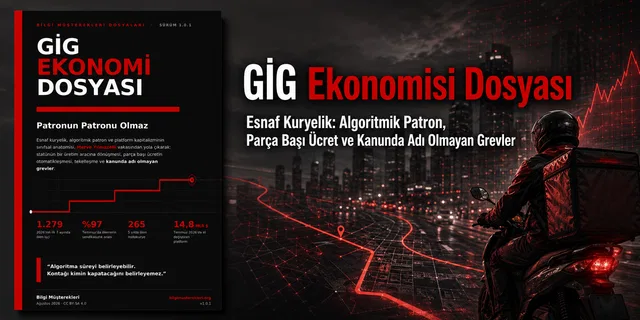
The "esnaf courier" we described in the Gig Economy Dossier is exactly the emblem of this passage: the young person who takes out a tax certificate and rides a motorcycle for a platform, registered as a self-employed tradesperson. In the statistics they appear in employment as an "own-account worker." They are neither unemployed nor a worker. They have neither severance pay nor a union. A form of employment that lowers the unemployment rate and raises insecurity.
Reading It Together with Our Economy Pieces
The unemployment figure does not take shape in a vacuum. Each of the pieces we have written under the economy heading over the last three months was telling one part of this table. Now let us join the parts.
Inflation: the other half of the distribution shock
In "The Compass of Class Struggle: The Political Economy of Inflation," which we wrote at the beginning of July, we defined inflation as a distribution shock: while prices rise, the purchasing power of the wage melts, and the wealth of those who hold material assets grows. The "disinflation programme" applied today is the other half of this shock. To bring inflation down, suppress demand. To bring demand down, suppress the wage and employment. The Minister of Treasury and Finance, Mehmet Şimşek, said this plainly on 16 September: "Disinflation requires a slowdown in growth in the short term." The first item a slowing growth cuts is employment. But what is cut is not always recorded as "unemployed." Full-time work turns into part-time, insured work into uninsured, the person looking for work into the person who has lost hope. The idle labour force of 31% is the bill of the disinflation programme in the labour market.
Diesel: the price is weekly, the wage is yearly
In "The Class of a Litre of Diesel" we had calculated that from January to September the minimum wage lost 45 percent of its value in terms of diesel fuel. We had also put the mechanism in a single sentence: prices are set weekly, wages yearly. The counterpart of this mechanism in the labour market is this. The worker whose wage does not suffice consents to a second job, to overtime, to the weekend shift. The rise of working time to 42.5 hours is the record, in hours, of the melting of the wage. In the same piece we also gave TÜRK-İŞ's August calculation: the hunger threshold for a family of four is 37,388 lira, the net minimum wage 28,075 lira. For a worker earning three-quarters of the hunger threshold, "being in employment" does not mean getting out of poverty. This is why the fall in the unemployment figure says nothing on its own. If the job does not take the worker out of poverty, a change of column in the statistic changes nothing in the kitchen.
The exchange: there is a circuit breaker for capital, and none for the worker
On 17 September, in "Circuit Breaker: The Bourgeoisie's Exchange Does Not Even Trust Itself," we told hour by hour the week in which the BIST 100 fell 5.54% in a day and 130 funds were liquidated. That week the Financial Stability Committee met, the Central Bank took three liquidity steps toward the banks, and the collateral ratio of the large leveraged player was lowered. When the price on the exchange falls too far, there is a "circuit breaker" that stops the transaction. It protects capital from its own panic.
There is no such mechanism for the worker. When 388 thousand jobs disappeared in July, neither a committee met nor a liquidity step was taken. Access to unemployment benefit is still narrow. A small part of the unemployed can receive the benefit, because the conditions leave the insecure worker out from the start. And the accumulation of the Unemployment Insurance Fund has for years been transferred not to the unemployed but to the employer, as an incentive. In the moment of crisis, a circuit breaker for capital, an idle labour force for the worker. The two bulletins of the same month are the two reflexes of the same state.
Artificial intelligence: not a tsunami, the organic composition
In July's "What Does the 'AI Tsunami' Conceal?" we objected to technological unemployment being told as if it were a natural disaster. The machine taking the place of labour is a rise in the organic composition of capital. What determines this is not the technology. It is in whose hands the means of production are. It is not possible today to measure the effect of artificial intelligence directly in Turkey's August figures. There is no such indicator in TÜİK's bulletin. But the direction of the movement is plain. A wave of "productivity" that cuts the work in half in call centres, in accounting, in software support units, and loads more work onto the worker who remains, produces underemployment and long hours at the same time. What is called a tsunami is in fact the reserve army being reinforced with a new generation, with intellectual workers.
Not "the useless," the reserves: a correction to our own piece
We owe a self-criticism here. In "The Bloody Steps of the Pyramid: The 2026 Global Dispossession War," which we wrote on 3 July, we wrote that billions of people had fallen into a "Class of the Useless." The piece's analysis of the organic composition and of dispossession was in place. But the word "useless" was wrong, and it was wrong because we borrowed this word from writers such as Harari.
The August figure shows this plainly: an idle labour force of 12.6 million is not useless. For capital it is extremely necessary. They are the ones who press down the wage of the person who is working, who impose overtime, who make possible the sentence "if you don't like it, there are people waiting at the door." This is why the word "reserve" in Marx's concept of the "industrial reserve army" was chosen. The reserve is not the one who is out of the game. It is the one who determines the game. To say "useless" is to show these people as a remainder thrown outside the system, and therefore also to make their power to organise invisible. From now on we will not use this concept.
Acemoğlu and the right: not institutions but property, not resentment but insecurity
In August's "The Acemoğlu–Economist Dispute and Its Class Meaning" we discussed what it is that bourgeois economics covers over when it tells unemployment in the language of "the quality of institutions" and "skills mismatch." In this language 31% is a "matching problem." The solution is education and flexibility. Yet the problem of the 5.5 million potential labour force is not skill. It is that there is no work. The problem of the 4.4 million underemployed is not a lack of flexibility. It is an excess of flexibility.
And let us return from here to the question we asked on 19 September: "Why Do Workers Vote for the Right?" What we told there with Gramsci's concept of "common sense" was that insecurity does not by itself produce a left consciousness. The young person who meets the figure "31 percent" every month, but hears no one explain this figure in the language of class, finds the explanation somewhere else: in the migrant, in women's working, in "someone else's" share. If it is not organised, the idle labour force can also turn into the reserve of reaction. This is why reading the figure correctly is not enough. The question of who will tell it is as important as the figure itself.
What the Bulletin Says, and What the Class Reads
| The sentence of the bulletin and of the official account | The class reading |
|---|---|
| "The unemployment rate fell to 7.8%." | Unemployment did not fall. It changed form: the idle labour force rose to 31%, and the gap widened to 23.2 points. |
| "Employment rose by 136 thousand." | Not even half of the 388 thousand jobs that disappeared in July came back. In two months employment is short by 250 thousand. |
| "Youth unemployment fell by 1.1 points." | Among young women it is 19.4%. Part of the fall is a passage from unemployment to insecure, piece-rate work. |
| "Average working time is 42.5 hours." | Those who work work too much, and 4.4 million people want to work more: two faces of the same mechanism. |
| "Women's participation is 35%." | The labour of two women in three is unpaid. The statistic does not see the factory inside the home. |
| "The disinflation programme continues successfully." | The programme's cost in the labour market: underemployment, long hours, a wage below the hunger threshold. |
| "Stability has been secured in the markets." | A circuit breaker and liquidity for the exchange; a narrow benefit for the unemployed, and a fund transferred to incentives. |
To the Young Comrades: How Should an Unemployment Figure Be Read?
Comrade, at the next unemployment bulletin ask these four questions. The answers are inside the bulletin, but not in the headline.
Which unemployment? The narrow definition, or the idle labour force? Whichever is in the headline, look for the other. If the gap between the two is widening, there is not an improvement. There is a change of place.
Where did they go? If the number of unemployed fell, did those people enter a job, or did they leave the labour force? If the rise in employment is smaller than the fall in unemployment, the difference is "those who have given up hope."
What kind of job? If employment rose, is it full-time or part-time, insured or own-account? The courier's tax certificate enlarges the employment figure. It does not shrink the class.
Whose hours? Did working time rise? If those who are working work longer while the unemployed wait, the problem is not the scarcity of work. It is the distribution of work. And the distribution of work cannot be thought apart from the distribution of property.
When you have asked these four questions, the figure "7.8 percent" turns into this sentence: "In August more than 12.5 million people are either unemployed, or working short, or have lost hope of finding a job; and those who are working are working longer hours than last month, and what they earn is below the hunger threshold." The bulletin does not make this sentence. You will.
Concrete Tasks
Carry the idle labour force into the headline. At the end of every month, when the TÜİK bulletin comes out, let the figure you share at work, in the union, on social media be 31%, not 7.8%. If you are going to share the narrow rate, always put the broad rate beside it.
Keep your own series. Starting from July, write each month's official rate, the idle labour force, and the gap into a table. When the minimum-wage debate begins in December, let a six-month series be in your hands.
Make working hours an issue. At the workplace, ask whether overtime is voluntary, and whether it is paid. The concrete counterpart of the sentence "while the employed work too much, the unemployed wait" is your shift schedule. Shortening the weekly working time without a loss of wages is an unemployment policy today.
Ask for the account of the Unemployment Insurance Fund. Carry onto the agenda of your union and your professional chamber how much of the fund's accumulation goes to the unemployed and how much to the employer as an incentive. Demand that the conditions for receiving the benefit be widened.
Take the esnaf courier, the part-timer, and the on-call worker into the organising. The 4.4 million people in underemployment do not fit the union's classic member profile. If the union does not fit these people, it is not the people who must change. It is the union.
Make women's unpaid labour visible. Voice the demands for nurseries, for homes for the care of the elderly, and for collective kitchens together with the demands on unemployment. Women's participation in the labour force does not rise unless the burden of care is made public.
Be the person who tells the figure. Tell the unemployed young person in your neighbourhood, at your workplace, in your school what this figure means. If you do not tell it, someone else will explain the figure, with some other enemy.
Dear Comrades,
TÜİK announced two figures this morning. One fell, the other rose. The figure that fell will make the news. The figure that rose will be forgotten until it rises again in next month's bulletin. But the two figures tell the same country: on one side, 32 million people working longer hours, whose wage does not meet the hunger threshold; on the other, more than 12.5 million people who want to work and cannot, who work short, who have lost hope. These two crowds are not each other's rivals. They are two halves of the same class. Capital's power comes from these two halves taking each other for rivals. Our power comes from their recognising each other.
Unemployment did not fall. It changed clothes. What changes the clothes is not the statistic. It is capital. And what will tear the clothes is not the statistic. It is organised labour.
Our related pieces
For our economy and class line: bilgimusterekleri.org/en/tag/ekonomi
Unemployment and the labour force
Inflation, the wage, the price
- The Compass of Class Struggle: The Political Economy of Inflation and the Plunder of the Working Class
- The Class of a Litre of Diesel
Capital and crisis
- Circuit Breaker: The Bourgeoisie's Exchange Does Not Even Trust Itself
- The Bloody Steps of the Pyramid: The 2026 Global Dispossession War and the Birth of the "Useless Class"
Technology, ideology, consciousness
- What Does the "AI Tsunami" Conceal?
- The Acemoğlu–Economist Dispute and Its Class Meaning
- Why Do Workers Vote for the Right?
Sources
- BirGün, "TÜİK figures: real unemployment rose to 31 percent," 30 September 2026: birgun.net
- Summaries of TÜİK's August 2026 labour force statistics: Alomaliye; İşçi Haber; Yeni Ankara; Karar; T24
- DİSK-AR, broadly defined unemployment for July 2026: Evrensel, 31 August 2026; DİSK-AR, The Outlook of Unemployment
- TÜRK-İŞ hunger and poverty thresholds for August 2026, and Şimşek's statement of 16 September: the sources in our piece The Class of a Litre of Diesel
- Karl Marx, Capital, Volume I, the chapter "The General Law of Capitalist Accumulation"
The sizes of the layers (underemployment ~4.4 million, potential labour force ~5.5 million, total ~12.6 million) and the full-time-job equivalent of the extra hours are approximate calculations we made from the rates TÜİK announced. Because seasonally adjusted data were used, they may differ by small margins from a calculation DİSK-AR would make with the raw data.