Whose Agenda at the Antalya Table?
The Official Agenda of COP31, the Current Debates, and the Class of the Crisis

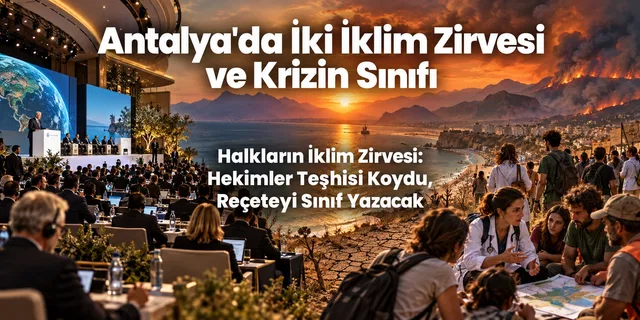
A month ago, in Two Climate Summits in Antalya, and the Class of the Crisis, we set two tables side by side. On one side was the United Nations' official table at the Antalya Expo, and on the other the table of the Peoples' Climate Summit. The spine of that piece was this: the doctors have made the diagnosis, and the class will write the prescription.
The summit is a week away. The agenda texts have been published, the presidency has announced its priorities, the United Nations' new Emissions Gap Report has come out, and the details of the host-country agreement have come into the open. This piece builds on that first one. We look at what will be talked about at the official table, what will not, and whose interest that serves.
First, a short summary
- Date and place. COP31 meets at the Antalya Expo on 9-20 November 2026. The Leaders' Summit is on 11-12 November. The president of the summit is Murat Kurum. The negotiations will be run by the Australian minister Chris Bowen. This is the first summit in the history of UN climate talks in which authority is split between two countries.
- The item that is not on the table: fossil fuels. In Belém (COP30) a roadmap for leaving fossil fuels could not be agreed. That item is not on Antalya's official agenda either. Kurum's words are plain: "We cannot reduce everything to fossil fuels alone."
- What the science says. According to UNEP's 2026 Emissions Gap Report, overshooting the 1.5°C limit is now all but unavoidable. On current policies the world is heading for about 2.8°C of warming by the end of the century. Emissions must fall by 45 per cent by 2035. What countries have promised brings a fall of only 11-15 per cent.
- The presidency's flagship, "35x35". The aim is to raise electricity's share of final energy consumption from 20 per cent to 35 per cent in 2035. It does not say where the electricity will be produced. Electrification without a plan to leave coal can mean coal finding a new customer.
- The money, which is the real question. The finance target is on paper, and it is not in the till. The Loss and Damage Fund has only just begun to operate. The promise to triple adaptation finance has been postponed to 2035.
- The host's mirror. Turkey's 2035 target does not cut emissions. It raises them, from the last measured 552 million tonnes to 643 million tonnes. By the Climate Network's count there are 68 coal plants in the country. The minister says "five or six".
- The right to speak. The host-country agreement places on participants a duty "not to interfere in Turkey's internal affairs". This clause had been removed in Brazil. It is back in Antalya.
- The voice in the shop window. Tarkan voluntarily re-recorded "Uyan", the song he wrote in 2008, in English as "Wake Up" for COP31. Minister Kurum thanked him, and the song drew wide attention. The song's call is sincere. In the same window, though, Cengiz, Limak and IC stand as "climate partners". The people who need to wake up, before the citizen, are those who award the coal tender and those who take it.
- The other table is growing. More than 180 organisations are taking part in the Peoples' Climate Summit. There is a march on 14 November and a summit on 15-18 November. Its slogan gives the heart of the argument: "Change the System, Not the Climate!" We recommend looking at the programme, the local assemblies and the call to take part at hiz2026.org.
- Our class position. The problem is not a lack of knowledge. It is property. The gain of fossil capital is protected at the table, and the cost is written onto the worker, the peasant and the poor countries. The way through is public and democratic control of energy, and a just transition in which the worker is the subject.
Now to the detail.
The road to Antalya: the calendar and the seating
The skeleton of the summit is this:
| Date | Event |
|---|---|
| November 2025 | In Belém (COP30) Turkey and Australia reached a deal. Turkey became the host, Australia the president of the negotiations. |
| 12 February 2026 | The first strategy meeting, in Istanbul. Kurum rejected a priority on fossil fuels. |
| 24-29 April 2026 | A conference on leaving fossil fuels was held in Santa Marta, Colombia (59 countries and the EU). |
| June 2026 | The host-country agreement was signed. The text was made public in September. |
| 8 September 2026 | The provisional agendas were published. |
| 21 September 2026 | The presidency announced the "35x35" electrification pledge. |
| 5-8 October 2026 | The Pre-COP was held in Fiji and Tuvalu. The Taku Pakasoa Declaration was adopted. |
| October 2026 | The UNEP Emissions Gap Report 2026 ("The Point of Return") was published. |
| 27 October 2026 | Kurum announced the ten priorities of the Action Agenda. |
| 9-20 November 2026 | COP31, Antalya Expo. |
| 14-18 November 2026 | The Peoples' Climate Summit: a march and four days of summit. |
In this two-president model the work is split as follows. The official negotiations, that is the draft texts and the final decision, are in Bowen's hands. The "Action Agenda", where voluntary pledges, initiatives and the shop window are gathered, is in Turkey. On paper, that is the arrangement. In September in Trabzon, though, Kurum said "we are not co-chairs; the final decision rests with the COP31 presidency" (Climate Home News). The official document gives Australia exclusive authority over the negotiations. We will see together what this ambiguity means on the last night of the summit, when the language of the text is locked.
This detail has a class meaning too. Turkey and Australia are presented as a "bridge" in climate diplomacy. Yet both are countries that are expanding the fossil-fuel supply chain. Australia is an exporter of coal and LNG. Since 2022 it has approved 37 fossil projects and is extending a mine in the Hunter Valley. Turkey is an importer making plans to expand its coal and gas capacity. Both feet of the bridge stand on the same ground.
The official agenda: what is on the table?
Let us summarise the negotiating headings from the provisional agendas and the presidency's statements (The Planet Brief, Euronews):
- The transition away from fossil fuels. Belém produced no roadmap. It is not clear whether Antalya will produce a negotiating text, or a voluntary "implementation path" outside the official process. Brazil's COP30 presidency is preparing a voluntary roadmap.
- Climate finance. The new collective quantified goal (NCQG) has been agreed, but how the money will be delivered has not been settled.
- The 2035 nationally determined contributions (NDCs). The UN synthesis covers only 64 plans, about 30 per cent of global emissions. About 50 countries have still not submitted an updated plan.
- Loss and damage. The fund's first financing cycle has only just begun. The 21.6 million dollars set aside for the Nepal floods remains symbolic beside the scale of the disaster.
- Just transition. In Belém a path to a "mechanism" was opened. Its structure, its governance and its money are still unclear.
- Adaptation. There is a target to triple adaptation finance, but it has been postponed to 2035.
- Article 6, carbon markets. Authorisations, registries and transfers have begun to operate. Public evidence on "corresponding adjustments" is still thin.
The ten priorities Turkey announced in the Action Agenda are these: zero waste, a circular economy, protection of the seas, food security, climate-resilient agriculture, energy efficiency, sustainable urban infrastructure, climate finance, a clean-energy transition and green industrialisation (Yeni Alanya). Added to them are targets to cut the energy intensity of buildings by at least 25 per cent by 2035, to halve the rate of growth in waste, and to raise the share of circular materials in industry to 15 per cent. An Antalya Ocean Declaration is also aimed at.
Look carefully at the list and one thing stands out: none of the ten items contains the word "coal", "oil" or "gas".
What the science says: "The Point of Return"
This year's UNEP report is called "The Point of Return" (Insights on India summary, UNEP reports page). The figures are these:
- In 2025 global emissions were about 58.4 billion tonnes of CO₂ equivalent. Emissions from fossil sources continue to rise.
- For the overshoot of 1.5°C to be kept limited, emissions must fall, against 2025, by 18 per cent by 2030, by 45 per cent by 2035, and by 69 per cent by 2040.
- Countries' promises for 2035 bring a fall of only 11-15 per cent. A gap of 16 billion tonnes remains.
- On current policies about 2.8°C of warming is expected by the end of the century. If every promise is kept, this can come down to 2.1°C. Other organisations also give estimates in the range of 2.3-2.6°C.
- The United States' formal withdrawal from the Paris Agreement adds 0.1-0.25°C to the projection on its own.
- Solar capacity has grown at seven times the speed foreseen in 2015. The consumption of coal, oil and gas has continued to grow as well.
The last item gives the heart of the table. Renewable energy is being added beside fossil fuel, not in its place. The technology exists and it has become cheaper, and still fossil fuel continues to grow. The reason is not technical. Capital invested in fossil infrastructure has to keep working in order to preserve its value. A coal plant, an LNG terminal or an offshore well is an investment that is expected to yield a return. A terminal built today has to be operated for thirty years. The report's warning that "new fossil infrastructure locks the supply chain in until 2035" is, in the language of this accumulation of capital, a confession.
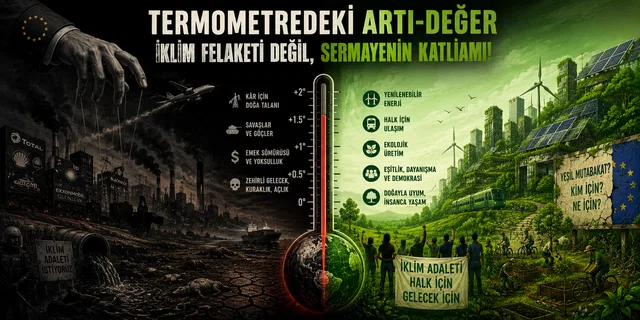
The other face of the table is seen in bodies. In the first four months of 2026, 150 million hectares burned. This August, at 1.65°C, was the hottest August on record. More than 50,000 people died in the heatwaves in Europe. In the Nepal floods more than 1,500 people died and 5,600 are missing. The Lancet figure we reported in the first piece is plain for Turkey too: in 2024 there were 33.6 heatwave days per person, and 642.9 million working hours were lost. Fifty-three per cent of that loss was in agriculture. We also told, in The Surplus Value on the Thermometer - Not a Climate Catastrophe, but Capital's Massacre!, that the thermometer has a class. The person working in the field, on the building site and in the warehouse in the heat, and the person sitting in an air-conditioned office, breathe the same air. They do not pay the same price.
The silence at the table: fossil fuels
Antalya's largest argument is about the item that is not on the agenda.
The legacy of Belém. At COP28 in Dubai the phrase "transitioning away from fossil fuels" entered a text for the first time. At COP30 in Belém the effort to turn this into a roadmap with a timetable was blocked by the objection of the oil exporters. In the end the Brazilian presidency took it upon itself to prepare a voluntary roadmap outside the official process.
The Santa Marta opening. Against this blockage in the UN process, Colombia and the Netherlands gathered the first conference on "transitioning away from fossil fuels" in Santa Marta in April (Climate Home News, Carbon Brief). Fifty-nine countries and the EU took part. Three working groups were set up: national roadmaps, the structure of subsidies, debt and investment, and trade. A science panel was also formed. France announced a timetable to end coal by 2030, oil by 2045 and gas by 2050. The second conference will be held in Tuvalu in 2027. The "Fossil Fuel Treaty" proposed by 18 countries, though, was not taken into the working groups. Even the greatest resolve avoids becoming a binding text.
The presidency's stance. Let us read Kurum's words from February again: "We cannot reduce everything to fossil fuels alone." He added that developing countries "will protect their development priorities" (Climate Home News). In September he accepted that there was no initiative in the Action Agenda on leaving fossil fuels, and he said that 1.5°C was no longer possible and that "about 1.5°C" would count as success.
The "right to development" argument has a real historical basis. Most of the carbon in the atmosphere was accumulated by the industrialisation of the North. To tell the South "you stop too" would be an injustice. In Antalya, though, this argument does another job. What profits from coal in Turkey is not "the people of a developing country". The ones who profit are the companies opening mines on expropriated olive groves, the plant owners who receive a purchase guarantee, and the capital groups that trade imported coal. If the "right to development" is defended without asking in whose name development is wanted, what is defended in the end, in the people's name, is the right of capital.
"35x35": whose electricity?
The presidency's flagship is electrification. Electricity's share of final energy consumption is about 20 per cent today. The target is to raise it to 35 per cent in 2035. This target is also among the recommendations of the UNEP report. Electric transport, the heat pump and electric industry really do cut emissions if they are fed from the right source.
The clause "if they are fed from the right source" is the critical one. A third of the world's electricity is still produced from coal. The target does not say where the additional electricity will come from. At a meeting of the Istanbul Policy Centre, specialists said this plainly: without a plan to leave coal and gas, electrification cannot be a climate target, and fossil fuel can meet the rising demand (Euronews Turkish). Climate Action Tracker also recalls that Turkey's 35 per cent target sits well above its own National Energy Plan. The country has not even written this target into its own plan.
A dimension we did not touch in the first piece comes to the front here. Artificial intelligence is also a heading in Turkey's Action Agenda. Yet one of the fastest-growing items of electricity demand in the world is the artificial-intelligence data centre. In Bubble or Debt? Meta's 145 Billion Dollars and the Class Character of the AI Bubble we told how one end of the technology monopolies' investments of hundreds of billions of dollars reaches the power stations. Part of the "35x35" target may not be electricity that heats a home and runs a bus. Part of it may go to data centres fed by gas turbines for the monopolies' model training. The target itself does not say for what purpose the electricity will be used either. Yet that is the real question of energy planning: for whose need is the electricity produced?
Money: the class of the gap
Kurum says that closing the "gap" in climate finance will be Antalya's priority. He gives the adaptation-finance gap as 5.6-7.1 trillion dollars a year. He also argues that rich countries must allocate to the climate more than the target of 5 per cent of GDP that NATO has set for defence.
This finding is right. But let us complete the table:
- The target agreed in Baku (COP29) is 300 billion dollars a year by 2035. "1.3 trillion from all sources" remained only a roadmap. A large part of this money is not a grant. It is credit.
- In the same period states gave a net 956 billion dollars in subsidies to fossil fuels (2023).
- NATO countries are preparing to raise defence spending to 5 per cent.
It is not that the money does not exist because it cannot be found. The money is somewhere else. In military spending, in fossil subsidies, in debt interest. The interest on the credit that countries of the South take for the climate returns again to the banks of the North. Setting up climate finance as "credit" turns the disaster itself into a relation of debt and claim. A country wrecked by a flood borrows in order to rebuild. The damage thus becomes a line of return for finance capital.
Carbon markets (Article 6) rest on the same logic. Instead of cutting its emissions, a company buys a "credit" from a forest project in the South. The land right of the community that lives in that forest turns into a carbon certificate. Pollution becomes a commodity, and a commodity yields a gain to its owner.
The host's mirror: Turkey
Let us look at the record of the country sitting at the head of the table in Antalya (Climate Network, ANKA):
- The 2035 target. It allows emissions to rise to 643 million tonnes. The last measured figure is 552 million tonnes. This is not a reduction target. It is a target of increase.
- Coal. About 33 per cent of electricity comes from coal, and about 60 per cent of that coal is imported. The Climate Network counts 68 coal plants. The minister says "five or six".
- The subsidy. Domestic coal receives a purchase incentive of 7.5 lira per unit. The cost of producing solar and wind is far below that.
- Employment. Employment in coal mining has fallen by about a third in 15 years. The line "we are protecting the coal worker" does not hold even against the figures.
- Industry. Turkey is Europe's largest producer of solar panels. About three quarters of the production is exported.
- Governance. The Climate Change and Adaptation Coordination Board has sector associations on it, but not unions, civil society organisations or consumer organisations.
- The source of the policy. According to specialists, Turkey's climate policy does not come from domestic planning. It is a "reactive" policy that comes from the European Union's Carbon Border Adjustment Mechanism (CBAM). The Emissions Trading System too is being built largely so that the exporter does not pay a tax to the EU.
In the first piece we wrote that the expansion of Afşin-Elbistan had been annulled by the court, and that in the same period an additional 1,050 MW unit was announced for Cenal in Çanakkale. This table has a class map. The labour of the worker who produces the panel is exported. The soot of the coal plant is breathed by the peasant who lives around the plant. The subsidy goes to the owner of the plant, and we pay the bill. Capital's associations sit on the board. The unions have no chair.
The right to speak: "do not interfere in internal affairs"
The host-country agreement also sets out the political climate of the summit (Climate Home News). The agreement was signed in June, but it was made public in September. Accredited participants are exempt from legal proceedings for words connected with the conference, and this protection continues after the summit for the first time. The same participants must obey Turkey's laws and "not interfere in internal affairs". Case by case, the host and the UN secretariat will decide together which speech is protected and which counts as "interference".
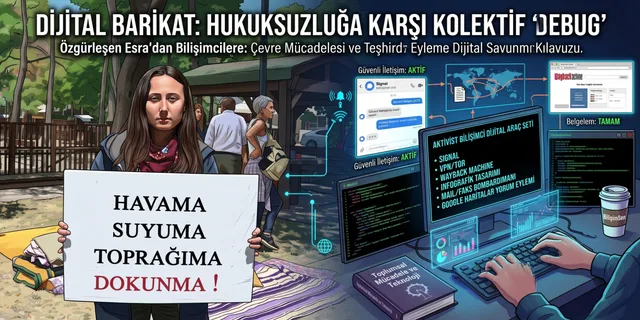
This clause was there in Dubai and in Baku, it was removed in Belém, and it has been brought back in Antalya. Amnesty International finds this "deeply disappointing" and warns that it will have a chilling effect on freedom of expression and of assembly. The warning is not in vain. The environmental defender Esra Işık received a prison sentence of more than two years for her peaceful protest against an expropriation decision given for a coal mine. Before the NATO summit more than 200 people were detained. In Freedom House's Freedom on the Net 2026 report, Turkey scored only 31 out of 100.
There is an important question here. Why should a country's coal policy, the smoke of a plant to be built in that country, and the deaths from that smoke count as an "internal affair"? Carbon has no border. The voice of the peasant who objects to the coal mine, though, is caught at the border of "internal affairs". This is a rule that protects the sovereignty of capital, not of the climate.
The voice in the shop window: Tarkan's "Wake Up", and the reactions
A week before the summit, a cultural event entered the agenda. Tarkan re-recorded "Uyan", the song he wrote in 2008, in a new arrangement, under the English name "Wake Up", for COP31 Turkey. The words and the music are his. According to the reports he did the work voluntarily. The video uses striking images of the climate crisis. The song draws attention to the climate crisis and calls for individual and social responsibility, and for acting together without falling into despair. Tarkan's words are plain too: "Our time is running out. We must act before it is too late." (ANKA, Takvim). Turkey had earlier also prepared an English promotional song for the summit, called "Let's COP".
The reactions gather in three clusters:
- The presidency and the pro-government media. Minister Murat Kurum thanked Tarkan on social media. He wrote that the song "touched our hearts" and that it raised awareness of the climate crisis. Channels close to the government announced the song under headlines of the kind "it shook social media" (TGRT Haber).
- Those who have a memory. The opposition media met this praise with a reminder. Tarkan's song "Geççek", released in February 2022, had been targeted by journalists close to the government, who said "the CHP commissioned it" or "it was written in Pennsylvania". Notbir gave its story the headline "What will the pro-government media do now?" (Notbir). The voice of an artist who was targeted yesterday because of "Geççek" is put in the presidency's shop window today.
- The wide listening public. The reports speak of intense interest. In the sources we surveyed, though, we did not find a gathered assessment of the song by climate organisations or by the components of the Peoples' Climate Summit. The criticisms of the ecology movement are aimed not at the artist but at the summit itself and at its sponsors.
How should it be read? Let us be fair first. It is not a small thing that an artist voluntarily sings again a climate song he wrote eighteen years ago. Tarkan's voice reaches millions of people that no declaration and no panel can reach. Every voice that carries the climate crisis into the kitchen and the earphone is valuable. We are not looking for the problem in the artist's intention.
The problem is in the frame the song is placed inside. That frame has three layers:
- To whom is "Uyan" sung? The song's call, as in most climate campaigns, is aimed at the individual: be aware, take responsibility, act together. The table we have seen in this piece says something else. Turkey's 2035 target increases emissions. Coal is subsidised, a new unit is added at Cenal, and an environmental defender who objects to a coal mine receives a prison sentence. The awake citizen is already there. What finds it convenient to sleep is capital and its state. This is not a lack of awareness. It is a question of property and power.
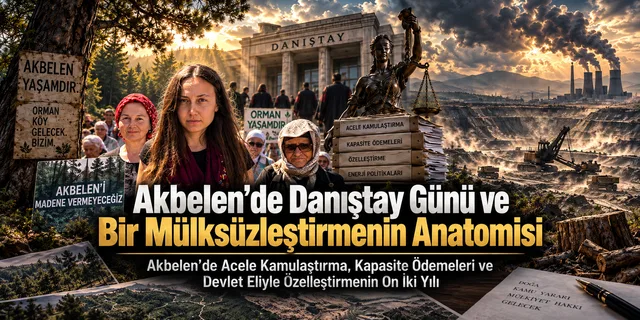
- The other corner of the same window. In the week the song came out, Yelda Erçandırlı in Evrensel recalled COP31's corporate partners. Cengiz Holding was announced as a "Sustainable Transformation Partner", and Limak and IC Holding as "Climate Supporters". YK Enerji, the partnership of Limak and IC, is the company that opened the olive grove at Akbelen to a coal mine. Cengiz's ETİ Alüminyum opened the forest to argument with the bauxite project at Akseki (Evrensel). In one corner "Wake Up" is playing. In the other, the capital that digs up Akbelen's olive grove stands as a "climate supporter". As Erçandırlı stresses, the question is not only greenwashing. The question is how capital's legitimacy is reproduced through climate politics.
- The function of popular culture. In Gramsci's language, domination is built not only by force but also by consent. The most effective carriers of consent are voices that are loved and trusted. An artist's sincere call can, against his own wish, become an instrument of the presidency's legitimacy. This has to be noted not against Tarkan, but against those who build this frame and those who do not look at that frame critically.
So, instead of rejecting the song, we propose to take its question seriously and complete it. Who should wake up? The ministry that awards the coal tender, the plant owner who receives the subsidy, the company that digs up the olive grove, and those who wrote the "do not interfere in internal affairs" clause should wake up. Those who are already awake are clear: the women of Akbelen, the peasants of Afşin, the seasonal agricultural worker in the heat of the field, and those who will march in Antalya on 14 November. The next song has to be sung together with them.
The other table: the Peoples' Climate Summit
The Peoples' Climate Summit, organised by the "Change the System, Not the Climate" platform, continues to grow. According to the call for participation announced on 28 October, 182 organisations are in the process. On 14 November there will be a global day of action and a march in Antalya, and on 15-18 November there will be thematic summit days. With the support of İklim Fest, free buses are being organised and applications are taken through an online form (DHA, Politika Haber). Participation is expected from different geographies, from South America to the Pacific. The demands of climate justice, opposition to war, and the freedom of Palestine meet on the same banner. The summit's own site is hiz2026.org. The programme, the local assemblies, the campaigns and the registration call are there. The call of 28 October named 182 organisations. The site today counts more than 392 supporting organisations. We recommend examining the site before going.
In the first piece we introduced this summit in detail and wrote our comradely criticisms too. Today we underline the same point: the strength of the summit will be measured by how far it reaches the workplace and the union. A march, a convention centre and a four-day panel are valuable. What will decide how lasting the summit is, though, is that the coal worker, the energy worker and the agricultural labourer take their place at this table with their own organisations.
Two languages, one table
| The language of the official agenda | A class reading |
|---|---|
| "An implementation-focused summit" | A voluntary pledge instead of a binding target. If it is not carried out, there is no sanction. |
| "We cannot reduce everything to fossil fuels alone" | The gain of fossil capital is kept outside the argument. |
| "The right to development" | Whose development? The plant owner's, or the peasant's who lives around the plant? |
| "35x35 electrification" | The source is unclear, and the purpose is unclear. To the data centre, or to public heating? |
| "Closing the finance gap" | Not a grant, but credit. The disaster becomes a claim for finance capital. |
| "Carbon markets" | Pollution becomes a commodity, and land becomes a certificate. |
| "About 1.5°C is a success too" | An admission that the target has been overshot. The South and the labourers pay the price. |
| "Do not interfere in internal affairs" | The voice of the peasant who objects to coal can be counted as "interference". |
| "A just-transition mechanism" | It has a name. It has no structure and no money. The worker is not at the table. |
| "A bridge country" | Both feet of the bridge stand on the fossil supply chain. |
| "Wake Up", a call for awareness | The call is aimed at the citizen. Those who award the coal tender, and the capital at Akbelen, are in the window as "climate supporters". |
Why the same scene for thirty years?
We asked this question in the first piece too. Today we can give a shorter answer.
The COP is a meeting of capitalist states. Every state is obliged to protect the competitive power of its own capital. Closing a coal plant early means a "stranded asset", that is, capital that has fallen in value. No group of capital willingly accepts the loss of value of its own asset. That is why, in the negotiation, every country waits for the other to move first. What comes out in the end is texts that are not binding, that are voluntary, and that are postponed.
The solar panel became cheaper, but fossil fuel continues to grow. This contradiction shows that the market cannot carry out the transition on its own. The market adds the renewable to the extent that it is profitable. It does not let go of the fossil for as long as it is profitable. For the transition, someone has to accept the loss of value of fossil capital. That acceptance becomes possible only when the property relation changes, when energy is a matter of public need and not of private gain.
Our class position
- Energy is a commons. Electricity, heating and transport, like water and knowledge, must be under public and democratic control. An energy system run by the drive for gain cannot save the climate.
- A timetabled exit from coal. There should be no new coal investment. Expansions such as Cenal should be stopped. Coal subsidies should be removed and the resource transferred to the worker and the region.
- A just transition is a transition in which the worker is the subject. The coal worker's wage, health and retirement must be secured. Priority of employment should be given in the new public energy enterprises. The unions should write the plan of the transition together.
- Labour's representation on the board. Unions, professional chambers and local people should enter the Climate Change and Adaptation Coordination Board.
- The panel for our own roof, not for export. The solar panel produced in the country should reach public buildings, village cooperatives and the roofs of poor neighbourhoods.
- Climate finance is not a debt. It is reparation. It should be grant-based and combined with the cancellation of debt. Its source is military budgets and the gains of fossil companies.
- The right to speak is not a bargaining chip. Cases against climate defenders should be dropped. The right of assembly and demonstration should be secured throughout the summit and after it.
Concrete tasks
- Let us be in Antalya on 14 November. Those who cannot come should join the local assembly and the day of action in their own city. Let us look at the programme, the local assemblies and how to take part at hiz2026.org.
- Let us talk about it at the workplace. Working in the heat, the right to stop work in a heatwave, and unionised workplace safety are the climate's counterpart at the workplace. Let us carry these demands onto our union's agenda.
- Let us read the bill. Let us talk about how the coal subsidy, the purchase guarantee and the imported-coal trade show up on our electricity bill. Let us continue the argument we began in The Class of Three Thousand Kilowatt-Hours.
- Let us make the data a commons. Plant emissions, air-quality measurements and expropriation decisions should be collected as open data and put within everyone's reach.
- Let us watch the summit and keep the note. Let us record how the words "fossil", "coal" and "just transition" appear in the official texts, and which pledge comes from whom. After the summit, let us write a continuation of this piece together.
Dear Young Comrades,
Two tables are being set in Antalya. At one, the most powerful states in the world will speak the diplomatic language of protecting the gain of fossil capital. At the other, those who pay the price of this crisis in the field, in the mine, in the factory and in the street will question the system itself.
The diagnosis of science is plain. The thermometer shows above 1.5 degrees, and we are approaching the point of return. The name of the report tells us something too: a return is still possible. Neither a presidency nor a voluntary pledge will carry out this return. What will carry it out is an organised force that will decide in whose hands, under whose control, and for whose benefit energy, land and labour will be.
The doctors have made the diagnosis. The scientists have put the figures in front of us. We, the organised workers, will write the prescription.
The peoples who unite will win, and life will go on.
The machine is new, the chain is old. The climate is new, the exploitation is old.
Sources
From Bilgi Müşterekleri
- Two Climate Summits in Antalya, and the Class of the Crisis (4 October 2026, updated on 21 October)
- The Surplus Value on the Thermometer - Not a Climate Catastrophe, but Capital's Massacre!
- Bubble or Debt? Meta's 145 Billion Dollars and the Class Character of the AI Bubble
- Hope Came from the South: Lula's Victory, Brazil's Hundred Years, and the Road Before the Class
Official and international sources
- The official COP31 site
- UN - the COP31 page
- UNFCCC - the 2026 NDC Synthesis Report
- UNEP - Emissions Gap Report 2026, summary (Insights on India)
- Wikipedia - 2026 United Nations Climate Change Conference
News and analysis
- Peoples' Climate Summit - hiz2026.org
- Climate Home News - Turkey says the "final decision" is its own (11 September 2026)
- Climate Home News - participants told not to interfere in "internal affairs" (25 September 2026)
- Climate Home News - the COP31 president rejects a priority on fossil fuels (12 February 2026)
- Climate Home News - the Santa Marta summit (30 April 2026)
- Carbon Brief - the key outcomes from Santa Marta
- The Planet Brief - the COP31 agenda and the negotiations
- Euronews - electrification, artificial intelligence and fossil fuels (6 October 2026)
- Euronews Turkish - Turkey's climate policy on the way to COP31
- Union of Concerned Scientists - COP31 in Türkiye
- Pressenza - COP31: Will Countries Finally Deliver?
- ANKA - the Climate Network: an urgent and just exit from coal
- Yeni Alanya - Kurum announced COP31's 10 priorities (27 October 2026)
- DHA - climate activists' COP31 march in Antalya (28 October 2026)
- Politika Haber - the Peoples' Climate Summit begins on 14 November
- ANKA - Tarkan's song for COP31 Turkey: Wake Up (1 November 2026)
- Takvim - the song Tarkan wrote in 2008 comes back to life for COP31 (1 November 2026)
- TGRT Haber - "Uyan" shook social media (2 November 2026)
- Notbir - Minister Kurum's "Wake Up" thanks to Tarkan (2 November 2026)
- Medyascope - Tarkan sang for COP31, Murat Kurum thanked him
- Evrensel - Yelda Erçandırlı, greenwashing at COP31 and the legitimacy of capital (30 October 2026)
This piece is published under the CC BY-SA 4.0 licence.