Two Climate Summits in Antalya, and the Class of the Crisis
The Peoples' Climate Summit: The Doctors Have Made the Diagnosis, the Class Will Write the Prescription

Measuring the Temperature Is Not Enough
The TTB's call to the Peoples' Climate Summit, and the class of the climate crisis
Dear Young Comrades,
Yesterday, on 3 October 2026, the Central Council of the Turkish Medical Association (Türk Tabipleri Birliği, TTB) published a call from its X account: it invites doctors, the forces of labour and democracy, "defenders of life" and the people to take part in the Peoples' Climate Summit (Halkların İklim Zirvesi, HİZ), which will gather in Antalya on 14–18 November 2026 (a march on 14 November, the summit on 15–18 November). This piece was written in order to take that call seriously. Because it is not every day that a professional organisation names the climate crisis "the capitalist mode of production" and "a regime of accumulation that commodifies nature."

Call graphic of the Turkish Medical Association for the Peoples' Climate Summit, 3 October 2026.

The Turkish Medical Association's call, 3 October 2026. X.

Antalya, Konyaaltı beach. Roy Egloff, CC BY-SA 4.0.
First a Short Summary
What is happening, in a few points:
- The official table: The 31st Conference of the Parties to the UN Framework Convention on Climate Change (COP31) meets on 9–20 November 2026 at Antalya Expo. The host is Turkey, the president is the Minister of Environment, Murat Kurum; the negotiations will be conducted by Australia's climate minister, Chris Bowen, in the capacity of "negotiations president." The leaders' summit is on 11–12 November.
- The peoples' table: In the same city the Peoples' Climate Summit (HİZ) meets: on 14 November a global day of action and the Antalya march, on 15–18 November the summit itself. Behind it are 183 supporting organisations, 173 of them from Turkey and 10 international, and local assemblies set up in twelve cities. Its slogan is "Beyond COP31," its closing sentence "The peoples who unite will win, life will go on."
- The TTB's call: The climate crisis is a health crisis; the COPs are bargaining tables that for thirty years have taken no binding decision to leave fossil fuels; carbon trading and "financialised climate policies" are not a solution; the solution is the common struggle of the peoples.
- Our contribution: The diagnosis is correct, and correct to an unusual degree. But when the words "peoples" and "life" are not filled with a class content, even the most accurate diagnosis does not turn into a prescription. This piece tries to fill that gap: who pays the bill of the climate crisis, who writes it, who can solve it? At the end of the piece we also propose a draft climate programme on the axis of class, from demands that can be won today to the social ownership of energy.
Now let us go into the detail.
What Did the TTB Say?
The spine of the statement can be gathered in five sentences, in their own words:
- The climate crisis "is an indisputable scientific reality," and its effects are lived in human health as directly as in nature: rising temperatures, extreme weather events, the widening of the area in which epidemic diseases spread, food security put in danger.
- The climate summits the UN has organised for thirty years "have remained nothing but bargaining tables squeezed into the narrow interests of companies and states."
- What has brought the planet to the edge of destruction is "the capitalist mode of production, colonial relations, patriarchy, and a regime of accumulation that commodifies nature."
- This crisis "cannot be solved by false market solutions, by carbon trading, or by financialised climate policies."
- The "most basic precondition" of protecting public health and of leaving a liveable world to coming generations is climate justice.
Let us not underestimate this. That a professional organisation in Turkey uses the expression "regime of accumulation" in a public statement is the trace, inside that organisation, of an accumulation on the side of labour, of years of struggle. The TTB stood on the same line in the pandemic, in the earthquake and in the workplace murders, and it paid the price of this with court cases and with being targeted. A doctor's work is to measure the temperature; this time the TTB also names the cause of the fever.
Why Are Doctors on the Climate Platform?
Because the climate crisis is no longer an "environmental problem"; it is a statistic of death. The climate and health report published every year by The Lancet, one of the world's oldest medical journals, Lancet Countdown 2025, sets the picture out plainly (the WHO summary):
- Heat-related deaths average 546,000 a year; the death rate has risen by 23 per cent since the 1990s.
- In 2024, 640 billion potential working hours were lost because of heat; the income equivalent of this is 1.09 trillion dollars.
- Because of drought and heatwaves, 124 million more people were pushed into moderate or severe food insecurity in 2023.
- In the same year states gave a net 956 billion dollars in subsidies to fossil fuels: three times the money promised to the countries most affected by the climate. Fifteen countries set aside more money for fossil fuel than for their entire health budget.
- On the other hand, thanks to the fall in pollution from coal, 160,000 premature deaths a year were prevented between 2010 and 2022.
The last point matters, because it shows us a choice, not helplessness. A part of the deaths is not inevitable; it is the result of a political decision, of an investment preference, of a subsidy line. When doctors say "this is a health problem," they are in fact saying "this is a problem of choice." Who makes the choice? The question arrives there.
On Whose Back Is the Crisis? The Class of the Thermometer
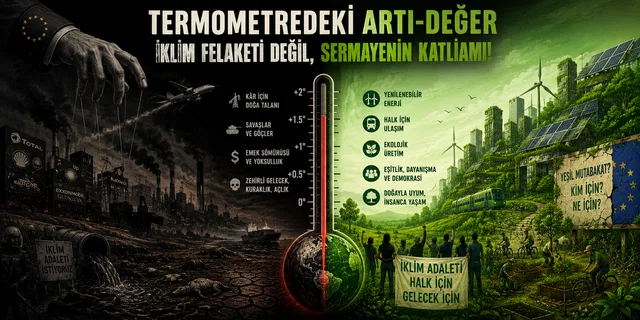
The sentence "the climate crisis affects us all" is true, but incomplete. A heatwave does not strike everyone the same way in the same city. We named this, in a piece we wrote on Europe, "the surplus value on the thermometer." Looked at from Turkey, the picture is this:
Dying while working. According to the 2025 report of the İSİG Meclisi, the Health and Safety Labour Watch, at least 2,105 workers died while working in Turkey last year. In agriculture and forestry 414, in construction and on the road 493 workers. Heart attack and cerebral haemorrhage were the cause of 299 deaths. These two lines are where heatstroke and a heavy workload come together most: the hazelnut orchard in the midday sun, the asphalt site, the roof. 97.6 per cent of those who died were not in a union; 94 were children.

A farmer in Turkey, 2006. Seattle Globalist, CC BY-SA 2.0.
Heat in the field. The seasonal agricultural worker is the living counterpart of what the Lancet calls "640 billion working hours lost." But those hours are often not lost; the worker goes on working in the heat, because the daily wage is not something that can be "lost." Bourgeois statistics write "loss of productivity"; we read "extra value drawn from the worker's body."
Heat in the home. The uninsulated gecekondu, the attic flat, the rented house without air conditioning. The death rate from heat is directly connected with the class of housing. The elderly pensioner, the baby, the poor family with a chronic illness: according to the Lancet, babies and the elderly are living four times as many heatwave days as twenty years ago.
Drought at the table. Food insecurity is "price volatility" for capital; for the poor it is an empty pot. When drought hits the harvest, the first to be affected are the households for whom food is the largest item of the budget.
Coal in the breath. The chimney of a coal plant does not smoke over the rich neighbourhood. We will open this below with the example of Afşin-Elbistan.
In short, the climate crisis is a multiplier laid on top of the class inequality that already exists. The sections named "disadvantaged groups" are, most of the time, the working class itself, unnamed.
Why Has the COP Produced No Result for Thirty Years?

A protest by Extinction Rebellion against fossil-fuel subsidies, The Hague, 9 September 2023. Ogidya, CC BY-SA 4.0.
The TTB's finding of a "bargaining table" can also be tested with concrete figures.
The first COP gathered in Berlin in 1995. Thirty-one years later, global emissions are much higher than on that day. Why?
Because the states that sit at the table are the representatives of the sections of capital in their own countries, and the accumulation of capital rests on cheap energy and on unlimited growth. Those who sit at the edge of the table are the more open face of this representation: according to the count of the Kick Big Polluters Out coalition, about 1,600 fossil-fuel lobbyists were registered at COP30 (Belém, 2025); one in every 25 participants. This is the highest rate among all the COPs that have been measured (Global Witness). The outcome document, the "Mutirão Decision," did not mention the words "fossil fuel" even once; a "roadmap for leaving fossil fuels," supported by more than 80 countries, could not enter the text.
Here it is not enough to say, with a moral anger, "the lobbyists captured the table." The lobbyist is not a deviation; it is the honest face of the system. The capitalist state is a committee that manages the common affairs of the whole of capital; the climate conference is the international meeting of those committees. Fossil-fuel capital does not infiltrate this table from outside; it is one of the founding partners of the table.
The TTB's criticism of "carbon trading" connects to this too. The carbon market turns the atmosphere into an object of property, and the right to pollute into a commodity that can be bought and sold. With the concept of digital enclosure we told how the knowledge commons are turned into private property; the carbon market is the enclosure of the sky. To privatise what is common (the atmosphere), and to try to solve the crisis with the mechanism that created the crisis (the market): this is the promise of putting out a fire with fire.
In Antalya, the Host's Mirror
That COP31 is meeting in Turkey takes this contradiction, for us, out of the abstract.
The target figures. At COP30 Turkey announced its new Nationally Determined Contribution: to bring emissions in 2035 down to a level of 643 million tonnes. The point of comparison is the 695 million tonnes foreseen for 2030 (bianet). So what is called "reduction" is a small retreat against a forecast that has not yet come about, and that has been allowed to rise. The same document repeats the 2053 net-zero target; but Turkey is still one of the European countries with no timetable for leaving coal.

Zonguldak harbour, the Turkish Hard Coal Enterprise (Türkiye Taşkömürü Kurumu). Dosseman, CC BY-SA 4.0.
Coal. In 2025 coal met 33.6 per cent of Turkey's electricity generation (Turkish Minute).
Afşin-Elbistan. A plant complex that has been working since 1984, with a capacity of 2,795 MW, in the basin where 40 per cent of Turkey's lignite reserves are found. In Elbistan the daily PM10 value was measured at 128.3 micrograms per cubic metre; the WHO guideline value is 15. The estimated number of premature deaths associated with the existing operation is 16,530. Because of the pollution, the population of the village of Çoğulhan fell from 10,000 to a few hundred. It had been calculated that the planned expansion would lead to 2,268 additional deaths and to a health cost of 88.4 billion lira.
One gain, and one step back. On 8 July 2026 the Kahramanmaraş Administrative Court cancelled the Afşin-Elbistan A expansion (688 MW). Municipalities, environmental organisations and medical chambers carried the case for years (Beyond Fossil Fuels). But in the same days the government announced that an additional unit of 1,050 MW would be built at the Cenal plant in Çanakkale. While one door was closed by a court, another door was opened by a ministerial decision.
The lesson that comes out of this is double. First: organised objection works. Since 2016, 86 coal projects proposed in Turkey, 75 GW in all, have been cancelled or shelved. Behind them are villagers, lawyers, doctors, engineers. Second: these gains are won case by case, project by project, and can be lost again each time. Because the property relation that determines energy policy does not change.
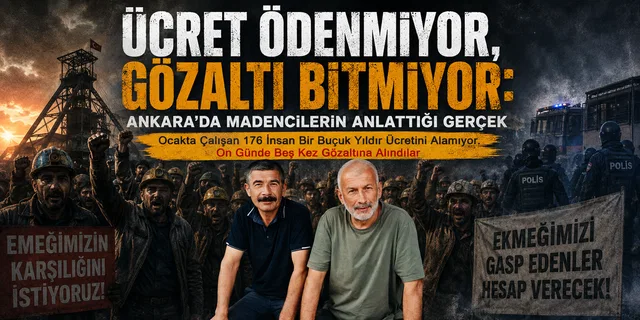
Three days ago, on 1 October, five miners lost their lives in a collapse at the underground lignite pit belonging to İmbat Madencilik in Soma. We took this up in the piece in which we told Soma, and the 150-year account of mining from Zonguldak to today: coal, in Turkey, exacts a price in the miner's lung, in the breath of the plant's neighbour, and in the climate itself. Three prices, a single profit account.
Two Tables: a Comparison
| Subject | The COP table | The peoples' table |
|---|---|---|
| Who sits there? | State delegations, companies, fossil-fuel lobbyists | Unions, professional organisations, peasants, women's and youth organisations, local assemblies |
| The cause of the crisis | "Emissions," an abstract "human activity" | The capitalist mode of production, unlimited growth for profit |
| The solution proposed | The carbon market, green finance, voluntary pledges | A binding exit from fossil fuel, energy democracy, food sovereignty |
| The status of the atmosphere | A right to pollute that can be bought and sold | A common wealth, a commons |
| The worker's place | A "stakeholder," a footnote under the heading "just transition" | Must be the subject of the transformation (steps are being taken, not yet enough) |
| Health | An item of "co-benefit" | The measure and the ground of the crisis |
| The measure of success | A phrase that has entered the text | A plant closed, a right won, an organisation founded |
| Who pays the price? | The taxpayer through the subsidy, the poor through health | Proposes to make the polluter pay the price |
Look at the fifth row of the table. For the peoples' table too we wrote "not yet enough." The summit is taking important steps in this direction; we will discuss below how far it can go.
Let Us Get to Know the Peoples' Climate Summit

A climate-justice march during COP27, Edinburgh, 12 November 2022. Friends of the Earth Scotland / Colin Hattersley, CC BY 2.0.
What is the place the TTB is calling people to? In this section we introduce the summit in detail. We drew the information largely from the summit's own site (hiz2026.org), from press statements, and from the reports of Medyascope and bianet.
At a Glance
| Heading | Information |
|---|---|
| What? | An alternative climate summit organised against COP31 and at the same time as it |
| When? | 14 November 2026: global day of action and the Antalya march. 15–18 November 2026: the summit |
| Where? | Antalya. Online participation is also possible |
| Who founded it? | The Climate Justice Coalition, the Ecology Union and the Turkey Environment Platform (16 December 2025) |
| Who supports it? | 173 from Turkey, 10 international, 183 organisations in all |
| How is it organised? | Local assemblies, axis meetings, working groups, forums |
| Main axes | The rights of nature; peace; food sovereignty; energy democracy |
| First campaign | "If the World Is to Burn, the Fossils Will Burn It" (Yakarsa Dünyayı Fosiller Yakar, 14 September 2026, 134 signatory institutions) |
| Participation | The Join the HİZ form; registration of participants for panels, workshops and assemblies |
| Contact | X, Instagram, YouTube |
How Was It Born?
According to the summit's About text, the three great umbrella organisations of the ecology movement in Turkey, that is the Climate Justice Coalition, the Ecology Union and the Turkey Environment Platform, came together on 16 December 2025. Immediately after COP31 was given to Turkey, they decided to organise "an alternative summit that would look to the needs of the peoples and to climate justice." Around this core a network of solidarity was woven, made up of NGOs, unions, grassroots movements, youth groups and justice networks.
A detail matters here: for long years the ecology movement in Turkey walked in a scattered way, locally, and through cases one by one. A village defended its own stream, a district its own olive grove, a city its own thermal plant. The HİZ is the attempt, for the first time at this scale, to bring these scattered resistances together under a single roof, on a single calendar.
What Does It Say? The Summit's Own Words
The About text begins with almost the same sentence as the TTB statement: the climate crisis was created by "the capitalist mode of production, colonial relations, patriarchy, and a regime of accumulation that commodifies nature," and this crisis cannot be solved "by false market solutions, by carbon trading, by financialised climate policies." It is plain that the TTB took this frame from the summit's common text. This also shows that the TTB's call is not the statement of a professional organisation on its own, but the voice of a common platform.
The text also describes the COPs plainly. Today the COPs, in the text's expression, have turned into "corporatised and securitised climate fairs," "sponsored by oil and gas companies, where delegations arriving by private jet are hosted, where the peoples of the Global South are shut out by visa walls," and where local resistances are crushed by police violence.
The answer given to the question of who pays the price of the crisis is, for us, the most valuable part: "While the burden of flood, drought, air pollution and forced migration is thrown onto the shoulders of the labourer, the peasant, the urban poor, women and local peoples, the fossil-fuel, construction, mining and so-called 'green' energy companies are growing their profits."
In this sentence the two poles are plainly there: on one side the labourer, the peasant, the urban poor; on the other the capital of fossil fuel, construction, mining and "green" energy. The emphasis on "so-called green" also matters: the summit sees that renewable energy too, in the hands of capital, can turn into a new field of plunder.
The assessment of Turkey's hosting is also clear. According to the summit, this hosting is "an attempt to legitimise, in the international field, a development model centred on fossil fuel, the plunder of mining, the plunder of forest and water, coal, nuclear and energy projects."
Four Axes
The summit's discussions are built on four main axes. According to Medyascope's account, the content of the axes is this:
The rights of nature. The right to life of rivers, the freedom of animals, the right of ecosystems to their own existence. This axis stands against the understanding that sees nature only as a "resource."
Peace. The struggle against war and militarism. The wars in the Middle East, Palestine and Rojava are on the agenda. The wars themselves are also a huge source of emissions and of destruction; military spending swallows the resources that could be set aside for climate adaptation.
Food sovereignty. Leaving industrial agriculture, agroecology, seed exchange, the protection of the small producer. That among the supporters there are bodies such as the Ancestor Seed Exchange Association, the National Agriculture and Food Union, and the Panköy and Güneşköy cooperatives shows the grassroots counterpart of this axis.
Energy democracy. A just and urgent exit from fossil fuels, community-centred renewable energy, and opposition to nuclear (Akkuyu and Sinop). That the network Trade Unions for Energy Democracy (TUED) is among the international supporters shows that a trade-union reading of this axis is also at the table.
Beside these four axes the summit's site lists twelve more thematic headings: labour, ecological destruction and ecosystems, climate resilience and human rights, democracy-law-justice, historical responsibility, youth, opposition to nuclear, gender and bodily autonomy, peace, emission reduction, health, and COP31 monitoring. Since the middle of September, broad "axis meetings" have been held on these axes.
The First Campaign: "If the World Is to Burn, the Fossils Will Burn It"
The summit's most concrete step so far is the "Yakarsa Dünyayı Fosiller Yakar" campaign, announced on 14 September 2026 in Muratpaşa, Antalya. The name turns the folk line "if the world is to burn, the poor will burn it." 134 institutions signed the statement. The statement recalls that Turkey is among the first 15 countries in the world that emit the most greenhouse gas, and it sends greetings to the struggle of those who pay coal's price "from Milas to Elbistan, from Silopi to Biga."
The campaign's demands are these:
- Existing coal-fired thermal plants should be closed in stages, beginning today.
- Expansions of coal mines should be stopped.
- Permits given for new coal plants and mines should be cancelled without exception.
- The incentives given to coal should end, and with these resources a just-transition plan should be built.
- The employment rights and the futures of all the labourers working in coal mines and thermal plants should be secured.
- Repair programmes covering ecosystems and the people should be applied in the coal regions.
- Community-centred renewable energy should be supported; a clean, just, local, participatory and democratic energy system should be founded.
- An end should be put to the excessive consumption that capitalism incites, and to growth-centred energy policies; an energy planning compatible with the planet's limits, and based on society's real needs, should be adopted.
The last point is especially striking: the word "planning." The idea of an energy planning determined by social need, not by the market, is one of the most basic ideas of a socialist economy. The campaign text does not name it so, but the substance is this.
The examples of Afşin-Elbistan and Cenal that we told above explain why this campaign is being made today. That the Afşin and Elbistan Platform for the Protection of Life and Nature is among the signatories also brings the campaign together with the voice of the plant's neighbours themselves.
Who Is There? A Map of the Supporters
The full list of the 183 organisations supporting the summit is on the site. When the list is grouped by social section, a map like this comes out:
| Section | Examples |
|---|---|
| Ecology umbrellas | Climate Justice Coalition, Ecology Union, Turkey Environment Platform |
| Local defences of life | Afşin and Elbistan, Validebağ, Kazdağı, Munzur, the anti-nuclear platforms of Sinop and Mersin, the Büyük Menderes Initiative, the environment platforms of Bergama, Muğla, Balıkesir |
| Workers' unions | Dev Maden-Sen, Dev Yapı-İş, Basın-İş, the United Agriculture and Forestry Workers' Union, Tümka-İş, affiliated to DİSK; Sosyal-İş, the Private Security Workers' Union, the Turkey Journalists' Union |
| Public labourers | KESK, Eğitim Sen, the Health and Social Service Labourers' Union (SES), Tarım Orkam-Sen |
| Professional organisations | The Turkish Medical Association, the Climate Crisis Working Group of the Istanbul Medical Chamber, the Turkish Thoracic Society, branches of chambers affiliated to TMMOB (Architects, Environment, Chemistry, Agricultural Engineers) |
| Peasant and food | Ancestor Seed Exchange Association, National Agriculture and Food Union, Panköy, Güneşköy Cooperative, the Poison-Free Tables Platform |
| Human rights | İHD, TİHV, the Human Rights Joint Platform, Amnesty International, Conscientious Objection Watch |
| Women and LGBTİ+ | EŞİK, the Women's Coalition, Uçan Süpürge, the World March of Women, Kaos GL, ÜniKuir |
| Peace and solidarity | the Social Initiative for Peace, A Thousand Youth for Palestine, International Solidarity |
| Local government | Fındıklı Municipality, the Union of Environmentalist Municipalities, the Association of Social Democratic Municipalities, the Turkey City Councils Platform |
| International | TUED, CAN Europe, Both ENDS, the Friedrich Ebert and Heinrich Böll foundations |
This map tells us two things. First, the presence of the unions. That DİSK/Dev Maden-Sen in particular is on the list matters: that the miners' union is at the table at a summit that talks of leaving coal means that a "just transition" can be talked of together with the worker, not over the worker's head. The unions of agricultural workers, construction workers and health labourers also represent the sections that heat stress hits most heavily.
Second, the breadth of the front. On the list, revolutionary socialist organisations and large foundations such as WWF or TEMA, from village associations to German political foundations, stand side by side. This is a richness. But it is also a responsibility: in a broad front the common ground must not sink to the lowest common denominator, and the voice of labour must stay independent and clear. We will return to this in the comradely notes below.
Statements of Support, Calls and Gatherings: a Linked List
Support for the summit is not only a list of signatures. Since February, organisations have published statements, gatherings have been held in the cities, a speech has been made from the rostrum of Parliament. Below we have compiled these in order of date, with source links. The list is made up of the statements we could reach in sources open to the public; it will be updated as new statements come.
The founding call, and the first steps
- 20 February 2026 — Climate Justice Coalition: The founding call headed "The Peoples' Climate Summit for Life, Against Ecological Destruction". It counts workers, women, LGBTİ+ people, the displaced and the young as the subjects of the climate-justice struggle; it puts a just transition, energy democracy, food sovereignty, opposition to nuclear and opposition to militarism as basic demands. The same day BirGün announced the call of the HİZ Assembly under the heading "Let us grow the collective will together".
- 10 March 2026 — Climate Justice Coalition, "The Peoples, the Anti-War Struggle, and the Cocoon of Peace": A call to an online meeting to discuss the role of militarism in the climate crisis. With the finding that "the huge carbon footprint of armies is being hidden," it opened the peace axis (Evrensel).
- 15 March 2026 — the Foça Platform of No to the Plunder of History and Nature: A pre-meeting for COP31 in Foça. The guest, Ecehan Balta from the HİZ Turkey Coordination, told of the fossil-fuel exploration in the Mediterranean and of the "rubbish diplomacy" that directs Europe's plastic waste to Turkey (Evrensel).
Assemblies and gatherings in the cities
- 26 April 2026 — the first HİZ Antalya gathering: More than 170 participants from different cities, political parties, faith organisations and rights organisations, in the Perge Hall of the AKM. The gathering ended with the decision to march with a "HİZ cortege" on 1 May (dokuz8HABER).
- 3 May 2026 — the HİZ Istanbul Assembly was founded: With more than 90 participants from NGOs, political parties and youth movements, at the Divriği Culture Association in Beyoğlu (bianet).
- 8 May 2026 — the Zonguldak gathering: Organised by the HİZ Assembly, the Zonguldak branch of the Alevi Culture Associations and the Zonguldak branch of the Consumer Rights Association; the Environment Association, the Labour Party (EMEP) and the All Pensioners' Union took part. The message was clear: climate decisions should be taken "not among companies, but together with the people" (Elmas TV).
- 9 May 2026 — the Muğla gathering: Academics, rights defenders and representatives of local resistances, at the Türkan Saylan Culture Centre. Climate justice was discussed not as a technical problem but as a problem of structural inequality (T24).
- 23 July 2026 — the Eskişehir gathering: The Alpu coal projects, the Porsuk Stream and the Sakarya Valley (HİZ).
- 25 July 2026 — the Rize Fındıklı gathering: Mining in the Black Sea, hydroelectric plants, concreting on the high pastures (HİZ).
- 3 September 2026 — İzmir Mor Dayanışma: A gathering in Karşıyaka, with the participation of the lawyer Nilay Sabuncuoğlu from the HİZ Istanbul Assembly. The call text stresses that solutions to the climate crisis must not be determined "only by governments, international institutions and big companies" (Mor Dayanışma).
- 29 September 2026 — the Çanakkale Labour, Peace and Democracy Platform: An information meeting in the Ercan Adsız Conference Hall of Çanakkale Municipality. Süheyla Doğan, chair of the Association for the Protection of the Natural and Cultural Assets of Kazdağı, told the summit's axes; transport and accommodation information was shared; the meeting ended with the slogan "Change the system, not the climate" (dokuz8HABER, Çanakkale Aynalı Pazar).
The common campaign, and institutional statements
- 14 September 2026 — the common statement of 134 institutions: In Antalya, in front of the Attalos Statue, the "If the World Is to Burn, the Fossils Will Burn It" campaign was announced. The HİZ volunteer Gülşah Tırış read the statement; the HİZ spokesperson Erol Malçok drew attention to Antalya's public-transport problem. Among the signatories are the TTB, KESK, Eğitim Sen, DİSK/BTO-Sen, Sosyal-İş, Tarım Orkam-Sen, the Climate Crisis Working Group of the Istanbul Medical Chamber, the Turkish Thoracic Society, Greenpeace Turkey, WWF-Turkey, 350 Turkey, Doğa Derneği, the Buğday Association, and dozens of local platforms (the HİZ full text and signatories, BirGün, Halk TV, Akdeniz Gerçek, Antalya Kent Haber).
- 2 October 2026 — the HİZ just-transition seminar: An online seminar with the union specialist Kıvanç Eliaçık as speaker (the HİZ X account).
- 3 October 2026 — the Central Council of the Turkish Medical Association: The call that is the occasion of this piece (X, TTB, ANKA, Politika Haber).
From the rostrum of Parliament
- 30 July 2026 — the General Assembly of the Grand National Assembly: While a bill on COP31 was being debated, Semra Çağlar Gökalp, DEM Party deputy for Bitlis, defined the HİZ as "a democratic alternative that aims to found the word of the peoples against the COP processes, which for years have produced no result and have turned into the greenwashing policies of companies and governments," and described the summit as "a social conscience that will test the democratic legitimacy of COP31" (the TBMM record).
Support and debate in the press and in left publications
- 29 June 2026 — Özgür Gazete Kıbrıs: A piece calling the ecology movement of Cyprus to take part in the summit (Özgür Gazete Kıbrıs).
- 9 July 2026 — Seferi Keçi: An interview with İsmail Karademirci from the HİZ coordination. The summit's horizontal and autonomous structure, a target of about 50,000 participants, and the principle of not accepting funds from fossil-fuel or polluting companies are told (Seferi Keçi). The journal published a second piece on 7 September: "Beyond COP31: it is not the climate, it is the system that has to change".
- 13 September 2026 — Medyascope: A comprehensive report conveying the summit's four axes and Ecehan Balta's criticism of the COP (Medyascope).
- 13 September 2026 — Politika Haber, Cemil Aksu: A piece criticising the summit from the left: it argues that the concept of "just transition" is the language of hegemonic climate politics, and that the working class should act not with this concept but with the aim of going beyond capitalism (Politika Haber). We touch on this debate in the comradely notes below.
- 23 September 2026 — marksist.org, Helin Alp: A piece supporting the summit as "a historical turning point," rejecting carbon markets and defending the protection of the workers in the fossil-fuel sector (marksist.org).
This picture shows that the summit is not the common work of a handful of environmental organisations, but of a network that runs from unions to professional organisations, from Alevi associations to women's solidarities, from left parties to local platforms. For the full list of the 183 supporters: hiz2026.org/destekleyen-kuruluslar.
Local Assemblies: the Capillaries of the Summit
The most valuable side of the HİZ, in our view, is the local assembly model. Twelve assemblies have been founded so far: Adana, Ankara, Antalya, Balıkesir, Bursa, Denizli, Istanbul, İzmir, Mersin, Muğla, Samsun, and Zonguldak-Ereğli. Where there is no assembly, a call is made to "start your own assembly."
Regional gatherings have also been held beside these assemblies. For example:
- The Eskişehir Gathering (23 July 2026): The coal projects planned at Alpu, mining, drought, and the protection of the Porsuk Stream and the Sakarya Valley were discussed.
- The Rize Fındıklı Gathering (25 July 2026): Mining in the Black Sea, hydroelectric projects, and concreting on the high pastures were taken up.
The existence of the Zonguldak-Ereğli assembly is meaningful on its own: a climate assembly in a miners' city, in Turkey's oldest coal basin. Fındıklı is the city of the people's-assembly experience we told in our guide Joining Local Government; Fındıklı Municipality is also among the summit's supporters.
The local-assembly model carries the potential to take the summit out of being a five-day event and turn it into a continuous network of organisation. Joining the assembly in one's own city is the most meaningful way of joining the summit.
The Teaching Face: a Pocket Dictionary and Seminars
The summit does not content itself with calling participants to Antalya; it also opens the concepts to debate. The "HİZ Pocket Dictionary" series published on its X account tells the basic concepts of the climate debate in short videos. The second part of the series is given to the concept of "just transition / just transformation," and it opens with the right question: we have to leave fossil fuels, but "who will pay the price of this exit?"
The same subject was also taken up on 2 October 2026 in an online seminar with the union specialist Kıvanç Eliaçık as speaker. That a just transition is told by a union specialist matters for pulling the debate onto the axis of labour.
Where Does It Come From? A Short History of Counter-Summits
Peoples' summits are not a new idea. The tradition of the peoples founding their own summits opposite the official climate conferences runs from the Klimaforum in Copenhagen in 2009, to the World People's Conference on Climate Change that gathered in 2010 in the Bolivian city of Cochabamba, to the Peoples' Summit in Glasgow in 2021. The About text also refers plainly to this tradition: it sees the solution, "just as in Glasgow and Belém," in the organised power of the peoples.
The nearest example is Brazil. While COP30 gathered in Belém in 2025, the Peoples' Summit (Cúpula dos Povos) held in the same city turned into a great gathering. bianet speaks of more than 70,000 participants; Ecehan Balta, who took part in the summit, tells of a registered delegation of 23,000 people from dozens of countries, of hundreds of events spread across the campus, and of a declaration signed by more than 1,100 organisations (Evrensel). In Balta's expression, a temporary "counter-city" had been founded. The existence in Brazil of a mass peasant-worker organisation such as the Landless Workers' Movement (MST) was an important source of that summit's strength. Antalya's question is here too: how do we found a mass base of the same scale in Turkey?
The Summit's Criticism: Why Does the COP Not Work?
Dr Ecehan Balta, an independent researcher from the summit's international-relations working group, summarises the problem of the COPs to Medyascope in two points. First, that no concrete success has been achieved since 2009. Second, that climate finance works not as aid but as a transfer of debt from the Global North to the Global South.
The second point is especially important. A great part of the money that rich countries give under the name of "climate finance" is in the form of credit. So the poor countries that have contributed least to the climate crisis borrow in order to repair the damages of the crisis, and pay the interest to the banks of the countries that created the crisis. This is where the climate crisis intersects with imperialism. The summit's finding that "green capitalism is impossible" also rises from this ground.
How to Take Part
- Individual participation: Participant registration can be made from the Join the HİZ page on the site. Registration is needed for taking part in panels, workshops and assemblies.
- Local assembly: You can join the assembly in your city, and if there is no assembly you can get in touch for one to be founded.
- 14 November: The global day of action, and the march in Antalya. A voice will be raised to the world's leaders with the slogan "Now is the time for real justice!"
- 15–18 November: The summit. Physical participation in Antalya, or online participation from anywhere in the world, is possible.
- Support as an organisation: You can apply for your union, your association, your student society to be a supporter of the summit.
Comradely Notes: from Diagnosis to Prescription
Both the TTB's statement and the summit's frame look in the right direction. A comradely contribution is to make the road clear together, while keeping company with what looks in the right direction. Five notes:
Who are the "peoples"? The name "Peoples' Climate Summit" is a good roof for bringing different social sections together. But there are classes inside "the people" too: the owner of the hotel chain in Antalya is also "the people," and so is the seasonal waiter who works in that hotel. The bill of the climate crisis is not cut the same for these two. For this reason the inside of the concept of "climate justice" must be filled with class justice. Who created the crisis, who profited, who is dying? If the answer to these three questions does not point to the same people, justice cannot be distributed equally to everyone either.
Energy democracy is a question of property. One of the summit's four main lines is "energy democracy." This concept is used with a clear content in trade-union circles such as TUED: the taking of energy into public and social ownership. If renewable energy also stays in the hands of private monopolies, the solar panel and the wind turbine too turn into a new field of rent; the peasant whose olive groves are uprooted is already living this in the wind plants and the geothermal plants. The question is not only "which energy?" but "whose energy?": in whose hands, under whose control, to whose benefit?
The miner should be beside us, not opposite. The demand to leave coal is correct, and it carries urgency. But if the mine and plant worker in Zonguldak, in Soma, in Afşin hears this demand as "they will take my job from my hand," capital mobilises this fear against the climate movement. We have seen the examples of this in Europe. The HİZ starts from a correct place on this: among the campaign demands is the securing of the labourers' employment rights, Dev Maden-Sen is among the supporters, an assembly has been founded in Zonguldak-Ereğli, and a just transition is the subject of a separate seminar. One step further can be taken. A just transition has to be turned into a concrete programme: job security, re-employment without loss of wages, the right to early retirement, public investment in the region. The mine and plant workers should write this programme too, together with their own unions. The worker in the coal basin is not the "problem" of the climate struggle, but its most natural ally, because that worker pays coal's price first.
The criticism that Cemil Aksu directs at the concept of "just transition" is a useful warning here. It is true that the concept is also in the mouth of the institutions of capital, from the World Bank to the EU; when its inside is emptied it can turn into a tool for reconciling the worker to the energy transformation. But the solution is not to give up the demand; it is to fill it with a class content. Job security, public investment and workers' control are demands that can be won today, and that organise the worker. The aim of going beyond capitalism does not contradict these demands; on the contrary, the worker who organises for these demands also gains the strength to walk to that aim. Revolutionary politics is to build a bridge between today's demand and tomorrow's aim.
The independent voice of labour in a broad front. The summit's map of supporters is very broad: from unions to international foundations, from socialist organisations to social-democratic municipalities. A broad front is a correct choice on a matter, such as the climate, that concerns the whole of society. But broad fronts have a known tendency: the common text slides towards the sentences that are least objected to. Concepts such as "green transformation," "sustainability," "stakeholder participation" are concepts that capital too can use comfortably. The HİZ's About text and the campaign demands look, for now, resistant to this slide; the expressions "capitalist mode of production" and "so-called green" are inside the text. That this clarity is also kept in the debates in November, and in the final declaration, depends to a great extent on how organised and how visible the unions and the labour organisations will be at the summit.
The summit is a day, organisation is every day. A four-day summit is a gathering. When COP31 ends, Antalya Expo will empty; the construction at Cenal, the chimney at Afşin, the heat in the field will stay where they are. The HİZ's local-assembly model is valuable from this angle: the summit's real success will be measured by the number of local assemblies, workplace representations, and health-labour-ecology networks that go on living after November.
A Solution on the Axis of Class: a Draft Climate Programme
Criticism is not enough; a movement that does not answer the question "well, what should be done?" is always pushed into the position of "dreamer" opposite capital's "realistic solutions." In this section we set out, as a draft, what kind of solution programme can be proposed for the climate crisis when it is looked at from the axis of class. The draft is built on the HİZ's campaign demands, the TTB's emphasis on health, and the trade-union debates on energy democracy. It is a proposal open to debate, not the last word.
First the Principles
We propose to test every solution proposal with four questions:
- In whose hands? Whose property does the proposed solution leave energy, land, water, technology in?
- Under whose control? Who gives the decision: the board of directors, the ministry, or the worker, the peasant, the neighbour who lives the results of that decision?
- To whose benefit? To whom does the gain go, on whom is the cost loaded?
- Who decides, who pays the price? If these two questions point to the same people, the solution is just; if they point to different people, whatever its name, the burden is again being passed downwards.
Two basic principles come out of these four questions:
Not the polluter, the one who profits pays. The famous principle of bourgeois climate policy is "the polluter pays." But in practice this turns, through fuel and electricity price rises, into the bill being cut to the consumer, that is to the worker. Yet who profits from polluting is known: the energy companies, the mining monopolies, construction capital. The bill should be cut to them.
The subject of the transformation is the worker, not its object. The energy transformation should not be something that "happens to" the worker; it should be a process that the worker plans and controls with their own organisations.
Two Understandings of a Solution: a Comparison
| Problem | Capital's solution | The class's solution |
|---|---|---|
| Emissions | The carbon market, trade in the right to pollute | A binding, planned, timetabled exit from fossil fuel |
| Energy | Private renewable investment, YEKA auctions, wind and geothermal rent | Energy in public and social ownership, under democratic control |
| The coal worker | Closure, compensation, "let them find a job in the market" | Job security, re-employment without loss of wages, early retirement, regional public investment |
| Heat stress | "Drink plenty of water," an individual measure | The right to stop work at a threshold temperature, a paid break, inspection in the workplace |
| Housing | An expensive "green building" certificate, urban-transformation rent | A public insulation and renewal programme beginning from the poor neighbourhoods |
| Transport | An incentive for the private electric car | Cheap or free, widespread, rail public transport |
| Food | Industrial agriculture, seed monopolies, imports | Food sovereignty, support for the small producer and the cooperative, public seed |
| Finance | Company incentive with public resources, "climate finance" in the form of debt | The cutting of fossil incentives, an excess-profits tax, the payment of the climate debt |
| Technology | Patented "green technology," licence income | Unpatented, open, commons technology |
| The decision | A closed negotiation room, a consultancy firm | The local assembly, the workplace representative, democratic planning |
Demands That Can Be Won Today
The demands below are demands that can be won today, inside the existing order, with an organised force. These are not the revolution; but they protect the worker's life, and they organise the worker.
Climate in the workplace.
- The right to stop work in the open above a determined temperature threshold; no wage deduction during this time.
- A compulsory paid break, in the midday hours (the hottest hours), in agriculture, in construction, in courier work.
- Shade, clean water and a rest area made into the employer's legal obligation; valid also for seasonal agricultural workers.
- Deaths from heatstroke, and heart-attack deaths related to heat, recorded as occupational accidents. The death that is not seen is the death that is not prevented.
- Climate risk added to the occupational health and safety boards; elected climate and environment representatives in the workplaces.
A just exit from coal.
- As the HİZ demands, a binding timetable for leaving coal that includes the staged closure of existing plants; the cancellation of permits for new plants and mines; the giving up of the Cenal expansion.
- The transfer of the incentives given to coal into a just-transition fund for the basin workers.
- Within the fund: job security, re-employment in the public sector without loss of wages, early retirement for whoever wants it, vocational training, public investment in the basins (renewable energy, repair, health).
- The preparation of the exit plan together with the unions of the mine and plant workers, with the medical chambers, and with the people of the basin.
- The repair of polluted basin land and water, by a public programme financed by the companies that profited.
The people's health.
- Public heat action plans against heatwaves: early warning, cooling centres, home visits to the elderly and the chronically ill.
- The strengthening of primary health care; a public data system for monitoring diseases that come from the climate.
- Independent measurement of air quality around thermal plants, and the opening of the results to the people instantly.
- A free, public and qualified health system: the precondition of resilience to the climate crisis.
Climate in the city.
- A public insulation and housing-improvement programme, beginning from the poor neighbourhoods, that protects the tenant (that forbids the rent increase after renewal).
- Cheap, becoming steadily free, widespread public transport; priority to rail. As HİZ Antalya also stresses, a city whose public transport is weak is also weak against the climate crisis.
- The closing of green areas, water basins and coasts in the cities to construction; the stopping of zoning changes opened for rent.
In the countryside, and at the table.
- Drought support, irrigation infrastructure and a public purchase guarantee for the small producer and the cooperatives.
- The protection of local seed, and public seed banks; the support of seed-exchange networks against the seed monopolies.
- The stopping of the opening of olive groves, pastures and agricultural land to mining and energy projects.
Finance: from whom will we take the money?
- The end of fossil-fuel incentives. According to the Lancet Countdown, 15 countries in the world set aside more money for fossil fuel than for their entire health budget; the transfer of this resource to health and to a just transition.
- An excess-profits tax on energy, mining and construction companies; the taxation of the extraordinary profits that form in energy crises.
- A transfer of resources from military spending to climate adaptation. The HİZ's peace axis turns here into a concrete budget demand.
- The prohibition of public banks financing fossil-fuel projects.
Structural Transformation: the Question of Property
Even if today's demands are won, the gains do not become lasting so long as the mechanism that produces the crisis stays in place. That a new unit is added at Cenal while the Afşin-Elbistan expansion is stopped by a court is the freshest example of this. For this reason the programme must be completed with an aim of structural transformation.
The social ownership of energy. The generation, transmission and distribution of electricity should be organised for need, not for profit. This means the nationalisation of privatised energy assets, and a layered democratic administration, under the control of representatives of workers, consumers and local government, from the scale of the municipality and the cooperative up to the national grid. Energy democracy becomes democracy only when energy is the property of society.
Democratic planning. The market cannot produce a solution to the climate crisis for three reasons: it discounts the future (it sacrifices tomorrow's disaster to today's profit), it loads the externalities onto someone else (the pollution onto the neighbour, the bill onto the people), and it has to grow (if it stops, it sinks). To solve the crisis requires that society itself decide what will be produced, how much, how, and for whom. The demand in the HİZ campaign for "an energy planning based on society's real needs" is the seed of this idea.
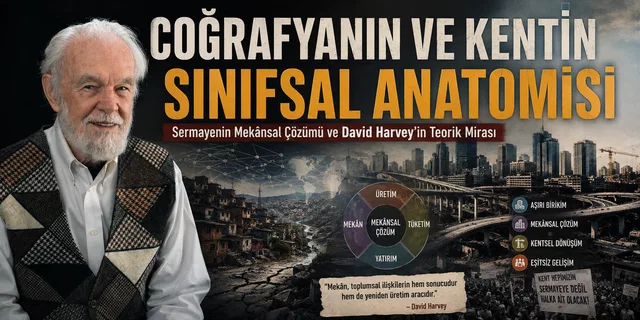
The commons of knowledge and technology. So long as green technologies, that is the solar panel, the battery, the heat pump, the drought-resistant seed, stay behind patent walls, the Global South has to buy this technology again from the monopolies. What we said as Knowledge Commons on digital enclosure holds here too: climate technologies born from humanity's common accumulation should belong to everyone. Climate technology developed by public research, unpatented and openly licensed, is an indispensable part of a climate programme on the axis of class. The same question should also be asked for the artificial-intelligence data centres whose energy consumption is rising fast: for whom, for which need, is this energy being spent?
Taking time back. The class way of living with fewer resources is not the poor tightening their belt, but the redistribution of social wealth. That increases in productivity turn not into more production but into less work, that is the shortening of working hours without loss of wages, protects both the worker's life and the planet's limits. The limiting of luxury consumption, of private jets, of the superyachts used by only a few thousand people, is the concrete demand to be set opposite the discourse of "let everyone make a sacrifice."
International justice, and the climate debt. A great part of historical emissions belongs to the rich capitalist countries. Climate finance has to stop being, in Ecehan Balta's words, "a transfer of debt from the North to the South." For this, the foreign debts of the Global South have to be cancelled against the climate debt, adaptation and loss-and-damage finance has to be given as a grant, not as credit, and the right of migration and asylum of those displaced by the climate has to be recognised. At this point, where the climate crisis intersects with imperialism, international solidarity is not an option; it is a necessity.
Whose Programme Is This?
No demand is won of itself. The expansion at Afşin-Elbistan stopped in court because there were people who for years opened cases, made measurements, wrote reports, went into the street. The coming into life of this programme also depends on the meeting of three organised forces:
- The union in the workplace: Only the organised worker can win the stoppage of work against heat stress, a just transition in the coal basin, social ownership in the energy sector. Climate demands should enter collective agreements.
- The assembly in the neighbourhood and in the basin: The HİZ's local assemblies, the villages' platforms of life, the urban defences. These are the bodies that will found and inspect the local counterpart of the programme.
- Knowledge in the profession: The medical chambers, the chambers of engineers and architects, the academics. A professional organisation that, as the TTB has done, puts scientific knowledge at the service of the people, and breaks capital's monopoly of "expertise."
When these three forces come together, the climate struggle stops being "the environmentalists' job" and turns into a front of the class struggle. The Peoples' Climate Summit is one of the rare moments when these three forces sit at the same table. To debate this programme at that table, to develop it, to turn it into a common class climate programme, can be November's most important work.
Why Health Workers in Particular?
It is not a coincidence that the TTB makes this call. Health workers are the "front-line" witnesses of the climate crisis: the elderly person who comes to the emergency room in a heatwave, the epidemic risk after a flood, the asthmatic child of dirty air, the disorder of nutrition that drought reflects onto the poor table. But the same workers are working in a health system that is collapsing, under performance pressure, under violence.
These two facts are bound to each other. A society resilient to the climate crisis is possible only with a public, free, qualified health system. A health system opened to the market manages the heatwave too as "congestion." So the climate struggle is not something outside the struggle for the right to health; it is the widening of the same struggle. The TTB's role here is to make this bond visible on every platform, with every report that is given.
Concrete Tasks for Young Comrades
- Get to know the summit, take part. Learn the registration form, and the local assembly in the city you are in, through hiz2026.org. If you cannot go to Antalya, join the assembly in your own city.
- Look from your own workplace. What measure is there against heat stress in the place where you work or do an internship? Is there water, shade, a break, the right to pause work in the hot hours? Carry these questions to your union, to your workplace representative. This is the most concrete form of the climate struggle.
- Draw your map. List the plants, the mine sites, the air-quality stations and the neighbourhoods most affected in your city. Whose chimney is smoking onto whose neighbourhood?
- Use the health data. Share the data of the medical chambers, of the İSİG Meclisi, of the Lancet Countdown, on social media, at school, in the workplace. Speak with a number, instead of a memorised "climate sensitivity."
- Talk with the miner, with the plant worker. Voice the demand to leave coal together with their demand for job security. Defend the just transition not "for them" but "with them."
- Watch the COP, question it. Throughout 9–20 November, read the official statements with three questions: In whose hands? Under whose control? To whose benefit? Find the property relation behind expressions such as the carbon market, green finance, "transition fuel."
- Debate the programme. Debate the draft climate programme above in your union, in your assembly, in your school; add its lacks, its mistakes, the demands particular to your own workplace and your city. Programmes mature not at a desk, but by being debated.
- Plan what comes after the summit. Think now what you will do in December with the people you meet in November. A reading group, a neighbourhood air-measurement study, a workplace heat-stress survey.
The Diagnosis Has Been Made, Now the Treatment
In the tradition of medicine, a good diagnosis is half of the treatment. The TTB's statement completes this half: the crisis is a scientific fact, its cause is the capitalist regime of accumulation, the market solutions are false. The other half, the treatment, is not a prescription that any professional organisation can write on its own.
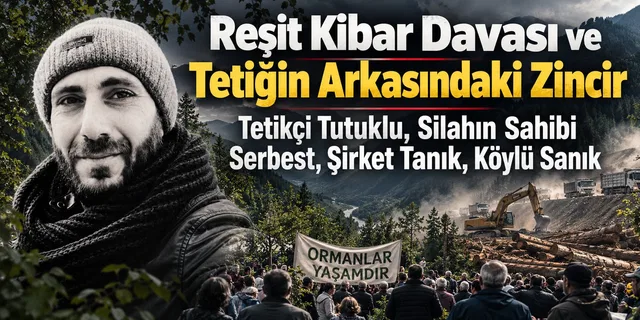
The working class will write that prescription: in the mine, in the plant, in the field, on the site, in the hospital, in the school. Because the only social force that can change the property relation that pollutes the atmosphere is those who have been left outside that property, but who produce the whole of the wealth. As we saw in the Reşit Kibar case, defending nature in this country exacts a price; those who pay that price not alone but in an organised way are the ones who win.
In Antalya in November two tables will be set. At one, the future of the planet will be a subject of bargaining; at the other, the future of the planet will be defended as a right. Which one we will sit at is clear. The real question is where we will go when we get up from that table.
Measuring the temperature is not enough, comrades. The temperature has to be brought down; the source of the fire has to be dried up.
The peoples who unite will win, life will go on. The class that organises will win, the planet will live.
Sources
- Turkish Medical Association, call to the Peoples' Climate Summit, X, 3 October 2026
- Politika Haber, Call from the TTB to the Peoples' Climate Summit: "The solution of the climate crisis cannot be postponed", 3 October 2026
- Peoples' Climate Summit, hiz2026.org
- Peoples' Climate Summit, About
- Peoples' Climate Summit, "Yakarsa Dünyayı Fosiller Yakar" press statement, 14 September 2026
- Peoples' Climate Summit, Supporting Organisations
- Peoples' Climate Summit, Local Assemblies
- Peoples' Climate Summit, announcements of the Eskişehir Gathering and the Rize Fındıklı Gathering
- Peoples' Climate Summit, X account (@hiz_2026): the HİZ Pocket Dictionary and the announcement of the just-transition seminar
- Medyascope, The Peoples' Climate Summit is founding the peoples' climate agenda "beyond COP31", 13 September 2026
- bianet, Beyond COP31, the Peoples' Climate Summit in Antalya
- Wikipedia, 2026 United Nations Climate Change Conference
- Lancet Countdown, 2025 Report
- World Health Organization, Climate inaction is claiming millions of lives every year, 29 October 2025
- Global Witness, COP30 verdict: People in, polluters still in?
- bianet, Kurum announced Turkey's Nationally Determined Contribution at COP30, 19 November 2025
- Turkish Minute, Turkey fires up coal pollution even as it hosts COP31, 19 February 2026
- Beyond Fossil Fuels, Public pressure cancels Türkiye's last coal project, only for the COP31 host to announce a bigger one, 9 July 2026
- bianet, In 2025 at least 2,105 workers died while working (İSİG Meclisi 2025 report)
The sources on the statements of support, the gatherings in the cities, and the debates in the press are given, linked and in order of date, in the section "Statements of Support, Calls and Gatherings."
Related pieces from Knowledge Commons
- Joining Local Government: From the Kent Konseyi to the People's Assembly (guide)
- A Class Seven Layers Underground
- The Reşit Kibar Case and the Chain Behind the Trigger
- Maricarmen's Stretcher, Elif's Key: Europe's Housing Crisis and the Class of the Home
- The Surplus Value on the Thermometer — Not a Climate Catastrophe, but Capital's Massacre!
- The Revolt of Crystallized Labor: A Call to the 20th Karaburun Science Congress
This piece is published under the CC BY-SA 4.0 licence. It may be reproduced, shared and adapted with attribution.
Tags: climate, ecology, health, TTB, COP31, Peoples' Climate Summit, class, energy democracy