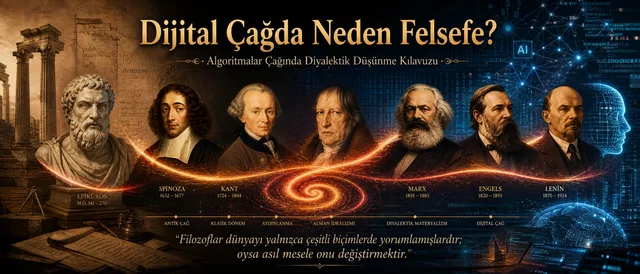
Objective Reality in the Theory of Knowledge and the Power to Transform the World
From Thales of Miletus to the Age of Artificial Intelligence: The Dialectical March That Does Not Merely Interpret the World, but Changes It

Hello, young comrades!
As you know, this evening—Friday, July 17, 2026, at 18:30—we will give a presentation at the Marmaris House of Culture and Arts under the Marmaris Philosophy Collective (MARFET). I also wanted to share this theoretical excitement with you valued comrades who for various reasons will not be able to be with us in person, and to carry the discussion into every field where you stand.
This evening's presentation is titled "Objective Reality in the Theory of Knowledge and the Power to Transform the World." In it we will discuss that long journey from Ancient Miletus to dialectical materialism—the voyage of a revolutionary tradition of thought that does not content itself with merely interpreting the world, but takes as its concern changing it. We will take up philosophy's fundamental question, the source of knowledge, and most importantly "practice"—the litmus paper of true knowledge.
Our journey is a historical line that begins in Miletus and stretches to dialectical materialism—a line that does not content itself with merely interpreting the world, but takes as its concern changing it with a revolutionary will. To that end I am sharing with you, step by step in fluent article form, the theoretical backbone of the presentation. Our first stop will be those roots of the history of philosophy that never age, and that confront us in every period with a new class shell.
Chapter 1: Philosophy's Fundamental Question and Ancient Roots
The theory of knowledge—that is, epistemology—has throughout humanity's adventure of thought always placed three plain questions before us. First we ask "What is knowledge?"; we try to understand whether hearing and knowing are the same thing, and which of rumors, observations, measurements, and theories carry the character of pure knowledge under which social conditions. Then we inquire where this knowledge comes from. Does knowledge filter only from abstract reason, or does it consist solely of the raw data the senses bring? For us Marxists the answer to this question is hidden in what carries and transforms both—that is, in the practice of life and of productive labor. Finally the question of how we will understand the truth of knowledge comes onto the agenda. Are beliefs, authorities, or logically consistent systems closed upon themselves the criterion of truth—or does objective practice always have the last word? The answers given to these three fundamental questions have for more than two thousand five hundred years divided the history of philosophy into two great irreconcilable lines.
In Friedrich Engels's incomparable formulation, the great basic question of all philosophy, especially of modern philosophy, is the problem of the relation between thought and being. According to the answers given to this question, the ranks become clear. Materialism holds that matter always comes first, and that thought is a function of the human brain—the most developed organic product of evolution. Nature exists objectively before the human being, before their consciousness and language; knowledge is the historical and dynamic reflection of this independent reality in the human mind. Idealism, standing on the opposite side, treats matter as the shadow or product of thought, of absolute spirit, or of a divine idea. The history of philosophy is nothing other than the ideological struggle of these two lines between the practices of the ruling classes and of the oppressed. Our theoretical journey this evening is the adventure of evolving from that static, mechanical understanding of matter in the early periods of the materialist line into dialectical materialism that thinks in processes and contradictions.
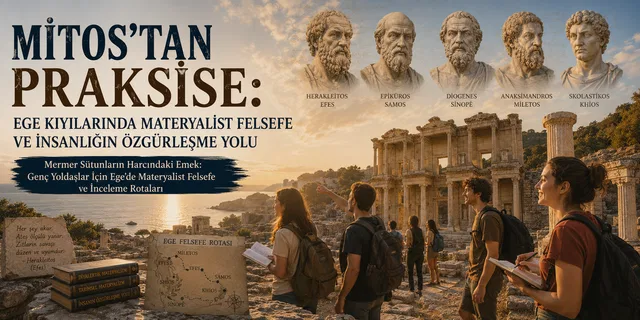
The first sparks of this adventure struck in the sixth century BCE in Miletus—a dynamic port city where trade, craft, and different overseas cultures were blended. When Egypt's need for practical geometry and Babylon's sky records combined with the practical intelligence of people working on the Milesian quays, material life itself preceded and gave birth to thought. Thales showed the daring to disperse the smoke behind mythological legends and to explain nature by material principles within nature itself. The first steps proving that celestial events are not the anger or arbitrary decisions of the gods, but part of a calculable and material order, were taken here. When the address of explanation was torn from legends and carried to the objective world, materialism's first historical victory was also declared.
Immediately afterward Heraclitus of Ephesus took the stage—in Lenin's words, "one of the founders of dialectics." With that famous saying "One cannot step twice into the same river," he showed that the universe is not a box of finished, frozen things, but on the contrary a totality of processes that flow, come into being, and pass away without cease. For Heraclitus even mountains or social institutions that appear permanent and static are subjects of a change working underneath. The motor of this development, of this flow, is contradiction—that is, the opposites both bringing each other into being and forcing each other. Like the tense relation of bow and arrow, every being in the universe moves through the struggle of the opposites within it. Moreover this change is not blind chance or chaos; it follows an objective lawfulness—a logos that kindles and is quenched by measure.
The peak of materialist comprehension in the ancient world came with the atomism of Democritus and Epicurus. Democritus said the universe could be explained not by divine interventions but by an objective mechanics consisting of atoms and void. Epicurus took over this theory and added a magnificent libertarian link to the history of philosophy: the concept of swerve (clinamen). By stating that atoms, while falling in a straight line, can make small deviations from their routes, Epicurus opened room in the universe beside rigid, mechanical fatalism for chance, free will, and new possibilities. For him, explaining nature by natural causes was a life practice of freeing humanity from ideological chains such as the wrath of the gods and the fear of death. It is no accident that the subject of young Karl Marx's 1841 doctoral thesis was the difference between the natural philosophies of Democritus and Epicurus. Marx saw in Epicurus's theory of the atomic swerve the materialist foundations of human freedom and revolutionary will.
So, young comrades: these voices rising from Miletus and Ephesus are the earliest, clearest sources of our scientific and revolutionary worldview today. When we defend that nature existed before the human being, that it is knowable, and that this knowledge, tested by practice, will change the world, that unshakable river of two thousand five hundred years flows behind us. Engrave this first chapter of the presentation notes as a theoretical map in your mind; for in the next chapter we will examine how this river turned into a vast cascade in the modern age with Spinoza and Hegel.
Chapter 2: The Modern Break and the Discovery of Dialectics
In the previous chapter we took up philosophy's fundamental question and discussed how the first seeds of materialism and dialectics were sown on the shores of Ancient Greece. Now we turn our course to a historical leap—to the birth of modern science and to the great ruptures that carried philosophy "from heaven to earth," and from there into action. Before us are empiricism that demolishes dogmas, dialectics that sees everything as process, and finally the heralds of revolutionary practice that does not content itself with watching the world.
Knowledge Is Power: The Leap from Scholasticism to Experiment One of the strongest manifestos of awakening from the Middle Ages' dogmatic sleep was written by Francis Bacon. In 1620, in Novum Organum, Francis Bacon declared a brand-new scientific program. He argued that nature must be learned not from scholastic books but from systematic experiment and observation. Saying "Knowledge is power," Bacon emphasized that the purpose of knowing is activities that will improve human life upon nature. This was a modern manifesto of the revolutionary bond between knowledge and practice.
For science to advance, the mind had to be cleaned of sediments. Bacon's famous "doctrine of the idols" gathered the prejudices that distort the mind under four headings:
-
The idols of the tribe—the illusions of the human species itself.
-
The idols of the cave—representing personal judgment and inclination.
-
The idols of the marketplace—born of the traps of language.
-
The idols of the theatre—resting on the supposedly unshakable authority of past teachings.
According to Bacon, science could advance only by clearing away these idols. This stance centering experiment and purposeful knowledge made Bacon, in Marx and Engels's assessment, "the real ancestor of English materialism and of all modern experimental science."
The Peak of Dialectics: The World as a Totality of Processes When we reach the early nineteenth century (1807–1831), we encounter a vast summit in the history of philosophy—Hegel. Hegel's revolution was to establish that reality is not finished things but a totality of PROCESSES. For him everything comes into being, develops, passes away, and is transcended. Hegel showed that the motor of development is contradiction. Every situation carries its opposite within itself; as this tension is resolved, a richer stage is born. We can also read this process in a simplified schema as "thesis–antithesis–synthesis."
The concept of "sublation" (Aufhebung) in Hegel's system is one of the finest aspects of dialectical development: the old is not simply thrown in the trash; it is both cancelled and preserved, contained at a higher level—just as Newtonian physics is "sublated" by Einsteinian physics.
Yet in Marx's famous diagnosis, this magnificent method stood "on its head" in Hegel. For in Hegel's system the subject of the processes is absolute Spirit (idea/spirit), and matter is only its shadow. For a correct scientific comprehension this system had to be "set upon its feet."
Feuerbach and the Limits of the Old Materialism: Descent to Earth The first great materialist blow to Hegel's upside-down system came from Ludwig Feuerbach. Feuerbach's The Essence of Christianity, published in 1841, struck like a bomb in its time. Feuerbach declared that it is not God who created the human, but the human who created God in their own image. The human had projected their own best qualities into the heavens and then bowed before them. Engels recounts the enthusiasm of those days by saying, "We all became Feuerbachians at once." After Hegel's Spirit wandering in the heavens, philosophy had finally returned again to the human and to nature—that is, to earth.
But we could not stop here. In the Theses on Feuerbach, written in 1845, Marx targeted the weakest point of the old materialism. According to Marx's critique, the human Feuerbach treated was an abstract, ahistorical, and passive "species-being." Yet the real human is the human who PRODUCES and ACTS within determinate social relations.
This was precisely the common and deep flaw of the old materialism: treating the world merely as an object to be contemplated, and failing to grasp sensory human ACTIVITY—that is, practice. A materialism without dialectics inevitably remains static.
Young comrades: we are on the bridge of the passage from philosophers who merely interpret the world to historical action that takes as its concern changing it. In the next chapter we will examine how Marx and Engels built this dialectical-materialist synthesis and the method's projections in nature.
Chapter 3: The Marxist Synthesis and Dialectics in the Natural Sciences
In this third chapter of our series we arrive at the most radical and earthbound leap in the history of philosophy. You will recall that in the previous chapter we said Ludwig Feuerbach brought philosophy down from heaven to earth, yet left the human as a passive object merely contemplating the world. Karl Marx and Friedrich Engels intervened precisely at this point and lifted philosophy out of being a static field of "contemplation" into an active power of "transformation"—that is, into praxis.
Our materialist worldview does not impose on nature rules invented from outside at a desk. On the contrary, dialectics is the scientific summary of the most general laws of motion that already operate in the laboratory, in nature, in history, and in the very heart of class struggle. Let us now look closely at the magnificent projections of this Marxist synthesis in the natural sciences and at the contradictory dynamics of the universe.
Laws Not Imposed on Nature, but Drawn from Nature: Engels and Dialectics
In Dialectics of Nature and Anti-Dühring, Friedrich Engels showed that the universe and science move not by blind randomness but by determinate dialectical laws. These laws are not dogmas dictated to the universe from outside; they are the forms of matter's own self-motion. Engels summarizes this motion in three fundamental laws:
-
The Leap from Quantity to Quality: Accumulations in matter do not always proceed in a straight line; at certain threshold points sudden qualitative transformations occur. The classic physical example is water, heating, then at a certain threshold changing phase and becoming steam at 100°C. In biology we see this when the simple behaviors of individual bees, coming together and reaching a critical number, give birth to the hive's common "decision mechanism" and collective consciousness. Small quantitative accumulations are inevitably pregnant with radical qualitative leaps.
-
The Unity and Struggle of Opposites: The motor of development and motion is not a divine pushing force from outside, but the essential contradiction within the being itself. We see this law in the balance of attractive and repulsive forces within the atom, and in the cycle of anabolism (building up) and catabolism (breaking down) that sustains the living organism. At the evolutionary level heredity and change contradict each other; at the social level this law concretizes itself in the irreconcilable struggle between labor and capital. The poles both bring each other into being and force each other without cease.
-
The Negation of the Negation: Historical and natural development does not advance in a straight line; it follows a spiral path. A seed that falls to the earth negates itself and gives birth to a plant. That plant grows, develops, and when its day comes dries up and is itself negated; yet in place of the single seed at the beginning it leaves behind a far richer harvest of hundreds of new seeds. The history of science itself is like this: classical Newtonian physics claimed absolute truths in matter; Einsteinian physics negated it, yet did not throw Newton in the trash—it sublated him by taking him into itself at a more encompassing and richer level.
Dialectical Patterns in Today's Science
The dialectical method is not an old philosophical formula left in the nineteenth century; on the contrary, it is the direct mother tongue of today's modern scientific discoveries. Whether the world of science is aware of it or not, when it examines nature it is compelled to write dialectical equations.
QUANTITATIVE ACCUMULATION > Rise in Carbon Dioxide
THRESHOLD / TIPPING POINT
QUALITATIVE LEAP > Permafrost and Glacier Melt
-
Climate Tipping Points: The accumulation of carbon dioxide in the atmosphere (quantity) heats the world gradually. Yet this process is not linear. In vast ecosystems such as the Amazon forests, the polar ice sheet, or permafrost (frozen soils) there are thresholds. When this quantitative critical threshold is crossed, the system suddenly leaps into a brand-new state from which there is no return. Climate science today is confirming the quantity–quality dialectic directly with mathematical models.
-
Heredity and Change in Evolution: Life is the unity of two opposing tendencies—"heredity," which tries to preserve sameness, and "mutation," which forces differentiation. The theory of "punctuated equilibrium" put forward by evolutionary biologist Stephen Jay Gould proves that evolution is precisely a dialectical process. While living beings appear static for millions of years with very small quantitative accumulations, in periods of sudden geological and environmental crisis they produce new species through rapid evolutionary leaps.
-
The Relation of Structure and Activity in the Brain: Classical medicine thought the brain was a fixed structure that produced behavior. Yet neuroplasticity, discovered by modern neuroscience, shows us that while brain structure produces behavior, human practical activity also turns back and reshapes the physical structure of the brain. Cause and effect exchange places without cease. This principle of "reciprocal action" is one of dialectics' most fundamental confirmations.
Hand, Labor, and Humanity's Self-Creation
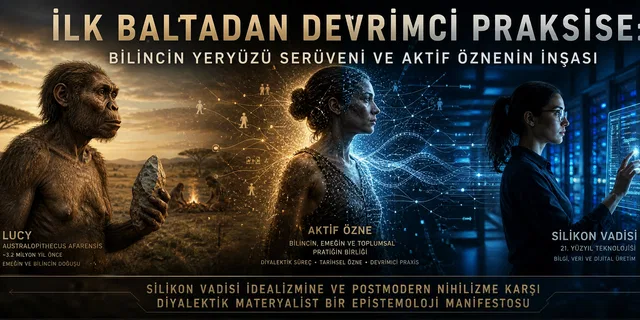
Engels's daring 1876 essay The Part Played by Labour in the Transition from Ape to Man is of vital importance for our theory of knowledge. The bourgeois scientists of the period claimed that the main element making the human human was a suddenly grown, magnificent "brain." Engels fiercely opposed this and advanced a materialist thesis that went beyond biology itself: Labor came first.
The hand, liberated together with upright posture, began to use tools. As the hand made tools, the tool developed the hand and the neural networks in the brain. Through this dialectical spiral in which cause fed effect and effect fed cause, the triad of hand–tool–brain evolved together.
The tool is humanity's first theory. Humanity learned the objective world not as a passive spectator with its eyes, but first with the hand that held the tool—by touching nature, transforming it, and breaking its resistance. Knowledge was born not from contemplation but from praxis.
When Engels wrote this thesis he had no concrete anthropological evidence in hand; it was a brilliant speculation. Yet today modern paleoanthropology has fully confirmed Engels. The oldest stone tools discovered in Kenya (the Lomekwi tools, ~3.3 million years) show that the hand went into action long BEFORE the evolution of large-brained Homo species.
Moreover, primatologist Richard Wrangham's "fire and cooking thesis" completes this spiral. The control of fire and the cooking of food carried the digestive process outside the body; thus the energy spent on digestion was freed and fed the energy-hungry human brain. As you see, comrades: practice and production have rewritten even our biology from scratch.
Freedom and Necessity: Lessons from a Kite
In closing this chapter we must give materialist clarity to the concept of "freedom," which idealism most abuses. Bourgeois philosophy markets freedom as "doing whatever one likes without being bound by any rule, law, or necessity." Yet in a lawless, entirely arbitrary universe no action of yours could have a foreseeable result; that situation would create not freedom but complete helplessness and blindness.
Following the path opened by Spinoza, Engels gave the scientific definition of freedom in Anti-Dühring: "Freedom is the recognition of necessity." The laws of nature and society, so long as we do not know them, ride upon us like blind masters and rule us; yet from the moment we grasp them they turn into levers that serve us.
-
The Kite Lesson: What makes a kite fly in the sky is the wind resistance created by the string that holds it—that is, necessity. If you cut the string so that it may "be free," the kite does not fly higher; it crashes head over heels to the ground. Necessity is not the obstacle to freedom; it is its condition of existence.
-
Examples from Nature: The law of gravity does not forbid us to fly. The human who grasps the objective laws and necessities of aerodynamics builds giant airplanes on those laws and rules the sky. While the blind force of lightning kills the human, the human who grasps the laws of electricity turns that blind force into the light of cities. A river is a flood bringing disaster to those who do not know the dam; to those who know how to build a dam it is clean energy.
-
Social Reality: Just like the laws of nature, the laws of society and of capitalism, when unknown, are lived as natural disasters. Economic crises, unemployment, and poverty are taken by the masses for "fate." Yet as Marxist theory grasps the objective laws of these mechanisms, these processes cease to be blind fate and turn into a field that can be intervened in, changed, and demolished by revolutionary action. Knowledge, to the degree it is bound to practice, is the greatest lever of freedom.
Chapter 4: Twentieth-Century Epistemological Crises, Bourgeois Philosophy, and Digital Caves
In this chapter of our text we will focus on how scientific revolutions shook philosophical ground, and how bourgeois ideology used these shocks to darken objective reality. From the beginning of the twentieth century to the digital age into which we are born today, whenever ruling-class philosophy has been cornered it has always resorted to the same move: denying the objective existence of matter, reducing truth to subjective experiences, and imprisoning philosophy once more in passive spectatorship.
For us Marxists, scientific crises do not refute materialism; on the contrary, by showing that mechanical and static materialism has grown old and worn, they prove that the dialectical method must be deepened. Come, let us examine together that epistemological barricade stretching from the physics crisis of the 1900s to today's debates on the Metaverse and virtual universes.
Lenin and the Physics Crisis: Did "Matter Disappear"?
At the beginning of the 1900s the natural sciences were living through a vast upheaval. The discovery of X-rays, the finding of radioactivity, and the detection of the electron smashed to pieces the model of the "indivisible, hard, unchanging solid atom" on which philosophers and physicists until then had based their thinking. When it was seen that even this smallest building block of matter was fractured within itself and that mass changed with velocity, some idealist physicists and philosophers of the period raised a hasty cry: "Matter has disappeared; only energy and equations remain!"
The current of Empirio-criticism led by thinkers such as Ernst Mach and Richard Avenarius used this crisis to argue that the concept of objective matter was an unnecessary metaphysical assumption. For them the world consisted not of objective beings but only of the sum of our sensations—that is, of "complexes of sensations."
Vladimir Ilyich Lenin, in Materialism and Empirio-Criticism written in 1909, built a magnificent philosophical barricade against this idealist assault. Lenin's two great objections in this debate remain cornerstones of our theory of knowledge even today:
-
First Objection (Distinction Between Philosophical and Physical Matter): Lenin showed that what had disappeared was not matter in the objective sense, but the old physical model of matter known until then (the indivisible solid atom). As a philosophical category, matter is objective reality that exists independently of human consciousness and sensations and that is conveyed to us through our sensations. This definition is independent of how physicists model the atom, the quark, or strings, and cannot be shaken by any physical discovery.
-
Second Objection (Solipsism and Natural History): If the world consists only of my sensations, how could this world exist before I was born—indeed when humanity did not exist on earth at all? The sciences of geology and paleontology lay before us layer by layer an earth of millions of years ago when the human and consciousness did not exist. Since there could be no sensation in those ages without consciousness, the world exists objectively and precedes consciousness.
The Lesson of the Book: Scientific revolutions do not refute materialism; they make its old and mechanical forms obsolete. Every crisis is the limit of a materialism without dialectics, and the method of solution is to deepen.
Lenin: A Spiral Approach to Truth
Lenin redefined materialist theory of knowledge, taking it out of being a static "mirror" and making it a dialectical process. Knowledge is the dynamic, constantly corrected and deepening reflection of objective reality in the mind. We can concretize this approach under three fundamental headings:
-
The Theory of Reflection: The correspondence of our knowledge to the external world is not a frozen record like a passive camera. It is like the process of making a map; it is drawn by practice, tested, its deficiencies seen, and corrected without cease to become more adequate to reality.
-
The Relation of Absolute and Relative Truth: Human thought is by nature capable of giving us absolute truth, yet it approaches that truth only through the sum of relative (partial) truths. Every scientific theory is incomplete for its period (relative) but carries grains of objective truth within it. Our knowledge approaches truth not in a straight line but in a spiral movement. That is why in dialectics "to err is to be on the way."
-
The Criterion of Practice: The final judge of truth is neither logical consistency nor desk-bound agreements; the last word is always spoken by experiment, production, and the practice of life. If the airplane you designed flies, the aerodynamic principles you relied on are objectively true. Yet because practice is dynamic it does not seal and approve any theory forever; the door of science always remains open to development through new practices.
Critique of Positivism: Ignoring What Cannot Be Measured
In the twentieth century the most comfortable refuge of the bourgeois world was the philosophy of Positivism, stretching from Auguste Comte to the Vienna Circle. Positivism emerged with the claim: "Only what is directly observable and verifiable is scientific; the rest is meaningless metaphysics." This understanding, offered with the promise of bringing a false discipline to science, was sunk in three great historical and theoretical errors:
-
A Self-Refuting Criterion: The sentence that is positivism's basic principle—"Only verifiable propositions are meaningful"—is itself not an empirically verifiable proposition. Thus positivism has a logical impasse that cannot even pass the first test it sets.
-
Theory-Laden Observation: There is no such thing in the world as a "naked, completely neutral fact." Your theoretical framework always tells you what to measure, how to measure it, and what to look at. A creationist and an evolutionary biologist looking at the same fossil do not see the same naked "fact"; observation cannot be isolated from theory.
-
Science Without History and Society: By imprisoning science within laboratory walls, positivism conceals who finances it, with which class interest, within which relations of production. Yet today we know very well that the "smoking is harmless to health" studies funded by tobacco companies, or the reports of fossil-fuel monopolies covering up the climate crisis, are concrete proofs that science does not live in a philosophical ivory tower independent of dominant social forces.
The Marxist diagnosis is clear: positivism is a modern continuation of the Mach line. By reducing objective reality and practice to intellectual data sets, it condemns knowledge once more to passive spectatorship.
Karl Popper: A Valuable Warning, a Contestable Verdict
Karl Popper, one of the most popular figures of modern philosophy of science, brought the criterion of falsifiability against positivism's dead end of "verificationism." According to Popper, for a theory to be scientific it must declare in advance under which practical evidence it would collapse (be falsified). Theories that refute themselves with no evidence and explain every situation in their own favor (for Popper, Marxism and psychoanalysis) are unscientific dogmas.
This warning Popper made against dogmatism is philosophically valuable and must be taken seriously. Yet Popper's condemnatory verdict on Marxism carries a deep methodological flaw:
-
Holistic Testing (the Duhem–Quine Thesis): The history of science shows us that theories are not immediately thrown in the trash after a single negative experiment. Theories are tested as a whole (auxiliary hypotheses, the reliability of measuring instruments, etc.). As Thomas Kuhn and Imre Lakatos also showed, science is a historical and social process; it does not fit the mechanical schema of "condemnation in a single session" that Popper claims.
-
Marxism Is Not Unfalsifiable: Marxist philosophy and economics are not, contrary to Popper's claim, a dogmatic dogma. As Marxist thinker Maurice Cornforth also replied, Marxism clearly sets out under which practical conditions its own predictions would be invalid. For example, the practical existence of a capitalism without internal contradictions, without surplus-value exploitation, or of a classless capitalist society would perfectly well falsify Marxism; yet capitalist reality continues every day to confirm Marx.
-
Confusion of Tendency with Prophecy: Popper confuses the historical laws of tendency Marxism puts forward with astrological or mechanical prophecies. Yet dialectical laws are tendencies that operate depending on conditions; like the science of meteorology, they are shaped by the interaction of determinate parameters.
Metaverse and Virtual Worlds: New Reality, or a Rented Cave?
The epistemological crisis has today changed form and moved into digital fields, virtual universes, and Metaverse debates. The thesis of Bishop Berkeley, that fierce idealist of the eighteenth century—"To be is to be perceived"—has today been turned by bourgeois monopolies into a billion-dollar business model. Virtual worlds are a new field of ideological encirclement in which objective reality is erased and perception itself is turned into a product that can be bought and rented.
When we apply Lenin's materialist filter to this virtual illusion, we confront these naked facts:
Monopoly Company Servers / Infrastructure > Sphere of Production and Labor (Material Base)
Virtual Universe / Metaverse Cave > Sphere of Perception Rented by Subscription
-
The "Cloud" Is Someone Else's Computer: Virtual universes, avatars, and digital assets are imagined to float in the air. Yet for those worlds to exist depends on vast data centers, chips, rare earth elements, mines, electrical infrastructure, and the living worker labor that produces that infrastructure. Everything virtual is the superstructural appearance of a very concrete and material infrastructure.
-
Experience Is Real, Dependence Is Different: Experiences lived in virtual environments create physical changes in the human brain (neuroplasticity); in that sense their psychological effects are real. Yet a virtual world can replace reality only up to a point; your avatar does not go hungry, but your physical body does, and to live it depends on material production. The pandemic period taught us clearly that virtual meetings can be held—but that without the workers who carry cargoes, produce energy, and work in factories, life would stop.
-
The Real Epistemological Risk (the Rented Cave): In Plato's allegory of the cave the slaves were chained and watched the shadows on the wall. In today's monopoly digital world the danger is greater: the cave wall itself is rented by subscription by technology monopolies that construct the environment of perception from a single hand. The total encirclement of our field of perception by software is a modern illusion designed to cover over class reality.
Young comrades: we will neither fall into technophobia and reject these tools wholesale, nor be deceived by techno-utopias and detach ourselves from objective reality. We will see virtual worlds and digital tools as instruments to the extent that they enrich our life practice and grow the struggle; yet we will never lose sight of the material infrastructure and class ownership behind them.
Chapter 5: The Examination Hall of Practice, Proofs That Transform the World, and Five Dialectical Habits
In this final and complementary chapter we step out onto the highest summit of the history of philosophy—that great square where theory is tested with flesh and bone inside life: the examination hall of practice.
Let bourgeois philosophy go on seeking truth in libraries, ivory towers, or language games closed upon themselves; for dialectical materialism the truth of a piece of knowledge is measured by its power to transform the world. If our theory cannot pass through the filter of material production, experiments, and class struggle, that theory is only intellectual chatter. Come, let us now examine together with current proofs how knowledge turns into a concrete force inside life, and let us turn this philosophical accumulation into habits of our everyday revolutionary practice.
The Court of Practice: Four Everyday Proofs
In that immortal work Faust, Goethe frames everything in this sentence: "Grey, dear friend, is all theory, / And green the golden tree of life." The problem of truth is not a riddle to be solved in the classroom or at the desk. The human being must prove the objective truth of their thought only inside praxis. Life offers us four plain examples of this every day:
-
The Bridge: However flawless a static calculation an engineer makes may appear on paper, the objective truth of that calculation is tested when load is placed upon the bridge. If the calculation is wrong, nature does not forgive the error; the bridge collapses. Static calculation is tested in concrete and iron.
-
The Vaccine: However elegant, however revolutionary a biochemical theory constructed in the laboratory may be, the final verdict on its power to protect humanity is always given by the field—that is, by clinical phase trials and the real monitoring of millions of doses in living organisms.
-
Software: The code a developer writes may work flawlessly on their own computer. Yet in the court of practice the defense "It worked on my machine" is entirely invalid. The real truth of the code appears the moment it is tested in the compiler, on the server, and ultimately in the end user's practical experience.
-
The Map: The plainest essence of the attitude of objectivity is hidden in the relation between map and terrain. If the map in your hand does not match the terrain you walk, you cannot blame the mountains or the rivers; what must be corrected and redrawn is the map, not the terrain.
Knowledge Is Transforming the World: Three Current Scientific Proofs
Dialectical materialism's emphasis on "objective reality" and "practice" continues every day to win magnificent victories on science's most advanced fronts. Here are three current and concrete proofs of how theory, when it meets practice, changes the world in a radical way:
History's Fastest Vaccine and 20 Million Lives
In the first year of the COVID-19 pandemic, the vaccines produced are estimated to have prevented approximately 20 million deaths worldwide (Lancet, 2022). This magnificent practical success did not descend from the sky. Behind it were the mRNA basic researches that Katalin Karikó and Drew Weissman (Nobel 2023) patiently worked like needle lace for decades. The moment this abstract laboratory knowledge met the urgent social need created by the pandemic and the practice of collective production, it turned into the fastest and most effective medical defense weapon in human history.
Half a Century of Climate Models and the Exxon Confession
The global climate projections Syukuro Manabe modeled on computers in the 1970s (Nobel 2021) were confirmed one-to-one half a century later by today's satellite observations and concrete measurements. The striking and class aspect of the matter is this: the secret projections made in those years by petroleum giant Exxon's own company scientists were also entirely accurate about today's climate destruction (Science, 2023). This shows us the power of objective knowledge as much as it documents this historical fact: When knowledge conflicts with the ruling classes' profit motives and interests, it is consciously suppressed and concealed.
GPS Systems and Relativity that Matters by 10 km/day
When Einstein put forward the General Theory of Relativity in 1915, bourgeois academia claimed it was merely a mental exercise. Yet today the GPS systems running on the smartphones in our pockets must make mathematical corrections according to Einstein's then "abstract" theory of spacetime curvature. If these quantum and relativity corrections were not made, GPS systems would make approximately 10 km of position error every day. That is, Einstein's theory is practically confirmed every second in your phone that receives signals from satellites every time you open the map.
Common Pattern: Objective reality + knowledge produced by labor and experiment + the test of practice = a transformed world.
Five Dialectical Habits for Everyday Life and Struggle
So, young comrades: when we put all this two-thousand-five-hundred-year philosophical and scientific legacy in our pockets and go out into the streets, factories, universities, and digital fields, what will we do? To take dialectics out of being a desk-bound memorization and turn it into a reflexive part of our everyday life, we must engrave these five golden rules in our minds:
-
SEE AS PROCESS > Nothing is frozen; follow the flow.
-
SEEK THE CONTRADICTION > Find the tension; crisis is a door of development.
-
PLACE IN CONTEXT > Look at who speaks, with which class interest.
-
TEST IN PRACTICE > Confront your opinions with concrete results.
-
GRASP NECESSITY > Do not flee from laws; make them the lever of freedom.
-
See as Process (like Heraclitus): Throw in the trash frozen, static judgments such as "This person never changes," "This union is always for sale," "Nothing will come of this society." When looking at a fact, ask the dialectical question: "From where to where is it coming, in which direction is it evolving now, and where is it going?"
-
Seek the Contradiction (like Hegel): Find the internal tension and irreconcilable opposition inside every situation, every organization, every class structure. Remember: crises and contradictions are often birth moments when what is static breaks and the door of development opens. Two opposing truths can exist at the same time in a single body.
-
Place in Context (like Marx): Do not evaluate any idea, theory, or news as if it were hanging in the air. Ask: "What is the social and class position of the one who puts forward this idea? Who is speaking, in which concrete condition, against what, and with which interest?" Remember: this filter is vitally valid today also for the artificial-intelligence outputs, algorithmic steerings, and data manipulations that confront us.
-
Test in Practice (like Lenin): Never fear confronting your theoretical opinions, political predictions, and beliefs with the concrete results of life. If the form of action you defend finds no response in the street, if your map does not match the terrain—redraw the map boldly according to the realities of the terrain.
-
Grasp Necessity (like Engels): Learn the objective laws of motion of those vast mechanisms you think you cannot change, under which you think you are crushed (capitalism's economic crises, instruments of social repression, etc.). For only grasped necessity is the greatest lever of freedom that will enable us to break those chains.
The Unshakable River from Miletus to Today's Digital Age
Young comrades: that unshakable river which began in the sixth century BCE on the Milesian quays with Thales's daring to explain nature without appealing to the gods has reached our arms today—passing through Bacon's experimental reason that demolished the idols, Hegel's dialectical flow, and Marx and Engels's synthesis of praxis.
The theoretical backbone of historical materialism cries out the same unshakable truth in every age:
Nature existed before the human being; it is knowable by reason and labor; this knowledge is tested only by practice; and ultimately it transforms the world with a revolutionary will!
Today we will not lose our bearings in the virtual caves of the digital age, in the monopoly encirclement of algorithms, or in the debates on artificial intelligence. The questions are the same questions; only their forms have been renewed. This revolutionary theory of knowledge that takes philosophy down from the clouds into the heart of the street, the barricade, and production awaits becoming in your hands a weapon that will change the world.
Keep sharpening your minds with the Marxist method and arming yourselves with the will to transform the world, comrades!