The Political Economy of Perception: Epistemological Resistance in the Age of Cognitive Capitalism
The Philosophy of Standing Side by Side Against Digital Isolation and Building the Human of the Future

Why Do We Need a Political Economy of Perception?
The debate we are conducting on epistemology and the nature of manipulation does not arise from intellectual curiosity or a desire for abstract philosophical exercise. On the contrary, it is an effort to transform a cry rising from the very center of the historical and social suffocation in which we are drowning into a theoretical reckoning. The intense manipulation to which the masses are subjected today is far beyond a simple "deception" operation; it is a structural necessity and a strategy of governance. In particular, the global and local lawlessness we have witnessed in recent times, the transformation of justice into an open weapon in the hands of the ruling classes, systematic waves of disinformation, and structural misdirection have made it impossible to avoid this topic.
We are living through a phase in which the rule of law is being liquidated, institutional structures are rotting, and even the most naked injustices are presented as "legitimate" through mass media. Mass manipulation is being deployed with the most refined methods to absorb the social anger produced by this lawlessness, to manufacture consent, and to drive the masses into deep political apathy (indifference). In an atmosphere where facts are bent, lies are institutionalized, and injustice is rendered invisible, asking "Who governs our emotions, our thoughts, and our perceptions?" carries a vital epistemological resistance. This work aims to expose the philosophical and class roots of the lawlessness in our concrete lives by naming the cognitive siege to which we are subjected.
Material Foundation: Consciousness Does Not Fall from the Sky — It Is Produced
The first step in grasping the epistemological nature of manipulation is to accept that consciousness does not descend from the heavens by parachute, that it is neither mystical nor a purely individual process of enlightenment. A large part of the opinions we believe we reach through our "free will," the desires we feel, and even our aesthetic tastes are reflections in our minds of dominant relations of production.
When Karl Marx and Friedrich Engels laid the foundations of philosophical materialism in The German Ideology, they formulated this universal law: "The class which is the ruling material force of society, is at the same time its ruling intellectual force." This mechanism has not changed in the historical process; only the instruments have changed. Under feudalism, the church pulpit and art under aristocratic patronage gave way, with the bourgeois revolutions, to printing presses, newspapers, and radio.
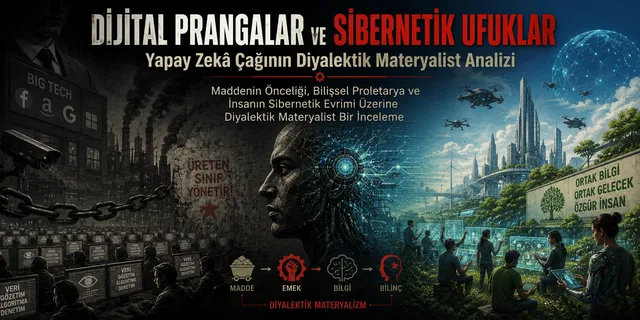
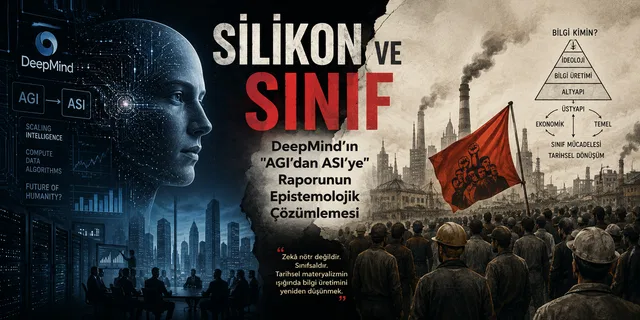
Today, the instruments of mental production are in the hands of global data centers, fiber-optic cable networks, and Silicon Valley monopolies. Capitalism no longer produces only shoes, automobiles, or weapons; it also manufactures the "subjectivities" (human minds) that will consume those commodities, submit to the lawlessness the system creates, and perceive poverty as individual failure. Our minds are the newest and most profitable terrain of exploitation occupied by capital accumulation.
Lenin, Reflection Theory, and "Post-Truth" as an Epistemological Weapon
The most insidious philosophical maneuver the ruling classes resort to in governing perception is severing the masses' connection to "objective reality." At precisely this point, Vladimir Lenin's philosophical analyses in Materialism and Empirio-criticism serve as a historical mirror. Lenin builds his epistemology on Reflection Theory. According to this theory, there is an objective material reality independent of us and our consciousness. Our sensations and consciousness are (practically tested) reflections of that material reality in our minds.
Modern bourgeois ideology (under the mask of postmodernism) denies the existence of objective reality. The era now called "Post-Truth" is in fact an operation to destroy objective truth so that capital can impose its own truth. The thesis that "there is no such thing as reality, only different interpretations and perceptions" is the ground on which every form of lawlessness and exploitation is legitimized. If there is no objective reality, then the hunger of a minimum-wage worker is not an "objective injustice" but merely a matter of "perception." The apparatuses of power use this distortion to recode poverty as "ingratitude" and unemployment as "lack of entrepreneurship." Lenin's warning is precisely here: every epistemology severed from objective reality serves the illusions of the bourgeoisie.
The Classics and Soviet Literature: The Construction and Demolition of Alienation
Mass manipulation produces enormous alienation in human beings. People become alienated from their own labor, their nature, and their mental capacities, turning into passive objects of the system. Marxist classics and Soviet literary intelligence offer the strongest historical practices for how this cognitive captivity can be broken.
Maxim Gorky's novel Mother is the clearest narrative of this epistemological leap. At the beginning of the novel, workers numbed by Tsarist despotism, religion, and alcohol see the misery they live in as "God's unchanging fate" (manipulated perception). Pavel and his mother Pelageya's encounter with revolutionary practice is not merely a political act but the shattering of the false reality in their minds. The moment they see objective reality (the class contradiction), manipulation collapses.
Mayakovsky, the stormy poet of the same era, brings a philosophical sledgehammer down on the bourgeoisie's numbing, melancholic conception of art with his futurist and agitational poetry. His art exists not to lull the masses but to awaken them. The characters in Chernyshevsky's What Is to Be Done? are models of the "new human" who do not surrender to rotten social perceptions but collectively construct their own rational ethics. This literary legacy shouts to us: Submission is not our nature; it is an illusion imposed on us; consciousness can be reclaimed through struggle.
The Hegemony of the Digital World: Algorithmic Exploitation and "Echo Chambers"
In the modern era, manipulation is not carried out through crude old-style propaganda. Contemporary mass media and AI-powered algorithms wage a micro-level war that targets our nervous systems, our dopamine releases, and our cognitive vulnerabilities directly. As Byung-Chul Han identifies in Psychopolitics, the system no longer exploits our bodies through coercion but voluntarily exploits our minds through the lies of "freedom" and "self-realization."
The most critical philosophical/technological weapon of this digital perception management is the Echo Chamber. An echo chamber is the situation in which algorithms (Twitter, Instagram, TikTok, YouTube, etc.) surround us only with content that confirms our own beliefs, anger, and prejudices. From a Marxist perspective, the echo chamber is not a simple technological glitch; it is a structurally designed isolation cell intended to fragment class solidarity.
In the past, workers who labored in the same factory and suffered the same exploitation could witness one another's objective reality in a shared physical space and develop a common class consciousness. Today, two workers sitting side by side are drawn into entirely different hostilities (culture wars, anti-immigrant sentiment, fake identity crises) because of the different algorithmic realities reflected on their screens.
Algorithms keep us on the screen by making us angry, but to prevent that anger from turning toward capital, they divert it horizontally — toward our own class siblings. Echo chambers prevent the formation of a universal class consciousness; they divide the masses into narcissistic, paranoid, and mutually hateful small tribes that hear no voice but their own. As Mark Fisher expresses with the concept of "Capitalist Realism," under this digital bombardment our minds are so paralyzed that imagining the end of capitalism becomes harder than imagining the end of the world.
Praxis, the Street, and Building the Human of the Future
Karl Marx makes that historic call in the 11th Thesis on Feuerbach: "The philosophers have only interpreted the world, in various ways; the point, however, is to change it." This sentence is the ultimate boundary line of epistemology. For a Marxist philosopher, knowing is not merely a mental grasp or a passive intellectual luxury; it is the will to change the world. The path to tearing down this enormous curtain of illusion that governs our perceptions passes precisely through action.
From Digital Isolation to Flesh and Bone: The Epistemology of Standing Side by Side
The most refined success of the rulers in the modern era is that they have separated us from one another and imprisoned us behind screens, in that sterile and artificial loneliness. Masses who experience a false satisfaction through "likes," "retweets," or keyboard rage unknowingly become passive data objects feeding capital's databases.
- Touching a Real Human Being: Today the most radical, most revolutionary act is to break free from those pixels, look into a real person's eyes, stand side by side, and feel their breath, anger, and hope in your flesh and bone.
- The Class Power of Physical Proximity: The one thing digital illusions cannot bend and algorithms cannot manipulate is that authentic, materialist bond two people establish when they stand shoulder to shoulder. Solidarity is not a social media trend; it is an objective force created by human warmth, shared pain, and shared desires.
The Call of the Street and the Workplace: Organization Is Everywhere
An epistemological line of resistance cannot be drawn in ivory towers, in theoretical debate halls alone, or on virtual networks. The true laboratory of consciousness is where exploitation and lawlessness are lived in their most naked form — in the material world.
- At the Workbench, in the Office, on the Construction Site: In the factory, in the plaza, on the courier's motorcycle, or in the mine... Wherever exploitation is, there too consciousness will awaken and shatter the dominant perception. Every authentic bond you forge with the worker beside you at the workplace is a concrete blow struck against capital's perception management that isolates you.
- In the Street and in the Flow of Life: The street is the greatest antidote to the bourgeoisie's strategy of locking the masses in their homes, atomizing them, and subduing them with fear. Wherever people are — in the neighborhood, at school, in the street — standing side by side means throwing the passive script the rulers wrote for us into the trash. To organize is not an abstract ideological mold; it is the act of making life common and taking control of that life back from capital's hands.
From Passive Puppets to Active Subjects: Taking Ownership of Our Lives
Capitalist psychopolitics wants us to be passive spectators who sit and watch the world from television or phone screens, who cry only for themselves, and who choose one of the false luxuries the system offers. It aims to turn us into consumption puppets whose strings are in the hands of algorithms and dominant media. Yet historical materialism whispers a very basic truth to us: Social transformations are not brought about by grace descending from above but by active humans who make history with their own hands.
Rejecting Fatalism: In the painful but hopeful dawn of Soviet literature, Chernyshevsky's immortal question still stands before us: "What Is to Be Done?" The answer is to give up being passive spectators, to stop waiting for life to hit us, and to take the reins of our pain, our labor, and our rights into our own hands.
Sitting and waiting our turn, pining in our corner for "someone to save the world," is voluntarily surrendering to the ruling class's mechanisms of manipulation. We must build the human of the future — who refuses to be played like a puppet and takes ownership of their own life and tomorrow — from today, from our practice in this very moment. The human of the future is not one whose consent is manufactured in laboratories but one who unites their will with class siblings and collective reason.
We must shatter the glass of our echo chambers, step outside our virtual tribes, and descend into the street of real-life class solidarity, organized reason — that is, praxis. Those who govern us and try to bend our perceptions are not mystical, invisible gods; they are a concrete class whose interests are built on our destruction. And history has shown that no illusion is permanent before an organized people. We need only remember the tremendous power of being active subjects and take ownership of our lives.