Digital Shackles and Cybernetic Horizons — A Dialectical Materialist Analysis of the Age of Artificial Intelligence
A Dialectical Materialist Inquiry into the Priority of Matter, the Cognitive Proletariat, and Humanity's Cybernetic Evolution

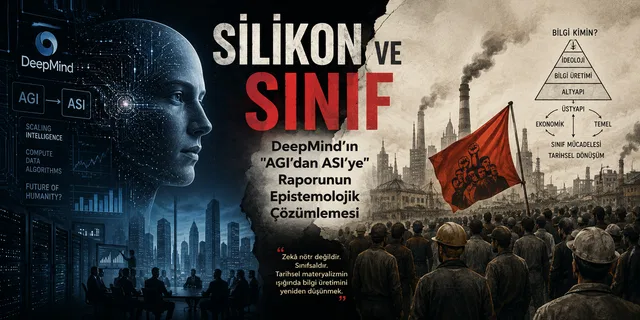
Silicon Valley's technocrats appear quite skilled at selling humanity a new theology. Concepts such as the "Singularity," uploading consciousness to the cloud, digital immortality, and transhumanism are nothing but secular promises of paradise invented to escape the crises of late capitalism, approaching ecological catastrophe, and deepening class contradictions. The religious dogmas once used to lull the masses have today given way to algorithmic promises and silicon-based miracles. Bourgeois ideology seeks humanity's salvation not in social revolution but in the nanometric shrinkage of microchip architecture.
Yet as Marxist epistemologists and theorists of the future, our task is to expose the material reality behind this technological glitter: production relations, property regimes, and the dialectic of nature. We must wage the relentless philosophical struggle Lenin waged against the followers of Ernst Mach and Richard Avenarius in Materialism and Empirio-criticism—today against the gurus of artificial intelligence. Lenin wrote:
"Matter is a philosophical category denoting the objective reality which is given to man by his sensations, and which is copied, photographed and reflected by our sensations, while existing independently of them."
Today too, the digital world, cloud systems, and neural networks cannot step outside this objective reality; on the contrary, they carry its sharpest contradictions within themselves.
The Purpose of This Article: What Are We After?
This philosophical expansion and analytical routine is not merely a futurist intellectual exercise. Through this work we pursue three fundamental goals:
- Demolish Cognitive Commodity Fetishism: Decode bourgeois propaganda that presents AI as a mystical "subject" independent of humanity. Show that AI is in fact a form of humanity's accumulated collective labor (dead labor) expropriated by capital.
- Clear the Epistemological Threshold: Block Silicon Valley's distortion of "consciousness," "being," "intelligence," and "reality"; restore these concepts to their materialist and scientific ground.
- Map a Cybernetic Battlefield: Neither reject technological progress with Luddite dogmatism nor sanctify it with technocratic blindness. Our aim is to map the dialectical rift between these technologies' dystopian limits under capitalist property relations and their emancipatory potential in a socialist planned economy.
What Should a Realistic Future Analysis Look Like?
Bourgeois futurism (Ray Kurzweil, Elon Musk) falls into the trap of "technological determinism" when analyzing the future. For them, technology is a magical force advancing independently of social relations and shaping society. This is a wholly idealist and false vision of the future.
A realistic future analysis must be dialectical and historical materialist. It rests on three pillars:
1. The Material Limits of Infrastructure (Physical Realism)
A realistic analysis knows that the "virtual" never hangs entirely in the air. Running AI models requires cobalt mined by child laborers in Africa, billions of liters of clean water to cool massive data centers, and enormous electricity from nuclear and thermal plants. Future analysis cannot ignore the ecological and raw-material limits of digitization. The essence of the virtual is a savage materialism.
2. The Contradiction Between Productive Forces and Production Relations
Marx's most fundamental law is in force: Productive forces (AI, automation, quantum computers, Neuralink) are in structural conflict with existing production relations (private property, profit motive, nation-state borders).
- Under capitalist reality: AI does not liberate the worker; it renders them unemployed, precarious, and increases the dose of exploitation (through digital surveillance) on those who remain.
- Under socialist reality: The same AI is the key to reducing working hours to ten per week, liquidating forced labor, and planning social needs flawlessly (a modern Project Cybersyn vision).
3. Class Struggle Moving into the Cognitive Realm
A realistic future analysis does not see humanity's "neural connection to the system" (Neuralink, etc.) as biological fantasy but as the outer frontier of class struggle. Future war will move from factories and streets directly into the cognitive realm—the neural networks where thought is produced and controlled. Whose mind will be formatted by which algorithm, in whose class interest—that is the essential political question of the future.
A realistic future analysis promises neither a utopian pink cloud nor an inevitable cyber-dystopia. It tells us: Technology does not determine what the future will be; the future is determined by which class seizes ownership of that technology.
From this fundamental philosophical threshold, let us deepen all your vital questions about AI, digital existence, and the cybernetic future through a systematic "explanation routine" filtered through dialectical materialism.
Ontological Foundations: Being, Consciousness, and the Material Limits of the Virtual
The philosophical fantasy Silicon Valley calls "Simulation Theory" (Nick Bostrom and followers) is not new in the history of philosophy. What we face is Bishop Berkeley's eighteenth-century subjective idealism or Ernst Mach's solipsistic frenzy at the start of the twentieth century—"the world is only the sum of our sensations"—repainted and remarketed with quantum computers and fiber-optic cables.
Against this digital idealism that reduces reality to a code sequence, we must defend the positions of materialist ontology and epistemology more radically than ever.
The Priority of Matter and the Deconstruction of "Virtual" Ontology
The answer to "What is being?" is the borderline of dialectical materialism. Friedrich Engels declares in Anti-Dühring that the real unity of the world lies in its materiality. Being is the objective material world that exists independently of the human mind, algorithmic systems, or the voltage of server farms.
So where do we place ontologically what we today call the "virtual environment" or "digital existence"?
- Dependent Ontology: The virtual environment is not a substance existing in its own right. It is a derived, dependent layer of reality arising from the organization of physical matter (silicon chips, rare earth elements, copper cables, electromagnetic waves) in a particular form.
- Reflection Theory: Lenin's reflection theory developed in Materialism and Empirio-criticism applies to the digital world too. A three-dimensional simulation on a computer screen or text produced by AI is a reflection of objective reality converted into code, abstracted, and reproduced through human labor.
- Commodified Abstraction: Under capitalism, virtual existence becomes less a tool for making sense of the objective world than a tool for appropriating it. A digital asset (land in metaverses, digital goods) is nothing but the copying of scarcity and property relations from the material world into the virtual for profit.
The Dialectical Genesis of Consciousness: Ilyenkov and the Role of Labor
Past crude materialists (Ludwig Büchner, Jakob Moleschott) claimed "the brain secretes thought as the liver secretes bile." Today's Silicon Valley technocrats are in the same pit of crude/mechanical materialism: for them the brain is "hardware" and consciousness is "software." Therefore once a sufficiently powerful processor (CPU) is built, consciousness will spontaneously exist.
This is a philosophical inadequacy. Consciousness is not an isolated secretion of a biological organ alone, nor an algorithm.
Ilyenkov's Ideal Concept: The great Soviet philosopher Evald Ilyenkov solved the secret of consciousness and "the ideal" in Dialectical Logic. For Ilyenkov, consciousness is a function of humanity's activity of transforming nature through social labor practice. As humans transform the external world, they "idealize" the forms of objects in their minds.
- Consciousness is social. A human alone, without language and social production relations, could not have consciousness.
- AI and neural networks do not carry out social practice. They do not feel hunger, do not enter a metabolic relation with nature to survive, belong to no class, and above all do not expend labor.
- To claim AI has "consciousness" is the extreme point of commodity fetishism Marx discusses in Capital. Humans load their collective intelligence and labor (their data) into the machine; then they stand before the machine and say, "This machine came alive, it thinks!" and begin worshipping the object they produced.
The "Mind Uploading" Fantasy: An Idealist Delusion
Transhumanists' greatest promise is to map all neural networks in the human brain (connectome), upload them to a computer, and reach "digital immortality." This fantasy is philosophically doomed because it severs humans from their historical and biological wholeness.
- Metabolic Rift and the Body: Human mind cannot be isolated from the body. The brain is in continuous dialectical interaction (metabolism) with the endocrine system (hormones), gut flora, heartbeat, and nerve endings. Emotions such as fear, enthusiasm, revolutionary anger, love, or hunger are concrete biological processes. What will be transferred to a hard disk is not these living processes themselves but only their static shadows and mathematical projections from the past.
- The Material Limit of Free Will: A disembodied "consciousness" simulation cannot suffer. A being without risk of death, without biological limits, cannot have ethics, law, politics, or therefore philosophy. With the promise of immortalizing the aging bodies of the ruling class, capitalism aims to destroy all the concrete and historical dynamics that make us human—to reduce humans to a flawless, obedient data packet.
The Savage Materialism of the Virtual: The Factory and Mine Behind the Cloud
The word "Cloud" is one of the greatest mystifications bourgeois ideology has created. It whispers that technology is weightless, clean, spaceless reality suspended in air. Yet behind the virtual lies capitalism's most savage, most primitive, most ruthless materialism.
When we adapt Karl Marx's theory of metabolic interaction between nature and society to today's digital world, the material limits of the virtual emerge in full nakedness:
[Virtual World / AI]
       │
       ▼ (Depends on)
[Massive Data Centers (Server Farms)]
       │
       ▼ (Consumes)
[Material Infrastructure: Power Grids, Rivers (for cooling)]
       │
       ▼ (Exploits)
[Nature and Proletariat: Lithium, Cobalt Mines, Heavy Manual Labor]
- Ecological Cost: Training and keeping a single large language model (LLM) running requires electricity equivalent to a medium-sized country's consumption. Rivers are diverted to cool data centers; billions of liters of clean water evaporate.
- New Colonialism and the Digital Proletariat: Behind AI's flawless algorithms stand children mining cobalt in lethal conditions in Congo, hundreds of thousands of "digital backstage workers" in the Philippines or Kenya labeling AI data for a dollar an hour, their psyches shattered cleaning violent and pornographic content.
The virtual is not escape from matter but the space where matter, nature, and human labor are exploited at the highest level by capitalist monopolies. Philosophically, we have reached an age where illusion has digitized but exploitation and matter have hardened all the more.
The Epistemological Threshold: Is AI Really Intelligent?
The greatest success of capitalist media and technology monopolies was getting the masses to accept the term "Artificial Intelligence" as a marketing miracle. Yet philosophically there is neither organic "intelligence" nor an independent epistemological subject. What we face is the most radical objectified form of humanity's collective intellectual accumulation—living labor—expropriated by capital.
To grasp this threshold correctly we must tear the mystical veil behind algorithms and invoke the relentless laws of epistemology.
Algorithms as the Highest Form of "Dead Labor"
When defining machines and the factory in Capital, Karl Marx uses a striking concept: Dead Labor. The lathe or machine in the factory is frozen, crystallized living labor expended by other workers in the past. The machine does not produce value on its own; only when operated by the worker does it transfer the dead labor accumulated in its body piece by piece into the new product. In Marx's words: "Capital is dead labor that, vampire-like, lives only by sucking living labor, and lives the more, the more labor it sucks."
Systems sanctified today as AI (LLMs, deep learning models, etc.) fit this definition exactly.
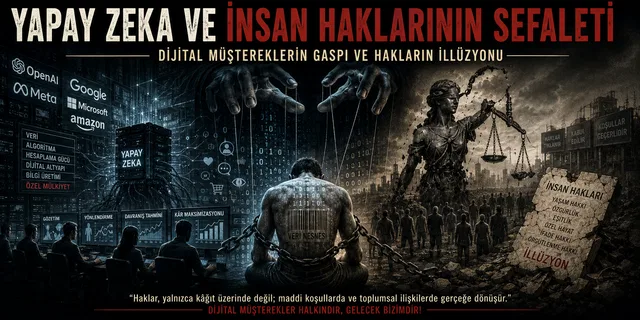
- Cognitive Primitive Accumulation: Training an AI model plunders billions of texts, artworks, software code, and human interactions on the internet. This data pool is living cognitive labor produced historically and socially by humanity. OpenAI or Google expropriates this pool, achieving digital "primitive accumulation."
- Fetishism of the Machine: AI has not become a subject and begun to "think"; capital has frozen the dead labor of billions of people inside complex mathematical matrices. To kneel before the machine and admire its "intelligence" is precisely the commodity fetishism Marx described: humans kneeling before the object they produced (data and algorithm), attributing mysterious powers to it.
Lenin, Epistemology, and the Practical Criterion (AI's Ontological Flaw: Hallucination)
Against idealist philosophies in Materialism and Empirio-criticism, Lenin defends epistemology's most fundamental law: Our sensations and consciousness are a copy, photograph, or reflection of objective reality. The ultimate judge of that reflection's truth is social practice. Humans learn the objective world by producing, transforming nature, and erring.
AI faces an epistemological threshold it cannot cross: It has no practical connection to the external world.
AI does not sense the world; it calculates the statistical arrangement of symbols that depict the world. For an AI model, the word "bread" does not mean oven, hunger, or wheat field; it is the probability of that word appearing next to other words in the dataset (e.g., "oven" or "food").
The most concrete proof of this ontological rupture is AI's famous hallucination problem. AI sometimes produces entirely fabricated historical events or nonexistent scientific papers. Bourgeois engineers see this as a "bug" to be fixed. Philosophically, hallucination is an epistemological flaw in AI's nature: a system not anchored to objective reality and social practice, turning only in a world of linguistic probabilities, is by nature a consistent liar. It does not produce meaning; it performs high-probability symbol manipulation. John Searle's famous "Chinese Room" argument is literally confirmed today in billion-dollar AI servers: the man in the room matches Chinese characters by rules but does not know Chinese.
Bourgeois Anthropomorphism: Why Do They Want to Dehumanize Intelligence?
Why does late capitalism insist on endowing AI with "human-like" (anthropomorphic) traits and attributing "consciousness" to it? The answer is ideological and directly concerns class struggle.
[Capital Owner / Oligarch]
       │
       ├─► Devalues Living Labor: "Look, the machine thinks like you too!"
       ├─► Shifts Responsibility to Algorithm: "AI decided your layoff."
       ▼
[Cognitive Proletariat's Submission]
- Devaluation of Labor Power: If the machine "thinks" and is "creative," human labor ceases to be a special privilege. Bourgeoisie waves AI like Damocles' sword over the working class to lower the value of labor power: "AI can write the code and do the design you do, so you must accept lower wages."
- Algorithmization of Responsibility: Class decisions (layoffs, credit scores, surveillance policies) are transferred to AI algorithms and dressed in an "objective and scientific" cloak. It is no longer the boss who fires the worker but the "objective algorithm." This is the bourgeoisie's way of evading historical responsibility.
Contemporary Approaches: Baudrillard and Epistemology at the Limit of Hyperreality
Modern philosophy's concepts of "Simulation and Hyperreality," especially Jean Baudrillard's, can be used—after a materialist revision—to understand the epistemological crisis of the AI age. AI produces the imitation (simulation) of reality so intensely and rapidly that at a certain point "reality itself" becomes a derivative of that simulation.
Unlike Baudrillard, however, we do not claim objective reality disappears within hyperreality. We say: The difference between virtual and real has not vanished; only the contradiction between them has sharpened. AI's flawless deepfake videos, disinformation waves, and algorithmic manipulation are ideological weapons aimed at blocking the working class's channels to truth. In this epistemological age, defending truth is no longer only a philosophical stance; it is directly a political and class form of resistance against the ruling class.
| Dimension | Material Reality | Virtual / Simulated Environment |
|---|---|---|
| Essence | Objective matter, biological metabolism, historical labor. | Algorithmic abstraction dependent on energy infrastructure. |
| Quality of Intelligence | Purposeful, practicing, transforming, suffering living mind. | Statistical, deterministic, past-data-dependent imitation. |
| Form of Exploitation | Direct surplus value expended in factory, office. | Data mining, attention extraction, cognitive proletariat. |
Existential Crisis of the Individual in the Digital Age and Hyper-Alienation
The structuring of AI as dead labor and the substitution of simulation for reality on the epistemological plane ultimately strikes human existential conditions as a concrete subject. The famous alienation (Entfremdung) theory the young Marx depicted for the worker under capitalist production in the 1844 Economic and Philosophical Manuscripts has evolved for the modern individual caught in smartphones, algorithmic feeds, and digital identities into a phase of "hyper-alienation."
Capitalism no longer colonizes only the muscular power the worker expends in the factory; it colonizes the individual's attention, desires, leisure time, and subjectivity itself.
Four-Dimensional Digital Alienation: Rereading Marx
Marx examines classical alienation in four compartments. Today these four dimensions have been mutated and deepened by the digital world:
- Alienation from One's Own Product: The factory worker could not drive the car they produced; in the digital world the individual is alienated from the data they produce. Every day we build a massive database through posts we like, searches we make, digital footprints. This raw material we produce is processed by technology monopolies and erected before us as an algorithmic monster that manipulates us, buys our attention, and forces us into certain consumption patterns. Our product has become a ruling power that governs us.
- Alienation from the Act of Production: Living and communicating in the digital age is continuous "free labor" performed without awareness. Scrolling social media, producing content, or spending time on a platform is no longer rest but production action imprisoned in the accumulation process of cognitive capital. The individual transforms life itself into an assembly line while completely disconnecting from what their action serves.
- Alienation from One's Species-Being (Gattungswesen): For Marx, humanity's species-being is free, conscious, creative activity. Digital capitalism reduces human creativity and thought to algorithmic templates. To capture an algorithm's attention, the individual begins to think, write, and produce according to its parameters. "Search engine optimization" (SEO) or "engagement rates" are new ideological shackles drawing the boundaries of free thought and creativity. Humans alienate themselves from their own authentic capacity to think by conforming to the machine's language.
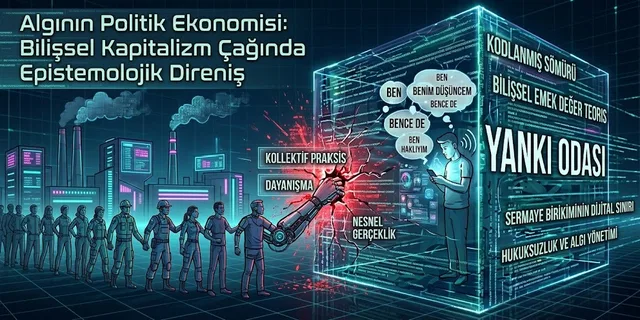
- Alienation from Other Humans: Digital platforms claim to keep us "connected" while radically atomizing us. Concrete, historical, and class bonds between people are severed; in their place come artificial camp formations in algorithmic echo chambers. The other person is not a "comrade" with whom we will transform the world together but an "image" on a digital screen to be liked or lynched—a digital object of display.
Reification and Self-Branding: Lukács's Prophecy
The great Marxist theorist György Lukács said in History and Class Consciousness that in capitalism's mature phase the mechanism of reification would envelop all of society. Reification is when social relations between people take on the character of relations between things and human consciousness itself hardens like an object.
The digital world has brought reification to its ultimate limit. Today, to exist in the digital universe, the individual must package personality, emotions, pain, and political stance like a commodity.
The contemporary ideology called "Self Branding" is the philosophical name for the individual's total alienation from their own subjectivity, seeing themselves as a digital profile object (sign) to be sold on the market. The individual is now simultaneously worker, raw material, and seller of themselves.
Psychopathology of the Cognitive Proletariat: The Exhaustion Society and Depression
This hyper-alienation process is not only a theoretical crisis but concrete psychological devastation in the individual's body and mind. The unshakable human will in Nikolay Ostrovsky's Soviet classic How the Steel Was Tempered—biting down and giving one's life for a social purpose—is deliberately paralyzed today by digital capitalism.
- Continuous Stimulation and the Attention Economy: The capitalist market profits by exploiting the individual's attention span. Notifications every minute, infinite scroll mechanisms seize the brain's dopamine system, making deep philosophical thought, organizing class anger, and collective focus impossible.
- The Political Economy of Exhaustion and Depression: The modern individual works 24/7 under the illusion of being "their own boss" (under the mask of freedom). Even in bed at night they continue producing data for capital through social feeds. This triggers the mass psychic collapse Mark Fisher discusses in Capitalist Realism. Depression, anxiety, and burnout are not biological failures but inevitable ontological damage the digital mode of production inflicts on the individual.
The Digital Panopticon and the Manufacture of Subjectivity
Philosophically, at this stage the individual's existence is shaped not by external coercion but by being made to desire from within. We are under algorithmic surveillance surpassing Michel Foucault's panopticon model, backed by big data.
Bourgeois states and technology monopolies do not merely watch the individual; through AI algorithms they predict and pre-manufacture the individual's next step, what they will love, which political party will anger them. While believing they decide with free will, the individual moves in a universe of probabilities optimized for them by a central server.
This risks the individual ceasing to be a "subject" and becoming a temporary intersection of data flows—a wholly objectified being. Here precisely lies the existential crisis of the individual in the digital age: being under capital's absolute control in the very sphere where they feel most free.
Cybernetic Horizon: Neuralink, General Intellect, and the Evolution of Communication
The objectification of the individual in the digital panopticon and the manufacture of subjectivity by algorithms bring us to the most radical and dangerous frontier of technological development: the direct integration of the human body and nervous system into the production infrastructure. Elon Musk's Neuralink project, transhumanists' telepathy promises, and "collective intelligence" scenarios are presented in popular science magazines as apolitical technological miracles.
Yet for a dialectical materialist theory of the future, these steps are the logical outcome of capitalism's attempt to incorporate human metabolism and cognitive capacity entirely into its valorization process (profit mechanism). To shatter bourgeois futurism's utopian illusions, we must analyze this horizon along two opposing historical paths, armed with the legacy of Marx and Soviet cybernetic theory.
"General Intellect" and the Material Basis of Technological Evolution
In the "Fragment on Machines" in the Grundrisse, Karl Marx makes a brilliant prediction about capitalism's mature phase: General Intellect. For Marx, with the development of large industry, the creation of wealth will depend less on labor time directly expended and more on how much science and social knowledge are applied to production. Knowledge will become a direct organ of society—a productive force.
Today the internet, AI networks, and brain-computer interfaces (BCI) constitute the concrete, objective infrastructure of this General Intellect. For the first time in history, humanity has reached the technological capacity (productive forces) to connect the entire global knowledge accumulation instantly and exercise collective reason. Projects like Neuralink are attempts to penetrate neural tissue directly, breaching the biological limits of this common mind (the skull wall and the slowness of language).
Yet precisely here dialectic's most fundamental law enters: The magnificent level productive forces have reached no longer fits the narrow molds of existing capitalist production relations (private property, profit motive, class exploitation). This contradiction forces humanity toward two definite and irreconcilable future scenarios.
First Path: Capitalist Enclosure (Fencing the Mind) and the Neuro-Proletariat
If Neuralink and similar body-integrated solutions spread under the current bourgeois property regime and technocapitalist monopolies, the most absolute slavery regime in human history—a cyber-feudalism—will be built. The bourgeoisie that fenced common pastures in sixteenth-century England through Enclosure Acts, dispossessing peasants, today aims to fence our nervous systems and the neural map of our brains.
Cognitive Taylorism and Absolute Surplus Value: Taylorism measured every movement of the factory worker with a stopwatch, submitting even seconds to capital's service. A chip integrated into the brain brings this exploitation directly to the neural plane. Focus duration, fatigue signals, momentary pauses are measured to the millisecond by a central AI. Rest, sleep, even dreams are incorporated into capital's data-mining operation and forced into "absolute surplus value" production.
- Neuro-Class Rift: Since chip technology and cognitive enhancement will be subject to market conditions, society will biologically split in two: a Cyber-Bourgeoisie controlling algorithms, cognitively enhanced, and a new working class whose minds are tied to corporate servers, thoughts filtered and manipulated: the Neuro-Proletariat.
- Absolute Panopticon and Telepathic Slavery: Under capitalism "telepathy" does not mean people freely understanding each other. Telepathy means thought flowing to the central server as raw signal without even passing through linguistic censorship. Bourgeois state and corporations will detect and suppress not only your actions but your as-yet unspoken revolutionary anger, anti-property thoughts through "pre-crime" algorithms. This is the absolute annihilation of subjectivity.
Second Path: Socialist Cybernetics and the Construction of the Noosphere
Yet this dystopia is not inevitable. If the working class seizes ownership of the means of production and these cyber technologies, Neuralink and collective-mind projects become a historical leap toward humanity's genuine emancipation.
Soviet scientist Vladimir Vernadsky called the phase when human mind becomes a geological force transforming nature the Noosphere. In the 1960s Soviet cyberneticist Viktor Glushkov aimed to plan the entire Soviet economy through real-time computer networks with the OGAS project. When production relations are rebuilt on a socialist basis, body-integrated technologies trigger these revolutionary transformations:
Evolution of Communication and the End of Alienation: Language is where class differences, ideological manipulation, and bourgeois hegemony seep most. Direct brain-to-brain communication with empathy and conceptual depth (genuine socialist telepathy) radically destroys artificial walls between people, racial, national, and class prejudices. Humans feel the other's pain and joy not as simulated data but as concrete reality in their own nervous system. This is the final overcoming of alienation.
- Collective Planning and Metabolic Harmony with Nature: The free will and needs of billions can be analyzed in seconds through a common cybernetic network. Which factory will produce what, which resource will flow to which region, can be planned flawlessly by collective mind without leaving it to the market's anarchic blind laws (supply-demand fluctuations). Humanity can manage its metabolic relation with nature rationally without ecological devastation.
Comprehensive Comparison: The Class Intersection of Technology
| Technology / Phenomenon | Under Capitalist Production Relations (Present) | Under Socialist Production Relations (Cybernetic Future) |
|---|---|---|
| Neuralink / BCI | Cognitive exploitation tool, 24/7 surveillance chip, neuro-Taylorism. | Enhancement of human capacity, surpassing biological limits. |
| General Intellect | Owned by tech giants, profit-oriented algorithms. | Common property of all humanity, democratic collective planning apparatus. |
| Telepathic Communication | Mind reading, destruction of privacy, absolute ideological control. | Overcoming linguistic barriers, boundless empathy and collective solidarity. |
| Future of the Individual | Reduced to data packet, atomized hyper-alienated object. | Free subject preserving authenticity while part of collective mind. |
Conclusion: Historical Decision Point and the Cybernetic Revolution
All dialectical links we have dismantled from the start of our analysis bring us to an inevitable philosophical and political crossroads. AI, neural interfaces, big-data algorithms, and digitizing modes of existence are magnificent productive forces humanity has produced within its own historical development. Yet today these forces are held prisoner in the property relations of dying but still colonizing late capitalism.
While Silicon Valley's transhumanist fantasies lull humanity with "technological singularity" tales, in the background the deepest class rift and dispossession operation in history is underway. At this historical decision point we must clarify the realistic philosophical map of the future with three fundamental radical findings:
1. Rejection of Technological Determinism and Overcoming Luddism
Historical materialism teaches us that technology is neither an absolute curse nor a spontaneous recipe for salvation.
- Collapse of Technocratic Idealism: As tech giants claim, AI will not "by itself" make the world fairer, greener, or freer. An algorithm programmed for profit can only serve the optimization of profit and exploitation.
- The Tragedy of Luddism: On the other side, neo-Luddite or primitivist approaches that wholly reject AI and digitization—"let us return to our essence"—are reactionary. The solution is not to smash computers with sledgehammers or unplug the internet. The working class learned through bitter experience in the nineteenth century that it was pointless to be enemies of the loom in the factory; the real enemy was not the loom but the bourgeois owner of the loom. Today too the enemy is not AI but the private property regime over AI.
2. The Highest Stage of Digital Capitalism: Cognitive Primitive Accumulation
The period we inhabit is one where capitalism can no longer develop productive forces further but parasitizes them. Global AI infrastructure and neural networks concentrated in the control of only three or four mega-monopolies (Microsoft, Google, Meta, Apple) is the cognitive-level counterpart of Lenin's Imperialism theory.
Capital no longer seizes only the physical commodity the worker produces in the factory; it expropriates all humanity's common cultural and intellectual heritage accumulated on the internet (General Intellect) and places it in its own monopoly. This is the colonization of cyberspace and the fencing of the human brain as a direct raw-material field. If this course is not cut by social revolution, an algorithmic dystopia where fascism would seem mild for the "Neuro-Proletariat" under cyber-bourgeois absolute surveillance becomes inevitable.
3. Class Struggle Moving into the Cognitive Realm and the New Subject
So who will break these digital shackles? Where are the unforgettable collective heroes of Soviet literature—the steelworkers in factories, the peasants in fields—today?
The proletariat has not disappeared; on the contrary, through dialectical transformation it has spread into the cognitive and digital realm.
The modern working class encompasses the blue-collar factory worker together with the subcontractor in Kenya labeling AI data for a dollar an hour, the programmer in Silicon Valley coding eighty hours a week without owning the means of production, the precarious courier raced by app algorithms to the millisecond, and billions of "digital workers" whose subjectivity is exploited before screens.
Cyber class war will begin with this new working class demanding control of the data, code, servers, and AI it produces. The task is not to destroy algorithms but to place algorithmic control at the command of workers' councils, collective mind, and planned socialist economy.
Final Synthesis: From the Realm of Necessity to the Realm of Freedom
When sketching humanity's horizon of salvation in the third volume of Capital, Karl Marx makes a captivating distinction: the Realm of Necessity (Reich der Notwendigkeit) and the Realm of Freedom (Reich der Freiheit). The realm of necessity is the phase where humans must expend labor to survive, eat, and shelter—struggling with nature and scarcity. The realm of freedom begins where this forced labor ends and humans truly self-realize through philosophy, art, science, and free communication. Marx writes: "The realm of freedom begins only where labor determined by necessity and external ends ceases."
Precisely here, AI and cybernetic technologies constitute the ultimate material lever that can carry humanity from the Realm of Necessity to the Realm of Freedom.
[Present Capitalist Order] ──► AI ──► Unemployment, Precarity, Hyper-Alienation
                                                │
                                                ▼ (Socialist Revolution / Expropriation)
[Cyber-Communist Future]   ──► AI ──► Liquidation of Forced Labor, Realm of Freedom
- Liquidation of Forced Labor: Under common ownership of the means of production, forced social tasks are taken over by machines through AI and advanced automation. Daily working time falls to one or two hours. Humans are freed from livelihood anxiety and the obligation to market themselves as a commodity (self-branding).
- Noospheric Awakening: When Neuralink and telepathic communication models are taken from profit-chasing oligarchs and offered to humanity's common development, existential crises produced by individual egoism and bourgeois individualism are resolved. Humanity leaps to a universal, communist level of existence where each individual preserves authenticity while connecting without mediation to all humanity's collective mind (Noosphere).
Philosophically, the age we have reached may be the final slavery where humanity is crushed under the machines it created—or the cyber-communist dawn where it makes machines its organ of freedom.
What will determine the future is not the perfection of code but the organized will of the oppressed classes and their resolve to take back the servers, mines, and algorithms in the hands of the rulers.
The machines are ours, the data is ours, the future is ours!