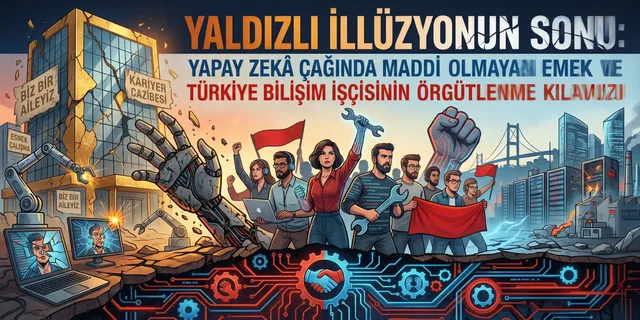
On the Threshold of Bilişim-Sen: Looking to the Future Through the Mirror of History
From Turnstiles to Squares: A History of IT Labor and the Class Struggle of White-Collar Workers in Turkey

From Loneliness at the Keyboard to the Class Podium
The IT sector today, behind the bright screens, the jargon-laden title games, and the "we are a family" refrains, harbors one of the most refined mechanisms of exploitation in history. This digital makeover—which, under the name of flexible work models, turns our homes into offices and occupies every moment of our lives with Slack and Teams notifications and Jira tasks—is in fact a technological version of the savage work order of the 19th century. From the developer to the system administrator, from the test specialist to the data labeler, all IT laborers are being isolated within illusions of corporate belonging and dragged into a deep burnout.
The only way to break this chronic isolation, to take our problems out of the labyrinth of individual bargaining and transform them into a creative collective power, is organized struggle. But as we, as Bilişim-Sen, begin to walk along a class line, the first rule we must not forget is this: History is not invented in a laboratory; it is built upon experiences lived in the street, in the plaza, and in the factory.
Why Must We Examine and Evaluate the Past?
Knowing that IT laborers are not starting their struggle for union rights from scratch is vital both for tearing down our mental barriers and for being able to produce proactive strategies oriented toward the future. Passing past union experiences through an objective filter of criticism is obligatory for these three fundamental reasons:
- Overcoming Representation and Class Illusions: Sector workers seeing themselves for a long time as being "in a privileged position" prevented them from acting as part of the working class. The historic IBM Turk unionization struggle of 2008 and the Plaza Protests that developed in its wake are the first great historical laboratory that shattered this illusion. Examining the struggle that engineers and technical staff conducted at that time under the roof of Tez-Koop-İş is the first step in understanding how technical training can be blended with class identity.
- Recognizing Capital's Defense Mechanisms: The tactics the bourgeoisie develops against the wave of organizing change shape over time. The IBM management attacking the union's authorization with fraudulent objections over the branch of industry, firing the union representatives, or resorting to sudden wage increases to break the protests are the classic capital reflexes we will encounter today as well. Likewise, the tent resistance of the Casper Bilgisayar workers under the banner of Birleşik Metal-İş in 2011 offers a concrete memory of how bosses can become aggressive when union authorization is gained in IT. A union mind that cannot read these moves is doomed to stall at the first bend.
- Seeing the Limits of Network Organizing and Digital Activism: Structures established in the past, such as the Plaza Action Platform (PEP) and the IT and Communication Workers Solidarity Network (BİÇDA), accomplished enormous things in carrying white-collar exploitation into the public sphere. But it is also a fact that a solidarity sustained only over internet environments and loose networks, independent of class consciousness and a social-economic base, cannot produce lasting structural gains. While using social media as a professional means of announcement and ideological reproduction, it is thanks to these experiences that we grasp that the real power lies in the initiative of the base and in physical workplace committees.
Experience Is the Will to Learn From Mistakes
Building the unionism of the future is possible by rejecting the hierarchical maladies of traditional union bureaucracy, without falling into the "competence traps" of the past. Bilişim-Sen aims to solve the branch-of-industry confusion that leaves IT workers without an address through the Branch of Industry No. 10 (Commerce, Office, Education, and Fine Arts), which is legally the common ground for all of us, and to establish a horizontal shared living space that tears down vertical pyramids.
As we begin this march, we must approach the rich treasure of labor history accumulated behind us not unprepared, but with a normative, analytical, and lesson-drawing vision. Every lesson learned from mistakes, unfinished resistances, and how capital uses legal loopholes (outsourcing/subcontracting, out-of-scope personnel games) will be the sharpest weapon of Bilişim-Sen at the collective bargaining tables it will set up tomorrow.
The mind that produces tomorrow's technology today will examine its own history, extract a collective maturity from prior experiences, and put an end to the savage exploitation of the 19th century in the digital world.
The Conceptual Illusions of White-Collar and IT Labor
The neoliberal phase of capitalism, especially with the spatial and technological transformations after 1980, accelerated the strategy of dividing the labor process into fragments along mental and physical categories. The most concrete ideological product of this strategy is the discursive illusion that leads the university-educated mass—working in offices and plazas, selling their mental labor—to see themselves as a stratum separate from the working class, "privileged," or "middle class." Viewed through an analysis of labor exploitation, the claims that white-collar workers, and more specifically IT laborers, are an aristocratic stratum are nothing but the packaging of the dominant discourse. While the dominant discourse markets these workers entirely as "intellectual, creative, free subjects who manage their own work process," it deliberately ignores the objective capital-labor contradiction behind production.
Yet the white-collar or IT worker is, in essence, a proletarian subject to the Labor Law, who earns a living by selling their (mental or technical) labor for a wage and is deprived of ownership of the means of production. Karl Marx's prediction about commerce and office workers nearly 150 years ago—that, with the expansion of commercial capital, these workers' skills would undergo standardization and their wages would inevitably fall—is today the naked reality of the developers, data analysts, and system specialists writing code in the dim rooms of the plazas. As capital's control and domination over mental labor deepen, software development practices are standardized, automated, and the engineers' relative autonomy over their work processes is pruned away.
As long as the IT laborer sees themselves as "privileged," they have stayed away from union struggle and collective reflexes, and this lack of organization has created for capital an oasis of unregulated, flexible, and boundless exploitation. Therefore, the history of IT and white-collar labor harbors, on the one hand, the ground of "disorganization and isolation" created by this illusion, and on the other, the story of these masses' inevitable "proletarianization" and awakening to class consciousness under crises and worsening working conditions.
Early-Period White-Collar Organizing in Turkey and the 1960–1980 Legacy
In Turkey, the historical roots of the class reflexes of the technical labor force and white-collar workers, unlike the lines of development in the West, took shape within the bounds of state bureaucracy and legal regulations. While in the late Ottoman period the first worker actions in the modern sense emerged in the form of destroying machinery and seeking rights, the fact that engineers took part in—and even led—worker organizing in the famous strike wave of 1908 shows the early class potential of technical labor. However, the statist economic model and authoritarian bureaucratic structures of the Republic's early years created a long period of disorganization and silence for public servants and technical staff.
The period of genuine rupture and transformation for the technical labor force and white-collar intellectuals was the 1960s. With the relatively libertarian environment brought by the 1961 Constitution, the granting to workers of the right to "collective bargaining with the right to strike" gave enormous momentum to class struggle. The engineers within the Union of Chambers of Turkish Engineers and Architects (TMMOB)—founded in 1954 as a professional organization with the status of a public body—underwent a radical transformation of their initial corporatist and elitist "bourgeois" perspective in the late 1960s and the 1970s. A significant portion of engineers and technical staff began to define themselves as "laborers," refusing any longer to identify their interests with those of capital owners.
Two great touchstones stand out in this period's tradition of white-collar union struggle:
- Sosyal-İş and the 1967 Strike: The Sosyal-İş Union, established independently by Social Insurance Institution (SSK) workers on December 10, 1966, organized a great strike wave at SSK workplaces exactly 59 years before August 2, 2026 (in 1967). This strike entered the history of Turkish industrial relations as the "first civil servant/white-collar strike," proving that office laborers could display class reflexes. Sosyal-İş would later join the ranks of DİSK in 1974 and adopt the line of militant class unionism.
- Technical Staff Unionism and TEKSEN: In the 1970s, with the avalanche-like growth in the number of salaried technical staff in the public and private sectors, engineers, architects, and technicians transcended narrow professional boundaries and organized under structures such as the Technical Staff Union (TEKSEN). The "socialist engineer" line that developed under the leadership of Teoman Öztürk after TMMOB's historic general assembly in 1973 clearly positioned the ranks of technical labor on the side of the working class, the blue-collar workers.
This Marxist theoretical awakening and practical vitality, rising on the ground of the mass production systems of the 1950–1970 period, was one of the most dynamic engines of social opposition until it was suspended by the fascist coup of 1980.
The 1980 Neoliberal Transformation and the "Market Generation" Illusion
The military coup of September 12, 1980, was engineered to radically transform not only the political sphere but also social memory and the labor-capital balance in favor of capital. With the 1982 Constitution and the union laws it brought along, the organized power of the working class was broken, strike rights were restricted, and de-unionization was made a structural state policy. Precisely on this dark climate, the neoliberal policies under the leadership of Turgut Özal, while integrating the Turkish economy into global capital, enormously expanded the service sector and the finance branches.
THE SEPTEMBER 12, 1980 NEOLIBERAL STRUCTURAL TRANSFORMATION
The 1982 Constitution and Repressive Laws > Making the union authorization system more difficult > The whittling away of strike and collective bargaining rights
The Global Integration of the Service Sector > Growth in the fields of finance, IT, media, and advertising > An explosion of young university-graduate employment
The Construction of the "Market Generation" / Yuppie Ideology > "We are a family" refrains and individual careerism > Isolation from class consciousness, alienation from unions
This process led to the inclusion of a new group of actors in the labor market: the "Market Generation," or, in the term used in the literature, the "Yuppies." The young people who graduated from universities in the 1980s and 1990s were employed in the chic and sterile offices of plaza buildings, with promises of glittering career ladders and high wages. Capital injected into this mass the lie that they were not "workers" but organic partners or managers of the company. Through individual employment contracts, salary confidentiality policies, and performance evaluation systems, employees were atomized and set against one another in merciless competition, robbing them of the opportunity to acquire a common class identity.
In the 1990s, with large private companies moving their administrative buildings to the glass towers of the Büyükdere-Maslak axis—the city's new Central Business Areas (CBA)—plazas became not merely workspaces, but the sacred temples of neoliberal work culture. In this order, where "after the turnstile it's a total deluge," white-collar workers internalized working through the nights and weekends as normalcy and consented to the unregulated and precarious flexible work regime. But this glittering dream would not last long; with the 2001 local crisis and the 2008 global capitalist crisis that followed, banks would go bankrupt, and tens of thousands of high-paid career-holding youths would be thrown out of the plazas overnight. The futurelessness and mass layoffs created by the crises would bring an end to the white-collar fairy tale, slamming the reality of "proletarianization" bitterly into their faces.
The Birth, Structure, and Gears of Exploitation of the IT Sector
Information technologies historically emerged as a product of the military-industrial complex and, from the second half of the 20th century onward, rose to the position of the main input of the global capitalist accumulation regime. In Turkey, however, the IT sector developed as a sub-branch lacking a technology-producing industrial infrastructure, completely dependent on the outside, and oriented toward assembly, sales, and services. Rather than being an independent production unit of its own, it serves as a digital network that determines, supervises, and deepens the exploitation of the production mode of all sectors (finance, metal, logistics, textile, etc.).
Although today, when the IT sector is mentioned, the dominant mind understands only a handful of engineers who develop computer software, our line of struggle and organizing rests on a broad definition of the working class that encompasses "everyone whose hand touches a keyboard." This definition expresses an enormous digital proletariat ranging from developers to hardware specialists, from system experts to data center workers, from graphic designers to call center workers, and even to all the office laborers who wear out their lives at a computer in the service sector.
The distinctive gears and structural problems that ensure the continuity of exploitation in the IT sector are as follows:
1. Placeless Exploitation and the Workday With Indefinite Boundaries
For the IT laborer to realize their productivity, there is no need to go to a factory; everywhere there is internet is a field of exploitation. This situation, marketed with the makeover of remote work and flexible work, leads to work enveloping all of life, with the worker remaining constantly connected to the system (on-call) at home, on the road, even on vacation. Daily working hours reach 12–13 hours without any overtime pay being paid, and the IT worker burns out, decoding code even in their dreams at night.
2. Algorithmic Surveillance and the Digital Big Brother
While IT workers think they are "free and autonomous," they are in fact subject to the most heavily dressed-up surveillance mechanisms in history. With spyware similar to Sapience Analytics installed on computers, even the worker's keyboard movements, toilet breaks, and the seconds they stand up to drink water are tracked, and performance pressure is established through data analytics.
3. Divide and Rule: Outsourcing (Subcontracting)
The most strategic weapon of exploitation in the IT world is the outsourcing—that is, subcontracting—system, which the bourgeoisie gilds with a fancy name. The large technology monopolies and banks divide their projects into sub-pieces and pass them to subcontractor firms. The workers in subcontractor firms are made to work without security, without insurance, and on a project basis for low wages.
Because workplaces are spatially fragmented, employee numbers fall below the legal union thresholds, thereby preventing organizing both in practice and legally. The permanent-staff worker, meanwhile, is isolated through a false perception of privilege, seeing themselves as superior to their subcontractor colleague.
Turning Point: The IBM Turk Unionization Struggle and the Plaza Protests (2008)
The first time the problems of IT workers in Turkey and the need for organizing became visible in the public eye was through the historic unionization struggle conducted in 2008 within the multinational US IT monopoly IBM Turk. The legend that IT workers were a "happy minority" in terms of economic and social rights collapsed with the rebellion of IBM's laborers.
THE CHRONOLOGICAL IBM TURK UNIONIZATION PROCESS (2008)
January – March 2008 Nearly 400 IBM workers who had not received a raise for 5 years took action. Secret organizing within the Tez-Koop-İş Union, affiliated with TÜRK-İŞ.
March 26, 2008 The legal majority was surpassed at the workplace, 50% of whose staff were engineers. An official collective bargaining (TİS) authorization application was filed with the Ministry of Labor.
June 11–17, 2008 The Ministry approved the authorization and notified IBM management. IBM management raised a forced objection, claiming "the branch of industry is not appropriate."
November 2008 To break the organizing, 3 union representatives were fired: Nedim Akay, Elvan Demircioğlu, Berk Alev.
December 3, 2008 The historic "Plaza Protests" began in front of Levent Yapı Kredi Plaza. For 8 weeks, a mass protest every Wednesday during the lunch break.
The IBM Turk employer, in order to break the union majority, first fired the veteran department manager Can Özler, who had taken the side of the workers; then, against the official authorization determination approved by the Ministry of Labor, it filed a forced objection lawsuit at the Sirkeci 7th Labor Court on the grounds that "the workplace majority was not achieved and the office branch of industry in which the union is situated is not appropriate." While the legal process continued, in order to sabotage the union's resistance, the company's three workplace representatives (Nedim Akay, Elvan Demircioğlu, Berk Alev) were dismissed one day apart.
Against this aggression, the IBM workers, together with the professional chambers and unions, launched the historic "Plaza Protests" on December 3, 2008, in front of Yapı Kredi Plaza, the first plaza of the Büyükdere-Maslak axis. Every Wednesday during the lunch break, hundreds of white-collar workers descending from the plazas stood shoulder to shoulder with professional chamber representatives and other resisting workers, crying out their class voices in the heart of the city. IBM management, in order to head off the organizing, was forced to hastily give 80 percent of its employees a 25 percent raise.
As a result of the long legal struggle, the Court of Cassation ruled that none of the three dismissed union representatives had been fired for just cause, handing down a historic reinstatement decision. The IBM Turk unionization experience, in representing the effort to transition from traditional professional organizing to mass worker unionism and in white-collar workers gaining visibility in the public sphere against bourgeois corporatism, is one of the brightest pages in the history of IT labor.
From Plazas to the Streets: The Rise of Organizing Networks (PEP, BİÇDA, ÇMÇ-DER)
The driving effect and class revival created by the 2008 IBM resistance triggered new searches and independent network organizing among white-collar workers crammed inside plaza buildings. In a climate where singular union models got stuck on bureaucratic obstacles, flexible solidarity platforms based on horizontal communication networks stepped onto the stage of history:
1. The Plaza Action Platform (PEP - 2009)
This is a network organization established by white-collar workers from different branches of the service sector after the IBM plaza protests. PEP focused on building a collective consciousness by holding regular meetings under the roof of democratic mass organizations and organizing workshops on performance evaluation, mobbing, confidentiality, anxiety, and stress. In the effective campaigns they conducted over social media, they raised their voices against staying connected to the boss at all times via smartphones, against work being imposed during vacations, and against the normalization of overtime.
When they first took to Taksim's May Day square in 2010, the slogan they carried in the DİSK/BANK-SEN procession summarized plaza exploitation: "Turnstiles divide, squares unite!".
2. The IT and Communication Workers Solidarity Network (BİÇDA)
BİÇDA, organizing against the precarity, subcontracting, and slavery conditions in the IT sector, clarified its sectoral scope as "everyone whose hand touches a keyboard." Bringing together a broad mass from graphic designers to internet cafe workers, from academics to developers, the network grew the struggle under the slogans "We Don't Want Subcontracting in IT!" and "Ban Layoffs!" The most fundamental manifesto of BİÇDA, which set the free software movement on a class basis, is this: "Software will not be free until the IT worker is free!".
3. The Call Center Workers Association (ÇMÇ-DER - 2008)
This was formed by the 2008 incorporation of the "Real Call Center" website initiative founded in 2005 against the over-disciplined, headset-wearing exploitation in call centers, dubbed chimneyless factories. One of the most mass-based and pioneering examples of white-collar organizing practice, this movement would evolve in later years (2013) into the Dev İletişim Union.
| SUMMARY TABLE OF NEW-ERA WHITE-COLLAR AND IT LABOR MOVEMENTS | ||
|---|---|---|
| Organization / Platform | Founding | Core Slogan / Principle |
| ÇMÇ-DER | 2008 | The right to a real voice against headset exploitation in chimneyless factories |
| PEP | 2009 | Turnstiles divide, squares unite |
| BİÇDA | 2010 | Software will not be free until the IT worker is free |
The new educated middle class proletarianized by these scattered and creative organizing networks would give the most mass-based response to the capitalist system's imposition of individualization in the historic Gezi resistance of June 2013, taking its place at the very front of the opposition.
The Hardware and Production Front: The Casper Workers' Resistance (2011)
The class struggle in the IT sector was not limited to the developers on the upper floors of the plazas; it was also the scene of heated conflicts on the assembly and factory lines carrying out hardware production. The most concrete and militant example of this is the historic resistance of the Casper Bilgisayar workers in 2011.
The Casper employer—declared the "best system-building partner" by the global technology monopoly Microsoft in 2010 and reaching enormous profitability rates in the Turkish market—had established a regime of exploitation at its production facilities in Ümraniye that seized workers' most basic legal rights. Against the harsh working conditions and low wages, the Casper workers, after 9 months of secret and patient organizing work, became members of the DİSK-affiliated Birleşik Metal-İş Union at the enormous rate of 80%.
80% Union Membership Rate (Birleşik Metal-İş) > Official Collective Bargaining Authorization Approval by the Ministry of Labor and Social Security (January 26, 2011) > The Employer's First Anti-Union Purge (3 Pioneering Workers) > Mass Layoffs (15 Workers in Total) > The Tent Resistance in Front of the Casper Plaza and the Taksim March
The Casper boss's response was not late in coming; on February 18, he threw the 3 pioneering workers who exercised their union right out the door, then expanded the dismissals to bring this number up to 15. Against the attempt at de-organization, Birleşik Metal-İş and the Casper workers launched an actual tent resistance in front of the Casper Plaza on February 21, 2011. With the mass Taksim march that ended in front of Galatasaray High School on March 12, 2011, the Casper workers, who announced their resistance to the entire Turkish public, showed friend and foe alike how blue and white collar in the IT field, technical training and factory discipline, could unite in a common metal-worker identity.
The Role of Professional Chambers and Class Clarification: BMO and EMO
In the IT and white-collar labor struggle, professional chambers, by pushing the bounds of traditional corporatism, served as intellectual and institutional outposts in workers' gaining of class awareness. The "Organizing in IT" meetings conducted from 2008 onward under the leadership of the Istanbul Branch of the Chamber of Electrical Engineers (EMO), and the mass panels held in the Yıldız Technical University Auditorium, wove the technical infrastructure and the ground of sectoral solidarity of the IBM resistance.
With the avalanche-like growth in the number of engineers and the increasing complexity of the problems, the Chamber of Computer Engineers (BMO) was founded on June 2, 2012, as the 24th chamber affiliated with TMMOB. From the day it was founded, BMO has followed a line that does not separate the narrow professional problems of computer engineers from the problems of the country and the class.
The fundamental activities conducted by the chamber that provided class clarification are as follows:
- The Computer Engineers Profile Survey: This comprehensive field study, conducted by the BMO Organizing Commission, aimed to measure not only the engineers' technical expertise, but also their employment status, working hours, the mobbing mechanisms they encountered, and most importantly their "class positions and awareness." The study revealed with objective data how high-income career dreams are condemned to the minimum wage in the plazas.
- Workplace Representations and Technopark Campaigns: In technopark regions such as METU Technopark, Cyberpark, and DEPARK—where capital compounds exploitation with tax exemptions—BMO and union specialists opened joint tables and organized "Current Developments in Working Life and Our Legal Rights" seminars. These efforts enabled engineers to armor themselves legally and politically against the bosses' attacks of leased labor and flexible working hours.
Legal Obstacles, the Out-of-Scope Personnel Game, and the Recent Constitutional Court Gain
In Turkey, the bourgeoisie and its legal apparatuses applied sophisticated legal barriers for many years to break the collective bargaining power of white-collar and IT workers. The most insidious of these barriers is the "Out-of-Scope Personnel" clause inserted into Collective Bargaining Agreements (TİS). Even if the union achieved a majority at the workplace and won authorization, employers deprived office workers, specialists, chiefs, and engineers of the wage increases and social rights brought by the TİS by declaring them "out of scope." The Court of Cassation, for many years, legitimized this lawlessness with its pro-capital decisions to the effect that "not giving raises to out-of-scope personnel does not constitute a violation of the employer's obligation of equal treatment."
But the persistence of class struggle and legal follow-up opened a historic breach in this fortress of exploitation. The General Assembly of the Constitutional Court (AYM), with the historic Hülya Şimşek Decision (Application No: 2022/18821) published on March 20, 2025, began a new era for the history of white-collar labor. Examining the application of a worker employed as an accounting chief in the mining branch of industry, who was left out of the scope of the TİS solely on the grounds of being white-collar/a chief, the AYM definitively ruled that this practice violates the right to unionize guaranteed under Article 51 of the Constitution. The AYM clearly ruled that, unless the worker is an employer's representative (a senior executive directing and administering the entire company), not allowing them to benefit from the collective bargaining agreement touches the very essence of the right to unionize.
LAW NO. 6356 - CONSTITUTIONAL COURT ANNULMENT DECISIONS
- The Annulment of Articles 25/4 and 25/5 of Law No. 6356
- The Old Situation: When workers not within the scope of job security (small workplaces or those with little seniority) were dismissed for union-related reasons, they could not file a reinstatement lawsuit and could not receive union compensation.
- The New Legal Status After the AYM: Regardless of the scale of the workplace where the worker is employed or their seniority, every worker dismissed through union discrimination earns: UNION COMPENSATION amounting to at least 1 year's wage > the right to 4 months' wages for the period spent out of work.
These historic decisions rendered the "out-of-scope personnel" thresholds applied at thousands of workplaces in the IT and service sectors legally meaningless, and razed to the ground the greatest legal-psychological obstacle in the way of white-collar workers sitting down at the collective bargaining table as union members.
The Universality of Corporate Despotism: Reflections in Other Structures
The exploitation and defense mechanisms exposed within IBM Turk are not an exceptional situation specific to this company; on the contrary, they are the common exploitation characteristic of all the gigantic corporate structures of the neoliberal era. The logic of capital accumulation applies the same agenda to break the organized will of workers, whatever the collar color or title:
The Examples of Akbank and Vodafone in the Finance Sector
The picture is the same in private banking and the GSM sector, where a flexible work regime reaching 12–14 hours a day has become the norm. In 2017, the strike decision of the white-collar bank workers organized in the DİSK/Bank-Sen procession to stop arbitrary dismissals at Akbank and for collective bargaining rights was effectively banned by being "postponed" through the collaboration of the government and capital. Likewise, Vodafone, in order to lighten the bill of the global capitalist crises, mass-laid off white-collar workers under the makeover of "restoration and restructuring."
The Turkish Airlines (THY) SMS Purge
At THY, the heart of the service sector, 300 cabin attendants who displayed their most basic democratic reflexes to protest the strike ban and rights violations were dismissed overnight using corporate mobilization tools (SMS/messages).
Conclusion: The corporate fascism applied at IBM, at Casper, at Akbank, or at Google is the same: capital, by atomizing the producers of knowledge and labor, is sworn to preserve its one-sided central authority.
Lessons From a Class Perspective: Recognizing the Bourgeoisie's Weapons
The IT proletariat, by shattering the false liberal illusions of corporate structures, must add the following concrete class lessons to its theoretical arsenal:
- The "Yellow Bribe" and the Economism Trap: The tactical 25% raise that IBM management gave when the union threshold was surpassed is an economic bribe aimed at preventing the workers from establishing the order of TİS and collective bargaining. The lesson drawn: class unionism must not allow such temporary improvements to loosen the struggle; on the contrary, it must grow agitation by explaining to the workers that this raise is proof of the actual class pressure created by union organization.
- The Limits of the Law and Using "Time" as a Weapon: Bourgeois law and authorization-determination mechanisms are engineered to dissolve union dynamism by spreading it out over time in courthouse corridors. The IBM case's being postponed for months tested the workers' threshold of resistance. The lesson: the law cannot be seen as the sole arena of class struggle; while the court calendar runs, what really needs to be done is to keep alive the actual actions in front of the plazas and the determination to halt production.
- The Divide-and-Rule Weapon: Outsourcing (Subcontracting): Corporate structures pass work on to subcontractors by dividing IT projects into sub-pieces. This spatial and legal fragmentation of workplaces prevents organizing by keeping the number of workers below the legal union thresholds. It also undermines class unity by producing artificial hierarchies among employees in the form of insource (permanent staff) and outsource (subcontractor). Class unionism, by rejecting title hierarchies, must establish a unified line of organizing that encompasses all subcontractors.
Class Stance and Organizing Guide: Bilişim-Sen's Roadmap
The class stance that IT workers must arm themselves with against modern corporate despotism, and the practical organizing tactics that Bilişim-Sen will apply in its base committees, should consist of these points:
Cellular and Secret Base Organizing (Matrix Structure)
In a corporate Big Brother environment where capital monitors keyboard movements and toilet breaks with spyware and AI analyses, the organizing process must be conducted in absolute secrecy until a legal majority is achieved. In-company tools (Slack, Teams, corporate emails) must never be used. Organizing must be woven through independent encrypted channels and horizontal workplace cells/committees based on face-to-face collegial solidarity, rather than vertical hierarchies open to being exposed.
Tearing Down the "Out-of-Scope Personnel" Threshold
Against employers' move to push engineers, chiefs, and analysts out of the TİS regime with the lie "you are white-collar, you are out-of-scope personnel," the Constitutional Court's (AYM) historic Hülya Şimşek Decision is our sharpest legal weapon. In workplace committees, workers must be instilled with the awareness that it is a constitutional right for every salaried white-collar worker—except the most senior directors who direct and administer the company—to benefit from the collective agreement as a union member.
The Establishment of Class Solidarity Funds
The IBM and Casper experiences have shown that the boss's first counterattack is to spread the virus of fear to those inside by firing the pioneering worker. To thwart this attack, "Material Class Solidarity Funds" must be established within the union the moment organizing work begins. The plaza worker who knows that a dismissed IT worker will be economically supported for months during their process of seeking their rights, and will not be left alone, will arm themselves with unshakable corporate courage against the boss's threat of dismissal.
The Matrix Synthesis of the Digital and Physical Repertoire of Action
The moment capital attempts to drag out the process with the courts, the IT worker must display the strategic power that stems from being the very brain of production. The physical tent actions in front of the plazas and public exposure must be supported by halting code deliveries in cyberspace (digital production freeze), virtual protests targeting company servers (cyber-picketing), and joint cyber blockades with global union networks (UNI Global, etc.).
Conclusion and Future Projection: Bilişim-Sen and the Struggle of Tomorrow
A Class Refutation of Technological Determinism: The Future Will Be Built Not by Algorithms, But by Living Labor
The ideological apparatuses of neoliberalism and the technology monopolies present artificial intelligence and autonomous systems as mystical, self-creating forces independent of the human, society, and class struggles. This conscious fetishism is engineered to inject helplessness into the masses at the keyboard and to render invisible the real subject of production. Yet viewed from a dialectical and historical materialist perspective, the situation is clear: the generative AI models, big data pools, and autonomous agents brought before humanity today as "threats" or "digital whips" are in fact nothing other than the objectified, frozen form of the collective intelligence and living labor of thousands of IT workers, developers, and science laborers.
Capital, by appropriating this enormous collective accumulation, tries to fragment labor processes, atomize workers, and suppress wages. But no matter how much property relations are distorted, the objective reality has not changed: It is living labor itself that constructs, codes, and gives life to the world of the future. The bourgeois illusion that isolated us by keeping us away from unions with fairy tales of a "privileged middle class" has now outlived its day. We are the true producers of the digital world, that is, the IT workers, who refuse to be imprisoned within the bounds of the plazas, the technoparks, and the home offices.
"We are not afraid of technology; we are the mind that brings it into being. Our demand is clear: artificial intelligence should be used not to threaten us with our jobs, but to reduce our weekly working hours and offer all of us a more secure life."
The Rebellion of "Dispossessed" Collective Intelligence in the Age of Artificial Intelligence
In the world of 2026, the technological leap has carried the contradiction between labor and capital to a plane more naked and sharp than ever before. The code we write day and night, the databases we optimize, and the system architectures we design are severed from social benefit by being locked away behind capitalist property law and rigid patent walls. The enormous value we produce only enlarges the profit columns of a handful of holding companies and the techno-financial oligarchy, while we are left with "leased labor," "hybrid exploitation," and chronic burnout.
The future projection to be engineered against this wave of dispossession will begin with the IT laborer taking ownership of their occupational dignity and their production. Defending that code, knowledge, and technology are humanity's shared common heritage is not merely an economic demand, but a political class stance. Bilişim-Sen is the sole organic bridge that will break the social isolation brought by remote work and the weakening of peer-support (collegial solidarity) mechanisms, and convert the loneliness behind the screens into a class togetherness.
We Are the Ones Who Steer the Future: The Digital Lever of the Power Coming From Production
Capital's greatest fear is that, owing to technology's strategic position in production processes, IT laborers become aware of their own power. We are not merely consumers or passive operators of systems; we are the creative will that makes these gears turn. The power of living labor coming from production has a far greater potential to paralyze and to transform in the digital age.
- The Right to Disconnect Will Become a Union Standard: Against Slack notifications arriving at midnight and Jira tasks sent on the weekend, we will arm ourselves with the "right to disconnect" as class armor.
- Worker Oversight Over Algorithms: Against the secret algorithmic systems and AI analyses that companies use for performance measurement and surveillance, we will put forward worker oversight boards that expose production.
- The Organic Unity of Blue and White Collar: By tearing down the artificial status walls that separate the developer from the call center worker, the courier, or the assembly line in the factory, we will unite IT in a class wholeness.
Bilişim-Sen's Historical Mission: From Turnstiles to Squares, a New World
Today, in June 2026, as we march toward Bilişim-Sen's 1st Ordinary General Assembly, behind us stands an enormous historical legacy and accumulation of experience filtered down from the Paşabahçe resistances, the IBM plaza protests, and the Casper resistances. This march is a new class practice—based on base initiative, dynamic and oriented toward social movement—that transcends the bureaucratic clumsiness of traditional unionism and the limits of "wage unionism."
This struggle, which we will conduct in coordination with other professional organizations, will be the double armor of the fragmented digital proletariat. We refuse to be lost in the whirlpool of futurelessness imposed by capital. We are taking the wheel into our own hands; because we know that, when the fingers striking the keyboards unite, those digital towers built by the monopolies will be shaken, and the world of tomorrow will be shaped not by the dignity of algorithms, but by the dignity of labor.
The human of the future is taking ownership of their future; though turnstiles divide us, squares unite us!
May our path be clear!
You may also be interested in...
https://paragraph.com/@bilisimsen/bilisimde-ikili-guc-sendika-ve-meslek-odasi-isbirligi-klavuzu
https://paragraph.com/@bilisimsen/bilisim-iscisi-icin-emek-teorisi-101