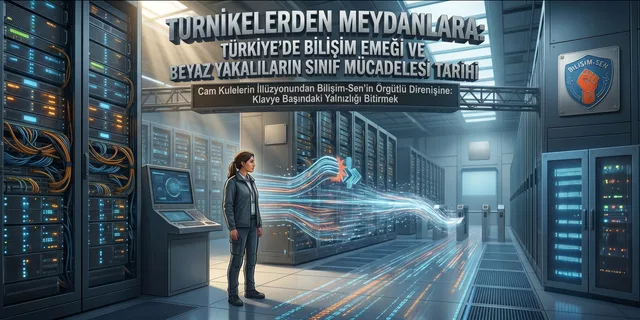
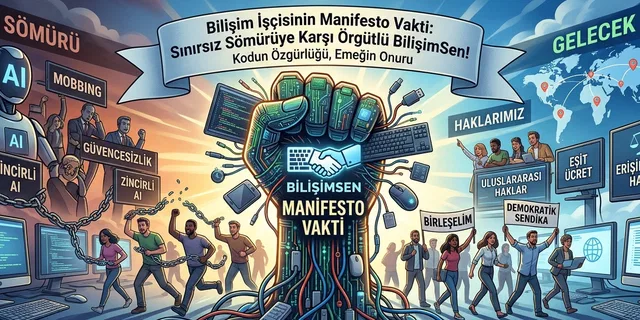
The End of the Gilded Illusion: Immaterial Labor in the Age of Artificial Intelligence and an Organizing Guide for the IT Worker in Turkey
Breaking the Chains of the Digital Proletariat and an Organizing Guide for Turkey's IT Sector

The Transformation of Artificial Intelligence and Production Models: The Usurpation of the General Intellect
The Theoretical Foundation: The Usurpation of the General Intellect and the Class Origins of Artificial Intelligence
Artificial intelligence (AI), large language models, and digital automation systems are not laborless or self-evident, neutral miracles as the capital-owned media claims. Behind the historical line of development of AI and computer technologies lie deeply critical class processes. Approached from a Marxist perspective, AI is a reflection of the working class's holistic labor—that is, of the collective worker; it is born from the working class, and it is the working class's own collective practice that gives birth to it. Capital uses universities, funds, and the power of ownership to bring science workers, engineers, and software developers under its yoke. In this way, by usurping the collective worker's productive force and humanity's common "general intellect," it seizes this immense productive power of labor as a monopoly.
The worker's skill, craft abilities, and mental labor are made codable, divisible, and imitable, and are absorbed into machines and algorithms. In this form, while technology is objectively a product and reflection of the productivity of labor, the moment it is used for profit within the framework of capitalist property relations, it turns into a destructive force alienated from its producer, controlling and dominating them.
In striving to understand this process of capitalism's technological transformation, two fundamental tendencies emerge in society and in union debates. The first is the technological-determinist approach, which claims that AI will change our lives, the economy, and society immediately and very rapidly; it practically fetishizes technology into a "black box" and either believes in blind fantasies or paints a picture of absolute unemployment. The second tendency—and the one we adopt—is the one that, rather than accepting this "brilliant" development as it is, focuses on the capitalist relations of production behind it and on the internal contradictions of the productive forces. For no wave of digitalization or technological innovation changes the property relations at the core. Capital positions AI and network technologies as tools to raise, at the cheapest cost, the mechanisms of surveillance and control over the labor process to their highest point during periods of crisis, and to deepen the class assault.
The Second Machine Revolution and Flexible Precarization
Following the traditional Fordist model based on mass production, this new phase grounded in digitalization, robotization, and automation is termed in the literature the "Second Machine Revolution." Although bourgeois economists present this revolution as a fantasy world in which robots will now do the work and labor, its organization, and its ideology will become superfluous, the objective reality manifests itself entirely differently. The class output of AI and automation is not the wholesale exclusion of labor; it is the deepening and spreading of cheap-wage, unorganized, unskilled, and precarious labor.
As Peter Fleming's research has also shown, despite the immense possibilities of robotization, human labor is still used intensively and widely. Capital's subcontracting of production by distributing it in the form of a network under the name of flexibility conceals a centralized, colossal monopolistic structure. And the inseparable counterpart of this flexibilization on the class front is a relentless wave of precarization. The demand for cheap, subcontracted, informalized, and race-to-the-bottom unskilled labor is increasing all over the world. Used in managing logistics networks, resource planning, and the real-time tracking of the labor process, AI is turning—under the capitalist profit motive—into an organizational mechanism that disciplines and controls scattered and isolated precarious workers at the cellular level.
Seniority-Biased Technological Change: The Liquidation of Youth Employment and Career Ladders
Today, large language models and generative AI (GenAI) tools built upon linguistic capabilities such as text analysis, summarization, and proofreading reach hundreds of millions of users in very short periods and directly affect labor markets. But this latest wave breaks the rote assumptions of the classic "skill-biased technological change" theory, which posited that technology increases demand for a labor force with high educational levels and cognitive capacity. The integration of generative AI into corporate processes, by its very nature, exhibits the character of a "seniority-biased technological change."
In knowledge-intensive sectors such as finance, law, insurance, human resources, and software, the marginal contribution of junior and entry-level tasks—data entry, routine reporting, content production, and producing first drafts—is decreasing, and these areas are being rapidly automated. The findings show that at firms that integrate AI into their systems, entry-level and junior employment has fallen by roughly 9–10%. By bringing to the fore high-level cognitive tasks such as oversight, verification, reasoning, and final decision-making—which by their nature depend on experience, contextual knowledge, and organizational socialization—AI is increasing the relative value and workload of senior roles.
This structural mechanism quietly closes off the channels through which young people could gain experience in real work processes, and erodes the first rungs of the career ladder. This blockage at the entry level and the transformation in the content of professions confront not only blue-collar workers but, first and foremost, university-educated white-collar employees and knowledge workers with a serious problem of job loss, precarity, unemployment, and idle capacity.
The Invisible Infrastructure of Artificial Intelligence: Ghost Workers and the Global Chain of Exploitation
Capital's effort to portray AI as "an autonomous technology that works without labor" is an illusion aimed at making invisible the physical infrastructure of production, which rests upon brutal exploitation. Behind the AI chatbots, cloud-computing systems, and data centers stands a vast army of labor whose exploitation is compounded. The secrets of technological progress in the sector and the workings of AI tools are built upon the slave-like working conditions of the precarious lower layers of workers termed in the literature "ghost workers."
Capitalist monopolies have established global chains of exploitation in order to have the inputs prepared that AI algorithms need to label their datasets—looking at images and sounds and marking them "correct or incorrect"—that is, for AI to "train itself." Giant companies like OpenAI employ people in poor countries such as Kenya, Nigeria, and India for less than 2 dollars an hour, on low piece-rate wages and without any security whatsoever.
The Exploitation of Emotional Labor: These ghost workers are exposed to billions of pieces of data, sounds, and images in order to make AI less toxic and to feed its filtering systems. The images they are forced to confront contain child abuse, severe violence, murder, nudity, and every kind of human rights violation. The mental health of the workers forced to sort through these traumatic inputs is shattered to pieces; in training the "great" AI, they are permanently crippled in the reproduction of their own emotional labor power.
Therefore AI is not a laborless cyber-miracle carrying humanity to a frictionless future; on the contrary, it is a monopolistic apparatus of capital that rises, at its most vital stage, upon the rendered-invisible emotional and physical exploitation of the world's precarious workers, migrants, and the peoples of poor countries.
The Collapse of the "White-Collar" Fairy Tale and the New Proletariat
The Origin of the Illusion: Titles, Individual Careerism, and Class Blindness
The greatest ideological success of capital and the neoliberal paradigm in the post-industrial society narrative has been to isolate higher-educated service and technology workers from working-class identity by convincing them that they are a "privileged middle class" or "managerial elite." The rise in educational level and the practices of individual career planning have produced an illusion that leads these workers to feel closer to the ranks of management.
This ideological illusion has brought with it a deep problem of class consciousness and a lack of organization. Field research has found that plaza and IT workers see union structures as belonging only to factories, to production, and to blue-collar workers; that they code themselves not as "workers" or "laborers" but as "white-collar staff" or "experts." The rote phrase "there are no unions in the private sector" and the fear of losing one's job are the fundamental mental barricades that keep higher-educated masses away from union processes.
Corporate management practices support this policy of isolation with concrete mechanisms:
- Pay Secrecy and Individual Contracts: The principles of pay secrecy imposed on workers and the regimes of individual contracts sever the organic bonds among employees.
- Performance Pressure and Competition: Human resources practices, total quality management, and performance evaluation policies turn employees into isolated apparatuses locked in a relentless race against one another instead of coming together side by side for their common rights.
- Erasing Memory: By keeping alive the memories of the generation that knew the bright days of white-collar work in past decades, today's precarious reality is screened off.
Immaterial Labor and Digital Taylorism
With muscle power giving way largely to mental power in post-industrial society, white-collar employees have become the leading actors of economic production. In these information-technology-dominated fields, the labor process is inherent with "immaterial labor" (informational-intellectual production) and "affective labor," which includes the skill of managing human relations. Entering data into automation systems, preparing reports from data, and managing customer relations and the sale of financial products are the daily practices of this labor.
But this mental orientation has not abolished exploitation; on the contrary, it has given birth to "Digital Taylorism," the version of crude blue-collar exploitation adapted to the world of the mind. Just like the scientific-management practices in traditional factories, modern automation systems have broken white-collar work into micro-tasks, routinized it, and deskilled the worker.
- The Atrophy of Skills: In routine and abstract job positions, the learning motivation of white-collar workers who work fully dependent on automation withers, and their human capital and acquired skills atrophy over time.
- Alienation and Disengagement: Job satisfaction and the inability to find meaning in the immaterial outputs produced lead employees into a deep corporate alienation and "disengagement from work."
- Target Pressure: The endless desire to win that companies impose out of profit-hunger, the relentless competition, and the target/KPI pressure quickly wear down and burn out young employees who were initially enchanted by promises of a corporate career.
Space with Its Borders Demolished: From Plazas to Home Prisons
The spatial organization of the service and IT sector has shifted from the axis of the factory toward the bureau, the office, the home, and virtual environments. This new regime, presented by companies as flexibility, freedom, and the comfort of "home-office/hybrid" work, is in fact nothing but the brutal exploitative order of the 19th century moved into the home with a glittering digital makeover. Smartphones, computers, and corporate communication networks have completely demolished all the protective walls between work and private life.
- Perpetual Overtime: Slack or Teams notifications arriving in the middle of the night, Jira tasks updated on weekends, and the expectation of "being reachable at all times" have made unplanned work the norm. At the end of the day, despite actual working hours reaching 12–13 hours, no overtime pay is paid.
- Social Isolation and Psychological Erosion: The physical loneliness brought by remote work destroys the peer-support mechanisms found in workplaces. When the worker encounters a problem, they are left alone staring at a screen, suffering a psychological erosion within illusions of corporate belonging.
- Occupational Alienation: The code written day and night, the systems designed, and all the value produced are expropriated, locked away behind companies' rigid patent walls. The value the worker produces is torn away from social benefit and serves only to swell the profit column of a handful of holdings.
Against this squeeze and these seizures of rights, the voices rising on social networks through the platforms set up by plaza workers ("I don't want to stay connected to my boss at all times via my smartphone at the plaza," "I don't want the normalization of working through the night at the plaza") lay bare the scale of the exploitation.
The Algorithmic Panopticon and the Birth of the New Proletariat
This flexible employment order, whose backbone is made up of women, young people, and white-collar workers, has been turned into a total surveillance prison by AI-based control tools. The culture of "Amazonism" or "Bezosism" applied in the warehouses and offices of the global technology monopolies controls workers' real-time performance through smart devices, sensors, and software. Workers who cannot meet the workload and the productivity limits measured in seconds are automatically warned by the system and fired by software decisions. In Turkey too, applications like "Messafe," developed during the pandemic, are local examples of these continuous tracking and surveillance practices.
The corporate-level integration of AI and algorithmic hiring systems, while bringing a so-called analytical precision to human resources processes, turns biometric data into inputs of production. Models that predict personality traits from facial features and AI interviewers give the definition of merit a deterministic structure. The feedback mechanism conceptualized in the literature as the "Quasimodo Syndrome" creates a field of ethical tension in which algorithmic predictions over time forcibly shape individual behavior and produce self-fulfilling prophecies.
What is more, far from creating new areas of employment and balancing out unemployment as is claimed, generative AI and autonomous systems are fundamentally shaking the job security of white-collar workers. The professions that will close down and disappear from the market due to automation carry the threat of turning university graduates' diplomas into ordinary scraps of paper and of creating a "middle-class erosion" through a wave of mass unemployment.
Class Synthesis: The concrete result of this structural transformation, the mass layoffs, and the uncanny neoliberal work regime is the birth—in the metropolitan areas, made up of white-collar workers and, though for now showing heterogeneous characteristics, common in terms of working conditions, precarization, and labor rights—of the "New Proletariat." The white-collar fairy tale is entirely over; the IT and service workers at the keyboard have ended up in exactly the same ranks as the blue-collar workers in the factory, in terms of the mechanisms of exploitation and their class destiny.
The Specific Case of Turkey: Structural Constraints and Unbreakable Chains
Dependent Technology and the "IT Colony" Strategy
In Turkey, the processes of digitalization, AI integration, and technological transformation do not develop along a line that takes social benefit or an independent national plan as its basis. The neoliberal policies, in particular cleared of obstacles by the legal regulations that changed after the 1980 military coup, have combined with global technological developments to transform the structure of the labor force radically in favor of capital. Today, rather than being a center that produces its own original technology, Turkey's IT sector exhibits the character of an outwardly-dependent assembly and service line, shaped according to the profit motive of global monopolies and their domestic collaborators.
Structures like the Turkish Information Industrialists Association (TÜBİSAD), which has taken on the ideological and economic representation of capital in this field, praise digital transformation to the skies while in the background controlling unbelievable profit margins and creating a brutal distributional shock by dragging labor costs to the bottom. The confessions of exploitation at the technology bosses' conferences clearly document this reality: while the cost of employing a worker in the traditional industrial branches reaches tens of thousands of dollars, in the IT and software sector a qualified specialist can be employed at far lower costs. The rapid opening of branches and increase of investments by global monopolies in Turkey is not a "technology revolution" as is claimed; on the contrary, it is an attempt to create an India-like "IT colony," where highly educated and qualified labor is cornered on the cheap.
In this order of "crocodile capitalism," shaped on the basis of these relations of dependency, the understanding of a social state is completely liquidated, and the contractions in employment or the seizures of rights are ignored. Brilliant technological innovations like digitalization and Industry 4.0 remain limited to workers in the restricted and "lucky" corporate zones where capital can find itself a place in the international division of labor. Across the sector as a whole, the increase in the organic composition of capital, in the name of raising the rate of profit, condemns broad masses of workers to live at the hunger line and in precarious working conditions.
The Aestheticized Name for Subcontracting: Outsourcing and Cellular Fragmentation
The most organized objective barricade before the organization of IT workers around a common class identity is the phenomenon of subcontracting, which has been made into a structural principle of management in the sector. The crude subcontracting practices of industry are legitimized in the IT and plaza world by being hidden behind glittering, aestheticized foreign concepts like "outsourcing." Through corporate wordplay, subcontracted workers are called "outsource" and permanent workers "insource"; yet in essence, a computer engineer, software developer, or analyst working as outsource is no different—in terms of class exploitation—from a subcontracted construction worker or a seasonal hazelnut picker.
Capital's passing off of production by breaking it into sub-parts and handing it to small contractor firms (vendors) produces an unbreakable chain of exploitation:
- The Legal-Threshold Trap and Addresslessness: When colossal technological projects are distributed to small firms, workplaces are fragmented both in fact and in law. Because of this fragmentation, the number of workers employed at each sub-workplace cannot reach the numerical majority that is the legal threshold for unionization, and workers are effectively deprived of their legal right to organize. The absence of an original branch-of-activity definition for IT workers in the union legislation deepens this addresslessness.
- The Sabotage of Solidarity: Workers laboring in the same office, on the same project, at adjacent desks, are divided into permanent and subcontracted. The companies' pressure to subcontract spreads rapidly, eventually encompassing even the worker who today sees himself as privileged because he is permanent; permanent employees wake up one morning to find they have lost all their rights and been pushed into the subcontractor pool with lower pay.
- Seizures of Economic Rights: The relentless competition within subcontractor networks turns into a chronic sector standard: vague wage policies, deep injustices in wage distribution, the constant lowering of real wages, and most importantly the fraud of paying workers' insurance premiums not on their real wages but at the minimum rate.
Legislative Obstacles and the "Branch of Activity" Straitjacket
In Turkey, the industrial-relations regime and the union legislation are full of legal obstacles designed to paralyze the working class's ability to act. One of the greatest structural constraints is that, although the model of branch-of-activity unionism is legally imposed in Turkey, these branch unions do not have the constitutional or legal right to strike at the branch level. The collective bargaining unit is absolutely squeezed into the limits of the workplace or the enterprise. The establishment of the "occupational unionism" model that would suit sectoral flexibility, meanwhile, is entirely prohibited by law.
This situation leaves the motorcycle couriers, software workers, and plaza workers scattered across dozens of different small sub-workplaces and digital platforms unprotected; it prevents traditional union structures from reaching these dynamic fields and seeking rights. Although, thanks to digitalization and e-government integration, joining a union appears technically to have become as easy as a click, the system's macro-level legal traps are designed to strangle the will to organize.
The process is, legally, a complete deadlock:
- When a union secures a majority in a workplace and applies to the Ministry of Labor for certification, the employer immediately objects to that certification—despite the state's own controlled e-government and KVKK-approved screen data.
- The employers' objections—on grounds such as "the choice of union does not match the branch of activity" or "the workplace majority falls below the legal threshold"—drag the matter into court corridors that will last for years.
- Indeed, exactly this scenario played out in the historic pioneer of the IT sector, the IBM Türk unionization struggle of 2008. When the majority of workers joined the Tez-Koop-İş union and the Ministry approved the certification, the IBM management bent the rules and applied to the courts with the claim that "the nature of the work performed does not fit this branch of activity," dragging out the process for years to seize the right to a collective agreement.
- During this process of legal attrition, while corporate managements unlawfully fired the worker- and engineer-pioneers of the union, they tactically gave raises of around 25% to break the will to organize among the remaining titled employees, dynamiting the union unity from within.
- Moreover, the legal limits in force and the provisions of employment contracts are brazenly violated by the bosses. Software workers are made to work day and night, including Sundays; but when it comes to litigation, the experts and the courts—despite WhatsApp exchanges, the messages managers send on Sundays, and system log records—wipe away overtime pay on the grounds that "we cannot fully determine the hour limits in the contract and the overtime." For the bosses, breaking the law and paying small compensation penalties is a far more profitable corporate strategy than handing over labor's rights.
Ideological Fences: The "We Are a Family" Fairy Tale and the HR Pressure Regime
Beyond the objective and legal obstacles, the mental world of IT and plaza workers is subjected to an intense ideological bombardment by neoliberal Human Resources (HR) and Total Quality Management mechanisms. Higher-educated, qualified white-collar workers—under the influence of the education they received and the cultural codes they acquired—do not see themselves as part of the working class; they believe they are in a privileged category between management and blue-collar workers, but closer to management. Capital uses this class blindness as a corporate weapon.
The corporate dictatorship builds a frictionless world of illusion in order to render relations of exploitation invisible:
- The "We Are a Family" Rhetoric: Colorful office designs, games with titles, promises of flexible work, and discourses of corporate belonging are in fact nothing but a digital makeover applied over the brutal exploitative order of the 19th century. This discourse leaves the worker utterly alone before the boss who owns the means of production.
- Pay Secrecy and Isolation: The individual contracts—whose very legal validity is debatable—forced upon workers, and the strict "pay secrecy" policies, prevent from the very start the formation among employees of a common class identity and a consciousness of distributional justice. The worker is isolated by HR practices and deprived of the power of collective bargaining.
- The Digital Panopticon and KPI Terror: Workers are constantly monitored through AI-supported performance systems and are forced to work while leaving a digital trace at every moment. This compels workers, instead of coming together side by side with their colleagues to weave solidarity for their common rights, into a relentless race of individual careerism that drives them to see one another as rivals to be eliminated.
- Algorithmic Discrimination and the Quasimodo Syndrome: The AI-powered interview and hiring systems (methodologies like Photo Big 5) that have become widespread at the corporate level in recent years, performing personality analysis from facial features and tone of voice, turn human capital entirely into a measurable and priceable object. This algorithmic power in human resources processes directly opens individual autonomy and human dignity to debate, establishing a regime of statistical discrimination. This feedback mechanism, termed in the literature the "Quasimodo Syndrome," leads employees over time to internalize algorithmic prejudices based on their facial features and to develop conformist behavior patterns consistent with these attributions; the analytical precision provided turns into a productivity trap that condemns the white-collar worker to absolute obedience and loneliness.
These unbreakable chains, woven by capital at the objective, legal, and ideological levels, subject the university-educated qualified masses to futurelessness and corporate dictatorship. The only way to break apart this hell of unregulated exploitation specific to Turkey is to tear up the gilded corporate fairy tales and confront the objective class reality.
Priority Organizing Scenarios and an Action Plan for Turkey
Scenario A: "Uniting the Cells" – A United Front Against the Value-Chain and Branch-of-Activity Deadlock
Against the model of exploitation in which capital flexibilizes production in the form of a network and breaks it into pieces through subcontracting (outsourcing), the labor movement's first step is to build a holistic class front based on the principle of "everyone whose hands touch a keyboard."
- The "Everyone Whose Hands Touch a Keyboard" Organizing Model: As the experience of the Information and Communication Workers Solidarity Network (BİÇDA) has also shown, the definition of an IT worker cannot be squeezed into narrow areas of specialization. From software developers to hardware workers, from R&D workers to system specialists, from data labelers to call center workers, all those who work at a computer must be described on the basis of a common class.
- A Multi-Layered Branch-of-Activity Strategy: The practice carried out by the Birlik Sendikası in branch No. 10 (Commerce, Office, Education, and Fine Arts) is a concrete guide for meeting this flexible structure. The software worker who sees himself as different from other workers under the illusion that he earns relatively high wages must be brought together under the same union roof with the precarious service workers in the plazas, the stores, or the offices. Organizing must be lifted out of abstract debates on careerism and raised on the basis of the most burning concrete demands, such as the payment of overtime pay, the struggle for the 8-hour workday, and a stance against corporate mobbing.
- Value-Chain Resistance Against Subcontractor Pools: Against capital's maneuver of bypassing the legal union thresholds by breaking large projects into sub-firms (vendors), lines of actual, legitimate resistance must be woven. We must not forget the experience of the determined resistance that the Kod-A IT workers—working as a subcontractor (sub-vendor) in Türk Telekom's archiving department—launched in front of the Türk Telekom building in Güneşli after they were fired for wanting to organize in the DİSK-affiliated Sosyal-İş union. The unorganized workers in small subcontractor offices must be united through "value-chain-focused" grassroots committees that bring the struggle to the main firm's door.
Scenario B: Breaking Corporate Illusions – Coordination of Professional Chambers and Grassroots Initiatives
The way to break the corporate ideology that leads white-collar workers to stay away from unions is to operate the barricade of professional honor and union power in synchronized fashion.
- Lessons of the Historic IBM Türk Organizing Drive: The most important unionization experience in the history of the IT sector in Turkey, the IBM Türk struggle of 2008, clearly shows both the concrete possibilities of white-collar organizing and capital's counterattack tactics. Nearly 400 IBM IT workers—who had not received a raise in 5 years, who were subjected to unregulated overtime, and whose personal entitlements like private pensions were being trimmed—organized in the TÜRK-İŞ-affiliated Tez-Koop-İş union.
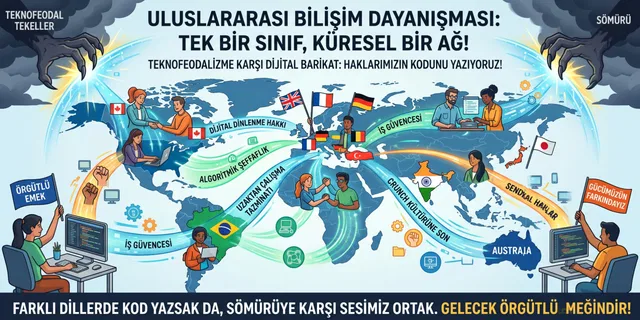
- An Upright Stance Against Capital's Raise-and-Law Trap: The IBM management took refuge in the courts on grounds like "the workplace majority was not achieved" and "IT activities do not fit the office branch of activity" in order to delay union certification, and it unlawfully fired the engineers who were union representatives. Not content with this, the corporate management ran a bribery mechanism by giving tactical raises of around 25% to 80% of employees in order to collapse the organizing bond from within. The way to grow solidarity against this relentless siege is to secure integration with global union networks (such as UNI Global), as in the experience of the international collective agreement the Belgian LBC union signed with IBM in 2003.
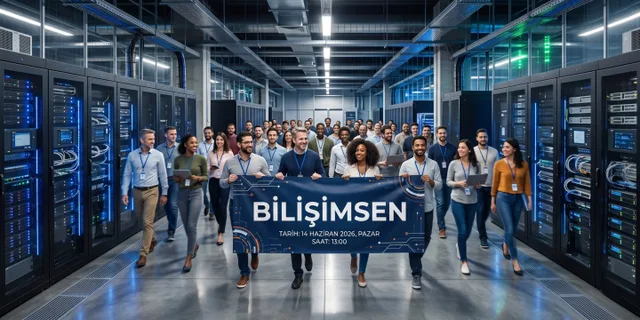
- Professional Chamber – Union Coordination: During the IBM process, the establishment of "Organizing in IT" platforms by structures such as the Istanbul Branch of the Chamber of Electrical Engineers (EMO) and the Chamber of Computer Engineers (BMO), with an understanding that supported union organizing, created a driving force in mobilizing technical staff and engineers. Under the leadership of BilişimSen, this experience must be institutionalized; the professional-rights definitions and legal shield of the professional chambers, and the collective bargaining agreement (CBA) certification power of the unions, must be turned into a coordinated guide.
- The Leverage Role of Civic Initiatives: The evolution of the "Gerçeğe Çağrı Merkezi" (Call Center to Reality) website initiative—set up in 2005 by call center workers to expose their poor working conditions—into the Call Center Workers Association (ÇMÇ-DER) in 2008 and finally into union action (Dev İletişim-İş), is concrete proof that grassroots movements in digital fields must be carried to a union position rather than remaining stuck in corporate associations.
Scenario C: Digital Union Standards and CBA Clauses Against the Algorithmic Panopticon
Because technology under the dominion of capital raises employers' control mechanisms to their highest level, unions must wage an actual and legitimate CBA (collective bargaining agreement) war that goes beyond the legal limits.
In 2017, the way the strike decision—taken at Akbank, where BANKSİS was organized, to stop arbitrary layoffs and for CBA rights—was banned by the government with jet speed shows us the bankruptcy of a unionism trapped within the limits of bourgeois law. By contrast, the victory of the white-collar workers organized in the Journalists' Union of Turkey (TGS) during the BBC Turkish strike of early 2022—who stopped production for 15 days against the management's imposition of a miserable 20% raise—is the most concrete proof that mental labor too can militantly wield the weapon of the strike.
The following concrete clauses, which will shatter the age's forms of exploitation, must be imposed uncompromisingly at Turkey's CBA tables:
- The Right to Be Unreachable and to Disconnect (Right to Disconnect): The European Social Partners Framework Agreement on Digitalisation signed between the European Trade Union Confederation (ETUC) and international employer organizations must be put on the table as a legal reference. By adding "Methods of Connecting and Disconnecting" to the CBA clauses, the obligation to respond to Slack, Teams, Jira, or email notifications outside working hours must be eliminated entirely, and the "right to be unreachable" must be registered as a standard worker's right.
- Limiting Algorithmic Oversight and Human Dignity: The ETUC Digitalisation Agreement and the 7-dimensional set of principles of the European Trade Union Institute (ETUI) for protecting the worker in the age of AI must be added to CBA texts. "Making transparent the purpose of AI algorithms," banning software that fires workers through automatic scoring, and protecting the worker's "right to an explanation" against algorithmic decisions must be guaranteed. Every kind of digital tracking device to be introduced into the workplace (applications similar to MESS's "Messafe," cameras, monitoring software) must be made subject to the absolute approval of the union and worker representatives.
- Real Wage Declaration and the Ban on Subcontracting: Against one of the greatest seizures of rights in the IT sector—the fraud of paying insurance premiums on the minimum wage—the official declaration of real wages and an end to subcontracting (outsourcing) must be made the CBA's red line. The "pay secrecy" provisions in individual contracts must be abolished entirely through the CBA.
- Professional and Digital Grassroots Organizing: Unions must abandon seeing social media merely as a simple news board or a showcase for increasing followers. Social media is not a magic wand for unions—true liberation lies in the class struggle; but it must be effectively integrated as a professional-level "complementary digital organizing model" that will break corporate isolation and bring together scattered home-based workers.
Final Word and Summary: The Wizard of the Future, or Its Digital Chains?
The Hybrid Character of Technology: The Objectification of Living Labor
AI, information technologies, and large language models are not metaphysical "enemies" standing before humanity, nor cursed independent subjects that will absolutely destroy living labor. Seen in the light of Marxist theory, AI is the frozen form—appropriated by capital—of the mental effort, scientific accumulation, and practical experience the collective worker has historically developed; that is, it is objectified dead labor. This level reached by technological development objectively shows the level of development of labor's own productive force and, in Karl Marx's conceptualization, of the "general intellect."
In its essence, AI is an immense tool worthy of human dignity—one that could beautify life, in which working hours are radically reduced, in which arduous, routine, and dangerous tasks are handed over to smart systems, and which gifts humans a vast amount of free time in which to realize their own potential.
But within capitalist relations of production, this liberating potential takes on the very opposite character. The problem lies not in technology's own pure capability or in its algorithm; it lies in the class purpose toward which the capital that owns this technology deploys it.
A Cyber-Whip in the Hands of Capitalism: The Digital Chain
In a society under the dominion of capital, AI works under the yoke of market relations and the profit motive. As long as the private ownership of the means of production goes untouched, every new technological wave becomes a tool for deepening the exploitation of the labor force, for increasing the extraction of relative surplus-value, and for raising the employer's control mechanisms to their highest point.
AI is turning into a digital chain that monitors the white-collar knowledge workers in offices with real-time performance analytics and races platform couriers against the seconds with navigation algorithms. If this technological power is left to the mercy of capital and the lawlessness of the market, the picture we will confront will not be a bright future but a dark dystopia screening off the crises of capitalism:
"Machines and the productive forces, if they are not brought under the control of the collective workers of the productive processes, will turn into destructive forces. The historic warning Ernest Mandel made in 1985 is far more current in the age of generative AI: if this mastery and control are not won by the labor movement, the threats are countless—mass poverty, the tsunami-like spread of precarity, the diminishment of freedoms, ecological destruction, and universal scarcity. The possible enslavement by machines will be only one of these threats, and probably not even the worst."
If preparation is not made and a class barricade is not erected, the immense productivity gains AI creates will only swell the bosses' coffers; and the diplomas of higher-educated young generations will turn into ordinary scraps of paper on the unemployment rolls, leading to a violent "middle-class erosion" and social collapse.
The Manifesto of the Class: Seize the Algorithms and the Means of Production!
The way to stop this dark course is not to reject technology or to try, with a liberal illusion, to set up ethics boards that take refuge in the mercy of capital. The solution is for the collective productive force that brings technology into being—that is, the working class itself—to rise up as an organized subject.
The union vision of the 21st century must possess a radical political clarity that targets property relations. The labor movement, which in past centuries aimed to make factories and workbenches public, must today include the founding elements of the age of AI in its repertoire of struggle as well:
- Worker Control Over AI and Data: IT workers, software developers, data scientists, and the precarious couriers racing across the field with algorithms must organize in a united class front. The fundamental demand is that the code, big-data pools (big data), cloud-computing infrastructures, and machine-learning systems that companies lock away behind rigid patent walls be taken out of the hands of capital and made the common shared heritage of humanity.
- Collective Production and Fair Sharing: The immense analytical precision and productivity that AI provides must be instrumentalized not to swell the profit column of the techno-financial oligarchy, but to radically reduce weekly working hours, to make the "right to be unreachable" a union standard, and to produce collective welfare for all of society.
- Actual and Legitimate Struggle: The illusions of titles imposed by corporate HR departments, the deceptions of individual careerism, and the chains of subcontracting (outsourcing) must be shattered through the "double-armor" coordination that professional chambers and unions will establish and through militant grassroots committees.
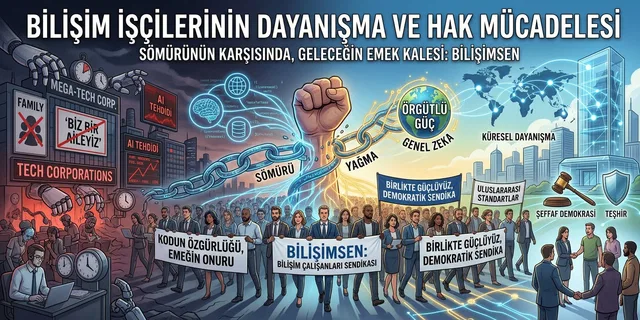
The future will not belong to the fetishized world of AI; the future will be determined by the organized labor movement that produces AI and, by seizing it, will build a just, classless, and sustainable social model.
https://paragraph.com/@bilisimsen/bilisim-senin-esiginde-tarihin-aynasindan-gelecege-bakmak