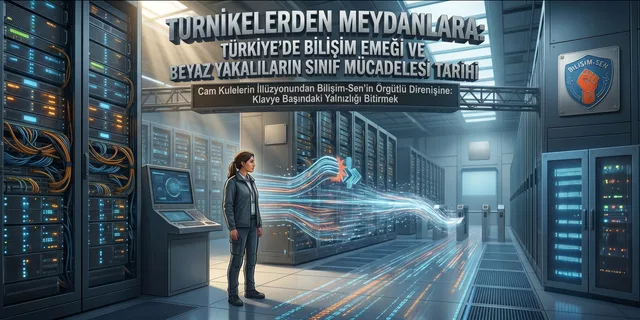
From Plazas to Technoparks, a Digital Union: A Class Barricade Against Algorithmic Exploitation
Network-Type Organizing Scenarios and a Strategic Action Guide Against Flexible Exploitation in Turkey's IT and Plaza Sector

Are you ready to dismantle the glittering structure of the IT sector and the plaza world, adorned with the illusions of being "flexible" and "your own boss"? Behind the lines of code, the titles (Senior, Lead, Agile Coach), and the comfort of freelance work, capital's most refined and savage mechanisms of exploitation are actually at work. The mass standing before us is the "New Proletariat"—people who do not consider themselves workers because they do not see the traditional factory chimney, yet who are entirely deprived of any ownership of the means of production.
To grasp this transformation, to overcome the cumbersome legacy of Turkey's trade-union past, and to organize IT laborers, let us set out with a historical perspective and then focus on concrete scenarios.
Trade-Union History in Turkey and the Transformation of the Class
The formation of the working class in Turkey and the course of the trade-union movement are a direct reflection of the transition from rigid Fordist forms of production to flexible informational capitalism, and of the painful macroeconomic fluctuations stretching from state-directed policies to neoliberal deregulation. To grasp the changes in the quality and quantity of the class, this process must be examined in four fundamental historical cross-sections.
The 1963–1980 Period: Fordist Rigidity, the Classical Proletariat, and a Class-Based Rise
This period corresponds to the rigid Fordist era in which Turkish capitalism rested on the import-substitution industrialization model and production was concentrated in large factories (textiles, metal, chemicals, automotive). On the relatively democratic ground established by the 1961 Constitution, the Trade Unions Act No. 274 and the Strike and Lockout Act No. 275, which entered into force in 1963, enabled the working class to make its mass entry onto the stage of history as a collective subject.
- Spatial Concentration and Class Consciousness: Workers labored side by side in factories of thousands of people in large industrial basins (the İstanbul–Kocaeli corridor, İzmir, Adana). This spatial rigidity brought by the assembly line and these homogeneous working conditions enabled the sense of "we" and class consciousness to crystallize rapidly.
- The Union Rupture and DİSK: In 1967, DİSK was founded as a revolutionary break from TÜRK-İŞ's conciliatory, "above parties" unionism that aligned with the state and capital. Trade unionism was no longer merely a tool of economic bargaining but became the most dynamic engine of social opposition and class struggle. The Kavel Resistance, the Paşabahçe Strike, and the June 15–16, 1970 Great Workers' Resistance, in which the working class openly displayed its power to capital, became the founding myths of this period.
In this cross-section the worker's identity was clear: blue-collar, in the factory, entirely deprived of the means of production, and able to wield the weapon of the strike directly against the mechanical gears of exploitation.
The 1980 Neoliberal Counter-Revolution: Depoliticization, Fragmentation, and the Seeds of Flexibility
The decisions of January 24, 1980, and the September 12 military coup that enforced their dictate, constitute the most radical and savage intervention made in favor of capital in the labor-capital contradiction in Turkey. In line with the goal of integrating into neoliberal globalization, the historical gains of the working class began to be taken away one by one.
- Legal Shackles and Bureaucratic Unionism: With the 1982 Constitution and the subsequently enacted Acts No. 2821 and No. 2822, the trade-union movement was virtually paralyzed. Political strikes, solidarity strikes, and general strikes were banned; unions were burdened with cumbersome bureaucratic obstacles such as high sectoral thresholds and notary requirements.
- The Fragmentation of Labor (Subcontracting): Large factories were gradually replaced by subcontracted production networks, subcontracting mechanisms, and flexible forms of work. In order to prevent workers from forming a collective force by keeping them under the same roof, capital dispersed production spatially. During this period, unions lost their connection with the rank and file and evolved into bureaucratized, cumbersome structures (yellow unionism) preoccupied only with preserving their membership numbers.
Post-Industrial Transformation and the Growth of the Service Sector
From the 1990s onward, Turkey felt most heavily the effects of the "post-industrial" transformation that global capitalism underwent. While classical industrial production was pushed outside the developed metropolitan areas, centers such as İstanbul, Ankara, and İzmir became the management headquarters for service-sector items like finance, marketing, advertising, logistics, and especially information technology.
- The Relative Loss of Privilege for White-Collar Workers: The white-collar stratum—initially situated within Weberian bureaucratic rationality or in the management ranks of the company, suited up, relatively highly paid, and appearing "privileged"—underwent a quantitative explosion with the enormous growth of the service sector. But this growth radically changed the very nature of white-collar labor.
- Flexible Exploitation Atop a Rigid Structure: In countries like Turkey, which never fully completed their industrialization, the old rigid hierarchical corporate structures were not liquidated; on the contrary, neoliberal flexible work models were adapted on top of these rigid structures. This hybrid model both exposed white-collar workers to the rigid target pressures and performance metrics of the old system and imprisoned them in the spiral of precarity, uncertainty, and limitless overtime brought by flexible capitalism.
IT and Plaza Laborers as the "New Proletariat"
As a result, there has emerged today—especially in the metropolises—a "New Proletariat" that displays amorphous, heterogeneous, and fragmented features but shares common ground in terms of working conditions, the risks it faces, and the violation of its rights. The most refined and most intensely exploited segment of this mass is the workers of the IT sector (software developers, system administrators, data analysts, digital-agency employees, and call-center workers).
| CLASSICAL PROLETARIAT (Blue Collar) | NEW PROLETARIAT (White / Gray Collar) |
|---|---|
| Place: Factory / Workshop | Place: Plaza / Technopark / Home |
| Form of Labor: Muscle Power | Form of Labor: Mental / Digital |
| Organizing: Physical / Union-Based | Organizing: Scattered / Digital |
| Exploitation: Fixed Working Hours | Exploitation: 24/7 Flexible / Timeless |
The exploitation of mental labor is no less savage than the muscular exploitation of the blue-collar worker; on the contrary, the concept of "alienation" that Marx spoke of is experienced here at its most extreme. The software developer is alienated from the code they produce, from the enormous software system that code produces, and ultimately—through the manipulations of teamwork (agile/scrum)—from their own coworkers. Lulled by individual performance criteria, confidentiality agreements, and the illusion of the career ladder, this segment—because they do not own the means of production (the great servers, the algorithms, the capital infrastructure) and sell their labor-power only in exchange for wages—stands objectively at the very center of the working class.
Beyond Yellow Unionism: Network-Type Organizing and Grassroots Experiences
Traditional yellow unionism has undergone a great molting in the age of neoliberal deregulation and post-industrial transformation. The sole enemy before us is no longer merely the state-directed, bureaucratic union bosses who shake hands with the employer; it is the individual performance contracts imposed through Human Resource Management (HRM), Total Quality Management (TQM), and the manipulation of corporate belonging. By liquidating the collective-bargaining order and replacing it with these flexible management strategies, capital aims to render labor invisible, to cover up class contradictions, and to completely destroy the ground for collective claims to rights.
These flexible exploitation practices, built atop rigid organizational hierarchies in Turkey, tear white-collar workers from their former relatively privileged positions and leave them facing far more disadvantaged, harsher conditions. This dynamic brings to the surface a "new proletariat"—in the metropolitan areas still amorphous and heterogeneous in structure, but which in the near future will share more common features in terms of working conditions and labor rights. It is impossible to organize this new class with traditional, cumbersome, status-quoist structures; therefore, Network-Type Organizing and Grassroots Experiences that move beyond yellow unionism are a vital necessity.
The Theoretical and Practical Framework of Network-Type Organizing
In an order where capital has been decentralized, where production is dispersed across cloud servers, homes, technoparks, and flexible spaces, organizing too must take on the form of a network with that same flexibility.
- Creating Horizontal Power Centers: The vertical, hierarchical, and bureaucratic decision-making mechanisms of traditional unions are paralyzed in the face of the fluid structure of the IT sector. Network-type organizing takes decision-making authority away from the union center and distributes it to the digital cells in the workplaces and to the worker committees at the grassroots.
- Reversing the Total Quality Management (TQM) Illusion: Under the name of TQM and teamwork, companies build systems in which workers police one another, applying performance pressure to each other and thereby rendering labor invisible. Network-type organizing breaks through the corporate boundaries of these teams and enables workers to build collective solidarity with one another rather than against one another. Teamwork is taken out of being capital's productivity trap and turned into the laboratory of the class's self-organization.
- Breaking Confidentiality Agreements with Transparency Networks: Person-specific pay practices that replace standardized wage policies, and the confidentiality agreements that support them, prevent workers from uniting around a common economic demand. The network-based structures to be established must tear down these artificial walls of secrecy and, through anonymous data-sharing platforms, make visible the real value of labor and the rate of exploitation.
Organizing Problems in Turkey and Grassroots Experiences
One of the greatest impasses for white-collar service and IT workers in Turkey is structural organizing problems. To break the prevailing perception of unions and to raise grassroots activism, the following concrete strategies should be prioritized in light of the new-generation grassroots experiences sprouting on these lands (PEP, BİÇDA, call-center associations, etc.):
- Collective Resistance Against the Measurement of Labor: In the IT sector, mental labor is mercilessly metricized through advanced algorithms and performance-measurement systems. Grassroots committees must prepare collective counter-reports that expose how these measurement systems exceed humane limits and destroy the balance between work and private life. This arbitrariness in the measurement of labor, which leaves workers defenseless one by one, must be turned—through grassroots organizations—into a matter of collective bargaining and resistance.
- Campaigns Against the Age-35 Limit and Age Discrimination: The strategies applied by the global tech giants themselves and packaged under the name of "rejuvenating the team" result in experienced workers over the age of 35 being shown the door on the grounds of cost reduction. Against this risk of precarity, fed by flexible practices in Turkey's technoparks and plazas as well, grassroots organizations must urgently organize an intergenerational class solidarity. The cycle of liquidating senior workers and making young graduates work cheaper and for longer hours can only be broken in this way.
- A Barricade Against the Limitless Exploitation of Time and Space: The flexible use of time and space abolishes the distinction between work and private life, turning leisure into preparation for work and seeping work into every area of daily life. Grassroots experiences must, without waiting for the cumbersome bureaucracy of legal union-certification processes, create the grassroots will to put the "right to digital unreachability" into practice in workplaces through de facto rules.
A Road Map for Overcoming Bureaucratic Unionism
The dialectical line of transformation that must be followed to overcome the corporate sluggishness and employer-collaborationism of yellow unionism is as follows:
| Traditional / Yellow Unionism | Modern / Network-Type Grassroots Organizing |
|---|---|
| Centralist, vertical, and hierarchical structure | Horizontal, flexible, and cell-based digital networks |
| Focused solely on legal certification and collective bargaining | Immediate de facto and digital action against violations of rights |
| Submission to HR policies and individual contracts | Collective, transparent, and open struggle against common risks |
| Tied to place (confined within factory / office boundaries) | Placeless and limitless (Remote work / Digital public sphere) |
Comrade, going beyond yellow unionism means building a model in which the worker does not hand their own destiny over to professional union bureaucrats, but instead—using digital tools and de facto methods of struggle together—monitors production from the grassroots. This model will transform today's "new proletariat," fragmented by corporate illusions, into a constitutive force whose rights and conditions are shared in the near future and whose class consciousness has become clear.
Concrete Organizing Scenarios Specific to Turkey
Comrade, those "creative and free" work desks behind the neon lights seeping through the glass façades of the plazas are in fact the most refined coal mines of the 21st century. Capital turned the assembly line in the factory into the software developer's "Jira board," and the foreman over the worker's head into a psychological supervisor bearing the titles "Agile Coach" or "Scrum Master."
Turkey's technoparks and plazas are precisely the center of the hybrid exploitation model examined in the academic literature and in field documents of resistance. In this context, we must address with concrete examples how, in Turkey, flexible work models are savagely mounted atop rigid organizational hierarchies, and how this situation turns white-collar workers into a more disadvantaged "new proletariat."
Below are three concrete organizing scenarios and action plans, grounded in reality, developed against the structural forms of exploitation we encounter on Turkish soil.
Scenario I: A FinTech Company in Levent – Taylorism Masked as "Agile" and Digital Cell Resistance
Background and Story:
Özgür, who works as a "Senior Software Developer" at a financial-technology (FinTech) company in Levent, is being crushed under weekly "sprint" targets. The company has divided its employees into teams through a system called Total Quality Management (TQM); thus, software developers, designers, and test engineers, made to appear as if they make joint decisions, have in fact been turned into a mechanism of surveillance over one another. As Özgür makes a deployment to production at 3:00 in the morning, he is angry at the coworker at the next desk because that coworker's low performance also affects his own bonus. While collectivizing production in this way, capital has, through Human Resources (HR), completely individualized the ground for claiming rights, isolating workers from one another with "pay-confidentiality agreements."
Organizing Plan (Digital Cell Model):
- Breaking the Illusion (From Personal Mentorship to Class Consciousness): Özgür takes the first step to expose the exploitation behind HR's "We are a family" rhetoric. With two software developers he trusts and one QA (test) engineer, he sets up an encrypted Signal group entirely independent of the company's corporate networks.
- Piercing the Wall of Secrecy: This core cell creates an anonymous and encrypted Google Form listing average salaries by title, overtime hours, and cases of mobbing in the company. The form spreads by word of mouth through the personal phones of the company's employees. The pay injustice that HR hid through individual contracts turns within two weeks into an Excel table that the whole company can see with the naked eye.
- The Form of Action (Code Slowdown / Refactoring Resistance): When the company ignores the workers' demands, a classic factory strike cannot be staged; for putting a chain on the door of the plaza does not stop the work. The cell decides on a technical slowdown under the pretext of "improving code quality and clearing technical debt" (refactoring). In sprint planning (at the bargaining table), the whole team, with a common will, declares the delivery times of tasks to be double. The Jira metrics that capital established to measure production are manipulated by the collective will of the workers and used as a bargaining weapon against the employer.
Scenario II: The "Age-35 Wall" at İTÜ Technopark and the Intergenerational Barricade
Background and Story:
Meltem, a 36-year-old Systems Engineer, has for years burned the midnight oil at a large software house in the İTÜ Technopark. Recently, however, signals begin to come from the company's senior management about "increasing team dynamism" and "cost reduction." Meltem is suddenly imposed with performance criteria (KPIs) that are impossible to meet. The aim is to force her to resign without paying her severance and to replace her with young workers fresh out of university—workers who do not know how to claim their rights and are willing to work 12 hours for much lower pay. This situation is a one-to-one reflection in Turkey of the systematic age discrimination applied by the global tech giants, which liquidates mid-career professionals.
CAPITAL'S CYCLE OF AGE-BASED LIQUIDATION
35+ Aged Laborer] > Performance Pressure / KPI > Forcing Resignation (Liquidation)
-
▲ ▼*
-
Cheap Young Worker Employment *
Organizing Plan (Intergenerational Solidarity Network):
- The Line of Union Intervention: The modern grassroots organizations that step in during this process do not see the matter as merely Meltem's individual legal struggle. Within the technopark, an open campaign is launched under the name "IT Laborers' Solidarity Against the Age-35 Wall."
- The Common Interest of the Young and the Senior Worker: The language of the campaign explains the following truth to the young workers: "The liquidation Meltem faces today is your future ten years from now. As capital employs you, it exploits Meltem's future; as it sacks Meltem, it exploits your youth."
- Concrete Action (Blacklist and Solidarity Fund): Software firms that practice age discrimination and mobbing are put on a "Blacklist" on technopark forums and digital platforms. Connections are established with university graduation committees, and young software developers are collectively prevented from applying to these firms. While the firms cannot find young workers to deliver their projects, thanks to the solidarity fund set up for liquidated senior workers like Meltem, the legal process is carried through to the end and the rights to reinstatement/severance pay are wrested away.
Scenario III: A Home-Office (Remote) in Kadıköy – the "Digital Switch" Against 24/7 Exploitation
Background and Story:
Deniz is a UX designer working remotely from her home in Kadıköy for a digital agency. Remote work at first felt to her like great freedom; but the flexibilization of time and space by post-industrial capitalism has completely abolished the boundary between work and private life. Deniz's home is now a free office for which the employer pays no rent, electricity, or internet bill. Her leisure has turned entirely into a phase of preparation for work, and the "There's an urgent revision" notifications arriving at 10:00 p.m. have taken her daily life captive.
Organizing Plan (Network-Type Union of Placeless Workers):
- Overcoming Placelessness: Since designers and agency workers cannot come together side by side in a physical space, the organizing move is carried out through broad-based professional solidarity networks.
- The "Digital Unreachability" Agreement: Without waiting for legal union thresholds, the network prepares a de facto "Manifesto of the Rights of Remote Workers." Through secret committees, the agency workers present this manifesto to their own management. The most basic demand is this: No message arriving after 6:00 p.m. through corporate communication channels (Slack, Teams, WhatsApp) will be answered.
- Concrete Action (Throwing the Digital Switch): When the employer rejects this demand and threatens an employee, accusing them of "incompatibility with teamwork," network-type organizing shows its power. On a designated Wednesday at exactly 6:00 p.m., all remote workers at the agency shut down their corporate accounts and write in their status code, "I Am Exercising My Right to Be Unreachable." The agency boss, right in the middle of projects that must be delivered to the client, is met with a digital silence (a de facto strike). Not a single computer is turned on. Capital is forced to take a step back in the face of the collective power of the labor behind the cables.
Conclusion: Our Road Map
As capital flexibilizes the form, time, and space of labor in order to overcome its crises and prevent the tendency of the rate of profit to fall, it wants to see before it a fragmented, atomized, and isolated mass of workers. In Turkey, the IT sector and the plaza world have long functioned as a fortress of this policy of isolation and of the illusion of the "above-class professional." But the makeup of the corporate rhetoric, the glittering technopark offices, and the fairy tales of being "your own boss" is peeling away.
The adaptation of flexible exploitation models atop rigid organizational hierarchies is fundamentally shaking white-collar workers out of their former relatively privileged positions. By exposing employees to the productivity pressure of both systems, this hybrid organizational structure makes them increasingly disadvantaged and creates a "new proletariat" that converges in the metropolises on the common denominator of precarity.
Today, in the IT and service sectors, every employee who does not own the means of production and survives only by selling their mental labor-power is objectively a part of this new proletariat. The road map of the coming period, therefore, is the line of transforming this objective reality into a collective consciousness and organized action.
Without Common Struggle, Common Ruin Is Inevitable
The greatest danger in the IT sector is that employees distinguish themselves from their coworkers through titles (Senior, Lead, Principal), forms of work (Remote, Freelance), or relatively high wages. Every white-collar worker who forgets that they are alone before capital, who imagines they can overcome the corporate gears through their individual talent, is no different from a victim awaiting their turn.
If a senior software developer today does not raise their voice against the merciless exploitation of a new-graduate intern or junior developer, against their being crushed by performance pressure, then tomorrow, when they themselves are shown the door on the grounds of "cost reduction," they will find no one to stand beside them. The massive waves of layoffs at the global tech giants, documented in Caixin reports, are the most concrete proof of this: at giants like Alibaba, Tencent, and Baidu, senior employees who had won superior-achievement awards and earned stock options for years, along with staff over the age of 35, were liquidated overnight under the name of "team rejuvenation" and cost management.
The same structural logic is working like clockwork in Turkey's technoparks and plazas. It must be emphasized openly and with underlining: if a common line of struggle is not woven without regard to differences of title, seniority, department, or place, then no one should have the slightest doubt that these structural problems and this precarity will be experienced in common. Unless they meet a collective barricade, capital's merciless algorithms will proletarianize the "creative professional" at the very top of the corporate hierarchy at the same speed as the call-center worker at the very bottom, and will squeeze them dry and throw them away. Our problems are common, therefore our resistance must be common too.
The Three Fundamental Pillars of the New-Generation Union War
To prevent this common ruin, a road map must be put into practice that goes beyond factory-focused yellow unionism confined to legal thresholds, and that takes de facto and legitimate struggle as its basis:
- Establishing Network-Type Class Centers: The model of organizing must now be shaped not in cumbersome branch buildings, but on encrypted digital platforms independent of the plazas' corporate networks (cell-type Signal/Discord networks) and in grassroots organizations (following in the footsteps of experiences such as BİÇDA, PEP, etc.).
- Dismantling Pay Secrecy and Performance Manipulation: The "pay-confidentiality agreements" and the arbitrary KPI/Agile metrics that companies use to atomize workers must be rendered meaningless through anonymous databases and collective counter-reporting set up under the leadership of union experts. Information must be taken out of being a weapon with which capital pits workers against one another, and turned into a tool of the class's transparency.
- De Facto Control Over the "Geography of Time and Space": Against the turning of homes into free offices and against the 24/7 exploitation of flexible work, de facto "Right to Digital Unreachability" actions must be organized in the workplaces without waiting for legal certification processes. The collective throwing of the digital switch when the designated working hours end will register the class's power deriving from production in the digital world.
Comrades: our keyboards are not the instruments of slavery of the corporate world, but the barricades of the new resistances for social rights. The time has come to take our common destiny out from between the two lips of capital and to write it with our own collective will.