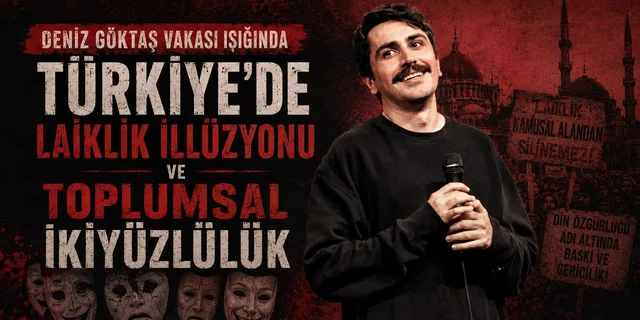
The Deniz Göktaş Detention — Dialectical Laughter and an Epistemic Barricade
The Anatomy of Intimidation Policies in Turkey and the Foundations of a Dialectical Human Rights Struggle

Dear Young Comrades,
The intellectual and critical capacity of a social formation is measured by how radically it shatters the "false consciousness" illusions the ruling class produces to lull the masses. The airport barricade comedian Deniz Göktaş has been subjected to today is not an isolated judicial error or a simple case of censorship. The scene before us is the naked "epistemic embargo" reflex of a bourgeois state apparatus whose capacity to manufacture consent has been exhausted and whose hegemony is shaken—developed against every ironic and dialectical truth that opens breaches in the consciousness of the masses.
In a country that defines itself as a "state of law" and claims to guarantee fundamental human rights, what should normatively have happened? According to contemporary legal principles and freedom of expression standards, an artist's satire of social dogmas, political figures, or theological narratives should have been protected as public richness and a democratic right. Even if there were a criminal allegation, a citizen whose address is known and who has openly declared that he is "not fleeing the country and will be here for many years" should have been summoned politely to give a statement—not have an artistic fiction criminalized through flat literalism.
So what is happening now? What is happening is repressive apparatuses hidden behind the constitutional shop window turning the judiciary directly into a "club of intimidation," laying ambushes at airports, and attempting to punish in advance the class/political criticism that seeps through comedy. An ideologically collapsing system can preserve its monopoly on truth only through naked instruments of violence.
Below you will find the detailed breakdown prepared so you can decode this structural crisis, grasp the system's contradictions, and arm the legal positions you will use while resisting such practices of domination.
Technical Chronology of the Process
- 1 June: Closed-house recording of the stand-up show "Ölü Deniz" (Dead Deniz) at Harbiye Cemil Topuzlu Open-Air Theatre.
- 24 June: Release of the show on YouTube into the public sphere and rapid viewing by millions of workers, laborers, and young people.
- 25–28 June: Faced with the show's power to expose social contradictions, coordinated digital lynch machinery triggered by actors of the ruling bloc and reactionary cliques. Göktaş being on vacation exploited to manufacture the manipulation that he "fled abroad."
- 29 June: Istanbul Chief Public Prosecutor's Office, treating artificial social media outrages as instructions, opening an official investigation on charges of "insulting religious values."
- 30 June: Through cooperation between the Information and Communication Technologies Authority (BTK) and the X (Twitter) platform, access blocks imposed on shares containing excerpts from the show under Article 8/A of Law No. 5651 ("protection of national security and public order").
- 2 July (Today): Upon return from vacation abroad, at Istanbul Airport passport control, detention carried out via UYAP record under the arrest warrant issued. Transfer to the Security Directorate on Vatan Avenue.
Grounds for Detention, Logical Absurdity, and "Delayed" Gravity
The technical grounds advanced by the Istanbul Chief Public Prosecutor's Office are TCK 216/3 (Publicly degrading religious values), TCK 299 (Insulting the President), and TCK 216/1 (Inciting the public to hatred and enmity).
The Epistemological Absurdity of the Grounds
Comedy is dialectical by nature. As Karl Marx noted, religion and dogmas are nothing but the reflection of worldly contradictions onto the sky. What Göktaş does in the "Hair" section of his show is to worldlyize the historical chronology of dogma and its function in political exploitation through irony.
To treat a pun, literary satire, and artistic metaphor as a "threat to public security" is crude censorship thinking that rejects the aesthetic nature of words. Producing punishment through abstract "values" when there is no concrete, imminent, and open danger is the bourgeois legal system's denial of its own rationality.
The Gravity of Intervention Days Later
That this detention occurred days after the show's release and consumption by millions of citizens shows the decision stems not from a legal necessity but from an organized plan of political revenge.
As Mikhail Bakhtin explains in his theory of the "carnival," when the solemn seriousness of official truth is shaken by humor, the powerful panic. The state apparatus chose to corner the comedian precisely at the airport border—the sharpest line of sovereignty—to deliver symbolic "intimidation." This delayed intervention is grim proof that the judiciary has completely lost its autonomy.
Digital Inquisition: Social Media Manipulation and Lynch Culture
In late capitalism, digital platforms have been turned into modern inquisition courts through the trolls and ideological apparatuses of the ruling class.
- Targeting by Political Actors: BBP Chair Mustafa Destici's direct threat of physical violence and death—"Do you want to be Salman Rushdie? You'll find your ruin"—is the institutionalized form of fascistic lynch culture. Figures such as Melih Gökçek and Şamil Tayyar inflaming this wave constitute an organized ideological assault.
- Digital Instructions Sent to the Judiciary: Artificial outrages on social media and 185 complaints organized through CİMER send the prosecutors of bourgeois justice a direct "command-and-control" signal. The judiciary has positioned itself not as stopping this fascistic lynch culture but as its executive force.
- Climate of Collective Fear: This lynch culture targets not only Deniz Göktaş but, in his person, all young comrades who think, question, criticize, and above all laugh. Fear is meant to be injected into social consciousness to produce epistemic paralysis.
Intimidation Policies in Turkey and the Human Rights Struggle
The repressive practice concretized in the person of Deniz Göktaş is neither the first nor the last link in the systematic intimidation policies (lawfare/war by legal means) the ruling class in Turkey uses to paralyze social opposition, intellectual production, and critical reason. A state's claim to be a "state of law" is the greatest ideological illusion concealing its class character.
As Lenin underscored in The State and Revolution, the state is a product and manifestation of the irreconcilability of contradictions between classes. The ruling class presents law as a neutral arbiter to sustain its domination; yet in moments of crisis this institutional mask falls and bourgeois law is exposed in its nakedness as a class weapon.
Epistemological Anatomy of Intimidation Policies: Apparatuses and Methods
In Turkey's current political formation, intimidation policies are not merely a physical act of closure but a form of epistemic violence targeting the masses' world of perception and the courage to think and speak. This policy rests on the following structural unlawfulnesses:
- "Dawn Raids" and Airport Ambushes as a Method of Psychological Warfare: It is no accident that artists, journalists, or academics whose address, work, and public visibility are known—and who would go to the prosecutor to give a statement if summoned—are detained in pre-dawn home raids or at passport barricades upon return from abroad. This method aims to create a climate of "unpredictable terror." The state apparatus sends the individual and society this message through ambushes set in symbolic places (home or border gate): "You are safe nowhere; you can face sovereignty's naked violence at any moment."
- Detention and Pretrial Processes Turned into Instruments of Advance Punishment: The principle of "presumption of innocence" and detention as a "measure"—among bourgeois law's most fundamental norms—have been completely inverted in Turkish practice. Detention has ceased to be a phase of gathering evidence; it has become a de facto administrative penalty that isolates the person's body, cuts them off from work and social life, and declares them "guilty" in advance before public opinion. Criminal peace judges function not according to legal norms but as "approval bodies" for the ideological needs of political power.
- Digital Panopticon and Access Blocks (Epistemic Censorship): The reckless use by BTK of apparatuses based on vague expressions such as Article 8/A of Law No. 5651 is a muzzle on the circulation of information in the public sphere. The digital space is blacked out to prevent the masses from laughing at, discussing mechanisms of exploitation, political corruption, or ideological decay. This is Antonio Gramsci's attempt at "producing collective ignorance" by seizing the masses' right to access information when hegemony is shaken.
Production of Self-Censorship: The ultimate structural aim of these intimidation policies is not to fill prisons but to erect bars in the minds of those outside. When a comedian is detained and thousands of young comrades must delete a tweet they would write, a joke they would make, a criticism they would produce, the system has successfully organized the cheapest and most effective form of pressure: self-censorship.
Truth Against the Myth of the Bourgeois "State of Law"
According to normative bourgeois legal theory, the state's duty is to protect the individual's fundamental rights and freedoms. Articles such as "freedom of expression" and "freedom of art and science" written in the Constitution look flawless on paper. Yet practical reality shows us that in Turkey law operates as an exception regime for the ruling bloc.
Laws that function so long as the interests of ruling cliques are untouched are suspended the moment radical criticism is made of class exploitation and political dogmas. Truth is replaced by the orders of the powerful; universal norms by lynch reports produced by social media trolls.
The Dialectical Transformation of the Human Rights Struggle: What Must Be Done?
Against this dark picture, a liberal, abstract human rights advocacy that shelters only in legal texts has failed. The human rights struggle must evolve from a passive position waiting for reforms the rulers may grant to an active and dialectical line of resistance.
- Breaking the Parenthesis of Individual Victimhood: We cannot see the pressure Deniz Göktaş or any other opponent faces as a singular, unlucky event. Human rights defenders and young comrades must read these attacks as an output of the system's holistic crisis (economic, political, moral). The struggle must not be limited to the demand "Freedom for Göktaş"; it must turn into exposure of the theological-political order of exploitation that produced this detention.
- Seeing the Legal Field as a Battleground: Universal human rights principles are not gifts the bourgeois state bestows upon the working class and the oppressed; they are positions wrested through centuries of class struggle. Therefore courthouses, police stations, and courtrooms cannot be abandoned as absolute domains of the rulers. The right of defense, constitutional rights, and legal procedure must be used as ideological ammunition that throws the system's own contradictions in its face.
- Weaving Collective and Organized Solidarity: The antidote to intimidation policies is collective courage. The ruling class's greatest fear is that oppressed subjects do not remain isolated but forge organic ties with broader masses. The human rights struggle must be conducted with organized reason that combines legal defense, artistic production, and solidarity in the street and digitally.
It must not be forgotten that when rulers are driven to violate their own laws, historical legitimacy and the knowledge of the future always stand with the oppressed and those who shout the truth. Rights are defended not by passively waiting in courtrooms but by turning those rooms and squares into dialectical fields of consciousness.
Knowing Our Rights: A Legal Roadmap Against the Repressive Apparatus
The bourgeois state's repressive apparatus (police, prosecution, cell) aims to break the subject's will by isolating, frightening, and pushing them into a spiral of legal ignorance. The Criminal Procedure Code (CMK) and constitutional rights are not favors the rulers grant us but historical gains of the history of class struggle. To know and apply these rights without compromise is to wage active trench warfare against the psychological and epistemic violence the state produces.
Below is an expanded legal roadmap that every comrade, artist, and intellectual under threat of detention and arrest must know by heart and use like ammunition in moments of panic:
Phase 1: The Moment of Arrest and Stop (First Epistemic Resistance)
When security forces stop you on the street, in a home raid, or at symbolic border gates such as the airport, they want to seize psychological superiority over the process. At this stage, rather than giving impulsive reactions, you must use the cool language of law as a shield.
Yet in the surveillance society of late capitalism, the repressive apparatus wants to seize not only your body but your smartphones—the digital extension of your body that holds all your class and political networks—and plunder your epistemic privacy. In the eyes of the bourgeois state, your phone is a potential "crime laboratory" and a digital panopticon that will expose your networks of comradeship.
Here is the expanded technical-legal defense line to be applied in these critical first moments against digital materials, mobile phones, and password demands:
1. Demand for Written Decision and Grounds (CMK Articles 90, 94)
Ask the officers who stop you directly and clearly: "Is there an arrest, detention, or summons decision concerning me? If so, I demand to see the written document." Oral statements and makeshift practices like "Come on, you'll explain at the station" are unlawful. Learn immediately which TCK article the charge rests on and fix it in memory.
2. Activating Collective Consciousness / Notification to Third Parties (CMK Article 95)
The state apparatus wants to take the individual by isolating them. CMK 95 states clearly: "When a suspect or accused is apprehended, the situation shall be notified without delay to a relative or a person designated by them." Do not leave this notification to police discretion. The moment you are detained at the airport or on the street—as in the Göktaş example—shout by phone or aloud (if in a public space) to your lawyer, family, or comrades which security unit is taking you and where. Break isolation in the first second.
3. Limits of Pat-Down Search (CMK Article 119)
Without a judge's decision or written order of the governor in cases of urgency, they cannot search your naked body under your clothes or your private belongings (deep inside bags, digital material contents) in detail. A search on the street is only a pat-down for weapons or dangerous substances.
4. Defense Against the Digital Panopticon: Shutting Off the Phone and Biometric Locking
At the moment of arrest or stop, police's first move is usually to grab your open phone or prevent you from locking it.
- Technical Intervention: In the first second you understand detention or arrest will begin (if possible, as you first make contact with police), shut your phone off completely (Power Off).
- Why It Matters: When a phone is fully shut down and restarted, operating systems (iOS and Android) enter "secure first boot" mode. Biometric locks such as face recognition (FaceID) or fingerprint (TouchID) are completely disabled and the device requires only the alphanumeric passcode you know. You have technically zeroed the possibility of police opening your phone by forcing it to your face or pressing your finger to the screen (unlawful data acquisition).
5. The Right to Refuse to Give Passwords: The "Nemo Tenetur" Principle (Constitution Article 38/5 and CMK 147)
Police will demand your phone's screen lock password, cloud account (iCloud/Google) passwords, or access codes for encrypted messaging apps (Signal/WhatsApp) at detention or at the station. They may push this demand with lies like "you are obliged to assist the investigation."
- Legal Response: Absolutely refuse to give your password. Constitution Article 38, paragraph 5 is your greatest legal ammunition: "No one shall be compelled to make a statement incriminating themselves or their relatives specified in law, or to produce evidence to that effect." (In legal literature this is called the Nemo Tenetur principle.)
- Epistemic Right: A password is knowledge inside your mind. The state apparatus can hold your body but you cannot surrender your mind. Not giving a password is not a "crime" but a constitutional right. You cannot be given additional punishment for not giving a password, nor can this be counted as presumption of guilt. Say "I don't remember my password" or directly "I am exercising my constitutional right and am not giving my password" and do not break this stance until your lawyer arrives.
6. Strict Limits on Digital Data Examination (CMK Article 134)
Police's general "search and seizure warrant" does not authorize rummaging through your phone's contents.
- Special Judge's Decision Required: Searching, copying, and decrypting texts in computers, computer programs, and computer logs requires a special court (judge) decision under CMK Article 134. Police at the station or the prosecutor have no authority on their own to browse your phone's gallery or messages.
- Obligation to Take an Image (Copy): If there is a valid judge's decision under CMK 134 and the phone is seized, police must take the device's "forensic image" (exact digital copy) to prevent alteration of all data inside and must immediately deliver a copy of this image to the suspect or their lawyer upon request. Keeping your phone open at the station without imaging and without recording hash values (digital fingerprints) in the protocol risks fake evidence (frame-up) being loaded from outside. Through your lawyer, insist on the note: "I do not permit the device to be tampered with before imaging is taken."
Phase 2: Police Station and Custody Conditions (Protecting the Subject) — Collective Resistance Against Spatial Domination and Isolation
The bourgeois state's custody room and police corridors are not merely spaces of stone and iron; as Michel Foucault depicts in Discipline and Punish, they are micro-fields of power aiming to subdue the body, discipline it, and atomize the subject through isolation. When the state's repressive apparatus pulls you from public space (street, stage, among comrades) and locks you in these gray cells, it wants to strip you of your political and intellectual subjecthood and reduce you to a mere "biological body" (bare life). The isolation, light play, and timelessness of custody are part of the strategy of crippling your will so you enter the interrogation room "submissive."
The way to break this spatial domination is to turn custody from a passive waiting cell into an active position of self-protection where you defend the bourgeois legal system's own limits against the state like a trench. Here are the expanded rights you must know and demand without compromise in this phase:
1. Psychological and Legal Barricade Against Informal "Interview" Pressure
- Reject Informal "Interview" Demands: Police offers such as "Come have tea, let's chat upstairs, let's clarify what you'll tell the prosecutor" at the station or custody entrance are unlawful psychological wear tactics outside CMK entirely. They have no legal binding force, and every friendly sentence you utter there is added to the file as an "intelligence note" against you. The only answer to give police is: "Every communication you establish with me is a legal act. I will not discuss any matter with you officially or informally until my lawyer arrives."
- Historical Optimism Against Threat and Isolation Psychology: Anxiety that may form in your mind when locked in a cell—"Was I forgotten?" "What is happening outside?"—is precisely the epistemic void the system wants to produce. Remember that outside, your comrades, lawyers, and organized public opinion are in motion for you. Recode time in the cell as dialectical "thinking and resting" time to clarify your theoretical/political line in your statement.
2. Class Defense of Biological and Human Needs
The bourgeois state tries to produce consent by offering detainees' human needs as a "favor." Yet custody conditions are bound to absolute standards under European Committee for the Prevention of Torture (CPT) standards and domestic law. Demanding them is your constitutional right:
- Right to Food and Clean Water: During detention the state must provide at least three meals daily of high caloric value and hygienic food and uninterrupted clean drinking water free of charge. Do not accept neoliberal tradesmanship like "There's no budget at the station, let's order from outside, you pay."
- Hygiene, Ventilation, and Medical Care: Ventilation of the cell, temperature appropriate to season (heating/cooling), and a clean bed/blanket are absolute rights. Have a protocol drawn up immediately through your lawyer against dirty, damp, or lightless cell conditions. If you take regular medication or have chronic conditions, inform the custody supervisor. Delivery of your medication under doctor supervision is the state's legal obligation; failure constitutes "violation of the right to health" and the crime of ill-treatment.
3. Control of Time and Bureaucracy (CMK Article 91)
The bourgeois state may stretch chronological limits to suffocate you in uncertainty. Tracking time and being guardian of legal deadlines is the technical dimension of resistance.
- 24-Hour Limit and Travel Time: In individual offenses detention cannot exceed 24 hours from the moment of apprehension. Even if mandatory "travel time" to the nearest judge or court (maximum 12 hours) is added, deadlines must be tracked meticulously. A suspect who does not know the time submits to police caprice.
- Right to Object to Extension of Detention (CMK 91/5): The prosecution may seek to extend detention on grounds of investigative necessity. Yet this extension cannot be taken in your absence; you must be brought before the prosecution or before a judge via SEGBİS, and your lawyer must be present when the decision is read to you. Through your lawyer, immediately file a written objection with the Criminal Peace Court against the extension decision to record the unlawfulness of detention.
4. Right to Rest Before Statement (CMK Article 147)
One of the repressive apparatus's favorite methods is to keep the suspect sleepless all night and take them to the interrogation room at first light when biological resistance is lowest. As Karl Marx narrated in Capital the struggle to limit the working day, the detainee must defend their own biological integrity as the worker defended their body against exploitation.
- Refuse to Give Statement While Sleepless and Exhausted: CMK 147 requires that a statement rest on free will. A statement given by a body kept in custody all night, unable to sleep, exhausted is corrupted. Tell your lawyer you are tired when they arrive. Through your lawyer, have recorded the demand "The suspect's biological rest, sleep needs must be met before the statement is taken." The state must not extract an epistemic concession from you through sleeplessness.
Custody is an isolation laboratory where the ruling class wants to deprive us of will. Rendering that laboratory inoperative through the bourgeois legal system's own imperative rules (CMK 91, 147, CPT principles) is the only way to enter the interrogation room standing with full political consciousness while protecting our mental and bodily integrity.
Phase 3: The Statement Process (The Dialectic of Speech and Silence) — Epistemic War and a Discursive Barricade
The interrogation room where your statement will be taken is an epistemic battlefield where the bourgeois state's naked violence apparatus confronts your ideological and philosophical stance directly. As Louis Althusser noted, the state's legal apparatus uses language not as a neutral communication tool but to construct a "truth fiction" suited to its class interests.
The moment you sit before the interrogator (police or prosecutor), their aim is not to uncover truth but to fit your fluid, artistic, or political discourse into the dull, crime-producing molds of the Penal Code (TCK 216, TCK 299, etc.). For them your words are merely "raw material" to feed the indictment fiction they prepared.
When you enter that room, both the production of speech and the preservation of silence must be dialectical tactical moves, not random reflexes. Here is the expanded strategic line to break this epistemic encirclement in the interrogation room:
1. Discursive Trap: Open-Ended Questions and "Meaning" Plunder
Interrogators usually do not begin with direct technical charges. To psychologically loosen you and seize your vocabulary they ask open-ended, philosophical, or intention-reading questions: "What was your aim when you made this joke?", "What did you actually mean here?", "Didn't you think you would offend believers?"
Dialectical Defense: Answering such questions with long philosophical, artistic, or theoretical explanations is sacrificing your words to the ruling class's judiciary. Every literary defense you make will be tweezed by the interrogator and bent against you as "The suspect admitted their intent was this."
Answers (if the right to silence is not used) must be minimal, angular, literally denotative, and entirely legal: "My statements in the show are artistic satire within the bounds of freedom of expression; I had no criminal intent." That much. Do not grant the rulers the luxury of expanding your sentence.
2. The Absolute Shield of the Lawyer (CMK Articles 147 and 149)
The bourgeois state exposes the suspect to an asymmetric power relation in the interrogation room. You are alone; facing you stands the state's entire institutional seriousness, its computer, and its armed force. The sole structural element that breaks this asymmetry is your lawyer.
- Never Without Counsel (CMK 147/1-c): Maintain epistemic alertness against police lies like "It's just us, we'll ask a couple of questions and release you" or "If a lawyer comes the process lengthens, the prosecutor will be angry." Do not speak a single word beyond identity verification until your lawyer sits beside you.
- Right to Intervene: Your lawyer in the interrogation room is not a passive observer. They have the right to intervene immediately against leading, manipulative, or degrading questions directed at you, to have the question recorded in the protocol, and to hold legal consultation (interview) with you alone. The moment you feel cornered or sense a trap in a question during interrogation, request a break in your statement and consult with your lawyer alone in the room.
3. The Political and Epistemological Power of the Right to Silence (CMK Article 147/1-e)
Bourgeois ideology tries to market silence as "weakness" or a "sign of guilt." Yet as distilled from revolutionary defendants' conduct in Lenin's tsarist courts, one of the most founding ways to reject the rulers' court and its legitimacy is strategic silence.
- Nemo Tenetur Principle: CMK 147/1-e absolutely guarantees your right not to make a statement about the offense charged (right to silence).
- Dialectic of Silence: Silence is not passive escape but an active stance that wholesale rejects the deceptive question-answer matrix the rulers set up. If you see the prosecution or police conducting interrogation with a completely intention-reading, presumptively guilty preconception, with your lawyer's approval utter this sentence and put down the pen: "Because I believe the investigation is being conducted in a biased manner, I will not answer any question you ask at this stage and will exercise my right to silence under CMK 147/1-e." This move instantly empties the interrogator's entire manipulation arsenal.
4. Exposure of Prohibited Interrogation Methods (CMK Article 148)
In the late capitalist period the state apparatus does not always apply torture through crude physical violence; modern interrogation rooms are full of psychological erosion techniques. CMK Article 148 clearly prohibits these methods and declares statements obtained thereby absolutely invalid (unlawful evidence):
| Prohibited Method (CMK 148) | Practical Interference in Interrogation Room | Legal Consequence |
|---|---|---|
| Ill-Treatment and Torture | Insult, degradation, being kept standing continuously, sleep deprivation. | Statement wholly invalid; criminal complaint against police. |
| Crippling Will / Administering Drugs | Substances or extreme exhaustion that impair capacity to stand trial. | Zero probative value under Constitution Article 38/5. |
| Deception (Fraud) | Lie: "Your comrade confessed everything; if you sign too you won't be punished." | Consent corrupted; protocol cannot be basis for judgment. |
| Unlawful Promise of Benefit | "Give us the name we want, we'll release you immediately/on judicial control." | Confession counted as evidence obtained by unlawful means. |
The moment you feel even the slightest trace of any of these methods in the interrogation room, stop your statement and through your lawyer have this situation written word for word in the "annotation" section of the protocol.
5. Written Text Wars: Protocol Control and Epistemic Revenge
When the physical process in the interrogation room ends, only the letters on paper remain. The police or prosecutor clerk, transferring your sentences to the computer, adapts them to their own jargon. For example you said "In that show I criticized the ignorance of those in power"; the clerk may enter on screen "The accused stated that they insulted the President by calling him 'ignorant.'"
- Censor the Text Line by Line: Do not sign the statement protocol hurriedly. Like a philosopher deconstructing a bourgeois text, read word by word. If there is the slightest nuance you did not say, distorted, torn from context—even the placement of a comma—point to that line and give the instruction "Correct this word."
- Power of Annotation (CMK Article 169): If police resist correcting the text, do not panic. In the blank space immediately above the signature area write in your own hand: "The statements in the protocol do not fully reflect my declarations. I do not accept the charges and wording on page 2 and am signing with this annotation." If you are physically prevented from writing an annotation, put down the pen and say "I am not signing; I refuse to sign." Have your lawyer also sign the protocol noting this unlawfulness. Remember, an unsigned or annotated statement protocol means disabling the greatest weapon in bourgeois courts' hands.
The interrogation room is a trap where the rulers want to strike you with your own language. The way to leave that room victorious is to defend your rights and your language like positions and paralyze the state's arrogant interrogation mechanism with law's own imperative articles.
Phase 4: Documenting the Body (Health Examination Guarantee) — Defense of Material Existence and the Forensic Medicine Barricade
Marxist philosophy emphasizes above all the priority of matter and objective reality. Against the bourgeois state's repressive apparatus, your "material existence"—your body possessing physical and psychological integrity—is the most concrete, barest front of class struggle.
The system, unable to ideologically subdue the subject, wants to batter and bring into line the biological level. Every kind of micro-violence possible during detention (excessively tight handcuffs, airless transport vehicles, being kept standing for hours, delayed medication) are material seals the ruling class stamps on your body.
At this point the Health Examination Process is not a routine bureaucratic procedure left to police discretion but the phase of producing material evidence of highest epistemic value where you will record all crimes the state committed or may commit against your body. The bourgeois state's reflex to protect its own police (shield of impunity) can be broken only by complete, scientific, untampered medical reports.
1. The Istanbul Protocol: The Medical Position of International Class Struggle
When taken from custody or the police station to forensic medicine, the greatest legal and medical instrument backing you is the Istanbul Protocol (Manual on Effective Investigation and Documentation of Torture and Other Cruel, Inhuman or Degrading Treatment or Punishment). This protocol is the dialectical union of medical science and the human rights struggle and is binding in our domestic law.
Epistemic Responsibility of the Physician: Under the Istanbul Protocol, the physician conducting the examination must act not as an official of the state or police but as representative of science and Hippocratic neutrality. The physician is obliged to diagnose in a free environment away from police pressure.
2. Sovereignty Struggle in the Examination Room: Right to Examination Without Police
Police personnel accompany you from the detention vehicle to forensic medicine and apply physical/psychological pressure to enter the examination room with you. Police's sole reason for wanting to remain in the room is to establish authority over the physician and prevent you from comfortably telling the doctor about violence or ill-treatment you suffered. This situation is clearly unlawful.
- What Does the Regulation Say? Article 9 of the Regulation on Apprehension, Detention, and Taking Statements and the Istanbul Protocol are clear: Examination is conducted in an environment where the physician and patient (suspect) are alone, where police cannot hear or see.
- Practical Intervention: When police enter the examination room, turn to the physician and make this clear warning and declaration: "Doctor, under the Istanbul Protocol and the relevant regulation this examination must legally be conducted in an environment without police. For my security and the independence of the examination I demand that security personnel leave the room. Otherwise the examination will be unlawful." The physician must have police leave the room; if not, have this recorded immediately through your lawyer.
3. Stance Against the Torture of Handcuffed Examination
Police, even when you sit on the examination table, cite "security risk" or "flight possibility" as pretext for not removing handcuffs. Being examined handcuffed is contrary to medical ethics and psychological violence aimed at human dignity.
- Legal Limit: Handcuffs must be removed during medical examination. Only if there is concrete aggression toward the physician or surroundings or an attempt to flee at that moment may police remain in the room or handcuffs stay on at the physician's written and reasoned request. Reject all other "automatic handcuff" impositions, demand the physician have handcuffs removed, and if handcuffed examination is performed have this recorded in the report.
4. Material Map of the Body: What Must Be Written in the Report?
Detention examination cannot be reduced to two-word printed forms saying "No assault, healthy." The physician is obliged to keep chronological and empirical record of the smallest anomaly on your body. In the room have the physician write the material map of your body word by word:
- Physical Traces: Show the physician one by one redness, bruising, or numbness on your wrists from reverse handcuffs during detention or in the vehicle; scrapes from rough pat-down; physical collapse from being kept sleepless and without water during detention. Have the phrase "Ecchymosis (bruising) present on wrists due to reverse handcuffs" added to the report.
- Psychological and Invisible Violence: Torture and ill-treatment are not only bruises. Insult, degradation, threat, humiliating treatment, or sensory manipulation such as leaving lights on continuously in the cell are also subject to medical examination. Tell the physician about psychological pressure you suffered and symptoms such as anxiety, sleep disorder, or tachycardia it caused; have psychological findings recorded in the report as "Suspect stated they were subjected to intense psychological pressure and threat."
5. Three-Stage Dialectical Control of the Forensic Report
The bourgeois state may want to tamper with reports to conceal damage to the body when detention is extended or the process concludes. Therefore health control is not one-time but a dynamic process:
| Examination Stage | Timing | Primary Purpose |
|---|---|---|
| Entry Examination | First hours of detention. | To fix in advance that you entered the station "undamaged" or violence police applied at apprehension. |
| Extension Examination | When detention is extended by prosecution. | To monitor whether bodily integrity was preserved throughout each additional day in custody. |
| Exit Examination | When sent to court or released. | To clarify bodily condition leaving the station; to seal all rights violations suffered inside. |
6. Right to Demand a Copy of the Report
Delivery of a copy of the forensic report prepared to you or your lawyer is a legal right. Police may want to hide the report from you, wrap and seal it. Read what is written in the report; if findings are missing demand immediate correction from the physician.
These forensic reports are the most unshakable material ammunition for criminal cases you will open later against torturing or ill-treating police officers, and for applications to the Constitutional Court (AYM) and the European Court of Human Rights (ECtHR). Defending your body is the most founding step in collapsing the state's monopoly of violence at the epistemic level.
Phase 5: Written Text Wars (Protocol Control and Annotation) — Semiotic Resistance Line Against the Freezing of Speech
When the verbal clash in the interrogation room ends, the state's ideological apparatus makes its final and most insidious move: transforming living, fluid, dialectical speech into inert, mechanical, bureaucratic text (protocol). When Karl Marx, in Critique of Hegel's Doctrine of the State, described how bourgeois bureaucracy inverts reality, he noted that bureaucracy abstracts living reality for its formal purposes.
The protocol is precisely the peak of this abstraction—the reification of language. The letters clicking on the police clerk's computer screen are a semiotic trap designed to fix your artistic irony or political criticism into the crime types of the Penal Code.
Those conducting the interrogation want to melt your upright stance and theoretical arguments in the protocol's cold labyrinths. Therefore the white papers placed before you are not neutral records but legal ammunition bourgeois justice will drop on your head in court. What must be done at this stage is not passive signing but a written text war in which you will subject the text word by word, comma by comma, to structural dismantling (deconstruction).
1. Semiotics of Bureaucratic Distortion: Word Hunting
The clerk does not write your sentences directly; they translate them into their own ideological and legal jargon. Seemingly innocent word changes during this translation cause epistemic shifts that can change the entire course of the case.
Examples of Institutional Manipulation:
You say "In the show I satirised the ignorance of those in power"; the clerk enters in the protocol "The suspect stated they insulted the President by calling him 'ignorant.'"" Satire (artistic act) is reified as "insult" (TCK 299).
You say "I discussed the historical chronology of sacred texts"; the clerk writes "Admitted to degrading religious values." "Discussion" (scientific/philosophical act) is cast into the mold of "degradation" (TCK 216/3).
Dialectical Intervention: Reading the protocol, apply Louis Althusser's method of symptomatic reading. Focus not only on what the text says but what it hides, how it bends words. If you see a single word or nuance you did not say or intend, put your finger on that line and say "This word is not mine; I demand correction."
2. Rules for Interrogating and Deconstructing the Text
When the protocol reaches the signing stage, psychological pressure in the interrogation room intensifies. Tactics like "Sign so we can finish," "The prosecutor is waiting" aim to prevent you from examining the text in detail. Break this pressure:
- Reading with Inspector's Rigor: Take the protocol, lean back, and read without haste, sounding words aloud if necessary. Go over the text twice with your lawyer.
- Cancellation of Blanks (Anti-Tampering Barricade): Ensure all blanks, line spaces, and margins between where the protocol text ends and the signature block at page bottom are crossed out with a "Z" line by police. Every uncanceled blank is an open invitation for fake statements or frame-up sentences to be added unlawfully after you leave the room.
- Chronological Timer Control: Check "Statement Start Time" and "Statement End Time" at the protocol's beginning and end against your watch. The time span must match reality. If you were kept sleepless or the statement lasted hours but the protocol records "half an hour," intervene immediately against this chronological fraud.
3. The Art of Annotation (CMK Articles 169 and 171)
If police or the prosecutor clerk resist correcting distortions and miswritings in the text and say "We deemed it appropriate this way," the strongest legal instrument in your hand is the Right to Annotate. Annotation is a legal nail you drive under the state's official document with your own truth.
-
How to Apply: In the area immediately above or beside where you are asked to sign, write your annotation in your own hand, clearly and decisively.
-
Template Sentences:
"The phrase '...' on page 2 of the statement protocol is not my declaration. My sentences were distorted by the clerk. Because my correction request was rejected, I am signing with this annotation."
"I annotate the irregularities in this statement taken while sleepless and exhausted, with restricted right to consult alone with my lawyer."
A protocol with annotation shatters the "conclusive evidence" illusion in the judge's hand when the case reaches trial. In the file the state's fiction and your annotation remain in dialectical conflict and bourgeois justice cannot lean absolutely on the text it produced.
4. Radical Negation: Right to Refuse to Sign (CMK Article 169/2)
If you are not even permitted to write an annotation and the text has become entirely a fiction and frame-up document, your move is radical negation that wholly rejects the mechanism of bourgeois law: refusing to sign.
- Legal Ground: No one can be forced to sign a text prepared against them or distorted without their consent. Not signing is not a crime.
- How the Process Works: Put down the pen and say "I am not signing this protocol." In this case police must add the phrase "The suspect refused to sign of their own will" below the protocol and close it accordingly. Your lawyer also annotates the protocol noting this unlawfulness. An unsigned protocol is reduced to a piece of paper produced unilaterally by the state's police and its legal validity is largely compromised.
Technical Checklist: Final Position Before Signing
| Control Point | Legal/Technical Ground | Action Required |
|---|---|---|
| Identity Information | Errors in name, ID No, address are open to procedural manipulation. | Check letter by letter; correct if necessary. |
| Lawyer's Presence | Statement taken without lawyer cannot be basis for judgment in court (CMK 148/4). | Verify your lawyer's name and signature block appear at top of protocol. |
| Leading Questions | Police's presumptively accusatory question stems must be entered verbatim in protocol. | If question form was distorted, correct the question too. |
| Page Numbers and Initials | Multi-page protocols risk page insertion/removal. | You and your lawyer initial each page at the bottom one by one. |
Young comrades; remember that writing is the rulers' oldest instrument of property and domination. Do not see the papers placed before you when leaving the interrogation room as simple bureaucratic documents. Fight for every word on the text. Against the state mechanism that wants to freeze your speech and convict you, turn that text into a counter-offensive document with your annotations and resolve!
In Conclusion: The Dialectic of Laughter, Historical Optimism, and the Future of Class Struggle
When we examine Deniz Göktaş's detention process concretized at Istanbul Airport's passport barricade from beginning to end, the final empirical reality in our hands is this: The ruling class is afraid. If a state apparatus—despite all its naked instruments of violence, ideological apparatuses holding the media's massive disinformation monopoly, its courts, prisons, and trolls—is this panicked and laying ambushes against a single ironic narrative of truth rising from behind a microphone, that state's ideological foundations are rotting.
Comedy is not a simple form of entertainment but an epistemological acid that melts the "false consciousness" illusion bourgeois superstructural institutions inject into the masses' consciousness.
Truth Is a Solvent; Laughter Is Destructive
Soviet Commissar of Education and Culture Anatoli Lunacharsky, in his writings on satire and satire's revolutionary function, noted that the most effective way to pierce the seemingly unshakable halo of sacredness of the rulers is laughter. The political clique before us built its hegemony less on the masses' consent than on metaphysical fears, dogmas, and "undiscussable sacreds." What Göktaş did in his show is to pass that artificial halo of sacredness (aura) through the filter of rationality and materialist irony and shatter it.
The worldlyization of the sacred is the profanation of the powerful. The moment the people begin to laugh at taboos the rulers produce, the most important epistemic link in the chain of obedience breaks. That is precisely why bourgeois justice coded the "Ölü Deniz" show not as a criminal element but as a radical ideological assault on its own ground of legitimacy and set the penal club in motion.
Pessimism of the Intellect, Optimism of the Will
Let us recall Antonio Gramsci's famous formula formulated in fascism's prisons: "Pessimism of the intellect, optimism of the will." Looking at the current climate of repression, ambushes at airports, inquisition courts on social media, and unending censorship decisions, the intellect may be driven to pessimism seeing bourgeois law turned entirely into a mechanism of liquidation. Yes, objective conditions are heavy; the state apparatus is reckless. Yet dialectical materialism teaches us that no regime of repression is free of its internal contradictions. That repression has become this naked and crude shows not the system's strength but its crisis of governability and inability to produce consent.
At this point we must preserve our historical optimism. History has recorded no ruling class that could shackle truth. With the unshakable faith in the lines of Soviet poet Vladimir Mayakovsky we must look to the future: The wind of the future fills our sails. If Deniz Göktaş's laughter overflowed from halls onto millions of screens, that seed of truth has already been planted in collective consciousness. The state's police cannot detain that seed; BTK cannot entirely erase that laughter from internet lines.
Call to Young Comrades: Do Not Abandon Positions, Weaponize Knowledge
Our human rights and legal struggle cannot consist, as bourgeois liberals do, of passively waiting for justice in courthouse corridors. We grasp law as an ideological battlefield where we will throw the rulers' own contradictions in their faces and agitate and organize the masses.
- Break the Wall of Fear with Laughter: The greatest antidote against the self-censorship and climate of fear the rulers want to create is preserving critical reason and joy. Against political power's long-faced, threatening, dogmatic language—never compromise on dialectical humor, art, and the fearless language of truth.
- Use Your Legal Rights Like a Shield: The legal roadmap detailed above is not an individual protection guide but a collective tactic of resistance. Defending your rights without compromise at the station, prosecutor's office, or in the street is gravel thrown between the teeth of the repressive apparatus. A youth who knows their rights and defends them with class consciousness cannot easily be taken by any police officer.
- Grow Organized Solidarity: Against the fascistic lynch culture targeting Deniz Göktaş we must erect the organized barricade of the working class, youth, and intellectuals. When a comrade, an artist, or an idea is censored or detained, we must raise our voice louder and spread that idea further.
Karl Marx writes in The Eighteenth Brumaire of Louis Bonaparte:
"Humanity evolves historical processes from tragedy to comedy so that it may part from its past with joy."
The delayed repression theater the powerful perform today is history's comic phase and consists only of the effort to postpone their own tragic end.
Comrades; sharpen your knowledge, arm yourselves with legal rights like shields, and stand with the power of light, science, and dialectical laughter against that hollow darkness the rulers call sacred.
Remember: Truth cannot be censored; laughter cannot be handcuffed!