Revolutionary Possibilities of the 21st Century and the Reconstruction of Scientific Socialism
An Assessment of the Historical Legacy, Contemporary Political Actors, the Age of NATO 3.0, and the Communist Horizon of the Future

From Historical Memory to the Founding Politics of the Future
As a Marxist, in order to understand and overcome capitalism's present crises, we are compelled to turn our eyes both to the theoretical accumulation of the past and to the concrete contradictions of the future. We closely follow Aydın Çubukçu's article On the Mahir Çayan Debate: The Theory and Practice of 'Uninterrupted Revolution'—an extremely critical reference point for understanding the historical roots and ideological ruptures of Turkey's revolutionary movement—as well as the theoretical-political debates that have grown out of this text.
Çubukçu's study, by passing the theoretical legacy of Mahir Çayan—the symbolic figure of the 1971 revolutionary rupture—through a dialectical-materialist filter, constitutes an open intervention against the petty-bourgeois radicalism and voluntarism that for long years were treated as taboo on the Turkish left. Yet our aim is not merely to reproduce the polemics of the past over and over again. We must reassess the debate in question both within the historical and social conditions of the 1970s themselves and within today's modern world—digitized, shaken by ecological crises, confronting new wars of redivision, and shaped by capital's new regimes of accumulation.
At this point, the line represented by CIPOML (International Conference of Marxist-Leninist Parties and Organizations)—one of the important focuses of the anti-revisionist communist tradition in the international arena—and by its representative in Turkey, the Labor Party (EMEP), symbolizes a historical backbone through its commitment to class politics and anti-imperialist principles. Yet the theoretical framework to which we take refuge while condemning the theoretical errors of Çayanism cannot itself remain exempt from the spirit of the age and from the structural transformations capital has undergone. We believe that the understanding represented by Aydın Çubukçu and by the CIPOML/EMEP line—a twentieth-century orthodoxy leaning on Comintern molds—must be enriched, stretched, and subjected to a radical theoretical update by the dynamics of the twenty-first century.
This study is a sincere and resolute step taken in order to expose the class limits of popular left actors, to take a clear stand against the apparatuses of imperialist war, and to place the construction of future power, together with the new forms of the class, at the center of revolutionary theory.
The Critique of Çayan Under the Conditions of the 1970s and Historical Justification
The greatest mistake one can make when judging a historical period is to judge the actors of that period from the comfortable seats of today through readings of their intentions. The second half of the 1960s and the early 1970s was a stormy age of revolutionary upsurge: the wind of the Cuban Revolution was blowing; the Vietnamese people were waging an epic resistance against U.S. imperialism; developments in China were shaking the world; and the rising youth and workers' movement in Turkey no longer fit within the parliamentary and reformist limits of TİP (the Workers' Party of Turkey).
Mahir Çayan and his comrades represented a radical rupture (the 1971 Revolutionary Rupture) from the pacifist, system-internal, and parliamentarist vise of the Turkish left. Their daring, their anti-imperialist stance, and their revolutionary resolve crystallized at Kızıldere constitute a historical badge of honor. Yet a revolutionary's moral and practical heroism cannot be the guarantee of their theoretical and methodological correctness.
Aydın Çubukçu's article, precisely at this point, strikes a historical-materialist scalpel and exposes the problems in the theoretical backbone of Çayanism. We can summarize the principal dimensions of Çubukçu's critiques directed at the conditions of the 1970s as follows:
| Çayanist Thesis | Historical-Materialist Reality | Class and Practical Consequence |
|---|---|---|
| The World-War Condition | According to Marx and Lenin, a world war is not a precondition for revolution; the chain breaks at its weakest link. | Declaring classical Leninist revolution and party theory "obsolete." |
| Artificial Equilibrium | Capitalism's internal contradictions are uninterrupted; the consciousness of the masses opens through mass action. | Regarding the mass movement as passive; a slide into Voluntarism and Focoism. |
| The PASS Strategy | Politics directs military means; military action cannot replace political work. | The party's transformation into a military apparatus, the rupturing of ties with the masses, and liquidation. |
| The Third Crisis Period | Capitalism's capacity for flexibility and Keynesian regulation was ignored. | Declaring economic-democratic mass struggle "pacifism." |
The Epistemological Distortion in the Relation of "World War and Revolution"
In the texts Uninterrupted Revolution I-II-III, Çayan constructed a "necessary precondition" that never existed in the classics of Marxism-Leninism, in order to legitimize his own revolutionary strategy. Çayan claimed that according to Marx, Engels, and Lenin a "world war" was a condition for proletarian revolutions to take place; and that, on the grounds that inter-imperialist wars of redivision had become impossible in the "Third Crisis Period" into which imperialism entered after the Second World War, classical Leninist party and revolution theories had become invalid. Çubukçu has demonstrated that this claim of Çayan's consists of nothing more than a distortion of Marx's concept of "revolutionary world war" in the context of 1848.
The "Artificial Equilibrium" Hypothesis, Voluntarism, and Subjective Idealism
The keystone of Çayan's theoretical architecture is the concept of "Artificial Equilibrium." According to Çayan, in the period of neo-colonialism imperialism had pacified the masses through covert occupation, consumer culture, and the illusion of relative prosperity, establishing an "artificial equilibrium" between the oligarchy and the masses.
"The internal contradictions of capitalism are uninterrupted, and the consciousness of the masses is opened not by a spark descending from heaven, but through their own self-activity and the making-visible of class contradictions."
Çayanism, by regarding the masses as pacified, claimed that the equilibrium could be broken only by a vanguard fighter from outside, and substituted "Armed Propaganda" for mass work. The economic, democratic, and trade-union struggle of the working class was belittled as "pacifism."
PASS and the Liquidation of the Leninist Party
Çayan defended the PASS (Politicized Armed Struggle Strategy) conception, which transformed the revolutionary organization from a political party into a military guerrilla apparatus. The Bolshevik Party model drawn by Lenin in What Is to Be Done?—rooted in factories, fields, and trade unions, combining legal and illegal forms of struggle in a dialectical unity—was rejected. This military structure, severed from mass ties, prepared the tragic yet inevitable liquidation of THKP-C in the process stretching from Maltepe to Kızıldere.
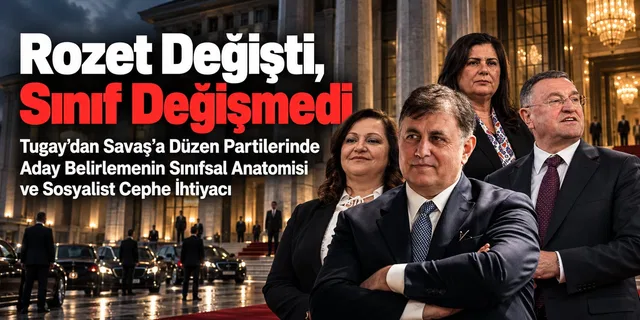
The Illusions of Today's Left: TİP, DEM Party, Parliamentarism, and the Kurdish Question
While condemning the voluntarism of the past, we are compelled to establish class and principled clarity against the popular currents of today's Turkish left. The two fundamental focuses that today hold hegemony in Turkey's left field—the Workers' Party of Turkey (TİP) and DEM Party (Peoples' Equality and Democracy Party)—even if in different lanes, exhibit serious theoretical and practical limits that distort class politics.
| Actor / Current | Sociological Base | Political Line / Illusion | Limit in Class Politics |
|---|---|---|---|
| TİP | Metropolitan secular-middle class, urban white-collar workers | Parliamentary populism, media showcasing, culture wars | Conceiving the working class as a passive "victim"; confinement to parliament |
| DEM Party | The Kurdish people, oppressed identities and democratic spheres | Ethno-political narrowing, geopolitical pragmatism, liberal alliance | Blurring class contradictions under the discourse of national unity |
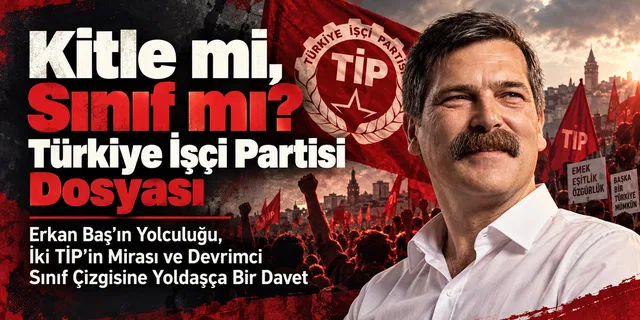
Critique of TİP: Parliamentary Cretinism and Secular Cultural Populism
Although TİP carries the word "worker" in its name, it draws its historical and practical body not from the heart of production—that is, from organized industrial zones, from the fields, from flexible laborers in the outskirts, or from motorcycle couriers—but from the secular-cultural opposition of the metropolises, from urban middle-class intellectuals, and from white-collar discontent.
-
Class Alienation and Showcase Politics: Instead of constructing class politics as an organic workers' self-organization at the contradiction-foci where production takes place, this line constructs it through podium shows in parliament, social-media algorithms, and media showcasing; it conceives the proletariat not as a historical revolutionary subject but as a "mass of victims to be represented."
-
The Illusion of Parliamentarism: This understanding, stricken with what Engels termed the disease of "parliamentary cretinism," spreads the illusion that the bourgeois state apparatus can be transformed through parliamentary arithmetic and parliamentary elections. When class struggle is turned into an accessory of culture wars, the bond the party establishes with the class ceases to be an objective organic bond and is reduced to an aesthetic sympathy.
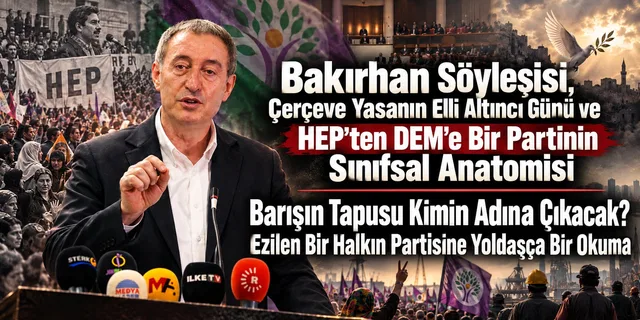
DEM Party and the Kurdish Question: From the Politics of the Oppressed Nation to Ethno-Political Constriction
For Marxism-Leninism, the Kurdish question is a historical, national, and democratic question of denial and oppression created by Turkey's ruling classes and by regional imperialism. To defend without reservation the right of an oppressed nation to self-determination and the struggle for equal citizenship is the minimum condition of being a revolutionary. Yet this stance cannot mean approving the political line of the Kurdish national movement without criticism.
-
The Substitution of Identity for Class Politics: While the DEM Party tradition represents the just and legitimate anger of the Kurdish people, it places at the center of its political analysis not class contradictions but oppressed identity. The irreconcilable class contradictions among the Kurdish bourgeoisie, Kurdish feudal lords, and the Kurdish proletariat are blurred under the discourse of "national unity."
-
Geopolitical Pragmatism and Liberal Wavering: DEM Party's geopolitical line frequently experiences class waverings because of the pragmatic relations it establishes with imperialist powers in the region (especially with the U.S./NATO axis) and with bourgeois-liberal alliances. The solution of the Kurdish question cannot be relegated to the "opening" calculations of bourgeois cliques or to the tables of imperialist diplomacy.
-
The Revolutionary Line of Solution: The real, lasting, and revolutionary solution of the Kurdish question passes through the common anti-capitalist and anti-imperialist front of the Kurdish and Turkish working class, through their common struggle against capital and nationalism. Every approach that substitutes identity for class is condemned to drag the proletariat behind bourgeois cliques.
NATO 3.0, Regional Wars of Redivision, and Turkey's Sub-Imperialist Role
As we leave behind the first quarter of the twenty-first century, the world has entered a bloody stage in which capitalism's crisis of over-accumulation has deepened and the crisis of imperialist hegemony is being attempted to be resolved through military conflicts. The Russia-Ukraine war and the expanding conflicts along the Iran-Israel/Middle East axis are proof that the imperialist balances established after the Second World War have completely collapsed.
| War / Focus of Tension | Imperialist Character and Position | Revolutionary Class Stance |
|---|---|---|
| The Ukraine War | NATO/EU Western Imperialism vs. Russian Revisionist Imperialism | Dual Defeatism: Rejection of both imperialist blocs; the brotherhood of peoples. |
| Middle East / Iran | U.S.-Israeli Zionist Aggression vs. Iran's Clerical-Bourgeois Regime | Stance against Zionist/imperialist aggression; class independence against reactionary regimes. |
| NATO 3.0 and Turkey | Global military encirclement and Turkey's sub-imperialist expansionism | Exit from NATO: Struggle against one's own bourgeoisie's regional war policies. |
"NATO 3.0" and Global Imperialist Domination
NATO, having completely abandoned the Cold War lie of a "defense pact," has transformed into an aggressive global security apparatus aiming to preserve the global hegemony of U.S. imperialism. This new phase, which we call NATO 3.0, aims to encircle China and Russia from Eastern Europe to the Asia-Pacific, to bring energy corridors under control, and to feed the military-industrial complex by forcibly increasing member countries' defense budgets.
The Two-Faced Role of the Turkish Bourgeoisie: Sub-Imperialist Expansionism
Although Turkey's ruling classes (the People's Alliance and capital blocs) present themselves as the "victims" or "neutral mediators" of imperialist conflicts, in reality they function as a regional sub-imperialist actor.
-
Both NATO Loyalty and Regional Expansionism: The Turkish bourgeoisie, on the one hand, remains umbilically tied to the Western imperialist bloc as NATO's second-largest army and approves NATO expansions; on the other hand, it seeks to expand its own market, raw-material corridors, and military influence in Iraq, Syria, Libya, and the Caucasus.
-
Revolutionary Stance: The task of revolutionaries is not to support the regional ambitions of "their own" bourgeoisie, nor to choose the "lesser evil" between the NATO/U.S. and Russia/China imperialist blocs. In accordance with the Leninist principle of "revolutionary defeatism" and the independent class line; neither NATO militarism, nor regional reactionary regimes, nor the sub-imperialist war policies of our own rulers can be supported! The sole stance is to raise the slogan: "Down with Imperialist War, Long Live Class War!"
Aspects of the CIPOML and EMEP Line That Need Development: Theoretical and Practical Leap Areas of 21st-Century Communism
As a Marxist, to acknowledge the historical right of the line represented by CIPOML (International Conference of Marxist-Leninist Parties and Organizations) and by its representative in Turkey, the Labor Party (EMEP), is a requirement of dialectical honesty.
This tradition, even in stormy periods when liberal left winds blew, when class politics was sought to be drowned within "identities" and "culture wars," and when revisionism and reformism sought to liquidate the revolutionary lane, has remained unshakably committed to the working-class ground, anti-imperialist principles, and an anti-revisionist backbone. This stance is the unshakable anchor point of the class movement.
Yet for a Marxist, no historical line can be a frozen dogma or an untouchable sacred. Justly criticizing the voluntarist and adventurist deviations of the past (Çayanism, Focoism, etc.) does not mean that the theoretical-political framework on which we ourselves stand is complete and absolute. Karl Marx's methodology shows us that theory, so long as it fails to grasp the structural transformations capital has undergone and the new quality reached by the productive forces, is condemned to grow conservative and fall behind practice.
We address with dialectical depth five fundamental areas in which the understanding of the CIPOML and EMEP line—leaning on twentieth-century Comintern molds—must be enriched, stretched, and subjected to a radical theoretical-practical update by the dynamics of the twenty-first century.
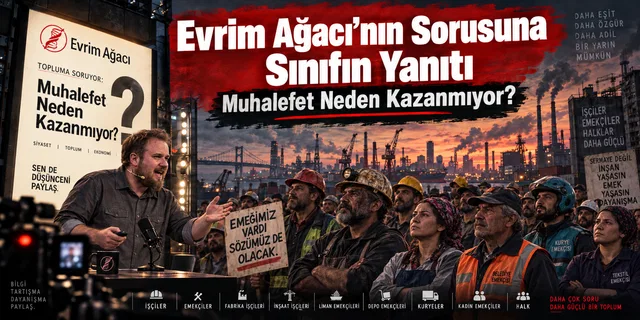
Leap in Class Analysis: From the Fordist Industrial Worker to the Cognitive Precariat
CIPOML and EMEP's class analysis and organizational strategy have focused largely on the twentieth century's Fordist (industrial) model of production and on the relatively homogeneous industrial worker who worked side by side in gigantic factories, spatially gathered together. While this understanding treats industry as the sole and absolute "essence" of the class, it remains conservative in grasping the structural transformations capital has undergone.
"Capital increasingly pushes living labour out of being the direct subject of production and into the position of supervisor and regulator of the production process... The creation of wealth rests less on the expenditure of direct labour time than on the application of the 'General Intellect' at the social level."
— Karl Marx, Grundrisse (Fragment on Machines)
This concept of the General Intellect, which Marx foresaw in the mid-nineteenth century, has found its full counterpart in today's cognitive and algorithmic capitalism. The regime of capital accumulation has shifted from Fordism to a Post-Fordist, flexible, and digitized model of accumulation.
| Axis of Comparison | 20th-Century Fordist Labour Regime | 21st-Century Cognitive and Fluid Labour (Precariat) |
|---|---|---|
| Space of Production | Factory-centered, spatially fixed and collective | Atomized, de-spatialized, home/street/network-centered |
| Class Composition | Blue-collar homogeneous industrial proletariat | Motorcycle couriers, platform workers, software developers, call-center laborers |
| Form of Exploitation | Physical muscle power and defined working hours | General Intellect exploitation, 24/7 algorithmic theft of life |
| Instrument of Organization | Classical factory trade unionism and collective bargaining | Digital network committees, platform unions, cryptographic solidarity networks |
-
The Reality of the Cognitive Precariat: Whether a person is a worker is determined not by their diploma, their clothing, or the physical structure of the place where they work, but by not owning the means of production and being compelled to sell their mental/physical labour-power in order to live. Today motorcycle couriers, platform workers, software developers, call-center laborers, graphic designers, and private-sector teachers are the dispossessed auto-proletariat (Cognitive Precariat) of the twenty-first century.
-
The Limits of Trade Unionism: The mass work of the CIPOML line is frequently confined to classical trade-union bureaucracy or to factory gates. Yet labour has been de-spatialized and atomized. Class work must overflow from the factories and produce a new language of agitation and organization encompassing digital networks, courier parking areas, software communities, and spaces of flexible labour.
Leap in State Analysis: From the Classical Police State to the Algorithmic Panopticon
The early Leninist period and Comintern traditions had developed principles of organization against the bureaucratic-military police state of the early twentieth century. CIPOML and EMEP still tend to see the state predominantly as consisting of these classical apparatuses of repression (police, army, prison).
| Form of the State | Mechanisms of Domination and Control | Response and Need of the Revolutionary Organization |
|---|---|---|
| 20th-Century Police State | Agentization, physical surveillance, censorship, official law-enforcement violence | Classical cellular secrecy, illegal publications, physical security |
| 21st-Century Algorithmic State | Big Data, Artificial Intelligence, facial recognition, biopolitical control | Cryptographic communication, open-source code organization, cyber-security |
Techno-Political Inadequacy: To regard technology as a "bourgeois instrument of degeneration" or as a neutral technical device is to leave the class unarmed. Classical leaflets and physical committees of course retain their validity; yet cryptographic communication networks, open-source code organizations, data-privacy strategies, and tools of cyber-struggle must be made organic components of the revolutionary organization. Technology must be wrested from being capital's instrument of control and transformed into the class's apparatus of liberation.
Leap in Ecological and Production Analysis: From the "Fetishism of Productive Forces" to the Metabolic Rift
Twentieth-century ML tradition (with a legacy inherited from the experiences of the Soviet Union and the Eastern Bloc) had entered a race with capitalism over "developing the productive forces faster and on a gigantic scale" (heavy industrialization, conquering nature as a raw-material depot). This approach bore an ideological parallel with the "developmentalist" logic of the industrial age.
| Approach / Paradigm | Conception of Production and Nature | Strategy Reflected in the Programme |
|---|---|---|
| Fetishism of Productive Forces | Seeing nature as an unlimited raw-material depot; emphasis on industrialization | A change of ownership is sufficient; production must grow quantitatively |
| Metabolic Rift & Ecosocialism | Grasping that the balance between human and nature has been disrupted | Ecosocialist Planning: What, how, and how much will be produced? Qualitative growth |
"Capitalist production develops only by drying up the two sources at the origin of all wealth: the soil and the laborer."
— Karl Marx, Capital (Volume I)
-
Metabolic Rift: In CIPOML publications the ecological crisis is generally treated as a "secondary environmental devastation" tied to capitalism's lust for profit. Yet the crisis is at the level of the Metabolic Rift that Marx underlined; that is, the irreversible rupturing by the regime of capital accumulation of the organic bond between human and nature.
-
Ecosocialist Planning and Qualitative Degrowth: Twenty-first-century Marxism cannot regard taking ownership of the means of production from capital as sufficient on its own. The quality and purpose of production must be radically questioned: an horizon of ecosocialist degrowth and ecological planning—oriented not toward profit-driven growth but toward need-oriented qualitative development, in harmony with nature—must be placed at the center of the revolutionary programme.
Leap in the Organization-Class Relation: From Bureaucratic Substitutionism to Participatory Digital Democracy
The bitterest experience of twentieth-century socialist experiences and of Comintern practice was that the principle of "Democratic Centralism" over time transformed into a centralist-bureaucratic administration that eliminated the base's right to speak, that the Party took the place of the Class (substitutionism), and that a bureaucratized state apparatus was created.
| Form of Organization | Decision-Making Mechanism | Relation Established with the Class |
|---|---|---|
| Bureaucratic-Vertical Organization | Hierarchical, top-down chain of command | The working class in the position of a passive mass listening to the Party's agitation |
| Participatory Digital Organization | Transparent, based on base committees, digital decision mechanisms with instantaneous participation | The working class as the subject that takes decisions, governs, and recalls representatives at any moment |
-
The Risk of Political and Trade-Union Bureaucracy: The fundamental weakness that also recurs from time to time in the CIPOML and EMEP line is to subordinate mass organization to the vertical decisions of party organs, or to confine the workers' movement solely within the limits of "trade-unionization and narrow economic rights-claiming." The working class must be not merely a mass that listens to the Party's truths, but the direct subject that takes decisions, governs, and supervises.
-
The Democratic Apparatus of the Future: CIPOML remains inadequate in methodologically confronting the disease of bureaucratization of real socialism. Twenty-first-century revolutionary practice must construct mechanisms of participatory and direct digital democracy in which the base can participate in instantaneous decisions, which are transparent, in which representatives can be recalled at any moment, and in which the right to vote is transferred directly to the masses through digital infrastructures.
Leap in Anti-Imperialism: Dual Defeatism in the Age of NATO 3.0
The binary camp logic remaining from the Cold War period is inadequate for grasping today's complex and multipolar imperialist market wars.
| Imperialist Focus / Actor | Political Role and Character | Revolutionary Class Stance |
|---|---|---|
| U.S. / NATO 3.0 / EU | Aggressive, globally encircling Western imperialism | Uninterrupted Rejection: Exit from NATO, closure of military bases |
| Russia / China Bloc | Revisionist imperialism expanding its own market spheres | Independent Class Line: Rejection of Eurasianist dreams and of Chinese/Russian capitalism |
| Turkish Bourgeoisie | A line combining NATO loyalty with regional market-seeking | Revolutionary Defeatism: Stance against the sub-imperialist wars of one's own rulers |
- The Principle of Revolutionary Defeatism: While the CIPOML and EMEP line takes an extremely clear stance against Western imperialism and NATO, it carries the risk of occasional waverings in the face of the regional expansionism of Russian revisionist imperialism or of Chinese capital. Twenty-first-century revolutionary practice, in accordance with the Leninist principle of "revolutionary defeatism," refuses to choose one of the imperialist blocs as the "lesser evil." The sole principled stance is to defend the independent class line against all imperialist blocs and against the sub-imperialist war policies of one's own bourgeoisie.
The Five Fundamental Leap Areas of the CIPOML and EMEP Line
| Theoretical and Practical Dimension | 20th-Century Comintern Template | 21st-Century Innovative Communist Horizon |
|---|---|---|
| 1. Vanguard Subject | Only the traditional Fordist industrial worker | Industrial Worker + Cognitive Precariat (courier, software developer, platform laborer) |
| 2. Exploitation of Labour | Physical working time in the factory space | General Intellect / 24/7 Cognitive and algorithmic theft of time |
| 3. State Analysis | Classical bureaucratic-military police state | Algorithmic Panopticon and Biopolitical Surveillance State |
| 4. Ecological Line | Growing the productive forces / Secondary environmental devastation | Metabolic Rift / Ecosocialist Planning and Qualitative Degrowth |
| 5. Form of Democracy | Vertical-bureaucratic representation / Party substitutionism | Direct participatory digital democracy and base committees |
A Call to Build the Future
The consistency exhibited by comrade Aydın Çubukçu in his critique of Çayan, and the insistence of CIPOML and EMEP on their class ground, constitute an invaluable foundation. Yet theoretical truths cannot be preserved as one preserves antiques in a museum.
Our effort is to bring the class backbone and anti-imperialist resolve represented by CIPOML and EMEP together with the twenty-first century's cognitive precariat, biopolitical surveillance state, ecological imperatives, horizon of participatory digital democracy, and construction of Cyber-Socialist power. Not a dogmatism that worships yesterday, but a dialectical creativity that dares to grasp today's concrete contradictions will win the future!
Construction of the Future and Conclusion: Building the Future with a New and Dynamic Class Consciousness
The Threshold at Which We Stand: The "Collective Illusion" of 21st-Century Capitalism
Historical dialectic teaches us that whenever humanity enters an interregnum in which the system is completely jammed and crises trigger one another, the ruling classes impose upon the masses the illusion that "no alternative is possible." What we are living through today is precisely this.
Twenty-first-century capitalism does not merely exploit physical labour-power in the factory; through artificial-intelligence algorithms, biopolitical mechanisms of control, and digital platforms, it seizes humanity's mental capacity, attention span, emotional world, and dreams of the future.
The picture before us is a fourfold spiral of crisis created by the capitalist system:
-
Economic Crisis: Flexibilization, precaritization, and a gigantic wave of dispossession.
-
Technological Crisis: The transformation of automation and artificial intelligence into a threat of unemployment and algorithmic slavery instead of liberating humanity.
-
Ecological Crisis: The Metabolic Rift created by capital accumulation as it exceeds the planet's biophysical limits.
-
Geopolitical Crisis: The global wars of redivision led by NATO 3.0 and rising fascistic militarism.
Just as taking refuge in the voluntarist adventurism of the past (Çayanism) is a tragic utopia in the face of this colossal destruction, so too is surrendering to TİP's parliamentary-populist vise, to DEM Party's ethno-political limits, or to the frozen 1930s dogmatism of the CIPOML/EMEP line equally fraught.
What will build the future is neither nostalgia for the past nor system-internal reformism. What will build the future is a New and Dynamic Class Consciousness born from the concrete conditions of the twenty-first century.
The Transformative Architecture of New and Dynamic Class Consciousness
Dynamic Class Consciousness does not regard the class as a static museum object. It is the common destiny of the blue-collar worker in the industrial outskirts and of the cognitive precariat who sweat in the call center, in the motorcycle-courier convoy, on the software screen, and in the service sector.
Class consciousness today is not merely a demand for a "wage increase"; it is the struggle for the liberation of time, space, data, and the planet.
| Axes of Transformation of Class Consciousness | 20th-Century Classical Conception | 21st-Century Dynamic Class Consciousness |
|---|---|---|
| Class Subject and Scope | Only the homogeneous industrial proletariat under the factory chimney | Industrial Worker + Cognitive Precariat (software developer, courier, platform laborer, precarious service worker) |
| Focus of Exploitation and Struggle | Exploitation of bodily labour-power within working hours | General Intellect exploitation; the struggle for the socialization of life-time and data |
| Identity and the National Question | Dividing the class into identities or ignoring the national question | Against chauvinism, the anti-capitalist, anti-imperialist revolutionary unity of Turkish and Kurdish laborers |
| Form of State and Organization | Vertical, bureaucratic party and classical police-state analysis | Against the Algorithmic Panopticon; transparent, participatory digital democracy and network-type committees |
| Ecological Horizon | Growing the productive forces / Logic of conquering nature | Metabolic Repair: Ecosocialist Planning and Qualitative Degrowth against profit-driven growth |
The Five Fundamental Founding Pillars of the Future
Cyber-Socialism and Data Commons (Data Commons)
The communist alternative of the future, while taking ownership of the means of production from capital, must socialize not only physical factories but also algorithms, artificial-intelligence infrastructures, databases, and digital platforms (Google, Amazon, Uber, etc.).
-
Algorithmic Planning: The bureaucratic planning problems of twentieth-century socialism can be overcome with today's gigantic data-processing capacity and artificial-intelligence algorithms. In place of market chaos and the lust for profit, a Cyber-Socialist Planning will be established that transparently calculates society's real needs in harmony with environmental limits.
-
The Liberation of Data: Data produced by humanity's collective intelligence will be wrested from the ownership of capital monopolies and transformed into a Data Commons open to the use of all society.
The Liberation of Time: The 20-Hour Working Week
As Marx stated, "The realm of freedom begins only where the realm of necessity ends." Under capitalism, automation and artificial intelligence mean unemployment, precarity, and intensified exploitation. In cyber-socialism, by contrast, technology is the fundamental instrument that will lift the burden of drudgery from humanity.
-
Concrete Target: Artificial intelligence and automation must be placed in the service of all society; the daily working time must be reduced to 4 hours, the weekly working time to 20 hours.
-
The radical reduction of working hours will ensure the fair division of work among all individuals in society, and will grant humanity a vast free time in which to engage with science, art, philosophy, and politics.
| System Model | Consequence of Automation and Artificial Intelligence | Social-Class Counterpart |
|---|---|---|
| Capital Capitalism | Dispossession, threat of unemployment, intensifying algorithmic exploitation | Impoverished precariat, growing precarity, psychological burnout |
| Cyber-Socialism | Fair division of work across society, radical reduction of working hours | Liberated time, explosion of social culture/art, human development |
Ecosocialist Metabolic Repair
Capital accumulation, by commodifying nature, is dragging the planet toward an irreversible ecological catastrophe. Twenty-first-century socialism must abandon the industrialist rote formulas that sanctify growth.
-
Qualitative Growth and Degrowth (Degrowth): Spheres produced solely for profit and harmful to society and nature (the arms industry, luxury consumption, products of planned obsolescence with short use-lives) will be liquidated; qualitative development will be targeted in the spheres of health, education, ecological repair, and culture.
-
Metabolic Repair: The organic bond between human and nature will be re-established; fossil-fuel domination will be ended and a transition made to renewable, local, and nature-compatible production planning.
Revolutionary Unification on the Kurdish Question and an Anti-Chauvinist Line
The future of Turkey's revolution passes through shattering the nationalist and chauvinist poison of the ruling classes. The Kurdish question can be relegated neither to the power calculations of the bourgeoisie nor to the tables of imperialist centers.
-
Equality on a Class Basis: Without establishing the revolutionary unity of the Kurdish and Turkish working class and of the oppressed, neither can capitalism be overthrown nor can the Kurdish people attain full freedom.
-
Turkish laborers will stand against the chauvinism of their own rulers; Kurdish laborers, for their part, without following their own bourgeoisie and imperialist dreams, will meet on a common revolutionary independent class line.
Dual Defeatism Against NATO 3.0 and Anti-Imperialist Peace
In the imperialist wars of redivision that turn the world into a lake of blood (Ukraine, the Middle East, the Eastern Mediterranean), the revolutionary stance is a matter of principle.
-
Revolutionary Defeatism: We refuse to choose between Western imperialism (NATO 3.0) and Russian/Chinese revisionist imperialism.
-
We raise the slogan "Class war against our own bourgeoisie!" for Turkey's immediate exit from NATO, the closure of all foreign bases, and an end to the sub-imperialist expansionist war policies that the Turkish bourgeoisie sustains from Syria to Iraq.
Strategic Political Line and Critical Comparison of Actors
| Political Actor / Current | Historical/Contemporary Limit | Our Radical Cyber-Socialist Alternative |
|---|---|---|
| Mahir Çayan / PASS | Voluntarism, vanguard warfare, rejection of the mass line | Organization based on the self-activity of the masses and dynamic class consciousness |
| TİP / Parliamentarism | Parliamentary shows, secular-middle-class populism, system-internalism | Direct and participatory workers' power rooted in the spheres of production |
| DEM Party / Ethno-Political | Substituting identity for class, liberal/imperialist waverings | Anti-capitalist, anti-imperialist revolutionary unity of the Turkish and Kurdish working class |
| CIPOML / EMEP | 1930s Comintern schematism, neglect of the cognitive precariat | Cyber-Socialism: Algorithmic commons, 20-hour work week, ecosocialism |
The Future Is Not Awaited—It Is Built with Daring!
The Leninist scalpel that Aydın Çubukçu struck against the 1971 revolutionary rupture and the legacy of Mahir Çayan has constituted a historical ground for our theoretical hygiene. The anti-revisionist consistency of CIPOML and the Labor Party on the class ground is our anchor point in stormy seas.
Yet as a Marxist our final word is clear: The anchor point is for holding the ship; what will chart the course and bring it to harbor is the daring to face the storm of the twenty-first century.
"Mankind thus inevitably sets itself only such tasks as it is able to solve, since closer examination will always show that the problem itself arises only when the material conditions for its solution are already present or at least in the course of formation." — Karl Marx
To be a revolutionary in the twenty-first century requires not being imprisoned in the romantic fetishism of the past, just as it requires not taking refuge in the frozen formulas of the 1930s; not falling for TİP's parliamentary shows or DEM Party's classless identity politics.
In this new age stamped by artificial intelligence, precarious digital labour, algorithmic exploitation, NATO 3.0 aggression, and the climate crisis, socialism must be the most modern mass movement that speaks the language of the future, instrumentalizes technology for the liberation of the class, returns time to humanity, and protects the planet.
We are the people of the future. The future is not awaited by keening in the shadows of the past; it is built with the daring, the reason, and the action of a new and dynamic class consciousness—in the street, in the factory, on the networks, and in the fields!