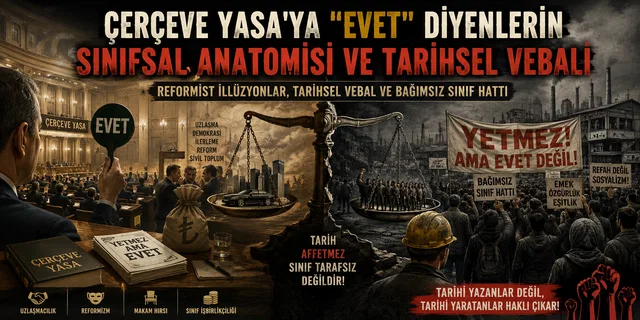
Why Is the Access Block on TİP's Accounts an Entirely Different Category?
Without a Closure Case: Cutting Off a Party's Voice

Summary: What Happened Today, and What Does This Piece Argue?
Dear Young Comrades,
On the morning of 14 October 2026, two pieces of news broke at almost the same hour.
The first: Police entered Halk TV's building, the TMSF (Savings Deposit Insurance Fund) was appointed as trustee to the channel, and its broadcast was stopped. The grounds given were an investigation into the chairman of its board, Cafer Mahiroğlu, for bribery, bid rigging and laundering the proceeds of crime. We covered the process and the grounds today in a separate piece: Who Blacked Out the Screen? A Trustee for Halk TV.
The second: Access to the Workers' Party of Turkey's (TİP) head office X account (@tipgenelmerkez), which has 582,000 followers, and to its Istanbul Provincial Branch account was blocked under Article 8/A of Law No. 5651. Neither the authority that issued the order nor its grounds have been disclosed. X has not yet enforced the order.
The thesis of this piece fits in one sentence:
A pretext of "financial crime" can be invented for a television channel, of "speculation" for a journalist, of "obscenity" for an association. But there is no ground that can be defended within the rule of law for cutting off the voice of a legal political party. This is not a new link in the chain of censorship but a change of category: the shift from interfering with press freedom to interfering with political representation itself.
In the rest of this piece, I will set out five things in detail:
- The balance sheet of a month-long wave of censorship, and where the TİP order sits within it.
- The difference between Halk TV and TİP: for one a "pretext" can be found, for the other it cannot.
- A look, one by one, at the question "What explanation could be given?", and why each possible ground collapses.
- The chain linking the fund crisis, Ahmet Şık's parliamentary questions and the timing of this order.
- Why everyone, whether or not the party is TİP, should treat this order as their own business, and what can be done.
A Month's Balance Sheet: How Far Has the List Grown?
In our first piece on censorship, we described the 48-hour wave of 12–14 September and spoke of a "law of expansion": once a tool has been legitimised, the category it covers expands. That day it was a prediction. Today it is a chronology. We have recorded the links in between one by one too: the shutdown of T24, how blocking is technically enforced, the silencing of EngelliWeb, journalists' open call to Musk and the electronic shackle for journalists who asked about the fund crisis.
| Date | What happened | Stated grounds |
|---|---|---|
| 12–13 September | LGBTİ+ associations, university societies, activists | "Ailem Güvende" ("My Family Is Safe") investigation, obscenity |
| 14 September | Evrensel, Amnesty International Turkey, the Academics for Peace, MLSA, TİP's LGBTİ+ Bureau | National security / obscenity (two grounds under the same order number) |
| 22 September | 194 accounts of economists, journalists and finance experts | "Posts made for speculative purposes" |
| End of September | T24's website and its X account with 1.9 million followers | The claim that 118 news reports were "LGBT propaganda" |
| 30 September | bianet's X account with 402,000 followers; at least 147 more accounts writing about the fund crisis | Not stated / speculation |
| 1 October | The account of EngelliWeb, which records censorship | "National security and public order" |
| 5 October | İFÖD's own account; the Women's Party (Kadın Partisi) | Not stated |
| 11 October | Three bianet reports on Ahmet Şık's parliamentary questions on the fund crisis | Not stated |
| 14 October | TİP head office and Istanbul provincial accounts | 8/A — grounds not disclosed |
Let us grasp the scale of the numbers. According to the records of the Freedom of Expression Association (İFÖD), in September 2026 alone at least 1,270 X accounts were blocked; about 90 per cent of them were made invisible from Turkey, and their combined following exceeded 35 million. For comparison: in the whole of 2025, the number of X accounts blocked under 8/A was 995. (bianet, in Turkish; Medyascope, in Turkish; we discussed the September balance sheet in detail in They Silence the One Who Keeps the Ledger Too.)
In a single month, more than in the whole of the previous year.
There are three turning points in the table, and their order matters:
- First, morality (LGBTİ+, "family"): the hardest category to defend.
- Then, the economy ("speculation"): those who wrote about the fund crisis.
- Then, those who keep the record (EngelliWeb, İFÖD): those who count the censorship.
- And now, political representation: first the Women's Party, today TİP.
Today was not the first time TİP was touched. On 14 September, the account of the party's LGBTİ+ Bureau had been thrown into the "obscenity" sack. And in April 2025, the account of its youth organisation, TİP'li Öğrenciler (TİP Students), was shut down by an order from a judgeship in Mersin that had nothing to do with the matter (Diken, in Turkish). So first the edges of the party, then its core. The law of expansion worked in the same order within a party's internal organisation.
Halk TV and TİP: One for Which a Pretext Can Be Found, and One for Which It Cannot
The question that may have occurred to you as a reader too is this: a trustee was appointed to Halk TV, TİP's account was shut down; aren't they the same thing?
They are not. And seeing the difference is the key to understanding today.
Halk TV: Entering Through the Channel of Ownership
Halk TV is a company. A company has an owner, partners, tenders, bank accounts and tax records. According to the statement of the Istanbul Chief Public Prosecutor's Office, the investigation is being conducted by the Financial Crimes Unit of the Istanbul Police; the transaction volume calculated by MASAK (the Financial Crimes Investigation Board) is 30.3 billion lira; the allegation is of unlawful gain through İzmir Metropolitan Municipality tenders. Halk TV's name does not even appear in the prosecutor's statement: the TMSF was appointed as trustee to the companies "in which Mahiroğlu is a partner, manager or otherwise associated", and Halk TV became one of them (Euronews, in Turkish).
This road is not new. According to Medyascope's round-up, Habertürk and Show TV (Can Holding, "violation of the tax procedure law, laundering the proceeds of crime"), Ekotürk and Flash TV ("illegal betting") and TELE1 ("espionage") passed under TMSF management in a similar way. The head of Halk TV's board of trustees, İbrahim Paşalı, is also the trustee of Ekotürk and Flash TV. Flash TV was sold under trustee management and switched to "entertainment-heavy" programming. TELE2, founded by TELE1's employees, closed on 2 October because it could not pay the 2-million-lira licence fee demanded by RTÜK (Medyascope, in Turkish).
From a Marxist point of view, there is something very instructive here: Because the media are capitalist property, all the instruments of property law can be turned into instruments of censorship. Seizure, trusteeship, sale, licence fees. Whether the allegations in the investigation are true or false does not change this structure; indeed, the government benefits from precisely this ambiguity. Anyone who says "this is interference with press freedom" can be answered with "so you are defending a bribery investigation?" The debate is moved off the ground of press freedom and on to the ground of financial crime.
This is a pretext, but a working pretext. It persuades part of the public, or at least confuses it. In our Halk TV piece, we put it this way: because of the boss's file, the newsroom and the workers in it are seized; the sanction is aimed not at the person but at the public's right to receive information. We had seen the same logic in the T24 piece too: what cannot be silenced through ownership is shut down through the law.
TİP: There Is No Channel of Ownership
Now try applying the same operation to a political party.
A political party has no holding company to seize, no partner who has bid in tenders, no company to which a trustee can be appointed. Under Article 68 of the Constitution, political parties are "indispensable elements of democratic political life" and are founded without prior permission. A party's X account is not a commercial media outlet; it is the platform from which the party speaks directly to its voters, its members and the public. And the speech made from that platform is not a sub-genre of journalism or commentary; it is political speech itself.
At Halk TV, the government entered from within the property relationship. At TİP, there is no such door to enter by. So it entered directly, with the naked tool: 8/A, that is, the power for "cases where delay would be prejudicial". Without disclosing any grounds.
| Trustee for Halk TV | Access block on TİP's accounts |
|---|---|
| Target: a company (commercial property) | Target: a constitutional institution (a political party) |
| Tool: a financial crime investigation, the TMSF | Tool: Law 5651 Art. 8/A, an administrative block |
| Grounds: allegations of bribery, bid rigging, laundering | Grounds: not disclosed |
| The allegation is directed at the chairman of the board | There is no criminal allegation directed at anyone |
| Can shift the debate from "press freedom" to "corruption" | There is no other ground to shift to |
| Appeal: within criminal proceedings | Appeal: attempted without knowing the grounds |
| Shows the fragility of property | Shows the fragility of representation |
| The economic face of censorship | The political face of censorship |
In one sentence: At Halk TV, censorship could hide behind a financial file. At TİP, there is no file to hide behind. That is why this order is censorship without its mask.
"What Explanation Could Possibly Be Given?" A Look at the Possible Grounds, One by One
The grounds for the order have not been disclosed. But the grounds listed in 8/A are known: the right to life, the security of life and property, national security, public order, the prevention of crime, public health. In addition, three more sacks have been in circulation for a month: obscenity, disinformation, speculation. If the government were forced to give an explanation, which could it lean on? Let us see.
"Obscenity" or "the family"
Shutting down a party's head office account on these grounds would mean declaring the party as a whole a moral offender. It was tried on the LGBTİ+ Bureau's account; but there is no way the head office's posts to 582,000 followers fit into this sack. It collapses.
"Speculation" or "financial stability"
During the fund crisis, two waves of 194 and 147 accounts came on these grounds. But are a party's statements on the fund crisis "speculation"? The very reason an opposition party exists is to criticise, expose and question the government's economic management. If you shut down a party's economic criticism as "posts that disrupt the market", you have taken the economy out of politics. That is an outcome even liberal democracy cannot accept. It collapses.
"Disinformation"
If a party's claim is false, there are answers: a correction, a statement, a reply in Parliament, a lawsuit if need be. Indeed, Justice Minister Akın Gürlek filed a criminal complaint against Ahmet Şık and sued him for non-pecuniary damages (24 Saat, in Turkish). The journalists Murat Ağırel and İsmail Saymaz, who asked about the political connections in the fund crisis, were also placed under house arrest with electronic shackles in an investigation opened on a minister's complaint. In other words, the government already has individual, judicial, appealable means at its disposal, and is using them. Shutting down the party's entire platform on top of that is not refuting the claim; it is making the claimant unhearable. It collapses.
"National security" and "public order"
The biggest sack. But consider the consequence: if the institutional voice itself of a legal party that has MPs in the Grand National Assembly and stands in elections is deemed a threat to national security, that means either the party itself is deemed a threat, or the threat is what the party says.
If the first is true, the Constitution provides a route: Article 69. A party can be closed only by a ruling of the Constitutional Court, on a case brought by the Chief Public Prosecutor of the Court of Cassation; there is an indictment, there is a defence, there is a reasoned judgment, there is review by the European Court of Human Rights. Turkey has used this route a great deal; more than twenty parties have been closed. It is worth recalling that the Workers' Party of Turkey founded in 1961 was also closed by a Constitutional Court ruling in 1971, after the 12 March memorandum. That ruling was a political one too. But there was at least a case, a defence and a published reasoning.
If the second is true, that is, if the threat is what the party says, then what is being banned is not a piece of content but a political stance. The legal name for that is censorship.
Either way, the order is a de facto partial closure that bypasses the constitutional regime for closing parties. Without bringing a case, without hearing a defence, without writing any reasoning.
Conclusion: No explanation can be given, because what has been done cannot be explained
The government can say "corruption" to a newspaper, "morality" to an association, "speculation" to an economist. What will it say to a party? No ground both stands up in law and can be defended before the public. The failure to disclose the grounds is not an oversight; it is a necessity.
The Chain: Question, Report, Criminal Complaint, Account
The order has no stated grounds, but it does have timing. And the timing is a text in its own right.
In the second half of September, TİP MP Ahmet Şık submitted a series of written parliamentary questions on the fund crisis:
- 21 September: He asked whether Justice Minister Akın Gürlek's connection to the TLY fund was being investigated (Medyascope, in Turkish). The same day, he put the question "why did you turn a blind eye?" to Treasury and Finance Minister Mehmet Şimşek (Evrensel, in Turkish).
- 23 September: He asked whether three named individuals had made million-dollar transactions (Medyascope, in Turkish).
- 25 September: He asked whether members of the judiciary's involvement in the funds had been investigated (Medyascope, in Turkish).
- 29 September: Minister Gürlek filed a criminal complaint against Şık and sued him for non-pecuniary damages.
- 30 September: At a press conference on the fourteenth day of the fund crisis, TİP took the "controlled demolition" claim and the doors that opened and locked to the public (Control for Capital, the Blast for Us).
- 11 October: Access was blocked to three bianet reports on Şık's questions and Gürlek's criminal complaint (Evrensel, in Turkish).
- As of 13 October: The journalists Murat Ağırel and İsmail Saymaz, who asked the same questions, were placed under house arrest with electronic shackles (House Arrest for Murat Ağırel and İsmail Saymaz).
- 14 October: Access to TİP's head office and Istanbul provincial accounts was blocked.
TİP's own statement draws the connection at the same point: the party links the order to its statements and posts exposing the "fund scam", says it learned of the orders from social media, and writes: "Attempting to block the speech of a political party is clearly contrary to freedoms and to the law." The statement ends: "We will win" (sondakika / ANKA, in Turkish).
There is something here that advances step by step:
- The MP asks in Parliament. Article 83 of the Constitution says that MPs cannot be held liable for what they say in the course of Parliament's work. The question cannot be touched.
- The newspaper that reports the question is touched. The question may be asked, but it must not be heard.
- A lawsuit is brought against the MP himself, outside Parliament.
- And finally, the party's own channel, which carries the question to the public, is shut down.
Let us put it in one sentence: Legislative immunity is being made to end at Parliament's door. The MP can speak at the rostrum, but his words cannot leave it. Parliament is turning into a hall whose sound does not carry outside. On the day the legislative year opened, we asked Parliament Is Opening, but What Is It For? and described, through the case of Can Atalay, how the tools of oversight were being hollowed out. Today a new link is added to the same question: even when a tool of oversight is used, its result does not reach the public.
The way 8/A works raises an important question at this point. The article says that an order can be issued at the request of the Presidency or the relevant ministries; a judge's approval comes afterwards. We do not know who made the request for TİP's account. But not knowing is itself a problem: if we cannot know whether a ministry named in the questions requested that the account of the party spreading those questions be shut down, we cannot know whether the principle that "no one may be a judge in their own cause" is working either.
So the first demand is simple: Who made the request? Which judge approved it? What are the grounds? Until the answers to these three questions are published, no claim can be made that the order is lawful.
Why a Different Category? A Class Reading
The liberal framework reads this order as a "violation of freedom of expression". That is true, but it is not enough.
The party is the means by which a class constitutes itself
A newspaper reports what has happened. A union organises in the workplace. A party, however, tries to turn these scattered experiences into a political will. This is exactly what Marx and Engels described as the "organisation of the proletarians into a class, and consequently into a political party": a class can constitute itself as a subject only through political representation.
That is why cutting a party's channel of communication is different from cutting a newspaper's. When you cut the newspaper, you block the news. When you cut the party, you block the link that would turn the news into a political programme.
In our first piece on censorship, we wrote: "Censorship is the act of cutting a class off from contact with itself." Today something needs to be added to this: Cutting off a party's voice is cutting a class off from contact with its political representation.
The fund crisis is a class matter, and that is what is being silenced
We set it out in detail on the fourteenth day of the fund crisis: there were more than 514,000 investors in the 130 funds put into liquidation, and most of them were wage earners trying to protect their savings from inflation. The measures gave breathing room to large, leveraged players while locking small investors' money into a liquidation whose "method is to be determined".
The question of who pays for a crisis is, in its purest form, a class question. The party that asks this question in Parliament, carries it to the public and names the connections is being silenced. While "corruption" is invoked for Halk TV, the voice of those asking about corruption's really big file, the connections in the fund crisis, is cut off. The discourse of financial crime is the grounds for censorship in one place and the subject of censorship in another. This double use is a kind of summary of today.
The state issues the order, a company carries it out
One more detail: TİP's account is still visible, because X has not yet enforced the order. Whether a political party will be heard in Turkey will in the end be decided by the compliance team of a company in the United States. EngelliWeb's account was made invisible four days after the order.
This is the most naked form of the structure we called "a two-legged regime of censorship" in the first piece: the state's power to decide and the private monopoly's capacity to enforce. We reached the same conclusion when assessing journalists' open call to Musk: the solution lies not in pleading with the platform but in making communication infrastructure public and common. We described what the order means at the level of the cable in How Does Blocking Work, Technically? A party's political existence is squeezed between two separate powers, the executive and the platform monopoly. No one voted for either.
To Those Who Say "I Don't Support TİP, But..."
Some of those reading this piece may keep their distance from TİP. Some criticise the party, some are in another organisation. In our TİP Dossier, we too directed comradely criticism at the party. These debates will continue, and they should.
But what is at issue here is not TİP's programme. What is at issue is this: A precedent is being set in this country whereby a legal party can be silenced without a court ruling and without any grounds being disclosed.
A precedent does not choose its party. The tool applied to TİP today and to the Women's Party yesterday can be applied to any party tomorrow. No guesswork is needed to prove this: in its statement on Halk TV today, DİSK Basın-İş recalled that what was done to TELE1 last year has now been repeated at Halk TV. The place where people said "it won't touch us" a year ago was another channel's door today. With every link in which you stay silent, the law of expansion comes one step closer to your own link.
In short: Just as in the Tayfun Kahraman piece we could defend the law without defending İmamoğlu, we can defend a party's right to speak without defending every position TİP takes. We have to defend it, because that right is our right too.
Concrete Tasks
-
Demand the grounds. Who made the request, which judge approved it, what are the grounds? These three questions should be asked again and again: through written parliamentary questions, through bar associations and legal organisations, through freedom of information requests. Questioning an order without grounds every day keeps it from becoming normal.
-
Demand a joint position across parties. This order is the business of every party. Every party with MPs, regardless of its own programme, should be called on to make a joint statement on the principle that "no administrative block may be imposed on political parties' channels of communication". Any party that does not should consider whom it will find at its side tomorrow, when its own account is shut down.
-
Keep records. EngelliWeb's account was shut down, but its archive remains. Follow the list at <a href="https://ifade.org.tr/engelliweb/" target="_blank" rel="noopener noreferrer">ifade.org.tr/engelliweb</a>, report what is missing, and reproduce it with the source cited.
-
Carry the word. An access block shuts down an account; it cannot shut down speech. Publish the blocked party's statements, the texts of the parliamentary questions and the parliamentary records through your own channels, citing the source. The records of the Grand National Assembly are public; the text of a parliamentary question is much harder to shut down.
-
Do not depend on a single channel. Whatever organisation you are in: mailing lists, your own domain name, RSS, Matrix/Signal groups, printed bulletins. If a party's or a union's communication with its members sits on a single company's servers, that organisation is that company's hostage. For digital self-defence, see the suggestions in How Does Blocking Work, Technically?
-
Use the legal route and put it on record. An objection to the criminal judgeship of peace, an individual application to the Constitutional Court, the European Court of Human Rights. The European Court of Human Rights has repeatedly protected parties' freedom of association and expression under Articles 10 and 11 of the Convention, and has many times found Turkey's party closures to be violations. Every rejected objection is a step on that road.
-
International record. On 12 October, 21 human rights organisations, including İFÖD, called for the blocks to be lifted. The silencing of a political party should be reported as a separate item to the Council of Europe, the OSCE and the Venice Commission. International trade union and academic ties should be used for this.
-
If you are an IT worker, take on the technical load. Mirror sites, archive copies, infrastructure support for organisations. This is the most concrete form of class solidarity.
-
Do not let the fund crisis be forgotten. What this order serves best is shifting the agenda from the fund crisis to censorship. While talking about censorship, talk about what those being silenced are saying too: where is the money of 514,000 small investors, who did what, when, and with whose blind eye?
Dear Young Comrades,
A month ago, the list began with an LGBTİ+ association. Then came the newspapers, then the economists, then those who count the censorship, then the parties. At every link a ground was found, or a show was made of finding one. Today, for the first time, the point was reached where finding a ground is impossible, and no ground was disclosed at all.
This is not a weakness; it is a confession. The ground that cannot be spoken is the real ground for the order: there are questions in this country that those in power do not want asked, and the political subject that asks them, whether an MP, a newspaper or a party, is to be silenced.
A trustee can be appointed to a company's channel. A party's account can be shut down. But a class seeing its own interest, counting it and turning it into a political will cannot be stopped by an account setting. The way to do this is clear too: multiply the word, keep the record, stand by one another.
Knowledge belongs to everyone. And the right to speak, whoever holds it, belongs to us all.
Our Related Pieces
Today, the same morning
- Who Blacked Out the Screen? A Trustee for Halk TV: The Process, the Grounds and a Class Reading: censorship through the channel of ownership; this piece's twin
The censorship series
- From Obscenity to National Security: The Anatomy of a Forty-Eight-Hour Wave of Censorship: the first link of the wave and the "law of expansion"
- Whose Family Is Safe?: a class dismantling of the "Ailem Güvende" operation
- They Shut Down What They Cannot Buy: The Story of the T24 Ban and the Class Roots of Censorship
- How Does Blocking Work, Technically?: the technical anatomy of censorship from the judge's pen to the cable, and digital self-defence
- They Silence the One Who Keeps the Ledger Too: 1,270 Accounts in September, EngelliWeb on the First Day of October
- Journalists' Open Call to Musk, and the Partnership of Censorship: the state issues the order, a company carries it out
- House Arrest for Murat Ağırel and İsmail Saymaz: an electronic shackle for the journalists who asked about the fund crisis
The fund crisis and Parliament
- Control for Capital, the Blast for Us: the fourteenth day of the fund crisis and TİP's press conference
- Parliament Is Opening, but What Is It For?: a Parliament made dysfunctional, from Can Atalay to the fund crisis
Party, constitution and history
- Mass or Class? A Dossier on the Workers' Party of Turkey: the party's history, its tendencies and comradely criticism
- Whose Contract Is the Constitution?: constitutional history and the regime of party closures
- The Badge Changed, the Class Did Not: the parties of the order and the need for a socialist front
- Tayfun Kahraman, and the Law That Everyone Needs: "We do not defend him, but everyone needs the law"
- 12 September: The History, Balance Sheet, and Present of a Class Coup: the founding example of class operations carried out on grounds of morality and security
Sources
The TİP order
- <a href="https://bianet.org/haber/bir-sansur-de-tipe-324400" target="_blank" rel="noopener noreferrer">bianet — "A censorship for TİP too", 14 October 2026</a> (in Turkish)
- <a href="https://kisadalga.net/haber/gundem/turkiye-isci-partisinin-tip-582-bin-takipcili-x-hesabina-erisim-engeli-karari-140939" target="_blank" rel="noopener noreferrer">Kısa Dalga — "Access block order on TİP's X account with 582,000 followers"</a> (in Turkish)
- <a href="https://medyascope.tv/2026/10/14/turkiye-isci-partisinin-x-hesabina-erisim-engeli-getirildi/" target="_blank" rel="noopener noreferrer">Medyascope — "Access to TİP's social media account blocked"</a> (in Turkish)
- <a href="https://www.sondakika.com/guncel/haber-tipin-genel-merkez-ve-istanbul-il-x-hesaplarina-20328552/" target="_blank" rel="noopener noreferrer">Sondakika / ANKA — "Access block on TİP's X accounts" (TİP's statement)</a> (in Turkish)
- <a href="https://www.cumhuriyet.com.tr/turkiye/turkiye-isci-partisi-x-hesabina-erisim-engeli-2546614" target="_blank" rel="noopener noreferrer">Cumhuriyet — "Access block on the Workers' Party of Turkey's X account"</a> (in Turkish)
- <a href="https://www.diken.com.tr/?p=1563073" target="_blank" rel="noopener noreferrer">Diken — "Erkan Baş draws attention to the 'coincidence' in account closure orders", 9 April 2025</a> (in Turkish)
The wave of censorship
- <a href="https://medyascope.tv/2026/10/14/engelliwebin-sosyal-medya-hesabi-turkiyede-gorunmez-kilindi-su-ana-kadar-hangi-hesaplar-erisime-engellendi" target="_blank" rel="noopener noreferrer">Medyascope — "Which accounts have been blocked so far?"</a> (in Turkish)
- <a href="https://ifade.org.tr/engelliweb/" target="_blank" rel="noopener noreferrer">Freedom of Expression Association (İFÖD) — EngelliWeb archive</a> (in Turkish)
Halk TV and trustees for the media
- <a href="https://tr.euronews.com/2026/10/14/halk-tvye-kayyum-atandi-polis-kanali-basti-yayin-durduruldu" target="_blank" rel="noopener noreferrer">Euronews Türkçe — "Trustee appointed to Halk TV: police raid the channel, broadcast stopped", 14 October 2026</a> (in Turkish)
- <a href="https://medyascope.tv/2026/10/14/tmsf-yonetimine-gecen-medya-kuruluslari/" target="_blank" rel="noopener noreferrer">Medyascope — "From Halk TV to Habertürk: the media organisations that have passed under TMSF management"</a> (in Turkish)
- <a href="https://www.karar.com/guncel-haberler/halk-tvnin-kapatilmasina-siyasilerden-tepkiler-fon-soygununu-unutturma-2078270" target="_blank" rel="noopener noreferrer">Karar — "Politicians react to Halk TV's closure: a move to make people forget the fund robbery"</a> (in Turkish)
The fund crisis and Ahmet Şık
- <a href="https://medyascope.tv/2026/09/21/ahmet-sik-fon-sorusturmasi-onergesi-akin-gurlek-tly-fonuyla-baglantisi-arastiriliyor-mu/" target="_blank" rel="noopener noreferrer">Medyascope — "A parliamentary question from Ahmet Şık on the fund investigation", 21 September 2026</a> (in Turkish)
- <a href="https://www.evrensel.net/haber/6001478/ahmet-siktan-mehmet-simseke-fon-sorusu-neden-goz-yumdunuz" target="_blank" rel="noopener noreferrer">Evrensel — "Ahmet Şık's fund question to Mehmet Şimşek: why did you turn a blind eye?", 21 September 2026</a> (in Turkish)
- <a href="https://medyascope.tv/2026/09/23/ahmet-sik-soru-onergesinde-3-ismi-sordu-milyon-dolarlik-islem-yaptilar-mi/" target="_blank" rel="noopener noreferrer">Medyascope — "Did three named individuals make million-dollar transactions?", 23 September 2026</a> (in Turkish)
- <a href="https://medyascope.tv/2026/09/25/ahmet-siktan-fon-krizi-hakkinda-soru-onergesi-yargi-mensuplarinin-fonlara-dahli-arastirildi-mi/" target="_blank" rel="noopener noreferrer">Medyascope — "Has the involvement of members of the judiciary in the funds been investigated?", 25 September 2026</a> (in Turkish)
- <a href="https://www.24saatgazetesi.com/akin-gurlek-ahmet-sik-hakkinda-suc-duyurusunda-bulundu" target="_blank" rel="noopener noreferrer">24 Saat — "Akın Gürlek files a criminal complaint against Ahmet Şık", 29 September 2026</a> (in Turkish)
- <a href="https://www.evrensel.net/haber/6004406/bianetin-fon-krizine-iliskin-uc-haberine-erisim-engeli" target="_blank" rel="noopener noreferrer">Evrensel — "Access block on three bianet reports on the fund crisis", 11 October 2026</a> (in Turkish)
Legal framework
- Constitution of the Republic of Turkey, Art. 68 (the founding of political parties), Art. 69 (the closure of parties), Art. 83 (legislative non-liability)
- Law No. 5651 on the Internet, Art. 8/A
This piece was published on Knowledge Commons. You may reproduce it under a CC BY-SA licence, citing the source. Reproduce it.