The Science Mask of Bourgeois Ideology: A Marxist Critique of Karl Popper and Celal Şengör's Fallacies
An Analysis of Karl Popper's Epistemological Misery and Celal Şengör's Crude Materialism

Friends, hello.
The day after we put the concept of "manipulation" on the table at the Marmaris Philosophy Community session, hearing sympathetic remarks about Karl Popper and his popular Turkish representative Celal Şengör in the corridor tea conversations produced a bitter smile in me. For the most refined, most systemic form of manipulation is carried out precisely through these "brilliant" figures of bourgeois epistemology.
Passing Popper and his crude positivist followers through a philosophical filter is not merely an intellectual exercise; it is a methodological necessity. Come, let us decode the ideological illusion behind that much-praised principle of "falsifiability" and the beautifications of the "open society" in the light of dialectical materialism.
The Misery of Falsifiability: An Epistemological Illusion
In The Logic of Scientific Discovery (1934), Karl Popper presents falsifiability as the criterion of scientificity. According to him, a theory is not scientific if it does not specify under what conditions it could be falsified. This claim, which at first sounds very "libertarian" and rational, is in fact an abstract laboratory fantasy that detaches science from its social and historical context.
Marx's Method vs. Popper's Positivism
Popper declares Marxism and psychoanalysis "pseudo-science" on the grounds that they "explain everything" and are unfalsifiable. Yet Karl Marx treats society in Capital not as a static laboratory object but as a historical process moving through its internal contradictions.
Marx's method is the ascent from the abstract to the concrete. Crisis tendencies within capitalism (for example, the law of the tendency of the rate of profit to fall) are not dogmas to be thrown in the trash through a simple "falsification" experiment as Popper claims; on the contrary, they are historical tendencies reconfirmed every day with concrete historical data, the emergence of monopolies, and imperialist market wars.
Lenin's Warning: In his masterpiece Materialism and Empirio-criticism (1909), while criticizing bourgeois philosophers (Mach and Avenarius) who reduce science to merely sensory data or linguistic propositions, Lenin was targeting precisely Popper's precursors. Lenin says that every epistemology that excludes or fragments objective reality will ultimately end in idealism and fiasco. Popper's atomized world of "facts" is an ideological curtain that prevents us from seeing the whole.
Whose "Misery of Historicism"?
The title of Karl Popper's The Poverty of Historicism (1957) is a proud irony that alludes directly to Karl Marx's famous response to Pierre-Joseph Proudhon, The Poverty of Philosophy (1847). Yet this irony is nothing other than the confession of Popper's own methodological shallowness and the misery of bourgeois epistemology. In this work Popper cunningly constructs a strawman; he caricatures Marxism as a crude, mechanical, and fatalistic "cult of prophecy" and then attacks the caricature he himself created.
Come, let us shatter this bourgeois fallacy with the tools of dialectical materialism and the Soviet philosophical legacy.
Caricatured Determinism: Is Marx a Fortune-Teller?
Popper defines historicism as "an approach that considers historical prediction the fundamental aim of science and holds that this aim can be reached by discovering the rhythms, patterns, laws, or tendencies underlying the evolution of history." According to him, Marx is a mystical prophet who declares the end of history (communism) an inevitable fate.
Yet Marx and Engels never saw history as a scenario written in advance by a transcendent force or a mysterious power outside human will. In The Holy Family (1845) this is stated clearly:
"History does nothing, possesses no immense wealth, declares no wars! It is man, real, living man, who does all this, possesses and fights; 'history' is not a person apart, using man as a means to achieve its own aims; history is nothing but the activity of man pursuing his aims."
Marxism is not a philosophy of prophecy but a science of tendencies and contradictions. Marx rationally demonstrated the collapse of capitalism not by looking at the stars but by analyzing the internal contradictions of the commodity form, the exploitation of living labor, and the structural blockages created by capital accumulation. This is like a doctor telling a patient who smokes and eats poorly, "At this rate you will have a heart attack." The doctor is not prophesying; they are showing the logical consequence of objective biological laws.
The Dialectic of Necessity and Freedom: The Response of Engels and Lenin
Popper, through mechanical rationalism, conflates necessity with fatalism. According to him, if there is a law in a system, human will and freedom disappear there.
Friedrich Engels, inspired by Hegel in Anti-Dühring, repeats that magnificent epistemological formula: "Freedom is the recognition of necessity." Human beings become free not by ignoring the laws of nature and history but precisely by grasping those laws and instrumentalizing them through revolutionary practice to abolish exploitation.
V.I. Lenin, in his notes on Hegel's Science of Logic in the Philosophical Notebooks, deepens this dialectic further. Lenin states that causality and objective historical necessity are a lever for changing the world (praxis), not for passively observing it. Marxist determinism does not make humans passive extras as Popper claims; on the contrary, it imposes a historical responsibility on them. Knowing the law strengthens the will (the specific founding subject, that is, the proletariat) that will change history.
The Response of Soviet Epistemology: Ilyenkov and the Concept of "Totality"
Popper's understanding of history rests on empiricist nominalism: for him history is merely the side-by-side placement of singular, isolated, atomized facts (historical fragments); therefore no law of the "whole" of history can be established.
Evald Ilyenkov, the genius of the Soviet philosophical renaissance of the 1960s and 70s, epistemologically demolishes this shallow facticism in The Dialectics of the Abstract and the Concrete in Marx's Capital. For Ilyenkov, scientificity is not merely collecting singular empirical data on the surface (trying to verify or falsify in the Popperian sense). True science grasps the essential contradiction within the concrete and the totality that constitutes that part.
- Popper sees facts as frozen, static objects.
- Ilyenkov and Marxist epistemology treat facts as momentary manifestations of a historical process, a network of relations in continuous transformation.
To claim that there are no general laws in history is as absurd as claiming that there are no laws of evolution in biology. With Popper's method, neither ecological crises nor imperialist wars of partition can be explained; because he rejects the laws of motion of the forest while looking at a tree.
The Real Misery of Bourgeois Historicism and Modern Irony
Popper and his positivist followers today, like Celal Şengör, display enormous hypocrisy while accusing Marxism of being teleological (driving history toward a predetermined goal).
The real teleology and the real "misery of historicism" exist in bourgeois ideology itself. When Francis Fukuyama put forward the "End of History" thesis after the dissolution of the Soviet Union in the 1990s and declared liberal capitalism and bourgeois democracy the final, absolute, and perfect stage humanity could reach, where were these Popperian empiricists?
A Hint from Classical Literature: The kind of blind, mechanical, and inevitable understanding of fate that Popper claims to find does not exist in Marxism; it can be found only in the semi-mystical historical determinism that Lev Tolstoy discusses in the epilogue of War and Peace, which zeroes out human will, or in ancient Greek tragedies. Marx possesses a Shakespearean realism: people make their own history, but they do not do so as they please, under self-chosen conditions, but under concrete, objective conditions inherited from the past.
Karl Popper's The Poverty of Historicism is the document of a bourgeoisie terrified before the scientific depth of Marxism, throwing in the towel at the philosophical level and taking refuge in demagogy.
This "petty-bourgeois engineering philosophy," incapable of grasping history as a dialectical totality based on class struggles, struggles to prove that the status quo is eternal. Yet human history is too alive, revolutionary, and dialectical to fit into Popper's and his positivist disciples' narrow laboratory tubes.
The "Open Society" Manipulation and Its Class Character
Our session topic was manipulation — and Karl Popper's The Open Society and Its Enemies (1945) is the pinnacle of this subject.
Karl Popper's The Open Society and Its Enemies (1945), polished immediately after World War II, is one of the most refined and most dangerous ideological illusions philosophy has seen. While lining up Plato, Hegel, and Marx as "architects of the closed society of totalitarianism," Popper markets the concept of the "Open Society" he places opposite them as humanity's ultimate refuge of freedom.
Yet for a Marxist epistemologist, the real manipulation begins in how this concept is philosophically defined and in the class interests it conceals. Popper's "Open Society" is nothing other than an aesthetic silk shawl draped over liberal bourgeois dictatorship.
Epistemological Hypocrisy: Abstract Freedom and Concrete Exploitation
Popper's liberal design of the "Open Society" promises a paradise where individual choices, critical rationalism, and "the rule of law" are protected. Yet the epistemological misery of this philosophy lies in completely severing the political superstructure from the economic base and imprisoning it on an abstract plane.
Karl Marx, in the early text On the Jewish Question (1844), had already decoded this two-faced character of bourgeois society. The bourgeois state declares people (legally) "free and equal citizens" on paper while leaving them in civil society (the economic sphere) as dispossessed, exploited, and enslaved beings.
- What is Popper's society "open" to? To the unlimited circulation of capital, the expansion of the market, and the free exploitation of labor power.
- What is that same society "closed" to? To questioning private ownership of the means of production and to the root liquidation of class privileges.
When Popper speaks of critical reason, he is not concerned with whether the worker can use that reason during a 12-hour shift in the factory. His definition of freedom is a negative bourgeois freedom that includes even the freedom to starve.
Lenin's Sharp Scalpel: Exposure of the "Pure Democracy" Myth
Popper constructs the open society as a "democratic system" that is the antidote to totalitarian regimes. V.I. Lenin, in The Proletarian Revolution and the Renegade Kautsky (1918), shatters these "pure democracy" or "general democracy" rhetorics of liberal theorists. Lenin writes:
"If we are not mocking the fundamental laws of bourgeois democracy, we must admit that exploiters and exploited cannot be equal... Even in the most democratic bourgeois republic the state is nothing but a mechanism for the bourgeoisie to suppress the working class."
Popper's open society is precisely the rationalized name of the bourgeois dictatorship that Lenin points to. In this society you can criticize everything — provided you do not actually threaten the system. In Marxist terminology, in the Popperian open society "freedom of expression" has become the freedom of the ruling class's hegemonic apparatuses (media, academy, culture industry) to manipulate the consciousness of the working class.
"Piecemeal Engineering" vs. Revolutionary Praxis
Popper rejects revolutionary transformations to preserve the open society and proposes instead the concept of "piecemeal social engineering." According to him, society is not a totality to be radically changed but a machine to be repaired in small steps.
This approach, at the philosophical level, is a rejection of the category of totality and is fully status-quo conservatism. Georg Lukács, in his masterpiece History and Class Consciousness (1923), states that the greatest weakness (and manipulation) of bourgeois thought is the inability to see social events as a dialectical totality affecting one another.
Popper presents poverty, unemployment, or imperialist wars created by capitalism not as structural and inevitable consequences of the system but as "engineering errors." Therefore the solution he proposes is to patch cracks while preserving the essence of the system. This is manipulation institutionalized in the language of philosophy.
Two Scenes from Classical Literature and the Present
The sterile, polite, and rational "open society" landscape that Popper idealizes was long ago stripped bare by the realistic geniuses of bourgeois literature. For example, the Paris that Honoré de Balzac depicts in Father Goriot or Lost Illusions is legally and philosophically a complete "open society"; everyone is free. Yet the only law rising in the background is Vautrin's ruthless truth: "You will obey or be swallowed." Popper cares about the legal politeness in the shop window; Balzac writes the class savagery in the basement.
Where do we see the most concrete, flesh-and-bone form of Popper's legacy in the modern world today? In the Open Society Foundations that George Soros founded directly inspired by this book. In 21st-century philosophical politics these foundations operate as funders of color revolutions, ideological vanguard of imperialist interventions, and instruments for liberalizing and domesticating local left movements. Popper's abstract theory has today become a global weapon of manipulation in the hands of finance capital.
In short, friends, Popper's "Open Society" philosophy is an eclectic soup of agnosticism, nominalism, and conservatism. However much it presents itself as "libertarian," this philosophy ultimately tells the dispossessed masses: "Do not fight the system; it conforms to universal reason. If you have a problem, try to solve it not through a total revolution but through small engineering interventions within the limits the bourgeoisie permits."
For us Marxists, freedom is not the openness of the bourgeois market but the end of human exploitation by human beings, the abolition of class society, and humanity's leap from the realm of necessity to the realm of freedom. It is time to remind our friends whose ears are full of Popperian fallacies Maxim Gorky's famous question: "Whose culture, whose justice, and whose open society?"
Celal Şengör and the Positivist Dead End of Crude Materialism: The Technocratic Illusion of the Turkish Bourgeoisie
In the wave of philosophy and science popularization in Turkey, the figure of Celal Şengör is marketed as the pinnacle of scientific rationalism. His authority at the international level in his own field (geology) creates the illusion that he speaks with the same scientific validity on social, historical, and philosophical subjects. Yet when Şengör's philosophical coordinates are examined, what we encounter is an eclectic and sour soup of crude (mechanical) materialism, which Marxism surpassed in the 19th century, and Popperian positivism, the reactionary bourgeois philosophy of the 20th century.
Let us begin with a hint from classical literature: Şengör is a modern and bourgeois caricature of the legendary nihilist/materialist character Bazarov in Ivan Turgenev's Fathers and Sons (1862). Bazarov says, "Dissecting a frog is enough to solve all the mysteries of the human soul," and applies the natural-scientific method bluntly to society. Şengör commits the same ontological error by trying to read social relations, revolutions, classes, and culture through geological strata, biological drives, or an abstract "reason/unreason" duality.
Epistemological Dead End: Materialism That Sees Nature but Blinds Itself to Society
When Marx and Engels criticized Feuerbach in The German Ideology, they pointed precisely to this. Feuerbach was a materialist, but the moment he looked at society he became an idealist. Şengör too is an uncompromising materialist when he looks at nature (he defends plate tectonics, evolution); but the moment he looks at society, politics, and history he sinks into the swamp of historical idealism.
Lenin, criticizing positivists who detach science from its class and social context in Materialism and Empirio-criticism, says they fragment objective reality and fail to see the whole. Şengör's methodological error is the same: he mechanically imposes the determinism of natural sciences on the social sphere, where human will and class struggles are the founding subject. Social laws, unlike physical laws, cannot be "falsified" in a laboratory; they are grasped within historical praxis, through the maturation of contradictions.
Exposure of Şengör Positivism Through Concrete Turkish Examples
Şengör's epistemological blindness turns into tragicomic political positions when it collides with Turkey's concrete social reality. Come, let us pass these examples through a Marxist filter:
The "The People Are Stupid" Myth and Elitism
The thesis Şengör frequently expresses — "90% of Turkey is utterly ignorant, therefore their right to vote should be questioned" or "Society should be governed by leaders and intellectual elites" — is the most primitive form of bourgeois enlightenment.
- Marxist Analysis: Şengör sees the backwardness of the masses' education and consciousness as their "biological or cultural inadequacy." Yet as Georgi Plekhanov proved in The Role of the Individual in History (1898), what determines the consciousness of the masses is their social being, that is, their position within relations of production. To blame the people for the result (superstructure) while ignoring the capitalist exploitation mechanism (infrastructure) that deprives the Turkish working class of qualified education, art, and philosophy is pure bourgeois hypocrisy.
The September 12 Military Coup and Admiration for Kenan Evren
Şengör's open defense of September 12 fascism and Kenan Evren, saying "The coup was a rational intervention necessary for the salvation of society," is a militarist manifestation of his Popperian "social engineering" understanding.
- Marxist Analysis: September 12 was not the "rational mind that prevented chaos" as Şengör thinks; it was a bloody class assault staged by the Turkish bourgeoisie to forcibly impose the January 24 decisions (the transition to neoliberalism) on the working class. Closing unions, banning strikes, and crushing the left were to clear the path for the capital accumulation model. Şengör's side here is not the neutrality of science but being directly the whip of the ruling class.
Geographic and Cultural Determinism (Admiration for Henry Thomas Buckle)
When explaining the collapse of the Ottoman Empire and Turkey's modernization crises, Şengör frequently cites the 19th-century English historian Buckle. According to him, everything can be explained by geography, climate, and "the absence of a scientific mentality."
- Marxist Analysis: This approach is an enormous curtain concealing the form in which Turkey was integrated into the imperialist world system (peripheral capitalism), the betrayals of the comprador bourgeoisie, and the country's entry into NATO/US bondage. The problem is not "mentality" but who holds the means of production and dependency relations.
The Epistemological Importance of Class Standpoint: Science for Whom?
If we cannot establish the dialectical bond between a person's philosophy and the class they belong to, we will lose to the liberal arguments of Popper and Şengör admirers.
| Criterion | Crude Materialism / Positivism (Şengör Line) | Dialectical Materialism (Marxist Line) |
|---|---|---|
| Class Affiliation | Big bourgeoisie, property-owning elites, technocratic elites. | Proletariat, dispossessed masses, revolutionary intelligentsia. |
| Role of Science | To rationalize the existing order, to code the masses as "objects" to be governed. | To transform nature and society, to liberate humanity from exploitation. |
| Historical Progress | From top to bottom, through the "engineering" interventions of elites and geniuses. | From bottom to top, through revolutionary struggles waged by the masses with class consciousness. |
Şengör's epistemological rejection of dialectics is a conscious class choice. Because to accept dialectics means to accept that capitalism, bourgeois privileges, and his own aristocratic way of life are historical and temporary, doomed one day to collapse. The bourgeois intellectual cannot write the death warrant of their own class, so philosophically they take refuge in "the eternity of the status quo." Popper's "falsifiability" and "open society" are precisely why they are a comfortable harbor for Şengör: declare large revolutionary transformations "unscientific" so your class comfort stays safe!
Our Epistemology and the Dawn of the Future
Friends, the ideological kinship between Karl Popper's status-quo-preserving "piecemeal engineering" and Celal Şengör's crude materialism that despises the masses is no accident. Both serve the effort to turn philosophy into an instrument of mass manipulation in the hands of the ruling class. Their epistemology belongs to a frozen, paralyzed world imprisoned in the present.
Our epistemology is dialectical and historical materialism, rooted in the bosom of history yet facing the future with unshakable resolve.
Transcending Limits: From the Realm of Necessity to the Realm of Freedom
While Popperian positivism reduces understanding the world to counting quantum particles or small experiments in laboratory tubes, Marxist epistemology focuses on the revolutionary potential of humanity's collective consciousness and productive forces. That magnificent future vision Friedrich Engels drew in Anti-Dühring is the ultimate horizon of our theory of knowledge: Humanity's leap from the realm of necessity to the realm of freedom.
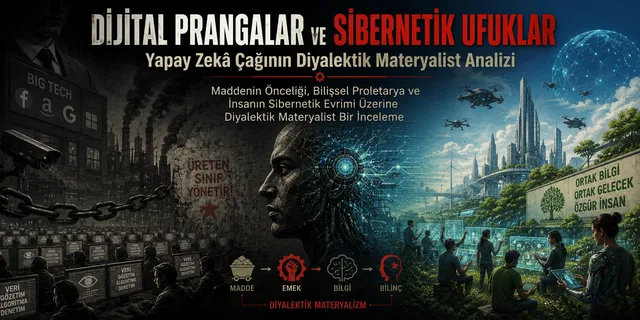
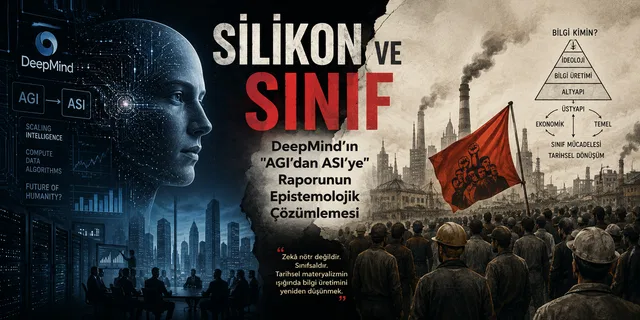
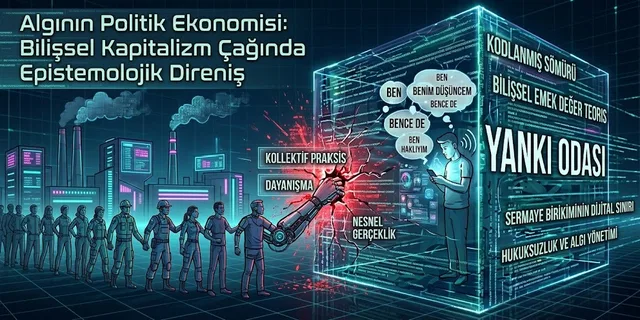
Today in the modern world philosophy is dying in the post-truth swamp of postmodernism, in the nihilism of speculative realisms, or in the "technological singularity" tales of Silicon Valley technocrats. In the 2026 world where artificial intelligence, automation, and algorithmic manipulation have peaked, bourgeois philosophy uses this tremendous technological leap to enslave the masses further, expand unemployment, and castrate minds.
Yet in the Marxist vision of the future, technology and science are the lever not of capital accumulation but of humanity's total liberation. The utopian yet grounded future depicted by the geniuses of Soviet science fiction, the Arkady and Boris Strugatsky brothers in works like Roadside Picnic or Monday Starts on Saturday, is precisely this: a world where science, freed from the profit drive, unleashes humanity's creative energy. Our epistemology is a theoretical weapon organizing that future from today.
Lenin's Revolutionary Optimism: In the midst of a tactical debate in What Is to Be Done? (1902), Lenin suddenly asks: "Should we dream?" And immediately answers by quoting Pisarev: If the bond between dream and life is not broken, dreaming is a philosophical necessity. Marxist epistemology is not a dry accounting of the present but the act of seeing the objective possibilities of the future from today and building it through praxis.
Speaking of the Future at This Table: A Call to the Philosophy Community
The manipulation session we held in our community cannot be limited to exposing the lies of the past or present alone. That is precisely why I look forward with great excitement to carrying this topic in upcoming sessions into much deeper waters — to discussing together epistemological ruptures, that magnificent future vision stretching from artificial intelligence to cyber-communism, and humanity's philosophy of liberation.
Philosophy is not a hobby to be consumed as an aristocratic intellectual pleasure object while drinking coffee in the corridors. Overcoming the positivist traps into which Popper and Şengör admirers fall is possible only by bringing this community to true philosophical depth and historical perspective.
Clarifying Our Class Standpoint
Friends, epistemology has never been a neutral, impartial, or supra-class field. Your theory of knowledge determines your side.
- If you see science and society as Popper does — as a tool for "preserving the status quo through small repairs" — your side is the comfort zone of the bourgeoisie.
- If you see society as Şengör does — as "an ignorant mass to be governed" — and position yourself as "an enlightened elite," your side is the ivory tower of technocratic fascism.
What falls to our lot is neither ivory towers nor the bourgeoisie's false "open society" tales. Our side is the side of the working class that rebuilds the world every day with its teeth, nails, and living labor and will radically change it.
As we continue discussions in our philosophy community, the first condition of mental clarity is to clarify this class standpoint. Let us not forget that the only way to grasp objective reality and win the future passes through shattering the epistemological illusions of the exploiters.
Let us remember Vladimir Mayakovsky's thunderous voice:
"We will rebuild everything anew; our minds and arms have the power to change the world!"
Friends, Popper's philosophy provides the ruling class a very comfortable space: "Do not build big theories, do not try to change the world; just try to falsify the small facts placed before you." This is a call to intellectual surrender.
Our epistemology lies hidden in the famous 11th thesis of Marx's Theses on Feuerbach (1845):
"The philosophers have only interpreted the world, in various ways; the point, however, is to change it."
We wield science not to preserve the status quo but as a weapon to uproot exploitation. Against Popper's false "openness" and the crude shallowness of positivism, we will continue to defend Lenin's methodological clarity and Marx's historical depth.