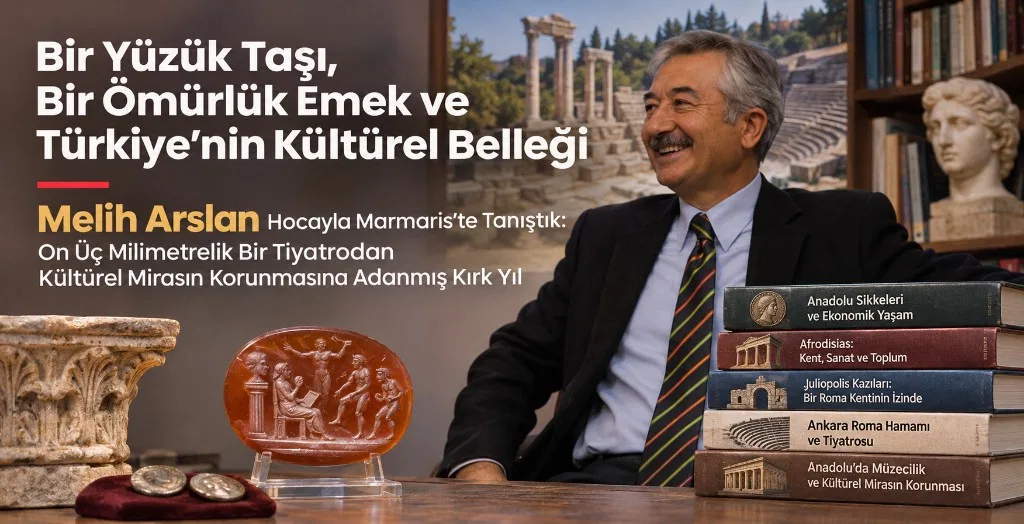
A Ring Stone, a Lifetime of Labour and Turkey's Cultural Memory
We Met Professor Melih Arslan in Marmaris: Forty Years Devoted to the Protection of Cultural Heritage, From a Thirteen-Millimetre Theatre Onwards
Dear Young Comrades
Sometimes, to tell of a society's cultural wealth, there is no need for great monuments or magnificent temples. A stone smaller than a fingernail is enough. This essay tells of a theatre scene carved onto a 13-millimetre agate, and of the archaeologist who brought that stone to the world of science and gave his life to protecting the memory of Anatolia: Professor Melih Arslan.
We met him at the Marmaris Film Days. In a setting where cinema, the stage art of today, was being discussed, it was no accident to speak of a ring stone that carries a play from two thousand one hundred years ago. In that conversation we saw this: In this country there are people who work quietly, without show, for decades, to protect a public value, and the labour of these people is not known well enough. That day we gave ourselves a task: to make this value known. And not only this stone: to make known, too, the people who, like our professor, have brought such values into being with their labour, who make our culture exist and who carry the memory of Turkey.
In Brief
- The object: A reddish, caramel-coloured agate ring stone, about 2,100 years old, measuring 13 × 11 millimetres. On it is a scene from a satyr play: a seated playwright, the leader of the chorus, satyrs, a herm symbolising Dionysus and, in the background, most probably Thalia, the muse of comedy.
- The publication: The article by Melih Arslan and Ahmet Emirhan Bulut, published in issue 14 (2026) of Cedrus: The Journal of Mediterranean Civilisations Studies. The object was dated to the first half of the 1st century BC.
- Why it matters: On the similar stones that are known, the actors are shown with their masks pushed up on top of their heads or held in their hands, that is, at the moment of "rehearsal". On this stone there is no mask; the actors have turned directly into mythological satyrs. This is a mode of depiction that had not been documented before.
- Where it is: In the Gaye Çarmıklı Collection, registered as a movable cultural asset under the Ankara Ethnography Museum. According to the museum records, it comes from the area around Sardis (Sart, Manisa).
- Who Melih Arslan is: A graduate in Classical Archaeology from the Faculty of Languages, History and Geography (DTCF) of Ankara University; a forty-year path in museum work running from the Aphrodisias and Fethiye museums to the Museum of Anatolian Civilisations; for about a quarter of a century a numismatist in that museum's coin section, and then its director. Head of the excavations at Juliopolis, the Ankara Roman Baths and Theatre, and Parnassos. More than a hundred articles; books and catalogues ranging from coins to glass, from ring stones to excavation monographs; a wide archive that can be read in open access on Academia and DergiPark.
- What it means for us: Cultural heritage is a commons. Every piece of labour that records it scientifically, catalogues it and publishes it takes that heritage out of the hands of the market and of plunder and adds it to the common memory of the people.
Now let us go into the detail.
A Scene Smaller Than a Fingernail
As told in the report of 5 November 2026 in Aktüel Arkeoloji, a nameless ancient gem engraver fitted five main figures, a column and a fine background figure onto a surface smaller than a human fingernail.
In the middle of the scene sits a man in a long garment; in his hand is a two-leaved writing tablet. The researchers identify him as a poet or playwright. Opposite him stands a figure with one foot set on a stone; in classical art this stance is usually associated with the leader of the chorus. The figures around them are recognised at once as satyrs by their horns, animal tails and the curved hunting sticks called lagobolon: the half-human, half-animal companions of Dionysus, god of wine, of ecstasy and of the theatre.
On the far left is a bearded herm, that is, a head rising on a square stone pillar. It is both stage scenery and a reference to the religious origin of Greek drama, to Dionysus.
And in the background, a tiny female figure with her hair falling down her back and her arms spread to either side. Arslan and Bulut propose her as Thalia, the muse of comedy and of cheerful poetry; but with scientific honesty they add that this is not certain knowledge but a strong hypothesis.
How Was It Made Without a Magnifying Glass?
Microscopic examination reveals the engraver's technique:
- The figures were cut in intaglio, that is, carved into the stone in negative; when pressed as a seal, they give a relief image.
- The first lines of the bodies were opened with round-tipped drills.
- The folds of the garments were worked with rotary abrasives of different thicknesses.
- The noses and facial details were given with tiny point-like holes.
Here we must stop and think, young comrades. A craftsman whose name we will never know pushed the possibilities of their eye and hand to their very limit two thousand years ago. History books write of kings and generals; but most of what has come down to us today from that world came from the hands of working people whose names were never written down.
Why Is This Stone a Turning Point?
Theatre scenes carved on engraved gems are already very rare. The few known examples are in the British Museum in London and in the Rijksmuseum van Oudheden in the Netherlands. They follow a strict formula: The actors gather around a seated poet, and the masks are either pushed up on top of their heads or in their hands. The message given to the viewer is clear: "These are people preparing for the play."
The Çarmıklı stone breaks this tradition.
| Known examples (British Museum, Leiden) | The Çarmıklı ring stone |
|---|---|
| Backstage, the moment of rehearsal | The play itself, or the idealised moment of the myth |
| Masks on top of the head or in the hand | No mask |
| The actor is shown as a human being | The actor has turned directly into a satyr |
| Theatre appears as "work" | Theatre appears as "transformation" |
| A known iconographic formula | An approach not documented before |
This difference may look small, but from the point of view of art history it is deep: The engraver carved not the actor, but the being the actor turns into. He captured the magic of the stage as it appears in the spectator's eye.
The Satyr Play: The Laughter That Comes After Tragedy
At the Great Dionysia festivals of ancient Athens, playwrights presented a series of four plays: three tragedies followed by a satyr play. The satyr play dispersed the heavy air of the tragedies with laughter and satire. Although these plays were much loved, almost no texts have come down to us; the only one we have complete is Euripides' Cyclops.
When the texts are this few, a stone like this becomes an irreplaceable witness to how these plays were staged and how they were perceived.
Let us note this as an aside: Ancient theatre was a public festival in which all the citizens of the city took part. It is known that in Athens an allowance was paid from a public fund so that poor citizens could go to the theatre. Theatre was a common space in which society spoke with itself, in which it could satirise even power and the gods. A stone that carries that stage is, in fact, a document of a form of publicness.
Who Owned the Ring?
A specially carved stone set in an iron ring was a sign of status in the 1st century BC. Arslan and Bulut think that the ring may have belonged not to an ordinary citizen but to a person of the theatre: a successful playwright, a leading actor or a wealthy patron of the performing arts. To carry a satyr scene on one's finger would have been a symbol of professional pride and of devotion to the cult of Dionysus.
That the stone comes from the area around Sardis is also meaningful. Sardis, the capital of the Lydian Kingdom and known as the city where money was first struck, reminds us once more what a deep-rooted cultural basin Anatolia is.
Melih Arslan: Forty Years of Public Labour
The journey of Professor Melih Arslan, who brought this stone to science, is like a story that tells what a work of patience museum work and archaeology are in Turkey.
From Ordu to Ankara, From Museum to Museum
According to his own CV, after Ordu High School he graduated in 1976 from the Department of Classical Archaeology of the Faculty of Languages, History and Geography of Ankara University; his thesis was on the Roman-period portraits of the Pamphylia region. Then began a path spent in public service across every corner of Turkey:
| Period | Post |
|---|---|
| 1976–1977 | Archaeologist, General Directorate of National Parks |
| 1977 | Archaeologist, Aphrodisias Museum |
| 1979–1981 | Archaeologist, Fethiye Museum |
| 1981–1985 | Specialist, İzmir Directorate of Surveys and Monuments |
| 1985–2009 | Archaeologist-numismatist, Coin Section of the Museum of Anatolian Civilisations |
| 2009–2014 | Director, Museum of Anatolian Civilisations |
| 2014–2015 | Director, Ankara Central Regional Laboratory for Restoration and Conservation |
| Since 2016 | Lecturer, Ankara Hacı Bayram Veli University |
It is a path that runs from the Lycian tombs of Fethiye to the marble workshops of Aphrodisias, from the surveys of İzmir's historic buildings to the coin vaults of Ankara.
The Museum of Anatolian Civilisations: A Quarter-Century Coin Vault
The Museum of Anatolian Civilisations, which presents together the history of Anatolia from the Palaeolithic Age to the Ottomans, is one of Turkey's most valuable museums. Melih Arslan worked in this museum's coin section for about 25 years. To an ordinary eye a coin is "old money"; but for a numismatist it is the document of an economy, of a trade network, of how a power presented itself. Which city struck which god, which emperor granted a privilege to which city and when, how wars and crises made people bury their hoards in the earth... All of it is written on these small pieces of metal.
He turned this accumulated knowledge into books: Roman Coins (1992), Anadolu Antik Camları (Ancient Glass of Anatolia, 1992), Antik Sikke Defineleri (Ancient Coin Hoards) and Greek Coin Hoards in Turkey (1999), Anadolu Antik Yüzük Taşları (Ancient Ring Stones of Anatolia, 2000), Galatya Krallığı ve Roma Dönemi Ankyra Şehir Sikkeleri (The Galatian Kingdom and the Roman-Period City Coins of Ankyra, 2004), Sinope (2010), Savaş, Güç ve İnanç (War, Power and Belief, 2011), Juliopolis (2013). A significant part of these books are works that publish as catalogues the objects lying in the vaults of museums and open them up to researchers and to the public.
In 2009 he was appointed director of the museum. A museum director carries on their shoulders not only the display cases but also the security of the collection, the order of the inventory, rescue excavations and the protection of the past beneath the city against the construction machines.
What Lies Beneath the Soil of Ankara
The excavations he headed brought to light layers of Ankara and its surroundings that were on the verge of being forgotten:
- The Necropolis of Juliopolis (from 2009): the cemetery of the ancient city near Nallıhan, under threat from the waters of the Sarıyar Dam. A race against water and construction.
- The Ankara Roman Baths and the Roman Theatre: public buildings of ancient Ankyra, in the heart of the capital.
- The Ancient City of Parnassos: His work on a church and its founder in this city in the north of Cappadocia was published in the international journal Gephyra.
- Rescue excavations: Çayyolu Höyük, Sincan Höyük, Çömlektepe, the Seydintepe Tumulus, the Güdül Mnizos Roman Baths.
The rescue excavation is perhaps the hardest and least visible face of archaeology in Turkey: before a dam, a road or a housing-estate construction begins, with limited time and resources, recording traces of the past that will never come back. In this race between the speed of rent and the patience of memory, every tomb and every wall that is saved is a gain.
He also took part in the great excavations of Anatolia, such as Erythrai, Pınara, Limyra, Miletus, Ephesus, Kyme and Pergamon.
A Half-Century Trace in Peer-Reviewed Journals
Melih Arslan's CV contains more than a hundred articles. These articles are spread across respected peer-reviewed journals in Turkey and around the world:
- Turkey's long-established journals: Belleten of the Turkish Historical Society, Höyük, Ankara University's Anadolu (Anatolia), Colloquium Anatolicum of the Turkish Institute of Ancient Sciences, and Adalya in Antalya.
- New-generation journals: Gephyra, Istanbul University's Anadolu Araştırmaları (Anatolian Research), Cedrus, Mediterranean Journal of Humanities, Arkeoloji Dergisi (Journal of Archaeology).
- International meetings: papers at congresses such as Munich (1994), Berlin (1997), Antalya (2013) and Kastamonu (2016); fellowships from the German Archaeological Institute (DAI) and the Bibliothèque nationale in Paris.
Looking at his publications of recent years, one thing stands out: magical amulets from Ankara, ring stones depicting Silvanus and Isis-Tyche, a Harpocrates figurine from the Adana Museum, a Telesphoros statuette from the Gaye Çarmıklı Collection, and now this satyr-play stone... He writes together with young researchers such as Yavuz Yeğin and Ahmet Emirhan Bulut. This means a living school, in which knowledge is passed from one generation to the next and the master works side by side with the apprentice.
An Open Archive: A Selection of His Work on Academia and DergiPark
A significant part of his work can be downloaded free of charge on his Academia.edu page and his DergiPark author page. On Academia, with 267 followers and more than 14 thousand views, he is in the top 2 per cent of the site's most-read authors. Keeping knowledge on the open shelf rather than in the vault is the very thing we call the "knowledge commons". We have gathered these works by subject:
Hoards: Economic History Buried in the Earth
A hoard is often the trace of a war, a famine, a flight. People bury their savings in the earth at a moment of danger and can never come back. His hoard publications are small windows onto the economic history of Anatolia:
| Work | Published in | Subject |
|---|---|---|
| Fethiye Müzesi'ndeki Erken Likya Stater Definesi / A Hoard of Lycian Staters in Fethiye Museum | Belleten | 19 silver Lycian coins |
| Fethiye Müzesi, Kargı Köyü Büyük Çalıştepe Rodos Drahmi Definesi (The Rhodian Drachm Hoard of Büyük Çalıştepe, Kargı Village, Fethiye Museum) | Belleten | 61 Rhodian drachms (167–88 BC) |
| Kapulukaya Solidus Definesi / The Kapulukaya Solidus Hoard | Belleten | Gold coins found in a pot near the dam lake at Keskin, Kırıkkale |
| Lysimachia Kenti Bronz Definesi (The Bronze Hoard of the City of Lysimachia) | Belleten | Bronze coins in the Okray Collection |
| Uşak Müzesi Eşme Yeleğen Altın Stater Definesi (The Eşme Yeleğen Gold Stater Hoard, Uşak Museum) | Arulis 13 (2023) | Gold staters |
Coins: The Mirror of Cities and Powers
| Work | Published in |
|---|---|
| Roma Dönemi Apameia Sikkelerinde Nuh'un Gemisi Betimli Sikkeler (Coins Depicting Noah's Ark on Roman-Period Coins of Apameia) | Arulis XIV (2023) |
| Ankara Müzelerinden Dört Antinoos Madalyon Sikkesi (Four Antinous Medallion Coins from the Museums of Ankara) | 2025 |
The coins of Apameia are especially interesting: In the Roman period this city, in today's Dinar district of Afyonkarahisar, linked the flood story of the Torah to its own local legend and put it on its coins. It is a document of how a city told its own story and built its identity.
Ring Stones and Amulets: The Miniature World of Everyday Belief
| Work | Published in |
|---|---|
| Depicting Hermes from Asia Minor in the Roman Imperial Period (34 stones, 2 clay seals) | Materiale şi Cercetări Arheologice XXII (2026, Romania) |
| Roman Imperial Octagonal Gems: Analyses and Interpretations | Materiale şi Cercetări Arheologice XXII (2026) |
| A Rare Ring Stone Depicting a Satyr Play (with A. E. Bulut) | Cedrus 14 (2026) |
| Gaye Çarmıklı Koleksiyonu ve Sadberk Hanım Müzesi'nden Doğuran Kadın Amuletleri (Amulets of Women Giving Birth from the Gaye Çarmıklı Collection and the Sadberk Hanım Museum) | Arkhaia Anatolika 6 (2023) |
| A Group of Gems with Isis-Tyche Depictions from Ankara (with Y. Yeğin) | Anadolu Araştırmaları (2022) |
| Ankara'dan Silvanus Betimli Üç Yüzük Taşı Üzerine Düşünceler (Thoughts on Three Ring Stones Depicting Silvanus from Ankara) (with Y. Yeğin) | Anatolia (2021) |
| Two Unpublished Magical Amulets in Ankara (with Y. Yeğin and R. Gordon) | Gephyra (2020) |
| Six Amuletic Gems in Ankara | Adalya |
| Roma dönemi yüzük taşlarında tanrıça Ma betimleri (Depictions of the Goddess Ma on Roman-Period Ring Stones) | Colloquium Anatolicum (2018) |
| Mehmet Durmaz Koleksiyonundaki Yüzük Taşları (Ring Stones in the Mehmet Durmaz Collection) (with B. Delikan) | — |
| Akdağmadeni Cam Yüzük Kaşı Mühür (A Glass Ring-Bezel Seal from Akdağmadeni) (with İ. Taş and H. K. Şenyurt) | Höyük (2013) |
This list tells us this: In the ancient world ordinary people entrusted their fear of childbirth, illness, bad luck and the dangers of travel to small stones. A work such as the "amulets of women giving birth" is a door opening onto the world of women, mothers and midwives who find no place in the history books.
Statuettes and Small Objects
| Work | Published in |
|---|---|
| A Marble Telesphoros Statuette from the Gaye Çarmıklı Collection (with A. E. Bulut) | Mediterranean Journal of Humanities XV/1 (2025) |
| Türkiye Müzelerinden (İzmir – Marmaris) İki Harpokrates Figürü (Two Harpocrates Figures from the Museums of Turkey, İzmir – Marmaris) | Anadolu/Anatolia 46 (2020) |
| A Terracotta Figurine of Harpocrates from the Adana Museum (with Y. Yeğin) | Arkeoloji Dergisi (2026) |
| Yeni Bir Bronz Kybele Heykelciği (A New Bronze Statuette of Cybele) | — |
| Ankara'da Özel Bir Koleksiyondan Cam Yağ ve Koku Şişeleri (Glass Oil and Perfume Bottles from a Private Collection in Ankara) | Arulis |
That he also published a Harpocrates figure in the Marmaris Museum, when we met him in Marmaris, is a happy coincidence for this essay.
Excavations and Cities: Juliopolis and Parnassos
| Work | Published in |
|---|---|
| Death and Burial in Bithynia: The Case of Iouliopolis (with L. Summerer) | Contextualizing Pompeiopolis, De Gruyter, Berlin–Boston (2025) |
| New Gold Lamellae and Amulet Capsules from (Judaeo-Christian) Graves at Juliopolis (with R. D. Kotansky) | Jahrbuch für Antike und Christentum (2021) |
| The Episcopal Palace of Parnassos in Cappadocia and its Early Byzantine Floor Mosaics | Anatolian Studies |
| Bishop Eustathios in Paradise: A Church and Its Founder in Cappadocian Parnassos (with P. Pilhofer and Y. Yeğin) | Gephyra (2021) |
The gold amulet capsules from the graves of Juliopolis show how Jewish and early Christian beliefs intertwined with local magical traditions in Roman-period Anatolia. This work is one of his most-read publications on Academia. These works with international co-authors (Latife Summerer from Germany, Roy Kotansky from the United States, Richard Gordon from England) also show how the archives of Turkey's museums are brought into world science.
Whose Is Cultural Heritage? A Note on Class
Dear young comrades, we do not want to leave this essay as only a piece of admiration. Because the story of this stone also puts before us an important question about the conditions under which cultural heritage is protected.
As the report states clearly, the stone was not found in a controlled scientific excavation; before reaching the collection it passed through the art market. In archaeology the context of a find, that is, where, in which layer and next to what it was found, is as valuable as the object itself. Every object that passes through the market loses part of this context. Turkey is a country that has paid a heavy price for years for illicit excavation and the smuggling of antiquities.
In the face of this picture, two things are important:
- Registering: That the stone is registered as a movable cultural asset under the Ankara Ethnography Museum brings it within public oversight. Even if the object is sold or changes hands, it remains visible in the state's inventory.
- Publishing: The scientific publication of an object takes it out of being private property and adds it to the common knowledge of humanity. That stone now belongs not only to a collector; it is the common heritage of every student, every researcher and every curious person who reads about it.
The forty years of labour of Professor Melih Arslan do exactly this: By cataloguing and publishing objects lying in vaults, storerooms and collections, he turns them into common memory. It is one of the most concrete examples of what we mean when we speak of the knowledge commons.
| The object in the eyes of the market | The object in the eyes of public science |
|---|---|
| Its value is its price | Its value is the knowledge it carries |
| Its owner is one person | Its heritage belongs to everyone |
| It is hidden, it sits in a vault | It is published, read and discussed |
| Its context does not matter | Its context is everything |
| Its maker is forgotten | The maker's labour is made visible |
And let us remember this too: Museum work, archaeology, restoration and conservation are, in Turkey, mostly jobs done on low wages, with limited staff and, in rescue excavations, under pressure from construction companies. The labour of those who protect cultural heritage is at least as valuable as the objects they protect, and the security of this labour is the security of the heritage.
A Contribution to Social Culture: From a Stone to a Society
We can summarise the contribution of Melih Arslan and scientists like him under four headings:
- Memory: recording the many-layered history of Anatolia, from the Phrygians to Rome, from Lydia to Galatia, as the common past of today's society.
- Access: turning the objects in museum vaults, through catalogues, articles and books, into knowledge that everyone can read.
- Protection: documenting through rescue excavations the areas that rent and construction would swallow; extending the life of objects in the restoration laboratory.
- Training: passing on mastery to the new generation of archaeologists at the university and in joint publications.
Taken together, these four headings deepen the relationship a society builds with its own past. A society that knows its past is also more resistant to nationalist or reactionary distortions of the past. Every scientific work that shows that Anatolia is a thousands-of-years-old sum of peoples and labours that does not fit into a single identity is at the same time a work of fraternity and enlightenment.
Concrete Tasks
What we can all do together to make this value known:
- Let us read: Let us read the Aktüel Arkeoloji report and the original article in the journal Cedrus; let us look through the open-access publications on his DergiPark and Academia pages.
- Let us visit: Let us visit the Museum of Anatolian Civilisations, the Ankara Roman Baths and the museums near us, not only as a school trip but as a meeting with our own past.
- Let us share: Let us bring talks on archaeology and cultural heritage into settings such as local philosophy communities, film days and reading groups.
- Let us stand up for it: Let us speak out against illicit excavation, against construction that begins before a rescue excavation has been carried out, and against the opening of historic sites to rent.
- Let us support: Let us make visible the struggles for secure working conditions for museum workers, archaeologists and restorers.
- Let us defend open access: Scientific publications being open to everyone is the precondition for cultural heritage truly belonging to everyone.
Dear Comrades
Two thousand one hundred years ago, a master whose name we do not know fitted a whole theatre onto a stone smaller than a fingernail. Today there is another master who reads his labour under the microscope and tells it to us: Professor Melih Arslan.
We made it our task to make known the labour of the professor we met in Marmaris, on an evening when cinema was being discussed. Because those who protect the values of this country are usually people who do not make the headlines, who make no noise, but who work with the same patience for forty years. To thank them, to make their labour visible and to raise the generations that will carry that labour on is the work of all of us.
The past should live not in the vault of a handful of collectors but in the common memory of all of us. Knowledge belongs to everyone.
Sources
- Aktüel Arkeoloji, "13 Milimetrelik Minyatür Bir Başyapıt" (A 13-Millimetre Miniature Masterpiece), 5 November 2026: aktuelarkeoloji.com.tr
- Arslan, M. & Bulut, A. E. (2026). "A Rare Ring Stone Depicting a Satyr Play", Cedrus: The Journal of Mediterranean Civilisations Studies, 14: dergipark.org.tr/pub/cedrus
- Melih Arslan, CV and list of publications: meliharslan.net
- Melih Arslan, DergiPark author page: dergipark.org.tr/@melih-arslan
- Melih Arslan, Academia.edu: independent.academia.edu/MelihArslan3
- Kotansky, R. D. & Arslan, M. (2021). "New Gold Lamellae and Amulet Capsules from (Judaeo-Christian) Graves at Juliopolis", Jahrbuch für Antike und Christentum: Academia
- Summerer, L. & Arslan, M. (2025). "Death and Burial in Bithynia: The Case of Iouliopolis", Contextualizing Pompeiopolis, De Gruyter: Academia
- Aktüel Arkeoloji, About: aktuelarkeoloji.com.tr/sayfa/kurumsal
This essay is shared under the CC BY-SA 4.0 licence.