On Getting Free from the Language of Hegemony
The Class of Words: From Confucius to Gramsci, from Voloshinov to Freire, Language, Power and Consent

Summary
This piece takes its cue from a call we made in the forum of the symposium "Classes and Politics in the 21st Century" in Izmir on 7 November, and it follows a single question: How do we get free of the language of the rulers? Before the long journey, let us set down where we will arrive, in ten theses.
1. Hegemony is built first in common sense, and the home of common sense is language. The ruling class does not rule by force alone. It rules by turning its own interest into everyone's natural assumption. That naturalness lives above all in everyday words: "employer", "human resources", "the markets", "reform", "survival".
2. "Cleaning up the language" is the wrong metaphor. Cleaning suggests a search for purity, and a search for purity suggests a purge. Turkey's own history of language shows this. Our work is not to purify the language. It is to take the language back into the hands of the class.
3. Language does not change "first". Marx and Engels mocked the Young Hegelians, who thought they were changing the world by making war on words with words. What changes a word is, most of the time, the organised practice that presses on the relation the word rests on. Language and practice change together.
4. Humanity noticed this problem a very long time ago. Confucius counted the "rectification of names" as the first task of government. Thucydides wrote how the meanings of words changed in a civil war. Bacon named the most dangerous deception the "idols of the marketplace", that is, the deceptions of words.
5. Marx's contribution is to place language inside the social relation. Language is "practical consciousness". The ideas of the ruling class are in every age the ruling ideas. Fetishism is also a form of language: it makes the relation between people speak like a relation between things ("money makes money", "the market punished").
6. Gramsci's lesson: every problem of language is a problem of hegemony. The common sense of the people is not something to be thrown away. The sound core inside it is found and raised to a critical consciousness. This work is the work of the organic intellectual.
7. Voloshinov's lesson: the sign is the arena of the class struggle. Every important word carries more than one class accent. The rulers try to make the word look single-accented and eternal. Words such as "freedom", "democracy" and "nation" are not positions to be abandoned. They are positions to be won.
8. Barthes, Klemperer, Orwell and Marcuse saw the same mechanism from different places. History is turned into nature. The poison is given in small doses. Euphemisms hide responsibility. Language is shortened, closed, and narrows thought.
9. Today the language of hegemony has four great dictionaries: the workplace, the economy, the state and technology. In the age of the algorithm a new layer has been added to these. Platforms decide which word will be visible, and language models automatically reproduce the average of the ruling language. Popular science is also a powerful carrier of this language. It narrates billions of years ahead with ease, and narrates a few hundred years ahead in today's company language, and produces a fiction of futurelessness. Circles that claim to be building another world fall into this frame easily too.
10. Getting free is a question of method. Putting the subject back into the sentence, naming the relation, historicising what looks natural, winning the word without abandoning it, seeing the ruling traces in our own language, and testing the new concept in organised practice. As Freire said: to exist humanly is to name the world and to change it. The everyday form of this method is to recognise the basic narrative fallacies below and to give each a short reply.
The detail is below.
Dear Young Comrades,
The story of this piece began last Saturday, on 7 November, on the anniversary of the October Revolution and on the day we remembered İlhan Erdost, in Izmir. At the symposium "Classes and Politics in the 21st Century", organised together by the Association for Labour Research (Emek-Ar) and the Izmir Branch of the Chamber of Architects at the Izmir Architecture Centre, a hall full of people talked about a single question: In a world of labour this scattered, this surveilled, this divided, how does the working class become a political force again? We shared the assessment of that day, made of two sessions and a forum, in Class Is Back at the Table.
In the short time that fell to us in the forum, we had underlined a heading we wanted to add to the whole day's discussions: language. The hegemony of the ruling class is built not only with the police, the judiciary and capital, but also with language. When we say "employee" we erase the class, when we say "productivity" we neutralise exploitation, when we say "economic realities" we present a property relation like a law of nature. Perhaps the most uncomfortable sentence we said in the forum was this: this language is not only the language of those opposite us. In the settings that appear beside us, in the circles with which we share the same halls, an important part of the language used is also the language of the order. We said this not as an accusation but as a call to comradely exposure, and we added that support has to be offered so that this exposure is understood rightly.
It was a thought of which, in a five-minute forum speech, only the underline could be drawn. On the way back from the symposium it stayed in our minds as a question: Is one of the ways of overthrowing hegemony not, first, to clear our own language of the language of the rulers? This piece is an effort, with the inspiration we took from that day, to look for an answer to this question in its philosophical grounds. It can also be read as one of the first steps of the support we spoke of in the forum.
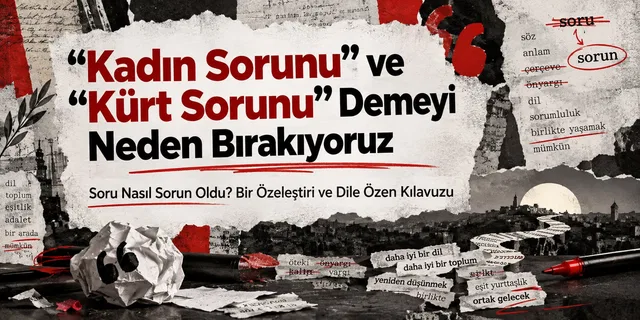
The subject is not new for us. A month ago we published a piece of self-criticism on this site: Why We Are Done Saying "the Woman Problem" and "the Kurdish Problem". With the warning of a psychologist comrade, we noticed how a formula that had settled in our mouths from a hundred years of left literature marks a community as a "problem", and how it takes the agent out of the sentence. At the end of that piece we made a promise: care for language is not a matter of politeness. It is a matter of analysis.
This piece is the continuation both of that promise and of the call in the forum. This time we will look not at a single formula but at a whole world. Our question is this: How does the ruling class speak with our mouths, and how do we take our own voice back?
We will try to answer this question by consulting the long memory of philosophy. Because the relation between language and power was neither discovered today nor is it only the problem of our age. But every age rebuilds this relation with its own tools. The tools of our age are advertising agencies, human-resources departments, algorithms and language models. We will look first at the old wisdom, then at today, and then at the work to be done.
First an Objection: Why Not "Cleaning"?
The question that gave rise to this piece was this: Is one way of overthrowing hegemony not to secure, first, the cleaning of our language? The direction of the question is right. But we have to stop on two of its words: "cleaning" and "first".
The word "cleaning" has a past. The recent history of Turkish is a history of purification. The Language Revolution, which began in the 1930s, aimed to sift out words of Arabic and Persian origin and to build a "pure Turkish" language. This movement had a democratic side against an Ottoman Turkish the people did not understand, and we do not belittle that. But the same movement was a project of nation-building. The idea of sifting the "foreign" elements out of the language was fed by the same mental world of the same period as the idea of sifting the "foreign" elements out of society. The banning of Kurdish and the purification of Turkish were decisions of the same decades.
A search for purity always leaves something outside. The idea of cleaning the language carries three dangers inside the left too.
The first is elitism. A wall is built between those who know the "right" word and those who do not. The student who knows the right words begins to correct the worker who uses the wrong word. Thus a language that thinks it was built against hegemony builds its own little hegemony.
The second is moralism. The word becomes an examination. Who speaks "cleanly" becomes more important than the truth of what is said. This shifts the discussion from content to form.
The third is magical thinking. Believing that when the word changes, reality changes too. Just as saying "employee" instead of "worker" did not abolish exploitation, saying "worker" instead of "employee" does not by itself abolish exploitation either.
The word "first" has a problem too. In The German Ideology Marx and Engels criticised the Young Hegelians of their time at exactly this point. These philosophers thought that what oppressed people was wrong ideas and wrong concepts, and they supposed they would liberate humanity by the criticism of concepts. The answer of Marx and Engels was sharp: these philosophers are fighting only with phrases against phrases, and they do not touch the existing real world at all.
This criticism does not make the work on language worthless. But it sets its place. Language is not an independent layer floating above social relations. It is born inside the relations, it carries them, it reproduces them. When a strike begins in a factory, the word "employer" turns by itself into "the boss". Nobody hands out a dictionary. The word tightens because the relation has tightened. So the order is not "first the language, then the world", but "the language and the world together".
For this reason, in this piece, instead of "cleaning the language" we will use the expressions criticism of language and winning the language back. The aim is not a pure language. It is a free language. A free language is the language the people speak, but it is aware of the ruling voice inside it.
The Long Memory of Philosophy: Name, Meaning and Order
The first thinkers who noticed the bond between language and power lived long before the modern age. Let us recall this memory at four stops.
Confucius: the rectification of names
In China in the fifth century before the common era they ask Confucius: If you were called to govern a state, what would you do first? His answer is recorded in the Analects: I would rectify the names. His student is surprised, and says what this has to do with government. Confucius explains: If names are not correct, speech does not fit reality. If speech does not fit reality, affairs do not go forward. If affairs do not go forward, justice does not find its place either, and the people do not know where to put hand or foot.
Confucius set this principle up for a conservative purpose, that is, so that everyone would know their place in the feudal hierarchy. The ruler should behave like a ruler, the minister like a minister, the father like a father, the son like a son. But the core of the principle is valuable for us too. When the gap between the name of a thing and its reality opens, the social order either decays or that gap turns into an instrument of power. Think of the gap today between the name of the thing called "flexibility" and its reality. The name suggests freedom. The reality is precarity.
Thucydides: when the meaning of words changed
In 427 before the common era a civil war breaks out in Corcyra (present-day Corfu). The popular party and the oligarchs cut one another's throats. The Athenian historian Thucydides, while telling this war in the third book of The Peloponnesian War, makes one of the sharpest observations about language in human history: in the civil war words too lost their ordinary meanings. Reckless aggression was named a loyal courage. Waiting with caution was counted the cloak of cowardice. Being measured was despised as a lack of manliness.
What Thucydides saw is this: when social conflict heats up, the sides fight not only with weapons but also with the dictionary. The moral value of words changes place. Think of how, in Turkey today, the word "terrorist" is stuck onto a journalist, a student, an academic, and how the word "survival" silences every objection. Thucydides described this process twenty-five centuries ago.
Plato: do names come from nature, or from agreement?
Plato's dialogue Cratylus lays the philosophical foundation of the question. Cratylus defends the view that names come from the nature of things. Hermogenes says that names are given by the agreement of people. Socrates tests both sides and in the end approaches this conclusion: instead of trying to learn the truth from names, we should look at the things themselves.
This discussion says this for us: names do not come from nature. People give them. Which people gave them is not philosophy's question. It is the question of history and of class relations. Plato did not take this last step. Marx would take that step two thousand years later.
Bacon: the idols of the marketplace
In 1620, in the Novum Organum, Francis Bacon counts four "idols" that mislead the human mind. He says that the most dangerous of these are the "idols of the marketplace". People come together in the market, in the bazaar, in trade, and they understand one another by speaking. But words are given according to the understanding of the crowd. Badly given words also obstruct the mind in a bewildering way. According to Bacon, words press on the mind, mix everything up, and drag people into empty arguments.
On this site, in the piece we wrote on deceiving ourselves, we had dwelt at length on Bacon's idols. Let us underline a single point here. Bacon's metaphor of the "marketplace" is not a coincidence. Words are born inside social exchange, that is, inside social relations. Bacon noticed this, but he did not ask whose marketplace the marketplace was. To ask this question, the capitalist marketplace itself had to be analysed.
Marx and Engels: Language Is Practical Consciousness
The first and most basic step of Marxism on language is in The German Ideology (1845-46). Marx and Engels say here that language is as old as consciousness, and they define it as "practical, real consciousness". Language is born from the need to enter into relation with other people, from the necessity of entering into relation. That is, language is not a tool inside the individual's head. It is the relation between people itself.
This definition has two great consequences.
The first consequence: ruling relations produce the ruling language. In the same work the famous thesis comes: in every age the ideas of the ruling class are the ruling ideas. The class that holds the material power of society is at the same time its ruling intellectual power. The class that holds the means of material production also holds the means of intellectual production. Today the means of intellectual production are newspapers, televisions, schools, platforms and data centres. We have asked hundreds of times on this site whose hands they are in. In whose hands? Under whose control? For whose benefit? These three questions hold for language too.
The second consequence: fetishism is a form of language. In the first volume of Capital, while describing the fetish character of the commodity, Marx says that the social relation between people takes, in people's eyes, the form of a relation between things. This is not only an economic fact. It is a way of speaking. Our everyday language is full of fetishism:
- "Money makes money." (Yet what multiplies the money is someone's unpaid labour.)
- "The market punished." (Yet the sell order was given by definite persons and institutions.)
- "Capital fled." (Yet those who made the capital flee are owners who have names.)
- "Artificial intelligence is destroying jobs." (Yet the dismissal decision is given by boards of directors.)
In all of these sentences the relation between people is told as a movement things make by themselves. The agent disappears, the thing becomes the subject. In Not the Madness of the Crowd, but the Knowledge of Those Inside we had shown that the language of the stock exchange does exactly this: the sentence "the market panicked" hid the names of those who knew in advance which share to leave, and when.
Engels has a very fine observation on this. In the preface he wrote to the third German edition of Capital, he mocks the German language of economics for the words "employer" (Arbeitgeber) and "employee" (Arbeitnehmer). The person who gives their labour to someone else in return for a payment is called the one who "takes work", and the person who takes someone else's labour is called the one who "gives work". Engels calls this inverted language "meaningless jargon" and says that in the translation of Capital he kept away from it. The Turkish word "işveren" is the trace of this inverted world that has reached us. It is so settled in everyday language that most of us do not even notice that it is inverted.
Gramsci: Every Problem of Language Is a Problem of Hegemony
Most people do not know that Antonio Gramsci studied linguistics at university. In Turin he was a student of the linguist Matteo Bartoli. The theory of hegemony in the Prison Notebooks has a deep bond with these first studies on language. To understand Gramsci is to understand the problem of language.
Hegemony and consent
Gramsci's question was this: Why, in Western Europe, could the working class not take power as the Russian workers did in 1917? His answer was that bourgeois power did not rest only on the coercive apparatus of the state. Power also rested on a network of consent woven in schools, in churches, in newspapers, in associations, that is, in civil society. In the East the state was everything, and civil society was primitive and scattered. In the West the state was only an outer trench, and behind it there was a sturdy chain of fortresses and earthworks.
Hegemony is the name of this chain of consent. And the most basic material of consent is the concepts with which people make sense of the world. On this site, in Rejecting the Ruling Class's Playing Field, we had opened the concepts of hegemony and passive revolution through the discussion of the Framework Law. Here let us focus on the dimension of language.
Everyone is a philosopher, because everyone speaks
In the notes on philosophy in the Notebooks, Gramsci begins like this: the prejudice that philosophy is a difficult work belonging to specialists has to be destroyed. Everyone is a philosopher, because everyone speaks a language, and every language, however primitive, contains a conception of the world. Gramsci counts three layers of this "spontaneous philosophy": language itself, common sense, and popular religion or popular beliefs.
This is a very important finding. The words a person uses carry a conception of the world that they have adopted without being aware of it. Words and sayings such as "fate", "it was allotted", "the elders know", "there is a good in every affair" are parts of a conception of the world. In the same way, "be your own boss", "leave your comfort zone", "equality of opportunity", "the war for talent" are also parts of a conception of the world. The first is the conception of the old rulers, the second of today's rulers. In Gramsci's expression, this common sense is "fragmentary, incoherent and contradictory". Layers left from different ages are piled on top of one another.
From common sense to good sense
Gramsci's most important lesson comes here. Common sense (senso comune) is not something to be despised or thrown away. Inside it there is a "sound core". Gramsci calls this "buon senso", that is, good sense. A core filtered from the everyday experience of the people, sensing exploitation, feeling injustice. Sayings such as "the rich get richer, the poor get poorer", "the law always works against the weak", "give the wage before the sweat has dried" are the expressions of this core.
The struggle against hegemony is to find this core, to make it coherent, and to raise it to a critical conception of the world. This is not teaching the people the right words from outside. It is walking together, from the people's own experience, to the right concepts. The danger of the idea of "cleaning the language" is exactly here: to count common sense dirty as a whole and throw it away is to throw the sound core away with it.
When the problem of language comes onto the agenda
In one of the last notebooks of the Notebooks (Notebook 29) Gramsci writes notes on grammar. There he puts forward a very striking thesis. Whenever the problem of language comes onto the agenda in some form, a series of other problems is in fact coming onto the agenda: the formation and expansion of the ruling class, the need to build tighter and safer relations between the ruling groups and the popular masses. In short, the reorganisation of cultural hegemony.
This thesis is surprisingly explanatory for Turkey. At the founding of the Republic the Language Revolution was part of the effort of a new bourgeois ruling class to build its hegemony. After 12 September the language of the "Turkish-Islamic synthesis" was part of a new arrangement of hegemony. In the AKP period the language of "the national will", "native and national", "survival" is the same. Every ruling bloc, while consolidating its power, builds a dictionary. In the 12 September dossier we had examined how the junta's language of "anarchy and terror" declared a whole political generation guilty, and in the illusion of "native and national" artificial intelligence how this adjective is stuck onto technology today.
The organic intellectual and the war of position
Two more of Gramsci's concepts are of key importance for this piece. The first is the organic intellectual. Every social class raises, from inside itself, the intellectuals who make its own conception of the world coherent and who give it a language. The organic intellectuals of the bourgeoisie are advertisers, managers, economists, columnists, and today also "thought leaders". The organic intellectuals of the working class are the representative in the factory, the teacher in the neighbourhood, the educator in the union, the writer on the blog. Their work is to pour the scattered experience of the class into a common language.
The second is the war of position. In societies of the Western type, power cannot be taken in a single move. A long and patient struggle is needed in every trench of civil society, in every institution, in every word. Language is one of these trenches. Perhaps it is the widest, because it is everywhere.
Voloshinov: The Sign Is the Arena of the Class Struggle
In 1929, in Leningrad, a young linguist, Valentin Voloshinov, published a book called Marxism and the Philosophy of Language. This book is accepted as one of the deepest Marxist works written on language. (There are academic debates about the book's relation to the Bakhtin circle and about who wrote it. These do not change our subject.)
Voloshinov's basic thesis is this: the sign, that is, the word, is the material body of ideology. Ideology does not live as an abstract thing inside the head. It exists materially in words, in utterances, in speeches, in writings. For this reason, to examine ideology is to examine the sign.
Then he brings his most important thesis: the multiaccentuality of the sign. Different classes speak the same language. For this reason the same word carries different accents in the mouths of different classes. In Voloshinov's expression, every ideological sign is the place where accents pulled in different directions intersect. The sign becomes the arena of the class struggle.
And what does the ruling class do? It tries to give the sign a quality above classes and eternal, to suppress the class struggle inside it, to make it single-accented. The "correct meaning" of the word is fixed as the meaning of the rulers. But according to Voloshinov this is never fully achieved. In periods of crisis, in revolutionary moments, the suppressed accents come to the surface again.
The practical result of this theory is large for us. We should not abandon some words to the enemy.
Think of the word "freedom". Liberals tried to make it single-accented as "market freedom", "freedom of enterprise", "freedom of choice". But this word is at the same time the word of the enslaved, of the serfs, of the colonies, of the strikers. To abandon it is to accept the accent of the rulers.
Think of the word "democracy". The bourgeoisie tried to narrow it to going to the ballot box once every four or five years. But inside this word there is also the accent of the people governing themselves, of workplace democracy, of council democracy. In the piece in which we told of the plenums in Serbia we had seen that this accent is still alive.
Think of the words "nation", "people", "homeland". Nationalists are trying to make these words single-accented. But inside the word "people" a class accent lives, and inside the word "homeland" the accent of defending bread, land and labour lives. Nazım Hikmet did not shrink from using the word "homeland". But he used it by asking whose homeland it was.
The distinction between abandoning a word and winning a word is the hardest judgement of the criticism of language. We can propose a general measure: if inside the word there is a memory of struggle of the oppressed, that word is a position to be won. If the word was invented only to describe the ruling relation (like "human resources"), that word is abandoned, and a word that names the relation rightly is put in its place.
Naturalising, Poison, Euphemism and Closed Language
In the twentieth century four thinkers observed the working of the language of hegemony from different angles. None of them was fully from our own ranks. Some are names the other side also used in the Cold War. But their observations are valuable, and we can read them with a class view.
Barthes: myth turns history into nature
Roland Barthes published Mythologies in 1957. In this book he examined the ordinary objects of French everyday life (a detergent advertisement, a wrestling show, a magazine cover) and in all of them he found the same mechanism: myth turns what is historical into what is natural. Myth is speech emptied of politics.
One of Barthes's sharpest findings is this: the bourgeoisie is the class that does not want its name to be spoken. In bourgeois society everything is bourgeois, but nothing names itself as bourgeois. Bourgeois morality is presented as "morality", bourgeois economics as "economics", bourgeois law as "law", bourgeois reason as "common sense". The ruling class universalises itself by remaining nameless.
This finding holds for Turkey too. Newspapers write what "the economy" wants, and do not write which class wants what. The values of "society" are spoken of, and it is not asked which class's values they are. For this reason the first work against the language of hegemony is to name what has remained nameless.
Klemperer: words can be like arsenic in small doses
Victor Klemperer was a Jewish professor who taught Romance languages and literature in Dresden. In the Nazi period he was dismissed from his chair, thrown out of his house, forced to work, and he survived. Throughout these years he secretly kept a diary. The book he published in 1947, LTI: The Language of the Third Reich, is a unique testimony that observes from the inside how fascism seized language.
Klemperer's most quoted finding is this: words can be like arsenic in small doses. They are swallowed without being noticed, at first they seem to have no effect, and after a while the poison shows its effect. Nazism entered people's minds not with long speeches but with single words, idioms and sentence formulas repeated millions of times. People adopted these mechanically and unconsciously.
There is something else Klemperer observed: fascist language seized even the language of those who were against the Nazis. Even people who were against the regime began, without noticing, to speak with the regime's words. This is a very important warning for us. The language of hegemony does not only stand opposite us. It also seeps inside us. In From Futurism to Techno-Fascism we had touched on how the fascist language of the future speaks again today in the mouths of the technology bosses.
Orwell: euphemism and the hiding of responsibility
George Orwell's 1946 essay "Politics and the English Language" says that political language is designed to make lies sound truthful and murder respectable. Orwell gives his examples from the colonial wars of his period. Defenceless villages are bombed from the air, the inhabitants are driven out into the countryside, the huts are set on fire, and this is called "pacification". The land of millions of peasants is taken from them, and this is called "transfer of population" or "rectification of frontiers".
One has to be careful while reading Orwell. The "Newspeak" in 1984 was used throughout the Cold War almost only as a weapon aimed at the socialist countries. Orwell himself, in his last years, gave the British state a list of "suspect" writers and journalists. But most of the observations in the essay "Politics and the English Language" are aimed exactly at the language of Western capitalism, of colonialism and of imperialist war. To read these observations with a class view is to take Orwell out of the hands of the Cold Warriors.
Today we can add new ones to Orwell's examples: "collateral damage" instead of "civilian dead", "restructuring" instead of "dismissal", "cost optimisation" instead of "a cut in wages", "austerity" instead of "impoverishment", "security" instead of "surveillance".
Marcuse: closed language and one-dimensional thought
Herbert Marcuse published One-Dimensional Man in 1964. One section of the book is given directly to language: "The Closing of the Universe of Discourse". According to Marcuse, advanced capitalist society wears down the critical dimension of language, that is, the ability to think beyond what exists. Words become functional. A concept no longer explains a thing. It only names it and repeats it. Abbreviations, slogans and fixed images erase the history and the contradiction of the concept.
Marcuse's example is "the free world". This expression is repeated as an unquestionable whole. The tension between "free" and "world", that is, the question of who in that world is how free, closes inside the expression. Expressions that do the same work today: "the free market", "the rules-based order", "responsible artificial intelligence", "stakeholder capitalism". In The Bourgeoisie Is Buying Time with Technology, and We Will Bury Capitalism and What Are the Artificial Intelligence Summits Selling? we had seen how these closed expressions multiply in the world of technology.
Who Can Speak? Bourdieu, Wittgenstein and Legitimate Language
Two more thinkers carry the question to a different place: not only what is said, but who is able to say it.
Pierre Bourdieu, in Language and Symbolic Power, developed the concept of "legitimate language". In every society some ways of speaking are counted "correct", "proper", "cultured", and others "coarse", "local", "uneducated". This distinction is not linguistic. It is social. Legitimate language is the way of speaking of the ruling classes, and it is imposed on everyone through the school. Symbolic power rests on this imposition not being seen as an imposition, on its being recognised as a natural superiority.
This finding has a very concrete counterpart in Turkey. In a television discussion, the word of a person who speaks with a Kurdish accent, a Black Sea accent, or a worker's speech is taken less seriously than the word of someone who says the same thing in "Istanbul Turkish". For this reason the struggle with the language of hegemony is not only a choice of words. It is a question of who has the right to speak, and who has the right to be listened to. We can read Bourdieu as a complement to Marxist theory. But we have to be careful against the tendency, inside his plurality of "fields" and "kinds of capital", to lose the centrality of the class struggle.
Ludwig Wittgenstein wrote, in his first work, the Tractatus, "The limits of my language mean the limits of my world." This sentence is quoted a great deal, and it is usually read as an individual thing. But Wittgenstein's later work, the Philosophical Investigations, says something more interesting: the meaning of a word is its use in the language. And uses of language are parts of "forms of life".
This second thought of Wittgenstein approaches, even if without intending to, Marx's thesis of "practical consciousness". Words gain their meaning not in the dictionary but in life. So changing the meaning of words cannot be separated from changing forms of life. A word changes its meaning when the common practice of the people who use it changes. This is one of the philosophical foundations of the objection to "first" at the beginning of the piece.
Today's Language of Hegemony: Four Dictionaries
Let us now return to today with our philosophical tools. We can gather today's language of hegemony, in Turkey and in the world, under four great dictionaries. In the table we show the relation lying under each, and the way of naming that relation rightly.
| What is said in the language of hegemony? | The hidden relation, and the way of naming it |
|---|---|
| The workplace dictionary | |
| Human resources | The human is reduced to an input, a raw material. "Personnel affairs", or plainly "the affairs of workers and labourers" |
| Employee, white collar, team member | The common class position is dispersed. Worker, labourer, wage earner |
| Employer / employee | The relation is turned upside down (Engels's warning). The boss, the owner of the enterprise |
| Flexibility | Precarity, the removal of job security |
| Be your own boss, tradesperson courier, partner | Hidden wage labour, fake self-employment |
| The war for talent, human capital | The labour-power market, the commodification of labour power |
| We are like a family | The emotional cloak of unpaid overtime and of having no union |
| The economy dictionary | |
| The markets are nervous, the market punished | The decisions of definite owners of capital are told like a natural event. The owners are named |
| Reform, structural transformation | The cutting of rights that were won |
| Austerity, fiscal discipline | Making the labourer pay the bill of the crisis |
| Creating employment | Capital that needs labour is presented like a "donor" |
| Informal | Making people work without insurance, that is, the boss's crime, told as the worker's "condition" |
| Public-private partnership | The guaranteed transfer of a public resource to private capital |
| The state and security dictionary | |
| Terror, terrorist (for every opponent) | The criminalisation of political opposition |
| Survival | The continuation of power is equated with the existence of the country |
| The national will | An election result is presented as the will of the whole of society |
| Urban transformation | Rent, and the displacement of the poor |
| Public order, tranquillity | The restriction of the right to assembly and demonstration |
| The technology dictionary | |
| Artificial intelligence will take your job | The decision is given not by the machine but by capital. "The bosses are dismissing people using artificial intelligence as an excuse" |
| The cloud | Physical data centres belonging to definite companies, and the consumption of energy and water |
| User, content creator | Those who give unpaid data and content labour |
| The sharing economy | Platform monopolies |
| Responsible artificial intelligence, safety | The claim that the monopoly supervises itself |
| Smart (phone, city, watch) | A surveillance device and a surveillance infrastructure |
Every row of this table became the subject of a separate piece on this site. We examined the relation behind the language of "be your own boss" in the Gig Economy Dossier, the rent behind "urban transformation" in A Building Does Not Collapse by Itself, the fact that the discourse of "responsible artificial intelligence" is a monopoly's grammar of self-absolution in "We Stopped Them All", and what the "tsunami" metaphor hides in What Does the "AI Tsunami" Conceal?. We had also seen, in Whose Family Is Safe?, how the word "family" is used as an instrument of moral panic.
While reading the table, notice one thing: in almost all of the words of the language of hegemony there is no agent, or the agent has changed place. The market is nervous, but who? Employment is created, but who is buying whose labour? Artificial intelligence takes the job, but who gives the decision? This grammatical detail is the most basic technique of the language of hegemony.
Language in the Age of the Algorithm: A New Layer
We live in a world that Gramsci, Voloshinov and Barthes never saw. Today the circulation of language passes, to a great extent, through platforms in the hands of a few technology monopolies. This adds three new layers to the language of hegemony.
The first layer: the control of visibility
Platform algorithms decide which word will be visible and which will be invisible. The most striking result of this is the birth of a new language called "algospeak" in the world. To avoid the words the algorithm punishes, people distort words, put numerals in the place of letters, and invent indirect expressions. Death, war, sexuality and certain political names are the target of this flight.
This is a reverse version of the thing Thucydides observed. Here the meaning of words does not change inside the conflict. Words are suppressed according to a company's rule book. In Age Verification on Social Media and Thirty-One Points we had told how, in Turkey, this control is intertwined with state censorship.
The second layer: the machine of the average
Large language models learn from a huge pile of text that humanity has written. Inside this pile the weight of the ruling language is crushing. Because those who get into writing, those who are published, those who are put on the internet are mostly the texts of the owners of the legitimate language. The model produces the statistical average of this pile. That is, it is very prone to reproducing the language of hegemony automatically.
In Whose Is the Machine's Voice? we had discussed this problem starting from Martin Fowler's observation of the "LLM voice". What is to be added here is this: when millions of people write their emails, their reports, their homework, even their love messages with the same models, the multiaccentuality of language comes into danger. The sign, which Voloshinov described as the arena of the class struggle, is pulled towards the average of a single company's model. This is a risk of single-accentedness unseen in history.
While writing this piece we are aware of this risk too. Working with language models is using a tool. But hearing the ruling voice inside the tool, correcting it, and protecting our own voice is our work. In The Class of Cognitive Surrender we had discussed the class meaning of this surrender.
The third layer: the ownership of words
Words are now not only spoken. They are also turned into property. Brands, trade names, domain names, hashtag campaigns. Which meaning of a word will come out on top in a search engine depends on who has paid more money for that word. In the piece we wrote on Google's artificial-intelligence summaries, we had seen how Google's artificial-intelligence summaries turn the language of journalistic labour into their own product. This is the enclosure of language. The defence of the knowledge commons is at the same time the defence of language as a commons.
Cosmic Apocalypse, Frozen History: The Futureless Language of Popular Science
One of the most effective carriers of the language of hegemony today is a field that at first glance does not look political at all: popular science. Millions of young people learn the universe, evolution, artificial intelligence and the future largely from YouTube channels, podcasts and short videos. Most of these channels work in good faith, with labour, and with a real love of knowledge. But good faith does not by itself clear the ruling voice inside the language.
A strange asymmetry
There is a striking asymmetry in popular-science content. The same channel tells, with great ease and imagination, that in five billion years the Sun will turn into a red giant and swallow the Earth, that in trillions of years the universe will cool with heat death, and how galaxies will collide. But when it comes to telling the world two hundred years from now, the imagination suddenly runs out. In that world there are still companies, shares, patents, wages and "users". Humanity "colonises" Mars. "Trillion-dollar" mining is done on asteroids. Artificial intelligence "takes our jobs", and the viewer is asked "so what will you do?"
That is, nature changes over billions of years, but property relations never change. Stars are born and die, but the stock exchange stays open forever. Cosmic time is told as an endless movement, and historical time as a frozen moment.
This asymmetry is exactly the thing Barthes called "myth". The laws of nature are told as unchangeable because they really are unchangeable. This is true. But social relations are told in the same tone of voice, with the same scientific authority, as if they too were laws of nature. What is historical is naturalised. The second law of thermodynamics and the law of profit of capitalism are presented in the same video, in the same narrator's voice, with the same certainty. The viewer cannot see the difference between the two, because the language does not show that difference.
Fredric Jameson's observation, later spread by Mark Fisher's book Capitalist Realism, was this: it is easier to imagine the end of the world than to imagine the end of capitalism. In From Futurism to Techno-Fascism we had discussed this sentence through the future design of the techno-bosses. In popular-science content this sentence becomes concrete almost word for word: the end of the world is told in detail, in colour and scientifically, while the end of capitalism never comes to mind.
The two faces of the fiction of futurelessness
The future narrative of popular science usually meets us in two forms. They look opposed to each other, but they say the same thing.
The first is the apocalypse narrative. Climate collapse, artificial intelligence out of control, an asteroid that will strike, the assumption called the "Great Filter", which claims that civilisations inevitably destroy themselves. In this narrative the future is a threat, and people are helpless spectators in front of that threat.
The second is the techno-paradise narrative. The singularity, immortality, cities on Mars, an economy of abundance, a superintelligence that solves everything. In this narrative the future is a gift, and the technology companies will bring that gift.
The common point of the two narratives is this: we do not make the future. Either it comes to us as a disaster, or it is offered as a company's product. In both cases collective human action, that is, organising, struggle and social transformation, stays outside the narrative. This is the fiction of futurelessness: the future is told in abundance, but we have no role in the future.
The subject of these narratives is also striking: "humanity". "Humanity will go to Mars", "humanity will face artificial intelligence", "if humanity cannot solve the climate crisis...". Yet the decision to go to Mars is given not by humanity but by the company of a few billionaires. How artificial intelligence will be developed is decided not by humanity but by five or six monopolies. The chief responsible parties of the climate crisis are also not the whole of humanity, but definite companies and states. The word "humanity" is, in Barthes's expression, the most useful disguise of the class that does not want its name to be spoken. When the agent is everyone, it is in fact no one.
The mixing of science and ideology
One example shows how fine this mixing is. In popular science there is a scale often used to measure the development of civilisations: the Kardashev scale. This scale, proposed in 1964 by the Soviet astrophysicist Nikolai Kardashev, classifies civilisations according to the amount of energy they can use. A civilisation that uses the energy of its planet is type one, one that uses the energy of its star is type two, one that uses the energy of its galaxy is type three.
Kardashev in fact proposed this scale in order to search for the signals of other civilisations, that is, as an instrument of observation. But in popular science this scale turns into a measure of progress, even into humanity's goal. The more energy a civilisation consumes, the more "advanced" it is. This is the carrying of the logic of unlimited growth and accumulation to a cosmic scale. Why is the development of a civilisation not measured by how much free time its members have, by how much knowledge is shared, by whether it has built an order in which no one goes hungry?
This example also has a note of honesty: the person who proposed the scale was a Soviet scientist. So the productivist view that equates growth and energy consumption with progress was a weakness not only of Western companies but also of twentieth-century socialism. Getting free of the language of hegemony requires seeing these kinds of remnants of our own tradition too.
When the authority of the natural sciences is lent to social assumptions, ideology dresses as science. What is said about the lifetime of the Sun is scientific knowledge. A sentence such as "human nature is competitive, so every society is hierarchical" is a conception of the world in the dress of science. In popular-science content these two kinds of sentence are most of the time presented side by side, with the same confidence and the same background music.
Why do they get stuck in this language?
The reasons popular-science channels get stuck in this language are structural conditions more than personal weaknesses.
Funding. A large part of the channels stays on its feet with sponsorships, advertising revenue and the donations of large foundations. Most of the sponsors are technology, finance or education-technology companies. It is hard for a channel to question the future imagination of the companies that finance it. Direct censorship is not needed for this. A spontaneous self-censorship is enough.
The algorithm. Platforms reward content that arouses fear and admiration. Headlines of "the end of the world" and "the incredible future" are watched far more than the headline "how can property relations be transformed?" Channels turn, without noticing, towards telling the future the algorithm likes.
The sources. A large part of the narratives about the future is fed by the reports of Silicon Valley companies, by the think tanks they finance, and by popular-science books in English. A large part of the people who speak as "experts" in these sources are either company researchers or academics working hand in glove with the companies. In Gramsci's language, these are the organic intellectuals of techno-capital.
Class position. As we discussed in The Class Position of Science Communication in Turkey, science communicators most of the time carry the point of view of the educated middle class. In this point of view capitalism is not a relation to be questioned. It is the natural environment inside which science works.
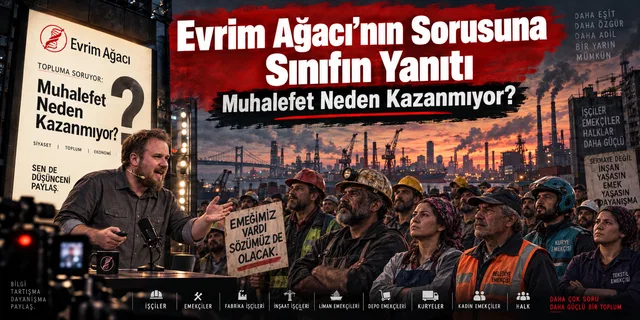
On this site we had examined two videos of Evrim Ağacı from this angle. The video "Why Can the Opposition Parties Not Win?" built a clever model with thermodynamics, evolutionary biology and game theory, but the word "class" never passed inside it. The video "What Will You Do When Artificial General Intelligence Comes?" told the workerless factories of thirty or forty years ahead with a great imagination. But whose property those factories were had never changed, and the question was asked only to the individual: What will you do? The machines change, property stays frozen. These two videos are the most visible examples in Turkey of the asymmetry we told above. We made this criticism not because we declared the channel an enemy, but because it reaches millions of young people and, for this reason, the responsibility of its language is large.
The trap of the alternative circles
What is really dangerous is that this frame pulls in not only the viewers of popular science but also the circles that claim to be building another world. Many circles that say they are against capitalism, while thinking about the future, think without noticing inside the frame the rulers have built. Let us remember Lakoff's warning: if, even in order to oppose a frame, you use its words, you strengthen the frame.
This trap has a few familiar forms.
Accepting inevitability. Accepting as it stands the proposition "artificial general intelligence is coming, the singularity is approaching, most jobs will disappear", and asking only "how will its blessings be shared?" This question is valuable, but it also carries with it the timeline, the terms and the prophecies of the companies that set the agenda. The question of in which direction the technology will develop, for whom it will develop, and at what speed it will develop, that is, the real political question, is lost inside the assumption of inevitability.
Using the ruling concepts while supposing them critical. Yuval Noah Harari's concept of the "useless class" is a good example of this. The concept looks like a critical warning, but it names people who have no work as "useless", that is, it defines the human only from the angle of capital's need. We too carried this concept into our headlines, in quotation marks, in order to criticise it. But even in quotation marks, repeating a concept contributes to its circulation.
Building the horizon at the level of consumption. The discussion of a universal basic income is important, and it contains demands that can be defended in today's conditions. But the imagination "in the future the machines will produce, and we will live on a basic income" positions people outside production and decision, only as consumers. Property stays again in a few hands, and a pocket money falls to the people. This is not an alternative world. It is a more polite form of managing the same world.
Mobilising with the language of apocalypse. Expressions such as "everything is collapsing", "we are too late", "the last ten years" are used to create a feeling of urgency. But when this language is repeated constantly, it produces hopelessness and immobility. If everything is already collapsing, organising has no meaning left. The fiction of futurelessness produces futurelessness even in the best-intentioned hands.
Building the alternative with the same measures. Circles that build an alternative against the platform monopolies measuring their successes by the same follower count, the same engagement rate, the same speed of growth. Or, in the name of a "native and national" alternative, the copying of the same model under a national flag. The form changes, the measure stays the same.
The common root of these traps is this: whoever asks the question also draws the limits of the answer. The question "what will you do when artificial intelligence comes?" does not ask in whose hands artificial intelligence will come. The question "how will humanity go to Mars?" does not ask how humanity lives on Earth. Building an alternative world begins by changing these questions themselves. Asking, instead of "what will you do?", "what will we do, in whose property, by whose decision?"
Taking the future back
So how do we get out of this frame? Philosophy offers us tools here too.
Ernst Bloch, in The Principle of Hope, makes a distinction between abstract utopia and concrete utopia. Abstract utopia is a dream that has no bond with today's conditions, a dream that comes down from the sky. Concrete utopia is the extension forward of possibilities that are already sprouting inside today. Free software, Wikipedia, cooperatives, the struggles to shorten the working day, the knowledge commons. These are signs not of a distant future but of the future inside today.
Marx, in 1859, in the preface to A Contribution to the Critique of Political Economy, had laid the foundation of this idea: humanity always sets itself only such tasks as it can solve. Because, looked at closely, the task itself arises only when the material conditions of its solution already exist, or are at least in the process of formation. Today the productive capacity that would feed the whole of humanity, the communication infrastructure that would share all knowledge with everyone, and the technology that would radically shorten the working day already exist. What is missing is not technique. It is the property relations. This is the most important truth that the fiction of futurelessness hides.
The science-fiction writer Ursula K. Le Guin, in an award speech in 2014, said this: we live in capitalism, and its power seems inescapable. But so did the divine right of kings. Le Guin's own novel The Dispossessed is one of the rare works that dares to imagine a society without property, with all its contradictions. The Soviet writer Ivan Yefremov, in Andromeda Nebula (1957), had also tried to think in detail a future in which exploitation had disappeared. None of these works is flawless. But all of them dare to tell the future not in the language of the companies but in the language of liberation. In From October to Infinity we had read, from this angle, how the revolution reimagined everyday life.
For this reason our proposal is this: while watching popular-science content, while listening to a narrative of the future, even while making our own designs of the future, let us ask three questions.
- Whose is the property in this future? Factories, data centres, spaceships, land, knowledge: in whose hands?
- Who gives the decision? Behind subjectless subjects such as "humanity", "technology", "the market", which institutions and which people are there?
- Which word has been carried from today? To colonise, market, user, productivity, competition. Does it have to be the case that these words are still valid in the world two hundred years from now?
These questions are asked not to belittle the love of science, but to complete it. A young person who learns with curiosity the billions of years of the history of the universe should be able to think, with the same curiosity and the same freedom, the next hundred years of their own society. The eye that looks at the sky should be able to look also at the property on the earth. Science teaches the laws of nature. But remembering that the laws of society are not laws of nature, that people made them and that people can change them, is also a scientific attitude.
Our Own Mirror: Hegemony Speaks in Our Mouths Too
Let us remember Klemperer's warning: the language of fascism settled also in the mouths of those who were against it. The struggle against the language of hegemony begins with the criticism not first of other people's language, but of our own. We have to be honest about this.
First: the "problem" formula. We told it in Why We Are Done Saying "the Woman Problem" and "the Kurdish Problem". The formula "the woman problem", "the Kurdish problem", "the migrant problem" makes a community into the problem itself. We learned this formula from the state, and we carried it without noticing.
Second: the swelling of jargon. Look at the headlines of the pieces from the first months of this site. Expressions such as "an epistemological and militant intervention", "dialectical materialist analysis", "the class and dialectical heritage" are in almost every headline. Each of these words is a valuable concept. But when they are sprinkled into every sentence they stop carrying meaning, and they turn into a sign of belonging. This is also another form of the legitimate language Bourdieu described: "we are the ones who know these words." In the later months we tried to simplify our language. But this is not a job done once and finished.
Third: military metaphors. Front, barricade, trench, position, militant, private soldier. These words have a history, and we respect that history. Even Gramsci's "war of position" is a military metaphor. But telling everything in the language of war can leave speechless the areas of life outside war: solidarity, care, comradeship, producing together. This language also carries a male-dominated conception of the world. In Four Ways of Standing Side by Side we had looked for the language of comradeship outside war.
Fourth: the language of swearing and humiliation. Inside the left too, curses and idioms that humiliate women, LGBT+ people, disabled people and certain peoples circulate. The curse used to humiliate a fascist or a boss most of the time carries the conception of the world of that fascist or that boss. This is the most insidious form of hegemony: expressing our anger against the ruler in the ruler's language.
Fifth: the commanding language of organisation. Expressions such as "the task was given", "the instruction came", "this is the line" can make relations inside the organisation resemble the relation between the boss and the worker. In Revolutionary Discussion Ethics and For a Left That Does Not Fear Criticism we had discussed what kind of language we have to build inside the organisation.
This self-criticism is not a side subject of getting free of the language of hegemony. It is the centre. A movement that does not see the ruling traces in its own language cannot be convincing in criticising the language of the rulers.
A Method from Freire: Naming the World
The last philosophical stop of this piece is Paulo Freire. The Brazilian educator Freire, in the 1960s, taught reading and writing to the poor peasants of the Northeast of Brazil. But he did this not with textbooks, but with "generative words" coming out of the peasants' own lives. While learning to read words such as "land", "brick", "wage", "crop", the peasants were at the same time discussing the relations behind these words, that is, whose the land was, why the wage was low, and to whom the crop went. Learning to read was learning to read the world.
In 1968, in Pedagogy of the Oppressed, Freire theorised this experience. One of the most beautiful thoughts of the book is this: a true word is the unity of action and reflection. A word cut off from action is empty talk, and action cut off from reflection is blind movement. To exist humanly is to name the world and to change it. The world that has been named also returns, as a problem, in front of those who named it, in order to be named again.
Freire's method is the practical counterpart of Gramsci's idea of "from common sense to good sense". The right words are not taught to the people from outside. One sets out from the people's own words, and by discussing together the relations behind those words one arrives at a new naming.
Setting out from this approach, we can propose seven principles of getting free of the language of hegemony.
1. Putting the subject back into the sentence. Asking "who?" in every passive sentence. Not "they were dismissed", but "the boss dismissed them". Not "prices rose", but "the companies raised the prices". Not "no measure was taken", but "the employer took no measure". This small grammatical habit is the most effective antidote to fetishism.
2. Naming not the thing but the relation. Making visible the social relation behind a word. Not "informal employment", but "making people work without insurance". Not "be your own boss", but "a platform labourer whose worker status has been hidden".
3. Historicising what looks natural. Showing when, by whom, and for which interest the thing said to have "always been like this" was built. The market, the state, the family, the working day: none of them is the weather. In What Did the October Revolution Give the World? we had told how the eight-hour day was the product of a struggle. Everything that looks natural has a history.
4. Winning the word without abandoning it. Not leaving to the rulers words that carry the memory of struggle of the oppressed, such as freedom, democracy, the people, the homeland, peace. But leaving the words invented only to describe the ruling relation (like "human resources"), and putting the right words in their place.
5. Finding the sound core in common sense. Not despising the intuition of justice, the knowledge of exploitation and the culture of solidarity in the language of the people. Binding them to a coherent conception of the world. There is no need to teach the concept of "class law" to a worker who says "the law always works against the weak". They already know that concept. It only needs to be named.
6. Producing the counter-concept. Refusing alone is not enough. What has not been given a name cannot be organised. Concepts such as "the knowledge commons", "mental Taylorism", "digital enclosure", "algorithmic supervision" are concepts produced in order to catch relations that the rulers have not yet named, or have named wrongly. A Glossary of the Knowledge Commons was a product of this effort.
7. Testing the new concept in practice. A concept lives only when people can make sense of their own experience with it, and can organise with it. A concept that is applauded in a piece or in a meeting, but that nobody uses in the workplace, is not yet a concept. It is a slogan. As Marx said in the Theses on Feuerbach, the reality and power of thought are proved in practice.
Basic Narrative Fallacies: Example and Reply
The dictionaries and principles above are packed, in everyday life, into short stories heard a few times. These are separate from the formal fallacies of a logic lesson. For the straw man, the attack on the person and the appeal to authority, see Revolutionary Discussion Ethics and Guide to Purging Fallacies. The subject here is not that. The subject here is the most basic stories with which the rulers tell the world. Each is recognised in one sentence, made visible by an example, and answered with a question. The reply is not for silencing the person opposite. It is for naming the relation together.
1. Naturalising. A historical relation is told as a law of nature. Example: "Human nature is competitive, so every society has a boss." "That is how the market works." Reply: When did this begin, who built it, who benefits? What is not the weather has a history. The eight-hour day was not always counted natural either.
2. Erasing the agent. The one who acts disappears from the sentence, and the thing becomes the subject. Example: "Prices rose." "They were dismissed." "The economy worsened." Reply: Who? The company raised the price. The boss dismissed them. A definite result is the decision of definite people.
3. Inevitability. A choice that has been made is presented as a future that cannot be avoided. Example: "Artificial intelligence is coming, most jobs will disappear, get used to it." "There is no alternative." Reply: Who decided, at what speed, for whom? What looks inevitable is most of the time a decision about property.
4. The universal subject. When everyone is named, the real agent is hidden. Example: "Humanity ruined the climate." "We are all in the same boat." "Society wants this." Reply: Which humanity, whose boat, which class of society? When the agent is everyone, it is no one.
5. Inverted naming. The relation is shown as innocent by being turned upside down. Example: The person who takes the labour is called the "employer", and the person who sells their labour is called the one who "takes work". Precarity is called "flexibility", and making people work without insurance is called "informal". Reply: Who gives, who takes? Say plainly the relation the word covers.
6. Euphemism. The name of what was done is softened so that it seems not to have been done. Example: Dismissal is called "restructuring", a cut in wages "cost optimisation", a civilian death "collateral damage". Reply: Rebuild the hidden act. Who did what, to whom?
7. Individualising. A common problem is told as one person's lack. Example: "What will you do?" "Leave your comfort zone." "Invest in yourself." Reply: Because the question is asked of one person, the collective subject disappears. "What will we do, in whose property, by whose decision?"
8. Merit. Inequality is told as the fair result of effort. Example: "If they had worked, they would have succeeded too." "Opportunity is equal, the issue is merit." Reply: The starting line is not the same. The person who writes the rule and the person who starts the race ahead can be the same person. The common sense that says "the law always works against the weak" already knows this.
9. False balance. An inequality of power is told as a fight between two equal sides. Example: "Both sides are extreme." "Politics is dirty, they are all the same." "The strike and the lockout are both violence." Reply: Who has the power to dismiss, and who has only their labour? A balance is built between those who are equal.
10. Apocalypse or gift. The future either comes as a disaster or is offered as a company's present. Example: "Everything is collapsing, it is too late." "The singularity will save us." Reply: In both, we do not make the future. Whose is the property, who gives the decision, which word has been carried from today?
These ten replies are not a list of slogans. They are a short ruler for stopping when a sentence is heard, and asking.
Concrete Tasks
So that this piece does not remain as a piece of philosophy, let us propose some work that all of us can do starting today.
-
Keeping a personal dictionary. For a week, note the examples of the language of hegemony you meet in the news you read, in the meetings at your workplace, on social media. Next to each, write the hidden relation and the word that names it rightly.
-
Hunting the passive sentence. Take the economy page of a newspaper and underline the sentences without an agent. For each, ask the question "who?" Doing this together in a reading group is very instructive.
-
Testing the language in the workplace. Read together with your workplace comrades the words in the human-resources correspondence and in the announcements inside the company. In a place said to be "like a family", ask whether the overtime is paid. Make the gap between the word and the reality visible together.
-
A check of the language inside the organisation. In your own organisation, union or association, hold a session of self-criticism of language. Read your declarations and your social-media posts together. Identify the "problem" formulas, the humiliating expressions, the incomprehensible jargon, the commanding language. Build this session not as an accusation but as learning together.
-
Compiling a people's dictionary. From your own neighbourhood, your workplace, your family, compile idioms, proverbs and sayings about justice, labour, solidarity and exploitation. This is the most concrete way of finding the sound core in common sense.
-
Working critically with language models. If you write texts with artificial-intelligence tools, read the outputs for the language of hegemony. Correct the sentences without an agent, the fetishism of "the market", the euphemisms. Publish not the voice of the tool, but your own voice.
-
An open dictionary held in common. We propose turning the table in this piece into an open dictionary to which everyone can contribute. As Knowledge Commons we are ready to start this dictionary under the CC BY-SA licence. We are waiting for every comrade who wants to contribute.
Questions for Discussion
If you want to discuss this piece in a reading group, you can begin with these questions:
- Which word do you use most often in everyday life, but have never thought about the relation behind?
- Should we abandon the word "freedom" to the rulers, or should we try to win it? Why?
- Which expressions circulate inside the left in your circle, and carry the ruling conception of the world?
- Have you lived a situation in which changing a word by itself changed something? Or did the word change only when the relation changed?
- How will the spread of language models affect the diversity of language? What can we do against this?
- In a piece of popular science you watched, how was the future told? Whose was the property in that future, and who gave the decisions?
- Can you give an example, including in your own circle, of circles that want another world falling into the rulers' frame of the future?
- Which of the narrative fallacies above does the last sentence you heard fall under, and what would the reply be?
Dear Comrades,
We began this piece with Confucius's principle of the rectification of names. For him, rectifying the names was the way of protecting the order. For us, rectifying the names is one of the ways of changing the order. The difference is whose interest, which class's interest, we rectify the names for.
The rulers built language according to their own interest, and they reproduced this language every day in schools, on televisions, in the plazas, on the platforms. This language has settled so far that most of us suppose it is our own language. But as Voloshinov showed, no word is entirely theirs. Inside every word there lives a suppressed accent, a memory of the oppressed. Hearing that accent, reviving that memory, is our work.
While doing this we have to avoid two traps. The first is the trap of purifying the language: building a jargon cut off from the people, speaking to itself. The second is the trap of supposing language is everything: supposing that when the words change, the world changes too. The right road passes between these two: speaking in the language of the people, but hearing the ruling voice inside that language. Working on words, but testing the words in organised practice.
In prison, in conditions where even finding paper and a pencil required a struggle, Gramsci went on thinking about language. Because he knew that a new world is built not only with new institutions but also with a new conception of the world, that is, with a new language too. That language will not come down from the sky. It will be born in the mouths of people who speak together, discuss together and organise together, in the factories, in the schools, in the neighbourhoods, in the unions.
We will take the words back. Because words belong to the people who live them and who change the world with them.
Sources
Philosophy and theory
- Confucius, Analects (Lunyu), Book XIII, section 3. (The rectification of names)
- Plato, Cratylus.
- Thucydides, The Peloponnesian War, Book III, section 82. (The civil war in Corcyra and the change in the meaning of words)
- Francis Bacon, Novum Organum (1620), Book I, aphorisms 43 and 59. (The idols of the marketplace)
- Karl Marx and Friedrich Engels, The German Ideology (1845-46). (Language is practical consciousness; the ideas of the ruling class; the criticism of the Young Hegelians)
- Karl Marx, Theses on Feuerbach (1845).
- Karl Marx, Capital, Volume I (1867), chapter 1, section 4. (The fetish character of the commodity)
- Friedrich Engels, preface to the third German edition of Capital, Volume I (1883). (On the jargon of "employer" and "employee")
- Antonio Gramsci, Prison Notebooks, especially Notebook 11 (philosophy and common sense) and Notebook 29 (notes on grammar).
- Valentin N. Voloshinov, Marxism and the Philosophy of Language (1929).
- Ludwig Wittgenstein, Tractatus Logico-Philosophicus (1921), 5.6; Philosophical Investigations (1953), §43.
- Victor Klemperer, LTI: The Language of the Third Reich (1947).
- George Orwell, "Politics and the English Language" (1946).
- Roland Barthes, Mythologies (1957).
- Herbert Marcuse, One-Dimensional Man (1964), chapter 4: "The Closing of the Universe of Discourse".
- Paulo Freire, Pedagogy of the Oppressed (1968).
- Pierre Bourdieu, Language and Symbolic Power (1982/1991).
- Karl Marx, A Contribution to the Critique of Political Economy, Preface (1859).
- Ernst Bloch, The Principle of Hope (1954-59).
- Nikolai Kardashev, "Transmission of Information by Extraterrestrial Civilizations" (1964).
- Ivan Yefremov, Andromeda Nebula (1957).
- Ursula K. Le Guin, The Dispossessed (1974), and the National Book Awards speech (2014).
- Fredric Jameson, "Future City" (2003); Mark Fisher, Capitalist Realism (2009).
- Raymond Williams, Keywords: A Vocabulary of Culture and Society (1976).
- George Lakoff, Don't Think of an Elephant! (2004).
Related pieces on Knowledge Commons
- Class Is Back at the Table (8 November 2026)
- Why We Are Done Saying "the Woman Problem" and "the Kurdish Problem" (11 October 2026)
- Rejecting the Ruling Class's Playing Field: The Reality of Hegemony, Passive Revolution, and an Independent Class Line (14 August 2026)
- Neden Kendimizi Aldatırız? (30 October 2026)
- Whose Is the Machine's Voice? (31 October 2026)
- The Class of Cognitive Surrender (4 November 2026)
- "We Stopped Them All": A Monopoly's Grammar of Self-Absolution (12 September 2026)
- What Does the "AI Tsunami" Conceal? (23 July 2026)
- Not the Madness of the Crowd, but the Knowledge of Those Inside (1 November 2026)
- Four Ways of Standing Side by Side (2 November 2026)
- Revolutionary Discussion Ethics and Guide to Purging Fallacies (16 August 2026)
- For a Left That Does Not Fear Criticism (17 August 2026)
- A Glossary of the Knowledge Commons: The Conceptual Tools of Liberation in the Digital Age (5 May 2026)
- 12 September: The History, Balance Sheet, and Present of a Class Coup (11 September 2026)
- The Illusion of "Indigenous and National" Artificial Intelligence and the Dialectic of Imperialist Integration (30 July 2026)
- From Futurism to Techno-Fascism (7 September 2026)
- The Philosophical Trap in Evrim Ağacı's AGI Video (25 October 2026)
- The Class's Answer to Evrim Ağacı's Question (7 September 2026)
- The Class Position of Science Communication in Turkey (9 August 2026)
- From October to Infinity: Reading the Everyday Life of the Revolution (7 November 2026)
- Whose Family Is Safe? (15 September 2026)
- Algoritmayı Yürüyerek Geçtiler: Sırbistan'da Plenum Sandığı Nasıl Yendi?
This piece is one of the living documents of Knowledge Commons. It is shared under the CC BY-SA 4.0 licence. You may copy, change and share it if you credit the source.