The Twilight of Stabilitocracy: Capital's 'Sustainable Hell' and the Seizure of the Future
Artificial Stability, Real Servitude — From Stabilitocracy to Technofeudalism

The jargon of bourgeois political science constantly produces new concepts to conceal capitalism's structural crises and imperialism's relations of domination. One concept we have heard frequently in recent years, beloved by liberal academia and media, is "stabilitocracy" (stabilitokrasi). Packaged by capital's media as "geopolitical necessities" or a "search for stability," this concept is in fact a historical document confessing the fall of liberalism's mask and the criminal partnership global finance capital has forged with autocracy for its own survival.
When we place this concept on the table with class consciousness and a historical materialist perspective, what confronts us is not an abstract "form of governance" but an authoritarian superstructural fortification that capital accumulation regimes resort to in moments of crisis.
What Is Stabilitocracy? The Class Essence of the Concept
Bourgeois academia and liberal political science present the concept of "stabilitocracy" as if it were merely a geopolitical choice, a "realpolitik" deviation in foreign policy, or the diplomatic cunning of authoritarian leaders. According to their definition, stabilitocracy is when international actors (the EU, the US, or global financial institutions) ignore democratic backsliding, the trampling of law, and human rights violations in a country in order to support or reconcile with the existing repressive regime solely for the regional/global stability that regime provides.
Yet when we put on the lens of historical materialism, we see that this definition is a liberal illusion, an ideological veil hiding capitalism's criminal partnership. Stabilitocracy is not an abstract governance crisis; it is an anti-democratic model of class domination and crisis management to which global finance capital resorts in periods of structural crisis.
We can deepen the political-economic and class essence of this concept under five fundamental dialectical headings:
The Dialectic of Base and Superstructure: Capital Throws Off the Mask of "Law"
As Karl Marx made clear, legal and political structures (the superstructure) rise above and serve economic relations of production (the base). Bourgeois democracy was the most favorable superstructural form for capitalism in its period of ascent, protecting the free market, competition, and property rights. Liberalism aestheticized exploitation with the fairy tale of the "free contract."
But when capitalism's global crises deepen and the law of the tendential fall in the rate of profit jams the system, bourgeois democracy becomes an obstacle to capital accumulation. Because democracy means the working class seeking rights, unionizing, going on strike, and demanding a share of the budget.
Class Essence: Stabilitocracy is the bourgeoisie's own throwing into the trash, in order to resolve the profit crisis in the base, of liberal ornaments in the superstructure such as "democracy," "rule of law," and "human rights." For the uninterrupted continuity of its cycle, capital chooses not legal predictability but the de facto predictability provided by weapons and repression.
The Autocratic Guarantee of Surplus-Value Exploitation
Capitalist exploitation rests on the capitalist's seizure of the difference between the value the worker produces and the wage paid to them (surplus value). There are two ways to raise the rate of exploitation: absolute surplus value (extending the working day) and relative surplus value (cheapening and intensifying labor).
A stabilitocratic regime guarantees global and domestic capital the most savage application of both forms of exploitation.
- Strike Postponements and Bans: Strikes—the working class's greatest weapon for seeking rights—are banned with a single decree in stabilitocracies under the pretext of "national security" or "economic stability."
- De-unionization and Repression: Worker organization is broken up; the judicial mechanism is turned into the employer's naked apparatus of violence.
Thus stabilitocracy guarantees global monopolies a "garden of roses without thorns"—an absolute oasis of exploitation where the cost and resistance of labor are reduced to zero.
The Role of "Subcontractor Autocracy" in Global Value Chains
Stabilitocracy is the modern form of the asymmetric exploitation relationship between imperialist centers and peripheral/semi-peripheral countries. Global finance capital (the IMF, the World Bank, sovereign wealth funds) demands two things from peripheral countries: cheap labor supply and absorption of the crises imperialism creates.
- Border Guardianship and Refugee Warehouse: Millions of migrants displaced by imperialist wars and ecological destruction are confined in stabilitocratic regimes so as not to threaten the comfortable liberal democracy of the Western bourgeoisie. In exchange for financial funds received, the regime assumes imperialism's "border guard" function.
- Contract Manufacturing Hub: For global supply chains, these countries are subcontract manufacturing bases where environmental regulations are trampled, nature is plundered, and workplace deaths are normalized.
Western capital sells a "human rights" vision to workers in its own country while sourcing its raw materials and cheap products from the bloody and insecure labor regimes of stabilitocracies.
Commodified Stability: Order Becomes Rent
Whereas classical fascism or military dictatorships are usually constructed as temporary regimes of exception, stabilitocracy is making authoritarianism a permanent, sustainable, and institutionalized form of crisis management. Here "stability" becomes a commodity sold to the global market.
The autocratic regime sends global capital this message: "If I am not here, there is chaos, worker uprisings, migrant waves, and market collapse. My authoritarianism is the insurance on your investments." Global bourgeoisie buys this commodity (stability), keeps the regime financially afloat (credits, hot money flows, political legitimacy support), and thus a mutual techno-political rent mechanism is established.
Digital Surveillance and the Suppression of the "Surplus Class"
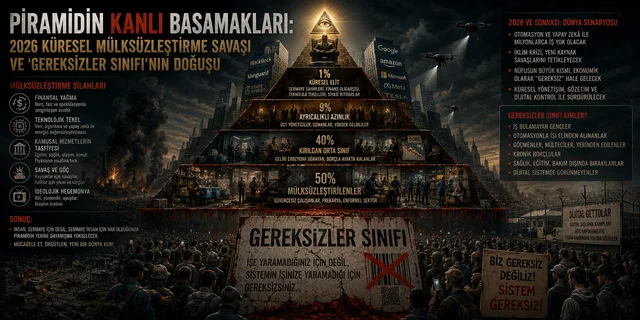
In the world of 2026, the class essence of stabilitocracy has been further refined by merging with the parameters of technofeudalism. Artificial intelligence, automation, and big data have raised productive forces to an enormous level, yet the private ownership of these technologies lies in the hands of Silicon Valley oligarchs and local compradors.
This situation creates a vast "surplus class" (surplus population) thrown outside the production process, which the system no longer even needs to exploit.
- Algorithmic Shackles: Stabilitocracy cannot manage the hunger, housing insecurity, and rage of tomorrowlessness of these billions of precarious people through democratic methods.
- Permanent State of Exception: Therefore the regime uses digital surveillance networks, predictive policing software, charity culture disguised as social assistance, and ideological apparatuses (media, religious orders) to absorb mass anger before it explodes.
The class essence of stabilitocracy is the manufacture of a "sustainable hell" in which humanity's overwhelming majority is watched, suppressed, and left precarious within seconds, in order to sustain capitalism's structural crises, imperialist chains of exploitation, and technofeudal domination. As long as this artificial stability barricade is not shattered by the organized class will of the propertyless, a free tomorrow for humanity will not be possible.
Stabilitocracy in Historical Process: From Bonapartism to the Cold War
The name may be new, but its practical manifestation is as old as the history of class struggles. At every historical threshold where it confronts structural crises, capitalism has lowered its "democratic" mask and secured stability through the apparatus of force.
Karl Marx and Bonapartism
The Bonapartism analyzed by Marx in The Eighteenth Brumaire of Louis Bonaparte is the first refined prototype of stabilitocracy in history. When the bourgeoisie, faced with the rising opposition of the proletariat, understood that it could not sustain its class domination through democratic means, it handed political power to an authoritarian figure holding the state apparatus (Louis Bonaparte). The aim was single: to keep economic property and capital accumulation "stable" at the price of suspending political rights.
The Cold War and "Our Son of a Bitch"
Throughout the twentieth century, imperialism applied stabilitocracy as a global foreign policy doctrine. The bloody dictatorships funded and supported by US imperialism from Latin America to Asia (Pinochet, Somoza, Shah Pahlavi) are its most naked examples. The famous remark US administrations made about these dictators—"He may be a son of a bitch, but he's our son of a bitch"—is the clearest summary of the class and imperialist morality of stabilitocracy. For the stability of capital against the communist threat, fascist juntas were protected.
Turkey's Stabilitocratic Memory: From January 24 to September 12
Turkey is one of the most savage examples of the "authoritarian stability" laboratories to which global capital retreats in moments of crisis. By the late 1970s, the import-substitution industrialization model (ISI) had jammed, the foreign exchange crisis had peaked, and profit rates for the bourgeoisie had fallen dramatically. The prescription of the capitalist class for exiting this crisis was the January 24 Decisions announced on January 24, 1980, under the architect Turgut Özal.
These decisions meant opening the economy outward, devaluation, removing agricultural supports, and above all cheapening labor and shifting to an export-oriented model of exploitation. Yet there was a dialectical obstacle: the Turkish working class was living through the most organized period in its history and had no intention of consenting to this destruction program.
The Barricade That Was Broken: The 1980 Strike Wave
The moment the January 24 Decisions were announced, they collided with the rising proletarian wave in the factories. The concrete data standing against the bourgeoisie's intention of "stability" were as follows:
- Explosion in Lost Workdays: While lost workdays in strikes in 1979 stood at 1.1 million, immediately after the January 24 Decisions, in the first eight months of 1980 this figure shot to a historic record of 7.7 million workdays.
- Workers in the Streets: In 1980, a full 57,000 workers were actually on strike and hundreds of thousands more were about to take strike decisions. The historic showdown between MESS (Metal Goods Industrialists' Association) and Maden-İş, affiliated with DİSK, had locked down industry.
The capitalist class understood that within parliamentary mechanisms and the limits of bourgeois democracy it could not bring the worker to the table or implement the January 24 Decisions. The September 12, 1980 military coup was precisely a stabilitocratic superstructural intervention ordered by global finance capital (the IMF and World Bank) to crush this strike wave with blood and the sound of boots.
"Stability" at Bayonet Point and the Destruction of Data
The moment the September 12 junta took power, it set aside freedom fairy tales and moved directly into operations to secure the base—that is, capital's profit rates. Halit Narin, president of TİSK (Turkish Confederation of Employer Associations) at the time, confessed the class character of stabilitocracy in these words:
"Until today we cried while the workers laughed; now it is our turn to laugh."
And so it was. The concrete balance sheet of attacks on labor immediately after the coup unfolded as follows:
- Union Destruction: DİSK and affiliated unions were shut down; their assets were seized. The death penalty was sought for 52 union leaders. Strikes were banned indefinitely.
- Collapse of Wages: Between 1980 and 1988, real wages lost on average 30 to 40 percent of their value. The purchasing power of the working class was rolled back at bayonet point.
- Plunder in the Distribution of National Income: While labor's share in national income (wages and salaries) stood in the 35–38 percent band in the second half of the 1970s, as a result of the September 12 regime and the neoliberal stabilitocracy that followed under Özal, this share was driven below 20 percent by the mid-1980s. Capital's share (profit, interest, and rent) reached its highest level in history.
The Bloody Surplus Value Behind the Export Miracle
Behind the illusion trumpeted by bourgeois economists of "Turkey opening outward in the 1980s, breaking export records" lies the bloody surplus-value seizure created by September 12 stabilitocracy.
This table tells us the following: the rise in exports did not come from a technological leap or a productivity explosion; it came from absolute surplus value cut from the worker's throat, seized through de-unionization and military pressure, and sold cheaply to the global market. Global banks (Chase Manhattan, Citibank) and the IMF gave top marks to this authoritarian "stability" that kept Turkey's external debt installments paid on time.
Historical Lesson: Yesterday's Boots, Today's Algorithm
Comrade, the January 24–September 12 dialectic of 1980 teaches us the unchanging rule of stabilitocracy: When capital accumulation jams, democracy is expendable trivia for the bourgeoisie.
Capital that yesterday took refuge in the army's boots, tanks, and State Security Courts (DGM) to crush the organized power of the working class today keeps the working class under pressure hand in hand with technofeudals who privatize the internet, data, and the agora. The Kenan Evrens of yesterday have been replaced today by algorithmic mass surveillance networks, platform bosses racing couriers against the second, and technocratic elites managing mass anger with artificial intelligence software.
Future Design and an Alternative Horizon
The cyber-socialist future design we must draw from this historical memory is to complete that great class march left unfinished in 1980.
- All those factories, banks, and today added digital data centers, cloud servers, and automation lines that capital seized in the name of stability will pass to the democratic control of worker councils.
- Production will be algorithmically planned not according to the IMF's debt repayment schedules or technooligarchs' stock values but according to society's needs for free healthcare, housing, food, and ecological repair.
Both the fake stability built with yesterday's tanks and the stabilitocracies fortified with today's algorithms will be shattered by the organized power of the working class arising from production.
When we think of the mass, physical union organization that September 12 stabilitocracy took from the working class's hands, what do you think should be the most practical method for the modern working class expanding today from factories to office towers, from Amazon warehouses to software rooms to build a new generation of "Underground Cyber-Unionism" and Class Networks that overcome digital surveillance networks and algorithmic firings?
Stabilitocracy and Class Struggle in Today's Turkey: The Political Economy of Decay and Resistance
When we look at the naked truth of Turkey in 2026, we see that stabilitocracy is not merely a diplomatic balancing game but a form of governance for social decay and a total algorithmic assault on labor. The late capitalist accumulation regime, unable to manage mass anger over hunger and precarity through the classical institutions of bourgeois democracy, must "stabilize" stability through naked repression, debt mechanisms, and digital isolation networks.
Let us place on the table, with a more dialectical lens, the concrete anatomy of this hegemonic model in today's Turkey and the new lines of class struggle fermenting within it:
International Subcontracting: Ghettoized Geography and the Racialization of Labor
Imperialist centers (especially European capital), in order to preserve the "clean," "green," and "liberal" makeup within their own borders, have subcontracted capitalism's greatest filth to semi-peripheral stabilitocracies like Turkey. The class map of this situation runs along two main axes of exploitation:
- The Cost of Border Guardianship: In exchange for billions of euros in funds and readmission agreements, Turkey has been turned into a vast open-air prison for millions of people dispossessed by imperialist wars. While Western bourgeoisie delivers human rights speeches, it invoices the refugee crisis to the stabilitocratic walls of this geography.
- Splitting the Reserve Army of Labor: The regime uses this enormous migrant population as a perfect lever to fragment class consciousness. Precarious, unregistered migrant labor with no legal rights is driven onto the market as a threat element to suppress local proletarian wages and drag working conditions back to medieval conditions.
"The bourgeoisie plays the cards of chauvinism and racism to divide the working class into 'native and migrant.' Thus common exploitation in the factory is converted into hatred workers feel for one another and becomes stabilitocracy's greatest lifeline."
Savage Exploitation Basin: Devaluation, Inflationary Shocks, and the "National Security" Shackle
The chronic inflation and deliberate devaluation policies experienced in Turkey are not economic "incompetence"; they are a conscious class choice aimed at radically shifting income distribution against labor and in favor of capital.
- Transfer of Resources to Capital: While workers', civil servants', and pensioners' wages erode within seconds under high inflation waves, corporate profits, bank balance sheets, and rent income of exporting compradors break historic records. This is value torn from labor's pocket and siphoned into the coffers of finance capital.
- Legalization of Strikebreaking: Whenever the working class raises its head against this inflationary plunder, it finds stabilitocracy's iron fist before it. Strikes by metalworkers, miners, or petrochemical workers are postponed—and thus effectively banned—with a single decree on the grounds that they "disrupt economic stability" or "threaten national security." Law has been turned into a corporate regulation ensuring uninterrupted market operation.
Digital Precariat and Algorithmic Surveillance: The Boss on the Phone Screen
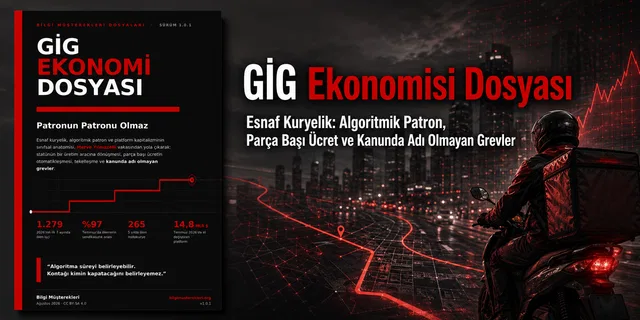
In today's Turkey, class struggle no longer runs only beneath factory chimneys but spreads through digital platforms threading through the capillaries of cities. Courier networks, logistics warehouses, call centers, and remote cognitive workers (developers, designers) are subjected to a savage exploitation machine by local subcontractors of technofeudalism.
- The Algorithmic Whip: Hundreds of thousands of young workers left precarious through fake illusions such as the "independent contractor" courier model are watched, scored, and punished second by second by algorithms on phone screens. Living labor is abandoned to the mercy of inanimate software code.
- The Threat of the "Surplus Class": In this age when artificial intelligence and automation are privatized in the hands of global monopolies, the regime constantly waves the stick from under the cloak at the working class: "If you do not accept these low wages and these twelve-hour working conditions, there are millions of unemployed waiting at the door; and if that is not enough, an artificial intelligence model or robotic line ready to replace you." Masses are tried to be pacified with permanent tomorrowlessness and systemic fear of being "made surplus."
New Fronts of Class Struggle and Foci of Actual Resistance
Yet the dialectical law is at work: Every site where repression intensifies this much, where fake stability barricades are fortified this much, ferments within itself a shattering counter-anger and new practices of resistance. Stabilitocracy's seemingly smooth surface is constantly cracking under actual class movements rising from below.
- Overcoming Yellow Unionism: At every turn when classical union bureaucracy reconciles with the regime and capital, workers leap forward by forming their own base committees and actual resistance committees. Courier boycotts, basin-based textile resistance, and office-tower actions reveal the new aesthetics of class organization.
- Ecological Class Front: Resistance by villagers and agricultural workers across Anatolia against mining companies' and energy monopolies' attempts to plunder nature is not merely an "environmental" struggle. These resistances are naked class war fronts that physically block the "fast and ruleless plunder" zones stabilitocracy offers capital and defend the common character of production and life.
Dialectical Way Out: From Fake Stability to Real Freedom
Comrade, to shatter the leaden sky that stabilitocracy and technofeudalism have collapsed upon us requires, above all, deciphering the mental shackles in which the ruling class has imprisoned us. Dialectical materialism teaches us that dominant orders do not endure by police baton or economic crises alone; they gain continuity by paralyzing mass consciousness and turning people into subjects who consent to their own servitude.
Therefore, the sole way to break through stabilitocracy's fake and suffocating "stability barricade" is not to take refuge in the market's deceitful restoration promises but to organize a revolutionary organization grounded in class consciousness, adorned with a wave of radical social enlightenment.
From Algorithmic Opium to Radical Enlightenment: Dissolving Commodity Fetishism
The commodity fetishism that Karl Marx dissected in Capital has reached its peak in the digital age. The apps glittering on our phone screens today, courier platforms, or artificial intelligence interfaces are modern veils that make invisible the enormous human labor and exploitation relations behind them. Humanity has knelt before the technology it produced and is forced to perceive it as a mystical and inevitable force of nature.
The social enlightenment we must target is not the abstract, classless, elitist call to "become reasonable" of bourgeois liberalism. Our enlightenment is a radical and material awakening:
- Tearing the Illusion: Showing masses that the algorithmic order ticking away behind the screen is not magical technology but the stolen lifetime (surplus value) of precarious workers, data labelers, and logistics laborers around the world.
- Overcoming Division: Deciphering with class-axis rationality the ideological opium stabilitocracy pumps into masses to pacify them—chauvinism, migrant hatred, cultural identity wars. Enlightenment begins the moment the native worker and the migrant worker, the developer in the office tower and the courier in the warehouse, recognize they share the same class fate against a common enemy.
Class-in-Itself to Class-for-Itself: Consciousness Turning into Organized Power
The dialectical law says objective conditions (poverty, precarity, exploitation) alone are not enough to create a revolution. The working class cannot automatically change the world merely because it is exploited. The class must leap from the passive stage where it exists merely because of its economic position (class-in-itself) to the founding stage where it becomes aware of its class interests and historical role (class-for-itself).
The sole bearer of this leap is Organization Armed with Class Consciousness.
"An unorganized class is merely raw material, a heap to be crushed in the gears of the exploitation apparatus. An organized class is the sole collective subject that will rewrite history with its own hands."
- Centralism Against Dispersion: Technofeudalism separates workers spatially through flexible work and subcontracting models, isolating them by imprisoning them in their homes or on their motorcycles. Class organization must break this artificial dispersion with cyber and physical networks and centralize scattered anger in a single class will.
- Symmetric Headquarters: Just as Peter Thiel and his allies coordinate their class interests at a global level at "Dialog" tables, the working class must respond to this organized elitism with symmetric class war by establishing its own Worker Committees and Councils in factories, office towers, and data centers.
The Political Economy of Real Freedom: From the Realm of Necessity to the Realm of Freedom
The realistic future design before masses that leap through social enlightenment and organize with class consciousness is, in Friedrich Engels's phrase, "that great leap humanity will make from the realm of necessity toward the realm of freedom." When the baton of fake stability is broken, the practical pillars of cyber-socialist construction will be rapidly deployed:
Commoning Digital Infrastructure and Data
All cloud servers, databases, logistics networks, and communication platforms in the hands of global monopolies and stabilitocratic partners will be expropriated and declared public commons (digital commons). Data will be removed from being a spying tool used to sell ads or surveil masses and turned into humanity's collective memory and production guide.
Cyber-Socialist Optimization and People's Planning
The market's savage anarchy that produces crisis, inflation, and artificial scarcity will be liquidated. Big data and advanced artificial intelligence algorithms will be recoded not to multiply stock values but to plan society's real and urgent needs (free and quality housing, food distribution, healthcare services, ecological repair) with live data, instantly.
The Radical Conquest of "Free Time"
Automation that threatens workers with unemployment and "being made surplus" in the capitalist order will become humanity's greatest lever of liberation under socialist planning. The enormous productivity technology brings will be used to radically reduce mandatory weekly working hours (for example, to ten hours).
In a classless society, the measure of wealth will not be accumulated digital money or rates of exploited surplus value but the uninterrupted, clean free time people possess to realize themselves, engage with science, art, philosophy, and the management of collective life.
We will tear down the castles; because as long as those castles stand, the enormous technological genius humanity has produced will continue to hammer the nails into our own coffin rather than liberate us.
It is time to conquer the agora—to destroy fake stabilities and build real freedom with our own hands!