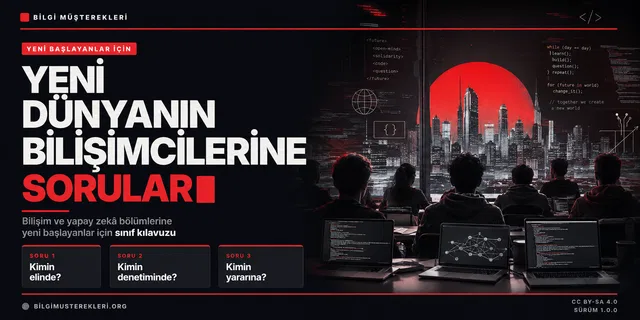
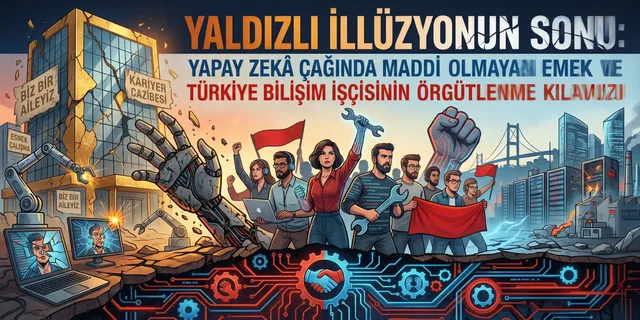
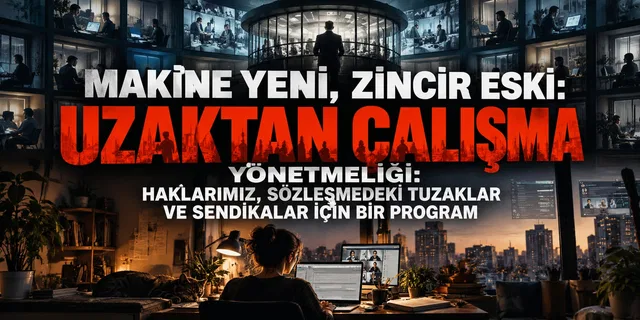
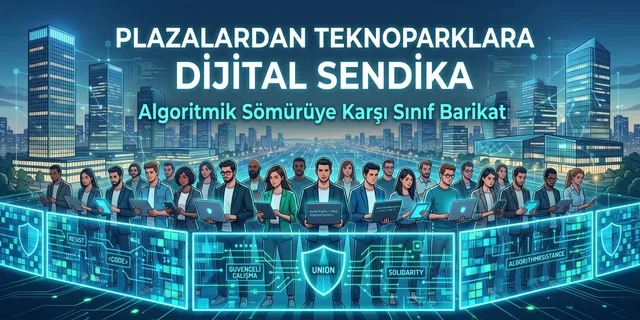
The Computing Worker's Handbook
For Everyone Whose Hands Touch the Keyboard - Labor, Rights, Organizing

"The Computing Worker's Handbook" Is Out
A roughly two-hundred-page handbook on labor, rights, and organizing for everyone whose hands touch the keyboard — 17 charts, 23 diagrams, ten appendices. Free in PDF, EPUB, and Markdown.


Dear Young Comrades,
Picture five people at once.
In Maslak, a product manager stares at a target board that will not turn green. In İzmir, a network administrator wakes at two in the morning to a vibrating phone; the shift is on the roster, the pay is not in the contract. In Ankara, a call-center worker’s screen shows three numbers: call duration, script-compliance percentage, resolution rate. A designer working from home is told their budget is being cut because “the machine now produces the visuals and you only fix them.” In Kadıköy, a data labeler counts not how many hours they worked that week but how many labels were approved — unapproved work goes unpaid, and there is no appeal button.
None of them know one another. All five think of themselves as “inside the sector but outside the class.” And when they sit down and think, all five form the same sentence: “I don’t know who I’m supposed to bargain with.”
The handbook we publish today begins with that sentence and tries to answer it. Its name is The Computing Worker’s Handbook; its subtitle is For Everyone Whose Hands Touch the Keyboard — Labor, Rights, Organizing. Roughly two hundred pages, eight parts, twenty-six chapters, ten appendices. In a single text, building its own theoretical ground as it goes, it explains what computing labor is in Turkey, how it is exploited, why it is divided, and how it can be organized.
Why now?
Three numbers explain why we wrote this handbook.
45,082 and 75. In Turkey, a union needs one percent of the workers in its sector to sign a collective agreement. Computing sits inside a catch-all sector called “Commerce, Office, Education, and Fine Arts,” with 4.5 million workers; one percent of that is 45,082 members. The official membership of the computing union established in that same sector, as of July 2026, is 75. The gap between them is six hundredfold. This is not a gap that goodwill can close; it is an arithmetic that forces the road itself to be rethought.
54,836. In 2025 alone, this many layoffs in the United States were announced openly by companies citing “artificial intelligence.” In the occupations most exposed to AI, the employment gap for the 22–25 age group rose to nineteen percent. In Turkey, Getir’s mass layoffs, the action of three hundred workers at a technology company whose wages went unpaid, and the National Artificial Intelligence Board set up without labor representation are local ripples of the same wave.
14 June 2026. A computing union in Turkey held its founding congress and listed “bureaucratization in unionism” among the sector’s six core problems in its own manifesto. The union form itself was opened to debate. A text was needed that took that debate seriously, worked on the plane of ideals, and offered a concrete model.
The handbook’s thesis
In one sentence: The computing worker is a collective worker who does not fit into a single profession, diploma, title, sector, or country. Everyone who writes code and everyone who builds the network, manages the project, defines the product, designs the interface, produces content, labels data, answers the call, and keeps the system running.
Every boundary that divides them increases capital’s bargaining power. Organizing is the practical sum of crossing each of those boundaries. And as everything workers in this country have won over the last five years shows: the law does not grant that crossing; struggle wins it, and the law recognizes it afterward.
Throughout the handbook we returned to two tests; we put every proposal through both:
A union that is not democratic will be left without members. A union that is not inclusive will stay below the threshold.
These are not two separate wishes but two faces of the same necessity. An organization that makes decisions at the top carries the agenda of its strongest segment and loses everyone else. An organization with a narrow scope cannot win mathematically under this country’s threshold system. Closed decisions produce narrow membership; narrow membership makes closed decisions easier. The way to break the chain is to attack both at once.
What’s inside?
Part I — Who is the computing worker? Ten clusters: software production, network and infrastructure, management and coordination (yes, the product manager and project manager too), design and content, data and artificial intelligence, service and support, games, those made invisible by contract form, the alliance ring (courier and warehouse worker — not in scope, but in alliance), and reproduction. We lay out in three arguments why the scope is this broad: production, exploitation, and the need to organize. Then six production-process diagrams and “the reality of what is shared as precarity” — five measurable indicators and three honest limits.
Part II — Political economy. Labor-power, surplus value, what the means of production are in computing, the fencing-in of knowledge, mental Taylorism, and the table “same regime, different screen”: story points, OKRs, revision time, uptime, script compliance, hourly labels. Then the digital panopticon and the computing worker’s dual position — the hand that builds the system is the only hand that can dismantle it.
Part III — Problems. Ten problems in Turkey: wage fraud, unpaid overtime and on-call duty, pay secrecy, title inflation, subcontracting chains, layoffs and the age of thirty-five, the rollback of remote work, surveillance, the closing entry gate, censorship. The same wave on different shores around the world. And beneath all of them a single core: division.
Part IV — The sector trap and the computing sector. The handbook’s first center of gravity. We show with arithmetic what Law 6356 means for computing; the Constitutional Court decisions that froze authorization for four and eight years after employer objection; how sector change is a weapon in the boss’s hand. Then a design: “Computing and Digital Services Sector.” Scope with NACE codes, two legislative options, transition provisions, four objections and responses. Then the only route that in Turkey actually works for winning before legal authorization — the practice of base unions — translated for computing: in place of the factory gate, leverage day; in place of turning off the ignition, stopping distribution and refusing on-call duty; in place of the boss’s home, the client company and the contracting authority. A four-line decision tree and a workplace protocol template.
Part V — A new organizing model. The second center of gravity and the handbook’s most original section. Eight structural problems of classical unionism and five founding risks every new union faces — without names of people or events, on the plane of ideals. Then good ideas drawn from the statutes of more than twenty computing unions around the world: the Danish computing union’s rule since 1967 that “anyone with hiring authority cannot be a member”; mandatory consensus-seeking before a vote in France; recall in the United States with five percent of members’ signatures; in Finland, half the leadership renewed every year; in Germany, two fixed youth mandates on every body. A model adapted to Turkey’s legal framework: open slate, term limits, audit by lot, cluster representation, solidarity membership, open budget, and the rule that “an unpublished decision does not exist.” Modernizing the tools: encrypted channels outside the corporate network, an open decision platform, statutes on Git. And producing together: a ten-project pool of public benefit — volunteer disaster-informatics network, digital-literacy campaign, election-security tools, free software for schools, algorithm-audit laboratory — together with professional chambers, free-software communities, journalists, and science communicators.
Part VI — Struggle dossier. Turkey’s own history: from Necdet Bulut’s union organizing at IBM in the 1960s to IBM Türk in 2008, the 2017 Akbank strike ban to the 2022 BBC Turkish strike and the courier wave. Seven patterns from the world: years from non-recognition to contract, the employer’s four weapons, the subcontracting ring as both weakest and most winnable, why an AI clause alone is not enough.
Part VII — The future. Seven dangers and, for each, what can be done today in the room and in the union — a three-column counter-task table.
Part VIII — Tasks for a computing union. Ten metrics for the first year; organizing programs for zero–six, six–eighteen, and eighteen–thirty-six months; eleven campaign headings; a nineteen-point demand package.
Appendices. Ten question cards against the algorithm, collective-agreement and protocol clause drafts, a draft computing-sector regulation, international statute comparison, model statute principles, templates for personal-data access requests and overtime-evidence guides, a chronology from 1938 to 2026, a fifty-term glossary, responses to ten objections like “I’m a product manager, not a worker.”
Four things that may surprise you
The idea of a union in computing is as old as the sector itself. Necdet Bulut, one of Turkey’s first computer-science PhDs, was among the pioneers of union organizing while working as a systems engineer at IBM in the 1960s. The historical answer to “there are no unions in our sector” is the generation that built the sector. The handbook is dedicated to Bulut and to Mustafa Akgül, this country’s public architect of the internet: one organized for labor’s rights, the other for knowledge to remain with everyone.
Every gain of the last five years came from outside authorization. Couriers’ three-day ignition shutdown brought a 38.8 percent raise; BBC Turkish’s fifteen-day strike, 32 percent; 173 days at Polonez, 53 days at Soma — resistance, protocol. In the same period, processes caught in the authorization-objection line took four years, eight years. Speed and visibility win; waiting exhausts.
Capital has already built its own computing union. On the employer side there is the Union of Informatics, Security, and Electronics Employers. On the labor side, computing does not even have its own sector. The handbook’s separate-sector design is a concrete answer to that asymmetry.
Even when a “ban on replacement by artificial intelligence” was written into a contract, it was not enough. At a platform company in the United States, a forty-two-day strike put that clause in the contract; three months later the company dismissed four union members and gave the work to a subcontractor using automated tools. The lesson: an AI clause matters together with scope and subcontracting clauses. That is why the handbook’s demand package has nineteen points, not three.
For whom, in what language?
Knowledge Commons prepared this handbook. We have no organic tie to BilişimSen, the computing union established in Turkey, beyond membership; we do not speak in the union’s name or offer it instructions. The handbook does not say “this union must do that”; it says “a computing union in Turkey can do this.” It cites the union’s public documents — manifesto, statutes, bodies, membership numbers — in fact boxes; it treats internal debates not at the level of persons and events but at the level of structural risks every new organization faces.
We approached professional chambers with the same honesty. The Chamber of Computer Engineers and the Chamber of Electrical Engineers produce the most valuable data on computing labor in this country, run the strongest ethics mechanisms, and set a reference point with TMMOB’s recommended minimum wage. But because chambers by law accept only degreed engineers as members, the majority of computing labor — the product manager, designer, content producer, tester, bootcamp graduate, call-center worker, data labeler — is left outside representation. The handbook states this openly in four places and offers three proposals for dual power to become real. The criticism is not to break alliance but to open alliance to the whole class.
And to this country’s free-software tradition — Linux Users Association, Free Software Association, Alternative Informatics Association, Internet Technologies Association — we gave a concrete place in the handbook’s project pool: disaster network, free software for schools, digital literacy, public-software commons. Because the shortest road to organizing is to do something together: you meet while producing, you trust while meeting, you organize while trusting.
Discipline with numbers
There is not a single unsourced percentage in the handbook. We did not turn the unmeasurable into numbers; the only graph without data is clearly marked “schematic.” We left twenty-eight points we were not sure of marked “to be verified” — most importantly, the threshold estimate for a new sector; the campaign’s first technical task should be that calculation itself. All seventeen charts and twenty-three diagrams were produced with open-source scripts; every chart has a source line beneath it.
This is because we know that one discredited figure can take the credibility of an entire text. Show us what you find wrong: with its source and reasoning. We will publish criticism, incorporate what we find justified into the text, and name contributors.
How to get it
Three formats, all free, all openly licensed:
- PDF — 206 pages, A4; print-ready. Terminal-style cover, dark-background part openings, paginated table of contents.
- EPUB — for phone and e-reader; fonts and images embedded.
- Markdown — to move into your own site, wiki, or organization’s publication; images in a separate folder.
→ Download from our Guides page
Reproduce it, print it, work through it in your reading group, debate it in your workplace committee, republish it with your own organization’s name added. You do not need permission. The only condition is that derivative texts circulate with the same freedom. For a collective that writes against the fencing-in of knowledge to fence in its own text with copyright would be the most visible contradiction we could build.
Call
Now we come to what we really want to say.
This handbook is not a diagnostic text but an organizing text. It was written not to be read but to be used. And to use it means this:
If you are a developer: find three people at your workplace. Open a channel outside the corporate network. Meet face to face once this month. That is the committee; the union starts here.
If you are a product manager, project manager, or team lead: the title “manager” does not remove you from being a worker — the Constitutional Court’s 2025 ruling is clear. You are both enforcer and object of the measurement regime; when you sit at the table, the side that knows best how the system is built has arrived.
If you are a designer, content producer, or translator: the sentence “the machine does it now” is not a technological observation but a wage-bargaining move. Alone, you lose when you hear it; together, you can answer.
If you are a network or systems administrator: the strongest lever of invisible labor is in your hands. Record on-call duty that is not in the contract; then talk together.
If you work in a call center, in support, or in data labeling: there is a human behind the screen that scores you, and that human is being scored too. You can stand in the same organization.
If you freelance, are job-seeking, or are studying: the law may not make you a union member; but what keeps you outside the organization is not the law but the organization that does not open the door. Solidarity membership, association, supporter network — you have the right to ask for the door to be opened.
If you are an engineer: you have your chamber, and it is good that you do. But you have colleagues who are not at your chamber’s table; sitting with them on the same committee is the only thing that makes dual power real.
If you are a courier or work in a warehouse: the people who write the algorithm that manages you are organizing too. Alliance is meeting on a core of shared demands — real wage, disconnecting, appeal against algorithmic decisions, security against dismissal, protection against termination for union reasons.
Today there is a computing union in Turkey: BilişimSen. This handbook does not speak in its name; but it says this: having an address for organizing is easier than organizing itself. The address exists; what remains is how many walk through the door and what they build inside. Join. If you have joined, form a committee. If you have formed a committee, demand cluster representation, open budget, an open slate, and that unpublished decisions count as nonexistent. A democratic and inclusive union is built by the insistence of its members — not by the favor of its leadership.
And beside the union, outside the union, before the union: produce together. Write code for a disaster tool, teach digital literacy in a neighborhood, wire a school’s network, dismantle and examine an algorithm. Contribution is the front door to membership.
If this struggle is to grow, it will grow not because someone starts it but because everyone joins.
We wrote the code. We built the network. We defined the product. We drew the interface. We produced the content. We labeled the data. We answered the call. We keep the system running.
We will have the word too.
In comradeship, Knowledge Commons
Publication note
The Computing Worker's Handbook, For Everyone Whose Hands Touch the Keyboard — Labor, Rights, Organizing — Knowledge Commons, September 2026 — Version 1.0.3
206 pages · 8 parts · 26 chapters · 10 appendices · 17 charts · 23 diagrams. Free in PDF, EPUB, and Markdown: Guides
Contents: Who Is the Computing Worker? · The Political Economy of Computing Labor · Problems: Turkey and the World · The Sector No. 10 Trap, the Computing Sector, and Winning Without Authorization · A New Organizing Model: From Factory Union to Open Union · Struggle Dossier · The Future of Computing Labor and Counter-Tasks · Tasks for a Computing Union. Appendices: toolkit, contract clause drafts, sector regulation draft, international statute compilation, model statute principles, legal templates, chronology, glossary, responses to objections, bibliography.
The handbook is dedicated to the memory of Necdet Bulut (1938–1978) and Mustafa Akgül (d. 2017).
This is a living document; every item marked “to be verified” will be closed with a primary source in the next edition. For testimony, criticism, and project proposals: bilgimusterekleri.org
License: CC BY-SA 4.0 — you may reproduce, distribute, and adapt with attribution and under the same license.
Typefaces Poppins, Inter, and JetBrains Mono; charts and diagrams produced with open-source scripts. For a text written against the fencing-in of knowledge to fence itself in with copyright would be the most visible contradiction we could build.