Questions for the Computing Workers of the New World
A Class Guide for Those Newly Entering Computing and Artificial Intelligence Departments

Our new brochure "Questions for the Computing Workers of the New World" is out.
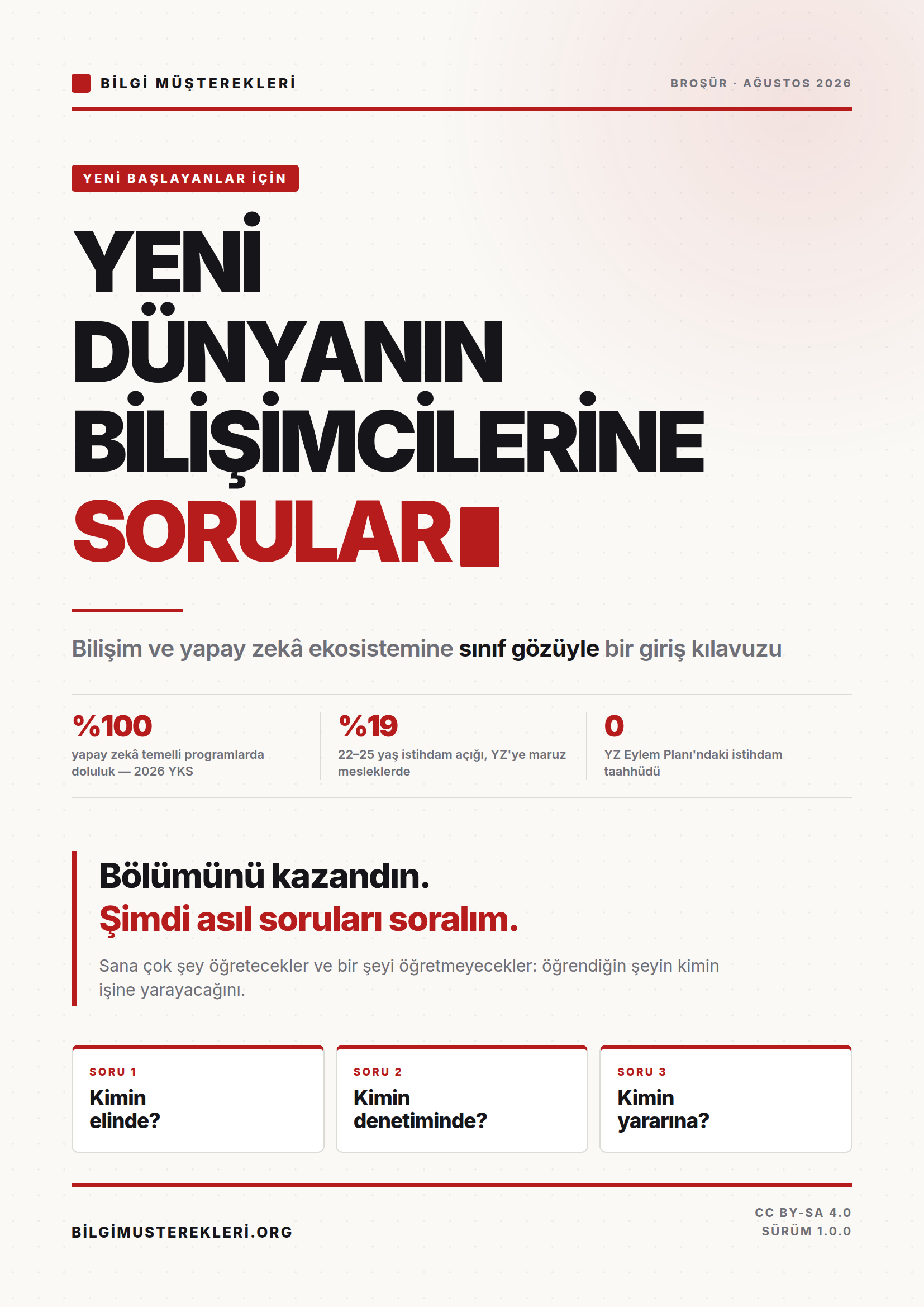
It speaks to young friends stepping into the computing and artificial-intelligence ecosystem — and tries to leave them not a body of technical knowledge, but a way of looking at technology.
A results screen opened
This month the same thing happened for hundreds of thousands of young people. An exam ended, a preference list was filled, a screen opened. The family's phone rang.
The numbers tell this year's picture: fill rates at state universities reached a historic 99.5%, with only 2,292 of 481,684 places left empty. Fill rates in engineering programs are above 98%. And every undergraduate and associate-degree program built around artificial intelligence filled 100%.
Comrade, if you are one of those facing that screen: welcome. We say this sincerely. This brochure does not tell you "you chose the wrong department," and nowhere does it say so.
What it says is something else: over the next four years they will teach you a great many things, and one thing they will not teach — whose interests what you learn will serve.
This brochure wants to be the first page of that missing lesson.
Most of the sentences you will hear will fall into two kinds
Recognize already the sentences that will surround you from registration week onward.
The first kind will be marketing. "You've chosen the profession of the future." "You will be a founder of the age of artificial intelligence." "There's no such thing as not finding a job in this field." A career coach, a bootcamp ad, a university promo film will say these things. All of them see you as a customer.
The second kind will be intimidation. "Artificial intelligence will leave no need for software developers." "There's no such thing as a junior position anymore." "You're already late." These, too, usually come from people who want to sell you a product — because fear is the best sales technique.
We have a third thing to say, and it is a method. The entire brochure rests on these three questions:
In whose hands? Under whose control? In whose interest?
When you read a technology news story, see a job posting, watch a product launch, or when a state document is published — always ask these three. This may be the most durable thing you learn in four years. Because tools change every three years; these questions do not.
What is in the brochure?
The brochure consists of thirteen sections, and each section is a question.
"Why is there so much demand for this department?" When demand for a field explodes, two things happen at once: the field gains value and the supply of labor in that field expands rapidly. Under capitalism labor-power, too, is a commodity; your future wage is the price of that commodity. Turkey's Artificial Intelligence Action Plan aims to give literacy training to 5 million people and train 115,000 specialists in two years — but it contains no employment commitment. The previous strategy set an employment target of 50,000 people; in the new one, an education target stands in its place. The difference matters: the state can fulfill an education commitment on its own; it cannot fulfill an employment commitment.
"Will artificial intelligence take my job?" This is the most asked question, and it is the wrong question. The right one has three parts: which part of my job will it take, what will I become in what remains, and what will happen to my bargaining power? The August 2026 release of a study by Stanford's Digital Economy Lab, using payroll data from millions of U.S. workers, shows this: in occupations exposed to artificial intelligence, employment of workers aged 22–25 lags 19% behind less-exposed peers — there is no such gap among experienced workers. And the contraction is happening not through layoffs but through not hiring.
So the door is narrowing; the room is not emptying. For a student this is not disaster news about the profession as a whole; but it is news that touches you directly. And the consequence is this: the apprenticeship rung is being pulled out. A junior learns by making mistakes beside a senior. When that rung is removed, no one says where the experienced person will come from — because this is not a problem for individual companies but for the whole sector, and the market does not solve such problems.
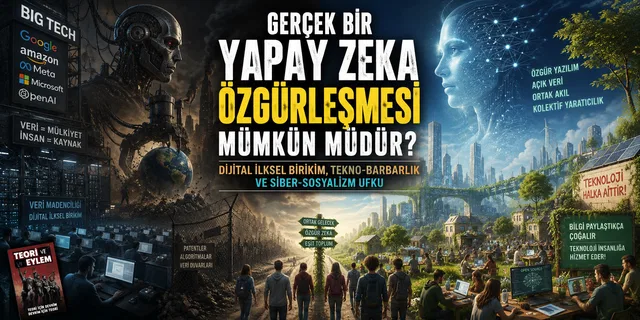
"Whose property will what I learn become?" In sixteenth- to eighteenth-century England the commons were enclosed; the peasant was separated from the means of production. Marx calls this primitive accumulation. Today the same operation runs over knowledge: patents, copyright, closed code, private data pools. And this is not an abstract concept for this profession — it is a clause in the contract you will sign when you graduate. Assignment of rights, invention clause, NDA, non-compete. On top of that a new layer has been added: the use of the work practice itself in model training.
"Who will measure me, and by what?" Story points, velocity, commit counts, PR turnaround time. The software laborer built the tools that make their own work measurable. The brochure does not demonize these tools — measuring is not a bad thing. What it asks is again the same: who sets the measure, who gets access to the result, and what is the result used for? A number the team keeps to plan its own work and a number that enters a year-end performance decision are not the same thing. The difference between them is not technical; it is a difference of power.
"On top of whom will what I write run?" This is the brochure's most important section. The computing laborer has a unique position: both object and builder of algorithmic management. Someone writes the system that scores the courier, the software that sets the warehouse worker's tempo, the panel that measures the call-center worker's "script compliance percentage" — and when you graduate, the odds are high that you will be one of those someones.
We do not frame this as an accusation. We frame it like this: The hand that builds the system is the only hand that can dismantle it.
"So what should I learn?" The brochure's most practical section — and its six points are at the same time a class strategy, because what you learn determines how easily you can be replaced. Learn foundations, not tools. Learn to see the system as a whole; what automation swallows most easily is fragment work torn from context. Use artificial-intelligence tools, but own them: if you can criticize what a tool produces, you are using it; if you cannot, it is using you. Learn open source as a commons — but knowing that being "open" does not guarantee being "free." Learn to write and to explain. And read outside the curriculum.
And ten traps
The section that will probably serve you most is this one: ten common practices you will meet in internships and first jobs. A few of them:
- Insurance paid on the minimum wage. Your real wage is 90 thousand; what is reported is the minimum wage. This is not a "tax advantage"; it is theft from your retirement, unemployment benefit, and severance calculation.
- Salary secrecy clauses. Preventing workers from knowing one another's pay eliminates the precondition of collective bargaining. Keeping the secret benefits the other side, not you.
- Title inflation. "Specialist," "lead," "chief" — status is given, wages are not. Moreover, the title also serves to count you as a "manager" and push you outside union coverage.
- "We're like a family here." Wherever this sentence is heard, it does the same job: making the conflict of interest invisible. There is no collective bargaining in a family, no payroll in a family, and you do not resign from a family.
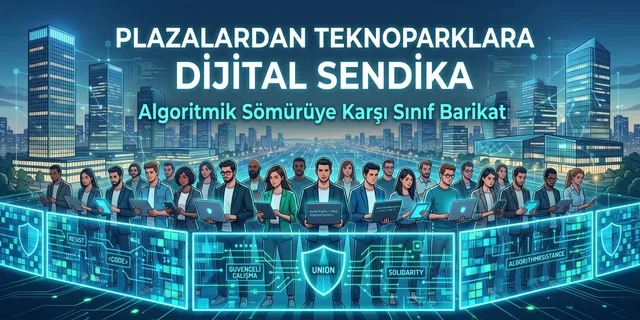
And the sentence at the end of the section is this: you cannot solve any of these alone — and that is not a failure; it is the design itself. Working harder, collecting more certificates, "self-improvement" does not touch any of these items. The common solution to all of them is in the same place: acting together.
At the end of the brochure there is also a ten-question card that can be cut out and carried in a wallet — questions to ask at a first job interview. And a glossary of concepts, and a reading list that can be spread across four years.
Those who passed through here before you in this country
You will hear the sentences "There's no union in our sector," "scientists don't do politics" many times. The best answer to these is not theory but our own history.
Necdet Bulut (1938–1978) was among the first people in Turkey to complete a doctorate in computer science; in 1975 he was director of the METU Computer Center, and his field was the measurement of software. And the same man, while working as a systems engineer at IBM between 1963 and 1969, was among the pioneers of unionization at the company. So in this country the idea of organizing computing labor is the same age as the sector itself.
Mustafa Akgül (–2017) devoted his life to establishing the internet in this country as a public possibility and software as a free commons. He was a founder of the Linux Users Association and the Internet Technologies Association.
One organized the rights of those who produce knowledge; the other that the knowledge produced remain everyone's. Both did the thing said to be impossible "in our sector" — when none of today's tools were in their hands.
To whom, where, how
This brochure was written to pass from hand to hand in registration weeks, orientation days, university clubs, and student houses. Its target is not only computer engineering: electrical-electronics, industrial engineering, mathematics, statistics — every technical and quantitative department that will enter the computing and artificial-intelligence ecosystem.
In a print-ready A4 layout and a screen-readable form, it is out free of charge under a CC BY-SA 4.0 license. You may reproduce it, distribute it, add your own club's name and reprint it. For a text written against the enclosure of knowledge to be enclosed by copyright would be the most visible contradiction.
Every figure in the text has its source on the back cover. This is not a stylistic preference; it is a principle: we do not use unsourced percentages, and we do not turn unmeasurable magnitudes into numbers. Because a single discredited figure takes down the credibility of an entire text — and that is exactly the method we oppose.
And this is a living document. If a datum is wrong, a source is mis-cited, or an inference is forced — write to us. Corrections are stated openly in the version notes; we do not change things silently. If you want to share a testimony from your own department, internship, or first job, there is a place ready for you in the second version.
Last word
In the years ahead you will often be told "you're already late," "this work is finished," "the machine does it now." Those sentences sometimes come from a correct observation, more often from a sales strategy. But in any case they do the same thing: they make you feel alone. And a person who feels alone cannot bargain.
This brochure is not pessimistic. It is not optimistic either. It defends staying awake.
Welcome.
Learn, but know whom you are teaching. Produce, but ask for whom you are producing. And never bargain alone.
We want our collective intellect back.
In comradeship, Knowledge Commons
Publication note
Questions for the Computing Workers of the New World A class-eyed introduction to the computing and artificial-intelligence ecosystem Knowledge Commons, August 2026 — Brochure version 1.0.0
It is freely available as HTML and as a print-ready A4 PDF. It may be freely reproduced in university clubs, at registration-period stands, and during orientation weeks.
This brochure is a sister text to the dossier Labor in the Age of Artificial Intelligence — The Machine Is New, the Chain Is Old and to the brochure They Made the Plan, We Will Hold Them to Account.
For criticism, contribution, and corrections: bilgimusterekleri.org
License: CC BY-SA 4.0 — you may reproduce, distribute, and adapt it provided you give attribution and share under the same license.