The Digital Commons and Direct Democracy Action Guide: Blockchain, Web3, and the Future of People's Assemblies
A Smart-Contract-Based Direct Democracy Model for Green Energy, Food Distribution, and Knowledge Sharing

The Historical Undeferrability of Democratization and the Necessity of Starting Today
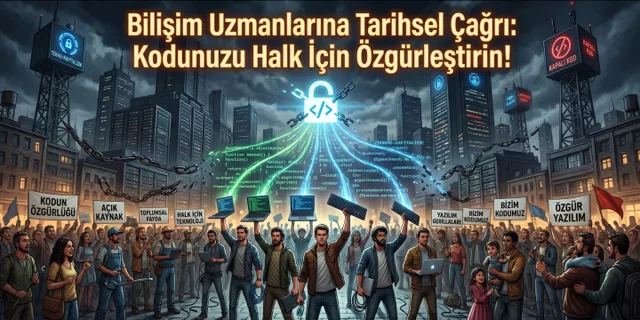
The history of humanity is the history of the centralization of governance models and relations of production in favor of the ruling classes, and of the struggles for rights and freedoms waged from below against this centralization. Today, models of representative democracy have moved completely away from reflecting the real will of the masses and have turned into cumbersome mechanisms that protect the interests of capital groups and bureaucratic elites. The squeezing of decision-making processes into a few centers, plazas, and parliamentary corridors creates a deep alienation and anxiety about a future-less future within the social fabric. In this context, to see democratization as an abstract ideal or as a utopia to be reached in some distant future, "after the revolution," means consenting to the continuation of the existing wheels of exploitation. To begin creating the direct governance models of the future not tomorrow but precisely today is a historical necessity.
The technological openings this guide will convey — such as Blockchain, Web3, Smart Contracts, and Decentralized Autonomous Organizations (DAOs) — must not remain mere subjects of theoretical academic debate. On the contrary, we must urgently move these tools to the center of our current political and social agendas, develop them into projects, and integrate them — starting today — into our existing unions, cooperatives, neighborhood assemblies, and mass organizations. At this critical threshold where the powerful have configured technology as an instrument of surveillance and AI as an apparatus of digital enslavement, laborers and the oppressed must also dig their own digital tunnels and weave an asymmetric line of defense and construction. This document is a concrete action map presenting both the conceptual infrastructure and the practical implementation methods of this transformation.
Digital Identity Management and Privacy: The Foundation of Secure Participation
One of the biggest obstacles in front of direct democracy practices and mass participation is the fear of being profiled, repressed, or deprived of one's economic rights by the powerful mechanisms, by corporations, or by the state apparatus. For people to participate in decision-making processes by their own free will, their identities must be valid but at the same time their identity information must remain confidential. The Web3 architecture overcomes this dilemma with two fundamental technological solutions:
- Self-Sovereign Identity (SSI): In today's digital world, our identities are stored on the servers of giant monopolies like Google and Facebook or in centralized databases, and they are constantly under surveillance. The SSI model, by contrast, provides the individual with a digital identity wallet that is not tied to any central authority and that they keep entirely under their own control by means of cryptographic keys. When a participant proves they are a valid member of an organization or assembly, they do not have to hand over their real name, address, or national ID number to the system.
- Zero-Knowledge Proofs (ZKP): ZKP is a method of mathematically proving the truth of a piece of information without showing its content to the other party. Let us explain it in language the person on the street will understand: when a critical vote is to be held in a neighborhood assembly, thanks to ZKP algorithms you present this proof to the system: "I am a valid member who lives in this neighborhood, has the right to vote, and abides by the community rules." The system confirms that this proof is 100% mathematically true and allows you to vote; but which particular Ali or which Ayşe you actually are can never be seen by either the system administrator or the other members. This technology tears through the climate of repression and fear, forming the ground for the absolute free declaration of will that direct democracy requires.
Unmanipulable Election and Decision-Making Mechanisms
The greatest theater of representative democracy is the ballot-box processes placed before us once every five years, after which we lose all our power of oversight. Moreover, these processes are tied at their core to fraud, suspicion, and cumbersome counting mechanisms. Blockchain technology offers an infrastructure that will make decision-making processes instant, transparent, and unmanipulable.
- Cryptographic Ballots and Open Audit: Every strategic vote cast on the blockchain is engraved into the network as an irreversible, undeletable, and unalterable transaction. It is technically impossible to steal the ballot box, to change votes in the middle of the night, or to tamper with the data on a central server. Because the code is open source, any person on the street can verify the mathematical soundness of the vote from their own computer in seconds. Trust is entrusted not to institutions but to mathematical formulas open to the direct oversight of the people.
- The Liquid Democracy Model: One of the biggest practical handicaps of direct democracy is that it is impossible for every individual to become an expert on every technical subject (budget management, zoning plans, agricultural policy, etc.). Liquid democracy solves this problem by means of smart contracts. Imagine an environment-and-nature vote is to be held in your neighborhood or your union; if you do not have enough time or knowledge on this subject, you temporarily delegate your voting right to an honest environmental engineer in the neighborhood whom you trust (delegation). But if the next vote concerns education, or if you do not like that engineer's decision, you can instantly take back the right you delegated with a single click and use it yourself. Seats are not permanent; power is in the hands of the base every second.
Smart Contracts and the Distributed Sharing Economy
Smart contracts are digital legal codes that execute themselves — when certain conditions are met — without the need for human intervention, bribery, favoritism, or bureaucratic approval processes. These tools are the economic engine for building the future's exploitation-free sharing economy starting today.
In traditional structures, the management of collected dues, revenues, and donations is always open to abuse and hierarchical skimming. In a blockchain-based sharing network, however, the rules are written from the outset.
A Concrete Cooperative Scenario: Let us imagine we have founded a courier or driver cooperative. The payment coming from the customer drops directly into the smart contract address (the common pool) on the blockchain. The contract code runs within seconds without any human hand touching it: it automatically distributes 70% of the income to the digital wallet of the courier who did the labor, 15% to the vehicle maintenance fund, 10% to the community's common health/solidarity pool, and 5% to the people's kitchen project in the neighborhood. There is no general chairman who could steal the money, no bank or holding-company executive who could take a commission. Labor meets the value it produces directly, within seconds, and without intermediaries.
The Digital Commons and Resource Management
The commons are assets — like water resources, energy, seeds, software, knowledge, and shared living spaces — that belong to the whole of humanity and should never be commercialized. While capitalism consumes the commons for profit by seizing them, hierarchical bureaucracies make them cumbersome. Blockchain enables the commons to be managed collectively and fairly without commercialization.
In a shared solar panel or local water network project, each household's amount of usage and the contributions it makes to the community (labor, data, resources) are recorded instantly into the blockchain ledger. Smart contracts bind the fair-use limits of resources to software rules. When a household consumes more resources than its share, the system warns it or automatically requires it to make a greater contribution to the community pool. Decisions are made not according to market conditions or the greed for profit, but according to the sustainability of the resource and the community's real needs, through the assembly, on the basis of instant data.
Decentralized Autonomous Organizations (DAOs) and the New Social Fabric
Decentralized Autonomous Organizations (DAOs) are a horizontal organizational model that completely eliminates traditional hierarchical structures (presidencies, boards of directors, headquarters), in which decisions and budget management directed toward a common goal are carried out through smart contracts. This model is the institutional body of direct democracy practices.
| Feature | Traditional Organizations (Hierarchical) | Decentralized Autonomous Organizations (DAO) |
|---|---|---|
| Governance Structure | Top-down (Board of Directors, General Chairman) | Horizontal and bottom-up (Direct Participation) |
| Decision-Making Mechanism | Through representatives, behind closed doors | Through smart contracts and open cryptographic voting |
| Budget and Finance Audit | Periodic and opaque reports, bureaucratic approvals | Instant on the blockchain 24/7, open and traceable |
| Organizational Security | Collapses if the center is raided or the leader purged | Decentralized; there is no single point of failure (Viet Cong Model) |
The DAO structure prevents the decay and cliquishness that hierarchy creates. When a union or neighborhood assembly is configured as a DAO, the moment a proposal submitted to the system is accepted, the smart contract releases the fund to be spent without needing anyone's approval or mercy. The distinction between ruler and ruled disappears; the community itself turns into an autonomous organism acting with collective intelligence.
Viet Cong Culture and Technological Asymmetry: Organic Growth
Against the enormous budgets, server farms, and media power of the powerful, our strategy is the adaptation of the historical Viet Cong style of resistance to the digital and social arena. Behind the Viet Cong there were no jet planes or limitless budgets; but there was the organic bond of the people, localized cell organization, and invisible underground tunnels. What we too must do today is dig digital tunnels that the holding companies cannot see and cannot block.
In this organizational model there is no single "head" or single "headquarters." We must establish thousands of independent people's cells spread across every corner of the country and the world, using open-source AI tools, communicating among themselves in encrypted form through blockchain networks and helping one another. Even if the powerful liquidate one cell, the rest of the network continues to work like clockwork and to make decisions. This growth does not come through an order from the top down; nourished by the urgent practical needs of the people at the base (free education, fair food, secure jobs), it organically wraps around the whole of society from the bottom up.
Organizing Your Future Today Through Commons Projects
As long as theory does not meet practice, it is nothing but an intellectual exercise. Bringing the vision laid out in this guide to life is possible through the concrete Commons Projects we will launch starting today. Supporting these projects requires a collective mobilization, from the idea stage to the coding process, and from there to integration into the daily life of the person on the street.
Here are concrete commons project ideas and our road map that we can turn into projects without delay and incorporate into our daily structures starting today:
- Commons Project 1: Neighborhood Data and Logistics Cooperative (Distributed Courier Network): Against the holding-company apps that constitute what is called the gig economy and enslave couriers, local software developers and courier unions should come together to establish a blockchain-based distribution network. Driving and map data should be kept in the common shared ownership of the workers, and income distribution should be done without intermediaries through smart contracts.
- Commons Project 2: Open-Source and Decentralized Education Network (People's Schools DAO): Within education unions, open-source AI agents should be trained as an alternative to the homogenizing AI curricula of the holding companies. These agents should offer poor children content in philosophy, critical thinking, and scientific education entirely free of charge and uncensored; the management of the network should be carried out through a DAO established by teacher-parent assemblies.
- Commons Project 3: Smart-Contract-Based Producer-Consumer Agriculture Chain: A direct, intermediary-free blockchain bridge should be established between farmer cooperatives in the countryside and consumption cooperatives in the cities. By binding all the logistics and payment processes — from the product's departure from the field to its arrival at the city warehouse — to smart contracts, fair-food islands that need no market speculators should be created.
- Commons Project 4: Neighborhood Direct Democracy Simulation: The decision-making processes of existing associations, cooperatives, or local assemblies should be moved, on a trial basis, to blockchain voting systems. By providing participants with self-sovereign identity (SSI) and zero-knowledge proof (ZKP) tools, the neighborhood's budget expenditures and common decisions should be voted on through these systems, and the practical culture of direct democracy should be instilled in the person on the street starting today.
When we begin digging these digital and social tunnels today, those enormous technological fortresses of the powerful will begin to be shaken from within. The fight is not a technical software fight; it is a fight over whose the future and whose the honor will be.
Our tea is fresh, our faith is full, and the asymmetric power of an organized people is invincible.
Tomorrow is too late — without delay, to work, today!
** Each of these projects will be addressed in detail. *