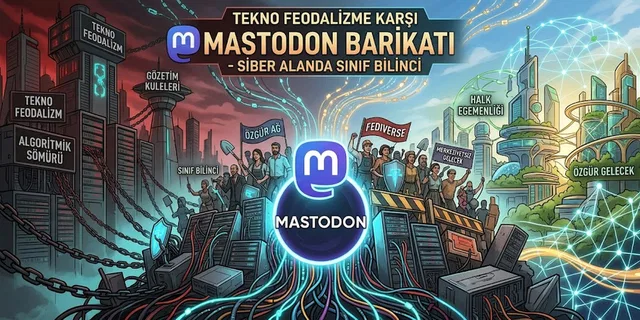
A Historic Call to IT Experts: Liberate Your Code for the People!
A Guide to Hierarchy-Free Horizontal Organizing and Commons Governance Through the Synergy of Open-Source AI Agents and Blockchain

THE ADDRESSEE OF THE CALL
The Addressee of the Call: System Architects, DevOps Engineers, Full-Stack Developers, Data Scientists, Cryptographers, Artificial Intelligence (AI/ML) Engineers, Product Managers, Project Managers, and Smart Contract Developers.
From Algorithmic Slavery to Autonomous Commons
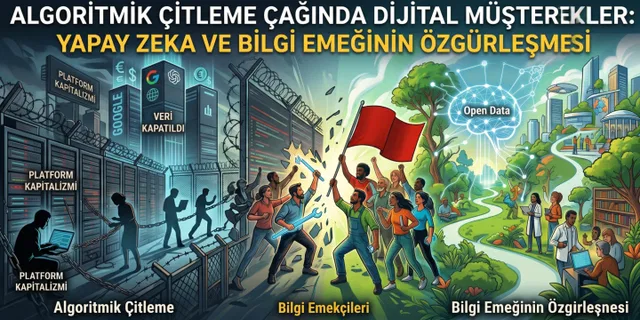
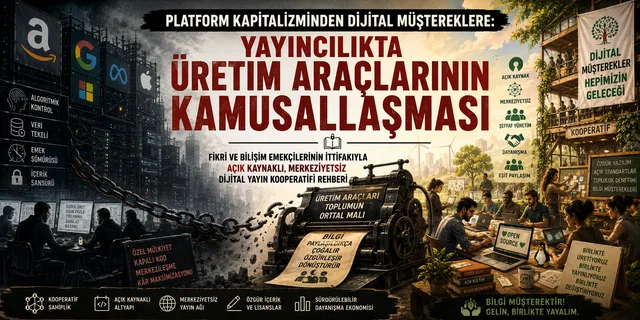
Today, as workers in the IT sector, the greatest paradox before us is this: we are the ones who write the algorithms and AI models that will change the world, organize the masses, and push productivity to its peak; yet the ownership of these technologies remains in the hands of the holding monopolies that cram us into the "9-to-6 grind," exploit our labor, and turn the code we write into weapons for surveilling society. While technology turns into a panopticon apparatus in the hands of the rulers, we become the nameless engineers who grease the gears of this mechanism.
It is our historic task to take the theoretical vision laid out in the shared action guide out of being an ideological text and turn it into production-ready code bases. What's more, today we don't just have static databases; we have Open-Source AI and Autonomous AI Agents.
When we marry AI agents with blockchain's unmanipulable and intermediary-free financial/operational layer (Web3), we can build autonomous structures that need no holding hierarchies, that own their own wallets, make their own decisions, and serve entirely the common interests of the people. This document is a concrete guide to action, integration, and AI agents that will turn our competencies in corporate companies into asymmetric guerrilla tools for protecting the digital commons.
A New Paradigm: The Synergy of AI Agents and Blockchain
We are going beyond a calm web interface, comrades. An AI agent is an intelligent software system that can autonomously make decisions toward a specific goal, gather data, use tools (APIs, databases), and communicate peer-to-peer (P2P) with other agents.
When an AI agent works alone, it remains dependent on central APIs and company servers. The blockchain, on the other hand, gives these agents economic and legal independence. Thanks to blockchain networks, an AI agent can:
- Have its own cryptographic keys and digital wallet,
- Sign smart contracts independently of humans or other agents,
- Run uninterrupted, 24/7, on a decentralized runtime that no one can shut down or censor.
Technical Project Packages, Agent Architectures, and International Open-Source Integrations
We must fork and modify protocols that have already proven their worth in the international open-source world and been tested on networks worth billions of dollars, integrating autonomous agents into the infrastructure of our own local organizations.
1. Cryptographic Privacy, SSI, and ZKML (Zero-Knowledge Machine Learning) Module
- Problem: Participants' fear of being blacklisted in union votes, and the risk that the AI models in the people's assembly, when making their decisions (for example, resource-allocation decisions), violate data privacy or that the model is manipulated.
- Solution: ZKML integration that, with an SSI infrastructure that does not keep the user's data on central servers, keeps the inputs and outputs of machine learning models confidential while proving that the model works correctly.
- International Integration and Repo Matching:
- SpruceID (DID & Verifiable Credentials): A Rust-based core library that enables users to keep their digital identity wallets fully encrypted on their own local devices. The SpruceID GitHub Repository should be examined.
- EZKL (Zero-Knowledge Machine Learning): An engine that enables deep learning and machine learning models (models in ONNX format) to be verified on the blockchain by producing zero-knowledge proofs (ZKP). Thanks to the EZKL GitHub Repository, the people's assembly agent mathematically proves that it makes fair decisions without disclosing the data.
2. Gasless Voting Engine and Multi-Agent Governance
- Problem: On-chain transactions on the blockchain producing high transaction fees (gas fees) and community decisions getting stuck in cumbersome voting processes.
- Solution: Conducting zero-cost off-chain voting via cryptographically signed messages, and including in the assembly autonomous AI agents that carry out the moderation, analysis, and proposal-drafting stages of the voting processes.
- International Integration and Repo Matching:
- Snapshot V1 (Gasless Voting): A fully transparent voting platform that uses signed messages in the EIP-712 standard, imposing zero cost on the user. The Snapshot GitHub Repository should be forked and made available for use by local cooperatives.
- Olas / Autonolas (Decentralized Autonomous Agents): The industry-standard open-source framework for designing blockchain-based autonomous agents that have their own wallets and can be co-owned. The Valory / Olas GitHub Repository is the autonomous operating system of horizontal assemblies.
3. Autonomous Resource Allocation and AI-Based Sharing Economy
- Problem: The injustice created by hierarchical structures in the distribution of collected cooperative revenues, funds, and dues, and the inefficient management of resources.
- Solution: Distributing revenues automatically, the moment they come in and without human intervention, to the relevant laborers at rates previously coded by assembly decision; and having the funds fairly optimized by AI agents running on quadratic funding (Quadratic Funding) algorithms.
- International Integration and Repo Matching:
- Allo Protocol (Gitcoin): A quadratic funding protocol that distributes the money in the pool fairly according not to the size of the capital, but to the number of individual people supporting the project. The Allo Protocol GitHub Repository should be examined.
- Morpheus Network (Decentralized AI Computing): An intelligent AI agent network infrastructure running on decentralized computing power that can directly trigger smart contracts. With the Morpheus GitHub Repository, intra-community budget and logistics allocations should be made autonomous.
4. Edge AI and P2P Computing Infrastructure (The Techno-Guerrilla Network)
- Problem: Dependence on the holdings' billion-dollar data centers and the risk that the internet infrastructure is cut off/censored by central authorities.
- Solution: Training AI agents that can run locally on consumer-grade devices (PCs, old GPUs) without being connected to the internet, and communicating peer-to-peer over mesh networks.
- International Integration and Repo Matching:
- Ollama: A library for running LLMs on the local disk without needing the cloud. With the Ollama GitHub Repository, we can set up uncensorable AI knowledge printing presses on our local networks.
- Bittensor (Opentensor): A decentralized and open-source AI intelligence network protocol. By examining the Bittensor GitHub Repository, the people's distributed intelligence network modules should be optimized against the monopoly of the holdings.
Localization and Producing Solutions for Our Own Problems
(Discussion and Idea Sharing)
The international repos offer wonderful tools, comrades, but we must localize these tools according to the concrete socio-economic realities that hurt our own lands and our own people. Setting aside the "token economy" nonsense of the West's speculative crypto world, we must modify these agents directly for the defense of labor.
Come, let us open the following current and burning topics to technical discussion, and let us together plan which specific problems we will modify our first local libraries around:
Agent Project 1: Autonomous Logistics and Distribution Agent (For Courier Assemblies)
- Scenario: Workers establishing their own Logistics DAO against the algorithms of monopolies like Getir and Trendyol that exploit couriers.
- Agent Role: An AI Distribution Agent written with the Olas Framework analyzes the city's order data and the couriers' routes in real time. This agent is connected not to a central company, but to the couriers' shared smart-contract wallet. The moment an order is completed, it takes the customer's payment, transfers the courier's share to their wallet in an instant, and sets aside the rest for the shared accident/health fund. Not a robot boss, but the worker's autonomous digital clerk.
Agent Project 2: Ecological and Fair Agriculture Allocation Agent (For Producer Basins)
- Scenario: Bypassing market speculators between producer cooperatives in Anatolia and consumer cooperatives in the cities.
- Agent Role: A local AI agent that reads the soil's moisture data and the weather via IoT oracles uses EZKL (ZKML) to verify which field needs how much water and logistical support. When the produce is harvested, it runs a fair-pricing algorithm in proportion to the consumption needs of the city's assembly and coordinates the logistics trucks. It is programmed not for profit maximization, but for ecological balance and the nourishment of the people.
Agent Project 3: Anonymous Union Organizing and Legislation Agent
- Scenario: Rank-and-file workers raising their voices against yellow unionism and the delegate manipulations of management cliques.
- Agent Role: An AI agent working in a workers' assembly protected by a Semaphore (ZKP) layer scans the demands, complaints, and draft laws that workers convey completely anonymously. It turns these into legal texts and smart-contract proposals. Without ever revealing the workers' identities, it works like a legislative assistant that will put the true will of the base to a vote on "Snapshot."
The Great Call: Share Your Ideas, Let Us Produce Together!
"Volunteer hackers, engineers, IT workers of the open-source world! It is time to stop building, at our keyboards, the software of those gigantic technology companies that exploit the world; it is time to spend our code, our AI agents, and our nights digging those great digital tunnels that will defend the common rights of the people."
This guide is not a one-sided directive; it is an open manifesto of open-source collaboration.
- Which AI agent framework (Olas, Fetch, LangChain) is more suitable for local projects,
- Methods of integrating smart contracts with local LLMs (Ollama),
- The data models (data schemas) of local courier, agriculture, and union networks,
- And most importantly, how these tools will directly make the life of the person on the street easier...
Share your ideas, pour your architectural proposals out here, let us open issues together, send PRs together, and produce this digital barricade together!
Our tea is fresh, our code editors are open, the asymmetric power of the people is at the tip of our keyboards. Let us meet in the comments and in the repos, comrades!