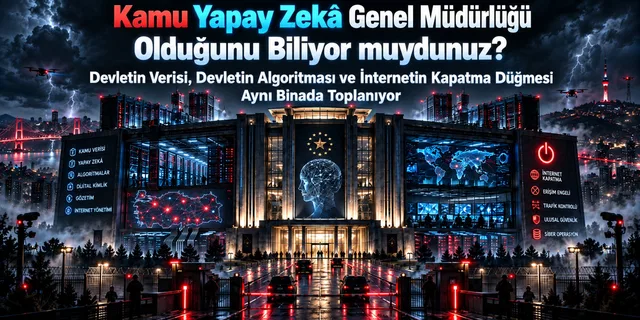
The Digital Obedience Regime and the Ruling Class's 'Black Box' Strategy
The Fate of Internet Infrastructure, Class Domination, and the Legal Labyrinths of Invisible Censorship

Modern scientific thought holds that technology and knowledge—brought into being by humanity's cumulative labor—must flow freely in order to expand collective welfare and social enlightenment. Yet within capitalist relations of production, the state apparatus shows a reflex to bring that free flow under control in the service of the ruling class's survival.
The press release published by the Freedom of Expression Association (İFÖD), titled The New Command Center of the Digital Obedience Regime: Internet Infrastructure, Social Networks, and Gaming Platforms Fall Under Cyber Security Presidency Oversight, lays bare precisely this new and most dangerous phase of class domination in the digital sphere.
First, we consider it a debt of gratitude to thank İFÖD for decoding—with clear scientific objectivity—this new shackle intended to strike at the struggle for social enlightenment and the people's freedom to receive news, and for organizing this vital response. Yet we expect this vital reflex not to remain on the shoulders of a single association alone; we expect it to be strongly owned and socialized by all democratic mass organizations, professional chambers, and unions that take the side of labor, science, and the people's interests—above all the TMMOB Chamber of Computer Engineers (BMO) and Bilişim-Sen. For the fate of the means of digital production and of communications infrastructure is umbilically tied to the organizational freedom of the working class and the broad popular masses.
Chronology of the Process: How the Digital Cage Was Built
One must understand how the people's free channels of communication and the technological infrastructure that is the product of collective labor have been step by step transformed by the ruling classes into a mechanism of social control and obedience. Examining this process, in the light of data, historical facts, and dialectical totality, through five fundamental phases is a scientific necessity:
Phase 1: The Seeds of Infrastructural Monitoring and Central Filtering (2006–2011)
The capitalist state apparatus's first institutional and technological experiments in bringing the internet under control were carried out in this period.
-
2006–2007: Alongside debates on an "Internet Monitoring Center," the first technical surveillance ideas were floated that would not restrict the people's freedom of communication yet would enable the rulers to monitor cyberspace. In the same period, Law No. 5651 entered into force and formed the first legal framework of censorship.
-
2011: The BTK's filtering decision introducing centralized state control under the name "Safe Internet" was put into effect. Redirecting users—without their consent—to a central interface called the "standard profile" raised suspicions of surveillance and logging to the highest level. Against this class encirclement, on May 15, 2011, mass "Don't Touch My Internet" protests were held with the participation of 60,000 people across dozens of provinces.
-
Surveillance Technologies Enter the Field: As exposed in Wikileaks' SpyFiles documents, laboratory-grade surveillance technologies such as Deep Packet Inspection (DPI), produced by firms like Inforcept and C2Tech, began to be installed at the service-provider level as "black boxes."
Phase 2: Legal Intensification and Infrastructural Encirclement (2014–2018)
In this phase, censorship moved beyond blocking individual websites and focused on destroying alternative sources of information outright.
-
2014: Amendments to Article 6 of Law No. 5651 expanded the scope of censorship and access blocking.
-
2016: Taking advantage of the state-of-emergency (OHAL) climate, Decree-Law (KHK) No. 671 shut down the Telecommunications Communication Presidency (TİB); legal wiretapping, technical equipment, and internet oversight powers were concentrated in a single hand and placed directly under the BTK President.
-
2017–2018: Access to the free encyclopedia Wikipedia was massively banned; VPN services that people used to bypass these barriers, and encrypted email services such as ProtonMail, were blocked. With an omnibus law enacted in 2018, internet broadcasting was brought under RTÜK oversight, imposing the single-voice character of capital media onto alternative and independent news channels on the internet as well.
Phase 3: Crisis Opportunism and Mass Profiling (2020–2022)
The ruling class used moments of social crisis as levers to deepen mechanisms of control.
-
2020: Under the pretext of the global pandemic, the "Pandemic Isolation Tracking Project" (İTP) sought to legitimize continuous monitoring of citizens through their smartphones and location data. These tracking mechanisms, presented under the mask of the public interest, turned into a permanent threat to the privacy of private life.
-
2022: One of the largest mass-profiling scandals in the history of the Republic broke out. It was revealed that the BTK—without any court order, and in complete violation of the Constitution and the Personal Data Protection Law (KVKK)—had massively collected from internet service providers all data in the outbound and inbound internet traffic of 85 million citizens (get/post data) under the name "Subscriber Pattern," and had kept society under indefinite tracking.
Phase 4: "Invisible Censorship" and Digital Martial Law (2023–2025)
To escape the political cost of censorship, the state apparatus institutionalized legally contested infrastructural blocking techniques.
-
2023: At a moment of great disaster—the Kahramanmaraş and Hatay earthquakes—when the people most needed to receive news and coordinate, bandwidth throttling was applied to social media platforms. By this method, internet speed was reduced by 50 to 95 percent; censorship was passed off to operators as if it were a "technical problem," and the people's constitutional right was usurped.
-
2025: As documented under the heading "Digital Martial Law" in the EngelliWeb 2025 report, the number of blocked websites and domain names in Turkey reached 1,505,484. Fully 84.6 percent of this enormous accumulation of censorship was carried out not by the courts but directly by the BTK, an administrative mechanism.
Phase 5: The Militarized Digital Panopticon (2026)
As of July 2026, the new draft law on the table constitutes the peak of this historical process.
-
Militarization of Powers: All of the BTK's powers of access blocking, content removal, and bandwidth throttling are being transferred to the Cyber Security Presidency (SGB)—an body distant from civilian oversight, integrated directly with the security and intelligence bureaucracy, that treats cyberspace as a "fifth domain of operations."
-
Making Bandwidth Throttling Invisible: The sole legal basis for the bandwidth-throttling sanction—Article 60/10—is being repealed and replaced by an undefined power of "ex officio measure" (60/A), whose boundaries will be filled in by the administration. Thus censorship is removed entirely from judicial and social oversight and locked inside a "black box."
-
An End-to-End Panopticon Backbone: The definition of traffic data is being expanded to include "source and destination port information." Combined with the newly established age-verification and e-Government token (account–identity matching) system, this technical move gives the ruling class the power not only to know who uses which account, but to analyze in real time how any citizen connects to any digital service. With legal wiretapping infrastructure also concentrated in the same institution, surveillance capacity has taken the form of an absolute "digital cage."
Unlawfulness and Open Doors: A Digital State of Emergency Under the Name of "Measure"
Modern scientific methodology and Enlightenment legal philosophy require that laws be based on foreseeable, determinate, and universal norms. This new draft law—in which the ruling class that holds economic and political power instrumentalizes legislative power for its own survival and to control social movements—completely liquidates even the bourgeois legal order's most fundamental achievement: the principle of "determinacy." As decoded through the Freedom of Expression Association's data, this legal text harbors deep unlawfulnesses and deliberately left-open doors that drag the digital sphere into a vortex of structural unaccountability. When the institutional practices that show how digital production and communication layers have historically been encircled are taken into account, it is clear that these ambiguities are a conscious strategy of domination.
Below, I detail objectively the open doors this legal arrangement has built in order to circumvent the people's constitutional rights, and the digital state-of-emergency regime it creates:
The Ambiguity of "Measure" and Unlimited Administrative Discretion
Article 60/A, added to Electronic Communications Law No. 5809 by Article 19 of the draft, creates an open-ended conceptual indeterminacy for the purpose of repressing the civilian sphere.
-
Undefined Sphere of Authority: Under the new draft, the Cyber Security Presidency (SGB) is empowered—upon the request of security and intelligence institutions, or ex officio, and on the grounds set out in Article 22 of the Constitution—to determine the "measures that must be taken."
-
Legal Indeterminacy: The law deliberately does not define what this "measure" is, its limits, its scope, or which concrete acts it may include. The administrative authority that will apply the measure will itself draw the boundaries of its own power according to its own discretion.
-
Infrastructure of Digital Martial Law: Instead of a concrete protective measure with a name and limits, an arbitrary mechanism is introduced whose content the administration will fill in itself. This open-ended power creates a digital state-of-emergency regime far beyond traditional access blocking—application and protocol blocking, traffic filtering, intervention in DNS and domain-name infrastructure, and service shutdowns through data centers.
Abolition of the Defined Ground and the "Black Box" Regime
While Enlightenment philosophy enjoins the accountability and transparency of power, this arrangement aims to render censorship mechanisms entirely invisible.
-
Removal of the Legal Basis: Subparagraph (f) of Article 25 of the draft, concerning the Electronic Communications Law, directly repeals paragraph 10 of Article 60—until now the sole clear legal basis for the bandwidth-throttling sanction.
-
Unlimited Framework: In place of this defined and limited provision that is being eliminated, the undefined "ex officio measure" power in Article 60/A is substituted. Thus the existing legal ground—narrow though it was—is abolished and replaced by an open-ended framework.
-
Deepening of the Transparency Crisis: When the secrecy reflex inherent in the security bureaucracy combines with "invisible censorship" practices such as bandwidth throttling that reduce internet traffic to dysfunctional levels, social oversight becomes impossible. What we face is a "black box" that both issues the censorship decision and holds the power to conceal the nature and grounds of that decision in a single hand.
Intervention at the Infrastructure Layer and Structural "Over-Blocking"
This move, which within capital's property relations targets internet infrastructure, carries the potential for disproportionate and mass censorship of collective communication channels.
-
Direct Infrastructure Intervention: Under the new arrangement, SGB decisions may be notified not only to internet access providers but directly to electronic communications operators, content and hosting providers, and data centers.
-
The Danger of Collective Silencing: An open-ended and indefinite intervention directed at a single data center will simultaneously make inaccessible thousands of websites, public digital services, and independent platforms that share that physical infrastructure and have nothing to do with the matter.
-
A Structural Censorship Practice: This incorporates past legally contested infrastructure interventions directly into the SGB's chain of command, turning over-blocking practices into a structural and permanent feature of the digital system.
The De Facto Destruction of Judicial Review and the Regime of the "Absence of a Decision"
The greatest constitutional illusion here is the argument that administrative acts will pass through a judicial approval filter. A dialectical analysis shows that this temporal design transforms the judiciary from an organ of oversight into a mechanism that in practice annihilates censorship from review.
-
Delayed Activation: Under Article 19 of the draft, a measure that has been applied will be submitted to a criminal judge of the peace for approval only within twenty-four hours, and the judge will announce a decision within forty-eight hours. In this model, judicial review comes into play only after a heavy interference with freedom of expression and communication has already been carried out and after harms difficult to remedy have arisen.
-
A Fictional 72-Hour Window: While operators must apply the administrative measure within two hours, the administration and judiciary are granted a maximum seventy-two-hour oversight window. Yet infrastructural censorships such as bandwidth throttling, used to silence the people, are typically applied and ended in much shorter periods (for example, the censorship of March 19, 2025 lasted approximately 42 hours).
-
The Very Absence of an Act to Review: Because the intervention is completed and achieves its purpose long before the maximum approval window expires, the administration may not even need a judge's approval at all. The theoretically assumed safeguard that "if not submitted for approval, the decision automatically lapses" serves no protective function in practice, since the intervention has already ended in fact.
-
Paralysis of Legal Struggle: Civil society's and labor-side forces' strategy of making the administration's concealed unlawful decisions visible through freedom-of-information requests and administrative lawsuits is completely collapsed by this structure. When judicial approval is never obtained, no judicial decision will even have been produced that could be pursued, whose annulment could be sought, or whose grounds could be questioned. This is not merely a delay or failure of judicial review; it is an absolute regime of unlawfulness and administrative impunity built upon the very absence of an act to be reviewed.
Political Background and Class Analysis: The Encirclement of the Digital Proletariat
Scientific dialectics and historical materialism teach us that technological infrastructures and means of production cannot be treated independently of the property relations and class conflicts of the society in which they exist. Although the internet was born as a vast product of humanity's common genius and collective labor, under capitalist relations of production it is being transformed into a gigantic ideological state apparatus through which the ruling class keeps the masses under surveillance, control, and manipulation.
The establishment of the Cyber Security Presidency (SGB) and the transfer of the Information and Communication Technologies Authority's (BTK) powers to this new military-intelligence structure are not merely steps of "technical specialization" or "bureaucratic practicality." This move is the strategy of a ruling class that cannot produce consent in capitalism's periods of structural crisis: to permanently etch the apparatuses of coercion into digital infrastructure.
The political background of the process and its class projections must be clarified under the following dialectical headings:
Militarization of the Means of Production: From Regulation to an End-to-End Censorship Backbone
The capitalist state's definition of cyberspace as a "fifth domain of operations" is an open admission that digital infrastructure will be governed directly by the reflexes of the law of war and martial law.
-
Class Transformation: The replacement of institutions such as the BTK—which in the past operated with relatively "market-regulator" norms—by the reflexes of the security bureaucracy itself is the militarization of the means of digital production, fully severed from civilian oversight.
-
End-to-End Domination: The concentration of access-blocking, content-removal, and bandwidth-throttling powers in a single intelligence structure means an "end-to-end censorship backbone" erected across the organizational lines of the laboring masses and oppositional foci.
The Class Mask of the "Digital Sovereignty" Discourse
Ruling ideology packages every authoritarian step in bombastic concepts such as "national sovereignty" or "protection of the cyber homeland" in order to dampen the people's reaction.
-
Legitimizing Domination: As the Freedom of Expression Association rightly observes, the "digital sovereignty" discourse here aims not to protect the citizen's fundamental rights against the state and capital, but on the contrary to expand without limit the state's capacity to control the citizen.
-
Partnership of Capital and State: With this discourse the state monopolizes digital property while turning the data centers and communications infrastructures of global and local capital groups into corridors sheltered against the people's collective objections.
Surveillance of the Digital Proletariat: Source and Destination Port Analysis and the Panopticon
The modern working class is no longer exploited only in factories or offices; it is also encircled through every digital trace left on the internet, every link clicked, and every piece of data produced (big data).
-
Capacity for Detailed Analysis: Expanding the definition of traffic information to "source and destination port information" under the new draft law is not a technical necessity but a step of mass profiling that schematizes both ends of a connection.
-
A Cell of Digital Martial Law: When this infrastructure combines with e-Government token systems, age verification, and account–identity matching regimes, a fully fledged digital panopticon emerges. The duty given to the SGB to "provide technical means for legal wiretapping and intervention" is a preventive counter-revolutionary strategy aimed at pruning, while still in the bud, every organic resistance and organizational reflex the digital proletariat might develop against the order of exploitation.
The Crisis of Ideological Hegemony and the Political Economy of "Invisible Censorship"
When capitalism is shaken by deep crises, the impoverishment and precarization of the broad popular masses are inevitable. This paralyzes the "consent" mechanisms the ruling class needs in order to govern the masses. When consent dissolves, "naked force" steps in.
-
Escaping Political Cost: Yet crude censorship applied in the squares or in square media carries a high political cost; it directs the masses' anger at the state itself. It is precisely at this point that bandwidth throttling comes to the bourgeoisie's rescue as a insidious tool of "invisible censorship."
-
Technical Illusion: No legal blocking screen appears before the user; internet speed is artificially reduced to dysfunctional levels. Thus the state removes the political bill of censorship from its own account and passes it on to operators "experiencing technical infrastructure inadequacy" or to the user's own hardware. The "Digital Martial Law" practices documented by İFÖD are the most useful manipulation apparatus the rulers use to silence the public voice and to render invisible workers' actions, social outcries, and mass coordination in moments of crisis.
Class Conclusion: Homogenizing and militarizing knowledge and infrastructure to this degree is the usurpation of the most important intellectual defense and communication weapon in the hands of the exploited classes. Showcase arguments such as cybersecurity or the protection of children are, in essence, nothing but hegemonic illusions constructed to make dispossessed masses submit to an absolute regime of digital obedience.
How Should the Process Work in a Democratic Society? A Call for Genuine Democracy
The greatest legacy the Enlightenment philosophy bequeathed to humanity is the cleansing of reason from dogma and the grounding of social relations in a transparent, accountable, and public contract. Looking from a dialectical frame as a person of science, opposing the transformation of digital networks and internet infrastructure into an apparatus of repression in the hands of the ruling classes is not merely advocacy of freedom of expression; it is the liberation struggle of the productive forces and of the masses on the side of labor. The data in our hands and the Freedom of Expression Association's analysis clearly show how the militarist approach that codes cyberspace as a "domain of operations" drives society into a vortex of silence.
So how should this process operate in a democratic society on the side of labor, under the guidance of reason and science? A call for genuine democracy requires taking the ownership and management of technological infrastructure out of the rulers' monopoly and placing it under the collective oversight of the public. In a democratic order the process must rest on these fundamental phases:
The Principle of "Law First, Measure Second" and Absolute Judicial Approval
In a democratic society, the administration cannot draw the limits of its own actions. All interventions on the internet must be subjected to independent and effective judicial review before they are applied—not under a logic of "apply first, question later."
-
The administration's arbitrary discretion in cyberspace must be abolished entirely.
-
Every measure applied must, regardless of the duration of the intervention, be bound to mandatory and effective judicial approval.
-
Short-lived but destructive practices such as bandwidth throttling must be firmly prevented from being left outside judicial review and the law on the pretext that "the intervention has already ended."
Collective Management of Public Infrastructure and Digital Commons
Internet infrastructure, data centers, and communications networks are not the private property of capital or of the state's intelligence apparatuses; they are the common assets (commons) of the digital proletariat and of the entire public.
-
Policies concerning cybersecurity cannot be determined unilaterally by a security bureaucracy operating behind closed doors, such as the SGB.
-
The process must be conducted through collective and transparent planning, with the direct participation of ICT workers' unions (Bilişim-Sen), professional chambers (BMO), academics, and civil society organizations.
-
The concept of "digital sovereignty" must be operated not to expand the state's capacity for control and domination over the citizen, but to protect the citizen's collective rights over their own data.
Proportionality, Reciprocity, and Administrative Responsibility
While the current draft law wraps the administration in an absolute armor of "impunity" and "irresponsibility" toward society, it imposes disproportionate burdens on social actors. In a democratic state of law, the principle of reciprocity is fundamental.
-
In administrative sanctions, proportionality—even a basic principle of bourgeois law—must be observed.
-
Procedural privileges such as the "per act" administrative fine regime and the guarantee exemption granted in favor of the administration must be redesigned in light of the proportionality principle, and the administration must be made financially and legally responsible to society.
-
Interventions directed at platforms and data centers must be narrowly framed and limited so that they do not turn into an "over-blocking" practice that usurps the rights of thousands of unrelated citizens.
Rejection of the Surveillance Society and Limitation of Data
Scientific progress flourishes in environments where the person's private sphere is protected and where one can think freely without fear of being profiled.
-
Information requests concerning gaming and social network platforms must be limited by clear laws that prevent the state's arbitrary data mining.
-
Moves to expand traffic data that track citizens from both ends (source and destination port information) as if they were suspects, and that imprison identities in a digital panopticon through e-Government token systems, must be ended.
-
Data security must be designed not so that the state can spy on society, but so that capital and the state are prevented from exploiting the citizen's data.
A Call for Democracy and Enlightenment
Turkey is being dragged from an open internet order toward a closed national intranet model whose plug can be pulled at any moment. This drift prunes society's rational wavelengths and places the organized voice of the working class, of youth, and of intellectuals under an infrastructural blockade.
We who stand on the side of science, free reason, and labor address the rulers: You cannot turn cyberspace—humanity's common heritage—into a digital barracks in which you line up the masses. All these open-ended "measure" drafts that bypass the law in order to silence the public voice must be withdrawn immediately. We call on democratic mass organizations, professional chambers, and all internet users to tear down the walls of the digital panopticon; to build together a cheap, fast, uncensored, and free internet. Reason cannot be subdued; collective labor cannot be silenced!