Why We Are Done Saying "the Woman Problem" and "the Kurdish Problem"
How Did a Question Become a Problem? A Self-Criticism and a Guide to Careful Language

Whose Problem? Why We Are Done Saying "the Woman Problem" and "the Kurdish Problem"
A Warning, a Self-Criticism, and Notes to Young Comrades on Taking Care with Language
Summary
While preparing a new dossier, our draft used the phrase "the woman problem" (kadın sorunu). A psychologist friend of ours warned us: this phrase is a red flag, the same goes for "the Kurdish problem" (Kürt sorunu), and we do not pay enough attention to such things in our language.
Our friend was right. We said thank you and corrected the text. This piece was written to share why our friend was right and what we learned from it.
In short:
- The "X problem" pattern makes X the problem itself. Just as one says "rat problem" or "flooding problem," when one says "the woman problem" or "the Kurdish problem," what gets marked as the problem is not a relationship but a community of human beings.
- The perpetrator disappears. The male domination that oppresses women and the state policy that denies the Kurdish people their language and identity drop out of the sentence; all that is left is a "problematic" community.
- This gaze is the gaze of those who rule. It is the point of view that sees a community as a "problem," as something to be managed, solved and, if necessary, liquidated. We learned this gaze from the state and from the dominant language; without noticing, we carried it into our own sentences.
- Our own tradition has a translation slip too. In the texts running from Marx to Zetkin and Lenin, the word Frage or question meant "a question, a matter, an open debate"; when it passed into Turkish as sorun, it slid towards the meaning "trouble, nuisance, malfunction."
- Correct language is not a matter of politeness but of analysis. Marxism names relationships. A wrongly named relationship is wrongly analysed; a wrong analysis leads to wrong organising.
- What will we do? We will place the problem on the relationship rather than on people, we will write the perpetrator into the sentence, we will listen to how people name themselves, we will correct ourselves without getting defensive when warned, and when we warn others we will not corner anyone.
Details below.
Dear Young Comrades,
Let me first tell you what happened, because part of the value of this piece lies in what happened itself.
We are preparing a comprehensive dossier on the oppression of women and on equality. In its first version, the draft's subtitle was "An Answer to the Woman Problem from the Human Being of the Future." The phrase "the woman problem" also appeared again and again in the text. It felt entirely natural to us; the phrase is everywhere in a hundred years of left-wing literature. Dozens of books carrying that title sit on our shelves.
A psychologist friend who read the draft left a short, clear note: "This phrase is a red flag. Women are not a problem. Likewise, saying 'the Kurdish problem' is troubling. You don't pay attention to these things in your language."
On first reading, a defensive reflex passes through you: "But we don't mean women, we mean the problems women face." Then we stopped and thought. The distance between what we meant and what we said was exactly the spot our friend had pointed to. We were not saying "the problems women face"; we were saying "the woman problem." And language carries what we say, not what we mean.
We said thank you. We changed the subtitle to "A Call for Equality from the Human Being of the Future." We went through the text from start to finish. And instead of quietly correcting it among ourselves and moving on, we decided to share it with you. Because this mistake is not only ours; it is a pattern lodged in all our mouths. And the best use of a mistake is to learn from it together.
What Does the Word "Problem" Do?
Let us start with a simple grammatical observation.
In Turkish, as in English, the compound "X problem" (X sorunu) sets X up as the source of the problem or as the problem itself. Look at examples from everyday speech:
- Rat problem: the problem is the rats; the solution is to get rid of the rats.
- Traffic problem: the problem is the traffic; the solution is to reduce the traffic.
- Limescale problem: the problem is the limescale; the solution is to remove the limescale.
- Damp problem: the problem is the damp; the solution is to dry it out.
In the natural logic of this pattern, the first element of the compound is the thing that must be removed, reduced or managed. Now put a community of human beings into the same pattern:
- The woman problem: are women the problem?
- The Kurdish problem: are Kurds the problem?
- The migrant problem, the Syrian problem, the Roma problem: are these people the problem?
Nobody may consciously mean it that way. But the pattern runs its own logic without waiting for intent. Language builds a frame in our heads; repeated, that frame becomes the ground on which we think. This is what the linguist George Lakoff has been explaining for years: if you repeat a frame even in order to reject it, you strengthen the frame.
There is something else: this pattern has no subject. When you say "the woman problem," who oppresses women, who commits violence against them, who profits from unpaid labour is invisible in the sentence. When you say "the Kurdish problem," who banned the language, who emptied the villages, who appointed trustees in place of the elected is invisible. What remains is a trouble without a perpetrator and a community that bears the name of that trouble.
In psychology, the name for something close to this is stigmatisation. In Stigma (1963), the sociologist Erving Goffman describes how marking an identity as socially "flawed" changes even the way the people who carry that identity see themselves. In Outsiders, published the same year, Howard Becker shows that "deviance" is not a quality of a behaviour but the result of the label attached to it. That is why our psychologist friend said "red flag": a person who constantly hears themselves named as a "problem" eventually begins to see themselves that way too. A woman waiting in a meeting for the five minutes set aside for "the woman problem," a young Kurd hearing the words "the Kurdish problem" on the news every day, learns something about herself or himself: you are a nuisance.
A Translation Accident in Our Own Tradition
Now let us be honest, because this is a piece of self-criticism.
We did not invent the phrase "the woman problem," but we used it more than anyone. Turkish translations of socialist literature are full of it. "The national problem," "the peasant problem," "the woman problem," "the Jewish problem": all of them appear in the titles, chapter headings and pamphlets of classic texts.
But notice something. In the original languages of these texts, the word used is not "problem" but "question."
- German Frage: question, matter.
- English question: question, contested issue.
- Russian вопрос (vopros): question, matter.
What August Bebel, Clara Zetkin and Alexandra Kollontai meant by Frauenfrage was not "women are a nuisance"; it was the question "how will women be liberated?" An open question, one that calls for debate and struggle. In Lenin's writings rendered into Turkish as "the national problem," vopros is likewise the question of how oppressed nations will win the right to self-determination.
The most instructive example here is Marx's 1843 text Zur Judenfrage, known in English as On the Jewish Question and in Turkish as Yahudi Sorunu Üzerine ("On the Jewish Problem"). Bruno Bauer argued that the obstacle to the emancipation of the Jews was their own religious identity. In other words, in today's terms, "the problem was the Jews." Marx turned this thesis on its head: the problem lay not in the Jews but in the political order that splits the human being into citizen and bourgeois, in the structure of the state and of civil society. Political emancipation was not human emancipation. (Some passages of this text are rightly criticised today; but its main move is to take the problem away from the oppressed and carry it over to the social relationship.)
So the best examples of our tradition used the pattern that was translated into Turkish as "problem" in exactly the direction our friend proposed: placing the problem on the relationship. When "question" turned into "problem" in the Turkish translations, this move was lost. A "question" is open; people look for the answer together. A "problem" is closed; it gets eliminated.
The conclusion we draw from this: We are not changing the titles of historical texts. Bebel's book is referred to by whatever its title is, and quotations are quotations. But when we build our own sentences, we do not use that pattern. What we inherit from the tradition is not the word but the move: taking the problem away from the oppressed and carrying it over to the oppressive relationship.
Why Is "the Woman Problem" Wrong?
The problem is not women but male domination
The source of the inequality women face is not women. The source is the set of relationships whose historical roots Engels showed in 1884 in The Origin of the Family, Private Property and the State: private property, control over inheritance, and the turning of women's labour and bodies into the infrastructure of that control. Today the names of these relationships are male domination, unpaid care labour, male violence, the gendered division of labour and unequal pay.
When we say "the woman problem," all of these relationships vanish behind a single word, the word "woman."
Everyday examples
To see how this pattern works in practice, let us look at sentences often heard in our own circles:
- "Our organisation has a woman problem." What do we mean? That we have few women members? That women are causing trouble? Or that meeting times, the burden of care and men's habits of taking the floor are blocking women's participation? The correct sentence: "Our organisation has a male-dominated way of working that blocks women's participation." This sentence also says what needs to change.
- "We'll deal with the woman problem separately." This sentence sets up the oppression of women as a separate heading, outside the main agenda, that can be postponed. It is the linguistic counterpart of the reductionism that says "it will be solved after the revolution." Yet unpaid care labour sits right at the centre of capital accumulation, not at its edge.
- "Would the women comrades like to say something on this?" It looks like a well-meant question; but it hands women's equality over to women. Male domination is men's responsibility too; indeed, theirs first.
- "My husband helps me with the housework." Here the issue is not the word "problem," but the logic is the same: housework is the woman's real job, and the man "helps" her with it. The correct version: "We share the housework."
The language of the media: the vanishing perpetrator
The same logic is even plainer in the language of the news. On bianet, Evrim Kepenek's piece on the language of the media goes through several examples one by one:
- "Obsessive love": presents a man killing a woman as a form of love and invents a justification for the violence.
- "Child bride": covers the abuse suffered by a child who is married off with a wedding term. The correct terms: child who was married off, child abuse.
- "Violence against women": not wrong, but it does not name the perpetrator. Kepenek's proposal: male violence.
It is easy to extend this list:
- "Fit of jealousy," "snapped," "a moment of anger": grants the perpetrator an excuse, even a state of mind. A killing is not a "fit"; it is an act.
- "Honour killing," "custom killing": carries the perpetrator's own justification into the headline. The correct term: femicide; if "honour" and "custom" are used at all, then only in quotation marks, as the perpetrator's claim.
- "Woman killed": passive voice. Who killed her? The correct version: "X killed his wife, Y."
- "Domestic violence": places the violence on the family, that is, on a setting, and not on the person who commits it. In most cases the correct term is male violence.
The Gender-Equal News Guide published in 2016 by the Women's Commission of the Journalists' Association of Turkey suggests that journalists ask themselves: "Did we manage to avoid clichés and stereotypes?" That question belongs not only to journalists but to all of us who write statements, pamphlets and social media posts.
So what will we say?
Instead of "the woman problem," depending on the context:
- the oppression of women, women's liberation
- male domination, male violence
- gender inequality, the gendered division of labour
- women's labour, unpaid care labour
- the struggle for equality, the women's movement
What they all have in common: they name a relationship or a struggle, not a community.
Why Is "the Kurdish Problem" Wrong?
Constructing a people as a "problem"
The phrase "the Kurdish problem" carries a heavier history than "the woman problem," because it comes straight from the language of the state.
From the first years of the Republic, the state's view of the Kurdish people was one of "problem" and "reform." The very name of the 1925 Reform Plan for the East (Şark Islahat Planı) says as much: ıslah, that is, reform as in correcting a defect. As Sinan Ok's piece on the resilience of Kurdish on bianet recounts, the plan's policies were headed by a ban on speaking Kurdish, compulsory Turkish in the civil service and in education, and a ban on Kurdish names.
In the decades that followed, the official language produced different names for the same gaze: "banditry," "the Eastern matter," "the East problem," "the Southeast problem," "separatism," "the terror problem." In the 1980s, the existence of Kurds was flatly denied in official discourse with expressions like "mountain Turks." For many years, Kurdish words entered the parliamentary records as "an unknown language." What all these names have in common is this: a people is either declared not to exist or constructed as a security matter. And even the process of recent years has been called "Terror-Free Turkey" in the official language. Even peace, in the language of the state, is named not through the rights of a people but through a security heading.
The phrase "the Kurdish problem" is a relatively soft link in this chain. But its logic is the same: the problem is the Kurds. And once a people is constructed as a "problem," the next question inevitably follows: How will this problem be solved? What does it mean to "solve" a people? In the history of Turkey, the answers to that question did not remain abstract.
Whose language are we speaking?
There is an important subtlety here. Some Kurdish politicians, intellectuals and organisations also use the phrases "the Kurdish problem" or "the Kurdish matter." In that case, why shouldn't we?
Because the same word carries a different meaning from different positions. When an oppressed people names the injustice it lives through as "our problem," it is an effort to make that injustice visible. When a Turkish-language publication from within the oppressor nation uses the same phrase, it reproduces the state's point of view. We do not interfere with how anyone names their own experience. We are correcting our own sentences.
A class reading: where is the Kurdish worker?
There is also a dimension that matters to us in particular. When one says "the Kurdish problem," the Kurdish people appear as a single homogeneous mass, as a "problem" bloc. Who is inside that bloc gets lost:
- families working as seasonal farm labourers in Çukurova and on the Konya plain,
- workers doing the most dangerous jobs on the construction sites of western cities,
- millions pushed into urban poverty by the evacuation of villages,
- children who fall behind at school because they cannot be educated in their mother tongue.
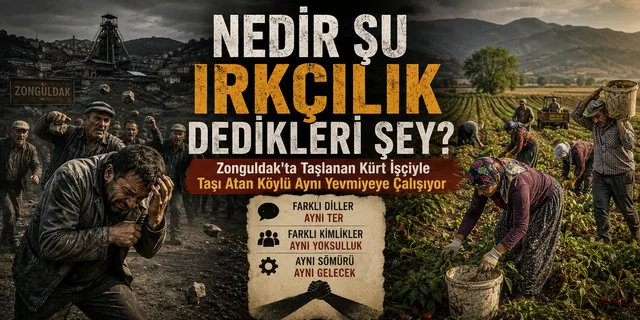
The policies of denial and assimilation directed at the Kurdish people and the turning of Kurdish workers into cheap, precarious labour are not separate processes. National oppression shapes the ground on which class exploitation operates. Saying "the Kurdish problem" erases both dimensions at once: both who applies the oppression and on whose backs the oppression is turned into profit.
So what will we say?
Instead of "the Kurdish problem," depending on the context:
- the rights of the Kurdish people, the Kurdish people's demands for equal citizenship and collective rights
- policies of denial and assimilation directed at the Kurdish people
- the right to one's mother tongue, the right to education in one's mother tongue
- the peace and democratic solution process
- national oppression (in theoretical contexts)
- and the simplest of all: Kurds, the Kurdish people. Not "our citizens of Kurdish origin"; the word "origin" presents an identity as a trace belonging to the past. Roundabout phrases that avoid saying the name, such as "the people of the region" or "Eastern citizens," are polite forms of the same denial.
The Same Pattern, Other Targets
Our friend's warning is not limited to two examples. A table showing how widespread the same pattern is in everyday language:
| Common phrase | What it says | What we can say instead |
|---|---|---|
| The woman problem | Women are the problem | The oppression of women, male domination, the struggle for equality |
| The Kurdish problem | Kurds are the problem | The rights of the Kurdish people, policies of denial and assimilation |
| The migrant problem, the Syrian problem | Migrants are the problem | The precarity of migrants, migration policies, the exploitation of migrant labour |
| Illegal migrant | The person is illegal, that is, a criminal | Undocumented migrant, irregular migrant |
| The Roma problem | Roma are the problem | Discrimination against Roma, housing and employment rights |
| The disabled problem, "handicapped" | The barrier lies in the person; the person is defective | The access rights of disabled people, accessibility; "disabled," not "handicapped" |
| The LGBT problem, LGBT propaganda | These people's existence is a threat | The rights of LGBTI+ people, discrimination and repression against LGBTI+ people |
| The Alevi problem | Alevis are the problem | Alevis' demands for equal citizenship and freedom of belief |
| Woman killed | There is no perpetrator | X killed Y; male violence |
You can apply the same test to every row of this table: is the first element of the compound a community of human beings, or a condition or relationship? Saying "the unemployment problem," "the housing problem" or "the rent problem" is not wrong, because unemployment, housing and rent are conditions, not communities. But the moment you say "the unemployed problem" or "the tenant problem," the language slips again.
A small historical note in passing: in the 19th century, the European bourgeoisie also had a name for the workers who went on strike, organised and demanded the vote: "the labour question" (Arbeiterfrage). In the eyes of the bourgeoisie, the problem was the workers themselves. The workers' movement answered in its own name: the problem was not the workers but exploitation. Naming a community as a problem is always the language of those who want to rule over that community.
To Those Who Say "But It's Just a Word"
When you open this discussion, you will most likely meet some objections. We thought through some of them among ourselves too. Here they are, with answers:
"Everyone understands what we mean." Yes, they do. That is exactly the problem. The phrase is so settled that nobody notices what it says. A frame is at its strongest when it goes unnoticed.
"The classics wrote it this way." We saw above: the classics wrote "question," and it became "problem" in Turkish. What is more, the best examples of the classics take the problem away from the oppressed and carry it over to the relationship. Fidelity to the classics means continuing their method, not their words.
"This is political correctness; the real issue is class." Marxism is a method of naming relationships. If you name a relationship wrongly, you analyse it wrongly. And class does not stand somewhere apart from women, Kurds and migrants; the great majority of them are the class itself. Capital knows very well how to use these differences as fault lines. The unity of the class begins with not reproducing these lines, even in language.
"Instead of fussing over words, let's deal with real problems." The two are not separate. In The German Ideology, Marx and Engels write that language is "practical, real consciousness that exists for other men as well." Valentin Voloshinov goes a step further in 1929 in Marxism and the Philosophy of Language: the word is an arena of class struggle; the ruling class tries to turn words into carriers of its own outlook by giving them a single, unchanging meaning. Language is not a sphere of ideology separate from the "real problems" we deal with; it is the place where those problems are reproduced every day.
"Nobody can speak with this much sensitivity." We do not expect anyone to speak flawlessly. We are writing this piece ourselves because a friend's warning made us notice a phrase we had used for years. The aim is not to put anyone through an exam, but to correct ourselves when we notice.
The Dominant Language and Our Language
| The dominant language | Our language |
|---|---|
| Names a community as a "problem" | Names a relationship or a policy |
| Hides the perpetrator, loves the passive voice | Writes the perpetrator in: who did what to whom |
| Carries the perpetrator's justification into the headline ("honour," "jealousy") | Gives the justification in quotation marks, as the perpetrator's claim |
| Names people from the outside | Listens to how people name themselves |
| Constructs the oppressed as an object to be managed | Constructs the oppressed as the subject of struggle |
| Looks for the "solution" in the disappearance of the oppressed | Looks for the solution in the disappearance of the oppressive relationship |
| Takes a warning as an attack | Takes a warning as a chance to learn |
How Can We Take Care with Language?
Correct language is not built by memorising a list of words; it is built through a habit of seeing. What follows are suggestions we have drawn from our own experience for acquiring that habit.
The four-question test
After writing a sentence, especially if you are writing about a community, ask yourself four questions:
- What is being marked as the problem? A community of human beings, or a relationship or policy?
- Where is the perpetrator? If I am describing an injustice, is the one who commits it visible in the sentence?
- Whose eyes am I writing through? Could I have read this sentence in a governor's office statement?
- How do these people name themselves? Is the name I use the name their own organisations and their own texts use?
Concrete habits
- Stop when you see the "X problem" pattern. If X is a community, look for an expression that names the relationship: "the rights of X," "discrimination against X," "the oppression of X," "policies directed at X."
- Question the passive voice. When you write "was killed," "was detained," "was dismissed," write who did it if you know.
- Don't turn the justification into the news. If you are quoting words such as "honour," "custom," "jealousy" or "snapped" from the perpetrator's mouth, give them in quotation marks and with their source; do not use them in your own voice.
- Say "share" instead of "help." Housework, childcare and elder care are nobody's "real" job.
- Follow the principle of self-naming. If you don't know which name a community prefers, look at the texts of that community's organisations. When in doubt, ask.
- Don't touch historical texts, but explain them. Don't change a classic's title when quoting it; if needed, explain the translation slip in a footnote.
- Ask for a reading before publication. If you are writing about a community, have the text read by a comrade from that community. Our mistake was spotted by a psychologist friend; without that reading, this phrase would have been printed on the cover of a book.
- Keep a small glossary for your organisation. Collect on a single page the expressions your union, association or student group has decided not to use in its statements and pamphlets, and what you will use in their place. What lasts is not personal sensitivity but collective decision.
When you are warned
- Say thank you. Someone warning you means they have given you their time and effort. Most people don't warn; they just drift away.
- Don't get defensive. The sentence "But that's not what I meant" is very likely true, but the issue is not your intention; it is what the sentence does.
- Correct it and make the correction visible. If you are correcting something in a publication, do it openly, not quietly. This piece is an example of that too.
When you warn others
- Warn without cornering. The aim is not to expose someone but to learn together. Rather than embarrassing someone in the middle of a meeting, a short note afterwards is often more effective.
- Give an example from yourself. The sentence "I used to say it that way for years too" lowers the other person's defensive wall.
- Be careful that it does not turn into language policing. An environment where people are afraid to speak is an environment where nobody learns anything. The goal is not to silence but to speak more accurately.
Concrete Tasks
- Go through your own texts. Search the statements, posts and presentations you have written over the past year for the word "problem." How many of them name a community as a problem?
- Put it on your organisation's agenda. Five minutes at the next meeting: "Which expressions are we deciding not to use in our statements?" Put the decision in writing.
- Pick a news story and rewrite it. Take a report of a femicide from a local newspaper. Rewrite the headline and the first paragraph so that the perpetrator is visible. Put the two side by side and share them.
- Draw up a self-naming list. Note down the names that the communities in your field (women's organisations, Kurdish rights organisations, migrant solidarity networks, disability rights organisations, LGBTI+ associations) use in their own texts.
- Pay attention to translation when reading the classics. The next time your reading group comes across a title translated as "problem," look up the original word and talk about the difference.
- Build a culture of reading before publication. Make it a rule in your organisation's publications that at least one reader from the community concerned sees the text before it is published.
Dear young comrades,
A psychologist friend taught us a great deal in a single sentence. We realised that a phrase we had used for years, one that stands as a title on our bookshelves and that we have read out as an agenda item in our meetings, made oppressed people look responsible for their own oppression.
This realisation did not diminish us. On the contrary, it took us back to the best side of our tradition: looking for the problem not in the oppressed but in the oppressive relationship. That is what Marx did in his reply to Bauer. That is what the women's movement did in saying "male violence" instead of "violence against women." That is what the Kurdish people did in their struggle to lift their own language out of the status of "an unknown language."
When language names a people or a sex as a "problem," it looks for the solution accordingly. We are looking for a different solution: not the disappearance of the oppressed, but the disappearance of oppression.
The problem is not women but male domination. The problem is not Kurds but denial. The problem is not the oppressed but the relationships that oppress them.
Once again, we thank our friend for the warning.
Related Pieces of Ours
- What Is This Thing Called Racism?: the language of discrimination and its class roots
- The Class of Alimony in the Centenary of the Civil Code: women's labour and the class of law
- The DEM Party Dossier: the Kurdish political movement today
- The 12 September Dossier: the form denial policies took during the coup period
- Event Organizing and Comradeship: "Being Organised, Taking Care"
Sources
Language and journalism
- Women's Commission of the Journalists' Association of Turkey, Gender-Equal News Guide (bianet, 16 March 2016, in Turkish)
- Evrim Kepenek, "Medyanın diline çuvaldızı niyetiyle" (Taking the needle to the language of the media), bianet, in Turkish
- Hrant Dink Foundation, Media Watch on Hate Speech report, September–December 2013 (bianet, 17 April 2014, in Turkish)
The Kurdish people and policies of denial
Theoretical background
- Karl Marx, On the Jewish Question (Zur Judenfrage, 1843)
- Karl Marx and Friedrich Engels, The German Ideology (1845–46)
- Friedrich Engels, The Origin of the Family, Private Property and the State (1884)
- August Bebel, Woman and Socialism (1879)
- Valentin N. Voloshinov, Marxism and the Philosophy of Language (1929)
- Erving Goffman, Stigma: Notes on the Management of Spoiled Identity (1963)
- Howard S. Becker, Outsiders: Studies in the Sociology of Deviance (1963)
- George Lakoff, Don't Think of an Elephant! (2004)
This piece is published on Knowledge Commons. It began with a friend's warning and remains open to growing with your warnings. You may reproduce it under the CC BY-SA 4.0 licence, with attribution. Reproduce it.