The Communist Manifesto 2.0
An Update for Young Comrades: The 2026 Version of the 1848 Manifesto Is Out

The Communist Manifesto 2.0
An update for young comrades: the 2026 version of the 1848 Manifesto is out
The Communist Manifesto 2026, version 2.0.1. All our dossiers are on the Guides page.
Dear Young Comrades,
An update arrives on your telephone every day. Your applications jump a version, your operating system is patched, artificial-intelligence models appear before you each month with a new number. But one of the most powerful tools of thought in humanity's hands, that twenty-three-page pamphlet printed in London in February 1848, has been circulating as the "first version" for one hundred and seventy-eight years.
Today we bring you an update: The Communist Manifesto 2026, version 2.0.1.
This is not a "patch". Nor was it written to replace the 1848 Manifesto. It was written to carry that method into the world of artificial intelligence, genetics, satellite constellations, the climate crisis and the new imperialist struggle for partition. The core is the same; the world it works in has changed.
Why an update?
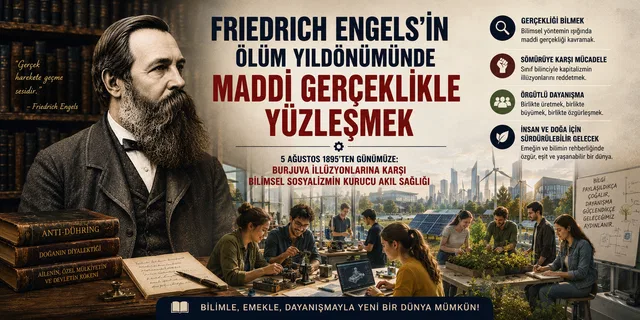
Twenty-four years after the Manifesto, in a preface they wrote in 1872, Marx and Engels said this: the general principles are altogether correct; but the application of those principles depends everywhere and always on historical conditions. In other words the Manifesto itself was a text that accepted, from the start, that it would be updated.
Look at what has happened since that day:
- In 1848 one billion two hundred million people lived on earth and most of them were peasants. Today we are more than eight billion, and for the first time most of us live in cities, selling our labour.
- In 1848 the fastest news was carried by horse. Today a message reaches the other end of the planet in a small fraction of a second.
- In 1848 the machine was a weaving loom. Today machines build language, write code, draw pictures; they feed on everything written by billions of people, that is, on our common mind.
- In 1848 there were no billionaires. In 2026 the wealth of more than three thousand billionaires reached 18.3 trillion dollars; the increase in 2025 alone was almost equal to the combined wealth of the world's poorest 4.1 billion people (Oxfam, January 2026).
- In 1848 there was not a single satellite in orbit. In 2026 a single company owns about two thirds of the active satellites circling the Earth.
And still the Manifesto's first sentence has not grown old: the history of all hitherto existing society is the history of class struggles. What changed was the material of the chain. The slogan of the update comes from there: The machine is new, the chain is old.
Who is writing the text, and to whom does it speak?
The first thing you will notice as you read this manifesto is its voice. The text does not speak from our age; it speaks from our future.
The narrator is a humanity that has leapt, on the astronomers' scale, to Type I — that is, to a planetary civilisation. A humanity that uses the energy of the sun, the wind and the water falling on the planet in common and in measure; that learns hunger, rent, debt and the word "billionaire" in history lessons; that has machines which think, but of which none has an owner. That humanity looks back, to 2026, that is, to us, and calls our age "the great threshold": humanity had in its hands every technical instrument of a planetary civilisation; but those instruments were the property of a handful of people.
This is not a prophecy; it is a method. The text says plainly: "We are only one of the possible outcomes of your struggle." Neither barbarism nor socialism is inevitable. Which of them comes to pass is a matter not of history but of our organisation.
Looking from the future gains us one thing: to see everything that is presented today as "natural", "unchanging", "it cannot be otherwise", as if it were a history-lesson topic.
What was updated?
We kept the basic structure of the 1848 Manifesto: bourgeois and proletarians, proletarians and communists, socialist and communist literature, the attitude towards opposition movements. On top of that we added sections that did not exist in 1848. A comparative summary:
| The 1848 Manifesto | The Communist Manifesto 2026 |
|---|---|
| No preface; the authors added prefaces after 1872 | "A Preface from the Future": the address of a humanity that has leapt to planetary civilisation, speaking to 2026 |
| "A spectre is haunting Europe" | "A spectre is haunting the world": from India's peasants to Kenya's young people, from Hollywood's screenwriters to Nairobi's content workers |
| The revolutionary role of the bourgeoisie, the world market, crises | Monopoly capitalism and its present phase, techno-capitalism; the seizure of the general intellect; mental Taylorism; the commodification of genetics, space and climate |
| The proletariat: the factory worker | The platform proletariat, the mental proletariat, care workers, migrant workers, white-collar workers "counted as middle class" |
| Ten measures | Twelve measures: restitution of the general intellect, a thirty-two-hour week, the right of appeal against the algorithm, patent-free health, a common orbit, disarmament |
| Critique of feudal, petty-bourgeois, "True" and utopian socialism | Critique of "responsible artificial intelligence", Silicon Valley basic income, green capitalism, the techno-feudalism debate, modern revisionism, Trotskyism and anarchism |
| Attitude towards opposition parties | Trade unions, climate, women's, migrant and digital-rights movements; "not camp but class"; the European Union; local government |
| None | "We Learn from Our Defeats": the lesson of more than twenty experiences, from the Paris Commune to Weimar, from Chile to 1989 |
| None | "Liberated Humanity": what sort of world we shall live in when the machine is held in common |
| "Working men of all countries, unite!" | "Workers of all countries, unite!" and a new addition: "The machine is common, the chain is broken." |
Let us now look a little more closely at the four most important updates.
Artificial intelligence: not a technology, a question of property
Every day they tell you two tales about artificial intelligence. The first is that it is an "ownerless" force of nature: no one can stop it, no one can steer it. The Manifesto's answer is plain: to say a thing has no owner is the cheapest defence of that thing's owner. Every model has an owner, every data centre a title deed, every decision a board of directors.
The second tale is that those who lose their jobs will form a "class of the superfluous". The Manifesto rejects this tale too: superfluity is the profit criterion stuck onto a human being. No human being is superfluous.
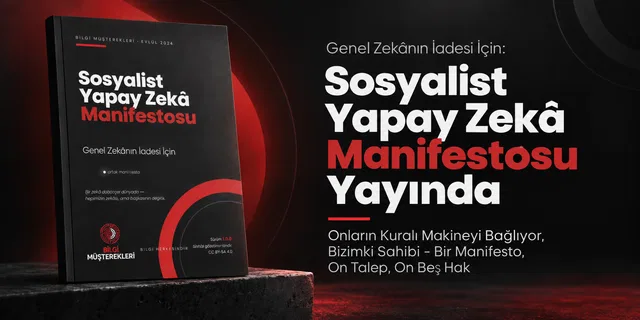
At the centre of the text stands Marx's concept of the "general intellect": the knowledge, skill and science accumulated by society. Artificial-intelligence models are that common accumulation, gathered without permission and sold back as private property. That is why our demand is not compensation but restitution. We are not against artificial intelligence; we are against its capitalist use, and we say that it belongs to us. We had worked these theses out in more detail in For the Restitution of the General Intellect: The Socialist AI Manifesto Is Out and 'Labor in the Age of Artificial Intelligence': Our Book Is Out; the new manifesto places them inside a general class programme.
Not camp but class
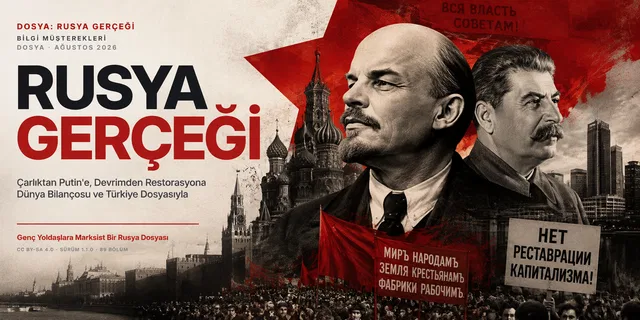
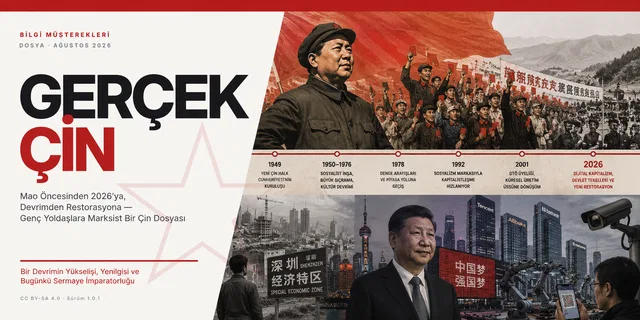
Another ready-made choice is also put before you: either you will stand with the West in the name of "democracy", or with the East in the name of "anti-imperialism". The Manifesto rejects this choice. Russia and China are imperialist powers; that they are not the equal of the United States does not change this, because being imperialist is a quality and the level of power is a quantity. A "multipolar world" is not liberation; it is not the number of poles that must change, but the relation of classes.
The working class's camp is its own class camp. We said this too in The Same Week, Two Tables: The US–China Summit, Artificial-Intelligence Bosses, and Not Camp but Class: not camp but class.
We learn from our defeats
This is perhaps the manifesto's longest and hardest section. In 1848 the working class did not yet have an experience of power; we have one hundred and seventy-eight years of victories and defeats.
Faced with defeat the text rejects two dangerous attitudes together: denying the defeat and attributing everything to the enemy's strength, to betrayal, to conditions; or making the defeat absolute and abandoning the principle with "so it could not be done". The third road: to examine, to criticise honestly, to draw the lesson.
From the Paris Commune to the collapse of internationalism in 1914, from the German Revolution to the class that split in front of fascism in Weimar, from Spain to Varkiza, from Indonesia to Chile, from the British miners to the dismantling of the welfare state, from the dissolution of the socialist bloc to the enclosure of the digital commons, every experience is read with the same question: what happened, why did it happen, what did we learn? The section closes with a table of more than twenty rows, "the source of the defeat / the principle that follows".
Our thesis on the dissolution of the socialist bloc is plain: socialism was not defeated; revisionism collapsed. After 1956 there was a step-by-step passage from plan to profit, from workers' power to the "state of the whole people"; 1989–91 was not a revolution but a passage from covert capitalism to open capitalism. But this thesis is not a consolation; it is a warning: even after the working class has taken power, it loses that power unless it uses it again every day through its own organisations.
The background of this section rests in large part on our piece Dossier: A History of the European Working Class Is Out.
Liberated humanity: when the machine is ours
The manifesto's sixth section is perhaps the one that will interest you most. The humanity looking from the future tells how it lives with the machine.
Working time shortens with every increase in productivity: first thirty-two hours, then twenty, then less. No human being dies at the bottom of a mine; machines do the heavy and dangerous work, and the assemblies of those who use them decide when they will stop. A child, in any corner of the world, in their own mother tongue, reaches the knowledge of all humanity. Medicines are patent-free; genetic knowledge is a common inheritance. The planet's energy is managed in a single, planned and democratic grid. Algorithms are open; artificial intelligence does not decide, it summarises. Art ceases to be a necessity of livelihood and becomes everyone's activity.
But the section is not a techno-utopia. Its first sentence is this: "It was not the machine that liberated us; it was we who liberated the machine." The same artificial intelligence can, in one world, be set to speed the worker up and leave them jobless, and in the other to shorten the working day and to cure disease. The difference is not in the technique but in the property. That is why a new slogan is added beside the slogan of 1848:
The slogan of your age was this: the machine is new, the chain is old. The slogan of our age is this: the machine is common, the chain is broken.
How should it be read?
The text is long: about twenty thousand words, ninety-six pages as a booklet. It is not a text to be read in a single sitting. We suggest a reading order like this:
- First sitting: "A Preface from the Future" and "Introduction: A Spectre Is Haunting". Get to know the text's voice and its world.
- Second sitting: Section I. A photograph of today's capitalism: monopolies, artificial intelligence, genetics, space, climate, the new face of the proletariat.
- Third sitting: Section II. What do we want, and why? Twelve measures and planning.
- Fourth sitting: Sections III and IV. With whom, and on what questions, do we argue; with whom, and how, do we walk side by side?
- Fifth sitting: Section V. The lessons of the defeats. Best of all, read this section with a group, discussing it experience by experience.
- Sixth sitting: Section VI, "Footsteps" and the Close. What are we organising for?
The appendices contain the sources the text rests on, our own work, and local notes for those reading from Turkey. You will find there the notes on 12 September, the Tekel resistance, the kent konseyleri and the pioneers of computing labour.
Concrete tasks
A manifesto is not written to be read; it is written to be used. A few suggestions:
- Form a reading group. Come together with three or five people at your school, your workplace, your neighbourhood. Use the six-sitting order above. At the end of each sitting write a question and send it to us.
- Choose a section and write it with your own experience. If you are a courier, test the algorithmic-management section; if you are a programmer, the general-intellect section; if you are a student, the education section, against your own life. Where does it hold, where does it not?
- Criticise it. The text is a version, not a sacred text. We shall publish, answer, and work into the next version every criticism written with the principles of criticism in the appendices; and we shall name the author of the criticism as well.
- Translate it. The text speaks to the whole world but for now it is in Turkish. If you can translate even one section into English, Kurdish, Arabic, German or any language you know, you will have made the most concrete contribution to this text's internationalism. The licence allows it.
- Copy it. Print the PDF, put the ePub on your e-reader, put the Markdown file on your own site. The only condition: credit the source and share under the same licence.
Download, read, share
The Communist Manifesto 2026, version 2.0.1, can be downloaded in three forms:
You can reach all our files from the Guides page.
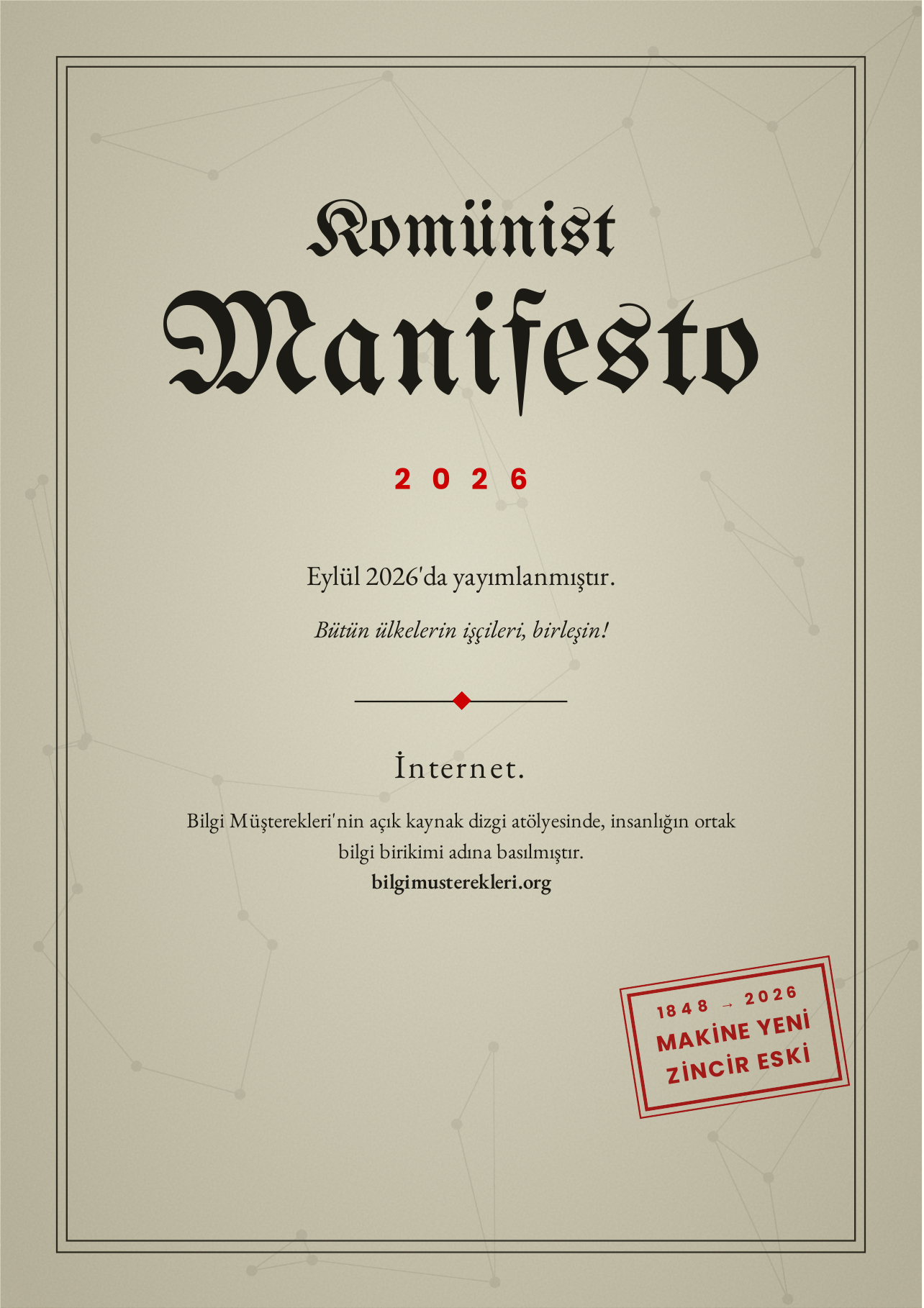
The cover is a nod to the cover of the first edition of the 1848 Manifesto printed in London: the same greenish-grey paper, the same gothic letters, the same line "Workers of all countries, unite!". Where it once said "London." it now says "İnternet." The red stamp in the corner of the cover also summarises the update itself: 1848 → 2026. The machine is new, the chain is old.
Dear Young Comrades,
Those who first read that pamphlet in 1848 were a few hundred workers and students across Europe. Its authors lived through the defeat of the revolutions a few weeks after the text was printed. But the text lived; because those who read it used it.
We give you this update with the same hope. Put it not on a bookshelf but on a discussion table, at a union meeting, in a reading group. Find its gaps, correct its mistakes, widen it with your own experience. The next version will be written with your contributions.
The people of the Manifesto who speak from the future say this to us: "We are writing you this text not because we know that you won, but because you must win."
We say the same to you.
Workers of all countries, unite!
Comradely.
Knowledge belongs to everyone.
Sources
- The Communist Manifesto 2026, version 2.0.1 (PDF) · ePub · Markdown
- Karl Marx and Friedrich Engels, Manifesto of the Communist Party (1848) and the 1872, 1883, 1888 prefaces, Marxists Internet Archive
- Oxfam, Billionaire wealth jumps three times faster in 2025 to highest peak ever, January 2026
- Knowledge Commons, For the Restitution of the General Intellect: The Socialist AI Manifesto Is Out, 15 September 2026
- Knowledge Commons, 'Labor in the Age of Artificial Intelligence': Our Book Is Out, 18 August 2026
- Knowledge Commons, Dossier: A History of the European Working Class Is Out, September 2026
- Knowledge Commons, The Same Week, Two Tables: The US–China Summit, Artificial-Intelligence Bosses, and Not Camp but Class, 25 September 2026
- Knowledge Commons, Guides
This piece and The Communist Manifesto 2026 are published under a CC BY-SA 4.0 licence. Copy, translate, discuss, use.