Enver Gökçe, Poet of the Working Class
On the 45th Anniversary of His Death, Remembering a Communist Who Saw Poetry as a Front of Class Struggle

Today is 19 November. Exactly 45 years ago, on 19 November 1981, the heart of a 61-year-old man stopped at his niece's home in Ankara. It was the first year of the junta that seized power on 12 September. The man was Enver Gökçe, one of the most authentic voices in Turkish poetry, able to sing folk song and struggle in the same breath.
We want to remember him not simply as a folk poet who suffered, but as a communist who, in his own words, made class literature and saw poetry as a front of class struggle.
First, Ten Theses on Enver Gökçe
- He came from a poor village and its folk songs. Born in Çit, in Kemaliye (Eğin), Erzincan, in 1920, he moved to Ankara with his family as a child. The songs of Eğin remained a source of his poetic voice.
- He studied folk culture systematically. He studied under Pertev Naili Boratav at the Faculty of Language, History and Geography; his graduation thesis was Songs of Eğin.
- He became an organised intellectual at an early age. He carried much of the work of the magazine Ant and was among the founders of the anti-fascist Turkish Youth Association.
- He was tried over his youth activism and arrested again in 1951. Arrested in the 1951 crackdown on the Communist Party of Turkey (TKP), he hired no lawyer and conducted his own defence.
- Prison broke his body but did not change his allegiance. He spent years in prison, followed by exile, and bore the effects of torture for the rest of his life.
- He worked under assumed names. As Mustafa Gökçe and Aydın Tataroğlu, he published folktales, biographies and translations of Neruda.
- “I make class literature,” he said. He believed a good artist should love the people and be committed to their most revolutionary class.
- Form was also a class choice. Against individualist urban fashions in poetry, he defended the sounds of folk poetry, turning the folk song into a language of struggle.
- He spent his final years in a care home, in loneliness. That loneliness raises questions not only about the state, but also about our own capacity for solidarity.
- He still offers guidance. At a time when algorithms enclose culture, a poet who collected the people's shared language and placed it in the service of struggle teaches us about cultural commons.
Let us examine these theses in turn.
Dear Young Comrades,
Many of you may not know Enver Gökçe. Those who do may know him through a song or an anthem sung at a demonstration, without knowing the poet. A poem travelling from voice to voice is beautiful; knowing who wrote it, at what cost and on whose side, is a way of claiming it anew.
From Eğin to Ankara: The School of Folk Song and Poverty
Enver Gökçe was born in 1920 in Çit, a village in Kemaliye, Erzincan, and moved with his family to Ankara in 1929. He grew up without his father. Eğin is known for its folk songs; the distinctive rhythm and local vocabulary of Gökçe's poetry draw on that world.
For Gökçe, folk song was not a nostalgic celebration of village life. It was a shared language accumulated by working people over generations, a cultural commons belonging to no single owner. His poetry sought to take that commons from the place where dominant culture dismissed it as backward or merely folkloric and make it speak to a modern class struggle.
In Ankara he attended Cebeci Middle School and Gazi High School, then entered the Turkish studies department of the Faculty of Language, History and Geography. His teachers included Pertev Naili Boratav, Muzaffer Şerif, Behice Boran and Abdülbaki Gölpınarlı; İlhan Başgöz was a fellow student (Metin Turan, BirGün). The faculty was home to a generation studying folk culture and society through scientific and materialist approaches; members of that generation would soon be targeted in the state's anti-communist campaigns.
In 1947 Gökçe prepared Songs of Eğin as his graduation thesis. It was published as a book only in 1982, after his death. A folk collection waiting 35 years for publication is a striking example of how access to the people's own culture can be delayed.
From Ülkü to Ant: The Making of an Organised Intellectual
Gökçe worked as a proofreader at Ülkü, the journal of the People's Houses. With Sefer Aytekin, whom he met there, he launched Ant. From its first issue on 15 March 1945, Gökçe carried much of the work of typesetting, proofreading, distribution and day-to-day production.
This detail matters, young comrades. His poetry did not emerge from a solitary desk alone. It was also the poetry of a worker who set, corrected and distributed a magazine; it cannot be separated from printer's ink and the fatigue of distribution.
In the 1940s he was among the founders of the Turkish Youth Association, which sought to bring anti-fascists and democrats together. These were years when fascism had been defeated militarily, but Turkey's ruling class was moving rapidly into Cold War alignments. The newspaper Tan was attacked on 4 December 1945; around the same period, an attack on the faculty prevented Boratav's lecture on Karacaoğlan. The youth association was also attacked, and eight people including Gökçe were tried for alleged communist propaganda and held in prison for three months. They were acquitted, but surveillance, dismissal and prosecution continued (BirGün).
An anecdote from that trial tells us something about Gökçe's character. According to İlhan Başgöz, after a witness who called himself a nationalist accused him of communism, Gökçe asked the judge whether the witness had failed Turkish grammar four times and been expelled from the faculty. The encounter between the self-described nationalist and the communist studying the people's language is a lesson in the class content of nationalism.
Gökçe himself recalled showing an early poem, “To My Fellow Villagers,” to Ahmet Kutsi Tecer. Tecer thought it very bad and advised him to write prose instead; Gökçe replied jokingly that he could write an even worse one. The poem later appeared in Dost Dost İlle Kavga. Whose poetry is considered good or bad, and who sets the measure?
1951: His Own Advocate in Court
Around October 1950 Gökçe began working for the student dormitory administration in Istanbul, most recently at Kadırga Student Dormitory. In 1951 he was arrested there during the major operation against the TKP.
The crackdown came in the year Turkey sent troops to Korea and sought NATO membership. Detainees were interrogated in the cells of Istanbul's Sansaryan Han. In his own account Gökçe said he was sentenced to seven years in prison and exile for a further third of that period; other sources report different sentence lengths. After prison he was exiled to Çorum.
He hired no lawyer and conducted his own defence, taking responsibility for his beliefs. The interrogations, coffin-like cells and confinement at Sansaryan Han took a lasting toll on his health.
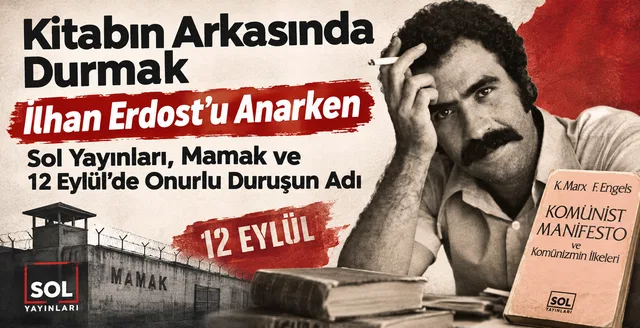
We are reminded of our article on İlhan Erdost. Erdost was killed at Mamak in 1980; Gökçe was broken at Sansaryan Han in 1951. Three decades separate them, but the method is recognisable: silencing thought, books and poetry by crushing the bodies that carry them.
Living Under Assumed Names: A Poet's Work for Bread
For a communist leaving prison, having his own name on a book cover could be nearly impossible. Gökçe turned to translation and compilation to make a living. As “Mustafa Gökçe,” he published biographies of Kemalettin Kamu and Ömer Bedrettin Uşaklı in 1958, Antillean, Indian and Chinese tales, and a selection of Pablo Neruda's poetry in 1961; as “Aydın Tataroğlu,” he published the tales of Dede Korkut. His work also included Kalila and Dimna, The Pugachev Rebellion and Vera Panova's novel The Child.
Look at that list, young comrades: tales from the Antilles, India and China, Dede Korkut, the history of a Russian peasant revolt and the poetry of Chilean communist Pablo Neruda. Even while earning his bread under other names, Gökçe brought the shared narratives of peoples into Turkish. This was a practice of internationalism.
Neruda and Gökçe share an affinity: both brought popular language, the sounds of their landscapes and the everyday objects of labour into poetry. There is a connection, too, between the Latin American nueva canción movement discussed in our Victor Jara article and Gökçe's poetry rooted in Eğin's songs.
“I Make Class Literature”: Poetry Is a Front
In a text offering advice to young poets, Gökçe said, “I make class literature”. His advice was that a good artist must love the people and be committed to their most revolutionary class; must love life in its good and bad, and nature with its water, mountains and soil; and becomes great and illuminating to the extent that this love enters the work (soL).
There are three strands here:
- Class commitment: The people are not an abstract, classless mass; Gökçe takes the side of a class within them.
- Commitment to life: Class poetry is not merely slogans. Workers carry joy, love and beauty as well as anger; mountains, water and flowers belong in their poetry too.
- The work's purpose: Poetry should illuminate the way. It does not merely describe a world; it participates in the struggle to change it.
M. Arif Erzen's academic study examines how class struggle shapes both the themes and poetic foundations of Gökçe's work, built through the sounds of popular speech. Class is not simply a subject of his poetry, but part of its structure.
Form Is Also Taking Sides
The Garip movement was influential in Turkish poetry during Gökçe's era, with an everyday, urban, individual and often ironic voice. Gökçe stood with folk poetry, met folk poets including Aşık Veysel and Aşık Ali İzzet, and wrote an early critical study of Aşık Veysel in 1944 (BirGün).
This was more than a difference of taste: it raises the question of who decides which voice is modern and which is backward. The table contrasts two ways of approaching folk poetry:
| Dominant cultural view | Enver Gökçe's approach |
|---|---|
| Folk song is frozen folklore to be preserved | Folk song is a living language capable of carrying contemporary struggle |
| The folk poet is an innocent, apolitical villager | The folk poet bears generations of class experience |
| Local speech is a provincial remnant | Local speech is a commons enriching the shared language |
| Folk poetry belongs in a museum, modern poetry in a salon | Folk poetry can carry the most modern political content |
| Art is the individual's inner world | Art is labour that helps build collective life |
| The poet expresses the self | The poet amplifies the voice of the most revolutionary class |
Reading His Poems
Writing about Gökçe's poetry cannot replace listening to it. The line “Dost dost ille kavga!” from “Dost” gives his first collection its title. Friendship and struggle stand together: friendship is tested in struggle, and struggle gains meaning through friendship. Folk-song repetition becomes a marching rhythm.
“Oy Beni” also reveals his search for language. According to soL, a line in early editions ended with “brotherly life”; Gökçe later changed it to “collective life” and sharpened the poem's opening and closing lament for the country. Returning to a line decades later, he chose a word pointing to social organisation. We can read this as a movement from an ethical aspiration toward a class programme.
“Panzerler Üstümüze Kalkar” uses short, broken lines to evoke life confronted by violence. The second collection, published in 1977, speaks to the years after the 12 March intervention and the fascist attacks that followed. Nihat Behram recalls how the poem names those who fall in streets, schools, demonstrations and torture chambers (soL). Three years after publication came the coup of 12 September 1980.
In a 1977 conversation Celil Denktaş asked Gökçe whether he felt bitter. Gökçe answered, “No, I don't.” For Denktaş, the collection showed that Gökçe had not laid down his weapon. Having endured torture 26 years earlier, he refused to withdraw into a personal grievance: his concern was collective.
“1909-1946” is a lament for his teacher Saffet Korkut (soL). Harvest workers, students and teachers mourn her: even grief becomes collective. “To My Fellow Villagers”, the poem Tecer dismissed, invites us to reconsider whose judgement defines literary worth.
A Communist in a Care Home: Whose Failure Is Loneliness?
Gökçe's final years were difficult. In 1977 he travelled to Bulgaria for treatment, then settled in Ankara and continued translating. He spent his final years at Seyranbağları Care Home and died of a heart attack at his niece's home on 19 November 1981.
It is easy but incomplete to attribute his loneliness solely to state repression. The state damaged him; we must also ask what it means when a movement cannot sufficiently support its own poet and witness. The greatest wealth of the oppressed is the ability to care for one another. Where that fails, the morality of everyone fending for themselves gains ground.
This is a lesson, not an accusation. Among us today are older comrades facing illness, unemployment or loneliness. One meaningful way to remember Gökçe is to knock on their doors.
A Death in the Shadow of 12 September
Gökçe died fourteen months after the coup. In his tribute, Nihat Behram recalls the poems he left behind, each carrying the voice of a dignified life.
As our 12 September dossier discusses, the coup targeted not only organisations, unions and parties, but social memory. Remembering a communist poet and the tradition his poetry represents is a way to defend that memory.
Why Read Enver Gökçe Today?
We see three connections to the present.
First, cultural commons. Songs of Eğin records culture passed between generations. Today, popular language, songs, stories and writing are collected by technology monopolies, fed into AI models and sold back through subscriptions. Gökçe collected popular culture to return it to the people; we defend access to the data, culture and models built from that shared heritage.
Second, language and hegemony. In our article on the class of words, we discussed how ruling-class hegemony enters language. Gökçe worked in the opposite direction, bringing popular speech from the margins to carry political thought. The change from “brotherly life” to “collective life” is a small example of language consciously remade through a class choice.
Third, personal principle. He defended himself in court and, decades after torture, refused to say he was bitter. In writing about Demir Küçükaydın and Yavuz Yıldırımtürk, we asked what a life is lived for. Gökçe's answer was to stand with a class and amplify its voice.
Concrete Tasks
Remembrance means putting what we remember to work today:
- Form reading circles. Read Dost Dost İlle Kavga and Panzerler Üstümüze Kalkar together, discussing the poems alongside the historical contexts of 1945, 1951, 12 March and 12 September.
- Read aloud and make music. Gökçe's poetry lives through sound. Read it at gatherings, listen to existing musical settings and invite young musicians to compose new ones.
- Return to local collecting. Gather workers' stories, labour songs, strike songs and oral histories in neighbourhoods, workplaces and villages; share them under open licences with the permission of narrators and rights holders.
- Visit older comrades. Visit those ageing in care homes, hospitals and lonely homes, record their testimony with consent and build networks of solidarity.
- Defend cultural commons. Support open archives, collections and public cultural institutions against the enclosure of popular culture in proprietary models.
- Make room for new poets. Share Gökçe's advice to young poets and offer workers and young writers space in publications and on stages.
Dear Comrades,
Enver Gökçe's poetry begins like a folk song and ends like a march. It brings love and struggle, mountains and barricades, the waters of Eğin and a cell in Istanbul into the same line. He saw poetry not as decoration but as a front of class struggle; though his body was broken, he did not abandon his side.
The state sought to silence him and made the circulation of his name and poetry harder. Yet his poems continued to travel from voice to voice, through demonstrations, songs and reading circles.
Forty-five years later, we read “collective life” not only as an aspiration but as a task. The path to a life of solidarity passes through organising collective life.
Farewell, Enver Gökçe. Your struggle continues.
Sources
- Metin Turan, “Enver Gökçe, 40 years after his passing”, BirGün, 2021.
- “Ölüm, adın kalleş olsun…”, Evrensel, 26 November 2020.
- “Remembering communist poet Enver Gökçe”, soL, 19 November 2023.
- “Gözden gezden arpacıktan”, soL.
- “Enver Gökçe and the faculty”, soL, 2025.
- Nihat Behram, “Enver Gökçe: A people's treasure erased”, soL.
- Nihat Behram, “Three bouquets in memory of Enver Gökçe”, soL.
- “A tribute to Enver Gökçe on the centenary of his birth”, bianet.
- Enver Gökçe: life and works, turkedebiyati.org, including his own account of his life.
- M. Arif Erzen, “Enver Gökçe's Poetry as an Ideological Battlefield”, DergiPark, 2018.
- Mehmet Özer (ed.), Şiirimizin Işıklı Irmağı: Enver Gökçe.
- Enver Gökçe, Dost Dost İlle Kavga, Yücel Yayınları, 1973; Panzerler Üstümüze Kalkar, Doğrultu Yayınevi, 1977; Eğin Türküleri, Yaba Yayınları, 1982.
Related articles: İlhan Erdost · Victor Jara · 12 September dossier · The language of hegemony · Demir Küçükaydın · Yavuz Yıldırımtürk
This article is shared under the CC BY-SA 4.0 licence. You may reproduce, adapt and share it with attribution.