The Revolutionary of His Age, Our Task: Remembering Mustafa Kemal on 10 November
The Legacy of Complete Independence, the Limits of the Enlightenment, and the Mustafa Kemal of Deniz and His Comrades

Today is 10 November. The 88th year of Mustafa Kemal Atatürk's death. At 09:05 the sirens will sound, and across the country people will stand still for one minute. Inside that stillness there are very different feelings: the memorised script of the official ceremony, the flag of nationalist anger, the concern to protect a secular life against reaction, and sometimes only the habit of a mourning.
In this essay we remember Mustafa Kemal neither as an idol nor as a demon. We remember him inside the conditions of his own age, as the leader of a class and of a period, and as a respected revolutionary leader who was able to take the most advanced steps of that period. He was not a communist. We know this, and he did not hide it. But to organise the war against imperialism in the Anatolia of 1919, in an occupied country, on the wreck of an empire, and then to pull down the institutions of the Middle Ages one by one, is a revolutionary work by the measure of its own time.
We are also writing this essay as a reckoning in good faith, without hiding the places where we say "if only he had been able to do these things too". The truest way to claim a legacy is to take on the task of completing the sides it left unfinished. We also want to recall that among the first to state this task in the clearest way were Deniz Gezmiş and his comrades, who in the autumn of 1968 walked from Samsun to Ankara and reached the gate of Anıtkabir on the morning of 10 November.
First, the Summary: Seven Theses
- The War of Independence is one of the first successful anti-imperialist wars of the 20th century. It was won in the international field opened by the October Revolution, with the gold and arms support of Soviet Russia. In the eyes of the oppressed world it became one of the first concrete proofs of the thought that "imperialism can be defeated".
- The Republic is a bourgeois revolution, but a bourgeois revolution that came late and was made from above. The abolition of the sultanate, the caliphate, the şer'iye courts, the lodges and the zawiyas; the recognition of women's legal existence; the unification of education; the change of the alphabet: these are radical steps by the measure of their own age.
- The principle of "complete independence" is the most living legacy Mustafa Kemal left us. This principle, which thinks political, financial, economic, military and cultural independence together, became the main slogan of the revolutionary youth of the 1960s.
- Mustafa Kemal's influence did not stay within Turkey. From Afghanistan to Iran, from Tunisia to India and on to Indonesia, the Enlightenment leaders of colonial and semi-colonial countries took him as an example.
- The limits of this revolution were class limits. Halkçılık, with the discourse of a "classless, privilegeless, fused mass", banned the class struggle. Land reform was not carried out. Workers' organisation and the communists were suppressed. The brotherhood with the Kurdish people established in the War of Independence turned into denial. The reforms were made from above, not with the organised participation of the people.
- The rulers who speak Mustafa Kemal's name most today are the ones who liquidate his legacy most. NATO, the IMF, privatisation, the breaching of cabotage, the religionisation of education: all of these run against the line of complete independence and of the Enlightenment.
- Deniz and his comrades, the Denizler, read Mustafa Kemal's revolutionary side as a beginning that had to be carried further. They joined the slogan of "a fully independent Turkey" with the aim of socialism and with the brotherhood of the Turkish and Kurdish peoples. Our task is to continue this line in today's conditions, in the age of artificial intelligence and of the digital monopolies.
Let us now open them one by one.
The World of 1919: The Wreck of an Empire and a New Age
To understand Mustafa Kemal one must first understand 1919. The First World War was the war of the imperialist powers to repartition the world. The Ottoman Empire came out of this war defeated. The Armistice of Mudros (30 October 1918) was in effect a document of surrender. Istanbul was under occupation, the Greek army had landed at İzmir, and there were French and British forces in Antep, Maraş and Urfa. The Treaty of Sèvres (10 August 1920) was a colonial map that opened Anatolia to partition.
But something else had also happened in the same world: the October Revolution of 1917. The Bolsheviks had published the secret treaties, among them Sykes-Picot, which partitioned Anatolia. They had recognised the right of oppressed peoples to determine their own destiny, and they had broken the imperialist chain at its weakest link. We discussed this in detail in What Did the October Revolution Give the World?. The War of Independence was born between these two facts: on one side the imperialism that was partitioning the world, on the other a revolution that stopped that partition for the first time.
The social structure of Anatolia was heavy. The great majority of the population were peasants. Even in the 1927 census the literacy rate was around 10 per cent. A handful of Muslim merchants and notables had begun to grow rich on the opportunities of the war years. The working class was small and scattered. In such a society the leadership of the liberation struggle would come from the intellectual cadres of the army and the bureaucracy, and from a native bourgeoisie trying to rise. This would determine both Mustafa Kemal's strength and his limit.
The War of Independence: Imperialism Can Be Defeated
Landing at Samsun on 19 May 1919, Mustafa Kemal took the first step that carried the source of sovereignty from the palace to the people, saying in the Amasya Circular that "the nation's independence shall be saved by the nation's own resolve and decision". The congresses of Erzurum and Sivas, and the opening of the Grand National Assembly on 23 April 1920, meant the practical rejection of the legitimacy of the sultan and of the Istanbul government. This was a war of liberation, and it was also a revolution of sovereignty.
The international alliance of this war is meaningful too. Three days after the Assembly opened, on 26 April 1920, Mustafa Kemal wrote a letter to Lenin, proposed cooperation with Soviet Russia in the struggle against the imperialist governments, and asked for help. With the Treaty of Moscow of 16 March 1921, the Ankara government gained one of the first great states to recognise it. The gold, arms and ammunition sent by Soviet Russia were a decisive support on the road from Sakarya to the Great Offensive. This was the hand that a revolution, itself struggling with poverty and civil war, extended to another people fighting imperialism.
Sakarya (1921), the Great Offensive (26–30 August 1922) and Lausanne (24 July 1923) are the military and diplomatic results of this process. The abolition of the capitulations at Lausanne, that is, the end of the legal and economic privileges foreigners had held for centuries on Ottoman soil, meant the official end of semi-colonial status.
Said from the side of class: the War of Independence was the just war of an oppressed nation against imperialism. Lenin's distinction between oppressor nations and oppressed nations was developed precisely to understand wars of this kind. The war of an oppressed nation's bourgeoisie against imperialism is progressive despite the class character of that bourgeoisie, because on the world scale it weakens the imperialist system. The first and firmest ground of Mustafa Kemal's historical respectability is this.
The Republic and the Revolutions: Against the Institutions of the Middle Ages
We discussed the class character of the Republic proclaimed on 29 October 1923 in Why Is the Republic a Bourgeois Revolution? and in Whose Republic? A Basic Guide in Its 103rd Year: the Republic is a bourgeois revolution. But to say bourgeois revolution is not to belittle it. In the Communist Manifesto Marx and Engels write that the bourgeoisie played "a most revolutionary role" in history, and that it broke up feudal and patriarchal relations. The leadership that took this role in Anatolia did the following in roughly fifteen years:
- The abolition of the sultanate (1 November 1922) and the proclamation of the Republic (29 October 1923): the taking of sovereignty from the dynasty.
- The abolition of the caliphate and the Tevhid-i Tedrisat Law (3 March 1924): the separation of religious authority from political power, the unification of education under a single roof, the closing of the medreses.
- The closing of the lodges and the zawiyas (1925): the breaking of the orders' network of social control.
- The Turkish Civil Code (1926): the recognition of monogamy, of women's right to divorce and to inherit, and of equality before the court.
- The removal from the constitution of the clause "the religion of the state is Islam" (1928) and the entry of secularism into the constitution (1937).
- The Alphabet Revolution (1 November 1928) and the Millet Mektepleri, the Nation's Schools: a vast mobilisation to make reading and writing a mass fact.
- Women's right to vote and to be elected: in the municipalities in 1930, in the Assembly in 1934. Women won this right in France in 1944, in Italy in 1946, and in Switzerland at the federal level only in 1971.
- The university reform (1933): Istanbul University in place of the Darülfünun; the acceptance into Turkey of a large number of scientists fleeing Nazism.
- The Cabotage Law (1926): the taking of coastal shipping from foreign companies.
- Statism (devletçilik) and the First Five-Year Industrial Plan (1934): the first large public industrial investments, above all the Kayseri and Nazilli cloth factories, with Soviet credit and specialists.
What Mustafa Kemal said about women in 1923 is extraordinary for the Middle East of that age. He said that a society cannot rise as a whole by advancing one half and neglecting the other. The sentence "the truest guide in life is science" is also the expression of an Enlightenment stand that put science in the place of religious authority.
Each of these is a step that, in the same period, had either not been taken at all in most of the Middle East and the Islamic world, or was taken only much later and in a far more limited way. They were done in a peasant society, in a country newly out of war, where nine tenths of the population could not read or write. We say revolutionary by the measure of his own age, because this is the situation.
His Effect on the World: The Example of the Oppressed East
Mustafa Kemal's influence crossed the borders. The source of this influence was a war won against imperialism standing together with the modernisation drive that followed it. For the intellectuals of colonial and semi-colonial countries, Anatolia was the concrete example of the claim that "one can be both independent and modern".
- Afghanistan: King Amanullah Khan took Turkey as an example in the 1920s for women's education, the lifting of the veil and legal reforms, and he visited Ankara in 1928. His reforms were overthrown by a reactionary revolt. This also showed how fragile reforms from above are when they have no social base.
- Iran: Reza Shah visited Turkey in 1934 and then entered upon reforms of education and dress. But he kept the monarchy. This was the basic difference between the two modernisations.
- Tunisia: Habib Bourguiba said openly that, after independence, he built women's rights and secular law by taking Mustafa Kemal as an example.
- India: Jawaharlal Nehru, in Glimpses of World History (Dünya Tarihine Bakışlar), the letters he wrote to his daughter from prison, told the War of Independence and the reforms in Turkey as a great example for the oppressed East. The aid campaign of the Khilafat movement in India for the War of Independence is the other face of this bond.
- Indonesia, Egypt, Pakistan: Sukarno, Nasser and Jinnah, in different forms, remembered Mustafa Kemal as the example of independence and of nation-building.
One thing has to be added while writing this picture. What opened the international field that made the awakening of the oppressed East possible was the October Revolution. The line running from the 1920 Baku Congress of the Peoples of the East to the colonial theses of the Comintern was the intellectual and material ground of the liberation of the colonies. Mustafa Kemal's exemplarity was a part of this general wave. He did not create the wave, but he was one of the most visible leaders in it.
If Only He Had Been Able to Do These Too
To remember a legacy with respect is not to ignore its lacks. On the contrary, one who does not know where a revolution stopped cannot know how far it has to be carried. We write the "if only" lines below in good faith, and with class clarity. Most of them are not Mustafa Kemal's personal faults. They are the limits of the class he led and of the bloc of power he built.
If only he had been able to found halkçılık on a class basis. The official ideology of the Republic defined Turkey as "a fused mass without privilege and without class". This discourse did not abolish the classes that really existed. It only banned the class struggle. The Labour Law of 1936 banned the strike. The Associations Law of 1938 banned the founding of associations on a class basis. While the native bourgeoisie was grown by the hand of the state, the worker's right to organise was taken away. The contradiction between the sentence "the peasant is the master of the nation" (1 March 1922) and the leaving of the worker and the peasant unorganised is the class limit of the revolution itself.
If only he had been able to carry out land reform. In Anatolia, large landownership and the ağalık remained the Republic's local partner in power. The giving of land to the peasant was postponed. The Law on Providing Land to Farmers, passed in 1945, was both late and largely watered down. A revolution that does not solve the land question leaves the peasant in the lap of reaction. One root of what we have lived since 1950 is here.
If only he had been able to continue the alliance with the communist comrades of the War of Independence. While the War of Independence was going on, Mustafa Suphi and fourteen comrades were killed off Trabzon in January 1921. This murder was never brought to light. With the Takrir-i Sükun Law of 1925 the left press was closed, and communists were tried again and again. Nazım Hikmet was sentenced to heavy imprisonment at the beginning of 1938, while Mustafa Kemal was alive. That those who stood beside him in the war against imperialism could not stand side by side in the order built after the war was the expression of the bourgeois leadership's fear of the working class.
If only he had been able to protect the brotherhood established with the Kurdish people. The War of Independence was the common war of Turks and Kurds. The traces of this are clear in the First Assembly. In the years that followed, this partnership turned into policies of denial and suppression. 1925 and 1937–38 were the bitter stops of this process. The effort to unite everyone in a single national identity damaged the spirit of brotherhood of the War of Independence. It is no accident that Deniz Gezmiş stressed precisely this point in court. We will return to it below.
If only he had been able to make the revolutions with the organised participation of the people. Almost all of the reforms were made from above, under single-party rule, without the organised and democratic participation of the masses. Even valuable institutions such as the Halkevleri, the People's Houses, remained an extension of the state. A revolution made from above can be taken back from above to the extent that it does not take root below. One reason why secularism and the Enlightenment could be worn away so easily after 1950, and especially in the process we told in 12 September: The History, Balance Sheet, and Present of a Class Coup, is this.
If only he had been able to bind statism to the property of the people. The statism of the 1930s built public industry, but this industry was not under the people's control. It served the bureaucracy and the bourgeoisie growing inside it. Statism was not a transition to socialism. It was a way of creating a bourgeoisie. That is why, from the 1980s on, those factories were easily privatised by the same state. Public property becomes truly "the public's" only when it is joined with social control.
Table: The Step That Was Revolutionary for Its Age, and the Side Left Unfinished
| The step that was revolutionary for its age | The place where we say "if only" |
|---|---|
| A war of liberation won against imperialism, an alliance with Soviet Russia | The killing of the war's communist comrades (Mustafa Suphi) and the later suppression of the communists |
| The abolition of the sultanate and the caliphate, the carrying of sovereignty to the people | The use of sovereignty by the single party and the bureaucracy, the failure to build the people's organised participation |
| Secularism, Tevhid-i Tedrisat, the closing of the lodges and the zawiyas | The holding of religion under state control through the Diyanet, a secularism from above that did not take root below |
| The Civil Code, women's right to vote and to be elected | Women's rights remaining in the law, while the domestic and field labour of the working woman was not transformed |
| The Alphabet Revolution, the Nation's Schools, the university reform | Education built not under the people's control but as the ideological apparatus of the state |
| The abolition of the capitulations, cabotage, economic independence | The growing of a native bourgeoisie by the hand of the state, the banning of the worker's right to strike and to unionise |
| "The peasant is the master of the nation" | The failure to carry out land reform, the ağalık remaining a partner in power |
| The common War of Independence of the Turkish and Kurdish peoples | Policies of denial and suppression directed at the Kurdish people |
The Mustafa Kemal of Deniz and His Comrades: "Mustafa Kemal for Complete Independence"
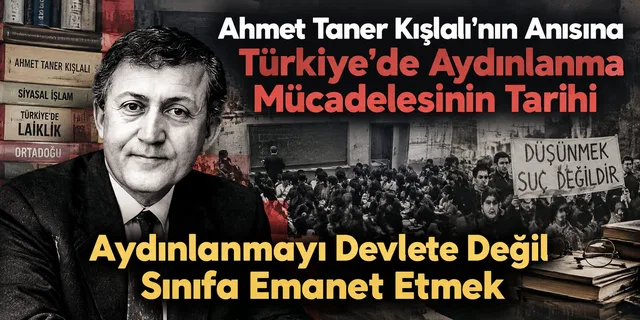
In the autumn of 1968 a group of revolutionary youth followed Mustafa Kemal's road of 1919 in the opposite direction, walking from Samsun to Ankara. The "March for Complete Independence", begun by Deniz Gezmiş, Bozkurt Nuhoğlu and Kazım Kolcuoğlu, and later joined by Cihan Alptekin and Hüseyin Cevahir, set out from Samsun on 29 October 1968 and reached the gate of Anıtkabir on the morning of 10 November. The slogan of the march was clear: "Mustafa Kemal for complete independence." (Oral Çalışlar's testimony, Serbestiyet) This slogan was one of the most basic slogans of the generation of '68.
In the same year the actions against the Sixth Fleet, and the struggle against the NATO bases and the presence of US soldiers, joined with the idea of a "Second War of Independence". The revolutionary youth of the 1960s saw the War of Independence as the "First War of Independence", and saw a Turkey that had become dependent on NATO, on US bases and on foreign capital as a country that had to be liberated again. Mustafa Kemal's principle of complete independence became, in the hands of this youth, a weapon against imperialism.
Deniz Gezmiş's words in the 1971–72 trial are the clearest expression of this reading. In court he said that the First Assembly and the National Pact (Misak-ı Milli) accepted Turks and Kurds as two brother peoples, and that "these two brother elements achieved the First War of Independence jointly". Against today's policy of denial he said "if Mustafa Kemal were alive he would be very surprised". And he added: "I wanted nothing other than Turkey's independence. And I am honoured, at the age of 24, to offer myself to Turkey's independence." In the letter he wrote to his father he also wrote that his father had lived in Mustafa Kemal's period and had seen what independence was, and that for this reason he would understand the meaning of dying for independence. (Cumhuriyet)
On 6 May 1972 his last words on the gallows gathered this whole line into one sentence: "Long live a fully independent Turkey! Long live the great ideology of Marxism-Leninism! Long live the independence struggle of the Turkish and Kurdish peoples! Down with imperialism! Long live the workers and the peasants!"
Let us look at the structure of this sentence, young comrades. "A fully independent Turkey" is taken over from Mustafa Kemal. But immediately after it come Marxism-Leninism, the brotherhood of the Turkish and Kurdish peoples, the workers and the peasants. The Denizler did not freeze Mustafa Kemal where he stood. They walked forward from the place where he had stopped. Almost every place where we said "if only" above finds an answer in the last sentence of Deniz and his comrades: class, the brotherhood of the peoples, the power of the worker and the peasant.
This reading was not undisputed on the Turkish left of the 1960s. Even among those who accepted the anti-imperialist character of the War of Independence, the class character of Kemalism, the role of the army and of the "dynamic forces", and the relation between the national democratic revolution and the socialist revolution were the subject of hard arguments. The gallows of 12 March was also the end of the hope that "the army and the youth go hand in hand". A state that swore in Mustafa Kemal's name executed the young people who carried his slogan of complete independence. This bitter lesson showed that the two lines inside Kemalism, the anti-imperialist revolutionary line and the line of the bourgeois order, had in the end separated.
Who Remembers Today, and Who Liquidates?
A part of the circles that speak Mustafa Kemal's name most today are part of the order that liquidates his most basic principles most. We touched this contradiction in The Republic Again, But Whose Republic? and in Whose Law Is the Republic's Law?: as identity polarisation covers the class agenda, Mustafa Kemal's name becomes a flag, and its inside is emptied.
| The principle Mustafa Kemal set | What today's order does |
|---|---|
| Complete independence: political, financial, economic, military | NATO membership, foreign bases, IMF programmes, an accumulation based on foreign debt |
| Cabotage and economic sovereignty | The handing of ports, energy and mines to foreign and native monopolies |
| Statism and public industry | The privatisation of public factories from Sümerbank to Tekel |
| Secularism and Tevhid-i Tedrisat | The religionisation of education, the opening of school doors by protocol to the foundations of orders and congregations |
| Women's equal citizenship | Withdrawal from the Istanbul Convention (2021), the making of women's labour precarious |
| "The truest guide in life is science" | The removal of university autonomy, the expulsion of scientists, the binding of science to capital |
This table also shows why the fight between "Atatürkist" and "enemy of Atatürk" is often a false fight. Between a politics that makes Mustafa Kemal's name a flag and defends NATO, the IMF and privatisation, and a politics that never speaks his name and applies the same programme, there is no difference from the side of class. The difference is between those who join complete independence and the Enlightenment with the interest of the working people, and those who sacrifice these to the interest of capital.
Complete Independence in the Age of Artificial Intelligence
Let us recall Mustafa Kemal's definition of "complete independence": complete independence in every field, political, financial, economic, judicial, military and cultural. In the 1920s the capitulations were foreign companies holding the ports, the railways and the mines. Today the new form of the capitulations is digital.
Our data sits in the data centres of foreign monopolies. The correspondence of public institutions passes through foreign cloud companies. The school life of our children is tied to Google's platforms. The news produced by the labour of journalists becomes a free raw material in the artificial-intelligence summaries of the search monopoly. The large language models trained with our language and our culture are the property of a few companies of the United States and of China. This is the test of the principle of complete independence in the digital age.
But here too the lesson of Deniz and his comrades must not be forgotten. Complete independence is not surrender to "native and national" capital. To put a native monopoly in the place of a foreign monopoly is not to abolish the capitulation. It is to change the owner of the privilege. Complete independence in the digital age is the people's ownership of the data, public control of the model, and the building of the infrastructure as a common. Bilgi Müşterekleri's line of "the people's data, the people's model" is the class counterpart, today, of the principle of complete independence. What Mustafa Kemal did with cabotage in the 1920s has to be done today by winning the data and the computing power for the commons.
Concrete Tasks for Today
- Take the memorial out of memorisation. On 10 November, at school, at the workplace and in the union, tell the anti-imperialist character of the War of Independence, the alliance with Soviet Russia and the letter written to Lenin. Make visible this bond that official history erased.
- Do not shrink from saying what was left unfinished. Speak, in a respectful and open language, of Mustafa Suphi, of the strike ban, of the failure to carry out land reform, and of the policies directed at the Kurdish people. Criticism is not a betrayal of the legacy. It is the task of completing the legacy.
- Defend the gains of the Enlightenment. Defend secular and scientific education, women's equal citizenship and the autonomy of the university as the agenda of the working people. Bind these to the class struggle, not to the identity fight.
- Carry complete independence into the digital field. Against the surrender of public data to foreign monopolies and against the schools' dependence on platforms, defend a public and free-software infrastructure, open models and data commons.
- Keep alive the line of Deniz and his comrades. Always speak the slogan of complete independence together with the workers, the peasants and the brotherhood of the peoples. Do not let nationalism cover the class agenda.
- Organise. Do from below, with the power of organised working people, what Mustafa Kemal did from above. Without organising in the union, in the chamber, in the neighbourhood and at school, no gain is lasting.
Dear young comrades,
When you remember Mustafa Kemal, stay away from two easy roads. The first is to turn him into an idol and to treat every word of his as beyond discussion. This tears him out of his own age, and it serves those who today swear in his name and sell his legacy. The second is to set him aside as a "bourgeois leader". That means not seeing a war won against imperialism, the revolutions made against the institutions of the Middle Ages, and the inspiration given to the oppressed East, and it leaves the field empty to reaction.
The right road is the road of Deniz and his comrades. Those young people who walked from Samsun to Ankara in 1968 saw Mustafa Kemal as a beginning. He had won the First War of Independence. The working people would win the second. Complete independence was not an end. It was a threshold. Beyond that threshold was a country where exploitation had been abolished, where the peoples lived as brothers and sisters, and where science and reason served humanity and not capital.
When you stand still at 09:05 on 10 November, fill that one minute not only with mourning but with a task. Think together of the war that showed imperialism can be defeated, of the revolutions that tried to free women and reason, and of the young people who walked to the gallows to carry them further. To complete what Mustafa Kemal left unfinished is the truest way to remember him.
For a fully independent, democratic and exploitation-free Turkey. For better futures, all together.
Sources
- Oral Çalışlar, "From Samsun to Ankara with Deniz Gezmiş", Serbestiyet
- "We Were Dyed in Red Blood for Independence", Cumhuriyet (Deniz Gezmiş's defence and letters)
- Deniz Gezmiş, Wikipedia
- Mustafa Kemal Atatürk, Nutuk (1927).
- Karl Marx, Friedrich Engels, The Communist Manifesto (1848).
- V. I. Lenin, Draft Theses on the National and Colonial Questions (Second Congress of the Comintern, 1920).
- Jawaharlal Nehru, Glimpses of World History (Dünya Tarihine Bakışlar, 1934).
- Treaty of Moscow (16 March 1921); Treaty of Lausanne (24 July 1923).
Related essays from Bilgi Müşterekleri
- Whose Republic? A Basic Guide in Its 103rd Year
- Why Is the Republic a Bourgeois Revolution?
- The Republic Again, But Whose Republic?
- Whose Law Is the Republic's Law?
- What Did the October Revolution Give the World?
- 12 September: The History, Balance Sheet, and Present of a Class Coup
This essay is published under the CC BY-SA 4.0 licence. It is a living document. It is updated with criticism and contributions.