Whose Is the Machine's Voice?
On Martin Fowler's "LLM Voice": Writing, Thinking and the Voice of Labour

Dear Young Comrades,
Martin Fowler, one of the most widely read names in the software world, added a short entry to the conceptual glossary (bliki) on his personal site on 29 October 2026: "LLM Voice". Fowler is the textbook author of a generation of programmers, through the book Refactoring and through what he has written on microservices and agile software. The subject of the piece is not technical. It is that the texts we read increasingly speak in the same tone.
In this piece we will first summarise what Fowler said, then ask the same question again from our window, the window of labour and class.
First, a Summary
- What does Fowler say? In more and more of the texts he reads on the web, he hears an "LLM voice". He cannot quite describe this voice, but he recognises it. As he reads, his interest wanes, and he feels a reluctance that sometimes amounts to disgust. He likens this to the "uncanny valley" in robotics: the unease produced by something that is almost human, but not quite.
- Are detection tools useless? For Fowler, the real issue is not the accuracy of the tool. The reader's reaction comes before the tool. A report that says "there is no artificial intelligence in this text" does not save a text that has already lost the reader.
- His advice to the writer: Do not have the model write the draft. However much you correct it afterwards, that voice does not easily leave the text. Be careful, too, with the model's suggestions that "it would be better if you said it this way". Drawing out the outline, the skeleton, with the model may be acceptable, but the writer should build the sentences.
- Why? Because writing is thinking. Fowler says he usually resolves the confusion in his head while wrestling with words. Whoever hands over the writing has also handed over the thinking and the understanding.
- Exceptions: The model being indispensable if Jim Highsmith, who lives with Parkinson's disease, is to go on writing; colleagues for whom English is a second or fourth language using the model for translation; texts "spoken to a process, not to a person", such as a report no one will read, or a formulaic petition written to an official body.
- His own rule: Every writer who receives help from artificial intelligence on Fowler's site must say so in the acknowledgements. He himself uses the model only as a search tool, and checks what he finds against the source. At the end of the piece he also notes that he used no artificial intelligence tool while writing this text.
- Our question: Fowler poses the matter as a writer's ethic. The reader's disgust at the voice is real. The criterion we set earlier, in A Debate on Writing with Artificial Intelligence, still stands. An informational text is weighed not by how it was written, but by what it says, whose side it takes, and whether the signature stands behind it. We will also ask where that voice comes from, whose labour it was distilled from, and why it spreads everywhere: whose voice is the machine's voice, under whose control, to whose benefit?
Fowler's Piece in Detail
A voice that cannot be described, but is recognised
Fowler lists the known signs of the LLM voice: a glut of long dashes, excessively ornate similes. But he adds at once: the matter is not confined to these signs. There is something that cannot be caught in individual sentences and is felt in the whole. At some point the reader loses interest in the text and cannot say why.
We recognise this voice in Turkish too: stock phrases such as "of critical importance", "an in-depth look", "not only X but also Y", "on this journey", "ecosystem", "transformative potential", a lesson sentence at the end of every paragraph, every list having three items. The sentences are flawless in grammar, but nobody is speaking.
Doubt about oneself
The most honest part of the piece is Fowler doubting his own ear. Language is changing. He has heard people using some of the patterns that disturb him. What he is experiencing, he says, may not be the difference between machine and human, but the difference between generations. This reservation matters: the charge of "LLM voice" can itself become a sorting tool. It is easy to say "a machine wrote this" of the text of a student, a migrant, or someone writing in a second language.
"Say it, then write it"
Fowler's own method is simple: he says the sentence in his head aloud, writes it, then corrects it. He says the habit he described earlier under the title "Say Your Writing" has become even more important in the age of LLMs. The skill of writing develops with practice. Whoever hands the practice to the machine has also handed over the skill.
Exceptions, and Nygard's note
Fowler's exceptions are humane: for someone who cannot write because of illness, the model is a prosthesis. For someone who has to write in another language, it is a bridge. Even so, Fowler says he prefers a clumsy but human sentence written in a second language to a fluent but soulless machine sentence.
The observation he quotes from Michael Nygard in a footnote is, for us, the most interesting place in the piece: when we write a formulaic petition, or a report no one will read, we are in fact speaking not to a person but to a process. The person "reading" that text is also working as part of a cybernetic organism. Bureaucracy had already turned the human into a machine; the model only brings this into the open.
Closing: the real fear
At the very end Fowler says that models may one day write so well that they cannot be told apart, and that this is more worrying than today's uncanny valley. One day only models may read the documents. But if we want to speak with humans, our humanity has to be read from the text we write.
From Our Window: The Political Economy of the Voice
We agree with Fowler's finding: the directionless voice covering the web is real, disclosure is a debt of honesty, and handing thinking over to the machine also hands over the skill. But the piece both leaves the matter to the individual writer's conscience and sets up the reader's disgust as if it were a criterion. We separate two things. The value of a text and the ownership of the tool are not the same judgement. We will look at the source of the voice, its distribution and its cost; and we will weigh the text by the criterion we set earlier.
Our criterion has not changed
We take Fowler's disgust seriously. We do not turn this disgust into a verdict. In A Debate on Writing with Artificial Intelligence we listened to both sides, then drew a line. The first side is right about how a text is judged: in an informational text, what matters is what is said, whether it is said correctly, and whether it satisfies the reader. The second side is right about the ownership of the tool and its social effect: its raw material is other people's labour, the employer uses it to push wages down, and handing over thinking also hands over the skill.
The problem is passing judgement on the place where the first side is right, from the place where the second side is right. To say "this text was written in an LLM voice" is to aim the anger felt at the owner of the tool at the text of the person using the tool. Fowler's ear is recording an aesthetic reaction. Our criterion is five questions: Is it correct? Is it clear? What does it say, and whose side does it take? Does it satisfy? Who takes responsibility for it?
This distinction also depends on the kind of text. In a literary text, the voice is the content itself. This is where Fowler says "our humanity should be read from the text we write". In an informational text, style is instrumental. To set aside a union pamphlet, an analytical piece or a teaching note because it "has no original voice" does not take the place of saying "wrong", "incomplete", "cannot be understood". The directionless average, the slurry that says everything and says nothing, appears both in the machine's text and in the directionless human's text. The question that catches it is not "did a machine write it?" but "whose side is it on?"
Transparency, meanwhile, is a condition, and it is not a shame. In that piece we said openly that artificial intelligence is used as a tool on this blog, and that the choice of subject, the framework, the choice of sources and the signature are ours. Here we meet the disclosure rule Fowler set on his own site. The dividing line is between having a machine write something and not standing behind it, and writing with a machine and standing behind it.
Whose voice is that voice?
A language model's "voice" comes from nowhere. Forum posts, encyclopaedia entries, news copy, books, lecture notes, code comments: it is distilled from what millions of people have written. This is the present form of the social knowledge Marx called the "general intellect". The process we described earlier in The Expropriation of the General Intellect and the AGI Illusion is at work right here: social labour is gathered, torn from its owners, averaged, and sold back as a service that can be rented.
This is also why the LLM voice feels "soulless". That voice is nobody's voice. It is the average of everyone's voice. Crystallised labour speaks, separated from the worker. A voice whose identity, whose standpoint and what it risks are unclear. The social name of what Fowler calls the "uncanny valley" is alienation: the language we ourselves produced returns to us as an alien power.
Handing over writing: mental Taylorism
Fowler says "whoever hands over the writing also hands over the thinking". Harry Braverman said this for the factory in 1974: monopoly capitalism separates the design of the work (conception) from its execution. Knowledge is concentrated in management, and the worker is left only with fragmented execution. The skill disappears, and the worker becomes cheaper.
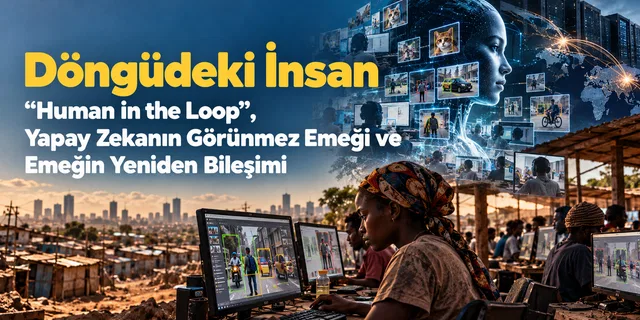
The same thing happens in writing. First it is said, "you build the skeleton, let the model write the sentences". Then it is said, "let the model build the skeleton too, you only approve". At the end the human becomes a "human in the loop", checking what the machine produced. We discussed this process in The Human in the Loop and, on the news that Microsoft has the model write forty per cent of its code, in Forty Percent of the Code, a Quarter of the Staff. The labour of writing is travelling the same road as the labour of code.
When Fowler says "skill develops with practice", he is giving individual advice. From capital's point of view this is a calculation: a writer, and a programmer, who has not practised and whose skill has not developed can be replaced more easily and employed more cheaply.
The pen may change. What we refuse is conception being taken from the worker, passed to management, and from there handed to the model. If the writer keeps the thought, the framework and the signature, making use of the machine is the use we counted as normal in that piece. What capital wants is the opposite: a labour-power that cannot tell the difference and is therefore cheaper.
Who can write slowly?
There is a class difference here that Fowler does not see. Fowler owns his own site, he is a writer who has been known for years, and he is in a position to have eight colleagues read his text and comment. For him, "write the draft yourself" is a choice.
The situation is different for a copywriter expected to deliver twelve texts a day in a content agency, a reporter working to a click quota on a news site, a translator paid by the page on a translation platform, a worker in customer service who "personalises" ready-made replies. Their performance targets are being reset to the speed of the model. Writing slowly is becoming a luxury. The reason the LLM voice covers the web is the adjustment of the pace of work to the machine.
So "writing in a human voice" cannot be protected by individual virtue. It takes time, and time is a matter of struggle over wages, posts and workload.
The monopoly of language
There is also a question of scale. The models of a few companies write the first draft of a growing share of the texts written in the world. This means a concentration over language itself with no precedent. In languages such as Turkish the situation is heavier: the model often builds Turkish as if it were thinking in English and translating. Sentence structures, idioms and emphases become the same. In Why We Are Done Saying "the Woman Problem" and "the Kurdish Problem" we discussed care for language as a cultural question. Today this is also a question of property: who sets the average of the language?
Fowler's exceptions are right, his measure is incomplete
Highsmith's illness, colleagues writing in a second language, the formulaic petition. The common point of these exceptions is this: the tool carries the human's voice, it does not take its place. This distinction is right, and it matters. We are not against technology. As we said both in For the Restitution of the General Intellect: The Socialist AI Manifesto Is Out and in A Debate on Writing with Artificial Intelligence, the question is in whose hands the tool works, and to whose benefit. We are against the capitalist use of the machine.
But who will decide who counts as an "exception"? Today the employer decides: in which job the model will be used, whose text will count as "good enough", which post will be abolished. The disclosure rule Fowler set on his own site is a good example. This rule needs to be set by the organised power of the workers, and not by a publisher's goodwill.
There is a concrete example of this: in the US, the screenwriters' union, the WGA, at the end of the 148-day strike in 2023, had artificial intelligence clauses written into the contract it signed with the producers. The measure of those clauses is not to ban the writer from using the tool by their own choice. Artificial intelligence cannot write a screenplay and cannot rewrite one; the model's output cannot be counted as a "source" that diminishes the screenwriter's labour; the company cannot force the writer to use the model; if the model was used in material given to the writer, this is disclosed. Fowler's individual rule is, there, a collective-agreement clause won by a strike. The gain is the banning of the employer using the pen against the writer.
Nygard's cybernetic organism
Let us take Nygard's note a little further. The model writing the formulaic petition, and another model reading it on the other side, means two institutions speaking to each other with no human in between. This looks like efficiency. But for the citizen writing the petition, the customer making a complaint, the worker raising an objection, it can mean their voice reaching nobody at all. The alienating language of bureaucracy is now being automated. The duty to listen to the people's voice is being reduced to a model's function of summarising.
Two Ways of Looking, Side by Side
| Fowler's piece | From the class window |
|---|---|
| The LLM voice creates an uncanny feeling in the reader | This feeling is a datum: alienation. It is not a verdict. The label "it smells of AI" does not take the place of the text |
| Do not have the model write the draft; build the sentences yourself | In a literary text the voice is the content itself. In an informational text the measure is five questions: is it correct, is it clear, whose side is it on, does it satisfy, does the signature stand behind it |
| Writing is thinking; whoever hands over the writing hands over the thinking | Handing over conception and responsibility is mental Taylorism. Making use of the tool while keeping the framework and the signature is normal |
| Skill develops with practice | The time to practise is a matter of wages, posts and workload. First learn to write, then speed up |
| Disclose the use of artificial intelligence | Disclosure is transparency, and it is not a shame; it should be a collective-agreement right, not a publisher's favour (WGA 2023) |
| Illness, translation and formulaic text are exceptions | Workers and readers should decide the exception, not the employer. The writer's own choice is not a matter for a ban |
| The real fear: models becoming impossible to tell apart | The real question is not whether the voice can be told apart: who spoke the word, and who sets the average of the language |
Concrete Tasks
For those who write (journalists, translators, copywriters, academics, programmers):
- First be sure you can build your own paragraph, then use the tool for speed. Let the framework, the stance and the signature stay with you. Verify the source yourself: the error is published under your signature.
- If you used a model, say so. Disclosure is a condition of transparency, and it is not a shame. Make this a rule in your own writing and in your own publication.
- Before dismissing a text as "LLM voice", say in one sentence what is wrong, missing or directionless. If you cannot, you are sticking on a label. Do not turn this charge into a sorting tool against people writing in a second language, against students, against migrants.
At the workplace and in the union:
- Oppose the imposition of model use in the job description and in performance targets. Open to debate the pace set by the calculation "with the model it is finished in so much time".
- Bring onto the agenda the demand to put an artificial intelligence clause into collective agreements and workplace rules: a ban on imposition, a duty to disclose, no abolition of posts on the grounds of model use, no unpermitted use in model training of the text the worker produced.
- Study the WGA experience in the press, translation and content sectors, and adapt it to our conditions.
For the knowledge commons:
- Ask whose model the stock of Turkish texts (news archives, encyclopaedias, academic work) is feeding. Be a defender of openly licensed Turkish corpora and of public models.
- Organise the practice of reading and writing. Reading groups, writing workshops, networks of comrades who read one another's texts: the most concrete way to defend human time against the speed of the machine.
Dear Young Comrades,
Fowler closes his piece from somewhere near the question "where does the pleasure of writing remain, then?" This question is a writer's question, but it is also a worker's question. Taking pleasure in one's work, seeing oneself in what one produces, is what Marx set against alienation.
The machine's voice has been distilled from everyone's voice, and it is nobody's voice. Our voice, by contrast, speaks from a definite place, from a definite class, from a definite struggle. It may be clumsy, it may be faulty, but it is ours. To protect that voice is to protect thinking. And protecting thinking is possible only if it is organised: by winning a say over our own time, our own language and our own knowledge.
We have written this before: when looking at a text, the question is not who held the pen. The question is who spoke the word, what it says, and whose side it takes.
Build your own sentences. Read one another's sentences. The machine is new, the chain is old. The pen is new, the word is old.
Sources
- Martin Fowler, "LLM Voice", martinfowler.com bliki, 29 October 2026.
- Martin Fowler, "Say Your Writing", martinfowler.com bliki.
- Martin Fowler's post on X: x.com/martinfowler.
- Masahiro Mori, the "uncanny valley": Wikipedia, Uncanny valley.
- Harry Braverman, Labor and Monopoly Capital: The Degradation of Work in the Twentieth Century (1974).
- Karl Marx, Grundrisse, "Fragment on Machines" (the concept of the general intellect); Economic and Philosophic Manuscripts of 1844 (alienation).
- Writers Guild of America, Summary of the 2023 MBA: Artificial Intelligence.
Related pieces from Knowledge Commons:
- A Debate on Writing with Artificial Intelligence
- The Expropriation of the General Intellect and the AGI Illusion
- Forty Percent of the Code, a Quarter of the Staff
- The Human in the Loop
- Why We Are Done Saying "the Woman Problem" and "the Kurdish Problem"
- For the Restitution of the General Intellect: The Socialist AI Manifesto Is Out
This piece is published under the CC BY-SA 4.0 licence. It is a living document; it can be updated with readers' comments.