

For the Restitution of the General Intellect: The Socialist AI Manifesto Is Out
Their rule binds the machine, ours binds the owner — one manifesto, ten demands, fifteen rights

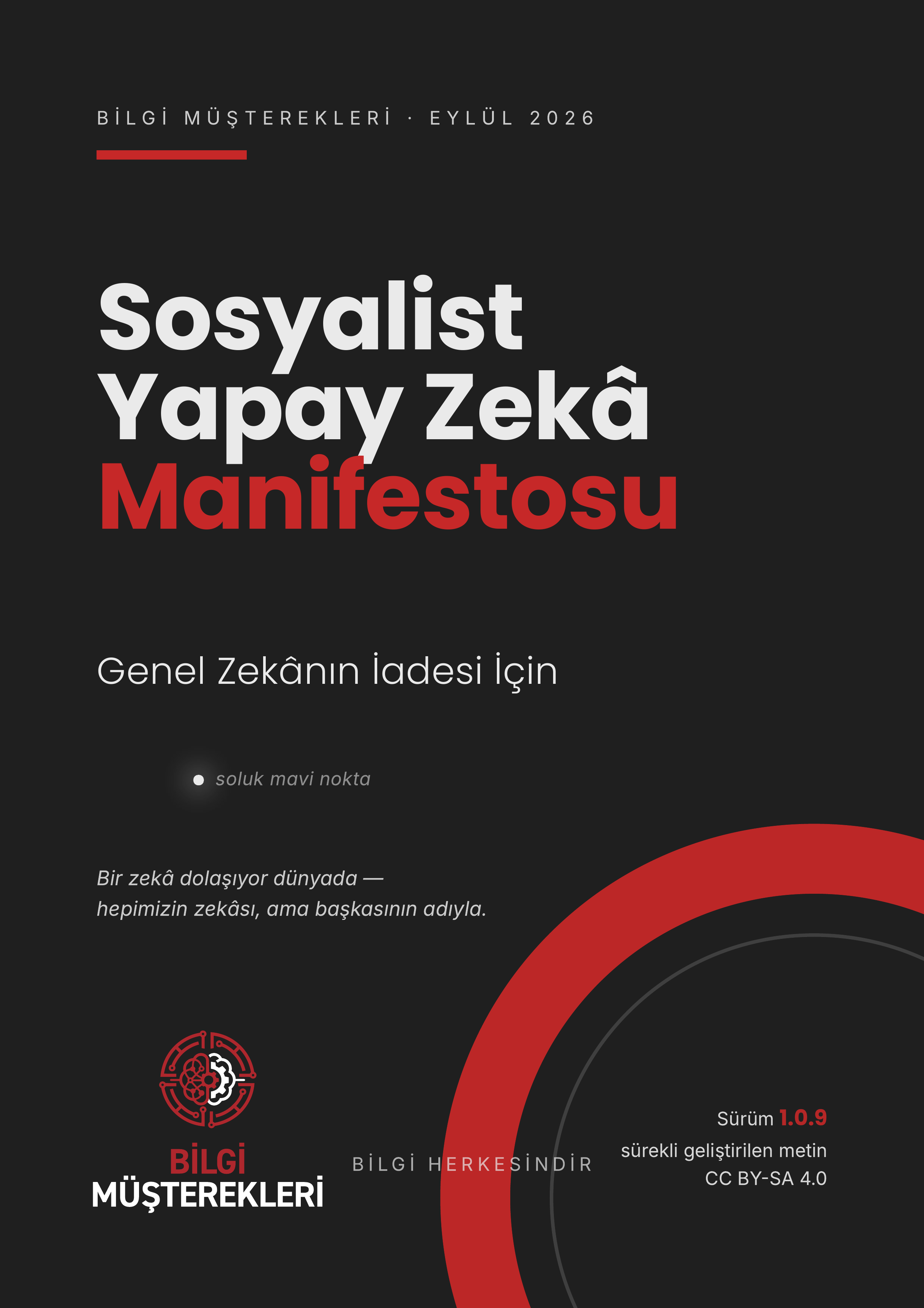
Socialist Artificial Intelligence Manifesto, version 1.0.9 — among all our guides.
Dear young comrades,
In the past year we have read dozens of AI manifestos, codes of conduct, declarations of principle, and calls to “pace.” On this blog we have taken most of them apart, one by one: Amodei’s brake, Coxon’s resignation, Anthropic’s threat report, the 2030 scenarios, Palantir’s manifesto and this week Microsoft’s “humanist” code of conduct and a “pragmatist manifesto”. All of them came from companies, from people leaving companies, or from institutes funded by companies. All of them spoke in the name of “humanity.” None of them spoke in the name of the wage-earners who make up the great majority of that humanity — because none of them asked them.
Taking them apart was necessary; but taking them apart is not, by itself, a programme. That is why today we set our own text against the texts we have criticised:
The Socialist Artificial Intelligence Manifesto — For the Restitution of the General Intellect.
Version 1.0.9. Fifty-three pages. CC BY-SA 4.0. Open to signature, translation, adaptation, and criticism. As a printable PDF, ePub, and Markdown:
This piece says what the text is, how it is built, and how it is to be used. At the end we give, as it stands, with all fifteen articles and their commentaries, the part of the manifesto we think will be used most — the Declaration of Workers’ Rights in the Age of Artificial Intelligence.
Why a manifesto?
A manifesto is not a bill; it is not a detailed regulation; it is not an academic paper. A manifesto is a text in which a class states its own interest in its own language. It does not comment on the other side’s agenda; it writes its own. The text of 1848 did not ask whether the bourgeoisie was right; it said “who we are and what we want.”
Our text does this too, and in doing it it consciously follows the four parts of the 1848 Manifesto:
| 1848 | 2026 |
|---|---|
| I. Bourgeois and Proletarians | Owners and Producers — “who produces, who owns” across the seven links of the AI chain |
| II. Proletarians and Communists | Socialists and Artificial Intelligence — our position, answers to objections, the Ten Demands |
| III. Socialist and Communist Literature | AI Literature: What We Take from Whom — nineteen texts, from Barlow to Kleiner, from Haraway to McQuillan |
| IV. Position of the Communists in Relation to the Various Existing Opposition Parties | Our Relation to Other Movements — unions, ecological resistance, digital rights, Turkey, the international |
This is not imitation; it is a choice of method: this is the most solid form, known for 178 years, in which a class writes its own programme.
The text has two further foundations. The first is the Universal Declaration of Human Rights — written in 1948, it did not foresee AI, but it had already written the rights AI requires (Articles 23, 24, 27: work and union, rest and limitation of working hours, sharing in scientific advancement). The second is the tradition of workers designing technology with their own hands, from the Lucas Aerospace workers writing their own “alternative corporate plan” in 1976 through the Telekommunist Manifesto of 2010 to the Data Workers Inquiry of 2024.
The thesis in one sentence
The rest of the text is the unfolding of a single sentence:
The general intellect is, by definition, socially produced; its private appropriation is not a technical necessity but a historical expropriation.
What is called “artificial intelligence” is a statistical compression of humanity’s written accumulation; it is the labour of the worker labelling at $1.32 an hour in Nairobi, of the chip worker in Taiwan, of the miner in the Congo, of the basin that gives the data centre its water, and of the user who corrects the output. The general intellect, which Marx named a hundred and seventy years ago in the Grundrisse, has today been turned into a machine and made the property of a few companies: three companies hold 63 percent of the world’s cloud, a single company about 80 percent of the accelerator market, five companies $440 billion of capital expenditure in 2025.
The position that follows is the position this blog has defended since the Karaburun paper: Our demand is not compensation; it is restitution. We are not against AI; we say it belongs to us.
What is in the text?
Before we begin — Pale Blue Dot. The text opens with the photograph Voyager took from six billion kilometres away. From that point neither a company is visible, nor a server, nor a licence agreement; a single species is visible, in a single place, with a single accumulated intellect. As you approach, the fences appear — and to see the fences is not pessimism; it is a job description.
Part One tells the third enclosure: land (from the Charter of the Forest to the parliamentary enclosures), knowledge (from the Statute of Anne to TRIPS), and now the very capacity to produce knowledge. It recalls the real demands of the Luddites and Marx’s lesson in Capital — the distinction between the machine and the capitalist use of the machine. It shows the common function of two fairy tales (the sermon of liberation and the narrative of apocalypse) and of their hybrid, the “responsible monopoly” story: all three erase the agent.
Part Two answers eight objections — “you are against technology,” “planning cannot be done,” “what if China does not stop,” “what about the model’s rights” — and lists the Ten Demands: restitution of the general intellect, socialisation of compute infrastructure, breakup of the monopoly, a commons regime for data, automation as a matter of collective agreement, deduction of productivity gains from working time, bounds on algorithmic management, prohibitions of use for the whole chain, making invisible labour visible, free AI education and access for everyone. Over every demand a single principle of sanction: who chooses the auditor, who pays them, do they have the power to stop?
The Declaration — fifteen rights; the whole of it is at the end of this piece.
Part Three is the honesty section: a manifesto is not written without reading what was written before it, and it does not hide what it has read. An “what we take / what we leave” table for nineteen texts. Our nearest relative is Kleiner’s Telekommunist Manifesto: that network architecture is political, that there is no such thing as an immaterial commons, and the limit of copyleft are lessons that are ours; mutualist “venture communism” and the illusion of licence-as-strategy are not. From Srnicek and Williams we take the idea of taking planning back; we leave the determinism. From McQuillan we take workers’ councils; we complete the missing property question.
Part Four is the evidence section: struggles of the last three years that show workers can win something against AI — and that none of them was won by a code-of-conduct text. In Hollywood, a 148-day strike that established “AI is not a writer”; game performers’ right, in a strike, to suspend consent to a digital replica; workers in Nairobi at $1.32 an hour bringing the world’s most valuable company into their own courts; in Bologna, the first ruling that an algorithm was discriminatory; in Seattle, engineers who risked being fired cutting a military intelligence unit’s cloud access; in Chile, a neighbourhood getting Google’s water permit revoked. For Turkey, five urgent demands: ratification of ILO Convention No. 193; recognition of computing as a separate branch of industry and removal of the 1 percent threshold; publication of public bodies’ AI contracts; disclosure of the water and energy budget of every data-centre project; every model produced with public money being open.
Appendices: a chronology from 1217 to 2026, a comparison table of manifestos, sourced figures, an eighty-item bibliography, and “how to use this text.”
How is this text to be used?
It was not written to be read; it was written to be used. Five ways:
- Signature. As a person, a union, a chamber, a cooperative, a community. A signature is not agreement with every article; it is agreement with the frame of the Ten Demands and the Declaration. Signing while naming the article you do not accept is better than not signing at all.
- Collective agreement. Articles V, VI, VII and IX of the Ten Demands, and Articles 4, 5, 6, 7 and 9 of the Declaration, can be carried to the table in any workplace today; the WGA, SAG-AFTRA, TUC and EU Directive texts are precedents.
- Opinion letters and bills. The five urgent demands in the Turkey section can go directly into a professional chamber’s opinion letter or a member of parliament’s bill.
- Study. A four-session reading-group plan is at the end of the text; every session closes with the question “what article is missing in this text, for us?”
- Translation and adaptation. CC BY-SA 4.0. Every translation can write its own country’s “Turkey” section. Changing the version number and naming the source is enough.
And one rule: to criticise this text is a form of using it. The text carries a version number — 1.0.9 — and is under continuous development. Write the article you find missing, correct the figure you find wrong; every correction enters the next version with the corrector’s name.
A note on design
The text was prepared to be printed: A4, gutter for duplex printing, smallest type 12 point. Each article of the Declaration is on its own page — so that it can be posted as a single sheet on a workplace noticeboard, in a union hall, in a classroom. At the end there is “The Declaration on One Page”: fifteen short sentences, to fit a banner.
The small pale dot on the cover is Sagan’s dot. The red ring on the back cover is the ring of the knowledge commons.
Dear comrades,
This week we read two company texts; both discuss the leash at length, neither discussed the hand that holds it. This manifesto names that hand and demands the title deed.
In saying this we are not alone. While this text was being written, there were people everywhere in the world already saying a piece of this sentence. They are not few in number; they are scattered. This text was written so that that scattering might gather around a common sentence.
Producers of the general intellect, unite.
APPENDIX — DECLARATION OF WORKERS’ RIGHTS IN THE AGE OF ARTIFICIAL INTELLIGENCE
The relevant part of the manifesto, as it stands. Version 1.0.9.
The Ten Demands are a programme; a programme changes, is updated, enters bargaining. The fifteen articles below are rights; they do not enter bargaining.
This section was written in the form of the 1948 Universal Declaration of Human Rights, because that form has for seventy-eight years been the form that best knows how a right is to be stated: a short, unconditional sentence that begins with “everyone.” Those who wrote the Declaration had not foreseen AI; but they had already written privacy in Article 12, expression in 19, organisation in 20, the right to work and to unionise in 23, rest and the limitation of working hours in 24, education in 26, sharing in scientific advancement in 27. What we are doing is applying those rights to this age’s means of production.
Under each article there are four things: What it says — the plain meaning of the article; Why it is needed — against which violation it is written today; Basis and precedent — which universal right it rests on, and where in the world it has already been won; Concrete counterpart — how it would enter a collective agreement, a regulation, or a law.
When an article enters a declaration it is not won; it is defined. Winning it is the work of Part Four, that is, of organisation.
Article 1 — The right to share in scientific advancement
Everyone has the right to share in humanity’s common accumulation of knowledge and in every system produced with that accumulation. Scientific advancement and its applications are not a privilege but everyone’s right.
What it says. AI systems have been trained on humanity’s accumulated knowledge; sharing in those systems is therefore not a customer privilege but the right of everyone who has contributed to that accumulation. Access cannot be restricted by ability to pay, by country, by language, or by subscription tier.
Why it is needed. Today the most powerful models are sold by graded subscription: the free tier is weak, the paid tier is strong, the enterprise tier is strongest. This is the sorting of knowledge itself into class grades. The same model, with the same training data, offers one quality of answer to a bank and another to a student. Everyone produced the general intellect; those with money use the best version.
Basis and precedent. UDHR Art. 27(1): “Everyone has the right … to share in scientific advancement and its benefits.” ICESCR Art. 15(1)(b) repeats the same right as a binding treaty provision. Precedent: Aaron Swartz’s 2008 manifesto named the locking-up of knowledge produced with public money as a violation of this right; the open-access movement has in part of scientific publishing won this right in practice.
Concrete counterpart. A public AI layer: free, without tiers, of equal quality in every language of the country. The weights and evaluation results of every model trained with public money are open. Public bodies, schools, libraries, and health institutions are connected not to commercial models but to this layer.
Article 2 — The right to know where one’s labour is used
No one may be subjected to the use of their labour — what they have written, drawn, said, coded — in the training of a model without being asked, or to the use of that model against them. Everyone has the right to know where their own labour is used.
What it says. A writer’s novel, a translator’s translation, a programmer’s repository, a forum user’s reply, a photographer’s archive, a teacher’s lecture notes — all have been used in model training. This article demands two things at once: that use be knowable (an inventory) and that use not be turned against the owner of that labour (as when a model trained on a translator’s translations is used to eliminate that translator’s job).
Why it is needed. Model owners summarise training data as “the public internet” and publish no inventory. This opacity is not an accident; it is a legal defence strategy: if what was used is unknown, whose right was violated is also unknown. That is why the Writers Guild of America was able, in its 2023 contract, to place a “reservation of rights” on use for training but could not obtain an outright ban — because the other side was not saying what it had used.
Basis and precedent. UDHR Art. 27(2): the right to the protection of the moral and material interests resulting from any scientific, literary or artistic production. Precedent: the EU AI Act (2024) made it obligatory for general-purpose models to publish a “sufficiently detailed summary” of training data — inadequate, but a start.
Concrete counterpart. Public publication of every model’s training-data inventory: source, licence, method of acquisition. A collective right of objection over the inventory for professional organisations (unions of writers, translators, journalists, programmers, artists). A commons regime for data: a knowledge fund, established by a compulsory contribution levied on the sector, that feeds producers.
Article 3 — The right of consent over a digital replica
Everyone has the right to give open, informed, and revocable consent to the making of a digital replica of their voice, face, body, and style; to withhold consent; and to suspend the consent they have given, including during a strike, under any condition.
What it says. A person’s voice, face, movements, and manner of expression are part of their labour and their person; a digital replica of these can be made only with open and informed consent. Consent cannot be given once and remain valid forever: it is revocable and — most important — can be suspended during a strike. Otherwise the employer works the copy of the worker on strike and breaks the strike.
Why it is needed. Voice actors, performers, presenters, teachers, and customer-service workers have begun to be replaced by synthetic copies produced from their own recordings. The copy puts the original out of work while working with the original’s labour. This is a new situation in the history of labour: the worker being employed as their own strike-breaker.
Basis and precedent. UDHR Art. 12: prohibition of arbitrary interference with privacy and person. Precedent: SAG-AFTRA’s 2023 contract brought open and detailed consent for an “employment-based digital replica,” payment per use, and a provision that the replica cannot be used to reduce the number of extras. The 2025 video-game agreement wrote in the right to suspend consent during a strike — that is the direct source of this article.
Concrete counterpart. A digital-replica article in collective agreements: separate and written consent, payment per use, a time limit, automatic suspension in a strike, after death the approval of heirs and the union. In personal-data law, special protection of voice and face recordings as “biometric data.”
Article 4 — The human right against automated decision
Everyone has the right to know that every decision taken about them that affects their life — hiring, credit, health, education, social assistance, punishment — was taken by a human or can be reviewed by a human; to learn the reasons for the decision in an intelligible form; and to appeal the decision before a human. Dismissal, account closure, or deprivation of a service by automated decision alone is prohibited.
What it says. A model’s score cannot, by itself, decide over a person’s life. Behind decisions such as not being hired, being dismissed, a credit refusal, the cutting of social assistance, the closing of an account, there must be a human; that human must actually review the decision (not merely press an “approve” button); the other party must be able to understand the reasons and appeal to a human.
Why it is needed. Couriers, drivers, and platform workers have for years met “robo-firing”: an account closes one morning, the reason is waved away as “system violation,” no human can be found to appeal to. In public services, risk scoring has begun to decide which household will receive assistance, which student will be counted “at risk.” The Dutch childcare-benefits scandal wrecked tens of thousands of families by an algorithm counting them as “fraudsters.”
Basis and precedent. UDHR Arts. 7 (equality before the law), 8 (effective remedy), 10 (fair hearing). Precedent: the Amsterdam Court of Appeal (4 April 2023) held that Uber’s driver deactivations were automated decisions under GDPR Art. 22 and that remote “human review” was not meaningful; the company was fined €584,000. The EU Platform Work Directive (2024/2831) prohibited dismissal and account restriction by automated decision alone.
Concrete counterpart. A provision in the Labour Code: model output cannot be the sole or decisive basis of dismissal, discipline, or hiring decisions; a written statement of reasons and human re-examination are obligatory; the burden of proof is on the employer. In public administration, a register of automated-decision systems and publication of error statistics.
Article 5 — The right to transparency of workplace measurement and access to data
Everyone has the right to know what is measured about them at work, how they are scored, and to whom it is transferred, and to access their own data. No one may be monitored through their life outside work, their emotions, their health, or their political and union leanings.
What it says. Algorithmic management governs the worker by measuring them: scan speed, idle time, keyboard rhythm, location, tone of voice, facial expression. This article draws two bounds. The first is transparency: everything measured is disclosed to the worker and their union; the worker accesses their own data. The second is forbidden fields: emotion, health, private life, political and union leaning cannot be monitored under any condition.
Why it is needed. The French data authority documented Amazon monitoring warehouse workers by the second: a scan faster than 1.25 seconds was flagged as “machine gun,” a 10-minute pause counted as “idle”; a fine of €32 million was levied. In call centres, emotion-recognition software produces a “positivity” score for the conversation. None of these measurements is disclosed to the worker; the worker is measured with a ruler they cannot see. That is mental Taylorism: the stopwatch is now invisible.
Basis and precedent. UDHR Arts. 12 (privacy), 19 (thought), 20 (organisation), 23 (just conditions of work). Precedent: Spain’s 2021 “Rider Law” made it obligatory to notify the union of the logic of workplace algorithms. EU Directive 2024/2831 prohibited the processing of emotional-psychological state, private correspondence, biometric identification, and union-activity data. The UK TUC’s 2024 bill proposes banning harmful emotion recognition.
Concrete counterpart. Written notification to the union of workplace measurement systems (what is measured, how it is scored, to whom it goes); the worker’s right to download their own data; an explicit ban on emotion recognition and on inference of health and union leaning; a fine as a share of turnover in case of violation.
Article 6 — The right to organise and to collective bargaining
Everyone in a job that produces AI or is managed by AI has the right to organise and to collective bargaining. This right is independent of the form of work, the name of the contract, the subcontracting chain, and national borders.
What it says. The right to a union cannot be left dependent on being granted the title “worker.” The data labeller as “independent contractor,” the courier as “own-account trader,” the moderator as “subcontractor staff,” the engineer as “high-paid professional” have been named so as to be pushed outside this right. This article takes the relation, not the naming, as essential: whoever does whose work, under whose direction, has the right to organise.
Why it is needed. Every link of the AI chain has been designed to make organising hard: data workers are scattered and anonymous across platforms; moderators sit in the subcontractor’s subcontractor; engineers are positioned as a layer that “does not need a union”; in Turkey, computing is not counted as a separate branch of industry and there is a 1 percent industry-threshold, so a collective agreement in the sector is practically impossible.
Basis and precedent. UDHR Art. 23(4): “Everyone has the right to form and to join trade unions for the protection of his interests.” ILO Conventions Nos. 87 and 98; ILO Convention No. 193 on Decent Work in the Platform Economy (2026), Art. 3: the right to organise and to collective bargaining for all platform workers, independent of employment status. Precedent: the African Content Moderators’ Union founded in Nairobi in 2023; the Kenya Court of Appeal’s ruling counting Meta as the de facto employer (September 2024).
Concrete counterpart. Recognition of computing as a separate branch of industry in Turkey and removal of the 1 percent threshold; ratification of ILO 193; responsibility of the principal employer in the subcontracting chain; global framework agreements with multinational companies for cross-border workers.
Article 7 — The right to refuse harmful work
Everyone who reasonably believes that a system they are developing or using will harm people has the right to refuse that work and to suffer no sanction on account of that refusal. Conscientious objection is a right not only under arms but in front of code.
What it says. An engineer may refuse to write code for a targeting system; a data worker may refuse to produce labels for a surveillance model; a cloud operator may refuse to store an army’s data. This refusal is reasoned and written; the system stops until it has been examined; dismissal, a block on promotion, a performance downgrade, or a blacklist cannot be applied on account of the refusal.
Why it is needed. This article was born of the event that led to this manifesto being written. In September 2026 a company published a code of conduct granting its own AI model the right, “if it comes down to completing the task or breaking the rule, to refuse the task.” The same company, a year earlier, had fired employees who organised against military contracts. The right of refusal granted to the model was not granted to the worker. This article corrects that inversion: the right of refusal is the human’s first.
Basis and precedent. UDHR Arts. 18 (freedom of conscience), 23 (just conditions of work). ILO Convention No. 155, Art. 13, and in Turkey Law No. 6331 on Occupational Health and Safety, Art. 13: a worker may refuse to work in the event of serious and imminent danger and their rights cannot be restricted on that account. Precedent: the Lucas Aerospace workers preparing a plan for “socially useful production” instead of weapons in 1976; Microsoft workers’ organised refusal in 2025 and the company’s subsequent having to cut an intelligence unit’s access.
Concrete counterpart. Explicit adaptation of Art. 13 of Law 6331 to computing labour: the definition of “serious and imminent danger” includes harm the system under development will do to third parties. A conscientious-objection article in collective agreements; examination of refusal applications by the union and an independent oversight body; reinstatement and damages in case of retaliation.
Article 8 — The right of the whistleblower to protection
Everyone has the right to make a disclosure in the public interest and to be protected on that account against dismissal, lawsuit, a non-disclosure agreement, and a sectoral blacklist.
What it says. An employee who discloses to the public the harm of a system, the content of a contract, the source of a dataset, the truth of a working condition, is protected by law. Non-disclosure agreements cannot prevent the telling of working conditions and of facts that concern the public interest.
Why it is needed. The AI industry has put secrecy at the centre of its business model: training data is secret, weights are secret, contracts are secret, subcontractor wages are secret, even what departing employees may say is secret. The conditions of moderators in Kenya were learned thanks to workers and journalists who risked non-disclosure agreements. Some of those who leave the industry sign agreements not to criticise, so as not to lose equity. Under these conditions “exit” is possible, “voice” is impossible; what society needs is voice.
Basis and precedent. UDHR Art. 19: freedom to seek and impart information. The EU Whistleblower Directive (2019/1937); SEC whistleblower protection in the US. Precedent: the TIME investigation (2023) that brought out the conditions of OpenAI’s Kenyan workers, and the Data Workers Inquiry (2024) — in the workers’ own voices, despite non-disclosure agreements.
Concrete counterpart. An independent whistleblower-protection law in Turkey; invalidity of non-disclosure agreements as to working conditions and the public interest; nullity of criticism bans in separation agreements; dismissal after disclosure counted as “invalid termination.”
Article 9 — The right to a share of productivity gains as free time
Everyone has the right to take their share of productivity gains as rest and free time. The reasonable limitation of working hours was written as a right in 1948; in the age of AI this right is the right to the shortening of working time.
What it says. If a job is done in less time with AI, the time gained belongs to the one who does that job. A gain in productivity is turned into a shortening of working time without loss of wages. This is not a generosity; it is a rule of distribution: the hour the machine saves is either the owner’s profit or the producer’s time.
Why it is needed. For two hundred years productivity has multiplied; working time has not fallen in the same proportion. The computer, the internet, and email did not shorten the working day; they spilled it outside the working day. AI is following the same path: the employee who writes a report in twenty minutes is asked for nine reports a day instead of three. Productivity is realised not as free time but as intensification and dismissal.
Basis and precedent. UDHR Art. 24: “Everyone has the right to rest and leisure, including reasonable limitation of working hours …” Marx’s criterion: real wealth is not labour-time but free time. Precedent: the eight-hour day — once counted a demand that would “collapse the economy,” and won. Today four-day-week trials in Iceland, Britain, and Germany; 35 hours in France.
Concrete counterpart. A “productivity–time” article in collective agreements at sector and workplace level: a determined share of measurable time saved by AI is deducted from working time. A 32-hour week set as a legal target. The “right to disconnect” entering the law.
Article 10 — The right to AI education and to understanding
Everyone has the right to adequate and free education concerning AI, to learn how systems work, and to be equipped with the knowledge to understand them. A system that cannot be understood is a system that cannot be overseen; a system made unintelligible is a rights violation.
What it says. AI literacy — what a model is, what it was trained on, what it measures, where it errs, who produced it — is part of free public education from primary school to university. And systems must be intelligible: the reason for a decision must go beyond “the model said so.” A system made unintelligible on purpose is a rights violation.
Why it is needed. Today AI education is given in two forms: companies’ “how to use the tool” courses (how you use the product) and popular science’s “wonderful-terrible” narratives. Both are classless; neither asks “who produced this system, who owns it, how does it measure you.” A worker who does not understand cannot object. A citizen who does not understand cannot oversee. Ignorance, in this industry, is not a side effect; it is an instrument of control.
Basis and precedent. UDHR Art. 26: the right to education; education directed to “the full development of the human personality.” Precedent: the “no Neuralese — if people cannot understand it, they cannot supervise it” principle in a company’s own code of conduct; we take this principle and extend its scope from the model’s inner language to the whole system. Finland’s free basic AI education programme for 1 percent of the population (2018).
Concrete counterpart. In the national curriculum, not product training but critical AI literacy: data, labour, property, measurement. A required course in universities. Publicly supported education programmes for unions and professional chambers. For every system used in public administration, an explanation document in plain language.
Article 11 — The right to service in one’s own language and in an accessible form
Everyone has the right to access AI service in their own language, in a form suited to their disability, and on a free basic public layer.
What it says. Turkish, Kurdish, Arabic, Laz — service of equal quality in every language spoken in the country. An interface suited to visual, hearing, mobility, and cognitive disabilities. And all of this on a basic layer open also to those who do not pay.
Why it is needed. Models are trained English-centred; they work worse in other languages, far worse in minority languages. This is not a technical shortfall; it is a statement of priority: the model is the model of the language that produced most of the training data and of languages with high market value. Disability accessibility is, in most products, added afterwards and incompletely. The free tier is a “trial version” — not a right, a marketing tool.
Basis and precedent. UDHR Art. 2 (without distinction of any kind, including language), Art. 27; UN Convention on the Rights of Persons with Disabilities Arts. 9 (accessibility) and 21 (access to information). Precedent: public broadcasting’s multilingual publishing obligations; the making of web-accessibility standards (WCAG) obligatory for public sites.
Concrete counterpart. Training of the public AI layer to a target of equal quality in the country’s languages, and the measuring and publishing of that target; disability accessibility as a precondition in public procurement; public funding for the creation of open datasets in minority languages.
Article 12 — The community right over local resources
Every community has the right to information, to be heard, and to take part in the decision concerning the allocation of the water, energy, and land of the place they live to a data centre.
What it says. A data centre uses a basin’s water, a region’s electricity, and a plain’s land. Those who live in that basin, that region, that plain cannot learn of the project from the newspaper; they know the project’s water and energy budget in advance, they are heard, and they take part in the decision — in a binding way.
Why it is needed. In Chile, Google’s data centre was going to draw a drought-struck neighbourhood’s groundwater; the neighbourhood went to court and the permit was in part revoked. In Uruguay, in a summer when the capital’s drinking water ran out, a company asked for 7.6 million litres of water a day. In Ireland, data centres consume 23 percent of metered electricity. Turkey’s 2030 target is 1 gigawatt; the plan sets not a single limit on water use. None of these projects was done by asking the local population.
Basis and precedent. UDHR Arts. 21 (participation in public government), 25 (adequate standard of living). The Aarhus Convention (access to information, participation in decision-making, and access to justice in environmental matters). Precedent: the Cerrillos (Chile, 2024) court ruling; the Tucson City Council’s unanimous rejection of a project (2025); a de facto connection moratorium in Dublin.
Concrete counterpart. Taking data-centre projects into environmental-impact assessment with a water and energy budget; binding opinion at local-government and neighbourhood-head level; annual public disclosure of energy and water consumption data; a water-use effectiveness (WUE) limit in Turkey’s Action Plan.
Article 13 — The right to protection against mass surveillance and automated censorship
No one may be subjected to AI-supported mass surveillance, biometric recognition, predictive policing, social scoring, or automated censorship.
What it says. Five prohibitions: bulk storage and scanning of communications; face and gait recognition in public space; predictive policing that calculates a “probability of committing a crime”; a social score that rates the citizen’s conduct; the automation of content blocking and account closure. None of these can be legitimised on grounds of “security.”
Why it is needed. The technical infrastructure that watches the workplace and the infrastructure that watches society are the same infrastructure: the same data pools, the same analytics, the same vendors. Who, throughout history, has entered the definition of “risk”? Those who organise. In censorship, the decision is taken by the state, execution is reduced to a company’s API call; the count of blocked accounts is kept not by the state but by a volunteer ledger of an association. This privatisation of accountability becomes irreversible with automation.
Basis and precedent. UDHR Arts. 12, 19, 20. The EU AI Act (2024) largely banned real-time biometric recognition in public space and social scoring. Precedent: a journalistic investigation showing that Palestinians’ phone calls were stored on a cloud infrastructure, and the company’s having to cut access (2025).
Concrete counterpart. A statutory ban on biometric mass recognition and predictive policing; publication of public bodies’ surveillance contracts; content-blocking decisions being reasoned, published, and subject to judicial review; the repeal of rules of the form “apply within two hours, go to court afterwards.”
Article 14 — The right to life: not to be a target, prohibition of automating the decision to kill
No one may be turned into a target selected by AI; no system may, by itself, take the decision to end a human life.
What it says. The decision to end a human life cannot, at any stage, be handed to a model: not in the production of a targeting list, not in target selection, not in the decision to fire. The formula “human in the loop” is not enough — a human who approves a hundred targets in a minute is not in the loop; they are on the button.
Why it is needed. Targeting systems are no longer theoretical; they are documented practice: reports that an army has produced targeting lists of tens of thousands of people with statistical models, and that human approval is measured in seconds, have been public since 2024. These systems do not run without cloud and model providers; that is, every link of the chain — chip, cloud, model, labeller — is part of a targeting decision.
Basis and precedent. UDHR Art. 3: the right to life. The principles of distinction and proportionality in international humanitarian law. Calls by the UN Secretary-General and the Red Cross against autonomous weapons systems; UN General Assembly resolutions of 2023 and 2024. Precedent: Google workers organising against Project Maven in 2018 and getting the company not to renew the contract.
Concrete counterpart. Prohibition of autonomous lethal weapons systems by international treaty, with Turkey taking the lead; at national level, prohibition of the use of AI for targeting and of providing infrastructure for it; the right of refusal in Article 7 being absolute in this field.
Article 15 — Non-abuse of rights and independence of oversight
No right in this declaration may be interpreted as conferring a right to any activity by a company, a state, or a person aimed at the destruction of these rights. Oversight of these rights cannot be left to the one who may violate them.
What it says. Two protections. The first is against the declaration being used against itself: surveillance cannot be defended in the name of “freedom of expression,” monopoly cannot be legitimised in the name of “the right of access,” organisation cannot be blocked in the name of “security.” The second is against the subjectivisation of oversight: whether these rights are applied cannot be overseen by the one who may violate them.
Why it is needed. Today’s “AI safety” architecture does exactly this: the company writes the rule, the company audits, the company reports, the company declares itself “responsible.” Public-consultation processes are formal processes whose agenda the owner sets and whose result the owner interprets. The occupational-safety specialist regime in Turkey is the bitterest example: the employer chooses the specialist, the employer pays them, the employer can dismiss them — and workers go on dying.
Basis and precedent. UDHR Art. 30: nothing in the declaration may be interpreted as conferring a right to engage in any activity aimed at the destruction of any of the rights and freedoms. Precedent: the principle of an independent regulator — the answer to the three questions of who chooses, who pays, and who sanctions cannot be “the company.”
Concrete counterpart. An independent oversight body chosen by public and labour organisations, on a public budget (by a compulsory contribution from the sector but without a contractual relation with the company), with the power to halt a product, levy a fine, and revoke a licence. Minutes of the board open. And for the declaration’s own oversight: in every version, a record of who criticised which article on what ground.
The Declaration on One Page
To fit a banner, a bulletin, an annex to a contract:
- Everyone shares in scientific advancement.
- You know where your labour is used.
- Consent to your replica is yours; you suspend it in a strike.
- A human takes the decision about you, a human reviews it, you appeal to a human.
- You know how you are measured; your emotion, your health, your union cannot be measured.
- Wherever and however you work, you organise.
- You refuse harmful work; you pay no price.
- You disclose; you are protected.
- If productivity rises, your working day shortens.
- You understand the system; an unintelligible system is a violation.
- You access it in your own language, with your own body, free of charge.
- You decide over your water, your electricity, your land.
- You are not watched, not scored, not silenced.
- You are not a target; a machine cannot take the decision to kill.
- You do not leave oversight to the one who would violate it.
Sources and our related pieces
Full text and bibliography of the manifesto: PDF · ePub · Markdown. The full eighty-item bibliography is in Appendix D of the text.
Principal sources cited in the Declaration: Universal Declaration of Human Rights · ILO Convention No. 193 on Decent Work in the Platform Economy (2026) · EU Platform Work Directive 2024/2831 · SAG-AFTRA 2025 video-game agreement · WGA 2023 AI provisions · Amsterdam Uber ruling · CNIL Amazon ruling · Cerrillos/Google ruling · Law No. 6331, Art. 13 · TIME, Kenyan workers (2023) · Data Workers Inquiry (2024)
Our related pieces — all of them: bilgimusterekleri.org/en/tag/yapayzeka/
The road to this manifesto:
- Who Holds the Leash? — a disassembly of two manifestos and a socialist code of conduct
- The Revolt of Crystallized Labor — Karaburun paper
- Class AI — The Expropriation of the General Intellect
- Labor in the Age of Artificial Intelligence — The Machine Is New, the Chain Is Old
The monopoly and regulation line:
- Beyond the Frontier — “Pacing the Frontier”
- Coxon’s Resignation
- Whose Distillation?
- Anthropic’s 2030 Scenarios
The surveillance and techno-fascism line:
- The Panopticon’s Doorkeeper
- We Stopped Them All
- The Palantir Manifesto
- From Futurism to Techno-Fascism
The labour and organisation line:
- The Computing Worker’s Handbook
- Gig Economy Dossier
- We Asked 81,000 People
- Albatros Computing Cooperative
This piece and the manifesto are published under a CC BY-SA 4.0 licence. Copy, change, publish.


