Dossier: The Real Russia
From Tsarism to Putin, From Revolution to Restoration — A World Balance Sheet and a Turkey File

Comrade, What Did We Lose in 1991?
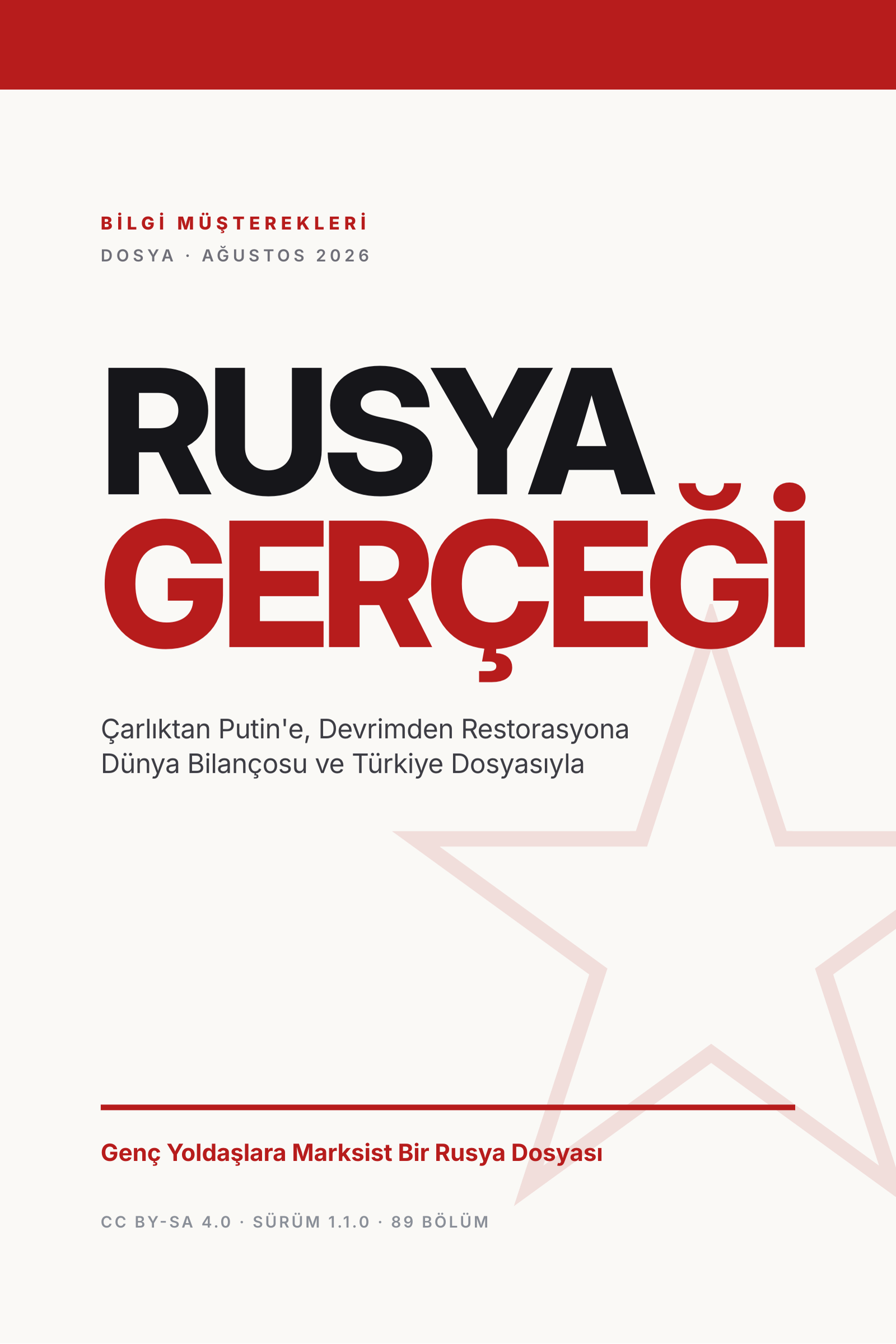
Our new dossier The Real Russia is out. 162 pages, 89 chapters, ten parts; from serfdom to the war budget of 2026, from Gosplan’s paper tables to planning with artificial intelligence, from the Fifteen at the bottom of the Black Sea to the two Soviet commanders in Taksim. Free and under a CC BY-SA 4.0 licence — as PDF, EPUB and Markdown on our Guides page.
Comrade, let us begin with this question.
On 25 December 1991 the red flag was lowered from the Kremlin. There was a communist party of eighteen million members — it did not take to the street. There was one of the world’s largest trade-union organisations — it did not strike. There were soviets — none of them took a decision. There was an army — it waited for orders.
Why did no one resist?
This dossier was written to answer that question. And the answer goes much further back than you might think.
First, three wrong answers
When Russia is discussed in this country you meet three narratives.
First: “Anti-imperialist Russia.” The current that supports Putin because he stands against the US and NATO, and that confuses Eurasianism with socialism. In Turkey it is strong not only on the right but on the left as well.
Second: Soviet nostalgia. The parade on Red Square, Red Army marches. That today’s Russian state uses these symbols leads people to take it for the continuation of the USSR. Yet the same state, on parade days, has a curtain drawn in front of Lenin’s mausoleum.
Third: “It was all the same anyway.” The echo inside the left of liberal historiography that treats the seventy-four years from 1917 to 1991 as a single “totalitarian” block.
All three make the same mistake: they do not subject Russia to a historical-materialist analysis. The first looks at the state’s foreign policy and skips class structure. The second looks at symbols and skips property relations. The third treats seventy-four years as one mass and cannot see the rupture inside it.
This dossier does a fourth thing: to defend 1917, to diagnose 1956, to explain 1991, and to call today’s Russia by its name.
The tool in your hand: four questions
Whether a country is socialist is not written on its flag; it is written in four questions:
In whose hands are the means of production? Who appropriates the surplus product? Is labour-power a commodity? Of which class is the state the apparatus?
What the dossier does is to put these four questions separately to 1920, to 1936, to 1975, to 2026, and even to a textile factory opened in Kayseri in 1935. The answers change — and that is the dossier’s thesis.
The dossier’s four findings
1. The October Revolution is to be defended. It overthrew an empire, gave land to the peasantry, withdrew from the war, recognised nations’ right to self-determination, and gave women equal rights before most of Europe.
2. The Stalin period is put to account — but not belittled. A backward agrarian country became, in a quarter-century, an industrial power that defeated fascism. That is an achievement; its cost is also real. To say both together is honesty.
3. 1956 is a rupture. The 20th Congress of the CPSU is not the start of a deviation but of a change of direction.
4. Today’s Russia has nothing to do with socialism. It is a Bonapartist form of state-monopoly capitalism; one of the parties to inter-imperialist rivalry.
Five things that will surprise you
One: The West did not destroy the USSR
On 17 March 1991 a referendum was held. The question was clear: should the union be preserved? In the participating republics 76–77 percent said “yes.”
Nine months later, on 8 December 1991, three people met in a hunting lodge and declared that the existence of the USSR had ended.
Three people. In a hunting lodge. They dissolved a union for which 148 million people had voted.
And all three came from inside the Soviet nomenklatura. Counter-revolution did not come from outside; the layer that already held power declared its own property. Look at the CVs of Russia’s first oligarchs: Komsomol managers, ministry cadres, enterprise directors, security-service personnel.
Two: The real rupture was not 1991 but 1956
The dossier adopts Enver Hoxha’s framework and states its grounds openly.
The three theses adopted at the 20th Congress were these: “peaceful coexistence” is the strategic line; a peaceful transition to socialism by parliamentary means is possible; and the CPSU is now “the party of the whole people,” the state “the state of the whole people.”
This last thesis is the open abandonment of the dictatorship of the proletariat. To say that a state has no class character is to reject the whole of Marxism’s theory of the state.
And the cost of the theory was paid in concrete: Chile, 11 September 1973. The Allende government followed exactly the “peaceful transition” line — it came by election, left the state apparatus as it was. The result was a bombed presidential palace.
The dossier also discusses the method of the secret report’s criticism: it reduced a structural problem to a person (“the cult of personality”), carried it behind closed doors rather than to the masses, and threw everything out without separating right from wrong. The Soviet worker learned his own history not from his own party but from the enemy’s newspaper.
Three: Capitalism’s “peaceful” balance sheet
We wrote the most contested years of the Soviet period in this dossier with figures: 5.5–7 million excess deaths in the 1932–33 famine; in 1937–38, according to archival records, ~1.58 million arrests, ~681,692 executions. No context normalises these, and the dossier does not normalise them.
Now write the other side too:
In 1992 prices in Russia were freed. Inflation exceeded 2,500 percent; a generation’s entire savings melted. GDP fell by half between 1991 and 1998 — a collapse exceeding the contraction of the Second World War, without a single bomb falling. Male life expectancy in Russia fell from 64–65 to 57–58 in 1994. A study published in The Lancet found a 13 percent rise in working-age male mortality in countries that applied rapid mass privatisation. By UN estimates, three million preventable deaths across the region.
No one was tried for this. No parliament passed a resolution of condemnation. The economists who wrote the programme went on teaching in universities.
History also chooses whose murders to count according to class interest.
And in October 1993 Yeltsin dissolved parliament in violation of the constitution and shelled the building with tanks. Western governments presented this as “reformers defending democracy.” The measure was not democracy; the measure was that privatisation continue.
Four: The 1936 Constitution and the Declaration of Human Rights
5 December 1936. Twelve years before the Universal Declaration of Human Rights, the following were written into a state’s fundamental law:
- Article 118 — the right to work. The first right to work written into any constitution in the world.
- Article 119 — the right to rest. A seven-hour working day, fully paid annual leave.
- Article 120 — security in old age and illness; free health care.
- Article 121 — free education including higher education, state scholarships for the majority of students, instruction in the mother tongue.
- Article 122 — equality of women, with paid maternity leave and a network of nurseries guaranteed.
On that day no bourgeois constitution in the world had anything like these. Everything you know today as the “welfare state” took its measure from here: an existing example becomes the measure for the rest of the world.
And five months after this constitution was adopted, NKVD Order No. 00447 of 30 July 1937 set arrest and execution quotas district by district. Article 127, which regulated the inviolability of the person, became void before the ink was dry.
The problem was not insincerity. The problem was that the apparatus that wrote those rights and the apparatus that trampled them were the same apparatus, and that no independent organ stood between them.
A right without an enforcement mechanism is not a right. The dossier writes the same sentence for the right of secession, for workers’ control, and for inner-party democracy.
Five: A voting list — 14 December 1960
The UN General Assembly adopted Resolution 1514 on the granting of independence to colonial countries and peoples. 89 in favour, 0 against, 9 abstentions.
Those who abstained: Australia, Belgium, the Dominican Republic, France, Portugal, Spain, the Union of South Africa, Britain and the United States of America.
The USSR voted in favour.
That is the full list of those who today claim a monopoly on human-rights discourse. (Honesty check: the USSR did not write the text — the USSR provided the initiative and diplomatic cover; 43 Afro-Asian countries provided the text and the votes. We wrote that in the dossier too.)
Women’s liberation: three sections, two sides
Perhaps the dossier’s most striking three sections are here.
Laws. December 1917: unilateral divorce without grounds. 1918: sixteen weeks of fully paid maternity leave, paid nursing breaks, free childbirth care, abolition of the category “illegitimate child.” 1920: the world’s first legalisation of abortion on request and free of charge. 1922: marital rape made a crime — England would do this in 1991.
Figures (1970s–80s): ~70% of physicians women (10–12% in the US); ~40% of scientists (10–15% in the West); 85–90% of working-age women in employment or education — the world’s highest rate.
And the other side. In 1930 the Central Committee closed the women’s autonomous organisation Zhenotdel. The pretext: "the woman question has been solved." In 1936, the same year as Article 122, abortion was banned and divorce made harder. Domestic labour was never socialised; it was added on top of women’s paid work. And in the Politburo, in seventy-four years, three women became full members — two of them in the USSR’s last three years.
Liberation was given; power was not. And the second explains why the first could not last.
Notice this: where there was a rule, there were women — entry to science was by exam and olympiad. Where there was the apparatus’s discretion, there were none — entry to power was by appointment.
Science, space — and the dark face of the same science
The dossier lists the firsts one by one: first satellite (1957), first human (Gagarin, 1961), first woman (Tereshkova, 1963), first spacewalk (Leonov, 1965), first soft landing on another celestial body (1966), first landing on another planet (Venera 7, 1970), first photographs from another planet’s surface (Venera 9, 1975), first space station (1971), and the 437-day single-flight record still unbroken today.
But there are two more lasting contributions:
Tokamak. Sakharov and Tamm proposed it in 1950–51; in 1968 the Soviets announced they had reached ten million degrees on the T-3; the West did not believe them; a British team went to Moscow, measured, and confirmed. ITER, under construction in France today, is the direct descendant of this design.
Smallpox. In May 1958 Soviet Deputy Minister of Health Viktor Zhdanov presented to the World Health Assembly a report arguing that the disease could be eradicated globally. Between 1958 and 1979 the USSR supplied about 1.5 billion doses of vaccine. On 9 December 1979 smallpox was wiped from the earth. In the same years Mikhail Chumakov mass-produced the oral polio vaccine and in 1959 tested it on more than fifteen million people; the WHO inspector’s report was decisive in the US licensing the vaccine in 1962.
Every child protected from polio today is protected because a state could organise the vaccination of 77 million people as a mobilisation. An industry run by patents, profit and market calculation could not have done it at that speed.
And the dossier does not stop here.
Lysenko. At the 1948 VASKhNIL session Lysenkoism was declared “the only correct theory”; genetics was removed from the curriculum; about 3,000 biologists lost their posts. Nikolai Vavilov — founder of the world’s largest seed bank — died of starvation in Saratov prison in 1943. 1948–1965: for seventeen years Soviet genetics was not merely unsupported but banned. The discovery of the double helix (1953) falls exactly inside that ban. And in honesty: in seventy-four years the USSR won not a single Nobel in Physiology or Medicine.
Chernobyl. For two days the USSR said nothing; the alarm was raised by workers who detected radioactive particles at Sweden’s Forsmark plant 1,100 km away. But the real charge is not the cover-up: the RBMK reactor’s positive void coefficient and control-rod defect were secret. Operators could not know how the machine they used would behave.
Secrecy was not the cover-up of this accident; it was one of its physical causes.
Accountability is not a moral ornament; it is a safety system.
What if Gosplan were artificial intelligence today?
This is the dossier’s most unexpected part.
Comrade, when “planned economy” is said a picture forms in your head: a giant computer calculating all the country’s needs. The reality was the opposite. Gosplan had no computer; it had paper. In 1973 balances were struck centrally for 1,943 items; the number of products in the economy ran to the millions.
But the real story is this: the tools existed and were not used.
1939 — Leonid Kantorovich, solving a plywood factory’s machine-allocation problem, discovered linear programming. So the mathematical answer to the objection “scarcity cannot be calculated without market prices” was given in 1939. The method was shelved on ideological grounds; in the West it was developed independently and used at once. Kantorovich won the Nobel in 1975 — for a method never used centrally in his own country’s planning.
1959 — Anatoly Kitov wrote Khrushchev a letter: let military computers be used at night for civilian planning; build a nationwide computing network. The letter never reached Khrushchev; his superiors intercepted it. Kitov was brought before a secret military court and permanently discharged from the army. That is how the first proposed national computer network in history ended.
1962 — Viktor Glushkov revived the idea on a far larger scale: OGAS. A three-tier network — a centre in Moscow, some two hundred regional centres, twenty thousand endpoints. And the most striking feature of the design: any authorised user could reach another without permission from the centre.
1 October 1970 — the Politburo met. The opponent was Finance Minister Vasily Garbuzov. His alternative: instead of OGAS, simple computers that turn lights on and play music in hen houses to raise egg yield. This is not a joke; it is a recorded proposal.
The real issue was of course not eggs: control of OGAS would pass to a rival ministry. Glushkov’s two strong supporters chose that day not to attend the meeting. The project was shelved. In 1969 the first nodes of ARPANET were being linked in the US — with public money, through inter-university cooperation.
OGAS was not a technology project. It was an accountability project.
A real-time network makes an enterprise’s real capacity visible; documents stockpiling; evaporates the ministry’s monopoly of information — that is, its real source of power.
What was rejected was not technology. What was rejected was transparency.
And today?
On the one hand: the calculation problem is over. Modern input–output accounting has a sparse-matrix structure and is solved by iterative methods; computing power has risen millions of times since 1970. And the most striking proof is not in theory but in practice: today a single retail chain manages millions of product lines in real time and centrally. In these companies’ internal workings there is no market — there is central planning.
Hayek said in 1945 that “knowledge is dispersed; it cannot be gathered.” Today every phone reports to a server in seconds where its owner is and what they will buy.
Knowledge was gathered. Only not for us.
On the other hand — and here the dossier brakes its own enthusiasm: artificial intelligence does not solve the real problem.
Because where Soviet planning collapsed was not computing power. In 1932–33 the centre did not know the harvest; under taut planning the enterprise hid its capacity; OGAS was rejected. In all three the problem was the same: the information existed, but telling the truth had a cost.
If you feed a system bad data, even the world’s most powerful model gives you a bad result — only faster, more detailed and more persuasive.
It also brings a new danger: the sentence "I’m not saying this; the model is" is the most modern way to close a debate.
The problem of planning was never mathematics. It was democracy. And it still is.
Artificial intelligence does not make planning possible — it already was. What it does is remove the excuse. One question remains: who will decide?
The dossier closes this part with eight design principles for the plan of the future — a loop in which people set the goal and the machine does the calculation; leaving what is solved locally to the local level; legal protection for the data-giver; open-source plan and algorithm; presenting the plan not as one but as options to be voted on; the power of recall; a measure that is not profit but met need and a shortened working day; and infrastructure remaining under public control.
What happens if inner-party democracy cannot be built?
The dossier also looks directly at the organisation question — because under every disaster the same gap appears.
The seventy-year trail of a single decision is followed: March 1921, Tenth Congress, the ban on factions. The conditions were real — siege, civil war, Kronstadt. And it was openly taken as temporary.
It was never lifted. The chain went like this: in 1924–29 oppositions were liquidated by this decision → in 1937–38 to be an opponent became a criminal matter → when Stalin died in 1953 there was no rule for the transfer of power → in 1956 no organised wing remained to debate Khrushchev’s report → in 1987–90 no alternative line against perestroika could form → in December 1991 an eighteen-million-member party could not react to the dissolution of its own country.
Every extraordinary measure is given an expiry date. If it is not, the extraordinary becomes ordinary.
Because to lift a power is to take it from the hand that uses it — and no one gives back their own power with their own hand.
The dossier also recalls 1917’s lost concept: recall. A soviet delegate could be recalled at any moment by the factory that elected them, before the term expired. A representative you vote for once in four years becomes independent of you afterwards; a representative who can be recalled at any moment must take you into account every day. This power in practice disappeared after 1921 and was never rebuilt.
And for every organisation we build today there is a seven-point warning list: the organisation becoming unable to see its own error; the cadre resembling the one who appoints rather than those they serve; privilege being born and institutionalised; every transfer of power turning into crisis; defencelessness against one person’s change of direction; no one rising in a moment of crisis; and most dangerous of all — in an organisation without the right of opposition, real opposition going outside and returning in the most reactionary form.
But take care: the conclusion of this part is not “the party is bad; let us stay unorganised.”
What the dossier shows is not that the party is unnecessary, but where an unsupervised party ends up. Institutions are built not on the assumption that people are bad, but on the assumption that no one must remain without oversight.
And from start to finish a Turkey file
Comrade, one part of the dossier is devoted entirely to Turkey. Because here the left either does not know this chapter of its own history at all, or knows only half of it.
The first state to recognise the Ankara government
26 April 1920 — one day after the opening of the Grand National Assembly — Mustafa Kemal wrote to Lenin: joint struggle against imperialism and a demand for five million gold rubles as a first instalment. On 2–3 June 1920 Chicherin’s reply recognised the GNA government and opened diplomatic relations.
Then aid came. The dossier gives the figures as two separate series, because the Soviet archival tally and Turkish archival studies do not match, and averaging them would be fraud:
- Soviet archival series (the whole war): 39,000 rifles, 327 machine guns, 54 guns, 63 million cartridges, 147,000 shells.
- Belleten series (September 1921 – June 1922 only): 43,374 rifles, 318 machine guns, 81 guns, 159,043 shells.
And gold: a total of 10 million gold rubles under the secret protocol of the Treaty of Moscow. The last instalment was paid on 3 May 1922.
The treaties of Moscow (16 March 1921) and Kars (13 October 1921) recognised the National Pact borders, abolished the capitulations and cancelled the Ottoman debts to Tsarist Russia. Turkey’s eastern border is still drawn by these two documents.
Those who today defend the thesis that “Russia is historically the enemy of the Turks” are forced to say that the border itself was drawn by a Bolshevik signature.
But Eurasianists cannot use this in favour of today’s Russian Federation either — because the state that signed was not the precursor of the state that abolished itself in 1991; it was the state that state destroyed.
The two Russians in Taksim
As you pass through the heart of Istanbul, look up. On the Republic Monument, behind Atatürk, stand two figures in Soviet uniform and dress. By the settled identification they are Mikhail Frunze and Kliment Voroshilov. (The scholarly debate is not closed: serious academics argue that one of the figures is ambassador Semyon Aralov, and there is no 1928 document naming the figures. We wrote this debate as it stands in the dossier.)
What is not debated is this: no representative of any Western state is on that monument.
In 1928 the Republic, carving its founding narrative in stone, chose to show who stood beside it. The side it chose was not those who imposed Sèvres, but those who sent arms against Sèvres.
Anti-communism in Turkey is an ideology that cannot read its own founding monument.
And the same years: the Black Sea
10 September 1920, Baku. Immediately after the Congress of the Peoples of the East, the founding congress of the Communist Party of Turkey met with 74–75 delegates. General Chair Mustafa Suphi, General Secretary Ethem Nejat.
Four months later, on the night of 28/29 January 1921, Mustafa Suphi and fourteen comrades were killed off Trabzon.
What is documented: the route was imposed by Kâzım Karabekir; the crowds that appeared “spontaneously” at every stop were organised; the man who supplied the motorboat and arranged the chase boat was Yahya Kahya, the Trabzon man of Teşkilat-ı Mahsusa; and no one was tried before the Independence Tribunal. A document containing the order to kill has never surfaced.
But there is something more. On 3 July 1922 Yahya Kahya was also killed. And in 1977, Atatürk’s Guard Regiment commander General İsmail Hakkı Tekçe openly confessed that he himself had shot him. The sentence Yahya Kahya is reported to have said before dying is this: "Was I alone? If they come down on me I will tell everything."
So what did Moscow do? Chicherin protested. No sanction was applied. No arms embargo was imposed. On the contrary, through 1921–22 the aid line widened.
This is the dossier’s heaviest paragraph:
The founding leader of the Communist Party of Turkey and fourteen comrades were killed on a route under the GNA government’s control, by a man of its intelligence organisation. The Soviet state learned this, protested, and the next month went on sending gold.
This is not a story of “betrayal.” This is proof that an interstate alliance and internationalism are not the same thing.
One: no communist party’s security can be entrusted to the support of any foreign state. Not Moscow in 1921, not another centre today. Two: to support an anti-imperialist government is not to surrender to that government. The condition Lenin set in 1920 — that communists preserve organisational and political independence — was violated in Turkey.
The answer to every voice that today calls for melting into a “native and national” front is at the bottom of the Black Sea.
Kayseri, Nazilli and the First Five-Year Plan
A significant share of the factories that come to mind when “statism” is said in Turkey were built with Soviet credit, Soviet design and Soviet machinery.
May 1932: İnönü in Moscow. Credit of 8 million dollars, interest-free, to be repaid in goods over twenty years — about a third of the cost of the First Five-Year Industrial Plan. August 1932: a Soviet expert mission headed by the economist Professor Orlov arrived; the mission’s report is a direct input into the plan that entered force on 17 April 1934. To build the factories, "Türkstroy" was set up under the USSR People’s Commissariat of Heavy Industry; about 200 Soviet enterprises supplied equipment.
- Kayseri Cloth Factory (16 September 1935): 8.5 million TL Soviet credit, designed by Soviet architect Prof. Ivan Nikolayev, built by Türkstroy. 32,000 spindles, 900 automatic looms, 2,777 workers. Completed in sixteen and a half months.
- Nazilli Printworks (9 October 1937): all machinery and equipment on Soviet credit. Opened by Atatürk.
(In the dossier we also wrote that Ereğli’s machinery came from Germany and Karabük’s from British capital — it is wrong to say “all of it was Soviet.”)
One: Turkey’s first serious industrialisation drive was carried out, while the capitalist world was inside the 1929 Crash, with interest-free Soviet credit and a report by Soviet planners. There is no need even to ask where the name “Five-Year Plan” came from.
Two: But what was built was not socialism. Who appropriated the surplus-value produced in Kayseri? The state of the developing Turkish bourgeoisie. The same factories were privatised from the 1980s on; the Kayseri factory closed in 1999.
State property alone is not an indicator of socialism. Ask the four questions every time.
1945: the costliest error of the relationship
7 June 1945. Molotov presented Soviet demands to Ambassador Selim Sarper: the return of Kars and Ardahan, Soviet bases on the Straits, revision of Montreux.
The result: the Truman Doctrine of 12 March 1947, NATO membership on 18 February 1952. And the trump card Turkish bourgeoisie would use for forty years in every anti-communist campaign.
To reopen a border drawn in 1921 and accepted by both sides, on the basis of the postwar balance of forces, is incompatible with the Leninist position on the national question.
That is: the policy that sent arms to Anatolia in 1921 and the policy that asked for Kars in 1945 belong to the same state but are not the same line. The first is the foreign policy of the revolution; the second is the foreign policy of a great state that had begun to lose its class content.
Nâzım
On 17 January 1938 he was arrested; from two trials a total of 28 years and 4 months. His crime was that soldiers read his books. The international campaign was built in 1949 with the names of Picasso, Robeson and Sartre. On 8 April 1950 he began a hunger strike; his mother Celile Hanım demonstrated on the Galata Bridge; Orhan Veli, Melih Cevdet and Oktay Rifat joined the strike. On 15 July 1950 he was released under an amnesty.
On 17 June 1951 he left by the Black Sea. On 25 July 1951 he was stripped of citizenship. On 3 June 1963 he died in Moscow. Citizenship was restored on 5 January 2009 — fifty-eight years later.
The Turkish bourgeoisie sentenced a poet to twenty-eight years and stripped him of citizenship — a link in the same chain as the Black Sea of 1921.
But the last twelve years in Moscow are also the dossier’s other theme: they did not silence him, nor did they fully open his voice. A revolutionary’s life was a century in which both countries proved too narrow for him.
The Ukraine war and Zimmerwald
The dossier names the war an inter-imperialist conflict and writes separately what that means and what it does not mean.
What it does not mean: not “both sides are equally guilty; let us not care.” The side that started the war and annexed territory is clear. Nor does it mean denying the Ukrainian people’s right to resist.
What it means: the principle laid down at Zimmerwald in 1915 still holds — the workers of each country oppose their own bourgeoisie’s war policy. The task of the communist in Russia is to oppose the Russian state’s war, not by saying “NATO is worse.” The task of the communist in Turkey is to expose their own state’s policy of extracting advantage from this war.
The question “should A win, or B?” is a mould that hides the third option. In 1914 European social democracy fell into exactly this mould and voted for war credits.
And a theft: 9 May
26.6 million people died defending a socialist country. Today their memory is used by those who destroyed that order and shared out its property to legitimise their own wars.
The narrative is built like this: the winner of the Great Patriotic War is “Russia,” today’s state is its continuation, therefore today’s war is the continuation of the same war. What is erased from this narrative is precisely socialism — collectivisation, the five-year plans, the soviet system, the Red Army’s composition of dozens of nations.
A victory that belongs to the grandchildren of the Red Army cannot be claimed by Gazprom’s board of directors.
That is why leaving 9 May to the Russian state would be our mistake. That victory is ours — of Russian, Ukrainian, Kazakh, Georgian, Uzbek workers.
We built the counter-theses in their strongest form
You can tell whether a text respects you by this: does it refute the other side from its weakest form, or from its strongest?
The dossier’s final appendix is a debate card that can also circulate independently: sixteen objections, sixteen short replies. Among them:
- "The USSR was socialist until 1991; to say 1956 is an exaggeration." — We accept that this objection is serious and answer it in detail.
- "Russia is a counterweight to US hegemony."
- "Russia is not imperialist; capital export is insufficient."
- "Socialism was tried; it did not work."
- "The USSR got the social rights written into the Universal Declaration of Human Rights." — This claim is not supported by the sources; do not use it.
- "The USSR was Turkey’s friend / enemy." — Both are incomplete.
The dossier also corrects with sources three claims common in our movement: the 1918 Constitution is not the world’s first to recognise social rights (Mexico 1917 is); the Bolsheviks did not “give” women the vote in Russia (the women’s movement wrenched it in March 1917; the Bolsheviks constitutionalised it); the social rights in the Human Rights Declaration did not enter under Soviet pressure.
A refutable boast is more harmful than a defensible truth.
And a note of honesty: the dossier’s periodisation of 1956 sets a rupture point earlier than the sequencing in our site’s Yabloko Ban piece and than CIPOML’s 2016 platform. We did not hide this; we wrote the tension openly and justified it with the essence/form distinction. In the same chapter we also discussed two difficulties in Enver Hoxha’s thesis, because comradely criticism applies to the texts of our own tradition as well.
So what did we lose in 1991?
A state was lost — but that is not the real loss. A flag was lowered — that is not it either.
What was lost was the proof that capitalism is not inevitable.
For seventy-four years there was a place in the world that, with all its faults, showed that things could be done otherwise. A country could industrialise without a market. Unemployment was not a law of nature. Health and education did not have to be sold. Literacy could be taught in a generation. Smallpox could be wiped from the earth.
When that proof disappeared, the working class everywhere lost bargaining power. Thirty years of rolling back social rights, the naturalisation of “there is no alternative” — all are the result of this void.
And one thing more was lost: a generation’s confidence. When you speak of socialism to a young person today, what usually meets you is not a theoretical objection; it is a tiredness: "it was tried; it didn’t work."
Our answer is this:
It was tried. Part of it worked; part of it did not. And the reason for the part that did not is known.
What failed was not planning — it was planning left to an unsupervised apparatus. What failed was not public property — it was public property in the hands of a layer accountable to no one. What failed was not the revolution — it was that the institutions that would make the revolution irreversible were not built.
The conclusion to draw from an experiment’s failure is not “let us not try again,” but "this time let us build what was missing."
The dossier’s whole balance sheet gathers in a single sentence:
The Soviet Union showed humanity what is possible — and also showed how that possibility cannot be preserved.
Your job is not to repeat the first half; it is to repeat the first half by removing the cause of the second half.
Where will you get it?
The dossier is free and under a CC BY-SA 4.0 licence. In three forms:
- PDF — print-ready layout, 162 pages
- EPUB — on phone and e-reader
- Markdown — to carry onto your own site or your organisation’s publication
→ Download from our Guides page
Reproduce it, print it, work through it in your reading group, add your organisation’s name and republish it. You need no permission.
Reading-group suggestion: the parts can also be worked through one by one. The Turkey part is ten chapters and about forty pages; at the end there is a ten-point discussion list. The planning part can be read on its own as a technology-politics seminar.
Last word
Young comrade, if only one thing from this piece is to stay in your mind, let it be this:
A system raised people who would defend it, but did not build the institutions that would defend it.
In 1941 those people, rifle in hand, stopped the Nazi army. In 1991 their children learned from television of a decision taken in a hunting lodge, and there was nothing they could do.
The difference is not courage; it is institutions.
And our comrades are not the Russian state. Not bullets and tanks.
Our comrades are the undocumented Uzbek construction worker in Moscow; the Russian teacher whose wage melts in inflation; the Ukrainian miner who sent a sibling to the front; and the young person tried for calling the war a “war.”
This dossier was written to be criticised. We gave contested figures as ranges, because we do not write what we do not know for certain as if we knew it for certain. Where we could not reach a source we wrote that we could not. Show the place you find wrong: with the source, with the reason.
Because the common denominator of every disaster this dossier recounts was a single thing: the suppression of criticism.
Let us not fall into the same error with our own text.
In comradeship, Knowledge Commons
Publication note
The Real Russia From Tsarism to Putin, From Revolution to Restoration — A World Balance Sheet and a Turkey File Knowledge Commons, August 2026
162 pages · 89 chapters · 10 parts · 4 appendices. Free as PDF, EPUB and Markdown: Guides
Contents: Before the Revolution: Understanding Russia · October and the Early Years (1917–1924) · The Stalin Period (1924–1953) · Revisionism and Restoration (1953–1991) · What the Soviet Experience Gave the World · Turkey and the Soviet Union · The Real Russia (1991–2026) · Planning, Calculation and the World of the Future · Party, Democracy and Organisation · Debate and Conclusion. Appendices: chronology, glossary, reading list and debate card.
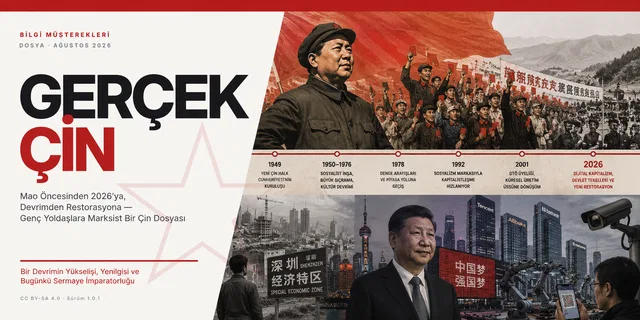
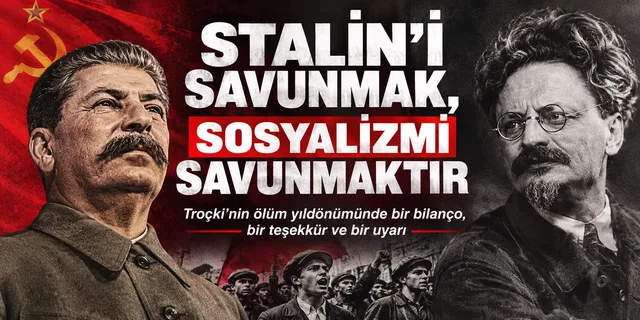
This dossier is the widened frame of our pieces The Stalin Reality and The Yabloko Ban, and the sibling text of the dossier The Real China: two restorations, two different paths, the same institutional void.
For criticism, contribution and corrections: bilgimusterekleri.org
Licence: CC BY-SA 4.0 — you may reproduce, distribute and adapt provided you give attribution and share under the same licence.
This is a living document; it grows by criticism. bilgimusterekleri.org