From October to Infinity: Reading the Everyday Life of the Revolution
Kavel Alpaslan's New Book and the Memory Shelf Built by a Young-Generation Historian

Dear Young Comrades,
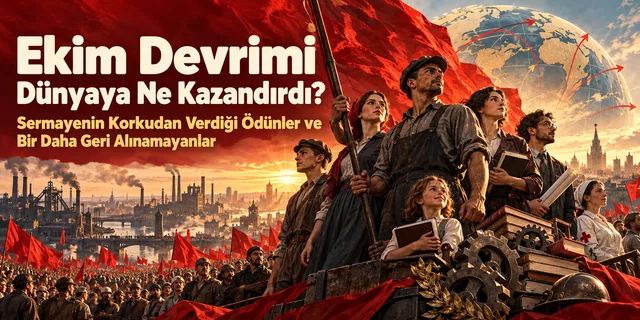
Today is 7 November. On the anniversary of the October Revolution, in What Did the October Revolution Give the World?, we traced what the revolution changed permanently across the world, along a line running from the eight-hour day to women's rights. This year we place a book beside that piece: Kavel Alpaslan's From October to Infinity: Life in the Soviet Union, published by Kor Kitap in September 2026.
In this piece we will first give a short summary; then we will introduce the book, its author, and the author's other work in detail.
Summary: This Piece in Five Sentences
- From October to Infinity is a collection of essays that reads the Soviet experience from inside everyday life, alongside the grand historical narrative: from the Putilov workers to housing policy, from the space programme to the changing lives of women, from photography to music and literature.
- The book's value is that it turns the question "what did the revolution promise?" into the question "how did the revolution change people's mornings, homes, work and art?"
- Kavel Alpaslan, born in Izmir in 1995, is a journalist working on the history of social struggles and on socialist culture. This book is the voice of a new generation that learned October from the memory archive, not from the textbook.
- The author's 2023 book from Sel Yayıncılık, Children of the Same Anger: Revolutionary Portraits from the World, and his contribution to İletişim Yayınları's Latin America collection The Far Corner of the World, are the other shelves of the same internationalist work of memory.
- Our proposal: read these three books together in a reading circle, and this time put the questions "in whose hands, under whose control, for whose benefit?" to the everyday life of the past.
Why Read a Book on 7 November?
Most of what is written on the October Revolution is either a history of power or a history of collapse. One begins with the storming of the Winter Palace, the other ends in 1991. The millions who lived in between, going to work in the morning, leaving a child at the creche, learning to read and write for the first time, taking the key to their own home for the first time, are usually either never told, or squeezed into a place between propaganda and caricature.
From October to Infinity settles into exactly this gap. According to the publisher's presentation, the book brings together essays on "the interaction between the ideals of the revolution and everyday reality". That is what matters to us: to discuss the revolution as a way of life, not as a history.
Why do we care? Because, as we said in I Read It, So What?, what we read draws the limit of what we can imagine. Capitalism's greatest ideological success is to convince us that another everyday life is impossible. Every book that shows, with documents, that another everyday life was lived stands like evidence against that belief.
Inside the Book: Six Doors
The text on the back cover lists the fields the essays reach. Let us read them as six doors. Beside each door we noted why the subject matters for young comrades.
1. The Putilov Workers: Who Made the Revolution?
Petrograd's Putilov factory was one of the largest industrial enterprises of Tsarist Russia, and from 1905 to 1917 it stood at the centre of every great rising. The lockout and the strikes there were an important link in the strike wave of February 1917. It is meaningful that the book opens from the struggle of a workers' district: it founds the revolution as the long labour of organised workers, not as "the genius of a few leaders".
This door reminds us of something. The real subjects of the revolution were not the names that appear in history books, but those whose names were never written in the factory committees, the strike funds and the neighbourhood meetings. The question we discuss for today's conditions in Organising 2.0 was answered in the concrete, a hundred years ago, in Petrograd.
2. Housing: Is a Home a Commodity, or a Right?
The section the book gives to housing policy in the Soviet Union should be read with particular care in a period when, in Turkey, rent swallows the wage. In the first years of the revolution, large dwellings were expropriated and opened to workers' families; in the later period, mass housing production took shelter outside the market. That was a historical answer to the question "whose is the home?"
In Capitalism's Rent Is Taking Its Revenge and A Building Does Not Collapse by Itself we told how housing turned into an instrument of rent. This section offers a good ground of comparison for seeing how the same question produced different results under a different property relation.
3. The Space Programme: How Did a Poor Country Reach the Sky?
That a country whose literacy rate had been low a generation earlier, and whose industry had been destroyed by war, sent the first artificial satellite and the first human into space is one of the most striking examples of what public planning and the social resources devoted to science can do. We told this story in The Space Race from Sputnik to Starlink, and in Satellite Crowding and the Class of the Right to Observe we discussed how that same sky is turning into the private property of a few billionaires. The book's space section builds a bridge between these two pieces.
4. Being a Woman: The Law Changed. Did Life Change?
After the October Revolution, women won the rights to vote and to be elected, to divorce, to equal pay and to maternity leave, decades before many countries in the West. But the real question is how the law was reflected in everyday life: creches, communal dining halls, literacy campaigns, women's entry into the factory and into science. The section the book gives to the changing lives of women tries to follow the everyday counterpart of this legal leap. The class content of the "family" discourse we discussed in Whose Family Is Safe? becomes clearer when read together with this section.
5. Max Penson's Photographs: The Changing Face of Central Asia
Max Penson was a photographer who spent years photographing the transformation of Soviet Uzbekistan. Women throwing off the veil, tractors in the cotton field, elderly peasants in literacy courses, crowds working on canal construction: all of these passed through his lens. That the book gives Penson a place reminds us that the Soviet experience was not only a Russian experience, but a multinational transformation reaching from Petrograd to the steppes of Central Asia. Here the principle of the fraternity of peoples stops being a slogan and becomes a photographic frame.
6. Music and Literature: The Feeling of the Revolution
Art carries best the feeling of a social transformation. The book's essays on music and literature look at what the revolution changed in people's inner lives. This continues a work Kavel Alpaslan has pursued for a long time. In his "Musical Atlas" essays in Gazete Duvar, he followed, for example, the trace of Engels's peasants in the songs of the socialist period in Hungary. The idea that "a song has a class too", which we told through Víctor Jara in The Song of the Broken Hands, can be a good companion in reading this section.
The Imprint
| Item | Detail |
|---|---|
| Book | From October to Infinity: Life in the Soviet Union |
| Author | Kavel Alpaslan |
| Publisher | Kor Kitap |
| Edition | 1st edition, September 2026, Istanbul |
| Pages | 406 |
| Cover design | Burak Bağçeci |
| ISBN | 9786257392747 |
| Genre | Essay and research |
Let Us Meet the Author: Who Is Kavel Alpaslan?
Kavel Alpaslan was born in Izmir in 1995 and grew up in Urla. He studied journalism at the Faculty of Communication of Istanbul University. He began in journalism at Agos in 2014; he then worked at various newspapers and prepared history and music programmes at Özgürüz Radio. Since 2016 his essays have been published in Gazete Duvar; his essays and interviews also appear in bianet, 1+1 Express and Birartıbir. He translates from English, Spanish and French, and he lives in Izmir.
The fields he puts forward when he defines himself are social struggles, history and foreign news. The common denominator of his work is to rebuild, for the young generations, the memory of socialist culture and of a history of struggle that has been made to be forgotten.
We care about this in particular. The generations born after 12 September either never heard the history of socialism, or heard it only from the narrative of its opponents. Kavel Alpaslan is one of the names who came out of that generation and tells this history again, with its documents, its photographs and its songs. As he does in the essay "Red Woodstock: East Berlin 1973", published in bianet, he tries to set lived reality against the "cartoon country" depictions of the mainstream liberal narrative.
The Author's Other Books
Children of the Same Anger: Revolutionary Portraits from the World (Sel Yayıncılık, 2023)
Kavel Alpaslan's first book is a 264-page collection of portraits. It stands in Sel Yayıncılık's "Grey Green Library" series (ISBN 9786257370929).
The book tells revolutionaries from different continents and different periods together with the background of the time they lived in. The publisher's presentation stresses that these portraits also try to show, as a whole, the turning points of capitalism's historical crisis. In other words, the book is not a series of separate hero stories. It is a sequence of windows, each opening onto a period.
Even a look at the table of contents is enough to tell the book's internationalist breadth:
- From Europe and the Paris Commune to the Spartacists: William Morris, Gustave Flourens, Eugen Leviné, Karl Liebknecht, James Connolly, Béla Kun, Feliks Cerjinski; also Moll, Bauer and Schapper, from the workers' organisation before Marx and Engels.
- Resistance against fascism: Misak Manouchian, Julius Fučík, Nikola Vaptsarov, Aris Velouchiotis, Olga Benário Prestes, Arditi del Popolo, the Jewish women soldiers of the Red Army, the Red Orchestra, Richard Sorge.
- The Spanish Civil War: Fernando Gerassi, Miguel Hernández, the miners of Asturias.
- Cyprus and the Caucasus: Derviş Ali Kavazoğlu and Kostas Mishaoulis, the 26 Baku Commissars, Nver Safaryan.
- Factories and streets: the FIAT workers, Red Harlem, the South Korean worker Jeon Tae-il.
- Latin America: Camilo Torres, Jorge Masetti, Roque Dalton, Arlen Siu, José Carlos Mariátegui, Miguel Enríquez, Rogelia Cruz, the prisoners of the FPMR, Maurice Bishop.
- Africa and the Middle East: Thomas Sankara, Patrice Lumumba, Amílcar Cabral, Ghassan Kanafani.
We care especially that Derviş Ali Kavazoğlu and Kostas Mishaoulis are named side by side in this list. These two trade unionists, killed together in 1965, are the symbol of the common struggle of Turkish and Greek Cypriot workers. This is the nearest example of how class solidarity united the workers that nationalism tried to divide.
The portrait of Eugen Leviné, one of the book's early chapters, shows the author's way of telling well. He tells the leader of the Bavarian Soviet Republic not only through his political identity, but together with his youthful letters, the love he felt for his wife, and his place inside "the flow of revolutionaries between countries". To follow how a young person who at fifteen wrote in his notebook "I must serve people" became a revolutionary takes revolutionary commitment, for young readers, out of being an abstract category and turns it into a human journey.
Let us recall here the principle we adopted in the Yılmaz Güney piece: to tell revolutionaries neither as saints nor as demons, and to understand them together with their periods, their decisions and their costs. Children of the Same Anger stands close to this approach.
The Far Corner of the World: Latin America, History, Society, Culture (İletişim Yayınları, 2020)
This book, edited by Esra Akgemci and Kazım Ateş, is one of the most comprehensive guides to Latin America in Turkish, and it is read as a course book in many universities. Kavel Alpaslan is among those who contributed to this collection, inside a wide group of authors made up of academics and researchers.
The collection takes up US interventions since the Monroe Doctrine, constitution-making processes, the regime changes in Chile, the rise and fall of the Brazilian Workers' Party, regional organisations and urban politics; it also covers the cultural field, from music to literature and from cinema to football. It is a good beginning for those who want to deepen the historical background we touched while telling Lula's victory in Hope Came from the South.
Three Books, One Shelf of Memory
When we set Kavel Alpaslan's three works side by side, a consistent project appears:
| Book | Focus | The Question It Asks Us |
|---|---|---|
| Children of the Same Anger (2023) | Revolutionary people from every corner of the world | Who struggled, and what price did they pay? |
| The Far Corner of the World (2020, contribution) | The history and culture of Latin America | How did the backyard of imperialism resist? |
| From October to Infinity (2026) | Everyday life in the Soviet Union | How did the revolution change people's lives? |
The first book builds the memory of subjects, the second of a continent, the third of a social experiment. Read together, the three form a line of reading that neither romanticises the history of socialism nor blackens it, and that shows it as a reality that was lived and that can be lived.
Why Now?
In the pieces we have written on artificial intelligence and platform capitalism, we often stress one thing: monopoly capitalism encloses not only our labour but also our imagination of the future. Almost all fictions of the future are put before us either as a promise of technological salvation or as an apocalypse scenario; in both cases today's property relations stay unchanged. In From Futurism to Techno-Fascism we discussed the class structure of these fictions of the future.
Books like From October to Infinity work as a memory commons against this enclosure. They show, with documents, that another housing policy, another life for women, another organisation of science was lived. What was possible in the past is possible in the future too. Memory, for this reason, is a matter of horizon, not of nostalgia.
Let us repeat here what we said at the end of What Did the October Revolution Give the World?: we will settle accounts with our past with a great maturity, learn from the experiences, and build a more beautiful world. These books are the material of that settling of accounts and of that learning.
Concrete Tasks
- Set up a reading circle. Divide the three books into a three-month reading plan: first five portraits a week from Children of the Same Anger, then the chapters of From October to Infinity, then selections from The Far Corner of the World.
- Ask each chapter three questions. For every practice you read: In whose hands was it? Under whose control? For whose benefit? Then turn the same questions onto housing, education, science and women's labour in today's Turkey.
- Recommend them to a library. Send these books as a purchase proposal to the library of your school, your university, your municipality. A memory commons is also built on shelves.
- Write a portrait. Taking the method of Children of the Same Anger as an example, write the portrait of a person of struggle whose name has been forgotten, from your own city, your workplace, your union. Send it to us, and let us publish it together.
- Follow the author, and support him. Read Kavel Alpaslan's essays in Gazete Duvar and bianet, and support independent publishing. Journalism and research without a patron stay standing with the reader's support.
- Look at Kor Kitap's October and Soviet series. We used The Future Is with Us, an oral-history book from the same publisher, as a source in the 12 September dossier. Following similar works widens the shelf of memory.
Dear Young Comrades,
The way to understand a revolution is to know its mornings, not only its leaders and its wars. Kavel Alpaslan's books tell us these mornings: the morning a worker entered their own home for the first time, the morning a woman went to a literacy course for the first time, the morning a peasant's child became an engineer of the country that sent a satellite into the sky.
On 7 November we remember these mornings. Because whoever remembers them knows that other mornings are possible too.
Happy anniversary of October. Good reading.
Sources
- From October to Infinity: Life in the Soviet Union, Kor Kitap, Ginko Kitap page
- Kavel Alpaslan author page, Ginko Kitap
- Children of the Same Anger: Revolutionary Portraits from the World, presentation, contents and first pages (Birazoku)
- Sel Yayıncılık, Grey Green Library
- The Far Corner of the World: Latin America, History, Society, Culture, İletişim Yayınları
- Who is Kavel Alpaslan? (Kreosus page)
- Kavel Alpaslan, Gazete Duvar author page
- Kavel Alpaslan, Birartıbir author page
- Kavel Alpaslan, "Red Woodstock: East Berlin 1973", bianet
- Kavel Alpaslan, "Musical Atlas: Meeting Engels's peasants in the songs of Hungary", Gazete Duvar
Related pieces from Knowledge Commons
- What Did the October Revolution Give the World?
- I Read It, So What?
- The Space Race from Sputnik to Starlink
- Satellite Crowding and the Class of the Right to Observe
- Víctor Jara, Chile, and the Class Legacy of Latin Resistance
- Whose Family Is Safe?
- Capitalism's Rent Is Taking Its Revenge
- A Building Does Not Collapse by Itself
- From Futurism to Techno-Fascism
- Hope Came from the South
- Organising 2.0
- Reading Yılmaz Güney Through Class
- 12 September
This piece is one of the living documents of Knowledge Commons. It is shared under the CC BY-SA 4.0 licence. You may copy, change and share it if you credit the source.