Be the Subject of History and of Your Own Life!
A Dialectical Manifesto of Everyday Class Struggle and Organized Hope Against Petty-Bourgeois Nihilism and Election Fetishism

Come, sit down comrade; let us refresh our tea and, at history's stormy dawn, in the darkest hour of the night, speak without circling around the point—directly with our hearts and our revolutionary reason.
I know that heavy feeling that gnaws at your mind when you look at the streets, at the dazzling yet fogged light of digital screens, or at that dead earth sprinkled over the masses. I hear the sigh of young comrades withdrawn into their shells, squeezed in the vise of insolubility, whispering "We were born into a bad period." My ears fill with the proud yet rotten noise of petty-bourgeois intellectuals who preach to us that "history has ended," that "everything is over," that "nothing can change anymore."
But stop and straighten up, comrade! History's wheel has never turned by the desire of the passive, of those who surrender, or of those who market defeat as an aesthetic tragedy!
Today the sermons of despair raining down upon us from capital's ostentatious palaces, the rising reaction, and the opiums that paralyze the masses arise not from capitalism's strength, but on the contrary from its historical blockage and deep helplessness. The enemy feeds on your loneliness, your broken hope, and your inaction. For us Marxists, philosophy is not an abstract series of concepts trapped in academic salons isolated from social reality or in dusty libraries; dialectics is the name of a practical consciousness that sees the cracks in the heart of darkness and tears the dawn out from there.
Now come; let us tear away with dialectics' sharp scalpel—which accepts no excuses—that polished curtain capital, the culture industry, and false saviors have drawn over our eyes.
Tearing Through the Illusions of Our Age: Materialist Disenchantment
Karl Marx, while explaining commodity fetishism at the very beginning of Capital, exposes how products of the human hand come to be perceived as independent of the human, as mystical and godlike powers. Capitalism does not merely exploit the body; it produces a dense ideological fog curtain that renders production relations, social contradictions, and the human's own action invisible.
Today this fog curtain has been layered with high-technology fairy tales, dystopian cultural products, and election fetishism. For a Marxist philosopher, "disenchantment" is the first and most fundamental step of the revolutionary will that will change the world. Stripping reality of the illusions capital offers is the sharpest mental scalpel that breaks inaction.
Technology and Artificial Intelligence: The Mystification of "Dead Labor" Domination
Today bourgeois media and technology giants market artificial intelligence and automation as a class-transcending, self-developing, miraculous or catastrophe-bringing "new god." The story told to us is simple: "Technology has advanced so far that human labor has been devalued, capital has turned into an invincible power, or artificial intelligence will soon leave you all unemployed and take over the world."
Dialectical Analysis:
-
The Living Labor – Dead Labor Contradiction: From the standpoint of Marxist philosophy, a machine, software, or artificial intelligence is the frozen form of labor workers expended in the past—that is, "dead labor" ($dead\ labor$). Dead labor lives only so long as it sucks living labor. Artificial intelligence did not descend from the sky; it is the product of the accumulated collective labor of millions of programmers, data workers, and manual laborers.
-
The Conflict Between Productive Forces and Relations of Production: Under capitalism, every technology developed is used not to shorten working hours and free the human, but to raise the rate of surplus value, to replace the worker and create a reserve army of the unemployed, and to tighten control.
-
The Truth: The problem is not in technology itself, but in property relations. So long as the means of production remain in private ownership, technology is a tool of exploitation; yet this technological leap, by simultaneously raising the socialization of production to its highest level, prepares capitalism's own gravediggers and its technical infrastructure.
The Culture Industry and Dystopia Fetishism: The Ideological Function of Nihilism
There is a vast fashion of "dystopia" and "apocalypse" covering cinema halls, streaming platforms, literature, and social media. Themes such as "The world will end," "The human species is a virus," "A great catastrophe is coming and we can do nothing" are constantly worked.
Dialectical Analysis:
-
The Trap of "Capitalist Realism": As Mark Fisher aptly noted, the idea that "it is easier to imagine the end of the world than the end of capitalism" is today imposed upon the masses. The culture industry takes the masses' unease and anger toward the system and, by transforming it into an aesthetic "dark tale," renders it harmless.
-
Nihilism as the Refuge of Petty-Bourgeois Intellectuals: The petty-bourgeois intellectual, isolated from production processes and keeping a distance from organized class struggle, sells their own helplessness in periods of defeat as "existential depth." The discourse "The masses are ignorant anyway, human nature is selfish anyway, nothing changes" is not an analysis; it is the theorized form of surrender and inaction.
-
The Truth: The human species is not a virus; what drives nature and the human toward destruction is the capitalist mode of production based on the lust for profit. The pessimism pumped out is the cheapest ideological opium the ruling class uses to keep the masses passive.
The Illusion of Politics: Election Fetishism and Capital's Restoration Moves
When the capital order sees the desire for change and the anger accumulating among the masses, it builds channels that will not let this spill outside the system. The most common path is to reduce political struggle merely to going to the ballot box once every few years.
Dialectical Analysis:
-
Safety Valves ("New Party" Illusions): When the system is blocked from within, capital circles quickly polish alternatives such as "New Faces," "New Parties," or "Nation Alliances." The masses are given the message: "Stay silent in everyday life, do not organize, just wait for election day; we will fix everything."
-
The Limits of Bourgeois Democracy: The bourgeois parliamentary system is makeup covering the dictatorship of capital. Whichever showcase comes to power, capital's logic, property relations, and the exploitation of labor continue to exist.
-
The Truth: Elections are not entirely independent of struggle, yet they have never been the real motor of change. Rights are won not at ballot boxes, but in the streets, in factories, in strikes, and through organized mass movements. Election fetishism strips the people of being the "subject" of their own lives and turns them into a passive "voter-object."
Materialist Disenchantment Table
We can summarize the illusions of our age and the dialectical reality behind them as follows:
| Field of Social Crisis | Bourgeois / Nihilist Illusion | Dialectical Materialist Truth | Revolutionary Duty |
|---|---|---|---|
| Technology & Artificial Intelligence | "Technology has made the human unnecessary; capital has reached an invincible power." | Technology is "dead labor," the accumulation of living labor. It intensifies exploitation but breeds new contradictions. | To grasp technology not as a threat, but as a productive force that will free the human when property relations change. |
| Culture & Art | "The world is heading toward extinction, humanity cannot be fixed, liberation is impossible." | The culture industry aestheticizes defeat; nihilism is an ideological tool that legitimizes inaction. | To reject dystopian passivity; to produce revolutionary art that contains solidarity, collective will, and organized hope. |
| Politics & Democracy | "Just wait for the ballot box; when the new party/leader arrives, everything will be solved." | Bourgeois restoration is a mechanism for absorbing anger; the fundamental contradiction is not resolved without a change in property relations. | To smash election fetishism; to make democracy a continuous struggle inside everyday life, the workplace, and the neighborhood. |
Tearing the Curtain and Girding the Will
Comrades, dialectical materialism gives us the courage to see the world as it is. That darkness surrounding us is not, as the brokers of catastrophe say, "the end of history" or "our inevitable fate." That darkness is the smell rising from the rotting of the old order; it is the birth pang of a new society.
The moment we tear the illusions, we see that:
-
Capital is not invincible; on the contrary, it is wrestling with its own internal contradictions.
-
Technology exists not to crush us, but, in the right hands, to liberate humanity.
-
Liberation is not in a distant leader or at the ballot box, but in our organizational unity and everyday action.
Exposing Petty-Bourgeois Nihilism: Surrender Cloaked as Theory
Comrade, now we will drive our scalpel into a poison that deepens the inaction of the masses most of all, yet from the outside markets itself as the "most radical," "most intellectual," or "most critical" stance: petty-bourgeois nihilism and intellectual pessimism.
In periods when social opposition or the socialist bloc retreats, the stage of class struggle witnesses a strange phenomenon: a section of intellectuals and middle-class members who have given up hope of changing the world begin to present their own class helplessness as if it were a universal law. The shouting of "The masses will never become conscious anyway," "The people choose fascism," "The human species is selfish" is not an analysis; it is the theorized form of fleeing revolutionary duties and of surrender.
Dialectical materialism analyzes this nihilism not merely as a moral weakness, but as an ideological deviation with class origins.
The Class Origins of Intellectual Defeat: Precarious Position and Alienation
The class position of the petty bourgeoisie and of the intellectual stratum cut off from production processes is dialectically dual (ambivalent). It is neither fully a capitalist nor the industrial/service proletariat standing at the heart of collective production.
-
Deprivation of Collective Power: The working class, standing side by side at the very center of production—in the factory or the plaza—learns collective discipline and the power of action by living them directly. The petty-bourgeois intellectual, by contrast, exists through individual mental labor. Because they have no collective class bond to lean on in moments of crisis, they are seized at the first storm by a sense of individual panic and helplessness.
-
Mistaking One's Own Crisis for the World's Crisis: The petty-bourgeois mentality takes its own class despair for the absolute end of objective reality. It projects its own inaction and fear onto the masses. The logic "If I cannot do anything, then nothing can be done" is the fundamental dialectical error of these strata.
The Ideological Function of Nihilism: Mass Manipulation and "Shouting"
That "the world is over, we are ruined" shouting we encounter today on social media, on screens, and in organs of the press is not an innocent melancholy. This attitude serves the interests of the ruling class in an indirect yet extremely effective way.
-
Instilling Disbelief in the Revolutionary Subject: The discourse "Nothing will come of the people" breaks the masses' self-confidence. People are inoculated with the idea that they cannot be the subjects of their own lives.
-
Legitimizing Inaction: If the world is in an unsalvageable state, organizing, keeping watch, distributing leaflets, or going on strike is labeled "a meaningless effort." Thus the petty-bourgeois intellectual cloaks their refusal to move a finger in the garb of "high intellectual comprehension."
-
Tearing Reality from Its Totality: Nihilism rejects dialectics' most fundamental rule—the law of "change and contradiction." It declares history stopped, reaction absolute and eternal. Yet no social formation is static; the darkest periods accumulate in their bosom the contradictions of new explosions.
Comparison of Nihilism and Dialectical Realism
Let us clarify the gulf between petty-bourgeois nihilism and the dialectical materialist attitude:
| Subject of Analysis | Petty-Bourgeois Nihilism (Surrender) | Dialectical Materialist Realism (Action) |
|---|---|---|
| The Rise of Reaction | "Humanity is regressing, the masses are ignorant, this order will never change." | Reaction is the result of the blockage of the capital accumulation regime. It is a temporary equilibrium, containing unsustainable contradictions. |
| Defeat and Retreat | Absolutizes defeat; treats history as a straight line and declares "the end of everything." | Sees defeat as a dialectical lesson and a phase of retreat; seeks the possibilities of a new leap. |
| The Condition of the Masses | Objectifies the masses, sees them only as a herd to be manipulated. | Sees the masses as candidates for historical subjectivity; explains inaction through objective conditions and ideological encirclement. |
| Social Duty | To make diagnoses from one's seat, to aestheticize pessimism, to theorize inaction. | To organize in every field one occupies, to sharpen contradictions, and to transform consciousness into action. |
Process Analysis: The Dialectics of Collapse and the Task of Revolutionary Reason
From the standpoint of process analysis, the rise of petty-bourgeois nihilism is no accident; it is an ideological reflection of capital's deepening crisis.
Deepening of the Capital Accumulation Crisis ↓ The Ruling Ideology's Need to Anesthetize the Masses ↓ Despair and Panic Among Petty-Bourgeois Intellectuals ↓ Pumping Nihilism Cloaked as Theory into the Masses ↓ Passivity and a Sense of Objectification Among the Masses
What will break this cycle is the intervention of revolutionary reason. Let us update Gramsci's famous formula: we must possess the sharpest pessimism in grasping the dimensions reaction has reached, capital's savagery, and the magnitude of the danger (pessimism of the intellect); yet an unshakable resolve in believing in the class power and organized will that will change this rotting order (optimism of the will).
What the nihilists call "insolubility" is in fact insolubility within the limits of capitalism. We are not looking for a solution within capitalism's limits so as to grow hopeless! Our horizon is the construction of a classless world that will tear those limits up by the roots.
Capital's Safety Valves: Election Fetishism, Restoration Projects, and Continuous Struggle
Comrade, now we will drive the scalpel into the field where the capital order is most skilled—the mechanisms that dampen the masses' desire for change and accumulating class anger within the system's limits.
In periods when its crises deepen and the masses' discontent rises, capital does not rely on a single method. While on the one hand hardening authoritarianization and apparatuses of repression, on the other it places before the masses "intra-system safety valves." The two most common forms of these safety valves today are election fetishism and capital restoration projects (New Party / New Alliance searches).
Seen through the eye of a dialectical materialist philosopher, this process is not a "promise of liberation," but on the contrary a strategy of passivizing opposition and turning the masses into historical objects.
Election Fetishism: Reducing Democracy to a Ritual Held Once Every Four Years
Bourgeois democracy, by its nature, tears politics from the everyday life of the masses and produces a tremendous alienation. The capitalist system pushes democracy outside the factory, the school, the plaza, and the neighborhood; it reduces it to nothing more than a scrap of paper cast at the ballot box once every few years.
-
The Passivization Strategy: The secret message conveyed to the masses is this: "Stay silent in your daily life; do not intervene against the exploitation at your workplace, the degradation at your school, the reaction in your neighborhood. Leave politics to professional politicians and wait for election day."
-
The Marketing of Politics: In this process, politics ceases to be the constitutive action of citizens and turns into an advertising campaign that bourgeois parties offer to "consumers" called voters. The masses are made not revolutionary subjects determining their own destiny, but passive spectators who watch actors from the screen and give ratings.
Restoration Projects and the "New Party" Illusion
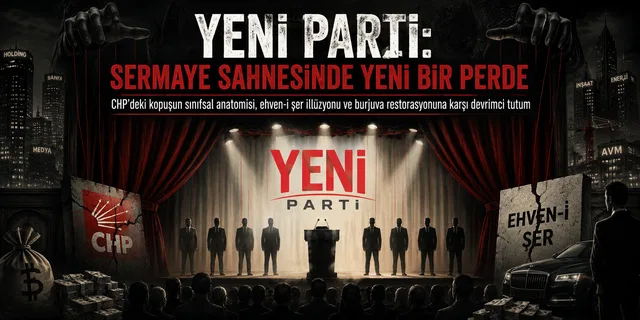
When the capital order is blocked and the existing power wears out, the ruling class's greatest fear is that the masses unite around an extra-systemic, radical, and class alternative. Precisely at these moments capital's ideological laboratories go into action and polish restoration projects under the names "New Party," "New Faces," or "Broad Alliance."
Dialectical Analysis:
-
Changing the Showcase vs. Preserving the Essence: Capital restoration is a move to renew the system's rotting showcase while preserving the essence of exploitation relations. The coming to power of a new party does not abolish the capital accumulation model, the ownership of the means of production, or the exploitation of surplus value.
-
Channeling Anger into Intra-System Channels: Accumulated mass anger is evacuated into the safe waters of the bourgeois parliamentary system so that it does not turn into a radical rupture (a revolutionary situation). The "New Party" illusion functions as a sponge absorbing the revolutionary energy of the masses.
-
Isolating from Everyday Politics: These projects concentrate the people in election periods and call them to return home when the election is over. Thus the trenches of struggle inside daily life (unions, assemblies, student clubs) are dried up.
The Continuity of Struggle and Class Truth
Whichever of capital's parties comes to power—whether the existing power fortifies itself or structures such as a "New Party" take over—the fundamental dialectical contradiction of capitalism, the labor–capital antagonism, is not resolved.
Dialectical Principle: Rights are not bestowed at the ballot box; they are torn away in the fields of production, in the streets, and under the pressure of organized mass movements. Whatever the name of the bourgeois party in power, class struggle is uninterrupted and must continue for something better—for a classless world.
Dialectical Comparison of Political Attitudes
| Criterion of Analysis | Bourgeois Election Fetishism & Restoration | Dialectical Revolutionary Politics |
|---|---|---|
| Conception of Democracy | A representative and passive ritual limited to going to the ballot box once every 4–5 years. | Collective subjectivation lived moment by moment inside everyday life, the workplace, the neighborhood, and the school. |
| Role of the Masses | A passive "voter-object" that consumes political promises and waits for election day. | A "constitutive subject" that writes history with its own hands, organizes, and takes decisions directly. |
| Intra-System "New" Parties | Safety valves established by capital to overcome crisis and absorb anger. | Restoration moves that do not touch the fundamental contradiction, merely change the showcase, and must be exposed. |
| Time of Struggle | A discontinuous, waiting-oriented process limited to election periods. | Uninterrupted and continuous trench warfare at every hour of the day, in every field where life flows. |
Smashing the Ballot-Box Illusion, Organizing in Every Moment of Life
Dear Comrade,
Our task is not to ignore elections entirely; it is to smash the mystical meaning loaded onto elections—that is, election fetishism.
Against the rulers' counsel to "Wait for the ballot box," we raise the call: "Organize today, where you are!" Whichever bourgeois clique comes to power; so long as capital's logic does not change, the worker's exploitation, the youth's futurelessness, and the plunder of nature will continue.
Real transformation is not in ballot papers, but in the solidarity built at the factory tea break, in the common voice that claims the future in the lecture hall, in the organized will that barricades reaction in the neighborhood. Politics is not a distant building or a ballot box; politics is our power to transform the conditions that determine our lives.
The Transformative Power of Everyday Life: From Passivity to Constitutive Subject
Comrade, the greatest victory of bourgeois ideology and petty-bourgeois nihilism is to alienate the human from their own action and turn them into a "spectator." Facing corporations, algorithms, digital streams, and colossal capital mechanisms, the individual feels dwarfed. The question "What can I change alone?" is the deepest paralysis capitalist alienation creates in the mind.
Dialectical materialism teaches us that although the objective world exists independently of the mind, social reality is the product of human action (praxis). Society is not a static structure, but a dynamic process continually produced and reproduced. Therefore passivity is not a human nature or a fate; it is the result of capitalism isolating and atomizing the human within relations of production.
The only way to break this vise of passivity is to set aside abstract dreams of salvation or waiting for election day and to become constitutive subjects at the very heart of everyday life.
Overcoming Alienation: Praxis and Subjectivation
Under the capitalist mode of production the worker is alienated from the object they produce, from their own action, from nature, and ultimately from other humans. This alienation is reflected in the political field as well: people do not believe they can change their social destiny; they see politics as a fetish field conducted by distant professionals.
Dialectical Analysis:
-
Praxis (Revolutionary Action): The dialectical unity of theory and practice, of thought and action. The human grasps their own consciousness and transformative power not merely by thinking, but when they pass into action in order to change the world.
-
The Leap from Quantity to Quality: The great upheavals of history do not descend from the sky on a rope. They are the quantitative accumulation of stubborn struggles carried out day by day in the bakery, the factory, the lecture hall, the plaza—struggles that at first glance appear "small" or "insignificant"—turning into a qualitative leap.
-
War of Position: As Gramsci expressed, in modern capitalist societies domination is preserved not only by state force, but by positions in civil society (hegemony). Therefore revolutionary struggle is a war of position to be woven stitch by stitch in every field of everyday life.
Struggle in Concrete Fields and the Transformation of Life
The struggle for democracy and freedom is not an abstract idea; it is the transformation of the ground one treads, the air one breathes, the desk one works at. Every comrade must become a constitutive focus within the objective conditions in which they find themselves.
| Concrete Sphere of Life | Ruling Imposition and Passivity | Revolutionary Transformative Intervention (Subjectivation) |
|---|---|---|
| Workplaces & Plazas & Factories | "Performance pressure, mobbing, and insecurity are fate; you are alone." | Standing side by side with a colleague, building solidarity networks and committees against rights violations, becoming aware of productive power. |
| Universities & High Schools | "You have no future; focus only on your individual career." | Uniting in clubs and lecture halls against commodified education; raising a collective voice for qualified and autonomous education. |
| Neighborhoods & Living Spaces | "You are helpless against rent projects, reaction, and degeneration." | Establishing solidarity assemblies with neighbors, claiming parks, green spaces, and cultural centers; creating enlightened positions against reaction. |
| Digital and Cultural Field | "Be a consumer, watch from the screen, share pessimism and nihilism." | Organizing contents that defend collective production, revolutionary memory, and truth against the narcotic contents of the culture industry. |
How Does Life Transform? A Concrete Dialectical Logic
To understand how a transformation in everyday life step by step becomes a great class power, we must analyze the dialectical process well:
-
Making the Contradiction Visible: An injustice lived at the workplace or school (for example mobbing or unpaid overtime) is first perceived as an individual victimization. Revolutionary consciousness shows that this problem is not an individual misfortune, but a class contradiction arising from capital's logic.
-
Breaking Loneliness: Individual anger turns into a collective consciousness through the contact you establish with the friend beside you. Two people standing side by side smash capital's "atomization" strategy at the first blow.
-
Gaining Position: A small solidarity committee established or a simple right won shows people that their own actions can yield results. This is the critical moment when alienation is broken and the feeling of being a "subject" is born.
-
Continuity and Connection: Every small position won is made part of the general class struggle. When the struggle at the workplace unites with solidarity in the neighborhood, when the voice on campus unites with the workers' strike, a whole class power rises to confront the ruling class.
A Concrete Call to Young Comrades: Be the Subject of Your Own Life!
Dear Young Comrade,
Capitalism wants to turn you into a passive consumer, a spectator who every evening watches the world's ruin from the screen. The most revolutionary answer to those who tell us "You were born into a bad period" is to turn every square meter we occupy into a trench of class struggle.
-
Stop Waiting for Distant Saviors: Neither the ornate politicians on the screens nor a miraculous moment of history will save you. Liberation is joining hands with the comrade beside you in the lecture hall, the plaza, on the courier motorcycle, or at the neighborhood tea stall where you are right now.
-
Organizing Is Life Itself: Organization is not a heavy armor put on or an abstract obligation. Organization is the human ending their loneliness, having a say over their own life and future—that is, becoming human.
-
Together We Are Strong: A single twig is easily broken; but no power can bend a bundle of twigs gathered together. Individual escape plans (dreams of going abroad, individual careerization, etc.) do not free you from your class conditions. Only collective struggle opens the door to a humane life for all of us.
History will be shaped in the hands not of those who stand aside and lament, but of those who plunge into everyday life with dialectics' sharp knowledge and transform it.
The Ideal of a Classless Society Is Not a Utopia, but a Historical Necessity
Dear Young Comrades,
At the final stop of our journey and analysis, we bring together all the fields we have driven the scalpel into in a single revolutionary synthesis. To those who wish to load upon our shoulders the burden of inaction and pessimism by telling us "You were born into a bad period," we answer with dialectics' plain truth: History's darkest moments are the phases in which contradictions sharpen most and the possibilities of a new social formation ripen most.
The yearning for a classless, exploitation-free world in which no human is servant to another is not a nostalgic dream, romantic literature, or an unreachable utopia. On the contrary, facing the ecological, economic, and social barbarism into which capitalism is dragging humanity, it is the only rational, scientific option that will keep the human alive.
Comparison of Historical Illusions and Revolutionary Strategy
Let us summarize with a clear table the bourgeois illusions we have exposed throughout the entire article and the revolutionary dialectical strategy we raise against them:
| Field of Struggle | Ruling Ideology & Nihilist Trap | Revolutionary Dialectical Strategy |
|---|---|---|
| Conception of History and Period | "We were born into a bad period; reaction has won absolutely." | Reaction is the helplessness of capital's crisis; it is the preparatory phase of a new leap. |
| Technology and the Future | Artificial intelligence and automation are a mystical power that makes the human unnecessary. | Technology is accumulated "dead labor"; when property relations change, it liberates the human. |
| Culture and Art | Dystopian literature/cinema: "The human is a virus; extinction is inevitable." | Nihilism is the cloak of inaction; the human writes their own destiny through collective will. |
| Politics and Democracy | Election fetishism: "Just wait for the ballot box; the new party will solve everything." | Bourgeois restoration is a safety valve; real democracy is in everyday struggle. |
| Individual and Subjectivation | "Alone you are nothing; either flee or remain a spectator." | Loneliness is capitalist alienation; as part of the organized class, one becomes a constitutive subject. |
The Breaking of Dawn Depends on Will
Rosa Luxemburg's historic warning is more current today than ever: "Socialism or barbarism!" Capitalism has turned into a system of barbarism that destroys nature for the sake of profit lust, isolates the human and drives them into psychological ruin, and darkens humanity's future with wars and reaction.
Facing this barbarism, to say "I am without solution," "I am passive," "I am useless" is to accept remaining an extra in the scenario written by the rulers. Yet for a Marxist, hope is not a passive state of waiting; it is a practical will armed with consciousness.
Let us not forget: The breaking of dawn is possible not through the night ending of its own accord, but through the stubborn resistance of the seed that falls to the earth, the hand that holds the wheel in the factory, the voice that claims the future in the lecture hall.
A Call to the Future: Organizing Is Life Itself
My comrade,
Let the nihilists theorize "the end of the world" in the elegant salons where they sit. Let bourgeois politicians bargain over the ballot boxes they will set before us once every 4–5 years. Our direction is turned toward where life flows—that is, toward the everyday life of the class.
-
Sharpen Your Consciousness: Use dialectical materialism like a scalpel against the false promises modern science and the culture industry present in shiny packaging.
-
Be a Position in Your Own Field: At the workplace, at the university, in the neighborhood, in the plaza… Wherever you are, establish a bond of solidarity, a discussion club, a rights committee. Remember: the greatest storms begin with the first drop.
-
Trust Collective Power: Throw individual salvation fantasies in the trash. Every thought that separates you from the comrade beside you is capital's victory. When we unite, there is no barricade we cannot overcome, no wheel of exploitation we cannot smash.
History will rise on the shoulders not of those who passively abandon themselves to the flow, but of those who plant their feet on the earth in the light of dialectics, who are aware of their productive power, and who organize to transform life.
Tear out pessimism, smash inaction! The future will be shaped in our organized hands!