The Poverty of Artificial Intelligence Ethics and Human Dignity
A Dialectical-Materialist Process Analysis Along the Axis of Ioanna Kuçuradi’s Philosophy of Values and the Material Ground of Human Dignity

Young Comrades!
At this critical turning point of history and class struggle, we confront a new front on which capital seeks to encircle our minds and our future: Technology and the ideological fog woven around it.
Let us recall the most fundamental lesson of historical materialism: The human being is the only being that, within the relations of production entered into with nature, creates itself and the world through labor. As Friedrich Engels showed in The Part Played by Labour in the Transition from Ape to Man; the first hominin who sharpened a simple stone in nature into an axe did not merely produce a tool—it also gave the first impulse to its own biological and social evolution. The extension of the tool was the human hand; the human being grew with its tool, became socialized, and became human.
The Historical Course of Human and Machine Evolution: The Captivity of Living Labor to Dead Labor
With the development of the productive forces, this dialectical relationship underwent a qualitative rupture:
-
The Age of Craft: The tool was a direct extension of the human body and of creative intelligence. Control over the production process was still in the hands of the producer.
-
The Industrial Revolution and Capitalism: The means of production were transformed into private property. The human being was now made into an extension of the machine, a cog in the mechanical wheel of the factory. In Karl Marx’s formulation; living labor came under the domination of objectified “dead labor” (the machine).
-
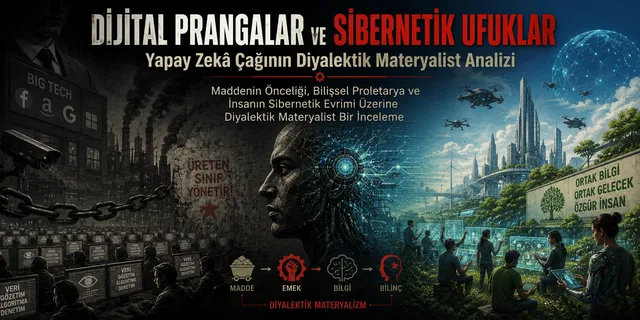
The Age of Digital Automation and Artificial Intelligence: Today, the common language, art, science, and cognitive accumulation that humanity has produced throughout history—that is, our collective mental labor—has been datafied and imprisoned in colossal servers. What we call artificial intelligence is nothing other than the algorithmically frozen form of the past labor of millions of workers—that is, digital dead labor. Living human labor is once again being alienated before this vast accumulation of dead labor.
The Illusion of Transhumanism: The New Religious Mysticism of the Bourgeoisie
While historical reality stands this naked; what do Silicon Valley’s monopolistic capitalists, techno-feudalist agencies, and bourgeois academics preach to us? Transhumanism!
These debates, conducted through concepts such as “the overcoming of the human,” “the Singularity,” “the immortality of cyber-consciousness,” or “the rights of humanoid robots,” constitute the most cunningly designed ideological illusion of contemporary capitalism. Transhumanism is a secular technological religion invented to conceal class contradictions, exploitation, and poverty.
In a world where hunger, housing crisis, and ecological destruction stalk everywhere, the promise of loading humanity’s collective mind onto a chip and escaping to an “other world” is no different from the medieval promise of paradise. This outlook regards the human being not as a social subject, but as a “biological error” to be discarded.
Fashionable “Ethics” and Its Ideological Function
Right at the heart of this illusion, a word appears that never leaves the lips of the bourgeois media and the monopolies: “Ethics.”
Today, “Artificial Intelligence Ethics” panels, corporations’ “Responsible AI Principles,” and international declarations have flooded the landscape. So what is this fashionable ethics?
Historical Observation: The more a concept is turned into a “fashion” in the language of the bourgeoisie, the more that is proof that its reality has been hollowed out and that it has been transformed into a public-relations (PR) apparatus.
While corporations and states design artificial intelligence as an instrument of exploitation, job destruction, mass surveillance, and war (autonomous weapons); they attempt to absolve their own crimes with “neutrality labels in the code.” Their “ethics” is nothing but an oil that allows the wheels of exploitation to turn more smoothly. This approach, which seeks the problem not in the ownership of the means of production but in algorithmic statutes, is a philosophical sophistry.
Our Position: Human Dignity Under the Guidance of Ioanna Kuçuradi
Young comrades, we will not be swept into these false waters! We will neither fall into the reactionary trap of Luddism (machine-breaking) that rejects technology wholesale, nor bow before capital’s technological fetishism.
Our philosophical position is clear: A dialectical-materialist stance that places the process of humanization and Human Dignity at the center.
In strengthening this stance, the philosophy of values of Prof. Dr. Ioanna Kuçuradi, one of the strongest names in our philosophical tradition, offers us an unshakable compass. As Teacher Kuçuradi insists:
-
Moral Judgments and Ethical Knowledge of Value Are Distinct from One Another: The rules proclaimed by corporations or by conjunctural centers of power are not ethics, but conjunctural “value judgments.”
-
Means Cannot Be Turned into Ends: Artificial intelligence is an object, a tool. To attribute subjective qualities to it (anthropomorphism) means the worship by the human mind of the object it has itself created.
-
Human Dignity and Singular Situations: Ethics cannot be sought in template codes or statistical data. Ethical action is the act of protecting human possibilities and worth within the dialectical analysis of concrete conditions.
In Kuçuradi’s words; in this ideological encirclement in which “robots are being humanized while human beings are being robotized”; we will stand for the human being, for humanity’s historical productive power, and for its inviolable dignity. Artificial intelligence is not a mystery; it is the product of human labor. The real philosophical and political struggle is the struggle over whether this colossal power will enslave humanity in the hands of a handful of global capitalists, or liberate humanity in the hands of society.
A Critique of the Artificial Intelligence Ecosystem from the Standpoint of Ioanna Kuçuradi’s Ethics
Ioanna Kuçuradi’s Philosophy of Values offers us unique philosophical instruments for passing the “technology ethics” debates raging through today’s artificial intelligence ecosystem through an ontological filter. While the bourgeois academy and monopolistic capital create an ideological fetish by presenting artificial intelligence as a virtually superhuman “new logic”; Kuçuradi’s philosophy, built upon humanization and the knowledge of value, tears away the veil covering this conceptual confusion.
From a dialectical-materialist standpoint, Kuçuradi’s philosophical intervention exposes at the epistemological level the process of reification that capital creates by confusing object and subject.
The Corruption of the Concept of Ethics: Bourgeois “Moral Norms” and Kuçuradi’s “Ethical Knowledge of Value”
Today’s technology giants (Google, OpenAI, Meta, and so on) publish their own “Artificial Intelligence Ethics Guidelines” and “Responsible AI” criteria and establish ethics boards. Kuçuradi’s philosophical legacy draws a radical distinction precisely at this point: the qualitative difference between Morality (norms/value judgments) and Ethics (knowledge of value).
-
What Corporations Call “Morality”: These are the variable group rules and norms of the “do this, don’t do that” type, produced by the ruling class or by conjunctural market needs. Capital bounds artificial intelligence systems with “moral codes” in order to limit its own legal liability and to refresh its image. This is nothing other than the dressing-up of the ruling-class interest of a particular moment in history in the guise of ethics.
-
Kuçuradi’s Ethical Knowledge of Value: Ethics is not a set of ready-made prescriptions, checklists, or a succession of prohibitions. Ethics is the activity of knowing the possibilities of the human species, the process of humanization, and the universal values that emerge in that process.
Bourgeois artificial intelligence ethics conceals the material purpose of the action (accumulation of profit, class domination) and reduces the problem solely to the rules of the software. This stance is a morality that has been gutted.
The Illusion of Anthropomorphism: The Enchantment of the Concept of “Intelligence” and Commodity Fetishism
One of Kuçuradi’s sharpest criticisms is the danger of anthropomorphism (humanization) caused by concepts used unconsciously for machines. To call algorithmic systems that are advanced probability calculators and vast data processors “Artificial Intelligence” or “Thinking Machine” is a philosophical scandal. Kuçuradi shows that this conceptual distortion leads the human being to worship the tool it has itself created.
| Conceptual Level | Dominant Idealist Approach (Anthropomorphic) | The Reality of Kuçuradi and Materialist Philosophy |
|---|---|---|
| Mental State | The machine “learns,” “understands,” “decides,” and “creates.” | The machine establishes statistical relations, processes data, and arrays the output. |
| Ontological Status | A new species, a candidate for subjecthood, with potential consciousness. | It is an object; it is the technological form of humanity’s objectified labor (dead labor). |
| Agency | “The algorithm’s bias or decision” (the machine is responsible). | The capitalist and the state that design the system and expropriate the data are responsible. |
Marx’s diagnosis of commodity fetishism, which he used in dissolving the mystery of the commodity, and Kuçuradi’s critique of anthropomorphism converge precisely at this point: Human beings attribute mystical powers to the object they themselves have produced (the algorithm); then they become the servants and victims of this object they have created with their own hands. The machine has no “intelligence”; what is manifested in the machine is the frozen collective intelligence and labor of the millions of people who feed it.
The Abyss Between Statistical Induction and Ethical Decision: The Dialectic of Singular Situations
One of the most original dimensions of Kuçuradi’s ethics is the emphasis that ethical decision is always the act of protecting human worth in a concrete, singular situation. An ethical action does not take place through the automatic application of predetermined patterns. The mode of operation inherent in the artificial intelligence ecosystem is precisely the opposite: Statistical Induction and Probability.
-
Artificial Intelligence Is Captivity to the Past: Large Language Models (LLMs) or decision-support algorithms process vast heaps of data produced in the past and deliver the “most probable” output. Yet those past data heaps are the historical accumulation of class discrimination, racism, patriarchy, and exploitation. Artificial intelligence is, by its nature, a conservative mechanism that carries past inequalities into the future.
-
It Cannot Grasp the Singular Situation: In a court decision, a medical diagnosis, or a hiring process, artificial intelligence cannot evaluate the human being’s concrete, unique, and historical condition (the singular situation) with a “knowledge of value”; it reduces it merely to average numerical categories in the database.
-
The Expenditure of Value: Every algorithmic system that cannot see the concrete situation and decides by inductive averages is, in Kuçuradi’s expression, condemned to expend (devalue) human worth in that singular situation.
The Disruption of the Means–Ends Dialectic: The Robotized Human Being and the Subjectivized Machine
That striking sentence of Kuçuradi’s that summarizes the tragedy of our age is the most lucid expression of the alienation created by the artificial intelligence ecosystem: “We live in an age in which robots are being humanized while human beings are being robotized.”
This diagnosis stands in perfect accord with the alienation (Entfremdung) theory of dialectical materialism:
-
The Robotization of the Human Being: Within capitalist relations of production, the human being bound to the artificial intelligence infrastructure is stripped of its creative, questioning, and emancipatory qualities. The cognitive laborer is transformed into a mechanical element on the “digital assembly line,” compelled to adapt to the speed and templates of the algorithm, whose performance is measured by metrics. The human being becomes robotized to the degree that it ceases to use its own mental capacities and knowledge of value.
-
The Humanization of the Robot: On the other hand, the granting of “rights” to artificial intelligence systems, their proclamation as “artists,” “writers,” or “ethical decision-makers,” is capital’s strategy of transferring qualities belonging to the human being onto the machine in order to liquidate living human labor from the market.
The transfer of creativity, reason, and ethical capacities belonging to the human being onto the machine (anthropomorphism) ultimately results in the deskilling and robotization of the human being.
The Place of Ethical Debates in the Class Struggle: From Kuçuradi to the Materialist Conclusion
Ioanna Kuçuradi’s philosophy of values is highly successful in collapsing, epistemologically and ontologically, the bourgeois myths surrounding artificial intelligence. It shows us that the machine is not a subject, that ethical value cannot be coded, and that human dignity can be protected only in singular situations through the knowledge of value.
Yet as dialectical materialists there is a point at which we must complete this philosophical critique: The transformation of material conditions.
The “humanization based on ethical knowledge of value” that Kuçuradi points to is rendered impossible for the broad masses in an order in which the productive forces belong to a handful of monopolistic capitalists. Capitalism, by the necessity of its profit drive, must robotize the human being, turn artificial intelligence into an instrument of control and exploitation, and trample human dignity underfoot. Therefore Kuçuradi’s ethics is for us not merely a theoretical defense of human rights; it is the indispensable philosophical lever of a socialist future in which the artificial intelligence infrastructure is socialized, ownership of the means of production is socialized, and the human being, through technology, attains its own free development.
A Dialectical-Materialist Critique of Kuçuradi’s Ethics and a Synthesis
Ioanna Kuçuradi’s philosophy of values is one of the sharpest ontological tools we possess for shattering the “artificial intelligence ethics” illusions created by today’s digital capitalism. Yet for a Marxist philosopher, to adopt a theory requires subjecting it to a dialectical critique within its own historical and class limits.
While Kuçuradi’s ethics carries a revolutionary potential through the blows it deals to positivist and pragmatist bourgeois ethics; it reaches its historical limitation insofar as it seeks the root of the problem not in the social-economic base, but on the mental/epistemological plane. In this section, we will pass Kuçuradi’s human-centered ethics of value through a dialectical-materialist filter, complete its gaps, and construct the material-revolutionary synthesis of protecting human dignity in the age of artificial intelligence.
Kuçuradi’s Historical Value: Radical Human-Centeredness Rising from Within Idealism
Kuçuradi’s philosophy of values, nourished by Kantian philosophy yet going beyond it, is a philosophical barricade in our age, dominated by post-modern relativism and technological determinism.
-
The Destruction of Post-Modern Relativism: Bourgeois philosophy has turned ethics into a dough that can be stretched according to the market and centers of power by saying, in artificial intelligence ethics, that “every culture, every corporation, or every individual has its own value judgments.” Kuçuradi, with the impassable boundary she draws between value judgments (morality) and ethical knowledge of value, proves that human rights and human dignity cannot be rendered relative.
-
Resistance Against Reification: Kuçuradi resolutely opposes the making of technology into a “subject,” the proclamation of algorithms as “decision-makers.” By emphasizing that the machine cannot be an ethical subject and that the agent is always the human being; she exposes at the philosophical level capitalism’s fetishist illusion that subjectivizes objects and objectifies human beings.
In this respect, Kuçuradi is an uncompromising defender of human possibilities and of the dignity of humanity in an age when the bourgeois academy kneels before techno-capital.
The Critical Breaking Point: Epistemological Enlightenment and the Neglect of the Base
Dialectical materialism confirms Kuçuradi’s diagnoses while also showing the idealist limits of her method of “treatment.” Kuçuradi attributes the expenditure of human values and the transformation of artificial intelligence into an instrument of domination fundamentally to two causes:
-
Conceptual confusion and lack of knowledge (the absence of ethical knowledge of value).
-
Lack of education and the human being’s unawareness of its own possibilities.
Dialectical-Materialist Critique: As Karl Marx stated in the Theses on Feuerbach, to see the world as crooked merely because it is explained with wrong concepts, and to try to correct it merely by “teaching the right concepts,” is an idealist illusion.
The root of structural problems is not a “lack of knowledge” in the human mind, but the objective laws of motion of the capitalist mode of production:
-
Why Is Human Dignity Expended? For the capitalist, leaving a worker unemployed through an artificial intelligence algorithm does not spring from being “devoid of ethical knowledge of value.” The regime of capital accumulation, by virtue of the law of the tendency of the rate of profit to fall, must reduce the cost of living labor and raise the rate of surplus-value. Give the owner of capital as much ethics education as you like; so long as the logic of capital (accumulation of profit) does not change, it will continue to expend human dignity.
-
Systemic Necessity vs. Individual Ethics: Kuçuradi’s ethics focuses on the “knowledge of value in the singular situation” of the individual who carries out the action (the programmer, the CEO, the politician). Yet under capitalism, individual intentions are of no consequence. An open-source algorithm developed by a “very ethical” programmer is sooner or later expropriated by monopolistic capital and used in mass surveillance or military autonomous weapons systems. The problem is not individual intention or knowledge, but property relations.
Alienation and Dead Labor: The Material Foundation of Human Dignity
Kuçuradi’s diagnosis of the “robotized human being” is an epistemological reflection of the Marxist theory of alienation (Entfremdung). Yet it is necessary to seat this diagnosis upon its material foundation.
The robotization of the human being under the artificial intelligence ecosystem is not merely mental laziness or a lack of ethical education. This situation is the final stage of the historical victory of constant capital ($c$ - constant capital) over variable capital ($v$ - variable capital).
The material process begins with the datafication of social knowledge, is transformed into artificial intelligence (digital dead labor) through expropriation by capital, and arrives at the result of the devaluation of living labor, the robotization of the human being, and the trampling of human dignity.
Artificial intelligence is “dead labor” distilled from humanity’s collective memory. Living labor (the human being) is objectified and robotized the moment it is compelled, in the production process, to conform to the rhythm, speed, and algorithmic commands of this dead labor. Therefore, the path to protecting human dignity cannot be pure “philosophical awareness”; it is the abolition of the private ownership of the means of production that place the human being under the command of the machine.
Dialectical Synthesis: From Philosophical Consciousness to Revolutionary Praxis
The synthesis of Kuçuradi’s Philosophy of Values with Dialectical Materialism maps the theoretical and practical course of defending humanity in the age of artificial intelligence. Kuçuradi shows us what we must protect (the process of humanization and human dignity); Marxism shows us how we can protect it (by changing the ownership of the means of production).
| Dimension of Analysis | Bourgeois / Techno-Mystical Approach | Ioanna Kuçuradi’s Ethics of Value | Dialectical-Materialist Synthesis |
|---|---|---|---|
| Definition of the Problem | Technical errors in the code, data deficiency, and uncontrolled AI autonomy. | Absence of ethical knowledge of value, conceptual confusion, and the turning of means into ends. | The contradiction between the productive forces (AI) and capitalist relations of production (private property). |
| Human–Machine Relation | The machine is becoming a subject, developing an intelligence equivalent or superior to the human being. | The machine is an object; the concept of “intelligence” belonging to the human being is transferred onto the machine through anthropomorphism. | The machine is “digital dead labor.” The robotization of the human being is capital’s domination over living labor. |
| Character of Ethical Decision | Sets of rules and constraints to be loaded onto algorithms (utilitarian calculation). | Knowledge of action directed toward protecting human worth and possibilities in singular situations. | Revolutionary praxis that serves the abolition of class exploitation and the social emancipation of the human being. |
| Method of Solution | Corporate ethics boards, legal regulations (AI Act), and technical updates. | Education based on ethical knowledge of value, human-rights consciousness, and philosophical awareness. | Socialization of the artificial intelligence infrastructure, revolutionary praxis, and socialist planning. |
From Word to Deed, from Theory to Transformation
Guided by Kuçuradi, we reject the “ethical” fairy tales of monopolistic capital. We throw into the dustbin the claims that machines have “rights,” the lies of algorithmic neutrality, and the transhumanist fantasies.
Yet we do not remain at the epistemological limit where Kuçuradi stands. Human dignity is not an abstraction or merely a conscientious stance to be defended in philosophy classrooms. Human dignity is the right of the worker labeling data in Kenya; the right of the courier crushed by algorithmic metrics; the right of the artist and the programmer whose labor is stolen.
The real ethical struggle in the artificial intelligence ecosystem cannot be won by appealing to the conscience of programmers. This struggle is the struggle to wrest the artificial intelligence infrastructure—humanity’s common accumulation—from the hands of a handful of Silicon Valley monopolies. Let us conclude by reinterpreting Marx’s famous 11th Thesis with Kuçuradi’s ethics:
“Philosophers have hitherto only interpreted artificial intelligence and ethics in various ways; the point, however, is to change the material world that produces artificial intelligence and robotizes the human being.”
Process Analysis and Conclusion: The Material Ground of Human Dignity
The greatest illusion of the bourgeois debates conducted around artificial intelligence is that they present technology as torn from its historical and social context—as a static object or as a mystical “epochal turning point” descended from the heavens. Yet dialectical materialism shows us that no technology stands alone. Every technological development is born within a definite mode of production, develops within it, and carries the contradictions of that mode of production to a qualitatively higher stage.
When we take up the developments in the artificial intelligence ecosystem through a dialectical process analysis, the picture that emerges is the plain material reality beyond idealist sophistries.
Process Analysis: The Historical Conflict Between the Productive Forces and the Relations of Production
In accordance with the fundamental law of dialectics, the qualitative development of the productive forces (technology, science, human labor, infrastructure) in time enters into a violent conflict with the existing relations of production (forms of property, legal structure, class distribution). Artificial intelligence is one of the sharpest phases of this historical conflict.
-
The Commodification of Social Accumulation: Artificial intelligence models (especially Large Language Models and generative algorithms) have been trained through the datafication of the language, art, science, and practical knowledge that the human species has collectively produced over centuries. That is, the infrastructure is the common social accumulation of all humanity.
-
Expropriation by Capital (Primitive Accumulation): Capitalism has seized this collective social accumulation under the name of “data” without paying a single penny; then, through colossal data centers and chips, it has transferred it into the private property of monopolistic corporations. This situation is the primitive accumulation of the digital age.
-
The Proletarianization of Mental Labor: Just as the Industrial Revolution deskilled manual labor and subjected it to factory discipline; artificial intelligence is rapidly devaluing and deskilling cognitive labor (the programmer, the translator, the academic, the designer, the journalist). The masses who supply mental labor are waking from the illusion of the “free entrepreneur” or the “prestigious specialist” and joining the ranks of the digital proletariat.
-
The Tendency of the Rate of Profit to Fall and Overaccumulation: As capital removes living labor (the worker) from the system and replaces it with dead labor (artificial intelligence/automation), it narrows the sole source that produces surplus-value (living labor). This deepens, in the long run, capitalism’s inevitable crisis—the tendency of the rate of profit to fall. To overcome this crisis, capital is compelled to multiply surveillance, military expenditure, and the rate of exploitation.
The Material Foundation of Ioanna Kuçuradi’s Concept of “Human Dignity”
In Prof. Dr. Ioanna Kuçuradi’s philosophy of values, “Human Dignity” is the protection of the possibility of realizing the ethical values that the human being potentially carries—that is, the possibility of “becoming human.” Kuçuradi states that ethical action is possible only under conditions in which the human being is not instrumentalized and its values are not expended.
Yet the dialectical-materialist standpoint must bring this extremely valuable philosophical diagnosis onto its material ground:
-
There Is No Abstract Human Dignity: Human dignity is not an abstract value descended from the heavens, as liberal law or ethics claims. Human dignity is the concrete living condition of the human being who can be housed, nourished, not exploited, look to the future with confidence, and who is a subject rather than an object in social production.
-
Dignity Cannot Be Protected Under Conditions of Alienation: In an order in which the means of production are in the hands of a handful of global monopolies, in which the human being spends twelve hours of the day carrying out the commands of an algorithmic system for a bare subsistence, to speak of “human dignity” cannot go beyond an idealist wish.
-
Kuçuradi’s Humanist Warning and Its Class Counterpart: Kuçuradi is entirely right when she diagnoses the “robotized human being.” Yet what robotizes the human being is not mental laziness; it is the capitalist wheel of exploitation that forces the human being to conform to the rhythm of the machine, devalues its labor, and renders its life precarious.
Therefore, the only way truly to protect the human dignity that Kuçuradi defends is to build the material and class conditions that will free the human being from this wheel of exploitation.
Process Analysis Table: Capitalist Exploitation or Socialist Emancipation?
The future of artificial intelligence technology must enter one of two distinct historical paths. This situation springs not from the technology itself, but from the relations of production within which it is situated:
| Process and Dimension | Artificial Intelligence Under Capitalist Property (The Present Process) | Artificial Intelligence Under Socialized / Socialist Planning |
|---|---|---|
| Role of Technology | “Dead labor” and a whip of control that substitutes for living labor and suppresses wages. | An instrument of emancipation that radically shortens socially necessary labor time. |
| Employment and Labor | Mass unemployment, precarity, the creation of “useless” masses. | Work for all, fewer working hours, abundant free time for art and philosophy. |
| Ethics and Law | “PR ethics” that covers corporate crimes, the illusion of algorithmic responsibility. | Genuine knowledge of value that places the process of humanization and collective human dignity at the center. |
| Data and Accumulation | The unpaid seizure of the labor of millions of people (digital expropriation). | Public data pools as humanity’s common cultural and scientific heritage. |
| Decision Mechanism | Market algorithms that maximize the accumulation of profit and market share. | Algorithms that plan social needs, ecological balance, and public welfare. |
From Philosophical Diagnosis to Revolutionary Praxis
The dialectical conclusion we have reached in the debates on artificial intelligence and ethics is clear and shattering:
-
Technological Luddism (Hostility to Machines) Is a Trap: The problem is not artificial intelligence itself, the complexity of algorithms, or the speed of processors. Artificial intelligence is a colossal product of humanity’s historical collective intelligence. Hostility to technology is a reactionary romanticism.
-
Bourgeois Ethics Is a Narcotic: The debates conducted under the names of “responsible artificial intelligence,” “transparent algorithms,” or “robot rights” are ideological illusions that capital uses to keep property relations off the agenda.
-
Kuçuradi’s Compass: Ioanna Kuçuradi’s ethical stance, which places human dignity, the possibility of humanization, and the knowledge of value in singular situations at the center, is an impassable philosophical barricade against the transfer of qualities belonging to the human being onto the machine (anthropomorphism) and against the robotization of the human being.
-
The Material Solution: To transform this philosophical barricade into a social victory is possible only through the socialization of the means of production. So long as the artificial intelligence infrastructure (data centers, supercomputers, chip production, and software models) is not wrested from the hands of a handful of Silicon Valley monopolies and the imperialist state; neither can human dignity be protected nor can a genuine ethical society be built.
Beyond Historical Prophecies, the Material Dawn of Emancipation
This, comrades, is the whole matter! When we disperse the ornate, mystical, and techno-utopian fog that capital and its intellectual guards have woven around artificial intelligence, what remains is the naked truth—nothing other than humanity’s millennia-long class and dialectical march.
Today, the property-owning technocrats of Silicon Valley seek to opiumize humanity with fairy tales of “the lordship of artificial intelligence,” to make hunger and exploitation forgotten through transhumanist fantasies, and to fence off their own zones of crime under the name of “ethics guidelines.” Against these colorful illusions of the modern worlds of art and science, our barricade is clear: The machine is not a god, a subject, or a moral judge; the machine is the datafied, frozen form of the collective intelligence that millions of workers, craftspeople, scholars, and artists have produced throughout history—that is, “digital dead labor!”
We cry out once more that great philosophical truth that Teacher Ioanna Kuçuradi has insistently engraved into humanity’s memory: This corrupted order, which robotizes the human being and humanizes robots, expends human dignity by reducing ethics to a corporate regulation. Yet that unique human dignity and ethical knowledge of value that Kuçuradi points to cannot be protected within capital’s digital dungeons, on algorithmic assembly lines of exploitation, and within the property boundaries of a few technological monopolies. Human dignity will attain its real material ground only at that revolutionary dawn when living labor is freed from the domination of this digital dead labor and the productive forces are socialized.
We will neither surrender to an outdated Luddism (machine-breaking) that curses technology, nor kneel before capital’s technological fetishism. We will wrest this colossal common intellect of humanity from the hands of that handful of capitalists! Artificial intelligence will be stripped of being a whip of exploitation that, in the hands of capitalism, condemns the human being to unemployment, precarity, and alienation; under common social property, it will be transformed into a genuine torch of emancipation that radically shortens humanity’s necessary labor time and enables every individual freely to realize their own artistic, philosophical, and human possibilities.
The future will be written not by a passive “ethical prescription” that takes refuge in the conscience of programmers, but by the collective human will that takes ownership of the productive forces into its own hands.
The struggle for humanization is not over; on the contrary, within the contradictions of the digital age, it is only now entering its most magnificent, most naked, and most resolute phase!