Spinoza and the Roots of Materialist Dialectics
A Guide to God, Necessity, and Freedom for Young Comrades

Greetings, Young Comrades,
Today we will share with you Spinoza and the revolutionary legacy he brought to philosophy, to materialist thought, and to humanity’s struggle for emancipation. To tame the history of philosophy, the bourgeoisie paints Spinoza either as an abstract "philosopher of tolerance" or as a passive mystic cut off from the world; yet from the standpoint of dialectical materialism, Spinoza is the most radical monist, who brought a sledgehammer down on theological darkness and opened the way to explaining nature and the human being by their own material laws.
The Materialist Leap Against Idealist Illusions
The line Spinoza laid down shatters at once the transcendent God that feudalism imprisoned in the heavens and the bourgeois ideology’s fable of "uncaused free will." He tore philosophy from mystical fantasies and set it upon the material causality of the earth.
| Bourgeois / Idealist Illusion | Spinozist Revolutionary Reality | Dialectical-Materialist Counterpart |
|---|---|---|
| A transcendent God who judges the human being | A single substance identical with nature (Deus sive Natura) | A material universe that moves of itself |
| The daydream of uncaused "Free Will" | The state of being unaware of causality | Determination by social and objective conditions |
| The fatalist and passive human being | The grasp of necessity by reason | Transforming the world by becoming conscious of necessity |
Three Main Axes of Dialectical Analysis
-
The Liquidation of Transcendence: By equating God with nature he liquidated all supernatural mysticism and argued that nature is the cause of itself (Causa Sui).
-
The Unity of Necessity and Freedom: He defined freedom not as an escape from causality but as grasping the necessary laws of motion of nature and society. The historical origin of Engels’s principle "Freedom is the insight into necessity" rests directly on this grasp.
-
Material Causality: He treated events not as miracles or individual intentions but as material processes within an unbroken chain of causality.
To grasp Spinoza by a dialectical-materialist method is one of the sharpest historical weapons we have for exposing the discourses with which today’s bourgeois media mystify science, its idealist lies, and its illusions of abstract freedom. We can now proceed to unpack this historical ground step by step.
Tearing God Down from the Heavens (Deus sive Natura)
Comrades, one of the greatest revolutionary leaps in the history of philosophy is Spinoza’s destruction of the concept of a "transcendent God" at the center of religion and idealism. From slave society through feudalism and on into capitalism, the ruling classes have always constructed a power that looks on "from outside," that judges, that punishes, and that stands outside the universe, in order to keep the masses under domination. This dualism is the most basic ideological apparatus that smuggles the source of exploitation and inequality in the world out of material relations of production and consigns it to the heavens.
With the formula Deus sive Natura ("God or Nature"), Spinoza struck a dialectical scalpel into the very heart of this ideological apparatus.
The Destruction of Theological Dualism and Materialist Monism
Traditional theology and bourgeois idealism split the universe in two: creator and created, spirit and matter, master and slave. Spinoza rejects this fracture. For him there is only one Substance (Substantia) in the universe. This substance is both God and Nature. The two are merely different names for the same material reality.
If God is not an architect outside nature but nature itself, this means stripping God entirely of theological and supernatural attributes. By bringing God down to earth, into the very interior of matter, Spinoza in fact destroyed everything supernatural and laid the historical foundation of the scientific method that explains the universe by the universe’s own inner, material laws.
The Annihilation of Miracles and Fatalism
All the illusions marketed today by the modern bourgeois media or the personal-development industry under the names of "sending energy to the universe," "fate," "chance," or "mystical beliefs" serve the alienation of the masses from their own material reality. By declaring that matter is the cause of itself (Causa Sui), Spinoza opened war on this alienation in the seventeenth century.
If nature operates as a total necessity, there can be no external power that would violate the laws of nature — that is, no "miracle." Sacred texts are not a divine dictation but human writings, products of definite historical and material conditions. This dialectical grasp enables us to read events not as accidents dropped from the sky but through accumulated and necessary causal bonds.
| Ideological Formation | The Ruling Class’s Illusion | Spinozist / Materialist Reality |
|---|---|---|
| Conception of Being (Ontology) | A transcendent creator and ruler outside the world | An immanent and single Substance identical with nature (Matter-Nature) |
| Operation and Law | Miracles, divine interventions, and accidents | An unbreakable chain of causality, objective laws of nature |
| Social Function | Putting the masses to sleep with obedience, fear, and the expectation of an afterlife | The potential to understand and transform this world by grasping its laws |
Comrades, Spinoza’s equation of God with nature is not a merely theological word-game. It is the breaking of the material sword of the fear of an "invisible and judging master" that the rulers have established over the masses. The method we will use today against the modern bourgeois ideologies that present capital’s crises as a "natural disaster" or as "bad luck," and that mystify science in order to paralyze the masses, is exactly this: to reject every transcendent, supernatural, or supra-class illusion; to grasp reality through purely material relations, contradictions, and forms of production!
The Dialectic of Necessity and Freedom
Comrades, we have arrived at the most vital point of Spinoza’s philosophy and of the dialectical-materialist revolutionary grasp: the resolution of the contradiction between necessity and freedom.
Bourgeois idealism and today’s liberal ideology construct the human being as an abstract individual isolated from social conditions, from relations of production, and from material reality — the "absolute master of their own fate." The fable of "free will" marketed to us is nothing but an ideological illusion designed to render capital’s mechanisms of exploitation invisible. As early as the seventeenth century Spinoza shattered this false illusion of freedom and drew freedom into the field of causality and objective laws.
The Illusion of "Free Will" and the Example of the Thrown Stone
According to Spinoza, nothing in the universe is uncaused or accidental. Every fact is, just as the sum of the interior angles of a triangle is 180°, a necessary result of the objective laws of nature. Human consciousness and desires cannot step outside this chain of material causality either. What idealists call "free will" is an ignorance arising from the human being’s unawareness of the objective and material causes that produce their own actions.
Spinoza explains this with a clear analogy: if a stone thrown into the air possessed the faculty of thought, it would imagine, as it sailed, that it was flying of its own will and that it itself determined its motion. Yet what sets the stone in motion is an external and objective force. In today’s capitalist order, the condition of the masses who consume, work, vote, and imagine that they act by "their own free will" is exactly like that of this stone; they are unaware of the class, economic, and ideological causalities that determine them.
Freedom as the Grasp of Necessity
The revolutionary kernel of Spinoza’s dialectic is this: freedom is not an escape from objective necessity or from causality. Freedom is not the opposite of necessity; it is necessity grasped by reason and knowledge.
In the Ethics he defines freedom thus: that thing is free which exists from the necessity of its own nature alone and is determined to action by itself alone; that which is determined to action by external causes is compelled, or passive.
-
Passivity (Ignorance): The human being who does not know the objective laws becomes the object and plaything of external powers, of class conditions, and of blind passions (fear, obedience, false hopes).
-
Activity (Freedom): The human being who grasps the material causes that determine themselves and society ceases to be a passive object and becomes the active subject of their action and of the historical process.
The Revolutionary Line from Spinoza to Engels
This grasp of Spinoza’s is the direct historical ground of the dialectical-materialist principle that Friedrich Engels would crystallize in Anti-Dühring: "Freedom is the insight into necessity."
The laws of nature and of society operate upon us as a blind instrument of pressure when we ignore them. The moment we grasp these laws — capitalist relations of production, the law of value, the class struggle — we do not submit to them; we turn them into instruments for transforming the world. A "struggle for freedom" waged without knowledge of the laws of nature and of history is daydreaming; emancipation is possible only through the dialectical grasp of objective necessities.
| Axis of Analysis | Bourgeois Idealist Illusion | Spinozist and Dialectical-Materialist Reality |
|---|---|---|
| Concept of Will | Uncaused, unconditional, abstract "Free Will" | Will determined by material and class factors |
| Definition of Freedom | Independence from laws and from necessity | The grasp of natural and social necessities |
| The Human Being’s Position | The passive "Stone" drowning in its own illusion | The active "Subject" who transforms the world by knowing its laws |
| Social Practice | Individual escapes, abstract liberal rights | Organized class consciousness and revolutionary practice |
Comrades, the discourses of "individual success," "being the architect of your own life," and "supra-class freedom" placed before youth today are the opium of bourgeois ideology. Spinoza teaches us this: the human being who does not understand the material conditions that enclose them cannot be free. Our task is to grasp the necessary contradictions of capitalism and to transform this necessity into the proletariat’s struggle for emancipation.
The Materialist Genealogy from Spinoza to Marx, and Its Limits
Comrades, Spinoza lived two centuries before Marx. To declare him a "Marxist" outright would of course be an anachronism that does not fit the historical-materialist method. Yet in constructing its own philosophical genealogy, dialectical materialism has drawn directly on Spinoza’s monist and materialist ground. Against the bourgeois academy’s fable that "there is no connection between them," we must bring this historical continuity to light with a correct grasp.
The Marxist Classics’ Reading of Spinoza
-
Georgi Plekhanov: One of the founding theoreticians of Russian Marxism, Plekhanov, makes this radical determination in defining dialectical materialism: "Marxism is a Spinozism that has become conscious of itself, a dialecticized Spinozism." For Plekhanov, against the Cartesian dualism that counts mind and matter as two separate worlds, the Substance-monism Spinoza offered is materialism’s firmest philosophical bone.
-
Louis Althusser: The twentieth-century Marxist thinker Althusser sees Spinoza as the first structural line that demolished the myth of the "abstract subject" standing at the center of bourgeois ideology. Spinoza’s treatment of the human being as a result of passive passions, imaginary ideas, and external causalities opened, for Althusser, the way to a non-humanist, scientific critique of ideology.
-
Antonio Negri: He evaluates Spinoza’s concept of Conatus (the striving to persist in one’s being and to increase the power of existing) as an early philosophical expression of the productive power (potentia) of collective labor and of the masses.
Spinoza’s Historical Limitation and the Materialist Critique
However radical Spinoza’s philosophy may be, it bears the limits of the material relations of production of the seventeenth century in which he lived and of the natural sciences still in their infancy. From the standpoint of dialectical materialism there is a fundamental deficiency in Spinoza that must be surpassed: Historicity and Negation.
Spinoza sees the universe and society sub specie aeternitatis (under the aspect of eternity). In his world, processes flow within a geometric order, a frozen chain of causality. Historical materialism, by contrast, reads the world not as a frozen geometric schema but through the explosion of contradictions, the conversion of quantitative accumulations into qualitative leaps, and class struggles. In Spinoza the creative and transformative power of contradiction (the negation of the negation) is still missing.
| Philosophical Plane | Spinozist Radical Monism | Hegelian Idealist Dialectic | Dialectical and Historical Materialism (Marx) |
|---|---|---|---|
| Nature and Matter | A single Substance; nature is the cause of itself (Causa Sui) | Nature is the Absolute Idea (Spirit) in a state of self-alienation | A material reality that moves of itself and is full of contradictions |
| Time and Change | An infinite and unchanging geometric order (the Eternal Aspect) | Historical time, contradiction, and the dialectical development of spirit | A historical process shaped by relations of production and class struggles |
| Method and Motion | The geometric method of proof, an unbreakable chain of causality | Contradiction, thesis-antithesis-synthesis, the mechanism of negation | The surpassing of material contradictions by revolutionary practice |
Spinoza offered us a materialist ground on which to shatter the illusions of idealism, of religion, and of bourgeois individualism. Hegel added historical motion and the dialectic of contradiction to this ground; Marx completed it by stripping this dialectic of idealist mysticism and setting it directly upon the material ground of relations of production and of class war.
Critique of Ideology, the Passions, and Collective Power (Conatus)
Comrades, the sole means by which the ruling classes can sustain their power is not the use of naked force; what is essential is the construction of ideological apparatuses that paralyze the mind and the desires of the masses. In the Theological-Political Treatise Spinoza exposes this mechanism with enormous courage: What do rulers need most in order to govern the masses? Fear and superstition (superstitio).
Ideology and the Political Manipulation of Passive Passions
Spinoza’s determination is extremely clear: when people are in uncertainty, anxiety about the future, and helplessness, they take refuge in superstitions and prophecies. Tyrants and ruling classes systematically inflame these passive affects (passio) of the masses. What leads people to defend their own slavery with zeal, as if it were a "deliverance," is this ideological apparatus built upon fear and empty hopes.
The situation is no different under capitalism today. The bourgeois culture industry, the media, and the instruments of digital illusion keep the masses in a constant state of inadequacy, loneliness, and anxiety about the future, and condemn them to rituals of consumption and to the "savior" figures of bourgeois politics. Spinoza’s theory of affectus (affect) is the first materialist psychology and critique of ideology that examines the human being not by abstract moral principles but through a material capacity to be affected.
From Conatus to Collective Action: Potentia and Potestas
The most dynamic revolutionary concept of Spinoza’s philosophy is Conatus: the material striving of every thing to persist in its being, to exist, and to increase its power of acting. Spinoza treats this power on two distinct planes of power:
-
Potestas (Sovereign Power): An external, top-down form of ruling power that passivizes the masses and lines them up by law and fear (the State, capital, theological tutelage).
-
Potentia (Collective Power): The real constructive force born when singular elements come together and unite their capacities for action, woven from below.
Isolation and abstract individualism weaken the human being’s Conatus and make them the object of external powers. By contrast, the union of singular wills and bodies toward a common aim raises the masses’ power of acting (potentia) to its maximum. Spinoza’s thesis that "the ultimate purpose of a state is freedom" points not to individual escapes but to the collective organization in which the masses become conscious of their own powers of acting.
| Category | Bourgeois Ideology and Sovereign Power (Potestas) | Spinozist and Materialist Organization (Potentia) |
|---|---|---|
| Emotional Ground | Fear, anxiety about the future, helplessness, false hopes | Active joy, objective grasp, and class self-confidence |
| Position of the Masses | An individualized, consuming, obedient, and passive object | A united, active subject that grasps its common interest |
| Form of Power | Top-down domination and bureaucratic pressure | Collective power of acting woven from below |
| Social Result | The masses taking their own slavery for freedom | The exposure of ruling ideology and revolutionary collective will |
Comrades, Spinoza shows us how the rulers passivize the masses by producing fear. What we must do today is to shatter the sadness spread by the bourgeoisie’s culture industry and digital opiates; to transform the masses’ striving to live and to resist (Conatus) into an organized, class power of acting (potentia).
Einstein’s Spinoza and the Exposure of Modern Illusions
Comrades, in 1929 Rabbi Herbert S. Goldstein of New York sent a telegram directly to Albert Einstein, the greatest scientific mind of the age, and put that relentless question: "Do you believe in God?"
Einstein’s reply, published in the New York Times and landing like a slap in the face of idealist circles, is clear:
"I believe in Spinoza's God, who reveals himself in the lawful harmony of all that exists, not in a God who concerns himself with the fate and the doings of mankind."
This single sentence is the declaration of the defeat of theological mysticism and bourgeois idealism before objective reality. The Spinoza to whom Einstein referred had, centuries earlier, razed the fable of a divine architect who favors people, who bends the laws of nature according to prayers, who punishes or rewards. For Einstein, "God" is nothing but a Spinozist name given to the universe’s solvable, graspable, unbroken chain of causality and its objective order.
The Mystification of Modern Bourgeois Science and the Illusion of Uncertainty
The bourgeois ideologues we encounter in everyday life and in the academy expend an enormous effort to mystify the limit-points of modern science — quantum mechanics, for example, or cosmological uncertainties. Distortions of the kind "the universe is a simulation," "reality is in the observer’s mind," or "quantum physics has proved free will and miracles" are contemporary fallacies produced to make the objective world and its laws unknowable in the minds of the masses.
This approach, which rejects material causality and the objectivity of nature, is the most reactionary form of idealism. If the universe does not operate by objective laws, then the social order does not operate by objective laws either; capitalist exploitation is thereby legitimized as an "unalterable accident."
| Axis of Analysis | Bourgeois Idealist Conception of Science | Spinozist and Dialectical-Materialist Grasp |
|---|---|---|
| Structure of Nature | Chaotic, accidental, dependent on the human mind, and mystical | Objective, causal, independent of the human mind, and graspable |
| Law and Causality | Relative, fictional, or open to divine intervention | An unbreakable chain of causality (Causa Sui) |
| The Possibility of Knowledge | Agnosticism and intuitive mysticism | The grasp of objective necessity by reason and scientific practice |
| Ideological Function | Treating exploitation and the social order as "fate/chance" | Transforming the world by knowing the laws of social motion |
Spinoza’s emphasis on the lawfulness of nature is a defense of the principle that nature and society are graspable. While science in the hands of the bourgeoisie is turned into an instrument of profit and of passivizing the masses, dialectical materialism strips the objective reality of nature of its ideological veils.
Spinoza’s insistence on causality in the seventeenth century, and Einstein’s taking it up in the twentieth, show us this clearly: like the objective laws of nature, the laws of motion of society and of history are also graspable and transformable. A science that does not accept the laws of nature is as hollow as a politics that rejects the laws of social development is fanciful.
Political Practice, Discussion Questions, and Revolutionary Orientation
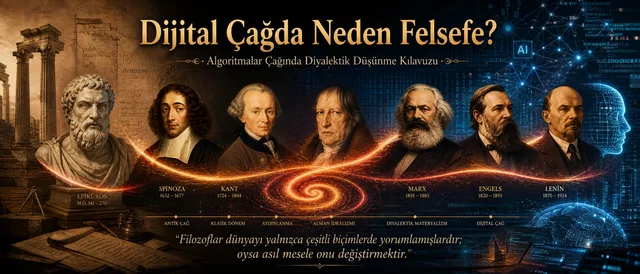
Comrades, we must take philosophy out of an abstract academic corridor and bring it down into the middle of the class struggle. As Marx put it in the famous 11th Thesis, "The philosophers have only interpreted the world, in various ways; the point, however, is to change it." Spinoza’s philosophy too is not a "mental gymnastics" but the first bearing of the material consciousness that will change the world.
Against the masses passivized by bourgeois ideology’s liberal fables, we can grasp how we will organize Spinoza’s revolutionary arsenal along these three basic lines:
| Spinozist Concept | Bourgeois Ideology’s Distortion | Dialectical-Materialist Revolutionary Practice |
|---|---|---|
| Necessity and Freedom | Individual escapes, market liberty, abstract rights | Grasping social laws and overthrowing the capitalist order by organized class power |
| Conatus (Power of Existing) | Individual competition, careerism, commodity fetishism of consumption | Growing solidarity and the power of acting (potentia) around common class interests |
| Critique of Ideology | Virtual illusions, "fate/chance" discourses, mysticism | Deciphering the fears and superstitions that passivize the masses and carrying class consciousness |
Discussion Questions for the Session
We should conduct this educational work with young comrades not as a passive presentation but as a dialectical process of discussion. At the end of the session we can deepen the debate around the following questions:
-
1. Necessity and Freedom: Why do struggles for rights waged without knowledge of the laws of capitalist exploitation stall in a reformist dead end? How does Spinoza’s principle that "freedom is the insight into necessity" orient our revolutionary strategy?
-
2. Critique of Ideology: To which of the "passive affects" of which Spinoza speaks does the atmosphere of "fear and uncertainty" created by today’s bourgeois media and culture industry condemn the masses? How do we disperse this blockade?
-
3. Collective Power (Potentia): What is the historical role of organization and of party consciousness in the transformation of individual and isolated strivings (conatus) into a collective power of acting (potentia)?
-
4. Spinoza’s Limit: How does Marx’s completion of the concept of "historical contradiction and negation," which is missing in Spinoza, change the way we read revolutionary situations today?
Suggestions for Reading and Study
-
Baruch Spinoza: Ethics (especially Parts I and V)
-
Baruch Spinoza: Theological-Political Treatise
-
Friedrich Engels: Anti-Dühring (Part I: Philosophy — Necessity and Freedom)
-
Georgi Plekhanov: Essays on the History of Materialism
-
Louis Althusser: Ideology and Ideological State Apparatuses
-
Antonio Negri: The Savage Anomaly
Comrades, Spinoza has left us a powerful materialist method that enables us to surpass theological conceptions and idealist illusions. Our historical task is to deepen this method with dialectical and historical materialism, to make the inner contradictions of the capitalist order visible, and to create the possibilities of social transformation.