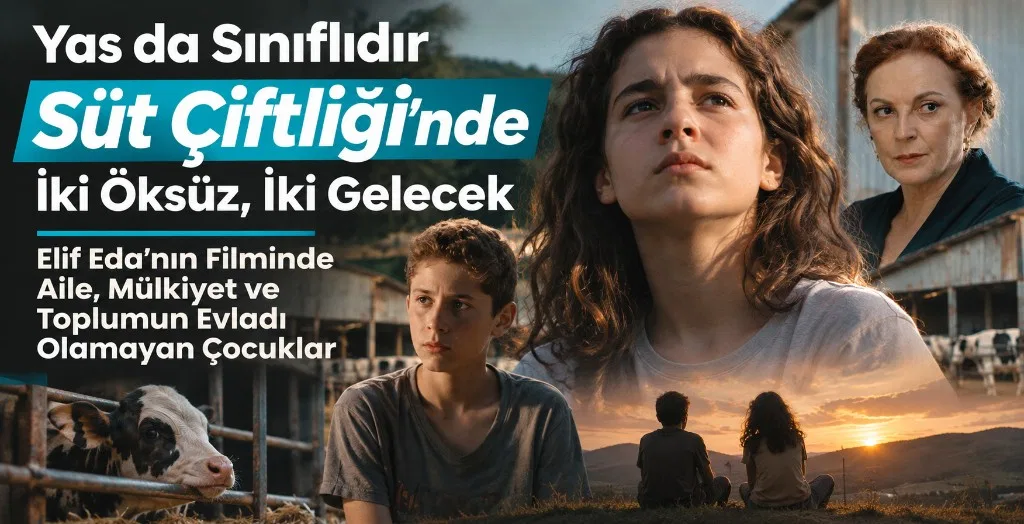
Mourning Has a Class Too: Two Orphans, Two Futures in Süt Çiftliği
Family, Property and the Children Who Cannot Be Society's Own, in Elif Eda's Film
Spoiler warning: This essay discusses the plot, the key scenes and the ending of "Süt Çiftliği" in detail. If you have not seen the film yet, we suggest you watch it first and read this afterwards.
At the Marmaris Film Days we watched "Süt Çiftliği" (The Dairy Farm), Elif Eda's first feature. When we left the hall, what we wanted to talk about was less the story of mourning the film tells than a question quietly placed inside that story: What awaits a child who has lost their family? And why does the answer change so much according to which family, which geography and which class the child comes from?
This essay tries to assess the film through what it makes us think, going beyond a film review. First a short summary, then the detail.
Summary: Süt Çiftliği in Nine Theses
-
The film sets up a mirror. The child who has lost her mother and the calf taken from its mother stand in the same frame. The mirror is powerful, but its real depth is not in individual empathy. It is in the logic of the order that produces the separation.
-
Mourning has a class too. The two orphans in the film, İrem and Halid, live the same loss but not the same mourning. One's anger is counted as "mourning" and met with understanding, while the other's can be read as "not knowing his place".
-
"I am not your slave" is a statement of position. The cry of a propertyless child who has come out of war is the moment the thin line between protection and the exploitation of labour is recognised.
-
The discourse of protection covers the relation of yield. The calf separated from its mother "for the sake of protection" and the child who takes refuge "in order to be protected" stand inside the same logic.
-
The family is a wall that protects and, at the same time, a wall that shuts people out. With private property, the family became the unit through which inheritance is passed on. The child became first the heir to a property, and a human being only after that. The child who loses their family learns, then, that society does not claim them either.
-
To lose is universal. What follows the loss is not. Any of us can be left alone in a moment. A traffic accident and a war may produce the same mourning, but they do not produce the same future.
-
Gaza is this contradiction at its extreme. There, not only the family is destroyed, but the whole social fabric that could make a child society's own.
-
The stories of this geography are still waiting to be told. As Derya Alabora also underlined in the conversation in Marmaris, in a geography where so much pain and so much resistance have been lived, Turkish cinema does not tell them enough. This is not a question of talent. It is the question of with whose money, with whose permission, and in whose hall cinema is made.
-
The answer is not despair. It is a demand. An order in which every child is counted as society's own, and in which care and the future are secured by rights rather than by inheritance.
What Does the Film Tell?
"Süt Çiftliği", whose screenplay Elif Eda also wrote, is her first feature. The film had its Turkish premiere in the New Perspectives section of the 45th Istanbul Film Festival, then met audiences with its team at the Ayvalık International Film Festival, and has now reached viewers in Marmaris.
The story is this. Twelve-year-old İrem, who has lost her mother and father in a traffic accident, moves to the semi-industrial dairy farm run by her grandmother. On the farm she notices that newborn calves are routinely separated from their mothers so that more milk can be taken. There is another orphan on the farm: Halid, who is apprenticed to the farm's veterinarian. With Halid's help, İrem takes a small but radical decision: to free the pregnant cows from the farm. İrem is played, with a striking performance despite this being her first experience, by the dancer Mira Saikali. The grandmother is played by Derya Alabora.
The director ties the film's starting point to her own experience of motherhood. She tells of coming across images from a dairy farm while she was breastfeeding her baby, and of the seed of the film being planted at that moment. This personal spark gives the film its warmth. The film can also carry the viewer far beyond that spark, to the historical questions of property, the family and belonging.
The reviews in the press bring forward the film's vein of mourning and hope. The film is mostly read as a moving work that carries hope at its core, and that reminds us how every living being separated from its mother is driven into loneliness and helplessness, whatever the justification of protection. The piece in Star stresses that the film asks whether, in an age when we are buried in ourselves, we can make room for the pain of others. These readings are valuable. We want to add a layer to them: class.
Two Young Ones in a Single Mirror: The Calf and the Child
One of the film's most discussed scenes is the moment when İrem, after learning that the calves are separated from their mothers, pushes away with the back of her hand the glass of milk set in front of her. The scene is powerful because it makes visible, in an instant, the invisible labour and the pain behind consumption.
The scene can open in two directions. The first is an ethics of individual consumption: "Should I drink milk?" The second is the relation of production: "For whose profit is this production organised in this way?" The first question eases the conscience, but leaves the order where it is. The second looks for the cause of the separation not in nature, but in the calculation of yield.
Nature gave the cow the instinct to bond with her young. It is not nature that breaks that bond. What separates the calf from its mother is the calculation which says that the milk must go to the market, and not to the calf. The film also shows the language that presents this calculation as a practice "for the sake of protection": the calf is supposedly taken into special care. The discourse of protection becomes a curtain drawn over the relation of yield.
The mirror deepens exactly here. The same curtain is drawn over the children who take refuge on the farm.
Mourning Has a Class Too: İrem and Halid
There are two orphans in the film, and the two orphanhoods are not the same.
İrem's mourning can lean on a grandmother, on a property, on a "home". Her silence, her anger, her pushing away of the milk are met with understanding, because there is a ground that can carry her feelings. The bond of blood, and the chain of property that comes with it, turns İrem's pain into a matter inside the family. Matters inside the family are treated with patience.
Halid's mourning is lived inside a refuge, and to take refuge here means to be in debt. That he is an apprentice is no accident either: İrem enters the farm as a grandchild, Halid enters it with his labour. There is no chain that binds to the farm a propertyless child who lost his family in war. His presence is therefore not a family matter. It is a matter of bargaining. The same anger is read as "mourning" in İrem, and can be read as "ingratitude" or "not knowing his place" in Halid.
This is the harshest observation the film leaves us, and in our view the truest: Whether a feeling is tolerated depends on the class position of the person who lives it. The rebellion of a wealthy child is labelled "adolescence"; the rebellion of a poor child is labelled "a tendency to crime". The mourning of a wealthy family becomes "privacy"; the mourning of a poor family becomes "a social services file". Even mourning is not distributed equally.
"I Am Not Your Slave"
The scene in which Halid cries "Köleniz değilim" ("I am not your slave") is the film's intellectual peak as much as its emotional one.
This cry is more than a child's burst of anger. It is a statement of position. For a child with no one, who has come out of war, the line between protection and exploitation is very thin. The farm gives him shelter, and in return it expects obedience and work. The food, the bed and the roof have a price, and that price is never said aloud. When Halid says it aloud, he lifts the cover from the silent contract.
The parallel with the calf ceases to be a metaphor here. The calf separated from its mother "for the sake of protection" and the child who takes refuge "in order to be protected" are inside the same relation: care in appearance, yield and control in substance. Halid's cry says what the calf cannot say.
Let us remember Yılmaz Güney's Sürü (The Herd) and Umut (Hope). The class face of the relation between the provinces, property and the human being had been seen this bare in Turkish cinema before. "Süt Çiftliği" continues that line in a much quieter, almost silent language. Silence is both the film's strength and, at times, its limit.
The Family: A Wall That Protects, a Wall That Shuts People Out
The human being is a species defenceless before wild nature. Its young need care for years. For this reason the first forms of human protection were collective: the clan, the tribe, the common hearth. A child was the child of a community. Their life did not depend on the presence of a single mother and father.
The transformation that Engels traces in The Origin of the Family, Private Property and the State begins exactly here. With private property, the family becomes the legitimate unit through which inheritance is passed on. It must be known for certain who is whose heir, because the property will pass to them. The child is now first the heir to a property, and a human being after that.
The cost of this transformation appears when the family breaks apart:
- The care of the child who has a family looks like a right.
- The care of the child who has no family is a favour, a work of charity, a burden.
"Süt Çiftliği" shows this distinction bare. What binds İrem to her grandmother is blood and property. What binds Halid to the farm is need alone. One's place is secured by inheritance law. The other's place depends on the goodwill of the owner of the house.
The contradiction is this: The human being can survive only as a social being, but class society offers them only as much protection as their family does. Solidarity and common care are the inheritance of the human species. What shuts that inheritance inside the walls of the family is the relations of property. The child who loses their family learns, then, that society does not claim them either.
This is why the rulers' discourse of "protecting the family" has to be looked at with care. As we discussed in Whose Family Is Safe?, when the family is sanctified, what is protected is often not the family itself. It is the reproduction, through the family, of property and of obedience. Children like Halid never enter this discourse. They have no family, and so they are treated as if they had nothing to be protected.
The child, though, must be society's own. This is not a sentence of sentiment. It is a demand for social organisation: that care, education, health, housing and the future be secured socially, without regard to which family a child was born into, or to whether that family is alive.
Having and Belonging
Another question the film leads us to is how far the deep bond between the things we attach ourselves to with love and the reality of life can wear us down.
The cows are property. The calves are the product of property. The farm is property passed on by inheritance. In this world, belonging too is defined through property: to belong to a place is to possess something in that place. In this order Halid is not only someone who possesses nothing. He is someone who can belong nowhere.
The distinction Erich Fromm draws between having and being takes on meaning again here. As we discussed in From Having to Being, a society that lives in the mode of possession builds both love and belonging in the language of property. We hold what we love by saying "mine". When we lose it, we feel we have lost not only a being, but a property by which we defined ourselves.
The propertyless child's search for belonging is for this reason a search that does not end. Because the thing they are looking for is, in this order, a thing that can be given only by property. In a world where belonging has not been torn from property and tied to the relation between people, to common labour and to solidarity, Halid's place will always remain temporary.
Chance, Geography, and Being Lost
The film also reminds the viewer of this: as we move at random through life, we cannot control what will happen to us. We can be left alone in a moment. We can be left orphans in a moment. Among the dozens of stories of death and separation we may meet in life, perhaps the heaviest truth is that we have not yet found an answer to this question, even for the human being.
A distinction has to be made here. To lose is universal. What waits after the loss is not. The traffic accident that took İrem's family and the war that took Halid's family produce the same mourning, but they do not produce the same future. When İrem grows up she will probably be the heir to that farm. Halid will probably be its worker. The film does not say this ending. It lets it be felt. What wounded us most was this: that a future without property waits for a child who lost his family in war.
The geography we are born into looks like chance. But whether there is war in that geography, whose land is occupied, whose house is bombed, who is kept waiting at the border, is not chance. These are the results of an order that produces the weapons, finances the wars, draws the borders and uses the migrant as cheap labour.
Gaza: Where Both the Family and Society Are Destroyed
"Being able to be lost in nature" is not a metaphor in Gaza.
The child left an orphan by war is normally claimed by the extended family. An uncle, an aunt, a grandmother, a neighbour. In Gaza this last guarantee is collapsing too, because there it is not only families that are targeted, but the whole social fabric that could carry a family.
The figures show the scale of this. According to UNICEF data from August 2026, in Gaza more than 58,000 children have lost their mother or their father, or both. More than a million children are in need of protection and psychosocial support. About 17,000 children are estimated to be unaccompanied or separated from their families. The ceasefire declared in October 2025 did not stop the picture either: at least 300 children were killed in the roughly 300 days that followed the ceasefire, which is one child a day on average.
The institutions that could stand in for the family are not standing either. According to UN figures, more than 1.9 million Palestinians have been displaced inside Gaza, most of them repeatedly, and more than half the population has lost its home. In the first months of the war UNICEF was already drawing attention to the fact that the relatives who might take these children on were struggling even to look after their own children.
Let us think of what a child in Gaza lives through. They are pulled alone from under the rubble. They wake in a tent, with no one left who knows their name. Only an identity bracelet on their arm reminds them who they are. Their school, their hospital, their neighbourhood, the water network, everything that could make them "society's own", has been destroyed.
All the layers of protection that humanity built over thousands of years against wild nature (the family, the neighbourhood, the institution and the law) can be wiped out at the same time for one child. What remains is the human being's first nakedness before nature. And this nakedness is the work of politics and of weapons, not of nature.
Let us come back to Halid from here. That a propertyless child who has come out of war is counted as "saved" in a shelter, while in fact being turned into labour power or into a burden, is also a sign of the future that waits for the children who manage to leave Gaza. The international order offers these children aid rather than rights, a camp rather than citizenship. Aid depends on goodwill, and goodwill can be withdrawn. A right is demanded.
Two Children, Two Worlds
| The orphan in a class society | The child who is society's own |
|---|---|
| Their care depends on the family's existence and wealth | Their care is socially guaranteed |
| If there is no family, care is a favour, a charity, a burden | Care is a right, whoever the child is |
| Their mourning is counted as "understandable" or "a problem" according to their class | Their mourning is supported in every case |
| To take refuge is to go into debt, paid with obedience and labour | To take refuge is a social responsibility; nothing is expected in return |
| Their future depends on inheritance: one an heir, the other a worker | Their future is secured by the rights to education, health and housing |
| Belonging is defined by property | Belonging is built by common labour and solidarity |
| The child fleeing war is offered aid and a camp | The child fleeing war is offered the rights of citizenship, and a future |
| The discourse of "protection" covers yield and control | Protection is organised for the child's own good |
A Silent Cinema in a Geography Full of Stories
What Derya Alabora said in the conversation after the screening in Marmaris should be part of this essay too. Alabora underlined that, in a geography where so many stories have been lived, Turkish cinema has not been able to express them enough. This observation is as important as the film itself.
These lands are not, in truth, short of stories. Millions of people who fled war and came here; migrant children put to work in the fields and the workshops; cities left under the rubble of the earthquake; workers killed in workplace murders; villages forcibly displaced; youths spent in prisons; lives lost in the mines. Each of them is waiting to be a subject for cinema, as much as Halid, as much as İrem. Why, then, can these stories not be told enough?
The answer should be looked for not in the talent or the courage of artists, but in the relations of production of cinema. Cinema, just like the dairy farm, is a field of production, and there too three questions have to be asked: In whose hands? Under whose control? To whose benefit?
In whose hands is the money? Independent cinema in Turkey depends, to a great extent, on two sources: the state's support funds, and the co-production means of the broadcasters. Each opens a door, and each also draws a limit. The difference between the project that is supported and the project that is not is usually set not by a written ban, but by an unwritten expectation. In time this expectation settles into the director's mind and turns into self-censorship. It is known which subject "will not get funding", and that subject leaves the table at the screenplay stage. That "Süt Çiftliği", inside these limits, with state support and as a co-production, can still touch a hard question is valuable. This situation also points to the question itself: Why do we have a cinema in which a question can be asked only through a calf's eye, and only by an indirect road?
Under whose control is permission? Censorship does not operate only at the support desk. At the 2023 Antalya Golden Orange, the removal from the selection of the documentary "Kanun Hükmü" (The Decree), which tells of people dismissed by emergency decree, and the festival crisis that followed, showed that a film can be made invisible even after it has been shot. The digital platforms, too, work under the supervision of RTÜK, with a mechanism of self-censorship that calculates in advance which character, which scene and which subject is "risky". The most painful areas of social reality (the Kurdish question, migration, war, the deaths of workers, the prisons) always stand in this risky zone.
To whose benefit is the hall? Even if a film is shot and passes censorship, reaching the viewer is a separate struggle. Cinema halls are concentrated in the hands of large chains, and the box office sets the programme. An independent film is shown in a few halls for a few days, and then withdrawn. Festivals, events kept standing by local labour and volunteering, such as the Marmaris Film Days, are almost the only place where these films can meet an audience. The long hours of cinema workers, their precarious contracts, and the weight of the series industry, which draws most of the labour to itself, are part of this picture too.
This question has a history. It was no accident that Yılmaz Güney's films were banned, that he had to make films in prison and then in exile, and that Yol (The Way) could not reach this country's screens for years. The 12 September coup aimed, among other things, to clear social reality out of cinema. Today, indirect telling, the symbol and the metaphor are an aesthetic choice of Turkish cinema, and often they are a necessity. The strongest films of our cinema have been not the films that could say what they wanted to say, but the films that could make felt, by other roads, what they could not say.
Alabora's observation should therefore be read as a definition of a task, more than as a reproach. A cinema that can tell the stories of this geography becomes possible only when cinema itself has been made a commons: independent and transparent public funds, the right to screen without censorship, city cinemas supported by local government, the organised power of cinema workers, and workers, migrants and young people who can tell their own story with their own camera. Halid's story will be told best by a Halid who one day takes his own camera in hand.
Assessing the Film: What Is Strong, and What Could Go Further
What is strong. The film makes visible, through a child's eyes, the invisible pain behind consumption. It uses silence as a language of telling, and Mira Saikali's acting, in her first experience, is able to carry that silence. The grandmother played by Derya Alabora creates an interesting tension as a figure caught between being an owner of property and being a grandmother. The character of Halid works as the door that takes the film out of a story of mourning and binds it to a social question.
What could go further. The matter of the agreement over the conditions of milk production, and the conflict with the villagers, stands in the film like a subplot left in the background beside the children's journey of healing. Some viewers may see this subplot as a weight that breaks the flow of the narrative. We think the opposite: the film's class vein is exactly in this subplot. If the tension between the small producer and the industrial plant, the capitalisation of the family business, and the position of the workers on the farm had been treated more boldly, the film could have carried the mirror between the calf and the child more strongly from individual empathy to a social understanding. Halid's past, and his labour on the farm, could likewise have been more visible. These lacks do not reduce the value of the questions the film opens. On the contrary, it leaves those questions to the viewer.
The director's own words sum up the film's philosophical centre well: "I want to exist, even if I do not." This sentence describes İrem's taking refuge in the cave. We read it for Halid too: the demand to exist of a child who has been made propertyless, alone and invisible.
What Can We Do?
A film opens a question. We build the answer to that question outside the hall, in an organised life. Concretely:
- Let us watch the film together and discuss it. In youth organisations, in union branches, in cultural centres, let us use Süt Çiftliği as the start of a discussion. Let the question be this: What determines the future of the two children in this film?
- Let us bring the conditions of children under protection onto the agenda. Let us look into, and make visible, the housing, education and employment problems of children under state protection in Turkey, and of young people who "leave" the children's homes at 18.
- Let us look at the labour of migrant and refugee children. Let us document the situation of migrant children put to work in the field, the workshop and the farm. Let us name the relation of "labour in exchange for refuge".
- Let us keep up the solidarity with the children in Gaza. Without forgetting that the declaration of a ceasefire did not stop the killing of children, let us keep on the agenda the demand that humanitarian aid arrive without obstruction and that the children be protected.
- Let us meet the discourse of "the family" with a class question. When the rulers sanctify the family, let us ask which family, whose family, and at what cost they are protecting.
- Let us stand by the cinema of the stories that are not told. By watching independent films at festivals and during their short runs, by giving our labour to local film days and to city cinemas, by defending the right of censored films to be screened, and by standing in solidarity with the organising of cinema workers, let us contribute to the stories of this geography reaching the screen.
- Let us defend the institutions of common care. Public nurseries, free and decent education, health for everyone, and social housing are rights that secure a child's future independently of which family they were born into.
Dear Young Comrades
Watching "Süt Çiftliği", we saw that a whole order stands behind a small hand pushing away a glass of milk. The calculation that separates the calf from its mother and the calculation that makes Halid feel like "a slave" are the same calculation. The violence that leaves a child utterly alone under the rubble in Gaza is that calculation in its barest and bloodiest form.
All of us will lose one day. Death, separation and loneliness are part of the human lot. What happens after we have lost is not fate. It depends on what kind of society we build. An order that ties a child's life and future to the existence and the wealth of their family can promise nothing to the child who loses their family in war.
Our demand is therefore plain: every child is society's own. Their care, their education, their health and their future must be secured by rights, not by inheritance. No child should have to cry "I am not your slave" in the place where they have taken refuge.
We will build this together, in an organised way, and not each of us alone.
Sources
- Merve Tur, "Elif Eda'nın 'Süt Çiftliği' Türkiye prömiyerini İstanbul Film Festivali'nde yapıyor" (Elif Eda's Süt Çiftliği has its Turkish premiere at the Istanbul Film Festival), Evrensel, 5 April 2026
- "Bir mandıradan manzaralar: Süt Çiftliği" (Scenes from a dairy: Süt Çiftliği), bianet (interview with Elif Eda)
- Filiz Zengin, "Başkalarının acısına yerimiz var mı?" (Do we have room for the pain of others?), Star
- "Ayvalık Uluslararası Film Festivali'nde Altıncı Gün" (The sixth day at the Ayvalık International Film Festival), Ters Ninja
- "UNICEF says one child killed per day in Gaza since 'ceasefire'", Al Jazeera, 6 August 2026
- "At least 300 children reportedly killed in Gaza in past 300 days", UNICEF, 6 August 2026
- "Stories of loss and grief: At least 17,000 children are estimated to be unaccompanied or separated from their parents in the Gaza Strip", UNICEF, February 2024
- "Painted backpacks offer children in Gaza some sense of normality", Arab News
- Süt Çiftliği film page, Moviefone
- Friedrich Engels, The Origin of the Family, Private Property and the State
- Erich Fromm, To Have or to Be
Related essays from Knowledge Commons: Whose Family Is Safe? · From Having to Being
This essay is shared under the CC BY-SA 4.0 licence.