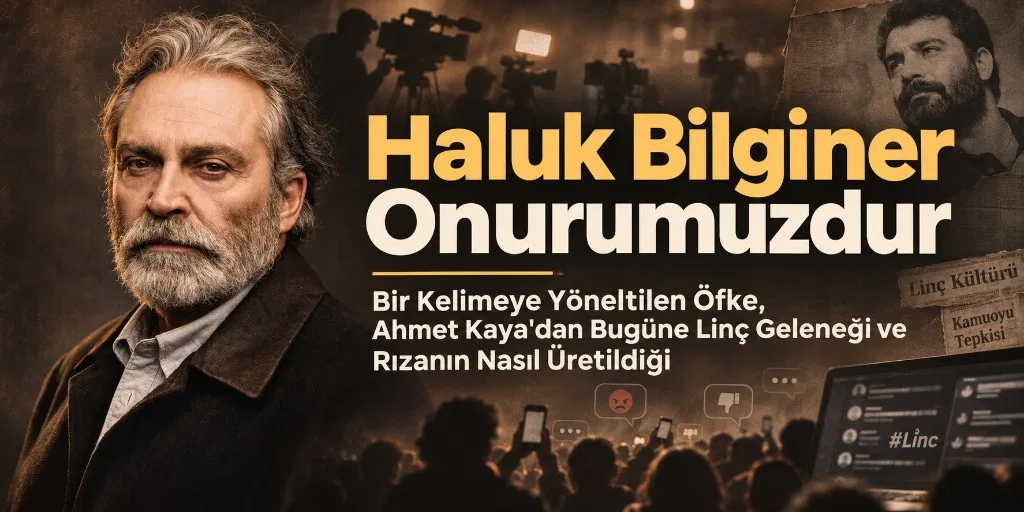
Haluk Bilginer Is Our Pride
The Fury Aimed at a Single Word, the Tradition of Lynching from Ahmet Kaya to Today, and How Consent Is Manufactured
We are writing this on 15 November. Tomorrow is 16 November, the 26th anniversary of the day Ahmet Kaya died in Paris, in exile, because his heart gave out. A week ago, on 9-10 November, a few seconds of footage cut from an interview Haluk Bilginer gave years ago were pushed back onto social media, and for days one of the country's greatest actors was called "ungrateful", "English" and "racist". In the same days workers were losing their lives in the explosion at HABAŞ in Aliağa. Simply looking at which of the two was talked about more sums up the subject of this essay.
First, a Summary
What happened? A clip from an interview Haluk Bilginer gave about thirteen years ago was shared again on 9 November 2026. In that interview, after saying "I see a happy future for Turkish cinema", Bilginer corrects himself: "Shall we call it the cinema of Turkey? 'Turkish cinema' doesn't seem right to me."
Who got angry? A broad front, from pro-government columnists to opposition journalists, from an İYİ Party MP to famous actors. Ece Üner called the phrase "plain racism", Fatih Altaylı asked "Is the problem the word Turk?", Yılmaz Özdil and Ersan Şen lashed out over citizenship and the constitution, and Talat Bulut reminded everyone of Bilginer's British citizenship and called his words "ingratitude". Even the journalist who conducted the interview became a target.
What had he actually said? That a country's cinema is the shared product of all the peoples, languages and working people who live in that country. Saying "the cinema of Turkey" excludes no one; on the contrary, it brings Kurdish, Armenian, Greek, Alevi, Laz and Circassian filmmakers under the same roof. It is a phrase that has been used for decades at festivals, in academia and in film writing.
Why so much fury? Because in Turkey lynching is not a spontaneous outburst of anger. It is an apparatus with a history, used by the ruling class to sustain its hegemony. The untouchability around the word "Turk" works as a curtain that covers class contradictions with national identity. Anyone who touches this curtain, whether Nazım Hikmet, Ahmet Kaya or Sezen Aksu, is put through a "loyalty test".
What did we see differently this time? That the lynching front brought government and opposition together on the same side. To put it in Gramsci's language, this is exactly what hegemony is: when the ideas of the rulers start speaking through the mouths of those who think they oppose them.
What is our position? Plain: Haluk Bilginer is our pride. We stand with a working artist who kept himself afloat in London by mopping floors and cleaning toilets, who carried this country's name to the world on stage and screen, and who sent his greetings "to those who stand upright in crooked times". Our task is to build solidarity against the lynching campaign, not to leave him alone, and to expose the class root of this culture.
What Happened? A Week's Chronology
9-10 November: The Clip Goes into Circulation
The row began when an old interview with Bilginer was shared again on social media on 9-10 November 2026. News sites could not establish for certain when the interview was first published. The Milliyet columnist Ali Eyüboğlu, however, writing "since you waited 13 years" in his column, indicates that the footage is about thirteen years old.
So there is no new statement. There is a sentence said more than a decade ago that caught no one's attention at the time. Even Fatih Altaylı had to ask the same question in his piece: why is this video back in circulation now? A good question. But instead of looking for the answer, he joined the caravan himself.
10-11 November: Opposition Writers Take the Lead
On 10 November the journalist Ece Üner wrote on her X account that saying "the cinema of Turkey" instead of "Turkish cinema" was plain racism. In his piece on 11 November Fatih Altaylı asked Bilginer whether he would say "the cinema of France" or "the Iranian's cinema", and implied that the real discomfort came from the word "Turk". That Altaylı went on in the same piece to warn about "Kurdish nationalists" in the "Terror-Free Turkey" process gives away the real context of the row by itself: the subject is not cinema, it is the Kurdish question.
The criminal lawyer Ersan Şen objected on the basis of the Constitution. The İYİ Party MP for Aksaray, Turan Yaldır, said "ask them and they are the greatest Kemalists" and accused Bilginer of disloyalty to the Republic. Yılmaz Özdil brought up the actor's British citizenship.
12 November: The Interviewer Is Targeted Too
A lynching hits not only its target but those around it. According to the Milliyet column, the interviewer, Gökçe Güzel, also got her share of the reaction and had to make a statement on X. The same columnist, recalling that in another interview Bilginer had said there had never been full democracy in Turkey, that Hitler too came to power through elections, and that he saw Gezi as a turning point, himself admits that the matter is not about a single word.
13-15 November: "Declarations of Loyalty" from the Art World
His former wife Zuhal Olcay pointedly used the phrase "Turkish cinema" at the opening of the Ankara Film Festival, and the press presented this as an indirect reply to Bilginer. The actor Gökhan Alkan said that the bounds of "Turk" are far wider than today's state and added, "we do not accept other ways of putting it". Emel Sayın, in more measured language, said she found the phrase "Turkish cinema" warmer.
The harshest outburst came on 14 November at a special screening at the Beyoğlu Cinema. Talat Bulut called it ingratitude for a British citizen who became famous and made money in Turkey to try to change the 114-year-old identity of "Turkish cinema". The director Orhan Oğuz and the actor Şerif Sezer spoke in the same vein.
Throughout this time Bilginer made no new statement. He chose to stay silent. In a lynching culture even that is a crime: the one who stays silent is declared "arrogant", the one who speaks "shameless".
What Did He Actually Say?
The flow of the sentence in the interview matters. Bilginer first says he sees a happy future for Turkish cinema, then stops and questions his own word. There is no imposition; there is a person asking "shall we?", thinking, correcting himself. He demeans no one, denies no one's identity, insults no people.
Nor is the phrase he proposed his invention. "The cinema of Turkey" has long been a term used in festival speeches, in film writing and in academia. At the 2021 Golden Boll, for example, the Mayor of Adana Metropolitan Municipality, Zeydan Karalar, used the same concept when speaking of the Golden Boll's contribution to the cinema of Turkey. Nobody called Karalar a "racist" that day.
The counter-argument the lynchers repeat most is the claim that in other interviews Bilginer said "English cinema" or "French cinema". Even one of the sites reporting the story had to note that these claims have not been verified and that part of the criticism rests on unverified claims. Lynching feeds on unverified information; verification cannot keep up with the speed of a lynching.
| What the lynching campaign says | What actually happened |
|---|---|
| Bilginer is uncomfortable with the word "Turk" | Bilginer corrected his own sentence and proposed a more inclusive phrase |
| He made a new and provocative statement | A few seconds of footage cut from an interview about thirteen years old |
| He says "French/English cinema" for other countries, a double standard | This claim has not been verified |
| Saying "the cinema of Turkey" is racism | A term covering all the peoples of the country, used at festivals and in academia |
| As a British citizen he has no right to speak | Citizenship is a tool for shifting the debate onto the person, for judging the speaker rather than the words |
| He is being "ungrateful" | The first actor from Turkey to win an International Emmy, the lead in the film that won the Palme d'Or with Winter Sleep |
Why Is the Word "Turk" So Sensitive?
Article 66 of the 1982 Constitution counts as a "Turk" everyone bound to the Turkish state by the bond of citizenship. On paper this is a definition of citizenship. But in everyday life and in politics the word "Turk" always circulates with an ethnic content. A Kurd is told "you are a Turk too", but singing in Kurdish counts as "separatism". An Armenian is told "you are a Turk too", but Hrant Dink is murdered.
This is the duality Bilginer's proposal of "the cinema of Turkey" removes. It is a definition by land, by country, by shared life: the cinema produced in this country, whoever produces it. A look at the history of Yeşilçam is enough: Armenian actors such as Kenan Pars (Kirkor Cezveciyan), Sami Hazinses (Samuel Agop Uluçyan) and Vahi Öz; a Kurdish director such as Yılmaz Güney; Greek and Jewish technicians, extras and cinema operators. This cinema is the shared product not of a single ethnic identity, but of the working people of these lands.
There is one more irony. 14 November 1914, accepted as "the birthday of Turkish cinema", is the day the demolition of the Russian Monument at Ayastefanos is said to have been filmed. A large share of film historians find this starting date, and even the existence of the film, disputed; the Manaki brothers and other filmmakers had shot footage in Ottoman lands before that. In other words, the phrase "114 years of Turkish cinema" is itself a nationalist origin story built on footage of a demolition. That is exactly what needs to be opened up for debate.
Lynching Is Not a Culture, It Is an Apparatus
We use the expression "lynching culture", but we need to be careful. The word "culture" gives the impression that there is something in this society's genes, its character, its "temperament". Years ago Haluk Bilginer said in an interview that the feeling of violence and lynching in society had to do with Turkey's recent history and what society had been taught in the past. He was right.
Lynching is taught. It is repeated. It is rewarded. It is left unpunished. It is not a society's "temperament" but a technique of rule that serves those who rule that society. From a Marxist point of view, lynching has three functions:
First, drawing the line. Lynching shows everyone what can and cannot be said. The person targeted is an "example"; the real addressees are the millions watching. The next artist, journalist or academic thinks twice before speaking. This is called self-censorship, and it is the real product of lynching.
Second, steering attention. Let us recall this week's agenda: the explosion at HABAŞ in Aliağa, the debates on the 2027 budget in the Plan and Budget Committee, the fund scandal, the minimum wage bargaining at the door. What was talked about for days on screens and timelines, though, was a word an actor said thirteen years ago. A worker's death lasts a day; the "Turkish or of Turkey" row lasts a week.
Third, dividing the class. The lynching campaign separates working people along ethnic and religious lines. Turkish and Kurdish workers exploited in the same factory, on the same building site, on the same courier platform are steered to look for their common enemy not in the boss but in each other's "identity". The sanctification of national identity is the thickest curtain drawn over class contradiction.
The Anatomy of a Lynching
The Bilginer case carries almost every stage of lynching campaigns in Turkey:
- Cutting out: A few seconds of footage stripped of context. No before and no after.
- Timing: Old footage is put back into circulation in a particular political climate. This time, the nationalist anxieties of the "Terror-Free Turkey" process.
- Labelling: "Ungrateful", "English", "racist", "enemy of the Turks". The debate shifts from the concept to the person.
- Spreading: Hundreds of news sites produce content on the same template, headlined "What did Haluk Bilginer say, and why is it trending?" These texts written for search engines are the click economy of lynching: anger turns into advertising revenue.
- Demanding declarations of loyalty: Journalists hold out microphones to celebrities: "What do you say?" Everyone is expected to take sides, and the majority to choose the "right" one.
- Hitting those around: The journalist who did the interview, users who show support, even former spouses are drawn into the game.
- Making people forget, and reminding them: The campaign ends, the record stays. It is put away in the archive, to be reopened at the next opportunity.
The age of the algorithm has greatly sped up these stages. As we said in the essay where we described echo chamber politics, platforms measure anger, reward anger and sell anger. Lynching no longer even needs a newspaper headline; a trending topic is enough.
Those Lynched, from the Past to Today
What was done to Bilginer is not new. Throughout the history of the Republic, artists, writers and intellectuals were targeted by the same mechanism. The price was sometimes a campaign, sometimes exile, sometimes prison, sometimes death.
| Person / Community | Year | Their "crime" | The price |
|---|---|---|---|
| Sabahattin Ali | 1940s | Socially committed literature, writing against racism | Trials, prison; killed at the border in 1948 |
| Nazım Hikmet | 1951 | Being a communist poet | Stripped of citizenship (restored in 2009) |
| Istanbul's Greeks, Armenians and Jews | 6-7 September 1955 | Being non-Muslim | Mass looting and pogrom, emigration |
| Yılmaz Güney | 1983 | Being a Kurdish director, making Yol | Stripped of citizenship, died in exile |
| Aziz Nesin and the intellectuals in Sivas | 2 July 1993 | Being secular and dissident | 33 intellectuals and 2 hotel workers burned to death at the Madımak |
| Ahmet Kaya | 1999 | Saying he would make a song in Kurdish | Lynching, prison sentence, exile; died in Paris in 2000 |
| Hrant Dink | 2004-2007 | Being an Armenian journalist, debating history | Convicted under Article 301; murdered on 19 January 2007 |
| Orhan Pamuk | 2005 | Speaking of Kurdish and Armenian deaths | Article 301 case, campaigns against his books |
| Elif Şafak | 2006 | Including the Armenian genocide in a novel | Article 301 case (acquitted) |
| Fazıl Say | 2012-2013 | Tweets | Convicted of "insulting religious values" (later overturned) |
| Memet Ali Alabora | 2013 | The tweet "It's not just about Gezi Park" | Targeted by Yeni Şafak, arrest warrant, living abroad |
| Academics for Peace | 2016 | The declaration "We will not be a party to this crime" | Dismissals, trials, cancelled passports |
| Sezen Aksu | 2022 | A single line of a five-year-old song | The President's "tear out tongues" remark, criminal complaints |
| Gülşen | 2022 | A joke on stage | Arrest, house arrest |
| Haluk Bilginer | 2026 | "Shall we call it the cinema of Turkey?" | A week-long campaign, humiliation over his citizenship |
The most striking thing about this table is the ordinariness of the "crime" column. A song, a tweet, a word, a declaration, a joke. The price column, meanwhile, reads death, exile, prison. The disproportion shows that the aim of lynching is not to punish but to frighten.
Ahmet Kaya: The Textbook Case of Lynching
The Ahmet Kaya case holds a special place because it showed every stage of lynching in Turkey in a single night and its aftermath. That is why it needs to be told in detail.
That night. On 10 February 1999, at the awards ceremony of the Magazine Journalists' Association, Kaya went up to the podium to receive the artist of the year award and said that, because he was of Kurdish origin, he would make a song and a video in Kurdish on his next album. That was all. An artist announced that he would sing in his mother tongue.
The hall erupted. People shouted "throw that man out" and "you are being a separatist". In a hall full of Turkey's "distinguished" artists, forks and knives were thrown. Then marches were sung; some artists, led by Serdar Ortaç, "answered" by singing the song "Memleketim". Kaya and his wife Gülten Kaya had to leave the ceremony in a hurry.
The headlines. In the days that followed a media campaign began. On 14 February 1999 Hürriyet ran the headline "Shame on you, dear". The same paper then published a photograph allegedly showing Kaya singing in front of an organisation's poster at a concert in Berlin, under the headline "The scoundrel". The photograph was later proven to be fake. Ferhat Tunç, who was with Kaya at that concert, would write years later that Hürriyet's reporters had been lying in wait and that Kaya's "death warrant" had long been prepared. The editor-in-chief of the time, Ertuğrul Özkök, expressed regret over that headline years later; but an artist's life did not come back.
Exile. Cases were opened against him, and he was given a prison sentence. Kaya left for Paris on 16 June 1999. In Gülten Kaya's words in later years, had he stayed in Turkey his fate would have been like that of their friend Hrant Dink. His daughter Melis Kaya says her father was both alone in exile and abandoned by his friends back home, and that this loneliness hurt him deeply.
Death. Ahmet Kaya died of a heart attack in Paris on 16 November 2000. He was 43. He was buried in Père-Lachaise Cemetery at a funeral attended by more than 30,000 people. Even his grave was attacked over the years.
The "honour" that came later. Twelve years later the same association gave him a special award. In 2017 the Presidential Spokesman İbrahim Kalın visited his grave and remembered him as one of the most talented artists in Turkey's history. The Kurdish song "Karwan" he had announced, and its video, were released after his death. Yet in a hospital operating theatre his songs could still be switched off with the words "the foremost of the terrorists".
This "honour that came later" is part of the lynching apparatus too. The rulers claim the artist they killed after his death; they turn him into a harmless symbol, a nostalgia. That is why it is no contradiction that some writers who commemorate Ahmet Kaya today called Haluk Bilginer "ungrateful" yesterday. A dead artist is harmless; a living artist speaks.
The Line Between Ahmet Kaya and Haluk Bilginer
Twenty-seven years separate the two events, but they are two forms of the same sentence: in this country the name, the language and the existence of those who are not Turkish must not be visible in public. In 1999 a singer was driven out with forks and knives for saying "I will sing in Kurdish". In 2026 an actor had his citizenship called into question for saying "Shall we call it the cinema of Turkey?" The form seems to have softened: a tweet instead of a fork, a trending topic instead of a headline. But the substance has not changed.
There is one difference that matters: in 1999 the front against Kaya was organised mainly from the centre of the state and the big media. In 2026 the loudest voices against Bilginer came from people who consider themselves opposition. That is proof of how deep hegemony has worked its way in.
Its Relationship with the Culture of Hegemony
Gramsci: Coercion and Consent
Antonio Gramsci showed that ruling classes do not rule by force alone, that is, by the police, the army and the courts. Lasting rule also requires consent. The ruled must adopt the rulers' world view as their own "common sense". Gramsci calls this hegemony. Coercion comes into play when hegemony weakens; but if hegemony is strong, coercion is often unnecessary, because society polices itself.
This is exactly where lynching sits. Lynching is coercion applied through civil society. The state does not need to throw forks; the "distinguished" people in the hall throw them. The state does not need to put an actor on trial; his colleagues declare him "ungrateful". The lyncher sees himself as a free citizen, even a "guardian of values"; in fact he is the voluntary gendarme of the ruling class.
In our earlier essay "The Class of Words" we described how hegemony is built in language, and how deciding which words count as "natural" and which as "dangerous" is a relation of power. The Bilginer case is a living example of this. "Turkish cinema" is natural, neutral, innocent; "the cinema of Turkey" is political, provocative, "racist". Yet both are choices. One is dominant because it can hide the fact that it is a choice.
The Load-Bearing Column of Hegemony in Turkey: National Identity
Since the founding of the Republic, the hegemony of the ruling class in Turkey has taken different forms: the official nationalism of the single-party era, the Turkish-Islamic synthesis of 12 September, the religious-nationalist bloc of the AKP era. But the common load-bearing column of all of them has been the sanctification of the concept of "Turkishness". As we described in detail in the 12 September Dossier, the 12 September regime deliberately strengthened this column as the ideological ground for crushing the class movement.
The class function of this sanctification is plain. Capital accumulation depends on the working class staying divided, unorganised and low-paid. Kurdish workers who migrate to the industrial cities of the west work in the hardest jobs for the lowest wages. They are told "you are a Turk too" and their identity is denied, and when they speak in their own language they are branded "separatists". The Turkish worker, meanwhile, is told "you are the real owner" and given a false sense of superiority over the Kurdish worker who suffers the same exploitation. As we said in our essay on racism, racism is one of the oldest tools capital uses to divide the working class.
Why Is the Opposition in the Lynching Front?
The most instructive thing about this week is the make-up of the front against Bilginer. Pro-government writers are where you would expect them. But Ece Üner, Fatih Altaylı, Yılmaz Özdil and an İYİ Party MP are in the same front. What is more, Altaylı was himself unlawfully jailed a while ago, a journalist who ought to know better than anyone what a lynching is.
This is no coincidence. A large part of the mainstream opposition in Turkey shares the same understanding of national identity as the government; it only argues over the "secular" or "religious" version of that identity. The trend we described as "rising ulusalcılık" (secular nationalism) in our essay on the bar association election fills the space emptied by class politics with a nationalist identity politics. When these groups, which position themselves against the government, speak the same language as the government on the Kurdish question and on national identity, the hegemony of the ruling class is complete.
This is the historical bloc Gramsci described: the ideas of the ruling class have become "common sense" not only among its own base but also among groups that appear to oppose it. That is why it is telling that Altaylı went after Bilginer while invoking the "Terror-Free Turkey" process. In a period like a peace process, even the smallest phrase that evokes the equality of the Turkish and Kurdish peoples is perceived as a "danger". Because a lasting peace means the class contradictions beneath the curtain of national identity becoming visible.
A Class Reading of the "Ingratitude" Discourse
The word "ingratitude" that Talat Bulut used deserves attention. Beneath this discourse lies the idea that an artist who became famous and made money in Turkey should see this as a "favour" and show loyalty in return. In other words, the artist is not a worker who received the return for their labour, but a subject who has been "granted" something and is therefore in debt.
Yet everything Bilginer gained in Turkey is the product of more than forty years of labour on stage and screen. Not a favour. This discourse also turns upside down who owes what to whom: the one truly in debt to an artist who won the first International Emmy ever given to an actor from Turkey, who played the lead in a film that won the Palme d'Or, and who founded his own theatre and opened the stage to hundreds of young actors, is the culture of this country.
The citizenship question is a product of the same logic. When the lynchers cannot argue with the words, they argue with the speaker: "British citizen", "Türkiyeli" (in mocking quotation marks), "someone who lives over there". This is today's language of the mentality that stripped Nazım Hikmet and Yılmaz Güney of their citizenship. Citizenship is seen here not as a right, but as a privilege earned by loyalty and lost by disloyalty.
Who Is Haluk Bilginer? Our Pride
What the lynchers want people to forget is who Haluk Bilginer is. So let us remember.
A worker. He was born in İzmir in 1954, the son of an insurance agent father and a housewife mother. He studied at the Ankara State Conservatory, then went to London. While training at the London Academy of Music and Dramatic Art (LAMDA), he swept floors, mopped floors and cleaned toilets to make a living. This is what those who sneer at him as "English" ought to know: Bilginer went to London as a migrant worker.
A master of the stage. In Britain he appeared on stage in plays such as My Fair Lady, The Caucasian Chalk Circle, Macbeth and The Phantom of the Opera. He was an actor from Turkey who played on the British stage Brecht's The Caucasian Chalk Circle, that great play which tells that the land belongs to those who work it. After returning to Turkey he founded Tiyatro Stüdyosu, and then Oyun Atölyesi. Many young actors performing on Turkey's stages today were trained on his stage; his colleagues describe him as a generous man who wants to lift everyone up.
A giant of the screen. For his role in Masumiyet (Innocence) he won best supporting actor in Antalya in 1997 and best actor in Ankara in 1998. Winter Sleep, in which he played the lead, won the Palme d'Or at Cannes. For his role as Agah Beyoğlu in Şahsiyet (Persona) he was named best actor at the International Emmys in 2019; it was the first Emmy won by an actor from Turkey. In February this year he was given an honorary award at the Turkey-Germany Film Festival in Nuremberg. He has appeared in around a hundred film productions.
A citizen who stands upright. The sentence he spoke when receiving the honorary award at the Golden Boll in 2021 still rings in our ears: "Greetings to those who stand upright in crooked times." In the same speech he said that in Turkey art has always been made "in spite of" something. In Nuremberg this year he said, "As long as those who know no shame rule, the world will get worse." He saw Gezi as a turning point and said openly that democracy had never been fully established in Turkey.
Perhaps that is his real "crime". What angers the lynchers is not a word; it is that one of this country's most loved and most respected actors has refused to bow for years.
We say it plainly too: Haluk Bilginer is our pride. We count him among the living treasures of this country's culture. We stand with him because he defends a vision of Turkey that embraces all its peoples, because he does not shy away from saying what he thinks, and because through his labour he carried this country's name to the world. Just as we should have stood with Ahmet Kaya in 1999. Not enough people stood with him then; we will not repeat the same mistake today.
A Reply to the Opposing View
It would not be fair to count every reaction as lynching. Some, such as Gökhan Alkan or Emel Sayın, expressed their own preference politely. An artist saying "I prefer to say Turkish cinema" is not lynching; it is a view. A view that deserves an answer.
The strongest basis for this view is this: by its definition in the Constitution, the word "Turk" is a political identity, not an ethnic one; the words French or German were once ethnic too, and today they denote citizenship. So saying "Turkish cinema" excludes no one.
The logic of this argument is consistent on paper. But life is not lived on paper. If the word "Turk" really were a citizenship identity purged of its ethnic content, nobody would have thrown forks when Ahmet Kaya announced he would sing in Kurdish; Hrant Dink would not have been murdered; the demand for education in Kurdish would not be treated as a question of "separatism"; and Bilginer's words today would not have caused so much fury. Whether a word is inclusive is decided not by those who use it, but by those left outside it. And in this country there are millions of people who feel themselves outside that word.
Besides, Bilginer imposed nothing on anyone. He asked, "Shall we?" That even asking a question led to such a large campaign shows that the aim was not debate but silencing.
Dear Young Comrades
Lynching tries to discipline you above all through the fear of being left alone. One day you too may become a target because of a tweet, a banner, a song or a word. Nehir and Nevin were jailed because of a banner. The Academics for Peace were left jobless because of a declaration. Ahmet Kaya lost his country because of a sentence.
Individual courage is not enough against lynching; organised solidarity is needed. It was not only the forks and the headlines that killed Ahmet Kaya; as his daughter said, it was loneliness. Had a few more people stood up in the hall that night and said "enough", had hundreds of artists signed a statement against those headlines the next day, perhaps everything would have been different. In 2022, when hundreds of artists told Sezen Aksu "you will never walk alone", the lynching campaign had to back down, and even the President had to say that his words had not been aimed at Aksu. Solidarity works.
Do not forget: the lynchers look more numerous than you, but they are not. Trending topics, bot networks and hundreds of identical news stories written for search engines reflect not a real majority but the noise of an organised minority and the click economy. Getting the silent majority to speak is our job.
Concrete Tasks
- Make solidarity visible: Multiply messages of support for Haluk Bilginer; call on professional organisations (the Actors' Union, cinema professional associations, theatre workers) to make a joint statement.
- Give back the context: Share the full clip, the date of the interview, and content describing Bilginer's artistic life. If the first weapon of lynching is lack of context, our first answer is context.
- Expose unverified claims: Document the accounts and sites spreading unverified claims such as "he says English cinema".
- See the economy of lynching: Research the news sites producing anger on the same template, their advertising revenue and the bot networks; ask the question "who makes money from lynching?"
- Recall history: When commemorating Ahmet Kaya on 16 November, show that the mechanism that killed him is still working today. Take the commemoration out of nostalgia and connect it to today's struggle.
- Take back the agenda: Talk with the same intensity about the issues lynching covers up: the workers who died at HABAŞ, the budget debates, the minimum wage.
- Clean up our language: Consciously use inclusive phrases such as "the cinema of Turkey", "Türkiyeli" and "the peoples of these lands"; take care with our language.
- Defend the unity of the class: Expand the work that explains the common interest of Turkish and Kurdish working people and puts forward joint organising against ethnic division.
Dear Comrades
A country's greatness is measured by how it treats its greatest artists. That an order which stripped Nazım of his citizenship, killed Sabahattin Ali at the border, drove Yılmaz Güney into exile, burned its intellectuals at the Madımak, threw forks at Ahmet Kaya and shot Hrant Dink in the street now calls Haluk Bilginer "ungrateful" shows that the order has not changed. But the same history shows us something else too: Nazım's poems, Güney's films, Kaya's songs and Dink's words live on. The names of those who tried to silence them have long been forgotten.
Culture belongs to those who produce it. Cinema belongs to the working people who shoot it, act in it, rig its lights, carry its sets and run its cinemas, whatever language they speak. The cinema, the theatre and the songs of these lands belong to all the peoples of these lands.
Haluk Bilginer is our pride. The memory of Ahmet Kaya lights our way. Greetings to those who stand upright in crooked times.
Sources
The Bilginer row (November 2026)
- Ali Eyüboğlu, "Haluk Bilginer'in 'Türk' rahatsızlığı!" (Haluk Bilginer's discomfort with "Turk"!), Milliyet, 12 November 2026
- "Haluk Bilginer'in 'Türkiye Sineması' sözleri tartışma çıkardı" (Haluk Bilginer's "cinema of Turkey" remarks spark a row), Haber Ankara, 10 November 2026
- "Haluk Bilginer'in 'Türkiye sineması' sözlerine Ece Üner'den sert tepki" (Harsh reaction from Ece Üner), Tele3 Haber
- "Haluk Bilginer ne dedi? 'Türk sineması' sözleri yeniden gündemde" (What did Haluk Bilginer say?), Timeturk, 10 November 2026
- Report on Fatih Altaylı's column, Rudaw
- "Ersan Şen'den sert tepki" (Harsh reaction from Ersan Şen), İnternet Haber
- "Yaldır'dan Haluk Bilginer tepkisi" (Yaldır reacts to Haluk Bilginer), Anadolu Ekspres
- "Yılmaz Özdil'den Haluk Bilginer'e salvolar" (Yılmaz Özdil's salvoes at Haluk Bilginer), Haber7
- "Zuhal Olcay'dan eski eşi Haluk Bilginer'e manidar yanıt" (Zuhal Olcay's pointed reply to her former husband), Son Dakika
- "Gökhan Alkan'ın yanıtı" (Gökhan Alkan's reply), Haberler.com
- "Emel Sayın'dan yanıt" (A reply from Emel Sayın), GZT
- "Haluk Bilginer Türkiye Sineması Olayı Nedir?" (What is the Haluk Bilginer "cinema of Turkey" affair?), Batman Pusula
- "Talat Bulut Haluk Bilginer'e ateş püskürdü" (Talat Bulut fumes at Haluk Bilginer), Nefes
Haluk Bilginer's life and art
- Haluk Bilginer, Wikipedia
- "Haluk Bilginer ve Kış Uykusu" (Haluk Bilginer and Winter Sleep), bianet
- "Altın Koza'da Onur Ödülü alan isimlerden Haluk Bilginer: Eğri zamanlarda dik duranlara selam olsun" (Haluk Bilginer at the Golden Boll: greetings to those who stand upright in crooked times), BirGün, 2021
- "Haluk Bilginer'e Onur Ödülü" (An honorary award for Haluk Bilginer), Hürriyet, January 2026
- Haluk Bilginer: Theatre, Turkey-Germany Film Festival
- "Her insanın içinde bir katil var" (There is a killer inside every person), Hürriyet Kelebek
Ahmet Kaya
- "Gülten Kaya: Ahmet yaşasaydı hayatın tüm kirliliğini şarkılarla yüzümüze çarpardı" (Gülten Kaya: had Ahmet lived, he would have thrown all of life's filth in our faces with songs), Diken
- "Tıp Fakültesi'nde şarkıları kapattırıldı" (His songs switched off at a medical faculty), BirGün
- Ferhat Tunç, "Ahmet Kaya'sız 11 yılın getirdikleri" (What 11 years without Ahmet Kaya have brought), bianet
- "Ahmet Kaya'yı kızı Melis anlatıyor" (His daughter Melis talks about Ahmet Kaya), bianet
- Ahmet Kaya, Wikipedia
- "Magazine journalists to honor Ahmet Kaya", Hürriyet Daily News
- "Attack on Kurdish musician Ahmet Kaya's grave in Paris", bianet
Other cases of lynching
- "Memet Ali Alabora İçin Tutuklamaya Yönelik Yakalama Kararı" (Arrest warrant for Memet Ali Alabora), bianet
- "Linç Kültürü ve Ahlak Bilgisi" (Lynching culture and moral education), BirGün
- "203 sanatçıdan Sezen Aksu'ya destek bildirisi" (A statement of support for Sezen Aksu from 203 artists), bianet
- "Erdoğan'dan 'Sezen Aksu' çıkışı" (Erdoğan's outburst over Sezen Aksu), Cumhuriyet
- "Ruşen Çakır yazdı: Sezen Aksu olayı" (Ruşen Çakır on the Sezen Aksu affair), Medyascope
Related essays from Knowledge Commons
- On Getting Free from the Language of Hegemony
- Why We Are Done Saying "the Woman Problem" and "the Kurdish Problem"
- What Is This Thing Called Racism?
- 12 September: The History, Balance Sheet, and Present of a Class Coup
- Whose Law Is the Republic's Law?
- Algorithmic Domination and the "Echo Chamber" Politics of Digital Capital
- The Explosion at HABAŞ: This Is Not an Accident, It Is a Mode of Production
- Why Saying "If We Have No Future, You Will Have No Peace" Is Not a Crime
- Truth Seeping Through the Smoke: The Class, Sociological, and Political Anatomy of the Sivas Massacre
This essay is published under a CC BY-SA 4.0 licence. It may be shared, copied and built upon with attribution.