The Hands Behind the Machine Unite
Data Workers United: An International for Data Workers, or a Project Cycle?

First, a Summary
- What happened? Workers who label and clean data used by AI systems and moderate platform content have established an international solidarity network called Data Workers United. Its website went live on 20 November 2026. An online introduction and launch will take place on 26 November, from 13:00 to 14:30 CET (15:00 to 16:30 in Türkiye).
- Who founded it? A core collective of 17 current and former data workers and activists from Kenya, Nigeria, Venezuela, the United States, Argentina, Germany and Spain. Berlin-based SUPERRR and DAIR, the institute founded by Timnit Gebru, initiated the project and will support it over 24 months.
- What does it say? Data work is not an individual struggle to make ends meet but a global class struggle. Its aim is decent working conditions and real worker power over how AI is shaped.
- Why does it matter? The living labour behind what is called "artificial intelligence" is building a cross-border network to speak and organise in its own name. This is a step from being an object of research to becoming an agent of change.
- What is missing? For now, the network is a foundation-funded project with a fixed timetable. How it will connect to union power, collective bargaining and shared demands directed at the monopolies at the top of the value chain remains an open question.
- What must we do? This work is also done in Türkiye. Workers moderating TikTok content in İzmir say they were dismissed for trying to unionise; the company denies the allegation. Building connections is our responsibility.
Dear Young Comrades,
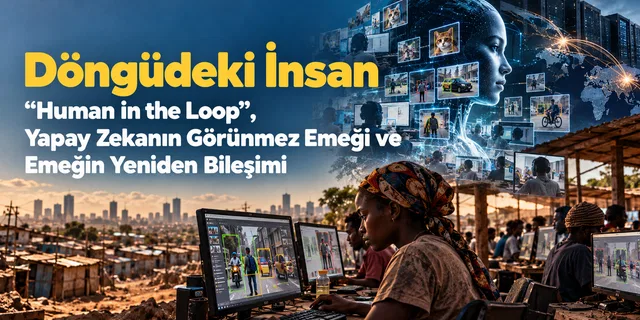
When you ask an AI model a question, there are more than chips and electricity behind the answer on your screen. Millions of people draw boxes around pedestrians in images, label an answer "correct" or "harmful", and spend hours reviewing and removing images of extreme violence. This article introduces a new network built by those people and examines it through the lens of class.
Who Is a Data Worker?
A data worker labels and classifies data, evaluates model outputs and moderates content. What the machine "learns" is an accumulation of decisions made by these workers. To use a concept we often return to on this blog, they are among the most direct and invisible sources of the crystallised labour within the model.
Capital cheapens this labour in three ways:
- Subcontracting chains. Companies such as Meta, TikTok, Apple and OpenAI outsource work to intermediaries such as Sama, Majorel and TELUS Digital. Responsibility disappears into the chain while profit accumulates at the top.
- Geographical arbitrage. Work flows to places where wages are low and unemployment is high: Nairobi, Caracas, Manila, İzmir.
- Non-disclosure agreements. Workers often cannot even say whom they work for. Invisibility is not an accident; it is part of the business model.
Depending on the job and country, the result can be low pay, piece rates, a pace measured in seconds and a risk of serious psychological harm: mental Taylorism in its starkest form.
Where Did the Network Come From?
Data Workers United did not appear out of nowhere. It builds on several years of work:
- Germany: Content moderators formed works councils at TikTok, Majorel and TELUS. An international conference was held at the ver.di union in 2023.
- Kenya: Data labelers founded the Data Labelers Association.
- Nigeria: The Digital Rights and Mental Health Initiative and the Gamayyar African Tech Workers Cooperative emerged.
- Spain: Content moderators held their first strikes.
- Research: Launched in 2024, Data Workers' Inquiry revived the tradition of workers investigating their own working conditions. Those familiar with Marx's 1880 workers' inquiry will recognise the name.
The organisers describe the new network as a transition from research to action. They have identified a real problem: these initiatives often lack the resources and time to connect with one another.
What Are They Planning?
Their work page lists four projects:
| Project | Purpose |
|---|---|
| Communication and Network Initiative | Connecting dispersed groups |
| International Coalition of Data Workers | Building a global coalition for recognition, representation and enforceable protections |
| Library of Survival and Resistance | A shared memory of organising and resistance |
| Mental Health Resources | Peer support and resources for workers facing trauma |
The timetable envisages initial collaboration in August–October 2026; monthly learning sessions and capacity-building from November 2026 to July 2027; an international gathering bringing data workers and union organisers together in autumn 2027; and documentation through June 2028. Funding comes from the Collaborative for AI in the Public Interest.
What Is Good and Important
First, workers are the agents. For years, data workers have appeared in the news as "victims". Now they are leading the launch and speaking for themselves. The principle that workers' emancipation must be their own work finds a concrete expression here.
Second, the language is about class. Instead of capital's preferred phrases, such as "ethical AI" or "responsible technology", the network speaks of a "global class struggle". This is a step beyond much civil-society language in the field.
Third, the scale is right. If capital can move work from Nairobi to Manila in a day, rights won in one country alone cannot be secure. The answer to a subcontracting chain is to organise throughout the chain.
Fourth, memory is a commons. The Library of Survival and Resistance treats knowledge gained through struggle as a shared resource, not private property. This directly aligns with our understanding of knowledge commons.
Fifth, care has not been forgotten. Mental health support is not an optional extra but a condition for organising in this sector. Workers worn down by their work face greater obstacles to organising.
Comradely Criticism: What Needs Developing
Dependence on funding. In its present form, the network depends on foundation funding and a 24-month timetable. History teaches us that an organisation sustained by grants rather than dues can dissolve when funding ends or be drawn into the funder's language. Endurance requires a structure sustained by workers' own resources.
The distance between "voice" and "power". Visibility, storytelling and speaker coaching are valuable, but they do not stop capital. The capacity to stop production does. That is why strikes in Germany and Spain have more to teach us than webinars.
Who is the counterpart? The website does not yet set out a common list of demands or identify a specific opposing party. Bargaining with subcontractors is not enough; the lead company at the top of the chain must also be held responsible. Without a demand for joint responsibility, a subcontractor can close and reopen under another name.
Relationship with unions. Associations, cooperatives, works councils and initiatives: there are many forms, but little collective bargaining authority. The network needs to clarify how it will relate to the work of organisations such as UNI Global Union. Parallel structures serve capital's interests.
The question of ownership. Having "a say in shaping AI" is right, but it is an incomplete goal. Our three questions remain: in whose hands, under whose control and for whose benefit? If a model embodies accumulated workers' labour, the debate must address not only working conditions but ownership of that accumulation.
Links with the labour aristocracy. An engineer at a company and a labeler employed by a subcontractor are links in the same chain. As we argued in The Tech Worker's Handbook, monopoly power cannot be shaken unless the two stand together.
Where Is Türkiye on This Map?
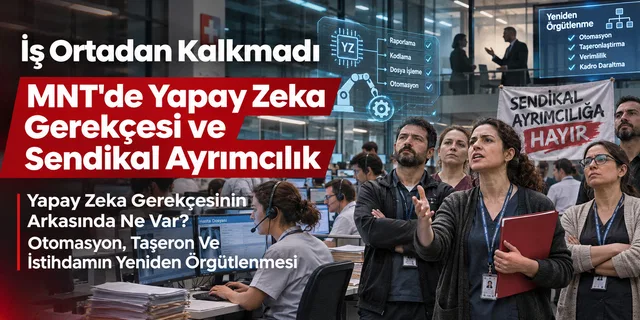
At its heart. According to reports from 2025, more than a thousand workers at TELUS Digital in İzmir were moderating TikTok content, with pay around the minimum wage. Workers began organising with Çağrı-İş in early 2024. According to the union, the company dismissed 15 members for union activity and the workers filed lawsuits. TELUS denies that allegation, attributing the dismissals to performance, misconduct and workforce reductions; it also legally challenged the union's authority to bargain (TBIJ, UNI Global Union).
Consider this: TELUS workers involved in works councils in Germany and workers dismissed in İzmir worked in the same company's global value chain. A former TELUS moderator in Germany featured by the network says she moderated Meta content; the İzmir reports concern TikTok moderation. No participant from Türkiye appears in Data Workers United's published description of its collective. That gap can be filled.
Concrete Tasks
- Attend the launch. Online on 26 November 2026, from 15:00 to 16:30 Türkiye time. The network's announcement provides a registration link.
- Build connections. Unions organising content moderators and data labelers in Türkiye should contact the network directly. It says it welcomes already organised groups of workers.
- Map the work. Who does this work in Türkiye, for which company and for what pay? The workers' inquiry method can be applied here too.
- Translate. The worker reports from Data Workers' Inquiry should be made available in Turkish. Bilgi Müşterekleri is willing to take on this work.
- Take a side as a tech worker. Engineers who train models and build data pipelines have a responsibility to ask about labelers' working conditions.
Dear Comrades,
Capital markets AI as a "human-free" miracle. Yet the machine is new and the chain is old: behind AI and platform services are human lives spent working in Nairobi, Caracas and İzmir. Data Workers United is an attempt by the people whose lives are spent this way to find one another. It has shortcomings and clear limits, but its direction is right. Our task is neither to applaud from the sidelines nor turn up our noses, but to help this network become a class organisation rather than end as a project.
Data workers of all countries, unite!
Sources
- Data Workers United: home, about, work, for data workers, newsletter archive
- Data Workers' Inquiry
- Data Labelers Association (Kenya)
- Digital Rights and Mental Health Initiative (Nigeria)
- The Bureau of Investigative Journalism, "TikTok workers sue employer over 'union-busting' firings", 15 March 2025
- UNI Global Union, "TikTok workers sue Telus for being fired", 17 March 2025
- Labor Notes, "TikTok Moderators Fight against Trauma and for a Union"
- Bilgi Müşterekleri: The Seizure of General Intellect, The Gig Economy Dossier, The Tech Worker's Handbook
This text is a living document. It is shared under CC BY-SA 4.0.