"Labor in the Age of Artificial Intelligence": Our Book Is Out
We Want Our Collective Intellect Back

"Labor in the Age of Artificial Intelligence — The Machine Is New, the Chain Is Old" — the new edition of the book we prepared on the control of labor, the enclosure of knowledge, and the future of the commons is out, free of charge, in every format, together with twelve visual diagrams and a further-reading network that ties each chapter to the debates on our site.
Five people who form the same sentence
A warehouse worker knows how many seconds the terminal in their hand has given them. A courier knows what it means when the score on their phone drops. A call-center worker knows their conversation is measured by a "script compliance" percentage. A software developer knows that at the end of the sprint it will be discussed how many story points they closed. An academic on a one-year contract knows that their citation count will determine their future.
All five, unknown to one another, form the same sentence: "I don't know whom to bargain with."
This book tells how that sentence came to be formed. And more importantly: how it will be broken.
This is not a technology story
Two great tales circulate about artificial intelligence. The first is Silicon Valley's sermon: the machines will free us. The second is the disaster narrative: the machines will take our jobs, then our world. These two tales, which look like opposites, have a common function: both make technology the subject — and render invisible the real subject, the class that owns the technology.
The book's line rejects both. Capital must extract the maximum labor from the labor-power it has purchased; for this it used a stopwatch at one time, a foreman at another. Today it uses an algorithm. That is why the name of the problem is not "technology"; it is in whose property and under whose control the technology sits.
The book proceeds not by a single thesis but by a pair of theses locked into each other:
First thesis — labor: Artificial intelligence does not abolish labor; it fragments, cheapens, renders invisible, and controls labor.
Second thesis — knowledge: The condition of its being able to do this is the enclosure of socially produced knowledge — its appropriation as property by patent, copyright, closed code, and private data pools.
These are not separate topics. What we call artificial intelligence is the collected knowledge produced by millions of people, turned into the property of a company; if that knowledge had not been enclosed, labor could not be controlled with it. In short: Our collective intellect is first taken from us, then stood up against us in order to govern us.
There is no such class as the "useless class"
The book's harshest chapter is devoted to the most dangerous concept in the popular literature. It is said that technology will render the greater part of humanity "economically useless," and that aid and entertainment will be what remains for them.
The book rejects this thesis on three levels. Morally: "useless" is not a description, it is a verdict — and history knows where that verdict has led. Conceptually: if millions of people are unemployed while millions of urgent jobs go undone, from care to education, from climate to housing, the problem is not that people are useless, but a system that distributes labor according to profit rather than need. And factually — this is the thesis's weakest point: the population declared "useless" produces data with every hour spent in front of a screen, feeds the model, constitutes advertising inventory. The population declared useless is an unpaid productive population.
The same chapter puts the proposal of a universal basic income on the table with four objections — and sets an alternative beside the rejection: a job guarantee, universal basic services, a shorter working week without wage loss. Because the counterpart of social production is not paid in money; it is paid by the commoning of the means of production. If the general intellect has been seized, our demand is not compensation; it is restitution.
From Taylorism to the panopticon: the anatomy of work
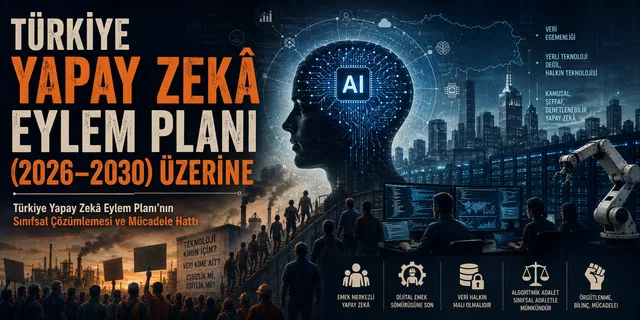
The middle part of the book opens, step by step, the break in the labor process. Taylor's stopwatch transferred the craftsman's knowledge onto paper; the algorithm makes it directly executable — the experienced worker's "intuition" is observed and turned into data, data into a model, and the worker's most valuable asset, their experience, quietly leaves the bargaining table. In the call center even emotion is scored; the software developer has built, with their own hands, the tools that make their own work measurable.
The surveillance chapter makes a deliberate break from the liberal debate: digital surveillance is, before it is a privacy violation, an instrument for squeezing surplus value. The privacy frame reduces the matter to an individual-rights problem; the class frame makes it a subject of bargaining. And the infrastructure that watches the workplace and the infrastructure that watches society are the same infrastructure: the areas of interest of "preventive" analytics have, throughout history, overlapped with those who organize.
Techno-feudalism? No — and this matters
The book also discusses the popular "techno-feudalism" thesis by taking it seriously: the observations are real, the diagnosis is wrong. The platform laborer is not a serf but a proletarian whose security has been stripped away; what we are living through is not an exit from capitalism, but the rentierization of profit. The distinction is not academic, it is practical: If you say "feudalism," your remedy becomes the competition authority; if you say "monopoly capitalism," your remedy is property. A wrong diagnosis produces a wrong treatment.
In this country the idea of organizing IT labor is as old as the sector
The book's Turkey dossier opens with a discovery: Necdet Bulut, one of Turkey's first computer-science PhDs, was also a pioneer of unionization there while he was a systems engineer at IBM in the 1960s. So the claim that "software developers don't unionize" is historically false — the generation that founded the sector had already done it.
The dossier runs from there to the present: the collapse from within of organizing at the same company in 2008 by a "tactical raise," the banned bank strike of 2017, the fifteen-day resistance of 2022 in which mental labor used the strike weapon and won. And from the world: court decisions that count platform workers as workers, the first examples that write algorithmic transparency into law, unions founded inside technology monopolies — proofs of what can be won, together with the lessons of positions lost.
The diagnosis is bound to thirteen concrete demands: from algorithmic transparency to the right to disconnect, from the declaration of real wages to the right of organized technical objection — to bringing under union protection the ability to say "I refuse to write this system" — clauses that can be put on the collective-bargaining table tomorrow.
What is in the book?
Four parts, thirteen chapters, three appendices, a Turkey struggle dossier.
Ground: the landscape, the general intellect and frozen labor, the enclosure of knowledge (and the dialectic of copyright: whose shield is copyright, whose weapon?). The break in the labor process: mental Taylorism, the digital panopticon, the factory whose boundaries are dissolving. The new map of class: the collapse of the middle-class myth, the lie of the "useless class" and the myth of the singularity, the collective worker from Congo to Cupertino, the techno-feudalism debate. What is to be done: today's demands, tomorrow's alliance ("the hand that built the system is the only hand that can dismantle it"), the Turkey and world struggle dossiers, knowledge commons on the horizon — from the real criterion of open source to the planning debate reopened.
In the appendices there are three practical tools: the Laborer's Toolkit, with 10 questions against the algorithm at work, collective-bargaining clauses, a mini glossary of concepts and a reading guide; Political Economy 101, which you can read off your own payslip without needing an economics education; and Licenses 101, a practical guide to "using copyright against copyright."
It is dedicated to two names
The book is dedicated to the memory of two names, and this dedication also tells the structure of the book. Necdet Bulut (1938–1978): he organized the right of those who produce knowledge — he was a scientist and a trade unionist; he was murdered in 1978. Mustafa Akgül (–2017): he organized so that the knowledge produced would remain with everyone — he gave his life to establishing the internet in this country as a public possibility, and software as a free commons.
One, the organizing of labor; the other, the liberation of knowledge. The book's entire thesis is that these two are inseparable.
A book written against enclosure cannot itself be enclosed
The book is published under CC BY-SA 4.0: provided you credit the source and share under the same license, you may reproduce, print, translate, and adapt it — you do not need to ask permission. This is not a formality; it is a requirement of the book's own thesis: for a book written against the enclosure of knowledge to be enclosed by copyright would be the most visible contradiction.
The same holds for the diagrams. You may take the graphics in the book into your own presentation, your workplace meeting, your union branch's educational work. They were made for that.
The book will be discussed in Karaburun
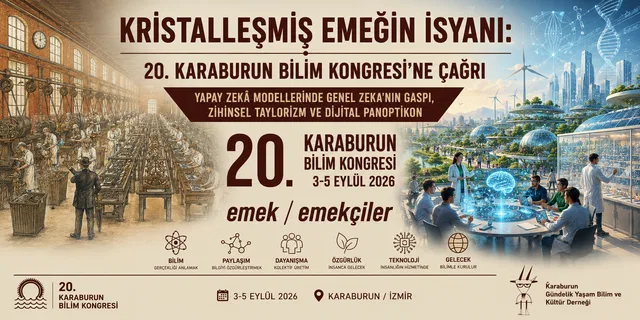
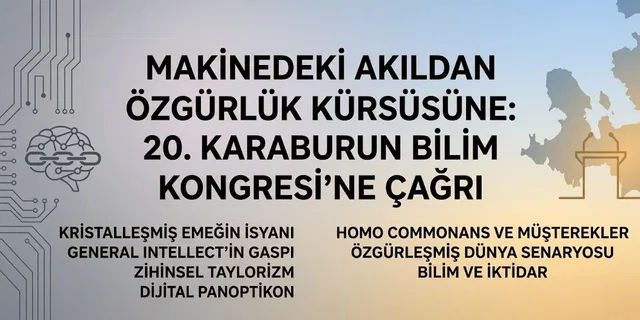
The book's core theses will be presented in a paper at the 20th Karaburun Science Congress: "The Revolt of Crystallized Labor: The Seizure of the General Intellect in Artificial Intelligence Models, Mental Taylorism, and the Digital Panopticon." The congress convenes this year under the theme "labor/laborers," on 3–5 September 2026 in Karaburun; participation is free.
If you have read the book and you have an objection, the best address is there. The paper and the presentation file are also freely available.
And this book is not finished
Like all our dossiers, it is a living document; it is published with a version number, and it grows by criticism. We ask three things of you:
Tell a case. What measures you, how it scores you, which decision it makes?
Show what is wrong. Corrections are stated openly in the version notes; they are not changed in silence.
Contribute. A missing heading, a struggle experience we do not know, a source that needs translating.
Because if the whole of the book is to fit into two sentences, those sentences are these:
The machine never replaced the worker; it always stood against the worker.
We want our collective intellect back.
Publication note
Labor in the Age of Artificial Intelligence The Machine Is New, the Chain Is Old — The Control of Labor, the Enclosure of Knowledge, and the Future of the Commons Knowledge Commons, 2026 — Expanded Book Edition
The book is available free of charge in PDF, EPUB, and Markdown formats.
It is a companion publication to Criticizing as Comrades, Advancing Together and the Revolutionary Discussion Ethics Guide; all three circulate under CC BY-SA 4.0.
The book is dedicated to the memory of Necdet Bulut and Mustafa Akgül.
For criticism, contributions, and workplace testimonies: bilgimusterekleri.org · @demirkapi · demirkapi@pm.me