Gig Economy Dossier
Owner-Operator Courier Work: The Algorithmic Boss, Piece-Rates, and Strikes with No Name in the Law

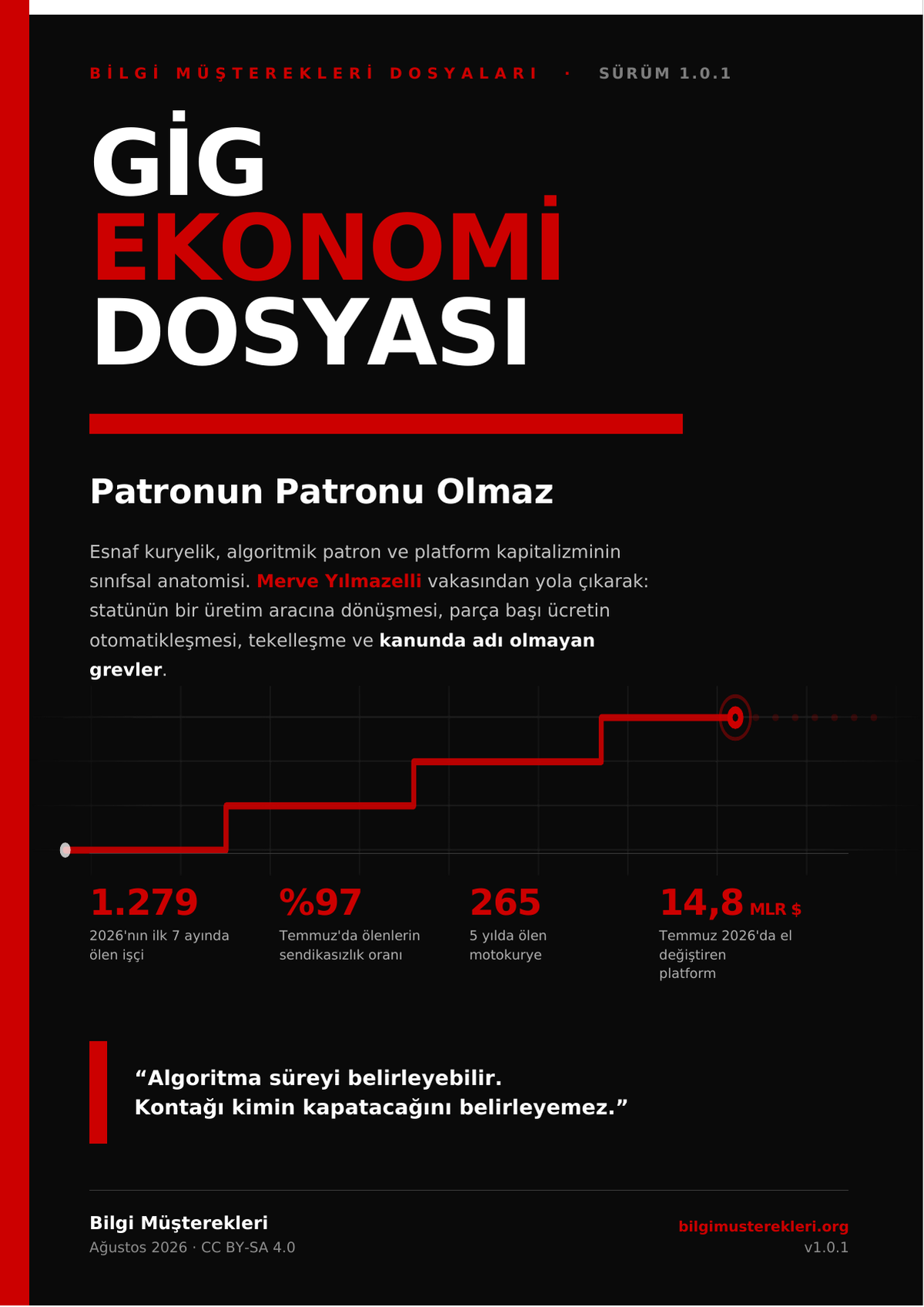
Our new dossier Gig Economy Dossier — The Boss Has No Boss is out. Version 1.0.2. Free and under a CC BY-SA 4.0 licence: as PDF, EPUB and Markdown on our Guides page.
Dear Young Comrade,
For months on these pages we have been discussing artificial intelligence: action plans, boards, data centres, models. Today we bring the same discussion down to another place: the stretch of the E-5 that looks toward Beylikdüzü.
Because that is where algorithmic management is most concrete, most bloody, and least spoken of.
On the night of 9 July 2026, there, 40-year-old motorcycle courier Merve Yılmazelli lost her life. A vehicle speeding and cutting across lanes hit her motorcycle from behind; the driver fled.
It went on the record as a "traffic accident."
The whole point of our new dossier is how those two words were chosen.
What determines which table a death is written into?
Not the physics of that night — the law of that night.
And the person who wrote that law is not the traffic officer who filled in the accident report; it is the company that put the phrase "business partner" into a contract.
Merve's motorcycle was her own. She paid for the fuel, the maintenance, the insurance. She had a file opened in her name at the tax office. Every month, whether she worked or not, she paid her Bağ-Kur premium out of her own pocket. On paper she was a one-person enterprise — that is, on paper she was the boss.
The chain built by the programme that is this dossier's starting point is worth learning by heart:
A boss has no boss. Anyone who is not a boss has no employer. Anyone who has no employer has no workplace accident.
The result is arithmetic. Official workplace-accident statistics are kept through employer notification: if there is no employer there is no notification, if there is no notification there is no record, if there is no record there is no number.
In this country workplace murders are counted not by a ministry but by the Workers' Health and Safety Assembly (İSİG Meclisi), built by volunteers.
The dossier's thesis
The "gig economy" is not a new mode of production.
It is piece-wages, the putting-out system, and subcontracting reconstituted through an algorithmic interface. It is the form, 138 years later, of the "sweating system" that the House of Lords could not define in 1888. The only thing that has changed is that the intermediary in the middle of the chain is no longer a human being, but a server.
And that is exactly why we do not call it "techno-feudalism." What stands before us is not rent, but surplus-value; not feudal dependence, but the labor regime of monopoly capitalism today.
The dossier weaves this thesis along four axes.
1. Legal status is a means of production
An employment contract has three elements: work, wages, and subordination. The courier carries parcels — there is work. Payment is per parcel — there are wages. The whole fight is in the third word.
The moment "subordination" is deleted from the contract, six line items disappear from the company's balance sheet at once: severance, notice, premiums, leave, overtime, and workplace-accident liability.
These items do not vanish. They merely change sides — they are paid out of the courier's pocket.
And the cost continues after death: because no workplace-accident notification is made, what remains is only a collusion / service-determination lawsuit. On average 1.5–3 years, with the burden of proof entirely on the family of the dead. Capital has externalised even the cost of proving.
2. The algorithm is the automation of piece-wages
When Marx defined piece-wages as "the form of wages most in harmony with the capitalist mode of production," he also said why: in this form there is no need to stand over the worker; the worker becomes their own overseer.
The platform scales this and negativises the penalty: nobody issues a penalty; the screen simply goes silent. This is, legally too, an ingenious solution — you cannot sue for something that was not done.
Mental Taylorism, the digital panopticon, and the expropriation of general intellect. All three are here, on the street: the courier who knows the city has that knowledge collected as data on every delivery, processed into the routing engine, and returned to the courier as an order.
3. What changed hands was the software
Between May 2025 and July 2026, in fifteen months, Turkey's delivery sector changed hands in three deals: Uber–Trendyol Go ($700 million), Uber–Getir delivery ($335 million), Uber–Delivery Hero (~$14.8 billion; Yemeksepeti was sold in a separate deal to New York-based SSW Partners).
So what was sold in these deals?
Not the motorcycles — those belong to the couriers. Not the fuel. Not the labor — labor had already been left off the balance sheet by contract.
What changed hands was the software that decides where that motorcycle will go.
And that software is the crystallised form of the data collected from millions of deliveries — that is, dead labor. The courier stands facing the dead labor they themselves produced, on their own motorcycle, at their own risk. And that dead labor gives them orders every day.
4. The reserve army of labor is no longer in the waiting room
The platform does not take in the person excluded from corporate employment — it turns exclusion into a business model. No interview, no references, nobody looks you in the face; upload your documents, register.
That sounds like equality, but it is not. The counterpart of flexibility is this: the only door that those for whom the other doors are closed can enter. And those who enter that door take on every risk the one who opened it did not assume.
The reserve Marx called the "relative surplus population" is no longer outside employment. Capital has turned the conditions of the reserve into employment itself.
A few findings from the dossier
- In the first seven months of 2026 at least 1,279 workers died while working — an average of six people a day. In July alone, 214.
- Of the 214 workers who died in July, 207 had no union: 97%. This is the figure in the dossier that says the most — because the others say what happened; this figure says what is missing.
- In 2026 an owner-operator courier's minimum monthly Bağ-Kur premium is 11,808 TL. So a month with zero orders is not zero income for them; it is minus ten thousand lira.
- Testimony from the field: a courier working 12 hours a day has a gross turnover of 85–90 thousand lira; after expenses, what they take home is at the level of the minimum wage.
- On 29 January 2026 the state defined the SRC KURYE certificate: there is an exam, a criminal-record requirement, an age limit. So the state recognises the occupation — but it does not count the person who does that occupation as a worker. This is not an absence of regulation; it is selective regulation.
- No official institution in Turkey knows how many owner-operator couriers there are. Not SGK, not TESK, not the ministry. The "one million" figure circulating in the press is an unsourced estimate.
- And the "sweating system" that the House of Lords spent two years failing to define in 1888, Marx had already named and written the mechanism of in 1867, in Capital. Twenty years earlier.
But this is not a dossier of victimhood
On 24 January 2022 Trendyol Express couriers shut off the ignition. It was not a strike — it could not be a strike, because they were not legally counted as workers. They had no unions, no collective agreements, no right to strike. What they did did not even have a name in the law.
They simply did not start the engines. It lasted two days. The company withdrew an 11% raise and made it 38.8%.
In January 2023 Trendyol Go couriers shut off again: an annual raise of 120%. On 18–20 January 2026, a simultaneous three-day action on seven platforms. In February 2026 at Kolay Gelsin, two thousand couriers in 15 provinces; a partial gain by the end of the third day.
Four waves in four years. This is not a one-off — it is a cycle.
And every time the same thing happened: people with no legal right got results faster than people with legal rights. Because the couriers' power comes not from the law, but from their position in the production process.
The third item on the January 2026 list of demands is a first in the history of the Turkish workers' movement:
Distance payments to be set according to real costs instead of artificial-intelligence calculations.
A group of workers has made the algorithm that determines their wages itself a subject of bargaining. This is not "being against technology"; it is asking in whose interest the technology is set.
So who is organising this?
Four waves in four years were made by people with no legal right. The question that needs asking is this: where, and how, do these people come together?
Two separate worlds: the cargo worker and the owner-operator courier
Let us make the distinction clear first, because everything follows from here.
In the Regulation on Branches of Work there is no separate heading called "cargo" or "courier." Corporate cargo companies are in practice registered in branch no. 15, Transport, and there the classical union mechanism works. TÜMTİS completed organisation at Aras Kargo in 2015; the process was stretched 22 months by the employer's objection, and authorisation was made final by a Court of Cassation ruling in 2018. In February 2023 a collective agreement covering about 5,000 workers was signed; in February 2025 the fourth-term agreement covered about 6,000 workers. A sixth-term agreement at DHL, an organising call at MNG.
So the problem is not that unions have stayed away from this field. Where there is status, the union wins.
With owner-operator couriers the debate seizes up one step earlier. For authorisation you first need the branch threshold (1%), then a majority in the workplace (50%+1). But because the owner-operator courier is not legally counted as a worker, they cannot even join a union; and there is no workplace either. There is no ground on which to calculate a threshold.
That is why owner-operator courier organisation developed outside the union form, and with other tools.
Associations, networks, assemblies
- Kurye Hakları Derneği (Courier Rights Association) — founded on 4 November 2022; connected with the circle around Kurye Haber, which has done volunteer labor journalism since 2021. Every year it publishes the Motorcycle Courier Deaths Report: uninterrupted since 2022. According to the 2025 report, most of those who died were under 28, four were of child age, and half were digital-platform couriers. Its main demand is clear: that motorcycle courier work be classed among very dangerous occupations. (X)
- Motorlu Kurye İşçileri Derneği (MİD) (Motorcycle Courier Workers' Association) — founded in August 2023 as the product of TEHİS's three years of field work. Its way of working is worth noting: committees and an assembly, participation on a volunteer basis, monthly open meetings, and, in their own words, decision-making by the principle of an "assembly of equals." That is, not a presidency, but an assembly. Among its concrete work are a stolen-motorcycle alert network, a warning chain against traffic stops, and the follow-up of cases of couriers who have died. Organised in Bağcılar and Maltepe in Istanbul; in formation in Izmir. It has no website; it is reached via X and Instagram.
- Kadın Kuryeler Derneği (Women Couriers' Association) — founded on 14 August 2022. It focuses on problems specific to women couriers: mobbing, harassment in traffic, low pay, and being treated as "auxiliary workers." (No verified website or social-media account belonging to the association was found; its existence is established by press reports.)
- MOTKURDER — founded in Istanbul in 2007, the oldest association in this field. National in scale; its tradition comes from "mutual aid." (X · Instagram)
- Local associations — provincial structures such as the Adana Motorcycle Couriers' Association are the backbone of local ignition-shutdown actions. Most of these associations have no website; they become visible through reports of actions.
- Patronların Ensesindeyiz (We Are on the Bosses' Backs) — a motorcycle-courier solidarity network; a line that follows and reports workers' struggles. Alongside it there are structures such as the Motorcycle Courier–Cargo Workers' Solidarity Network and a local network founded in Van. These are not associations; they are channels of communication and solidarity. (X · Instagram)
- TEHİS — an independent union founded on 11 December 2020, in branch no. 18, Entertainment and Accommodation. The most persistent union actor in motorcycle-courier organisation; it is running a precedent case aimed at the owner-operator courier model itself. The phrase the union's lawyers use when they describe the case sticks: "This is a breakwater." (X)
On the cargo side there are TÜMTİS (Aras Kargo, DHL, MNG) and Nakliyat-İş; the İSİG Meclisi, which counts workplace murders, is also an indispensable link in this network.
And a history not to be forgotten: this is not the first attempt. In 2016 there was a union initiative called Moto-Kur-Sen, and Nakliyat-İş had also worked in this field with the "BanaBiSendika" campaign. There is a ten-year accumulation.
The real organising is on WhatsApp
But let us be honest: what has carried the four waves since 2022 was not the calls of these associations.
Actions are built in WhatsApp and Telegram groups, spread over X and Instagram, and carried by temporary spokespersons. A sentence from a courier in Izmir tells this by itself:
"As Izmir Courier Team we were only able to organise in WhatsApp groups, and nowhere else."
The form of action is also specific to the platform: shutting off the ignition, closing slots, convoys. The academic literature calls this a "virtual solidarity medium" — a digital common space taking the place of the physical workplace.
It has a strength: it is fast, it can spread, it is hard to suppress. And it has a weakness: it is not lasting. When the wave recedes the group goes quiet, there is no cadre left, the next wave starts from zero. As the dossier also stresses, the real problem of organising in this field is not the moment of action, but the interval between actions.
The same bind in the world
This is not a problem specific to Turkey, and the two union strategies in the world are in conflict with each other.
The United Kingdom tried both. GMB signed a recognition agreement with Uber in 2021 covering 70,000 drivers, and in 2022 a "voluntary partnership" agreement with Deliveroo covering 90,000 couriers — but in the second, the couriers' independent-contractor status was preserved. The rank-and-file union IWGB — its courier and logistics branch defines itself as "by couriers, for couriers" — called this "an empty and cynical PR stunt" and took the status fight to court. In 2023 the Supreme Court held that Deliveroo couriers were not workers and had no collective-bargaining rights (IWGB v CAC). So the agreement route brought limited recognition, and the litigation route was lost.
In Spain, behind the Ley Rider stood not only CCOO and UGT but also Riders x Derechos, founded by the couriers themselves — a rank-and-file structure organised in seven cities.
In Italy in 2020 the courier companies signed a national contract with a union of disputed representative strength; CGIL, CISL and UIL rejected it as a "yellow contract" that legitimised piece-wages, and launched the first class action in Europe in the name of gig workers. At the base, Deliverance Milano, which defines itself as a "union on demand," and NIdiL, CGIL's atypical-workers arm, are at work.
France set up mandatory representation elections for platform workers. The result is instructive: in the 2024 elections turnout in the courier segment was only 3.9%. The state set up the ballot box; the workers did not come — because institutional representation cannot by itself close the rupture created by spatial dispersal.
At the international level there are two lines. One is institutional: ITF, the transport federation running a campaign for a binding ILO convention for platform workers — TÜMTİS is a member. The other is rank-and-file: the Transnational Federation of Couriers, founded in Brussels in 2018 by 34 organisations from 12 countries. The second does not even have a lasting website; it operates as a loose coordination network. That is a finding in itself.
And there is a third path: CoopCycle, an international federation bringing courier cooperatives together — 11 countries, more than 60 cities, over 50 member cooperatives. They share a common software infrastructure; that is, a model in which the couriers jointly own the "software that changed hands." Mensakas in Barcelona is the best-known example. There is not yet an example in Turkey; the subject is still being discussed at an academic level.
The number itself is a problem
One last point, and it confirms the dossier's main argument. There are three separate volunteer sources counting courier deaths, and the three give different figures: the Courier Rights Association says at least 265 over the last five years; MİD gives 58 for 2024 and ~68 for 2025; KHD's own annual reports give 63 for 2024 and 44 for 2025.
This is not an inconsistency — it is evidence. Because there is no single official count, everyone is counting with their own network, with their own means.
Sometimes the first work of organising is this: to count.
Where to go?
If you are a courier, if you know a courier, or if you want to organise solidarity in this field:
| Organisation | What it does | Link |
|---|---|---|
| Kurye Hakları Derneği | Rights advocacy, annual death reports | kuryehaklari.org · X |
| Motorlu Kurye İşçileri Derneği | Assembly-style organising, case follow-up, alert networks | X · Instagram |
| MOTKURDER | Since 2007; national-scale association | motkurder.org.tr · X |
| TEHİS | Independent union; precedent case against the owner-operator courier model | tehis.org · X |
| TÜMTİS | Collective-agreement organising in cargo/logistics | tumtis.org |
| Nakliyat-İş (DİSK) | Transport-branch union | nakliyatis.org |
| Patronların Ensesindeyiz | Solidarity and communication network | patronlarinensesindeyiz.org |
| Kurye Haber | Independent courier journalism | kuryehaber.com |
| İSİG Meclisi | Workplace-murder counts and reporting | isigmeclisi.org |
International: ITF platform workers campaign · IWGB Couriers and Logistics Branch (UK) · Riders x Derechos (Spain) · NIdiL-CGIL riders (Italy) · CoopCycle (federation of courier cooperatives)
Every link in this list was verified one by one. The Women Couriers' Association and most local associations are not on the list, because no verifiable web address could be reached — that too is a sign of the organisational scatter of the field.
A signature in Geneva, a wait in Ankara
On 12 June 2026 in Geneva, at the 114th International Labour Conference, the world's first binding international standard on platform work was adopted: ILO Convention No. 193.
The vote: 406 in favour, 8 against, 36 abstentions. And this detail is politically very useful:
The government delegate, the employer delegate, and the worker delegate participating from Turkey — all three voted in favour.
Under Article 19 of the ILO Constitution the convention must be submitted to the Grand National Assembly (TBMM) by 12 June 2027 for a decision on whether to ratify.
So there is no vague "we'll look at it later." There is a numbered timetable.
In the same period the deadline for EU member states to transpose the Platform Work Directive (2024/2831) also falls on 2 December 2026. From December this tableau will appear: the same companies, with the same algorithms, will employ people counted as workers in Madrid and as owner-operators in Istanbul.
This is not a difference of technology. It is a difference of law and power.
The most concrete, most unifying demand of the period ahead also comes from here, and it is a single sentence:
"You signed in Geneva — ratify in Ankara."
Download the dossier
Gig Economy Dossier — The Boss Has No Boss · Version 1.0.2 · 66 pages
The dossier is also on our Guides page.
The dossier is a single piece: it refers to no extra file or side text. Twenty-one chapters, two boxed tables, nine concrete tasks; and it contains within itself a data appendix (monthly workplace-murder series, four separate chronologies, cost and income tables, legal bases), a post-accident evidence-collection checklist, and a full bibliography.
The checklist was prepared to be copied and distributed. The most critical piece of information in it can change the fate of a case on its own: when the account is closed, the order history goes with it. The first job after an accident is to take screenshots of every screen in the app.
A note on the numbers
Every figure and date in the dossier was verified from independent sources. In that process we had to correct two figures from the programme that was our starting point:
| Subject | As given in the source | Verified |
|---|---|---|
| July 2026 workplace-murder count | 219 | 214 (İSİG Meclisi July report) |
| Value of the Uber–Getir delivery deal | $435 million | $335 million |
Nine points we could not verify were also listed openly under a separate heading at the end of the dossier — among them the absence of a published Court of Cassation precedent specifically on platform couriers.
This transparency is not a display of fastidiousness; it is a necessity. Because capital has no obligation to get the numbers right; we do. A single wrong figure is enough to make everything else that is right open to dispute.
Closing
Almost all of the 1,279 workers who died in the first seven months of 2026 had one thing in common. It was not that they were poor. It was not that they were careless. It was not that they were unlucky at all.
It was that they were non-union.
Those who gathered at Merve Yılmazelli's grave in Silivri on 15 July were organised by no union; no permit was taken, the press was not called. The couriers told one another, shut off the ignition, and came on their motorcycles. They lined their helmets around the grave.
Those helmets are a working class the law does not recognise recognising itself.
Owner-operator couriers had said "we are the backbone of the system." They were right. And a backbone is noticed not when it breaks, but when it stirs.
The algorithm can set the time. It cannot determine who turns off the ignition.
The dossier's starting point: İzel Sezer, "Owner-operator courier work: the digital interface of nineteenth-century exploitation", İzel Sezer ile Deşifre.
This dossier is shared under a CC BY-SA 4.0 (CopyFarLeft) licence. Copy it, distribute it, discuss it.