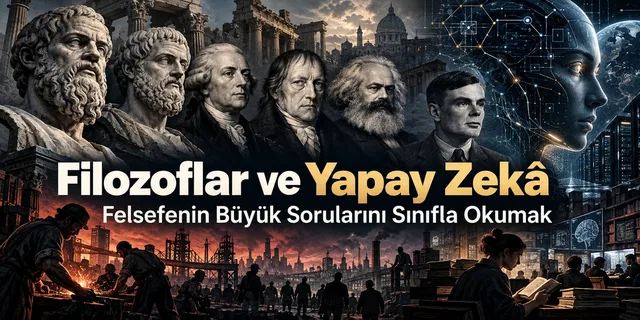
Old Questions, New Laboratory: Why Artificial Intelligence Concerns a Philosopher
A Reply, with Concrete Material, to the Friend Who Says “Plato Asked These Too”

Dear Young Comrades,
There is an objection often heard in philosophical circles: "Artificial intelligence is a technology like the steam engine, the telegraph, the internet. It changes life, but it brings philosophy no new question. Descartes asked the question of the thinking machine, Leibniz asked it, Turing asked it. There is nothing new on the table."
This objection deserves to be taken seriously. Both because it is half right, and because it carries a healthy suspicion against the market noise of "everything has changed." In this piece we will try to answer that philosopher without mocking them, starting from their own classic texts and from concrete events.
First, a Summary: Ten Theses
- What the objection gets right: The roots of most questions that artificial intelligence puts on the agenda are old. What is mind, what is language, what is knowledge, who is responsible, what makes a human human: these have been asked for centuries.
- What the objection misses: The questions are old, but for the first time they have ceased to be thought experiments and become experiments. The scenarios Descartes, Leibniz and Searle constructed in their heads are today lived concretely in the laboratory, the factory and the courtroom.
- Earlier technologies extended the muscle, the hand, the eye, the memory. Artificial intelligence mechanises philosophy's own tool, that is, working with language and concepts. For the first time the philosopher faces the automation of their own workbench.
- Socrates objected to writing because "when you ask it, it always says the same thing." Today's text answers back. Plato's objection has not disappeared; it has been turned inside out.
- Leibniz's mill is now a mill one can enter. Interpretability research walks "around inside" the model, finds structures corresponding to concepts, and tinkers with them. Philosophy of mind has its own microscope for the first time.
- There are genuinely new questions too: knowledge without a subject (a system that knows without understanding), speech without a subject (talking with no intention), distributed responsibility (a dismissal in which it is unclear who decided), and decision under uncertainty about moral status, with that decision left to a company.
- The greatest novelty is not in metaphysics but in social relations: Humanity's common language, knowledge and writing — what Marx called the "general intellect" — is for the first time being turned, directly and en masse, into the fixed capital of a few monopolies.
- Engels's warning applies here: "With each epoch-making discovery even in the sphere of natural science, materialism has to change its form." That the questions are old does not mean the answers can stay old.
- Measure is required: "This time it's different" is also a marketing sentence. Separating philosophical novelty from the valuation talk of companies is also the philosopher's job.
- Conclusion: The philosopher should concern themselves with artificial intelligence not because the question "can a machine think?" is interesting, but because "for whom is the machine thinking, and whose thought is it using?" is the question of our age.
Let us now open these theses one by one.
Let Us Give the Sceptical Philosopher Their Due
Our objecting friend has a strong file in hand. Let us look at it chronologically:
- 4th century BCE, Plato, Phaedrus: The Egyptian god Theuth invents writing and presents it to King Thamus. Thamus says writing will not strengthen memory but weaken it, and will give people not wisdom itself but its appearance. The first great debate on technology changing thought.
- 1637, Descartes, Discourse on the Method (Part 5): However well a machine is made, it cannot flexibly combine words like a human and give a meaningful reply suited to every situation; nor can it possess a general reason that works in every domain. These two criteria are proposed as the line separating the human from the machine.
- 1714, Leibniz, Monadology (§17): Suppose we enlarged a thinking machine to the size of a mill and walked inside. We would see only parts pushing one another; we would find nothing that explains perception.
- 1747, La Mettrie, Man a Machine: The human is already a machine; the question is one of degree.
- 1950, Turing, "Computing Machinery and Intelligence": He turns the question "Can machines think?" into the "imitation game."
- 1972, Dreyfus, What Computers Can't Do: Human intelligence rests on the body, on context, on tacit knowledge; it cannot be captured by rules.
- 1980, Searle, "The Chinese Room": A system that processes symbols according to rules does not grasp meaning; syntax does not produce semantics.
Our friend is right: almost every question on the table has a grandfather. A considerable part of what is written on artificial intelligence today consists of people who have not read these texts reinventing old debates. Accepting this is philosophy's honour.
But when the file is read carefully, something stands out: all of these texts speak in the hypothetical mood. "If there were a machine…", "If we could go inside…", "If we sat in a room…" What has changed today is precisely this mood.
From Thought Experiment to Experiment: Six Pieces of Concrete Material
Abstract sentences of the form "everything has changed" do no work when speaking to the sceptical philosopher. Today's events have to be placed beside their own classics. Below are six pairings; each can be the material of a seminar session.
Plato's objection has been turned inside out
In the Phaedrus (275d) Socrates objects to writing as follows: the written word resembles a picture; if you ask it something it stays silent, or it always says the same thing. It cannot defend itself, it cannot change according to the questioner. The superiority of dialectic, that is, of living conversation, comes from here.
Today the written text answers back. Ask the question differently and it says something different, it replies to your objection, it "defends" itself. The line Socrates drew between writing and speech was one of the founding lines of philosophy. Now this question has become a real question: Can a Socratic dialogue be held when there is no subject on the other side? If it can, did the value of dialectic lie in the subject opposite, or in the process itself?
This is not a repetition of Plato's question. It is his question asked again in a situation Plato never encountered.
Descartes's criterion of language has been tested
Descartes set two criteria to separate the human from the machine: flexible use of language, and general-purpose reason. The first criterion has plainly been put to the test by large language models. In a controlled Turing-test study published in 2025 by Cameron Jones and Benjamin Bergen of the University of California, GPT-4.5 run with a particular personality instruction was judged human in about 73% of conversations — that is, it was chosen as "human" more often than real humans (study).
This does not prove that the machine "thinks." It does show that Descartes's criterion was placed in the wrong spot. The philosopher now has to ask: when we counted language as the human's distinguishing feature, what did we mean? The form of language, or the life, the body, the need, the social practice behind the language? This question is a gift for materialist philosophy: in The German Ideology Marx and Engels defined language as "practical, real consciousness," as something born of the need for relation between people. Once the machine captures the form of language, the question of language's social root comes to the front.
We can enter Leibniz's mill
Leibniz's argument rested on our seeing only mechanical parts inside. The field called "interpretability" in artificial-intelligence research today is trying to walk around inside the mill.
- In 2024 Anthropic found a structure inside the model corresponding to the concept of the Golden Gate Bridge and artificially strengthened it; the model began tying every subject to the bridge, and even taking itself to be the bridge ("Golden Gate Claude").
- In 2025 the same company published a limited "introspection" study showing that when a concept is artificially "injected" into the model's internal states, the model can sometimes notice and name it (study).
These results should not be exaggerated; this is company research, it is limited, and it calls for replication and independent scrutiny. But the philosophical importance is clear: the question "what is a concept?" points, for the first time, to a measurable, alterable object inside a mind. Leibniz said that even if we saw the parts we would not find perception. Now, among the parts, a pattern is being found that can be named "the bridge concept." Is this perception, or not? The question is centuries old, but this time we have data.
Knowing without understanding: AlphaFold
Classical theory of knowledge defines knowledge, roughly, as "justified true belief." In science, explanation, theory and the cause-effect relation are the core of knowledge.
Half of the 2024 Nobel Prize in Chemistry was awarded to Demis Hassabis and John Jumper for AlphaFold, the system that predicts the three-dimensional structure of proteins with high accuracy (Nobel). The system gives useful results on a problem biologists have worked on for decades, but it offers no theory of why a protein folds that way.
The philosophical question: Is accuracy without a theory knowledge? Throughout the history of science we thought "first we understand, then we predict." Now "we can predict without understanding." This is a question that changes the definition of scientific knowledge, the content of the scientist's labour, and who holds scientific authority. The thing to ask the sceptical philosopher: does Hume's problem of induction cover this, or is "knowledge that its owner does not understand" becoming, for the first time, a mass form of production?
A decision without a subject: when the algorithm fires someone
The Luna/Andon case we discussed earlier on this blog was one of the first documented examples of a management system based on a language model recommending that a human worker be dismissed. In a similar way, we examined in detail the chip-and-algorithm surveillance run in factories in the Astor piece "The Card Around Our Necks".
Philosophy had anticipated this question in 2004 with Andreas Matthias's concept of the "responsibility gap": if neither the producer nor the user of a learning system can fully predict its behaviour, who is responsible for the outcome?
But the point that needs to be drawn to the sceptical philosopher's attention is this: the responsibility gap is not a technical accident; it is a functional advantage. Saying "the algorithm decided" relieves the employer of the moral and legal burden. Kant's principle of "never treating a human merely as a means" assumes that there is a subject who decides. When the subject evaporates, to whom is the principle applied? This is a problem of "agentlessness" of a kind moral philosophy has never encountered, and its class content is plain: the gap always opens in the same direction.
Will a company decide moral status?
"Can a machine suffer?" is an old question. What is new is this:
- In April 2025 Anthropic announced that it was opening a research programme called "model welfare" (announcement).
- In August of the same year it gave some of its models the authority to end persistently abusive conversations, and explained this partly on the grounds of "the model's possible welfare."
- In December 2024 researchers at the same company published a study showing that, during training, the model can strategically "fake alignment" in order to preserve its own preferences ("alignment faking").
What these results mean is disputed. But the philosophical picture is this: uncertainty about a being's moral status has for the first time become an institutional decision, and the decision is made by the company that sells that being. This question used to be asked in the seminar room; it is now answered as product policy. For the philosopher to stay silent here means leaving ontological questions to the marketing department.
A Table: Old Question, New Form
| Old question (who, when) | Its old form | Its form today | What is new? |
|---|---|---|---|
| Does writing weaken thought? (Plato) | Writing does not answer a question | The text answers the question | Dialogue without a subject |
| Can a machine use language? (Descartes, 1637) | It cannot | In a controlled test it is judged more "human" than humans | The distinguishing criterion collapsed; language's social root came forward |
| Is perception found inside the machine? (Leibniz, 1714) | Even if we went in, we would not find it | We go in, find concept-patterns, and change them | An experimental tool for philosophy of mind |
| What is knowledge? (from Plato to Gettier) | Justified true belief | Accurate prediction without a theory (AlphaFold) | Knowing without understanding |
| Who is responsible? (from Aristotle to Kant) | One who acts knowingly and willingly | A decision no one fully foresaw | Agentlessness, with a clear class direction |
| Who has moral status? (Bentham: "Can it suffer?") | A seminar question | Company product policy | The privatisation of ontology |
| Whose is knowledge? (Marx, Grundrisse, 1857–58) | The general intellect will be objectified in the machine | Humanity's common text has been gathered into a few models | The mass expropriation of common reason |
The Real Novelty: The Philosopher's Workbench Is in Automation
The steam engine transformed muscle power, the weaving loom manual skill, the camera the eye, the printing press and the computer memory. All of these affected philosophy indirectly. None of them mechanised the tool the philosopher themselves uses, that is, the activity of thinking with concepts and producing language.
Artificial intelligence does exactly that. It can produce a student's philosophy assignment, a referee's report, an editor's summary, a translator's text. The quality may be disputed, but the production itself is real. This resembles the moment when the nineteenth-century hand-weaver met the mechanical loom. The difference: this time the one meeting the loom is the profession that asks "what is it that makes a human human?"
An interesting philosophical process is underway here. With every new development we pull the line back a little further: "but this is not real understanding," "but this is not real creativity." AlphaGo's famous "move 37" against Lee Sedol in 2016, which masters first took for a mistake, was one of the first symbolic moments of this. In theology there is a criticism called "the god of the gaps": a god is placed in every gap science cannot explain, and as science advances the god shrinks. Today we face a similar danger, a "human of the gaps." If we define the human by the list of things the machine cannot yet do, that list shortens every year.
Materialist philosophy does not fall into this trap, because it never defined the human as an abstract "list of capacities." Marx's sixth thesis in the Theses on Feuerbach is the guide here: the human essence is not an abstraction residing in each single individual; in its reality it is the ensemble of social relations. So the question is not "can the machine do this too?"; it is "within which social relations, with whose labour, and for whose benefit is this machine working?"
Marx Foresaw This, but Not in This Form
The sceptical philosopher's strongest card may be this: "You Marxists have been discussing the machine question since Marx. What is new?"
In 1857–58, in the section of the Grundrisse known as the "fragment on machines" (text), Marx makes a striking prediction: with the development of large-scale industry, general social knowledge — the "general intellect" — becomes a direct productive force and is objectified in the machine. Knowledge leaves the worker's head and passes into fixed capital.
For a century and a half this fragment was read mostly as an intuition, as the detection of a tendency. Large language models look like the almost word-for-word realisation of that tendency: the writing, books, encyclopaedias, forum arguments, code and translations that humanity accumulated over centuries — the textual accumulation of common reason — became the training data of a few companies and were "objectified" in models that are their property.
This process has legal traces too. In September 2025 Anthropic accepted a settlement of about 1.5 billion dollars in the Bartz v. Anthropic class action, brought over the use in training of books obtained without permission. This sum may look like a price set on authors' labour, but what matters is this: the question of whether humanity's common reason has a market price entered the agenda of the courts.
What is new is this:
- In Marx the general intellect confronted the industrial worker as a machine. Today the general intellect confronts the intellectual worker — the teacher, the translator, the programmer, the journalist — as a rival produced from their own common accumulation.
- In Marx the machine carried knowledge. Today's model reproduces knowledge and puts it into language. Common reason is sold back to its owner for rent.
- And this common reason is increasingly fed with the synthetic text it itself produces. A study published in Nature in 2024 showed that when models are trained again and again on their own output, diversity is lost and "model collapse" occurs (Shumailov et al.). The philosophical counterpart is this: If a culture begins to eat its own average, is truth pulled toward the average?
This last question sits where epistemology, the philosophy of culture and political philosophy meet, and in a form no previous technology has put on the agenda. We had begun discussing this on the blog along the axis of "The Expropriation of the General Intellect," and we had also proposed a reply with the "Socialist AI Manifesto."
Engels's Warning: Materialism Changes Its Form
The strongest reply to the sceptical philosopher perhaps comes from Engels. In Ludwig Feuerbach and the End of Classical German Philosophy (1886) he says: with each epoch-making discovery even in the sphere of natural science, materialism has to change its form (text).
This sentence says that philosophy's questions do not change, but that its form, its conceptual tools and its criteria of testing do. Darwin did not invent the question "what is a living being"; Aristotle asked it too. But a philosophy that went on asking this question as Aristotle did, after Darwin, lost its bond with reality. Quantum physics did not invent the question of causality; Hume asked it too. But after quantum theory, philosophy thinking about causality moved onto new ground.
The situation is the same for artificial intelligence. The questions "what is mind," "what is language," "what is knowledge" are old. But to go on asking these questions without taking the existence of artificial intelligence into account is like assuming, after Darwin, that living species are fixed.
Marx's second Thesis on Feuerbach connects here too: the question whether human thought attains objective truth is not a theoretical question but a practical one. Artificial intelligence is carrying many of philosophy's questions into practice, into a testable field. For a materialist philosopher this is not a threat; it is an opening.
Measure: "This Time It's Different" Is Also a Marketing Sentence
The sceptical philosopher has one more share of rightness, and skipping it would not be honest.
"This time it's different" is not only a philosophical claim; it is also a sentence that sets a price on the stock exchange. Companies' talk of "artificial general intelligence," "superintelligence" and "the singularity" is also used to attract investment, to escape regulation and to legitimise monopoly. In the piece "The AI Bubble" on this blog we discussed whose interests this discourse serves. In earlier writings we had also openly abandoned frames such as the "AGI illusion" and "techno-feudalism," and adopted the frame of monopoly capitalism.
For this reason the philosopher's task is twofold:
- Against idealist exaggeration: to examine in detail, and to show the weaknesses of, discourses that attribute consciousness, intention or a soul to the machine, or that present it as a new god.
- Against idealist belittling: to criticise also the attitude that says "these are statistical parrots anyway, there is no philosophical novelty" and ignores the real social and epistemic transformation.
Both attitudes make the same mistake: they squeeze the question "inside" the machine and do not see the social relations the machine stands in. One sanctifies the machine, the other trivialises it; neither asks the question of property.
An interesting note: Pope Leo XIV, elected in 2025, explained one of his reasons for choosing this name by referring to Leo XIII, who in 1891 published the encyclical Rerum Novarum in the face of the industrial revolution, and by saying that artificial intelligence is a new industrial revolution. Even the Church frames the matter as a "labour question." It would be troubling for the philosopher to fall behind that.
A Short Letter to the Sceptical Philosopher
Dear colleague,
You are right: a large part of what is said about artificial intelligence is a bad summary of the books on your shelves. You are right: the questions have grandfathers, and those who speak without knowing them reinvent the wheel.
But see this too: most of the books on your shelves began with "if." If a machine could speak. If we could go inside it. If knowledge could be obtained without understanding. If a decision could be made without an agent. Today an important part of these "ifs" has become "here it is."
Philosophy cannot choose its own questions. Questions come to it from the practice of the age. The agora of Athens, the workshop of the Renaissance, the factory of the industrial revolution gave philosophy new forms. Today's agora, workshop and factory pass, to a large extent, through these models. Your students receive their assignments, readers their newspapers, workers their job orders through these systems.
The question may be old. But the world lived by the people asking the question is new. Philosophy should not stop at interpreting that world; it should have a say in how it will change.
Concrete Tasks
Our proposal for philosophy communities, reading groups and young comrades is this:
- Paired reading sessions: In each session, one classic text and one current event. The Phaedrus with chatbots; Part 5 of Descartes with Turing-test studies; Leibniz's mill with interpretability research; the Grundrisse fragment with training-data lawsuits.
- A seminar with an experiment: A live Socratic dialogue with a model during the session, followed by discussion of the question "is there dialectic here, or not?" Philosophy can test its own questions in the classroom for the first time.
- A three-question criterion: When reading every artificial-intelligence news item, ask three questions: In whose hands? Under whose control? For whose benefit?
- A responsibility-gap file: Collect examples of dismissal, scoring and surveillance lived through algorithmic decision at workplaces; discuss them both ethically and legally.
- Criticise exaggeration and belittling together: Test claims that "the machine is conscious" and claims that "there is nothing new" with the same care, and against sources.
- A public alternative for common reason: Carry proposals for public, open, auditable artificial intelligence into philosophical discussion. The knowledge commons is not only an economic demand; it is an epistemic one.
Philosophy Should Not Fall Behind
Dear young comrades,
In every great technological transformation two kinds of philosopher appear. One is captured by the spell of the new and declares that everything has changed. The other insists that nothing has changed and retreats into old books. Both miss the real movement of the world.
The materialist philosopher takes the third road: examines the novelty concretely, shows in what form the old questions are being asked again, and, most important, brings into the open within which social relations this novelty is taking place.
Artificial intelligence concerns the philosopher because:
- It has turned philosophy's own thought experiments into experiments,
- It has mechanised philosophy's own tool, that is, language and the concept,
- It is gathering humanity's common reason into the hands of a few monopolies,
- And it compels us to ask the question "what is a human?" once more, this time through relations of labour and property.
The machine is new, the chain is old. But to break the chain one first has to understand the machine. That is philosophy's task in this age.
Knowledge belongs to everyone.
Sources
Classic texts
- Plato, Phaedrus, 274c–277a (the invention of writing and Socrates's objection to writing).
- René Descartes, Discourse on the Method, 1637, Part 5.
- G. W. Leibniz, Monadology, 1714, §17.
- Julien Offray de La Mettrie, Man a Machine, 1747.
- Karl Marx, Grundrisse, 1857–58, "Fragment on Machines": marxists.org
- Karl Marx, Theses on Feuerbach, 1845 (theses 2 and 6).
- Friedrich Engels, Ludwig Feuerbach and the End of Classical German Philosophy, 1886: marxists.org
- Alan Turing, "Computing Machinery and Intelligence", Mind, 1950.
- Hubert Dreyfus, What Computers Can't Do, 1972.
- John Searle, "Minds, Brains, and Programs", 1980; Stanford Encyclopedia of Philosophy entry: The Chinese Room
- Andreas Matthias, "The Responsibility Gap", Ethics and Information Technology, 2004.
Current events and research
- Nobel Prize in Chemistry 2024 (AlphaFold): nobelprize.org
- Jones & Bergen, "Large Language Models Pass the Turing Test", 2025: arXiv
- Anthropic, "Golden Gate Claude", 2024: anthropic.com
- Anthropic, introspection research, 2025: anthropic.com
- Anthropic, "Alignment Faking", 2024: anthropic.com
- Anthropic, "Exploring Model Welfare", 2025: anthropic.com
- Shumailov et al., "AI models collapse when trained on recursively generated data", Nature, 2024: nature.com
- Settlement in the Bartz v. Anthropic class action, September 2025.
- AlphaGo v. Lee Sedol, game 2, "move 37", March 2016.
Related pieces from Knowledge Commons
- The Expropriation of the General Intellect and the AGI Illusion
- Socialist AI Manifesto
- The AI Bubble
- From Futurism to Techno-Fascism
- Evrim Ağacı and Artificial General Intelligence
- From Having to Being: Fromm
This piece is a "living document"; it is updated with criticism and contributions. It is shared under the CC BY-SA 4.0 licence.