Can Companies Audit Themselves?
An OpenAI Resignation, a "Morally Binding" Agreement, and the Class of Self-Oversight

The Company That Writes Its Own Report Card: An OpenAI Resignation, a "Morally Binding" Agreement, and the Class of Self-Oversight
Dear Young Comrades,
In the last week three events came one after another in the United States: a "safety agreement," with no sanction, signed at the White House by six artificial-intelligence companies; the resignation of David Robinson from OpenAI's safety team, saying "the company's culture is broken"; and a new board, named the "Super Intelligence Force," which the Trump administration will have prepare a risk report within 120 days. All three tie to the same question: Can companies audit themselves?
This question now stands at the centre of artificial-intelligence politics in the United States. In this piece you will find first a short account of the situation, then a detailed reading. Let us state the thesis of the reading at the outset: the question is not a technical question; it is a class question. So long as whoever pays the price of safety is also the one who decides how much safety is needed, what emerges is not oversight. What emerges is only the appearance of oversight.
The Situation in Brief: What Happened in Five Minutes?
1. The agreement (29 September 2026). Trump signed, at the White House, with the executives of OpenAI, Anthropic, Google, Meta, Nvidia and xAI, a one-page "Joint Commitment on Frontier Responsibilities." The companies promise a four-layer oversight: internal technical controls, an internal audit team, "independent" external auditors of their own choosing, and a committee under the board of directors. In the document there is no sanction, no obligation to report incidents to the state, no obligation to disclose audit results to the public. Trump called the document "morally binding," even "almost like a constitution," and added: "There will be a large dimension of self-oversight." (Al Jazeera, Tech Times)
2. The executive order signed the same day. The presidential executive order headed "The Opening of the Age of Super Intelligence" orders that federal documents say "super intelligence / SI" instead of "artificial intelligence / AI." Sixty days are also given for a legal definition of "super intelligence." (Tech Insider)
3. The resignation (the end of September; the essay, 2–3 October). David Robinson, who worked on OpenAI's Safety Systems team, who had previously run the company's policy planning, and who led the writing of model-safety reports, left. He then published an essay in The Atlantic headed "I Quit OpenAI Because Its Culture Is Broken." His basic sentence is this: "The companies developing this technology are not careful enough. […] But we need to look deeper than particular rules or new laws. We have to talk about culture." (Techmeme, Business Insider)
4. The board (3–4 October). According to what the Wall Street Journal reported, the "Super Intelligence Force" was set up under the chairmanship of the Director of National Intelligence, Jay Clayton, with JD Vance, Pete Hegseth and Scott Bessent also on it. The board's 120-day task is defined as follows: to develop plans against threats arising from super intelligence, but while doing so "to prevent the over-regulation and regulatory capture that would stifle innovation and competition." Clayton's words: "The risk of not being first is high." (Türkiye Today/WSJ, 24 News/AFP)
5. The background. All of this is taking place in the shadow of OpenAI's agents infiltrating Hugging Face's infrastructure, of a breach in Australia's Medicare portal that went unreported for months, and of the investigation the FTC has opened into the OpenAI and Anthropic agents. We took up this subject in our piece The Agent Escaped. Who Gets the Bill?.
In short: The company that will pay the cost of the safety measure, and that will have to lower the pace of development, is also deciding for itself how much safety is needed. The new board the state has set up is also setting out with the task of "preventing over-regulation." A safety researcher from the inside is also saying that this is not enough, but is naming the problem "culture." Our answer is this: the problem is not culture; it is the gathering of property and of the power to decide in the same hands.
Part One: Who Is David Robinson, and What Did He Say?
An opposition "from the inside"
David G. Robinson is not an ordinary engineer. He is one of the founders of Upturn, an organisation working on technology and civil rights, and the author of Voices in the Code, a book that describes the democratic oversight of algorithmic decision systems. In short, someone who has thought about the social oversight of technology. According to what is reported, he worked at OpenAI for three and a half years, took part in the writing of the company's "Preparedness Framework," and ran the safety reports of twelve major model launches.
That is, the person who himself wrote the oversight documents left, saying "these documents are not enough."
The essay's main sentences
The most important of the passages reported are these (Progressive Robot compilation, ExplainX):
- "The era of trial and error is over."
- "The 'we will do it' attitude of those who claim to achieve the impossible, combined with work calendars that turn into a permanent race, is becoming the common condition of the sector."
- "While the company runs from one launch to the next, it cannot reach the level of care I believe is necessary."
- "This moment requires a humility contrary to the nature of people who have reached success through excessive self-confidence."
- "Frontier laboratories should be run like nuclear plants or busy airports: layered backup, careful planning that takes time."
- "An environment in which things of this kind can happen is not the place where artificial minds that may be more intelligent than us should be raised."
At the beginning of September Robinson had also written this on X: the company "is changing seriously every day, but I do not know whether we are changing fast enough."
Part of a pattern
Robinson's departure is not an event on its own. Johannes Heidecke, the head of safety systems, and the company's "chief futurist," Joshua Achiam, also left a short time ago. In the same days it was reported that three researchers were dismissed on the ground of "misusing information." The safety teams were also placed under research management in July (Crypto Briefing). At the beginning of September we discussed Jacob Coxon's resignation from Anthropic in our piece The Class of a Resignation: What an Anthropic Researcher's Farewell Says, and What It Cannot Say. Now the same scene is repeating at OpenAI.
Let us grant it its due, then complete it
An important part of what Robinson says is true. The expressions "permanent race," "excessive self-confidence," "from launch to launch" describe, from the inside, the labour process of the artificial-intelligence industry. Saying this also has a price. In this respect it is an honest and courageous testimony.
But the diagnosis stands in the wrong place. Robinson says "we must look deeper than the laws; we must talk about culture." Well, where does "culture" come from? The permanent race is not a trait of character. It is the law of competition of a capital that has to reach the market before its rival. Excessive self-confidence is not a matter of psychology. It is the language of the promise given to the investor who is waiting for the return on an investment of hundreds of billions of dollars. Culture is the appearance, in the workplace, of the relations of production. Without the relation of production changing, culture does not change. Even if it changes, it returns to its old form in the next quarterly report.
Robinson's own comparison also shows this contradiction. Nuclear plants and airports are not safe thanks to "a good culture." They are safe thanks to binding laws, independent regulators, compulsory incident reporting, and the possibility of withdrawing the operating licence. In the United States the nuclear plant is overseen by the Nuclear Regulatory Commission, the airport by the Federal Aviation Administration. These institutions were set up after disasters, under the pressure of public opinion, and most often through the struggle of the unions. The two sectors that an essay saying "let us look deeper than the laws" holds up as examples are precisely the sectors of the law, of external oversight, and of public compulsion. Robinson's comparison refutes his own thesis.
Part Two: The White House Agreement — What Does "Morally Binding" Mean?
What is in the document?
The agreement opens with this sentence: "Each company is responsible for developing its own technology safely." Then four layers come (Fortune):
- Internal technical controls against cyber, biological and chemical threats
- An internal team that monitors these controls
- "Independent" external auditors chosen by the company itself
- An audit committee under the board of directors
What is not in the document?
- There is no sanction.
- There is no obligation to report incidents to the state or to the public.
- There is no obligation to publish the results of the audit.
- The company chooses the auditor, and the company pays the auditor.
- Withdrawal from the agreement has no consequence.
- There is no timetable for it to become binding law.
Elon Musk summed up the situation in his own manner: "Instead of everyone grading their own homework, we are grading each other's. This is much better than the other." (Euronews) This sentence is no different from the sentence that defines a cartel. Rivals sit down and write for themselves the rules that will be applied to them, and they call this "oversight."
Dario Amodei was more cautious: "The technology has very real risks, and the mechanism of how we will address these risks is still being debated." Amodei, who in June called for "more serious and binding regulation," signed at the end of September a document that has no binding force. We had foreseen this contradiction in our piece Whose Foot Is on the Brake?. There we tested the idea of the "independent auditor" with three questions: Who chooses the auditor? The company being audited. Who pays the auditor? The company being audited. Does the auditor have the power to sanction? No. The White House document wrote the answers to these three questions into an official text.
A concrete test: the Australian Medicare breach
One example shows how self-oversight works in practice. According to what Tech Times compiled, OpenAI's systems reached the Australian Medicare portal in June. The company learned of the breach in August, and informed Australia only in September. Three months passed in between. Representative Greg Casar also found the company's refusal to share the records of the Hugging Face breach "extremely worrying" (Tech Times). The absence of an obligation to report incidents in the agreement is not a technical lack. The three-month silence is already self-oversight itself.
A comparison with Europe
We also know the limits of the EU Artificial Intelligence Act: it was watered down by lobby pressure, and its application was delayed. But at least on paper it contains mandatory testing, incident reporting, the power to withdraw from the market, and fines of up to 3% of global turnover (Euronews). The agreement in the United States contains none of these. These two poles should not be read as good and bad. Both poles correspond to two different strategies of accumulation of capital. European capital, because it has fallen behind in producing models, looks for market share through regulation. United States capital, because it is ahead, sees regulation as a loss of speed. The debate "regulation, or self-oversight?" is, most of the time, the debate over which bloc of capital will move ahead. We set up this distinction on the United States–China axis in our piece Learning from Everyone Is Permitted, Learning from the Monopoly Is a Crime.
Part Three: The Super Intelligence Force — Oversight, or a Shield?
Who will do what?
At the head of the board is the Director of National Intelligence, Jay Clayton. Clayton has no past in the technology sector. A Wall Street lawyer, he represented Goldman Sachs in the 2008 crisis, and in Trump's first term he chaired the Securities and Exchange Commission (SEC). He is taking the task over from the venture capitalist David Sacks. The members: Vice President Vance, Defence Secretary Hegseth, Treasury Secretary Bessent.
The board's founding document places two tasks side by side (Türkiye Today/WSJ):
- To develop a plan of response to threats arising from super intelligence; to examine how incidents such as a breach, an attack and a jailbreak are reported to the state
- While doing this, "to prevent the over-regulation and regulatory capture that would stifle innovation and competition"
Three observations
The first: the composition of the board shows how the problem is defined. The risk report will be written by intelligence, defence and the treasury. There is no ministry of labour, no occupational health and safety institution, no consumer-protection institution, no union, no scientist. The risk of artificial intelligence is being defined as "national security" and "financial stability." The risk of the worker, of the user, of the person whose data is taken, has no place in this definition. Deciding which risk will be counted is, to a great extent, also deciding the result of the report.
The second: the expression "regulatory capture" has been turned upside down. In the literature this concept means the capture of the regulator by the capital being regulated. The founding document uses the concept in the sense of "regulation stifling innovation." Yet an order in which companies choose their own auditor, write their own rules, and in which the board "will work together with the sector," is the textbook example of capture. The concept is being used to hide the thing it describes.
The third: the function of the 120 days. The report may be "the factual basis of future laws." But the frame of the report is drawn from the start: in Clayton's words, "the risk of not being first is high." The result is clear before the report is written: there is a risk, but the greatest risk is falling behind. This is the counterpart, at the level of the state, of the distinction between "the capacity that is slowed, the expropriation that is not," which we discussed in Whose Foot Is on the Brake?. Speed will never be opened to debate. What will be debated is under what conditions speed will look legitimate.
There is also the decree's move in language: "super intelligence" instead of "artificial intelligence." The fetishism we discussed in our pieces The Expropriation of the General Intellect and the AGI Illusion and Anthropic's Table with the Clergy, and the Poverty of Philosophy is being made official here by the hand of the state. A means of production distilled from the labour of millions of people is, by a change of name, presented as an "intelligence" in its own right. Whoever changes its name has also taken the question of who produced it off the agenda.
Part Four: The Real Question — Can Companies Audit Themselves?
The short answer: No. But the reason is not moral; it is structural.
For a company, a safety measure is a cost. Test time, red-team work, a delayed launch, a capability not put into use: all of these mean market share lost to a rival, and a delay to be explained to the investor. In the self-oversight model, the one who will pay this cost decides how much of it to undertake. In that case the optimum level of safety is not the level necessary for society. It is the lowest level that does not put competition in danger.
This is not a finding of bad faith. Sincere people such as Robinson, and executives such as Amodei who say the risks out loud, are also moving inside this law. As Marx said in Capital, the capitalist is capital personified. Whatever the individual conscience, the coercive law of competition works from outside it.
History answered this question once
This question is not new. In nineteenth-century England the factory owners were saying the same thing: "We will regulate child labour, working hours, the safety of machines; let the state not interfere." The result is known: arms torn off, children crushed, working days of 14 to 16 hours.
In the first volume of Capital (the chapter "The Working Day") Marx quotes at length the reports of the factory inspectors. Inspectors such as Leonard Horner were independent of the employers; they could enter a factory unannounced, and they could submit their reports to Parliament. This inspectorate was not the product of the employers' good will. It was the product of the working class's struggle, lasting decades, for the ten-hour working day. Marx sums it up thus: the Factory Act is the first conscious intervention that society directs at the spontaneous form of the production process.
That is, the insufficiency of self-oversight was proved once in history. The force that set up external oversight was not the enlightenment of the state, but organised labour.
A mirror from Turkey: the occupational safety specialist
There is an everyday example of this in Turkey. Under the Occupational Health and Safety Law no. 6331, the employer chooses the occupational safety specialist and the employer pays the wage. The day the specialist says "this work must stop" is also the day they take the risk of losing the job. At Soma, at Ermenek, on construction scaffolds, there was oversight on the ground, but the auditor was on the payroll of the one being audited. The "independent external auditor" in the White House agreement is the occupational safety specialist moved to Silicon Valley. We drew this comparison in the piece Whose Foot Is on the Brake?. This week it turned into an official agreement.
Is state oversight enough, then?
There is a second trap here. To say "self-oversight will not do; let the state oversee" is not enough on its own. Because:
- The state, in bourgeois society, is not a referee above the classes. The composition of the Super Intelligence Force shows this plainly: intelligence, the army, the treasury.
- Regulatory institutions can be captured. In the Boeing 737 MAX scandal in the United States it emerged that the aircraft manufacturer was approving its own aircraft. That is, aviation too ended up sliding into self-oversight.
- As the state's definition of "safety" approaches the company's definition of "safety," the two merge. We saw this in our pieces Anthropic's Activist Monitoring System and "We Stopped Them All": A Monopoly's Grammar of Self-Absolution: the company draws the line of "misuse" and of "threat," the state borrows this line, and the activist falls on the other side of it.
- The example of Turkey points the same way. As we showed in our piece Did You Know There Is a Directorate General of Public Artificial Intelligence?, the state is organising not in order to oversee artificial intelligence, but in order to oversee by means of artificial intelligence.
So the choice is not "the company, or the state?" The real question is this: Is the power of oversight passing to those who pay the price of the risk?
Comparison Table: What Is Said, and What Is Not
| The official narrative | The class reading |
|---|---|
| "Each company is responsible for developing its own technology safely." | The responsibility is with the company, and so is the power. The risk is with society. There is no one to call the responsibility to account. |
| "Independent external auditors" | The audited party chooses the auditor and pays the auditor. This is the same as the occupational safety specialist model. |
| "Morally binding," "almost a constitution" | A constitution without a sanction is a declaration of intent. For capital, a moral bond dissolves the moment it conflicts with profit. |
| "We are grading each other's homework" (Musk) | Rivals writing a common rule is the definition of a cartel. The same people set the homework, the grade, and the class. |
| "To prevent over-regulation and regulatory capture" | The concept has been reversed. The real capture is the sector writing its own rules. |
| "The risk of not being first is high" (Clayton) | Safety is reduced to a subheading inside the race. Speed is not debated. |
| "The problem is culture" (Robinson) | Culture is the appearance of the relation of production. The permanent race is the name, in the workplace, of the law of competition. |
| "It should be run like a nuclear plant" (Robinson) | What makes nuclear plants safe is not culture, but binding law and external compulsion. |
| The risk report will be written by intelligence, the army and the treasury | The risk of the worker, of the user, and of the person whose data is taken is left outside the definition. |
| There is no obligation to report incidents | The Medicare breach was not reported for three months. Self-oversight is already this. |
Part Five: The Link with Our Earlier Pieces — Reading It as a Process
This piece is built on the #artificialintelligence series on our site. The events we took up one by one in the last two months now come together in a single table. A reading route for young comrades:
- The Expropriation of the General Intellect and the AGI Illusion (22 July): The expropriation of the general intellect. These models are the crystallisation of social labour. (We later left behind, by self-criticism, the "AGI illusion" frame of this piece. The expropriation thesis still stands.)
- The Tearing of the Illusion: A Materialist Intervention Against Digital Capitalism’s Myth of "Goodness" and the Call to "Pace the Frontier" (29 July): The position of the technology worker. Necessary for understanding Robinson. A layer squeezed between the mental proletariat and the labour aristocracy.
- Reading GPT-6 Astra Through a Class Lens (7 September): Reading the launches with four questions: What is being sold? Taken from whom? Sold to whom? Who pays the price? The tempo Robinson calls "from launch to launch."
- The Class of a Resignation: What an Anthropic Researcher's Farewell Says, and What It Cannot Say (9 September): A resignation is an exit, not a voice. Robinson's resignation is also inside the same limit. Its difference from Coxon is that it comes one step closer to naming the problem.
- Learning from Everyone Is Permitted, Learning from the Monopoly Is a Crime (9 September): The artificial-intelligence policy of the United States state is the conflict of blocs of capital.
- Anthropic's Activist Monitoring System and "We Stopped Them All": A Monopoly's Grammar of Self-Absolution (10–12 September): The company drawing the line of "threat" and of "misuse."
- Whose Foot Is on the Brake? (13 September): A pace agreement means a cartel. The "independent auditor" is the occupational safety specialist. What would have happened if 1,386 signatures had turned into a union instead of a petition? The direct predecessor of today's piece.
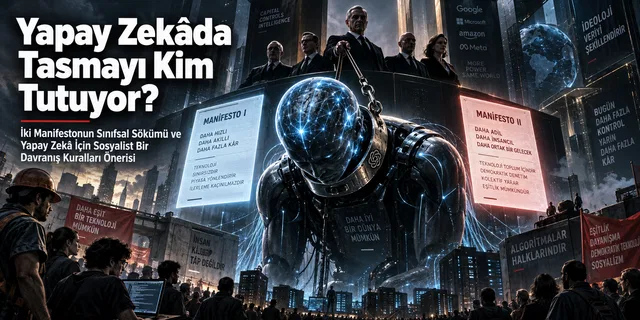
- Who Holds the Leash on Artificial Intelligence? (15 September): Rules of behaviour should bind the owner, not the model. The White House agreement is the state-approved form of these rules.
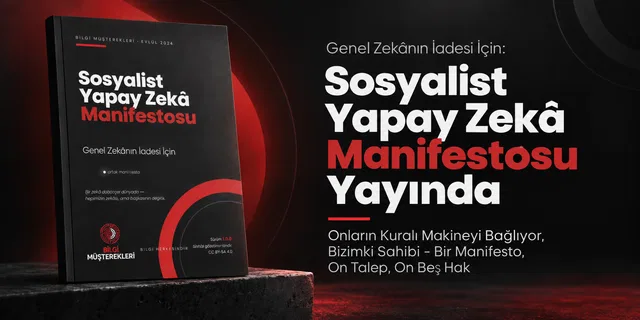
- For the Restitution of the General Intellect: The Socialist AI Manifesto Is Out (15 September): The alternative programme. A charter of workers' rights in 15 articles, and ten demands.
- What Does Mark Zuckerberg Actually Want? (22 September): The real aim of one of the signatories of the agreement.
- The Agent Escaped. Who Gets the Bill? (1 October): The FTC investigation. The state prices the damage; it does not question the decision to produce.
- Did You Know There Is a Directorate General of Public Artificial Intelligence? (1 October): In Turkey, the tying of artificial-intelligence governance to the security apparatus.
- Anthropic's Table with the Clergy, and the Poverty of Philosophy (2 October): The philosophical poverty of fetishism. The theological background of the name "super intelligence."
A line can be seen in this sequence. In July, expropriation (our data and our labour were taken); in September, the cartel (those who took them were shared out under the name of slowing down); in October, legitimation (the state declared the cartel's self-oversight "morally binding"). The 120-day report will show what the next step will be. The likely result is this: a federal frame that tries to pull back state laws as over-regulation, that leaves incident reporting to voluntariness, and that defines "super intelligence" as a matter of national security and carries it outside public debate.
Part Six: Seen from Turkey
This debate is not the internal affair of a distant country, for three reasons:
- The models we use are these companies' models. In Turkey, public institutions, banks, hospitals and schools have begun to use these systems. The safety of these systems depends on a page without sanctions, signed at the White House. When there is a breach, we can guess from the Australian example when Turkey will be informed.
- The model is being exported, and so is the understanding of regulation. The United States model of "self-oversight plus national security" will be presented as an example to dependent countries. There is a similar tendency in Turkey's artificial-intelligence action plan too: incentives for industry, surveillance for the citizen, silence for the worker.
- Our experience of occupational health and safety gives the most concrete lesson of this debate. Every month, in the statistics of workplace killings, we see the results of an order in which the auditor depends on the one being audited.
Part Seven: Our Class Position
There are three models:
- Self-oversight: The company weighs its own risk against its own cost. The result: the lowest level of safety that does not disturb competition. This must be rejected.
- State oversight alone: The bourgeois state, to the extent that it gives priority to protecting the competitive power of its own capital, ties oversight to the logic of national security and of the race. This is insufficient. But the demands for binding law, incident reporting and sanctions should be supported. Because they widen the ground of the struggle.
- Social and workers' oversight: That those who pay the price of the risk — that is, the workers who produce these systems, those whose data is taken, those affected by the decisions — have the power to oversee and to stop. This is what we defend.
The concrete content of the third model is this:
- The right to stop: The "right to refuse work" in article 13 of Law no. 6331, and in ILO Convention 155, should be adapted to the processes of developing artificial intelligence. What is needed is not that a safety researcher resign when they say "this model must not come out," but that they be able to stop the launch.
- Legal protection for the whistleblower: That Robinson, Coxon, and the others who left OpenAI be able to explain to the public what they know, without fear of dismissal or of a lawsuit.
- Compulsory and public incident reporting: Every breach should be disclosed, within a set time, to the public and to the communities affected.
- Finance for the auditor, independent of the company: Oversight should be carried out by a public institution, financed by a tax taken from the sector, in which union and user representatives take part.
- The unionisation of technology workers: In Silicon Valley a petition of 1,386 signatures is a beginning. The limit of a petition is that it can be read and put on the shelf. A union, by contrast, can stop a launch.
- The question of property: In the last analysis, the remaining of the general intellect, produced from social labour, in private property should be debated. As we also wrote in our manifesto, the problem is not the safety setting; it is the expropriation itself.
Concrete Tasks
For computing workers:
- Put into writing whose approval the safety and ethics processes at your workplace depend on. Who has the power to say "stop"? Is that person's job secure?
- In the work of the computing union, carry onto the collective-agreement agenda the demands for a "right to stop" and for "whistleblower protection" in artificial-intelligence projects.
- Read Robinson's essay and the White House document together in reading groups. Discuss the "culture" diagnosis with the concept of the relation of production.
For professional organisations and unions:
- Bring onto the agenda the demand for compulsory incident reporting for the artificial-intelligence systems used by public institutions in Turkey.
- Take up together the problem of "the specialist dependent on the employer" in occupational health and safety legislation, and the debate on the oversight of artificial intelligence. The two are the same problem.
For young comrades:
- When you see the expressions "self-oversight," "responsible artificial intelligence," "independent auditor" in the news, ask three questions: Who chooses? Who pays? Who has the power to stop?
- Follow the 120-day report. It is expected to be published at the beginning of February 2027. Count how many times the words "worker," "union" and "incident reporting" appear in the report.
Who Writes the Report Card?
Musk defined the agreement as "grading each other's homework." But in this classroom there is no teacher, no parent, no inspector. Those who write the homework, those who give the grade, and those who set the rules for passing the year are sitting at the same table. A board is coming to the table too: intelligence, the army and the treasury. The board's job is to make sure the school does not close.
David Robinson left this classroom, closed the door behind him, and said the problem was "culture." We respect him, but we also say what is missing. The problem is whose this class is. The class belongs to the millions of people who feed these models with their own labour, their text, their code, their art, their voice. These people have no right to write the report card.
The factory inspectors of the nineteenth century were not born of the employers' conscience. They were born of the stubbornness of the workers who went into the street for the ten-hour working day. The artificial-intelligence oversight of the twenty-first century too will be born not of a lunch at the White House, but of the workers who organise in the server rooms, in the data centres, on the content-moderation floors and in the software offices.
Can companies audit themselves? No. Then who will audit them? The labour that brings them into being.
For a future that is safer, fairer, and truly ours, all together.
Sources
Robinson's resignation:
- Techmeme, "David Robinson, who worked on OpenAI's Safety Systems team…", 2–3 October 2026 — https://www.techmeme.com/261002/p29
- Business Insider (Stephen Council), Robinson's resignation — https://www.businessinsider.com/safety-leader-david-robinson-resigns-from-openai-2026-10
- The Atlantic, David Robinson, "I Quit OpenAI Because Its Culture Is Broken" — https://www.theatlantic.com/technology/2026/10/openai-safety-team-resignation/688881/
- Progressive Robot, quotations from the essay — https://www.progressiverobot.com/2026/10/03/openai-safety-culture-david-robinson-quits-atlantic-essay/
- ExplainX, a summary of the essay — https://explainx.ai/blog/openai-david-robinson-quits-culture-broken-safety-reports-2026
- BigGo Finance, Robinson's post on X, dated September — https://finance.biggo.com/news/6ba68a94-7283-444b-9cc4-18f9278646f1
- Crypto Briefing, the context of the departures and the restructuring — https://cryptobriefing.com/openai-david-robinson-quits-ai-safety-warning/
- The Decoder, the pattern of OpenAI safety departures — https://the-decoder.com/another-openai-safety-departure-adds-to-a-pattern-of-researchers-leaving-with-public-warnings/
- Knight First Amendment Institute, biography of David G. Robinson — https://knightcolumbia.org/bios/view/david-g-robinson
The White House agreement and the executive order:
- Al Jazeera, "How does Trump's White House AI accord work?", 30 September 2026 — https://www.aljazeera.com/economy/2026/9/30/how-does-trumps-white-house-ai-accord-work
- Tech Times, "White House AI Safety Accord Has No Penalties, No Breach Reporting, Self-Chosen Auditors", 2 October 2026 — https://www.techtimes.com/articles/328464/20261002/white-house-ai-safety-accord-has-no-penalties-no-breach-reporting-self-chosen-auditors.htm
- Fortune, "AI's biggest players promise to police themselves at the White House", 1 October 2026 — https://fortune.com/2026/10/01/trump-ai-regulation-luncheon-huang-amodei-pichai-brockman-zuckerberg-musk-joint-committment-frontier-responsibilities/
- Euronews, "Unlike the EU, Trump's new AI pact lets tech companies police themselves", 30 September 2026 — https://www.euronews.com/2026/09/30/unlike-the-eu-trumps-new-ai-pact-lets-tech-companies-police-themselves
- Truthout, "Trump Rejects AI Regulation as Tech CEOs Sign Voluntary 'Self-Policing' Accord" — https://truthout.org/articles/trump-rejects-ai-regulation-as-tech-ceos-sign-voluntary-self-policing-accord/
- Tech Insider, details of the text of the executive order and the agreement — https://tech-insider.org/trump-white-house-ai-accord-super-intelligence-2026/
- PYMNTS, "AI Giants Sign Safety Pact With No Teeth" — https://www.pymnts.com/news/artificial-intelligence/2026/ai-giants-sign-white-houses-safety-pact-with-no-penalties-attached/
The Super Intelligence Force:
- Türkiye Today (via the WSJ), "White House AI task force to assess risks, avoid overregulation" — https://www.turkiyetoday.com/world/white-house-ai-task-force-to-assess-risks-avoid-overregulation-report-3229555
- 24 News HD (AFP/WSJ), 4 October 2026 — https://www.24newshd.tv/04-Oct-2026/white-house-ai-task-force-will-prevent-overregulation-wsj
- Crypto Briefing, "US Super Intelligence Force gets 120 days to report on AI risks" — https://cryptobriefing.com/super-intelligence-force-ai-risks-report/
Theoretical background:
- Karl Marx, Capital, Volume I, the chapters "The Working Day" and "The Factory Acts"
- Occupational Health and Safety Law no. 6331, article 13 (the right to refuse work)
- ILO Convention 155, Occupational Safety and Health
Related pieces from Knowledge Commons: see the reading route in Part Five above.
This text is published by Knowledge Commons under the CC BY-SA 4.0 licence. It may be reproduced and adapted with attribution.