Did You Know There Is a Directorate General of Public Artificial Intelligence?
The State's Data, the State's Algorithm and the Internet's Shutdown Switch Are Gathering in the Same Building

Did You Know There Is a Directorate General of Public Artificial Intelligence?
The state's data, the state's algorithm and the internet's shutdown switch are gathering in the same building. Today's appointment turned on the light in one room of that building.
In short: What happened, and what does it mean?
Dear Young Comrades,
By decision 2026/322, published in the Official Gazette this morning, Dr Osman Gazi Güçlütürk, a faculty member at Galatasaray University's Faculty of Law, was appointed Director General of Public Artificial Intelligence. The same decision also made appointments to the Cybersecurity Presidency's directorates general of the Digital State, Cyber Defence, Ecosystem Development and administrative services, and to the office of the first legal counsel (CNN Türk).
Most of us learned that such a directorate general exists from this news. First, in outline, these are the things one needs to know:
- What? The Directorate General of Public Artificial Intelligence was established on 25 December 2025 by Presidential Decree 192. It is attached not to a ministry but to the Cybersecurity Presidency, which is attached directly to the Presidency.
- What does it do? It prepares the legislation on the use of artificial intelligence in the public sector, contributes to the national strategy, runs pilot artificial-intelligence applications in public institutions, builds a shared data infrastructure among institutions, and sets the rules for how the state's data will be managed from the moment it is produced until the moment it is deleted, that is, the principles of data governance.
- Why does it matter? Because the same Presidency has, since 2025, also gathered the following powers, step by step: the public sector's cybersecurity, e-Devlet and digital transformation (the former Digital Transformation Office), the blocking of access and the removal of content on the internet, the supervision of social-media and gaming platforms, the technical infrastructure of lawful interception, domain names. Today artificial intelligence and data have been added alongside these powers.
- How does it differ from the BTK? The Information and Communication Technologies Authority (BTK) is an institution, established by law, with a board structure, that regulates the telecoms market. The Cybersecurity Presidency is a security apparatus attached directly to the executive. Since July 2026 the BTK's "security" powers over the internet have passed to this apparatus; licensing, frequencies and consumer affairs remained with the BTK.
- What is its class meaning? All the data the state keeps on the citizen, the algorithm that will process that data, and the power to cut off the voice that discusses that algorithm are coming together in a single security institution. This institution is organised not by Parliament but by presidential decree; unions, professional organisations, and the citizens whose data is processed have no place in the decision. Public data is being treated not as a commons but as an input of administration and surveillance, and as a raw material to be opened to capital.
In the rest of the piece we will open these one by one. First we will get to know the institution, then we will move to the class reading.
Where did this institution come from?
To understand a directorate general, one first has to know the building it stands in. The chronology is this:
| Date | What happened? |
|---|---|
| 8 January 2025 | By Presidential Decree 177, the Cybersecurity Presidency, attached to the Presidency, was established (alomaliye). |
| March 2025 | Cybersecurity Law 7545 entered into force. The Presidency was given the power to demand information and documents from institutions, to inspect on site, and to copy electronic data. Prison was provided for whoever does not give information, and 2 to 5 years in prison for whoever spreads unreal data-leak content for the purpose of "creating panic" (T24). |
| 28 March 2025 | The Presidency's Digital Transformation Office was closed. The duties of e-Devlet, public digital transformation, and "the spreading of artificial-intelligence applications" were transferred to the Cybersecurity Presidency (ICT Media). |
| 25 December 2025 | By Decree 192, the Directorate General of Public Artificial Intelligence and the Directorate General of the Digital State were established inside the Presidency. 204 new posts were added to the establishment. The Presidency was given the power to found companies at home and abroad, and to open 7 representative offices inside the country (AA, Memurlar.net). |
| 25 December 2025 (the same day) | The name of the National Technology Directorate General in the Ministry of Industry and Technology became the National Technology and Artificial Intelligence Directorate General (AA). |
| 31 July 2026 | By Law 7590, the BTK's basic powers over the internet passed to the Cybersecurity Presidency: access blocks and content removal, the supervision of social-network providers and gaming platforms, the technical infrastructure of lawful interception, domain names (Paksoy, BirGün). |
| 18 August 2026 | Turkey's Artificial Intelligence Action Plan (2026–2030) was published by Circular 2026/9. Coordination of public artificial-intelligence applications was given to the Directorate General of Public Artificial Intelligence (KS Avukatlık). |
| 1 October 2026 | For the first time, a name was appointed to the head of the directorate general. |
Read the table as a whole. In less than two years, an institution whose name is "cybersecurity" took on almost all of the state's digital business. Today's appointment is the last link of this process. The institution existed on paper for nine months; now someone has been put at its head, and it is beginning to work.
What is it for? What are its duties?
According to the decree and the news of its establishment, the duties of the Directorate General of Public Artificial Intelligence are these (Memurlar.net, Döviz.com):
- Legislation: To carry out the legislative work relating to artificial-intelligence applications in the public sector.
- Strategy: To contribute to national artificial-intelligence policies, strategies and action plans.
- Alignment: To support the alignment of internal regulations with international standards.
- Data governance: To set the principles, procedures and standards covering the whole process, from the creation of data to its deletion, for the digital state and for public artificial-intelligence systems.
- Pilot application and shared data infrastructure: To run artificial-intelligence applications in the public sector as pilots, to determine needs together with the institutions concerned, to put the shared data infrastructure into effect, and to set quality standards for the data of the applications.
- Data quality: To set data-quality criteria and to secure compliance with them.
- Ecosystem: To strengthen infrastructure and human-resource capacity, and to contribute to enterprise and R&D activity.
The Action Plan adds one more role to this list: the directorate general will coordinate public artificial-intelligence applications inside the plan's Programme Office, and together with TÜBİTAK's Artificial Intelligence Institute it will develop a capacity for security assessment (KS Avukatlık).
If we tell these duties in plain language
Let us set the bureaucratic language aside. The work put before this institution is this:
To bring together, in a shared infrastructure, the data that stands separately in every institution of the state, to bring that data to a quality that artificial-intelligence systems can "eat", and to decide which work in the public sector will be handed to artificial intelligence.
Let us think concretely. A citizen's data is today kept in dozens of places: e-Devlet, population, the social-security institution, the tax administration, the health system, education records, the land registry, justice, the police, municipalities, social-assistance systems. "Shared data infrastructure" and "end-to-end data governance" mean that these scattered records become linkable to one another, queryable, and processable by algorithms.
This has two faces, and both have to be said plainly:
- The face that could be positive: Not asking for the same document separately from five institutions, the speeding up of procedures, better statistics for the planning of the public service.
- The dangerous face: Everything the state knows about a citizen coming together in a single place, and decisions such as who will receive assistance, who will enter a tax inspection, who will be counted "risky", being handed to an algorithm.
Which face weighs more depends not on the technique but on under whose oversight the institution is, and for whose benefit it works. The rest of the piece is about this question.
Why was a jurist appointed today?
What came to the head of the directorate general was not an engineer or a data scientist but a legal academic. Güçlütürk's field of work is artificial-intelligence law, information-technology law, and data protection. His doctoral thesis is on the lawful use of data in machine-learning systems, and it received the Council of Higher Education's 2022 doctoral-thesis award. He has also taken part in the OECD's work on artificial-intelligence policy (Bölge Gazetesi Van).
This piece discusses not a person but an institution. But the profile of the name appointed tells us something about the institution's priority:
- Legislation comes first. The legal framework of the use of artificial intelligence in the public sector, the legal ground of data sharing, the pressure to align with the EU Artificial Intelligence Act. Three bills on artificial intelligence are waiting in Parliament, and none of them brings a comprehensive framework (N Partners). It is understood that the gap will be filled by a directorate general inside the executive.
- A language of legitimacy is needed. "Trustworthy", "ethical", "human-centred", "aligned with international standards" artificial intelligence. The legal and academic ground of these concepts makes it easier for a security institution's work of merging data to be accepted by the public.
There is no drawback, in itself, to the law coming first. But who writes this law matters: a parliamentary committee, an open process in which the social parties take part, or a directorate general inside a security presidency? For now the third holds.
A class reading: four questions
Let us ask this institution the four questions we use when we take institutional texts apart: In whose hands? Under whose oversight? For whose benefit? Who decides?
In whose hands?
The power of artificial intelligence and of data governance was given not to a civilian ministry, not to an independent board, and not to the ordinary functioning of public administration, but to a security presidency. This is not a matter of a name; it is a matter of an approach.
The organisation of a field under the heading of "security" determines what can be spoken of in that field. In a health ministry a discussion of data is held with "the patient's privacy", in education with "the student's right". In a security presidency the same discussion is held in the language of "threat", "critical infrastructure" and "national security". In this language the position of the one who objects is weak from the start, because the one who objects to security comes to look suspect.
We established this when we wrote on Anthropic's "critical infrastructure" move: to declare a field a matter of security is the easiest way to take it outside democratic oversight. In Turkey this method has turned into an institution.
Under whose oversight?
The Cybersecurity Presidency and the directorates general inside it were established and expanded by presidential decree. It is not an independent administrative authority established by law. A board structure, social parties represented on that board, activity reports required to be published regularly, or a mechanism of accounting to Parliament, is not described.
For comparison: the Personal Data Protection Authority, for all its limits, has a board, published decisions, and annual reports. The Directorate General of Public Artificial Intelligence, although it is the institution that will merge the whole of the state's data, has none of these.
The same Presidency was equipped with a law that provides prison for the official of an institution who does not give it information. It also threatens, with 2 to 5 years in prison, the person who reports a data leak. That is, the institution that merges the state's data can also count as a crime the reporting of this data's leaking. The question we raised in our KVKK piece gains still more weight here: while the data in the state's hands is sold on the dark web and on query panels, whom does a structure protect that punishes not the leak but the news of the leak?
For whose benefit?
This question has two layers.
The first layer: a capacity to administer and to surveil. A unified data infrastructure, and the algorithms that process it, give the state the possibility of seeing the citizen as a single whole: where they work, what they earn, which assistance they receive, which hospital they went to, which association they are a member of, which school they attend. This information can on the one hand serve the planning of the public service, and on the other it can also serve the measuring of obedience. Which it will be used for is not determined by the technique itself; the class character of the apparatus determines it.
The second layer: public data opened to capital. The Presidency was given the power to found companies. The Action Plan targets at least 2 percent of the public investment budget being set aside for artificial-intelligence projects, a data-centre capacity of 1 GW, and 10 billion dollars of investment "led by the private sector" (KS Avukatlık). As we showed in our piece on the Action Plan, the model is clear: the public takes on the risk and the cost of the infrastructure, private capital takes the profit and the property.
Public artificial intelligence will also work inside this model. Who will develop the pilot applications? Tenders, partnerships, companies the Presidency will found. Public data changes hands twice in this process. First it passes from the citizen to the state; the citizen has no chance to choose in this. Then it passes from the state to the model of the company that wins the tender. The process we called "digital enclosure" in The Revolt of Crystallized Labor, that is, the closing of common knowledge into private property, works here by the hand of the state.
The discourse of "data sovereignty" and "domestic artificial intelligence" does not change this picture. Data standing in the data centre of a domestic capital group, rather than on the server of a monopoly in California, changes the language of surveillance for the worker, but it does not abolish surveillance itself. The contest between domestic capital and the foreign monopoly is a fight over market share. Our question is under whose oversight the data is.
Who decides?
The refusal of an application for social assistance, being put on a list for tax inspection, the cutting of an unemployment benefit, the assessment of a student's grant according to a "risk score". These are decisions that affect people's lives directly. Public artificial intelligence means increasing the algorithm's share in these decisions.
We know how this turns out in the world:
- The Netherlands: The risk-classification system the tax administration used in childcare benefits declared tens of thousands of families "fraudsters" without justification. Benefits were demanded back, families sank into debt, more than a thousand children were taken from their families. Families of migrant origin and poor families were targeted disproportionately. The scandal led to the government's resignation in 2021 (Wikipedia).
- Australia: The automatic debt-calculation system called "Robodebt" produced debts, contrary to law, for hundreds of thousands of recipients of social assistance. A royal commission described the programme as "crude and cruel" (Wikipedia).
In both examples the systems were first tried on the poor. This is not a coincidence. The first field of experiment of the algorithmic state is always those who can object the least: those who receive social assistance, migrants, those who work without security. In our September 11 piece we identified the direction in which the surveillance apparatus's target list expands as "terrorist, then migrant, then opponent, then worker". In algorithmic public administration the list generally begins with the poor.
In Turkey it is not defined today by which algorithms these decisions will be given, which data will be an input to which model, or where a citizen will apply to say "why did the algorithm refuse me". This institution will write the answers to these questions. But it is plain that, while it writes the answers, the citizen, the worker and the union to whom the questions are addressed are not at the table.
Powers gathered under one roof: all the keys of the digital state
It would be misleading to read the Directorate General of Public Artificial Intelligence on its own. What matters is with which powers it stands under the same roof. The powers gathered today in the Cybersecurity Presidency are these:
| Field | Power | Where did it come from? |
|---|---|---|
| Public cybersecurity | Demanding information and documents from institutions, on-site inspection, copying data | Law 7545 (2025) |
| News of leaks | 2 to 5 years in prison for unreal leak content | Law 7545 (2025) |
| The digital state | e-Devlet, public digital transformation | The closed Digital Transformation Office (2025) |
| Public artificial intelligence and data | Shared data infrastructure, data governance, pilot applications | Decree 192 (December 2025) |
| Internet content | The basic administrative authority for access blocks and content removal, to be carried out within 2 hours | Law 7590 (July 2026), from the BTK |
| Platforms | Supervision of social-network providers and gaming platforms, administrative fines, bandwidth throttling | Law 7590, from the BTK |
| Communications | The technical infrastructure of lawful interception | Law 7590, from the BTK |
| Domain names | Strategy and policy | Law 7590, from the BTK |
| Economic activity | Founding companies at home and abroad | Decree 192 |
Read this table carefully. The same institution:
- can merge the whole of the state's data on the citizen,
- writes the rules by which this data will be processed with artificial-intelligence systems,
- manages the technical infrastructure of the interception of communications,
- can decide within two hours what will be visible on the internet,
- can threaten with prison the person who reports a leak that occurs in any of these.
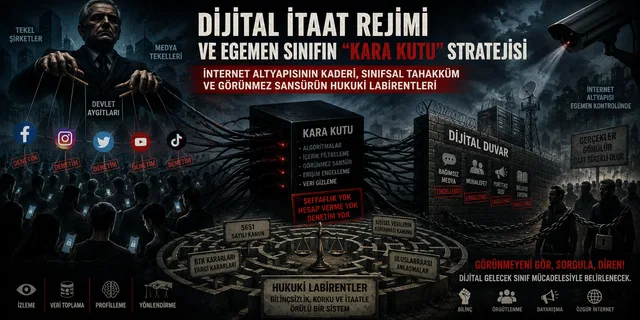
This is the state form of the structure we called the digital panopticon in the Karaburun declaration. In the panopticon the one who watches is invisible, and the one who is watched knows they are seen at every moment and adjusts their behaviour accordingly. Here the one who watches is a single institution, which determines both the data it sees and what will be said about that data.
We have seen how this power is used
We are not speaking of an abstract worry. When an access block was placed on the newspaper Evrensel's X account on 14 September 2026, the paper's editor-in-chief, Hakkı Özdal, announced that the company had told them the blocking request came from the Cybersecurity Presidency. On the same list there was a union, human-rights organisations, and lawyers' associations. We told this in detail in our piece on the wave of censorship. Today too the shutdown of T24 stands before us as another example of the same regime.
Istanbul MP Mustafa Yeneroğlu summed the situation up like this in the July debates on the law: "This bill is not cybersecurity; it is the transfer of the internet to the security bureaucracy." (Yeneroğlu). The EngelliWeb project of the Freedom of Expression Association also warned that an undefined power of "intervention" carries the risk of an end-to-end censorship infrastructure (Euronews).
Today artificial intelligence and data governance have been added to this infrastructure. The censorship power and the power to merge data being in the same institution means this: the institution that can see who says what, and that can stop this speech, can now also reach the whole of the citizen's administrative record.
How does it differ from the BTK?
Many young comrades will ask, "Was the internet not already run by the BTK?" To understand the difference, let us set the two institutions side by side.
The BTK (Information and Communication Technologies Authority) was established in 2000 as the Telecommunications Authority, and in 2008 it took its present name with Electronic Communications Law 5809. Its real work is to regulate the telecoms market: to license operators, to allocate frequencies, to watch over competition and the consumer. When the Telecommunications Communication Presidency (TİB) was closed by decree-law in 2016, its internet powers, that is, the infrastructure of access-blocking and interception, also passed to the BTK. We are not clearing the BTK. Since 2016, hundreds of thousands of access blocks have been carried out by its hand.
The Cybersecurity Presidency, by contrast, is not a market regulator. It is a security institution, attached directly to the Presidency, with no board structure, organised by decree, and working in the language of "threat", "critical infrastructure" and "defence".
| BTK | Cybersecurity Presidency | |
|---|---|---|
| Basis of establishment | Law (4502, 5809) | Presidential Decree (177), then Law 7545 |
| Attachment | Related to the Ministry of Transport and Infrastructure; on paper, administratively and financially autonomous | Attached directly to the Presidency |
| Decision organ | A board (members are appointed, but board decisions are published) | A president and directors general; no board |
| Its real language | Licence, frequency, competition, the consumer | Threat, critical infrastructure, cyber defence |
| Its power today | Operator licences, frequencies, consumer rights | Access blocks, platform supervision, interception infrastructure, domain names, e-Devlet, public artificial intelligence and data |
| Its relation to artificial intelligence | Proposed, in one bill, for the supervision of deepfakes | The real institution of public artificial intelligence and of data governance |
| In whose name does it speak? | The order of the market | The security of the state |
The change here is not limited to the power being carried from one institution to the other; the quality of the power is changing. In the BTK period the access block was a business that ran alongside telecoms regulation. Now it is a part of the security doctrine. One can object to a market regulator's decision by saying it is "disproportionate". When one objects to a security apparatus's decision, the argument is pulled onto the ground of "national security".
The class meaning is here too: for capital, market regulation remained at the BTK. Licensing, frequencies, relations with operators go on as ever. The work of governing society and its voice passed to the security apparatus. A regulator for the market, security for society. This is the bourgeois state's division of labour.
Two directorates general, two wings
On 25 December 2025, on the same day, two separate "artificial intelligence directorates general" were established. This too shows a division of labour:
| National Technology and AI Directorate General | Public AI Directorate General | |
|---|---|---|
| Where it is attached | Ministry of Industry and Technology | Cybersecurity Presidency |
| Whom it addresses | Capital: enterprises, data-centre investors, industry | The state: public institutions, the citizen's data |
| Its real work | Incentives, data-centre standards, certification, funds | Merging data, public applications, legislation |
| Its language | Competition, growth, investment | Security, sovereignty, trust |
Read together, the whole picture comes out. One wing provides a market and incentives to capital; the other wing regulates the citizen's data so that it will be an input to this market, and puts it under security. In neither of these two wings is there a representative of the workers, of public employees, or of the citizens whose data is processed.
The official narrative and the class reading
| Official narrative | Class reading |
|---|---|
| Artificial intelligence in the public sector will speed up services | Speed for whom? The examples of systems that first target the poor were lived in the Netherlands and in Australia |
| We are securing data sovereignty | What matters is not which country the data stands in, but under whose oversight it is. Domestic surveillance is surveillance too |
| Trustworthy and ethical artificial intelligence | Who defines "ethics"? A security institution with no board, no report, no social representation |
| A shared data infrastructure brings efficiency | Scattered data was a boundary that protected the citizen. Unified data means the state seeing the citizen as a single whole |
| We are strengthening our cybersecurity | The same institution also carries the powers of the access block, the interception infrastructure, and punishment for news of a leak |
| We are supporting the ecosystem and enterprises | Public data and the public budget are being opened to capital through tenders and company partnerships |
| Alignment with international standards | Even the mechanisms of objection and transparency for public algorithms, which the EU itself counts as high-risk, are not described here |
| An expert jurist was appointed | Expertise is a good thing. But what determines the rule is not a person's competence; it is to whom the institution gives an account |
What changes for the public worker?
There is also a side of this subject that looks from the inside. Public artificial intelligence concerns not only the citizen but also, directly, the public worker.
- Workload and posts: The first fields of the pilot applications are generally office work such as correspondence, the assessment of applications, the call centre, the classification of documents. The work of the clerk, the contracted personnel and the subcontracted worker who do these jobs will either intensify, or be counted a "surplus" in the planning of posts.
- Mental Taylorism: The tacit knowledge the office worker has accumulated over the years, that is, what to pay attention to in which file, how a regulation is applied in practice, is turning into the training data of artificial-intelligence systems. In the gig-economy dossier we told how the courier's knowledge passes to the algorithm. The same process will be lived at the desk as well.
- Algorithmic oversight: The measurement of performance, the tracking of the workflow, "efficiency" scores. The public worker too is turning into an object that produces data and is measured.
- The shift of responsibility: When the algorithm gives a wrong decision, of whom will an account be asked? In the Dutch example the burden remained on the clerk who applied the system, and on the citizen who was harmed.
For this reason the public workers' unions need to take up this subject not as a "technology agenda" but as an agenda of job security and working conditions. The tasks we described for workers in public computing in The Computing Worker's Handbook find a concrete counterpart here: those who write, set up and run these systems are workers too.
What do we want?
We are not, in principle, against the use of artificial intelligence in the public sector. We wrote plainly, in The Communist Manifesto 2.0, that in a socialist society planning, the public service and science will use these instruments: "The machine is common, the chain is broken." The problem is not in the instrument itself; it is in whose hands the instrument is, and under whose oversight.
For this reason, the demands that can be defended from today are these:
- A register of public algorithms: Every artificial-intelligence and automated-decision system used in the public sector should be entered on an open register. Which institution, for what purpose, with which data, gives which decision? Cities such as Amsterdam and Helsinki have been publishing registers of this kind for years.
- A right to object to an algorithmic decision: Every citizen whose right is refused under the effect of an algorithm should be able to learn the reason, and to ask that a human review the decision again.
- A ban on automated decisions in social rights: In fields such as social assistance, unemployment benefit, and the rights to health and education, a negative decision resting only on an algorithm should not be given.
- Establishment by law, and parliamentary oversight: An institution that will merge the whole of the state's data should be established by law, not by decree; it should publish annual activity and impact reports, and it should give an account to Parliament.
- The separation of security from data governance: An institution that carries the powers of the access block, the interception infrastructure and censorship should not take on the governance of public data and of public artificial intelligence.
- Social representation: Unions, professional chambers (bar associations, medical chambers, engineers' chambers), universities and civil society should take part in public data governance.
- The governance of public data as a commons: Public data should not be turned, through tenders, into the raw material of private models. The models and the code developed for the public should be open source.
- The repeal of the article that punishes news of a leak: Making a data leak known to the public is not a crime; it is a public duty.
- The judiciary first in an access block: The order of "first the block, then the court" should be lifted.
Concrete tasks
Dear young comrades, we learned today that this institution exists. What can we do tomorrow?
- Keep the record. Follow every regulation, circular, tender, pilot project and partnership the Directorate General of Public Artificial Intelligence will publish. In which institution, and on which group of citizens, will an artificial-intelligence system first be tried? If no one records this, no one will know.
- Use the right to information. Under the Right to Information Law 4982, ask in which institutions which artificial-intelligence applications are being tried. Even if no answer comes, the refusal itself is a record.
- Carry it onto the union's agenda. If you are a public worker, make this an agenda item in your union branch: "which artificial-intelligence systems are being used in our institution, and how will they affect our workload and our posts?" Articles on algorithmic oversight and job security should be added to collective-agreement demands.
- Build a tie with the professional organisations. Bar associations, medical chambers and engineers' chambers are institutions that can state a view in this field. If you are a student of law, medicine or computing, open this subject for discussion in the student sections.
- If you are a computing worker, take on the technical reading. Examine the tender specifications, the technical documents, and whether they are open source. Those who can best read what the system does are those who write it.
- Build your own communications infrastructure. While the censorship power and the data power are in the same institution, an organisation tying its communications to a single platform is a security gap. Spare channels such as an email list, one's own website, RSS and a printed bulletin should be set up from now.
- Learn from international experience. Get to know the families who exposed the childcare-benefits scandal in the Netherlands, and those who brought the collective case against Robodebt in Australia. There are struggles won against the algorithmic state.
- Multiply the piece. Tell those around you that this institution exists. It is not possible to oversee an institution that is not visible.
Dear young comrades,
This morning we read an appointment decision. For most people it was an ordinary line of the Official Gazette. But behind that line there is a structure built in twenty months: a single institution that merges the state's data, designs the algorithm that will process this data, decides what will be visible on the internet, manages the infrastructure of the interception of communications, and can punish the person who reports a leak that occurs in any of these.
We did not even know this institution existed. That too is a problem. The digital state is being built in a place the citizen cannot see, and the citizen meets this structure only on the day an application is refused, an account is shut down, or their name comes out on a risk list.
Our task is to make this structure visible. Artificial intelligence is not only a technology; it is at the same time a relation of property and of power. The same machine can be used to distribute a social assistance more fairly, and to declare the poorest a fraudster. Which it will be is not an engineering question; it is a class question.
The machine is new, the chain is old. But the data is ours, the labour is ours, and knowledge belongs to everyone.
Our related pieces
Artificial intelligence and the state
- On Turkey's Artificial Intelligence Action Plan (2026–2030): public risk, private profit
- The Revolt of Crystallized Labor: A Call to the 20th Karaburun Science Congress: digital enclosure, mental Taylorism, the digital panopticon
- Who Holds the Leash on Artificial Intelligence?: oversight mechanisms should bind the owner, not the model
- The Communist Manifesto 2.0: "The machine is common, the chain is broken"
Surveillance, censorship and data
- From Obscenity to National Security: The Anatomy of a Forty-Eight-Hour Wave of Censorship
- They Shut Down What They Cannot Buy
- KVKK's "80s Trend" Warning and Privacy in the Digital Age
- Anthropic's Activist Monitoring System: the function of a "critical infrastructure" declaration in taking a field outside oversight
- Two Towers, One World: Twenty-Five Years of September 11: the direction in which the target list expands
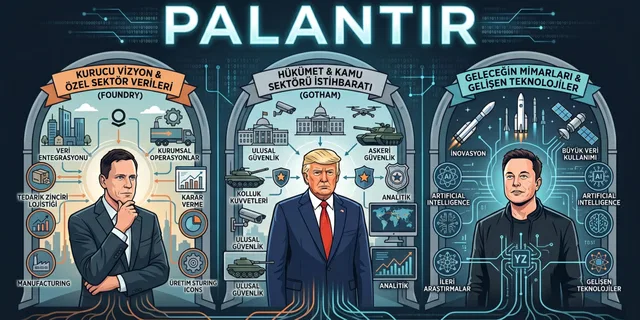
- The Declaration of Techno-Fascism: The Palantir Manifesto and the Dialectic of Class Struggle in the Digital Age
Labour
Sources
The appointment and the establishment
- CNN Türk: "Published in the Official Gazette: appointments to the Cybersecurity Presidency one after another", 1 October 2026
- Bölge Gazetesi Van: "Who is Osman Gazi Güçlütürk?", 1 October 2026
- Memurlar.net: "The Directorate General of Public Artificial Intelligence has been established", 25 December 2025
- AA: "A change was made in the organisational structure of the Cybersecurity Presidency", 25 December 2025
- AA: "The Ministry of Industry and Technology will carry out the coordination duty in the field of artificial intelligence", 25 December 2025
- Döviz.com: "The Directorate General of Public Artificial Intelligence has been established"
- EKOTÜRK: "A new period in the public sector in the field of artificial intelligence: the Directorate General has begun to operate"
The Cybersecurity Presidency and the legislation
- alomaliye: Official Gazette of 8 January 2025, Decree 177
- Lexpera: Cybersecurity Law 7545, Official Gazette text
- T24: "The Cybersecurity Bill passed Parliament: is a punishment coming for reporting a data leak?"
- ICT Media: "The Digital Transformation Office was closed, its duties were transferred to the Cybersecurity Presidency"
- Paksoy: "The Cybersecurity Presidency took over key administrative powers in the digital field", August 2026
- BirGün: "The BTK's powers were transferred to the Cybersecurity Presidency: first the access block, then the court decision"
- Euronews Turkish: "The Cybersecurity Presidency's powers are expanding: how will the internet now be controlled?", 27 July 2026
- soL haber: "The censorship powers on the internet are now at the Cybersecurity Presidency: first the block, then the court"
- Mustafa Yeneroğlu: "Press statement on the internet regulations in the omnibus law", 21 July 2026
Artificial-intelligence policy
- KS Avukatlık: "Circular on Turkey's Artificial Intelligence Action Plan (2026–2030)"
- N Partners: "The 2026 Artificial Intelligence Law in Turkey: a comparison of the three bills submitted to Parliament"
Examples of the algorithmic state from the world