A Collective Agreement for the Algorithm
What Kaiser Therapists Won, What They Did Not, and What We Can Learn

Dear Young Comrades,
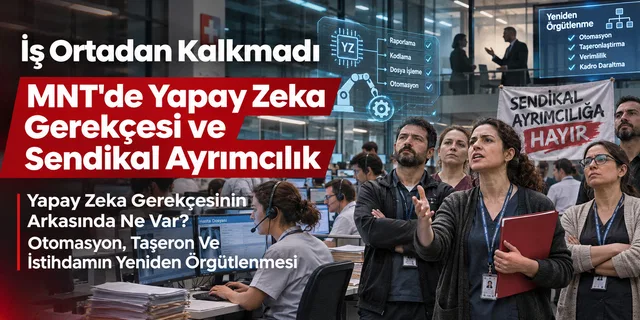
In Work Has Not Disappeared, we discussed eight unionised workers dismissed from a hospital in Istanbul and the AI-related explanation one of them said she had been given. This week brings a story from the other side of the same question: mental health workers in California have made the use of artificial intelligence at work a subject of collective bargaining. Let us read the news without exaggerating it or diminishing it.
First, the Summary
- What happened? Approximately 2,400 therapists, social workers and psychologists at Kaiser Permanente in Northern California and the Central Valley approved a four-year collective agreement after 16 months of bargaining. Voting ended on Sunday, 15 November; the result was announced on 16 November. Turnout was approximately 80 per cent, and 97 per cent voted in favour.
- What was won on AI? When considering systemic changes to the model of care, including AI, the employer must consult an advisory group of union-appointed clinicians, notify the union of its decision in writing and bargain over effects other than layoffs through a limited procedure.
- What else? A prohibition on layoffs until the day before the agreement expires, wage increases totalling 17.5 per cent over four years, preservation of approximately seven hours a week of patient care support time, and preservation of the right to strike in sympathy with other unions.
- What was not won? The proposed language stating that AI is intended to help workers, not replace them, was not fully included. The union has no veto: there is consultation and limited effects bargaining. The union waived bargaining over the effects of layoffs resulting from a change in the model of care. The algorithmic screening system remains in use.
- Why does it matter? Consultation on the use of technology and bargaining over some of its effects entered the agreement; the final decision on the model of care remains with the employer. The door has been opened, but not all the way.
The Key Issues in Collective Bargaining
Throughout bargaining, Kaiser held to three demands. Workers called them the “terrible three”:
- Full “flexibility” to introduce AI;
- “Sole discretion” over the model of care, including unrestricted outsourcing and layoffs;
- Reductions in patient care support time.
Put these three demands together and the picture becomes clear. The question was not simply whether a piece of software was good or bad. It was who would decide how the work was done.
The concrete setting is this: according to therapists, a licensed clinician previously spoke to the patient by phone, picked up cues in their voice, screened for the risk of self-harm and performed the initial assessment. Under the new system, a patient encounters either a phone operator reading questions from a script or an online questionnaire. Ilana Marcucci-Morris, a social worker who worked as a triage clinician, said she was reassigned from that role in May 2025. The union complained to California's health regulator, alleging that the screening algorithms violated state law requiring treatment determinations to be made by licensed clinicians. The regulator had not yet issued a determination. Kaiser says the tool does not diagnose or make clinical decisions and that patients can reach a person by telephone.
The second issue is recording. In 2024, Kaiser introduced Abridge, a tool that records medical visits and generates notes. Mental health workers said that therapy sessions were also recorded and that the consent sought from patients did not explain how their data would be handled.
Another detail is particularly instructive. In its 2025 agreement with mental health workers in Southern California, Kaiser accepted language that new technology was intended to help workers, not replace them. In the North, it refused the same wording, invoking “flexibility”.
What Is in the Agreement?
| Kaiser's demand | What the agreement provides | What remains missing |
|---|---|---|
| Full “flexibility” on AI | An advisory group of union-appointed clinicians, written notice of the decision, and limited bargaining over effects other than layoffs | Final decision remains with the employer; no veto or binding “not replacement” provision |
| “Sole discretion” over the model of care, unrestricted outsourcing and layoffs | According to the union, the original demand was withdrawn; layoffs prohibited through 29 September 2029 | Final decision remains with the employer; protection ends one day before the contract |
| Reduced patient care support time | Approximately seven hours a week preserved | Grievances alleging violations of the provision continue in Southern California |
| Wages | Increases totalling 17.5 per cent over four years: 9.5 per cent initially, followed by 4 per cent each in October 2027 and October 2028 | — |
| Strike rights | The right to strike in sympathy with other unions preserved | — |
According to the union's agreement summary, the agreement runs from 1 October 2025 through 30 September 2029. It lists wage increases of 5 per cent for 2025, 4.5 per cent for 2026, and 4 per cent for each of the following two years. The 17.5 per cent figure is the sum of these rates, not a compounded increase.
A note on coverage: sources differ on the number of workers. The union says 2,400, Kaiser says approximately 2,500, and the Los Angeles Times reported 2,200. We use the union's figure.
One Text, Two Claims of Victory
Read the two parties' statements side by side. The union says it beat back Kaiser's dangerous demands. Kaiser presents the same agreement as a collaborative approach to AI and flexibility to change the model of care, saying that it achieved all three of its priorities.
These accounts emphasise different aspects of the same outcome. A central gain is a procedure, not a guarantee of a particular result. The agreement does not say that AI cannot replace a therapist. It requires consultation and written notice, and provides limited bargaining over effects other than layoffs. What fills that procedure with substance will depend on the balance of power.
The workers recognise these limits. Marcucci-Morris calls the contract a major victory but says they did not get all the language they wanted and that the agreement bought legislators time to set boundaries for AI. The warning from the union's president emeritus Sal Rosselli is plainer: Kaiser has violated agreements before, so workers must remain vigilant.
A Class Reading
In whose hands? Both the triage tool and the software recording sessions are used and controlled by the employer. Yet their raw material includes clinicians' accumulated knowledge and patients' most intimate accounts. Work previously performed by a licensed clinician can be reduced to a set of questions and transferred to an operator or software. This recalls the process Harry Braverman described in office and factory labour half a century ago: separating conception from execution and concentrating control of skills in management's hands. It is what we call “mental Taylorism” in the clinic.
Under whose control? Notice Kaiser's key terms: “flexibility” and “sole discretion”. These are not merely technical terms; they are expressions of property and power at work. Capital treats the organisation of production as beyond bargaining. Wages may be discussed, but the machine is not. In the chapter on machinery in Capital, Marx observes that many inventions after 1830 armed capital against workers' resistance, suggesting that a separate history of them could be written. Kaiser's position at the bargaining table recalls that observation: the company sought to reopen severance and layoff provisions, saying industry pressures around AI made layoffs “a real threat”. The threat arrived at the table before the machine had completed its work.
For whose benefit? Kaiser is a nonprofit organisation on paper. Yet the means of reducing costs can still include substituting cheaper labour and software for licensed work and compressing the time available for care. Productivity gains do not automatically return to workers as shorter hours or to patients as longer sessions. Workers therefore framed the fight not simply as “protect our jobs” but as “protect patients”, building public support.
There is a subtle but important distinction here. The therapists did not demand that the machine be smashed. Nor did they categorically reject note-taking software. They demanded a voice in its use. As Marx observed of the Luddites, it takes time for workers to distinguish machinery from its use by capital. Kaiser workers have turned that distinction into contractual language.
How Was It Won?
Goodwill did not produce this result. Consider the sequence:
- Strike. A one-day strike took place on 18 March 2026. Nurses and other Kaiser workers joined in solidarity. In October, workers authorised a three-day stoppage but held off ahead of mediation.
- A shared cause. Patient safety was placed at the centre alongside workers' concerns. Those providing and receiving care were brought together.
- Alliances. The San Francisco Board of Supervisors unanimously called on Kaiser to withdraw its demands. Professional organisations and mental health associations wrote letters.
- Persistence. Bargaining lasted 16 months. The Southern California bargaining unit had spent nearly seven months on strike the previous year. This gain stands on the shoulders of that struggle.
- Political climate. Marcucci-Morris attributed Kaiser's change of position at the table to voter backlash against AI. That is her interpretation, but it is worth noting: power inside the workplace is also shaped by the climate outside it.
The Limits
Let us not exaggerate: exaggeration is an enemy of organising.
The advisory group is not a veto body. Under the agreement text, the employer must consider clinicians' input, but the final decision on the model of care remains with management. After written notice of the decision, bargaining over effects on wages, hours or working conditions other than layoffs is limited to at most six meetings. The union waived the right to bargain over the effects of layoffs resulting from a change in the model of care. After the layoff prohibition expires, predetermined provisions apply, including 60 days' notice, priority when applying for open positions and conditional severance. This exception matters when assessing the scope of effects bargaining.
The layoff prohibition lasts through 29 September 2029; the agreement expires on 30 September 2029. The fact that protection ends before the contract, and the conditions that apply afterwards, matter for the next round of bargaining. Nobody knows today what technology management will bring to that table.
Algorithmic screening continues. The union's complaint remains before the regulator.
And there is the scope: 2,400 people. These provisions do not cover the millions of non-union workers in California. A collective agreement is a defensive position for a bargaining unit, not an entire industry. Joining those positions together is another task.
Lessons for Türkiye
One of the eight unionised workers dismissed by MNT Tıp said that AI had been given as the reason for her dismissal. As we noted in the earlier article, we could not find a public response from the company; the union alleges the dismissals were connected to organising. Collective agreements can regulate the conclusion, content and termination of employment contracts; the effects of technological change on working conditions can also be brought to the bargaining table. The legality and application of any particular clause require separate assessment. What is needed is preparation and the power to put such demands on the table.
There is a difference to recognise. At Kaiser, nurses stopped work in support of therapists, and the therapists' right to sympathy strike was preserved in the agreement. In Türkiye, Article 58 of Law No. 6356 confines a lawful strike to a collective bargaining dispute and statutory conditions. Although the law does not name sympathy strikes separately, the legislative justification and prevailing legal interpretation treat them as unlawful. One of the levers behind the California gain is therefore restricted here. This does not invalidate the lesson; it identifies another issue for struggle.
Concrete Tasks
Draft clauses should already be prepared for the next bargaining rounds in every sector. A minimum list:
- Advance notice. Written notice and reasonable time before introducing software or automation affecting work, workload or employment.
- An elected technology committee. A committee appointed by the union, not the employer, with access to relevant documents and data.
- Bargaining over the decision. Not just its effects, but the introduction itself: one step beyond the Kaiser agreement.
- No layoffs on technology grounds. Protection covering the entire agreement, without excluding its final day.
- “Assist, not replace”. Clear, binding language reflecting the Southern California provision.
- Data and recordings. No recording without the informed consent of workers and service users; no use of recordings for performance measurement or model training.
- Human decisions. In healthcare, hiring, discipline and dismissal, the final decision must be made by a responsible human being, not an algorithm.
- Sharing the gains. Productivity gains should return to workers as shorter working hours without loss of pay.
- Alliances with service users. Patients, students, passengers, readers: this is perhaps the Kaiser example's most transferable lesson.
Dear Comrades,
The Kaiser agreement is not a monument to victory, but a foothold. Employers are no longer the only ones speaking about how AI enters the workplace. But management still has the final word. Closing that distance requires not merely better-written clauses, but organised power capable of winning them.
Technology neither liberates nor enslaves by itself. We must ask in whose hands it rests, who controls it and whose interests it serves. California's therapists have written a small but real answer to the second question into their agreement. The first question, ownership, remains.
The machine is new, the chain is old. And the force that loosens it remains the same: organised labour.
In solidarity.
Sources
- NUHW, tentative agreement and agreement summary, November 2026
- Law No. 6356 on Trade Unions and Collective Labour Agreements, Article 58 and legislative justification
- NUHW, “Mental health therapists beat back Kaiser Permanente's dangerous contract demands”, 17 November 2026
- NUHW, “Kaiser mental health clinicians ratify four-year contract with A.I. protections”, 16 November 2026
- Kaiser Permanente, “NUHW agreement supports therapists, patients, and mental health care”, November 2026
- Becker's Hospital Review, “Kaiser mental health clinicians ratify contract with AI provisions”, November 2026
- Los Angeles Times, “Kaiser mental health clinicians in California ratify labor contract with some AI guardrails”, 16 November 2026
- CalMatters, report on the union's complaint about Kaiser's screening tool, July 2026
- CalMatters / American Community Media, report on recordings of therapy sessions, June 2026
- NPR, “AI in the mental health care workforce is met with fear, pushback and enthusiasm”, 7 April 2026
- NUHW, statement on the San Francisco Board of Supervisors' resolution, 2 September 2026
- Karl Marx, Capital, Volume I, “Machinery and Large-Scale Industry”
- Harry Braverman, Labor and Monopoly Capital
- Bilgi Müşterekleri, “Work Has Not Disappeared”, November 2026
This text is shared under the CC BY-SA 4.0 licence. Knowledge belongs to everyone.